Camper Trailer Towing Guide Australia: Which SUV Can Tow Which Trailer? (2026)
Tow capacity by popular Australian SUV, matched against real trailer weights, with the GCM trap most buyers miss.
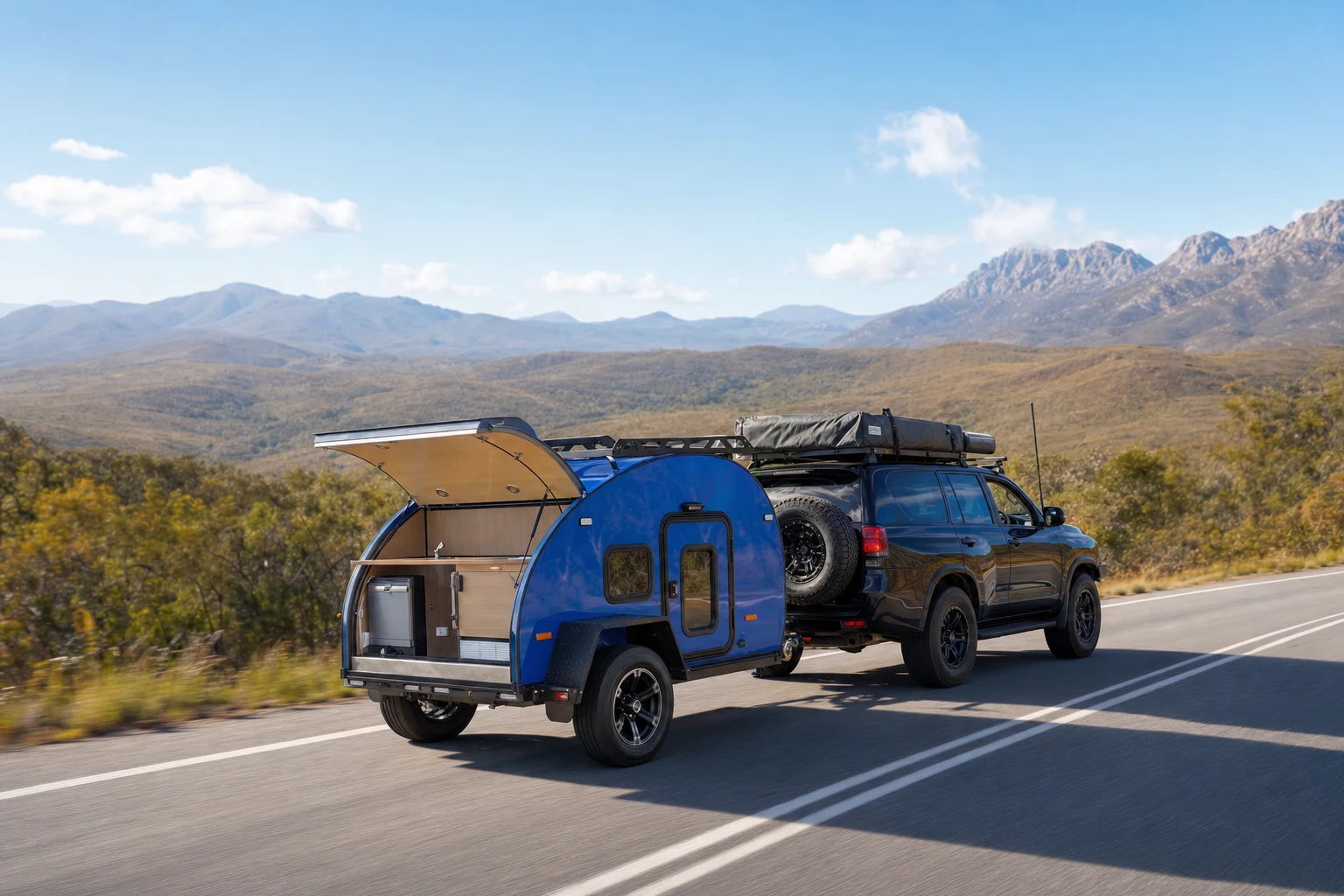
If you’ve ever Googled “can my RAV4 tow a camper trailer?” at 11 pm, you’re not alone. Towing anxiety is one of the biggest barriers stopping Australians from buying their first camper — and it’s mostly unnecessary. The reality is that most modern mid-size SUVs can confidently tow a lightweight trailer without breaking a sweat, and in 2026, the market has never had more options in the 700–1,500 kg sweet spot.
This guide cuts through the jargon. You’ll learn what ATM, GTM, and GVM actually mean, which popular Australian SUVs can tow what, what gear you legally need before you hitch up, and — critically — how to match a specific trailer to your specific vehicle without guessing.
Spoiler: if you drive a Toyota RAV4, Subaru Outback, Mazda CX-5, Hyundai Tucson, or similar, you almost certainly can tow a teardrop camper trailer today.
The Numbers That Actually Matter: ATM, GTM, Tare, GVM, GCM
Before you compare a single trailer spec sheet, you need to understand five terms that appear everywhere in the Australian caravan and towing world:
| Term | What It Means | Why It Matters |
|---|---|---|
| Tare weight | The trailer’s weight empty, as it left the factory | Starting point only — always lower than what you’ll actually tow |
| ATM (Aggregate Trailer Mass) | Maximum legal loaded weight of the trailer | The number you compare against your vehicle’s braked towing capacity |
| GTM (Gross Trailer Mass) | Maximum weight resting on the trailer’s own axles (excluding towball load) | Used for road registration and axle ratings |
| GVM (Gross Vehicle Mass) | Maximum legal loaded weight of your tow vehicle (passengers + fuel + gear) | Easy to exceed without realising — especially in smaller SUVs |
| GCM (Gross Combined Mass) | GVM + ATM — the total legal weight of vehicle + trailer combined | The hidden ceiling that catches people out |
The critical rule: your trailer’s ATM must be equal to or less than your vehicle’s rated braked towing capacity. That’s the single most important check before you buy.
But ATM doesn’t tell the whole story. Even if your SUV is rated to 1,500 kg, you must also ensure your GCM doesn’t exceed your vehicle’s limit. An overloaded tow vehicle — packed with camping gear, passengers, and a fully loaded rooftop — can eat into your theoretical towing capacity faster than you’d think. Always check your specific vehicle’s handbook, not just the headline number.
Australian Towing Laws You Cannot Ignore
Australia doesn’t have one single towing law — regulations are set at the state and territory level — but some rules are essentially universal:
Brakes: The 750 kg Threshold
Any trailer with an ATM above 750 kg must have its own braking system. Between 750 kg and 2,000 kg ATM, the trailer must be fitted with brakes on at least one axle. Above 2,000 kg ATM, brakes are required on all wheels, plus a breakaway system.
All Breath Trailer models are fitted with electric brakes as standard, so this is already handled for you.
Electric Brake Controllers
If your trailer uses electric brakes (which most modern camper trailers do), your tow vehicle needs an in-cab electric brake controller to activate them. These typically cost $200–$600 installed and must be fitted by an auto electrician or caravan dealer. They’re required any time your trailer’s ATM exceeds 750 kg.
Towball Weight Limits
Your towball download limit (the downward force the trailer hitch places on the vehicle) is typically 10% of the trailer’s ATM, with a hard maximum of 350 kg. Check your vehicle’s handbook for its specific towball download limit — some mid-size SUVs cap out at 150–200 kg, which matters when loading heavier trailers.
Speed Limits When Towing
Speed limits when towing vary by state, but the general national rule is: drive to the signposted speed limit. NSW allows up to 110 km/h. Western Australia limits trailers above 750 kg GTM to 100 km/h. When in doubt, 100 km/h is a safe default across all states and is more fuel-efficient anyway.
Insurance
Most car insurance policies cover towing incidental damage, but some require you to declare the trailer or add an endorsement. Check your policy before your first trip. Dedicated caravan and trailer insurance is inexpensive (typically $300–$600/year for a mid-range trailer) and covers damage to the trailer itself.
Popular Australian SUV Towing Capacities (2026)
Here’s a reference table for the most commonly sold SUVs in Australia in 2026. These figures represent the braked towing capacity (the number that matters for camper trailers with their own brakes).
| Vehicle | Braked Towing Capacity | Towball Download Limit | Notes |
|---|---|---|---|
| Toyota RAV4 (petrol/hybrid) | 1,500 kg | 150 kg | All variants — 2.5L petrol & hybrid |
| Subaru Outback (2.5L) | 2,000 kg | 200 kg | AWD variants |
| Subaru Outback (2.4T XT) | 2,400 kg | 240 kg | Turbo variants |
| Subaru Forester (petrol) | 1,800 kg | 180 kg | Non-hybrid |
| Subaru Forester (hybrid e-Boxer) | 1,200 kg | 120 kg | Lower capacity due to hybrid system |
| Mazda CX-5 (2.5 AWD) | 1,800 kg | 180 kg | Petrol AWD |
| Mazda CX-5 (turbo AWD) | 2,000 kg | 200 kg | 2.5T variant |
| Honda CR-V (petrol/hybrid) | 1,500 kg | 150 kg | 5-seater; 7-seater drops to 1,000 kg |
| Hyundai Tucson | 1,600 kg | 160 kg | Petrol or diesel variants |
| Kia Sportage | 1,900 kg | 190 kg | All variants |
| Nissan X-Trail | 2,000 kg | 200 kg | All variants |
| Mitsubishi Outlander | 1,600 kg | 160 kg | PHEV: check manufacturer specs |
| Toyota Prado | 3,000 kg | 300 kg | Large SUV |
| Ford Everest | 3,100 kg | 310 kg | Large SUV |
Note: Always verify specs in your specific vehicle’s owner’s manual. Figures vary by model year, variant, and configuration. Use Know My Tow for an authoritative Australian towing calculator.
A Word on Hybrid SUVs
There’s a persistent myth that hybrid SUVs can’t tow. This is largely false. The Toyota RAV4 Hybrid, for instance, maintains the same 1,500 kg braked towing capacity as its petrol equivalent. The Subaru e-Boxer Forester is the exception rather than the rule — its hybrid system does reduce the towing capacity to 1,200 kg. If you drive a hybrid, check your specific model and variant rather than assuming either way.
Which Camper Trailer Suits Your SUV?
Now that you know what your car can tow, you need a trailer whose ATM fits within that limit. The table below uses real ATM specs from Breath Trailer’s 2026 lineup to make the matching straightforward.
| Model | Tare Weight | ATM | Min. Required Towing Capacity | RAV4 / CR-V ✓? | Outback / X-Trail ✓? | Notes |
|---|---|---|---|---|---|---|
| Breath Essential | 700 kg | 1,500 kg | 1,500 kg | ✓ (at limit) | ✓ | Entry model, no fridge standard |
| Breath Plus | 800 kg | 1,500 kg | 1,500 kg | ✓ (at limit) | ✓ | Solar + fridge included |
| Breath Ultra | 900 kg | 1,500 kg | 1,500 kg | ✓ (at limit) | ✓ | Awning, 60L fridge, external shower |
| Breath Max | 1,200 kg | 1,900 kg | 1,900 kg | ✗ | ✓ (Outback 2.4T, X-Trail) | Bathroom + standing height; needs larger SUV |
The key insight: the Essential, Plus, and Ultra all share an ATM of 1,500 kg — exactly at the towing ceiling of the Toyota RAV4 and Honda CR-V. You can legally tow any of these three models with Australia’s best-selling mid-size SUVs, provided you also respect the GCM limit and don’t overload the vehicle itself.
The Breath Max, at 1,900 kg ATM, requires a vehicle rated to at least 2,000 kg — which means the Subaru Outback (2.4T), Nissan X-Trail, Kia Sportage, Mazda CX-5 turbo, or larger SUVs like the Toyota Prado or Ford Everest. If the Max’s bathroom, standing height, and queen bed are calling to you, the Subaru Outback 2.5i AWD (2,000 kg capacity) is a comfortable match.
For a full breakdown of what each model includes and how they compare on price and features, see our Breath Trailer model comparison page.
The 85% Rule: Why You Shouldn’t Always Tow to Your Maximum
Vehicle manufacturers publish braked towing capacities as legal maximums, not comfortable everyday limits. Many experienced towers and caravan clubs recommend staying at or below 85% of your vehicle’s rated braked towing capacity for safe, manageable towing — especially if you’re new to it, if you’ll be towing in hilly terrain, or if you’re travelling in crosswinds.
For a RAV4 rated to 1,500 kg, 85% = 1,275 kg ATM. That means the Essential, Plus, and Ultra (all with 1,500 kg ATM) are technically at 100% of the RAV4’s capacity when fully loaded. If you plan to carry significant gear inside the trailer, you’d be wise to either:
- Keep the trailer lightly packed (gear in the car), or
- Upgrade to an Outback or X-Trail (2,000 kg rated) for a more relaxed margin
This isn’t a showstopper — plenty of RAV4 owners tow 1,500 kg trailers without issue. But it’s worth knowing before you depart with a fridge, gear, clothes, and food fully loaded.
Equipment You’ll Need Before You Hitch Up
Even if your SUV’s towing capacity is confirmed, you likely need to add some equipment before you can legally and safely tow a camper trailer in Australia.
1. Towbar
Most mid-size SUVs don’t come with a towbar as standard. A quality aftermarket towbar, professionally fitted, typically costs $500–$1,000 installed depending on the vehicle and towbar class. Ensure it’s rated to your trailer’s ATM and towball download weight.
2. Trailer Connector (7-pin or 12-pin)
Your vehicle needs a wiring connector to power the trailer’s lights, indicators, and electric brakes. Most Australian trailers use a 7-pin flat or 7-pin round connector; a 12-pin is increasingly common on trailers with multiple electrical accessories. Your towbar installer can add this at the same time.
3. Electric Brake Controller
Required in Australia for any trailer with electric brakes (standard on all Breath Trailer models). This in-cab unit lets you control trailer brake intensity, adjust for load, and test the trailer’s braking from the driver’s seat. Modern wireless units (like the Elecbrakes system) clip directly to the trailer coupler and pair to a phone app, eliminating the need for hard-wiring in the cabin — a popular upgrade.
4. Wheel Chocks and a Tow Ball Cover
Small but worth having. Wheel chocks stop the trailer rolling when uncoupled on uneven ground. A tow ball cover protects the ball from corrosion and prevents that notorious black grease ring on jeans.
Total expected outlay before your first trip: $700–$1,500 depending on what your vehicle already has fitted.
Common Towing Myths, Debunked
“I need a 4WD or ute to tow a camper trailer.” Not for a lightweight teardrop. An all-wheel-drive SUV with 1,500 kg+ towing capacity is more than sufficient for the vast majority of Australian camping trips. 4WD is only needed if you’re going significantly off-road — and even then, a teardrop camper is far lighter and easier to manoeuvre than a large caravan. See our guide on off-road teardrop camping in Australia for more on where teardrops can go.
“Hybrid SUVs can’t tow.” Mostly false. The RAV4 Hybrid, Honda CR-V Hybrid, and Nissan X-Trail hybrid all maintain competitive towing ratings. Always check your specific variant — the Subaru e-Boxer is genuinely lower (1,200 kg) — but most hybrids handle a lightweight camper trailer without issue.
“My tow rating is the only number that matters.” It’s the most important number, but not the only one. GCM, GVM, and towball download limits all apply simultaneously. A vehicle technically rated to 1,500 kg towing but already at its GVM limit (with passengers and gear) may have less practical towing capacity than the headline suggests.
“Teardrops are difficult to tow and park.” The opposite is true. At 3.9–4.5 metres overall length, a teardrop camper is significantly shorter than a small caravan and has a low centre of gravity — which makes it one of the most stable trailers available. Reversing is genuinely easy once you have the muscle memory. Most first-time towers report being comfortable within a weekend.
“I need to upgrade my car before I can go camping.” With lightweight teardrops like the Essential and Plus sitting at 1,500 kg ATM, the car you’re driving right now — assuming it’s a standard mid-size SUV — is probably already capable.
Practical Towing Tips for First-Timers
-
Practice in an empty car park. Before your first trip, spend 30 minutes reversing into an imaginary campsite. Muscle memory matters more than diagrams.
-
Add 10 metres to your following distance. A loaded trailer significantly increases your stopping distance. If you’re used to driving without one, this is the biggest safety adjustment to make.
-
Take corners wider than usual. The trailer cuts corners tighter than your car. Watch your left-rear mirror on left turns — kerbs are the most common first-timer damage.
-
Check your mirrors every 10 minutes on long straights. Trailer sway starts subtly. If you catch it early (with gentle counter-steering and light braking), it’s easily managed. If you overcorrect with hard braking, it can escalate.
-
Ease into 100 km/h. Fuel economy drops around 25–35% when towing at highway speeds. Setting cruise control at 90 km/h for long runs is often more comfortable and significantly cheaper.
-
Do a complete check before every departure. Lights, handbrake released, coupling locked, safety chains crossed, jockey wheel fully retracted. A five-second check saves a very expensive accident.
For a deeper look at whether buying a trailer makes sense for your lifestyle versus hiring, read our teardrop camper hire vs buy Australia comparison.
What Will It Actually Cost?
Here’s a realistic total cost of entry for a first-timer setting up a teardrop camper towing rig in Australia in 2026:
| Item | Estimated Cost (AUD) |
|---|---|
| Towbar installation | $500–$1,000 |
| 7-pin trailer wiring | Included or $150–$300 extra |
| Electric brake controller (in-cab) | $200–$600 installed |
| Wireless brake controller (e.g. Elecbrakes) | $350–$500 fitted |
| First trailer insurance year (approx.) | $300–$600 |
| Breath Essential teardrop (entry model) | From $23,320 |
| Total entry setup (approx.) | From ~$21,500 |
Compare this to a second-hand pop-top caravan in similar condition, which typically costs $25,000–$45,000 plus a mandatory upgrade to a heavy-duty tow vehicle. The total cost of entry to quality teardrop camping is significantly lower, and your existing SUV remains perfectly capable.
For a full breakdown of teardrop camper pricing in Australia, see how much does a teardrop camper cost in Australia.
Frequently Asked Questions
Do I need a brake controller to tow a camper trailer in Australia?
Yes, if your trailer’s ATM exceeds 750 kg. All Breath Trailer models exceed this threshold, so an electric brake controller is legally required. In-cab controllers cost $200–$600 installed; wireless solutions like Elecbrakes are increasingly popular for their ease of installation.
Can a Toyota RAV4 tow a camper trailer?
Yes. The 2026 Toyota RAV4 — petrol and hybrid — is rated to 1,500 kg braked towing capacity. This makes it compatible with the Breath Essential, Plus, and Ultra (all 1,500 kg ATM). The Breath Max (1,900 kg ATM) exceeds the RAV4’s limit and requires a larger SUV.
Can a Subaru Outback tow a teardrop camper?
The Subaru Outback is one of Australia’s most capable mid-size SUV towers. The 2.5L AWD variant is rated at 2,000 kg and the 2.4T XT at 2,400 kg, making it one of the few mid-size SUVs that can comfortably tow every Breath Trailer model, including the Max.
What is the 85% rule for towing in Australia?
The 85% rule is an industry guideline — not a legal requirement — suggesting you tow no more than 85% of your vehicle’s rated braked towing capacity for safe, comfortable towing. For a 1,500 kg-rated RAV4, that’s 1,275 kg ATM. This gives a safety margin for wind, hills, and load distribution. It’s a good practice, especially for new towers.
Does towing a camper trailer affect my car insurance?
It can. Most comprehensive policies cover the tow vehicle when towing, but some require you to notify your insurer when hitching a trailer permanently or for extended trips. Third-party damage caused by your trailer to other vehicles or property is typically covered under your car policy — but the trailer itself requires separate trailer or caravan insurance.
How much does towbar installation cost in Australia?
Typically $500–$1,000 all in, depending on your vehicle and the towbar class required. Dealers and specialist towbar fitting shops (like Hayman Reese authorised installers) are the most reliable option. Many caravan and camper trailer dealerships can arrange installation as part of a purchase package.
Recommended Reading
- Best Teardrop Campers Australia 2026 — Full Buyer’s Guide
- Small Caravans and Camper Trailers Australia — 2026 Comparison
- Teardrop Caravan Australia — The Complete Guide
- Teardrop Camper with Shower & Toilet — Australia’s Options Explained
- How to Choose the Right Teardrop Trailer for Your Adventure
Ready to Find Your Match?
The barrier to towing a teardrop camper in Australia in 2026 is lower than most people assume. If you already own a mid-size SUV, you probably already have the tow vehicle — you just need the right trailer to pair with it.
Breath Trailer builds all four of its models in Sydney with exact ATM specs designed to suit the most common Australian tow vehicles. The Essential, Plus, and Ultra hit the 1,500 kg ATM sweet spot for RAV4, CR-V, and Forester owners. The Max is the match for Outback and X-Trail drivers who want a full bathroom and standing height without stepping up to a full caravan.
Compare all four models side by side or book a personalised walkthrough to get a quote for your exact configuration — including confirming towing compatibility with your vehicle.
Your SUV is probably already ready. The question is: which trailer do you want to park behind it?