Off-Grid Teardrop Camper Australia: Power Setup Guide 2026
Battery, solar and DC-DC sizing for genuine off-grid stays, with the setups that run a fridge for a week.
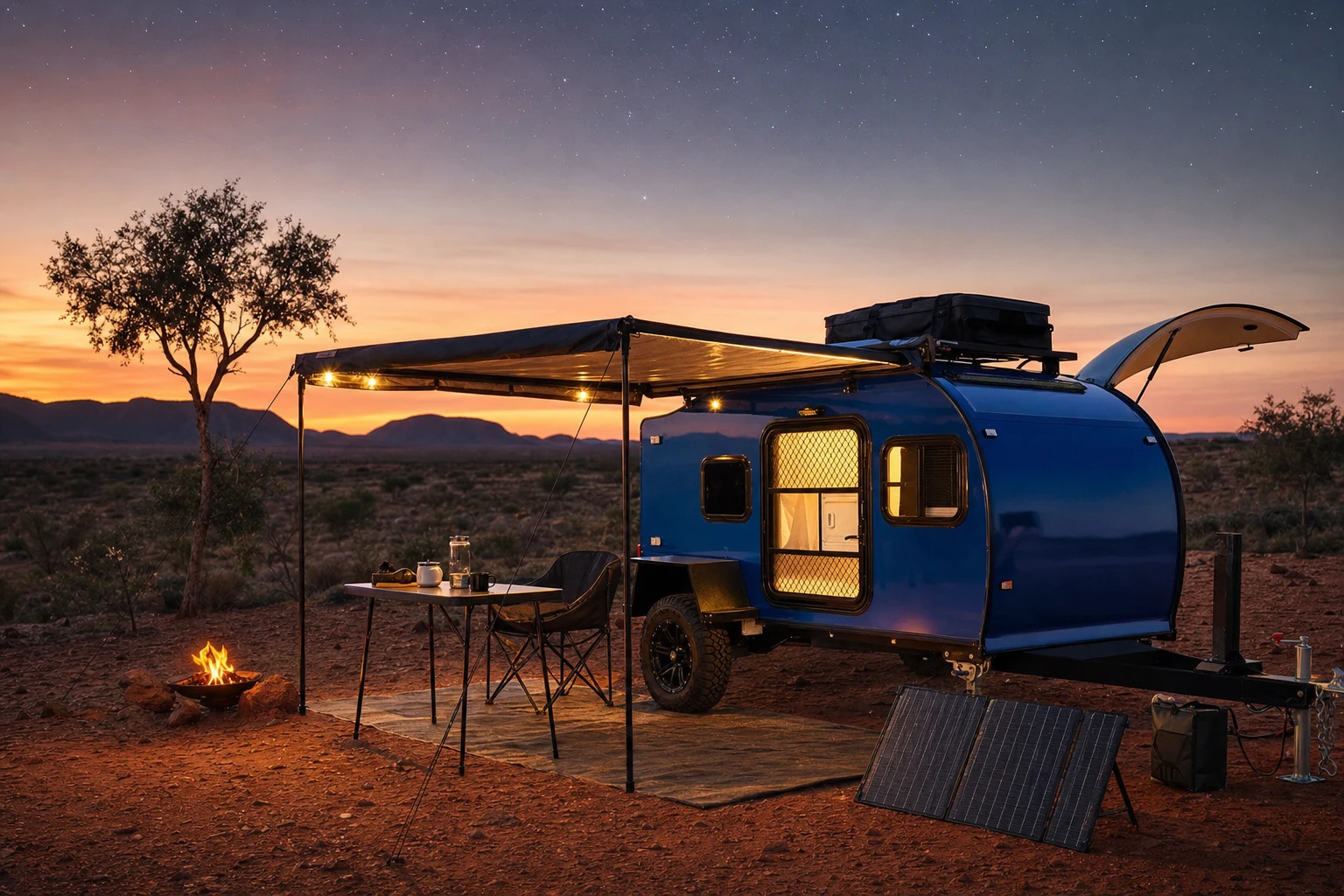
There is a particular kind of silence you only find when you camp away from a powered site. No hum of a neighbour’s air-conditioner, no glow of a powered-site post, no $55-a-night booking fee. Just you, a fire, and a teardrop camper that runs entirely on the sun. In 2026 this is no longer a hardcore-only pursuit reserved for people who build their own rigs — a well-specified off-grid teardrop camper will keep your fridge cold, your phone charged and your lights on for days at a time, and it’ll do it on a battery the size of a shoebox.
But the internet makes this harder than it needs to be. Search “how to power a teardrop trailer” and you’ll land on American forum threads arguing about shore power and 120-volt generators, none of which apply to Australian conditions, Australian regulations, or the brutal reality of a 38°C afternoon in the Flinders Ranges. Australia has more sun, hotter batteries, longer distances between towns, and a thriving free-camping culture that makes genuine off-grid capability the single most valuable upgrade you can make to a small camper.
This guide fixes that. We’ll walk through the four building blocks of an off-grid power system, give you real sizing numbers for Australian conditions (not theoretical ones), show you exactly how much power a two-person setup actually uses per day, and lay out what a sensible off-grid teardrop looks like across price points — including honest mention of how the Breath Trailer range is configured. By the end you’ll be able to size your own system or sanity-check any camper a salesperson tries to sell you.
What “off-grid” actually means for a teardrop camper
“Off-grid” gets used loosely, so let’s define it properly. A truly off-grid teardrop camper can do three things without any external connection:
- Generate and store its own electricity — solar panels feeding a deep-cycle battery, so you never need a 240V powered site.
- Carry and manage its own water — fresh water on board, plus a legal way to deal with grey water and (ideally) a toilet, so you’re not dependent on amenities blocks.
- Run for multiple days unassisted — enough capacity that a few cloudy days or a long stay doesn’t leave you flat.
Most of this guide focuses on the first point — power — because it’s the part people get most wrong and the part that costs the most to fix retrospectively. Water and self-containment matter too, and we cover them in depth in our dedicated guide to the self-contained camper in Australia, but a camper with great water storage and a dead battery is still stuck.
The good news: teardrops are easier to take off-grid than full-size caravans. They’re smaller, lighter and have far lower power demands. A 22-foot caravan with a washing machine, a microwave and a rooftop air-conditioner is a different engineering problem. A teardrop with a 12V fridge, LED lighting and a couple of phones to charge is a problem solar solved a decade ago.
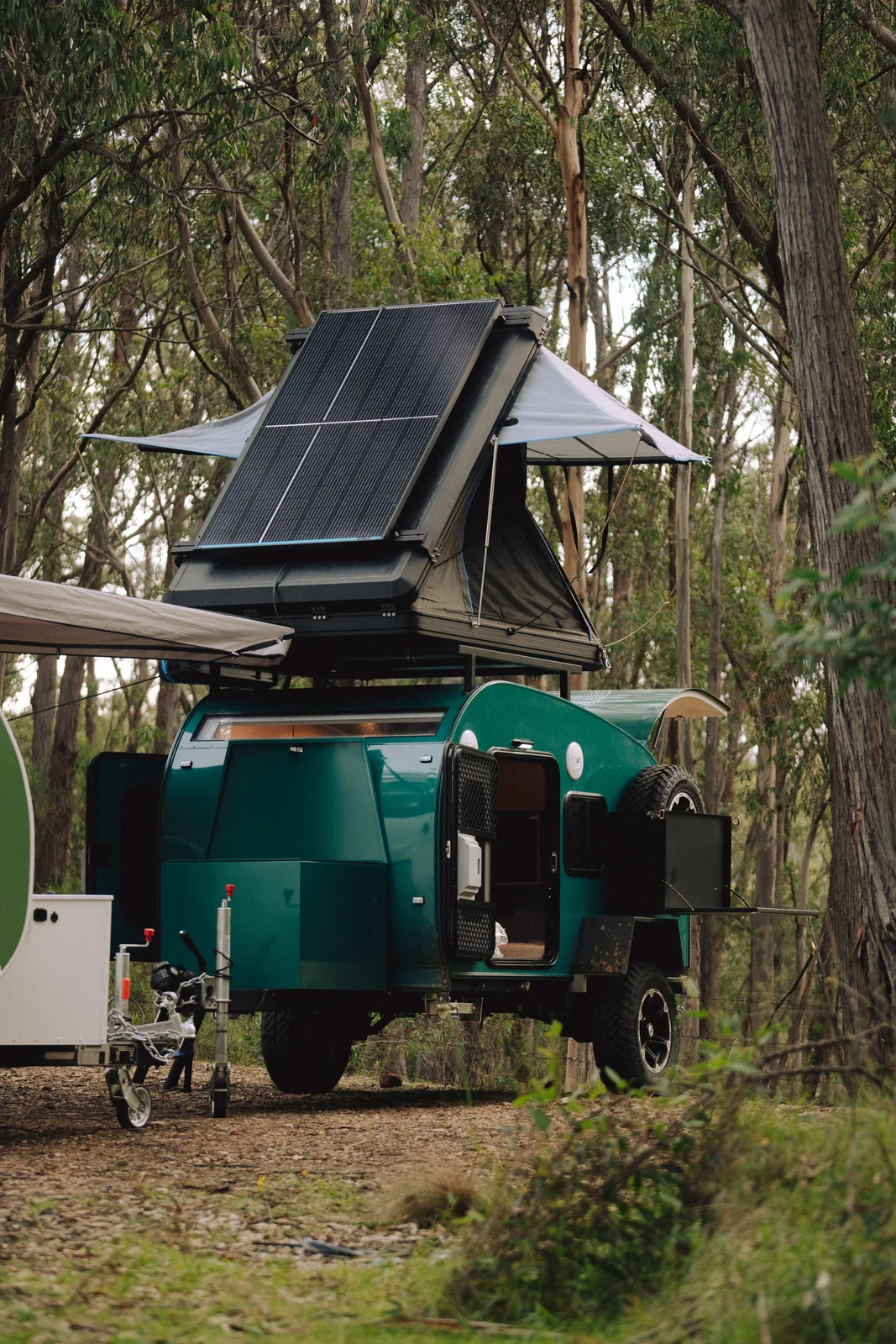
A teardrop’s small power demand is a problem solar handles comfortably.
The four building blocks of an off-grid power system
Every off-grid power system, whether it’s a teardrop or a $200,000 expedition truck, is built from the same four components. Understanding what each one does makes the whole thing far less intimidating.
| Component | Job | Typical teardrop spec |
|---|---|---|
| Battery (house battery) | Stores energy for use when the sun isn’t shining | 100Ah lithium (LiFePO4) |
| Solar panels + charge controller | Generate power from sunlight and feed it safely to the battery | 150–300W with an MPPT controller |
| DC-DC charger | Charges the camper battery from your tow vehicle while you drive | 20–25A unit (e.g. REDARC BCDC) |
| 12V distribution + optional inverter | Delivers power to lights, fridge, USB points; inverter makes 240V for small mains appliances | Fused 12V circuits, optional 600–1000W inverter |
Get these four right and sized for each other and you have a system that quietly works. Get them mismatched — a big battery and a tiny solar panel, or a huge solar array charging through a cheap PWM controller — and you’ll be chasing flat batteries and frustration. Let’s take them one at a time.

Roof solar, battery, DC-DC charger and wiring only work well when they are sized for each other.
Batteries: lithium vs AGM in 2026
The single biggest decision in an off-grid build is the battery chemistry, and in 2026 the answer for almost everyone is lithium iron phosphate (LiFePO4).
The reason is usable capacity. A traditional AGM deep-cycle battery should only be discharged to about 50% of its rated capacity before you start damaging it — so a “100Ah” AGM really only gives you about 50Ah of usable energy. A lithium battery of the same rating can be discharged to nearly 100% without harm, giving you roughly double the real-world capacity from the same nameplate number. As Battery World explains, lithium also weighs around half as much — a serious consideration when every kilo counts toward your camper’s tow weight.
| Spec | 100Ah AGM | 100Ah LiFePO4 |
|---|---|---|
| Usable capacity | ~50Ah | ~95–100Ah |
| Weight | ~30 kg | ~12–13 kg |
| Cycle life | 300–500 cycles | 2,000–4,000+ cycles |
| Charge speed | Slow (tapers badly) | Fast (accepts full current) |
| Cost (2026) | $300–450 | $600–1,100 |
| Best for | Tight budgets, mostly-powered-site use | Genuine off-grid, long-term value |
Lithium costs more up front, but over a five-year ownership window it’s usually cheaper per usable amp-hour because it lasts many times longer and you can actually use all of it. For a couple doing weekends and the occasional week away, a single 100Ah lithium battery is the sweet spot. For full-timers doing the Big Lap with a bigger fridge and daily laptop use, 200Ah gives genuine multi-day autonomy.
A note on heat: Australian summers are hard on batteries. LiFePO4 handles heat better than lead-acid but shouldn’t be charged below 0°C, which is rarely an issue here. Mount the battery somewhere ventilated, not in direct sun against a black panel, and it’ll outlast the camper.
Solar: how much do you actually need?
Solar is where Australia has a natural advantage. Across most of the country you can count on roughly five peak-sun-hours per day averaged over the year — far more than the UK or northern Europe — which means a modest panel does real work.
The rule of thumb most Australian installers use is to match your solar to your daily consumption with headroom for cloudy days. Practical numbers, drawn from guides like Outbax’s caravan solar guide:
- Weekend couple, 12V fridge + lights + phones: 150–200W of solar paired with a 100Ah lithium battery will keep you topped up indefinitely in good conditions.
- Extended touring, bigger fridge + inverter use: step up to 300–400W of solar and 200Ah of lithium for comfortable, sustainable off-grid living.
There are two ways to mount panels, and the best off-grid rigs use both:
- Fixed roof panels charge automatically whenever the camper is parked in the open — zero effort, but useless if you’ve parked your teardrop in the shade (which, on a hot day, you’ll want to).
- Portable folding panels (a “solar blanket” or folding array) plug into an Anderson socket and can be dragged into the sun while the camper itself stays cool under a tree. Folding rigid panels are generally preferred over flexible mats because they’re more efficient and more durable.
Crucially, insist on an MPPT charge controller, not the cheaper PWM type. MPPT (Maximum Power Point Tracking) controllers harvest up to 30% more energy from the same panels, especially in the marginal light of early morning, late afternoon and overcast skies — exactly when you need every watt. On a small system the extra cost is trivial and the gain is real.
Charging from your tow vehicle: the DC-DC charger
Here’s the part beginners overlook: you don’t only charge from solar. Every time you tow the camper to your next spot, the engine is running and your vehicle’s alternator is producing far more power than the car needs. A DC-DC charger captures that and pumps it into your camper’s house battery.
This matters enormously in practice. Drive three or four hours between camps — a normal day on a touring trip — and a 25A DC-DC charger can put 75–100Ah back into your battery, often fully recharging it before you’ve even arrived. It means a string of cloudy days never leaves you stranded, because moving the camper is charging the camper.
You can’t just run a wire from the car to the battery, though. Lithium batteries demand a specific charging profile, and a long cable from the tow vehicle suffers voltage drop. A purpose-built DC-DC charger solves both. The market leader is Australian-made REDARC, whose BCDC range delivers the correct charge profile, acts as an isolator (so the camper can never flatten your car’s starter battery when you’re parked), and — on dual-input models — accepts solar and alternator simultaneously, prioritising free solar first. REDARC units are built and tested for Australian extremes, rated to operate in heat up to 80°C and survive deep water crossings, which is exactly the kind of over-engineering you want in a remote-area component.
For a teardrop, a 20–25A DC-DC charger is the right size. Bigger isn’t always better — a huge charger can overload a small vehicle’s wiring — and 25A is plenty to keep a 100–200Ah lithium bank healthy on the move.
How much power do you actually use per day?
This is the number everything else is sized from, and it’s far smaller than people fear. Here’s a realistic daily budget for a two-person teardrop running off-grid, based on Australian consumption figures from sources like Caravan RV Camping:
| Appliance | Typical draw | Hours/day | Daily energy |
|---|---|---|---|
| 12V compressor fridge (40–60L) | ~3–4Ah/hr (cycling) | 24 | ~35–45Ah |
| LED interior + awning lights | ~1Ah | 4 | ~4Ah |
| Phone + tablet charging | — | — | ~3–5Ah |
| Water pump | ~5Ah | 0.2 | ~1Ah |
| Laptop / device charging | ~5Ah | 2 | ~5–10Ah |
| Total | ~50–65Ah/day |
The fridge is the elephant in the room — it accounts for two-thirds of your usage and runs around the clock. Everything else is rounding error by comparison. This is why fridge efficiency, good insulation and shade matter so much off-grid.

The 12V fridge runs around the clock and accounts for most of a teardrop’s daily power use.
Now the maths gets reassuring. A 100Ah lithium battery holds ~95Ah usable, so even with zero solar input it’ll run that setup for about a day and a half. Add 200W of solar generating ~80–100Ah on a sunny Australian day and you’re net-positive — you finish each day with a fuller battery than you started. As Outbax notes, a 200Ah lithium bank can run a typical fridge-based setup for four to five days with no charging at all. That’s genuine off-grid freedom.
Off-grid is more than electricity: water and self-containment
A complete off-grid teardrop also needs to manage water. Free camping on many Australian council and national-park sites increasingly requires vehicles to be “self-contained” — meaning you carry your own fresh water, contain your own grey water, and have an on-board toilet so nothing ends up on the ground.
For most teardrops, electricity is the easy part and the toilet is the blocker. A camper with a brilliant solar setup but no bathroom still can’t legally stay at self-contained-only sites. This is where the interior layout of the camper itself becomes a power question by proxy — and it’s covered fully in our guides to the self-contained camper and the teardrop camper with shower and toilet. The short version: if free-camping at premium sites is your goal, you want both an off-grid power system and genuine self-containment, and very few teardrops on the Australian market offer both.
Off-grid setups across the Breath Trailer range
So what does a sensibly specified off-grid teardrop look like in practice? Here’s how the four Breath Trailer models are positioned, from weekend-ready to fully self-contained free-camper. Prices are AUD, 2026.
| Model | Price | Tare | Off-grid character |
|---|---|---|---|
| Breath Essential | $23,320 | 700 kg | Lightweight weekender; solar-ready, ideal for powered-site-plus-occasional-bush use |
| Breath Plus | $29,766 | 800 kg | Fridge included; the natural starting point for genuine weekend off-grid |
| Breath Ultra | $34,749 | 900 kg | External shower + more capacity; built for longer remote touring |
| Breath Max | $42,900 | 1,200 kg | Full interior bathroom + self-containment — the only teardrop under $50k in Australia that pairs off-grid power with free-camping legality |
The pattern is deliberate: as you move up the range you add the capacity (battery, solar, water, bathroom) that turns a great weekend camper into something you can disappear into the outback with for a fortnight. The Breath Max is the standout for serious off-grid free-campers because it solves the self-containment problem that leaves most teardrops stuck on powered sites — 2.1 m standing headroom, a queen bed, an internal bathroom, and the off-grid systems to run it all.
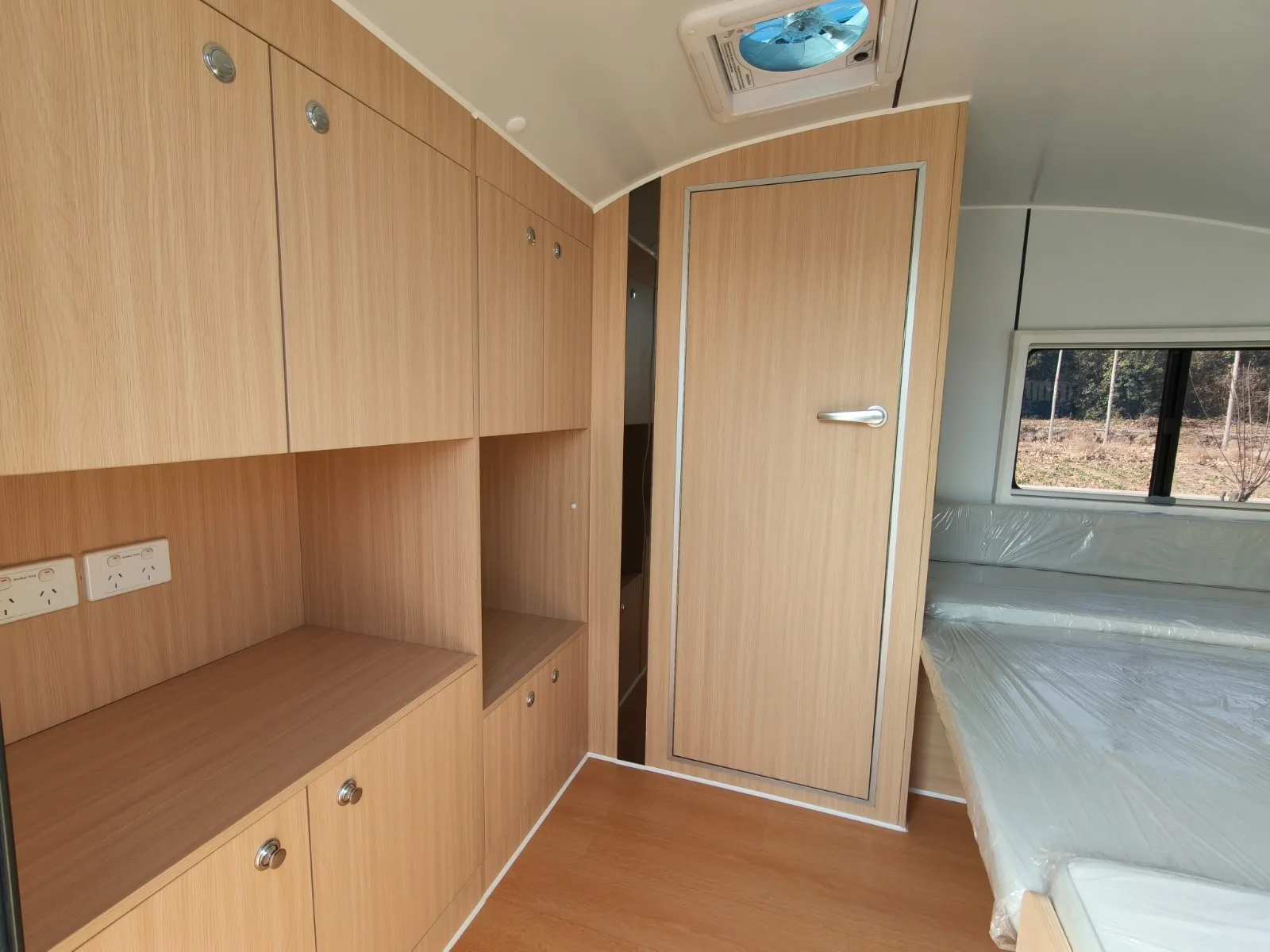
The Max’s onboard bathroom is what solves the self-containment problem for serious free campers.
If you’re weighing models, our best teardrop campers in Australia comparison and the off-road teardrop camper guide cover the suspension and clearance side of remote touring, which pairs naturally with the power side covered here.
Five common off-grid mistakes (and how to avoid them)
- Undersizing solar relative to the battery. A 200Ah battery with a single 120W panel can’t refill itself in a day. Match generation to storage.
- Buying a cheap PWM controller to “save money”. You lose up to 30% of your solar harvest in exactly the conditions you need it most. Always MPPT.
- Ignoring the tow vehicle as a charger. A DC-DC charger turns every drive into a recharge and is the cheapest insurance against a run of cloudy days.
- Forgetting water and waste. A perfect electrical system doesn’t make you legal at self-contained-only sites. Plan both together.
- Parking solar panels in the shade with no portable backup. On a hot day you’ll want the camper shaded — which means a fixed-only roof array does nothing. A folding portable panel solves it.
Frequently asked questions
How long can an off-grid teardrop camper run without sunlight?
A 100Ah lithium battery powering a typical 12V fridge, lights and device charging will run for roughly 1.5–2 days with no charging at all. A 200Ah lithium bank stretches that to four or five days. Add solar and, in Australian conditions, you’re effectively unlimited as long as you get some sun every few days.
Do I need solar if I have a DC-DC charger?
They solve different problems. A DC-DC charger only charges while you’re driving, so if you stay put for several days you need solar to top up. The best off-grid setups use both: solar for stationary days, DC-DC for travel days. Together they make a flat battery almost impossible.
Is lithium worth the extra cost over AGM for a teardrop?
For genuine off-grid use, yes. Lithium gives you roughly double the usable capacity, half the weight, and many times the cycle life. Over a five-year ownership window it’s usually cheaper per usable amp-hour. AGM only makes sense on a tight budget or if you mostly use powered sites.
How much solar do I need for a 12V camper fridge in Australia?
For a 40–60L compressor fridge plus lights and charging — around 50–65Ah of daily use — a 150–200W solar array with an MPPT controller and a 100Ah lithium battery keeps you net-positive in good Australian conditions. Step up to 300–400W and 200Ah for extended touring with a larger fridge and inverter use.
Can a teardrop camper be fully self-contained for free camping?
Some can. True self-containment needs on-board fresh water, contained grey water, and a toilet — alongside the off-grid power system. Most teardrops have the power but lack the bathroom. The Breath Max is one of the few under $50,000 in Australia that offers both, making it legal at self-contained-only sites.
Do I need an inverter in an off-grid teardrop?
Only if you want to run 240V mains appliances like a laptop charger, hair dryer or small kettle. A 600–1000W pure-sine inverter covers most needs. Many teardrop campers skip it entirely and run everything off 12V and USB, which is more efficient — every conversion to 240V wastes a little energy.
The bottom line
An off-grid teardrop camper is one of the most liberating things you can own in Australia. It unlocks thousands of free and low-cost campsites, frees you from booking fees and powered-site availability, and lets you camp in the places caravans can’t reach. And the technology to do it well has never been cheaper or more reliable than it is in 2026.
The recipe is simple once you strip away the forum noise: a 100–200Ah lithium battery, 150–400W of solar through an MPPT controller, a 20–25A DC-DC charger for charging on the move, and — if free camping is the goal — genuine self-containment to go with it. Size those four things to each other, account for that fridge that runs all day, and you have a camper that quietly looks after itself.
If you’d like to see how these systems are configured across real models, compare the full Breath Trailer range side by side, or book a viewing to inspect an off-grid setup in person before you commit.