Off Road Teardrop Camper Australia: Complete Guide 2026
Suspension, clearance, dust sealing and payload: the specs that separate a real off-roader from a sticker.
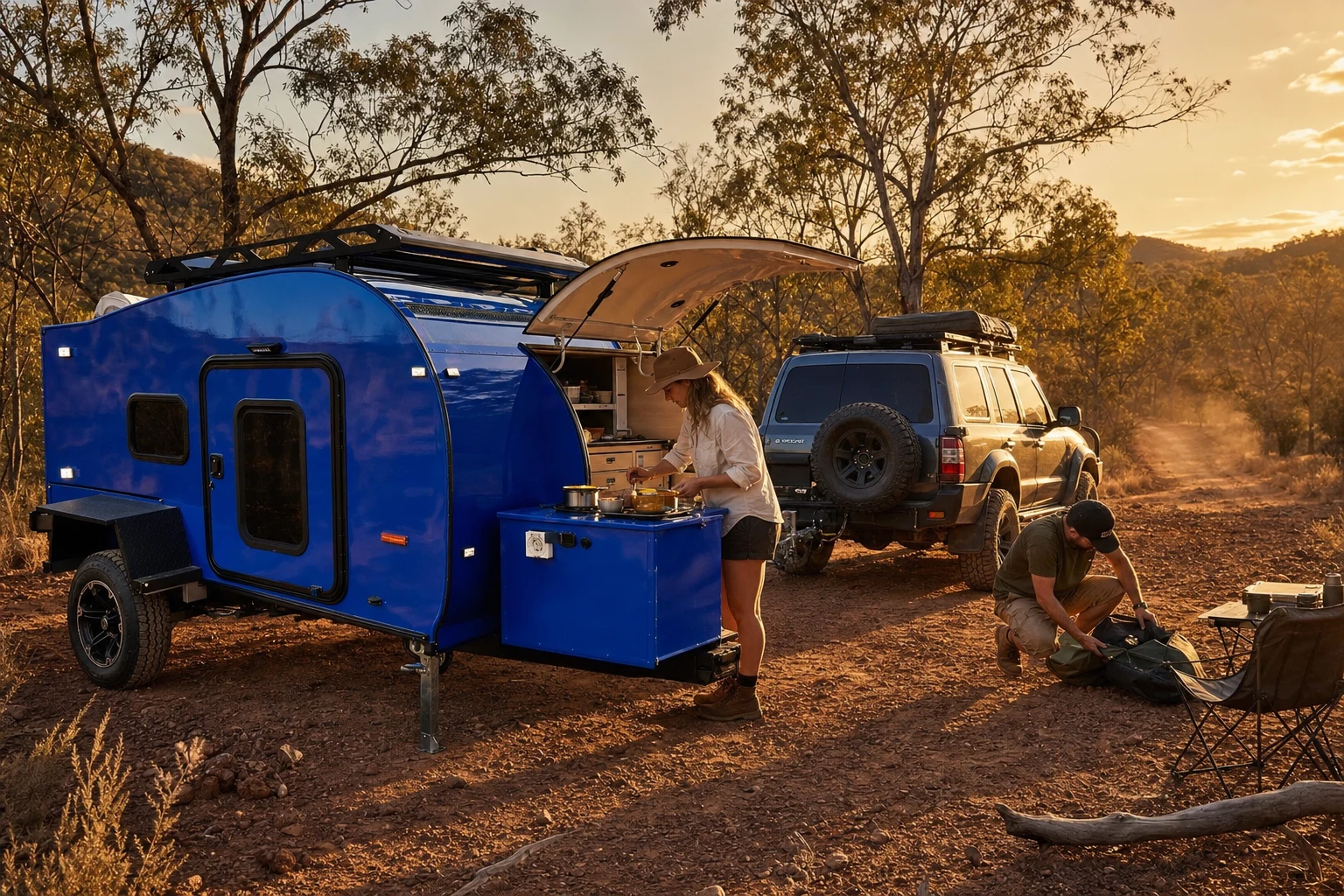
Australia has more unsealed roads than any country outside Russia — over 700,000 kilometres of dirt, gravel, and corrugated track stretching from the Kimberley to Cape York. If you want to reach the campsites that actually take your breath away, you need a setup that can handle what lies beyond the bitumen.
That’s where the off road teardrop camper has changed the game. In 2026, a well-specified teardrop can tackle the Gibb River Road, park on a Snowy Mountains firetrail, or reach a free camp in the Flinders Ranges — all while weighing less than half a traditional caravan and fitting in a standard suburban garage when you get home.
But not every teardrop is born equal. The difference between a road-going camper and a genuine off-road unit comes down to chassis design, suspension, body construction, and coupling spec. This guide covers everything you need to know before you buy, including a frank comparison of the off-road teardrop campers available in Australia right now, what tow vehicle you actually need, and the regulations that apply under Australian law.
What Makes a Teardrop Camper “Off-Road Ready”?
In Australia, the term “off-road” is used loosely — sometimes to describe a camper with slightly larger tyres, sometimes to describe a unit built to handle remote 4WD tracks. Here’s what genuinely matters:
1. Hot-Dip Galvanised Chassis
A chassis that’s powder-coated or painted will corrode once road debris chips the surface. Hot-dip galvanised steel forms a zinc bond with the metal that won’t flake, making it the minimum standard for anything that will see outback dust, creek crossings, and salt air. Look for RHS (rectangular hollow section) steel of at least 75 × 50 mm on the main rails.
2. Independent Trailing Arm Suspension
Leaf springs — common on budget camper trailers — transmit every corrugation directly from the wheel into the chassis and your cargo. Independent trailing arm suspension (like the Cruisemaster XT or AL-KO off-road systems) allows each wheel to move independently, dramatically reducing body flex and internal chaos on rough roads. For serious off-road use, look for airbag-assisted systems that let you adjust ride height at camp.
3. Ground Clearance
The body of the camper — not just the axle — needs to clear rocks and ledges. Most off-road Australian teardrops offer 300–400 mm of ground clearance under the chassis. Anything less than 250 mm will see you high-centred on a modest obstacle.
4. Off-Road Coupling
A standard DO35 or equivalent off-road coupling allows the drawbar to articulate in multiple planes — up/down and side/side — rather than only in the plane of the tow ball. This prevents the camper from ripping itself apart (or your towbar off) on undulating terrain. Never take a camper rated “road-use only” on anything rougher than a well-graded dirt road.
5. All-Terrain Tyres
Road tyres lose grip quickly on loose gravel or wet clay. All-terrain tyres (AT) carry a more aggressive tread pattern and reinforced sidewalls that resist punctures from sharp rock edges. Most off-road Australian teardrops ship on 16-inch or 17-inch AT rubber.
6. Body Construction
Hard-shell composite panels (aluminium skin over foam core, or fibreglass monocoque) handle flex and vibration far better than timber-framed construction. Check that body joins are sealed and that the rear kitchen hatch uses a waterproof seal — corrugated tracks pump fine red dust into every unsealed gap.
Off-Road Teardrop Campers in Australia — 2026 Model Comparison
| Model | Price (AUD) | Tare Weight | ATM | Suspension | Best For |
|---|---|---|---|---|---|
| Breath Essential | $23,320 | 700 kg | 1,000 kg | Coated steel chassis | Light gravel & weekends |
| Breath Plus | $29,766 | 800 kg | 1,100 kg | Upgraded chassis + fridge | Extended trips on mixed roads |
| Breath Ultra | $34,749 | 900 kg | 1,200 kg | Off-road-ready + ext. shower | Dirt roads, remote bush camps |
| Breath Max | $47,190 | 1,200 kg | 1,500 kg | Full off-road build + bathroom | Big Lap, free camping, 4WD tracks |
| Cruizy Vagabond Brumby | $34,990 | ~900 kg | 1,140 kg | Leaf spring + AT tyres | Budget-conscious off-roaders |
| JAG Pod | ~$47,000 | 860 kg | est. 1,200 kg | Independent suspension | Ultra-lightweight off-road |
| Kimberley Kube Classic | from $76,865 | from 1,100 kg | 1,950 kg | Premium independent | Serious remote expeditions |
Prices as at June 2026. Confirm current pricing and lead times directly with each manufacturer.
The price spread is dramatic — from $23,320 to nearly $80,000. Understanding what drives that spread matters more than the sticker price alone.
The Kimberley Kube is the benchmark for remote Australian off-road travel: alloy body, panoramic glazing, king-size bed, and a 850 kg payload. But it requires a serious tow vehicle (minimum 2,500 kg braked towing capacity is recommended), and its price puts it firmly in the premium tier.
The JAG Pod’s independent suspension makes it one of the most capable lightweight off-roaders available, while the Cruizy Vagabond Brumby sits at a more accessible price point with fibreglass monocoque construction and Cooper AT tyres.
The Breath Trailer range sits in the middle of the market — Sydney-designed, available in 100+ custom colours, designed for the family SUV buyer who wants to go further than a caravan park without paying Kimberley Kube prices. For a deeper ranking across all models, see our best teardrop campers Australia 2026 guide.
What Vehicle Do You Need to Tow an Off-Road Teardrop?
This is the question that trips up more buyers than any other. There are two separate legal limits to understand, and both apply simultaneously.
ATM vs Tare Weight
- Tare weight is how much the camper weighs empty, leaving the factory.
- ATM (Aggregate Trailer Mass) is the maximum the trailer may weigh when fully loaded — water, food, gear, everything.
- Your vehicle’s braked towing capacity must equal or exceed the trailer’s ATM.
A Breath Essential with 700 kg tare and 1,000 kg ATM can be legally towed by a Toyota RAV4 (2,000 kg braked towing capacity) with 300 kg of headroom for gear. The Breath Max at 1,500 kg ATM needs a vehicle rated to at least 1,500 kg — comfortably met by a HiLux, Ranger, or Prado.
| Tow Vehicle | Braked Towing Capacity | Compatible Breath Models |
|---|---|---|
| Toyota RAV4 (2.5L hybrid) | 1,650–2,000 kg | Essential, Plus |
| Mazda CX-5 (diesel) | 2,000 kg | Essential, Plus |
| Subaru Outback (XT) | 1,800–2,000 kg | Essential, Plus |
| Toyota Kluger | 2,000 kg | Essential, Plus, Ultra |
| Ford Everest (V6) | 3,000–3,500 kg | All models |
| Toyota LandCruiser 300 | 3,500 kg | All models |
| Toyota HiLux (2.8 diesel) | 3,500 kg | All models |
| Ford Ranger (Raptor) | 2,500–3,500 kg | All models |
Always verify your specific vehicle’s towing capacity in its owner’s manual or the manufacturer’s towing guide — capacity varies significantly by engine and specification.
GCM: The Often-Overlooked Limit
Beyond individual towing capacity, your vehicle has a Gross Combined Mass (GCM) — the maximum total of vehicle + trailer when loaded. Exceeding GCM is illegal and voids insurance. Heavier off-road teardrops with water and camping gear can eat into GCM quickly.
Do You Need a 4WD?
On well-graded dirt roads, any capable AWD or 4WD SUV will manage a teardrop comfortably. For tracks that require low-range 4WD — river crossings, soft sand, steep hill climbs — you need a genuine 4WD with a low-range transfer case. The camper handles it fine; it’s the tow vehicle that dictates your access.
For an in-depth towing breakdown, the small caravans and trailers Australia comparison guide covers tow vehicle compatibility in detail.
Off-Grid Capability: Power, Water, and Free Camping
Taking a teardrop off-road is only half the appeal. The other half is getting away from powered sites — and for that, you need genuine off-grid capability.
The Australian “Self-Contained” Standard
In Australia, self-contained has a specific meaning under most state and territory guidelines: the camper must carry its own toilet, shower, and greywater storage — you must leave no waste behind. Fully self-contained status unlocks access to a much wider network of free camps, particularly on National Parks land and remote stations.
Most teardrop campers fall short here — they offer a bed and a kitchen, but no toilet or interior shower. This is the gap the Breath Max was designed to fill: it’s the only teardrop on the Australian market under $50,000 with a full interior bathroom (toilet + shower), making it the most practical option for couples wanting unlimited free camping access.
The Breath Ultra includes an external shower — useful for rinsing off at the end of the day, but not sufficient for formal self-contained certification. For the Ultra, a portable camp toilet paired with the external shower gets most couples close to practical self-sufficiency.
Power Setup
A typical off-road teardrop setup for extended trips includes:
- 100–200 Ah lithium battery (LiFePO4 — lighter, deeper discharge than AGM)
- 200–300 W solar panel on the roof
- 12V outlets and USB-C charge points
- Inverter for 240V appliances (optional, draws heavily)
This supports a 12V compressor fridge, lighting, USB charging, and an electric water pump for four to seven days between solar top-up, depending on cloud cover.
Water
Most off-road teardrops carry 40–100 litres of fresh water. At 3–4 litres per person per day for drinking plus cooking, a couple can stretch 80 litres across five days before needing to refill. Many remote free camps have no water supply, so map your water points before leaving bitumen.
For more detail on spec options including showers and water systems, see our dedicated teardrop camper with shower and toilet Australia guide.
Breath Trailer: Off-Road Credentials Across the Range
Breath Trailer is a Sydney-based teardrop camper brand, designing and finishing premium hard-shell campers since the company’s founding by Patricio, who won the Gold Sydney Design Award 2025. With more than 350 customers and a 3–4 month lead time, the range has built a reputation for build quality and low tow weight relative to what’s included.
Here’s how each model handles off-road use in practice:
Breath Essential — $23,320, 700 kg tare
The lightest in the range. At 700 kg, it’s towable by almost any SUV on Australian roads — including smaller AWD vehicles and plug-in hybrid SUVs with a tow bar fitted. The Essential is best suited to well-graded dirt roads, national park campgrounds, and weekender trips off the bitumen. Think Grampians, Snowy Mountains, and most South Australian outback stations.
Breath Plus — $29,766, 800 kg tare
Adds a compressor fridge as standard, making multi-day off-grid trips genuinely comfortable. The extra 100 kg over the Essential is negligible for towing. The Plus is the workhorse of the range — capable enough for most Australian outback travel without requiring a dedicated 4WD.
Breath Ultra — $34,749, 900 kg tare
The Ultra adds an external shower, a 12V electrical system, and a more complete off-grid package. It’s designed for buyers who want to spend a week at a time away from powered sites. All-terrain tyres and the off-road-ready chassis spec make it suitable for corrugated outback roads. The Ultra is the most popular choice for couples doing extended Fraser Coast or Flinders Ranges loops.
Breath Max — $47,190, 1,200 kg tare
The Max is the flagship — and the one that solves the bathroom problem that stops most teardrop buyers from committing to free camping. With a full interior bathroom (toilet + shower), 2.1 m standing headroom, a queen bed, and a self-contained rating, the Max is designed for the Big Lap and extended remote travel.
At 1,500 kg ATM, it needs a capable tow vehicle (a HiLux, Ranger, Prado, or LandCruiser handles it comfortably). But at $47,190, it undercuts every comparable self-contained option on the market by a significant margin — the Kimberley Kube with similar self-contained specs starts above $76,000.
All Breath Trailer models come standard with a 5-minute setup — no poles, no tent attachments, no fuss at the end of a long dirt road drive. You drop the jockey wheel, unhitch, open the rear kitchen hatch, and you’re done. When you’re arriving at a remote campsite at dusk after a six-hour corrugated run, that matters.
Explore the full range and compare specs on our model comparison page.
The Best Off-Road Destinations for Teardrop Campers in Australia
Once your teardrop is spec’d and hitched, these are the destinations worth heading to in 2026:
| Destination | State | 4WD Required? | Self-Contained Needed? | Best Season |
|---|---|---|---|---|
| Flinders Ranges | SA | No (most tracks) | Recommended | April–October |
| Grampians NP | VIC | No | No (sites available) | Year-round |
| Snowy Mountains | NSW/ACT | No (summer) | No | November–April |
| Gibb River Road | WA | Recommended | Recommended | May–October |
| Cape York Peninsula | QLD | Yes (essential) | Strongly recommended | June–October |
| Kangaroo Island | SA | No | No | March–November |
| High Country | VIC | Seasonal | Recommended | December–April |
| Strzelecki Track | SA | Recommended | Yes | April–September |
Flinders Ranges (SA) is the ideal first off-road teardrop trip: Rawnsley Park and Wilpena Pound have excellent powered and unpowered sites, the tracks are manageable in a standard AWD, and the landscape is extraordinary. A Breath Ultra or Max is more than capable.
Gibb River Road (WA) is 660 km of corrugated dirt linking Derby to Kununurra through the Kimberley. River crossings are common after rain. A 4WD tow vehicle is strongly recommended, and carrying adequate water is non-negotiable. The Max’s self-contained certification gives you far more options for where to stop overnight.
Cape York is the most demanding on this list — deeply corrugated tracks, rocky climbs, and seasonal creek crossings. It’s possible in a well-prepared teardrop, but requires an experienced driver, a proper 4WD tow vehicle, and a trailer with full off-road spec. It rewards accordingly.
How to Inspect an Off-Road Teardrop Before You Buy
Whether you’re buying new or second-hand, run through this checklist before committing:
Chassis and structure:
- Hot-dip galvanising — not just powder coat. Look for the uniform grey zinc finish. Chips or rust spots are a warning sign.
- Weld quality at junction points — should be full-penetration welds with no visible porosity or cracking
- Drawbar geometry — a bent or repaired drawbar is a serious structural concern
Suspension and running gear:
- Bounce each corner and watch for uneven rebound (worn shock absorbers)
- Check trailing arm pivots for play or wear
- Inspect tyre sidewalls for cracking, bulges, or uneven wear (indicates alignment issues)
- Verify the spare tyre is the correct size and actually fits the rim
Coupling and electrics:
- Test the DO35 or off-road coupling — it should move freely in all planes with no binding
- Test all lights (running, brake, indicator) with your tow vehicle connected
- Verify breakaway cable and electric brake controller wiring if ATM > 750 kg
Documentation:
- VSB1 compliance certificate (mandatory for trailers registered in Australia)
- Trailer Plate (post-1989 legal requirement stating compliance with Motor Vehicle Standards Act)
- Build spec sheet from the manufacturer
Australian Regulations for Teardrop Trailers
Every teardrop camper sold and registered in Australia must comply with Vehicle Standards Bulletin 1 (VSB1) — the federal document governing all trailers under 4,500 kg ATM. This covers braking requirements, lighting, coupling specifications, and maximum dimensions.
Key rules to know:
- Trailer brakes are required if ATM exceeds 750 kg. For most off-road teardrops, this means electric drum brakes — and you’ll need a brake controller fitted to your tow vehicle.
- Speed limits: Most states cap towing at 100–110 km/h regardless of road speed limits. Check your state’s specific rule.
- Registration: Every trailer must be registered in a state or territory. If you’re interstate for extended periods, check whether a permit is required.
- Trailer Plate: All trailers manufactured after 1989 must display a compliance plate stating the ATM and conformance with the Motor Vehicle Standards Act.
For importers and buyers of second-hand trailers first registered overseas: the trailer must pass a state AIS inspection and comply with VSB1 Revision 6 (in force from 1 July 2023) before it can be registered in Australia.
For a comprehensive cost breakdown including registration, insurance, and running costs, see our teardrop camper cost Australia guide.
Frequently Asked Questions
Can I tow an off-road teardrop camper with a standard SUV?
Yes — if the trailer’s ATM is within your vehicle’s braked towing capacity. A Breath Essential (1,000 kg ATM) can be legally towed by a Toyota RAV4, Mazda CX-5, Subaru Outback, and similar mid-size SUVs. Always check your specific vehicle’s towing capacity in the owner’s manual, and verify your GCM (Gross Combined Mass) is not exceeded when both the vehicle and trailer are loaded.
What is the difference between ATM and tare weight for a teardrop camper?
Tare weight is how much the camper weighs empty. ATM (Aggregate Trailer Mass) is the maximum total weight when the camper is fully loaded with water, food, and gear. Legally, your tow vehicle’s braked towing capacity must equal or exceed the trailer’s ATM — not just the tare weight.
Do I need a 4WD to tow a teardrop camper off-road?
Not always. Well-graded gravel roads, most national park campgrounds, and station tracks are accessible with a capable AWD or 4WD SUV on standard road tyres. Low-range 4WD becomes necessary on loose sand, steep rocky descents, or river crossings. The trailer’s off-road spec affects how well it handles the terrain; the tow vehicle dictates your actual access.
What does “self-contained” mean for free camping in Australia?
A self-contained camper carries its own toilet, shower, and greywater storage — meaning you generate no waste that must be left behind. Self-contained status unlocks more free camping locations, particularly on National Parks and remote station land. In 2026, the Breath Max is the only Australian teardrop camper under $50,000 offering a full interior bathroom that meets this standard.
How much do off-road teardrop campers cost in Australia in 2026?
Entry-level Australian off-road teardrops start around $23,320 (Breath Essential). Mid-range models with more off-grid capability typically range from $30,000–$45,000. Premium models with full self-contained specs (like the Kimberley Kube) start above $76,000. For a complete breakdown, see our teardrop buying guide Australia.
Is a Breath Trailer suitable for off-road use?
Yes — all four Breath Trailer models are built for Australian conditions including unsealed roads. The Ultra and Max are the most capable off-road options in the range, with off-road-ready chassis specs and the Max offering a full self-contained bathroom for extended free camping. At $47,190, the Max is the most affordable self-contained teardrop in Australia, and it’s been validated by 350+ customers including couples on the Big Lap.
Conclusion
The off road teardrop camper has matured from a niche import into a legitimate category of the Australian camping market in 2026. Whether you’re drawn by the lightweight tow, the quick setup at the end of a long corrugated day, or the freedom to park wherever the map runs out of roads, there’s now a well-built option for almost every budget.
For most buyers, the decision comes down to three questions:
- How rough is your roughest planned trip? — gravel roads favour any well-built teardrop; serious 4WD tracks demand an off-road coupling, independent suspension, and AT tyres.
- Do you need a bathroom? — if yes, the Breath Max is the most affordable path to full self-containment.
- What does your tow vehicle support? — check ATM against your braked towing capacity before you fall in love with a specific model.
The best way to answer all three is to see the campers in person. Breath Trailer has viewing locations around Australia where you can inspect, ask questions, and understand exactly what your SUV can handle before you commit.