Small Caravans & Trailers in Australia: 2026 Comparison Guide
Every small caravan and camper trailer type sold in Australia, side by side: tare, ATM, price, and which SUV can legally tow it.
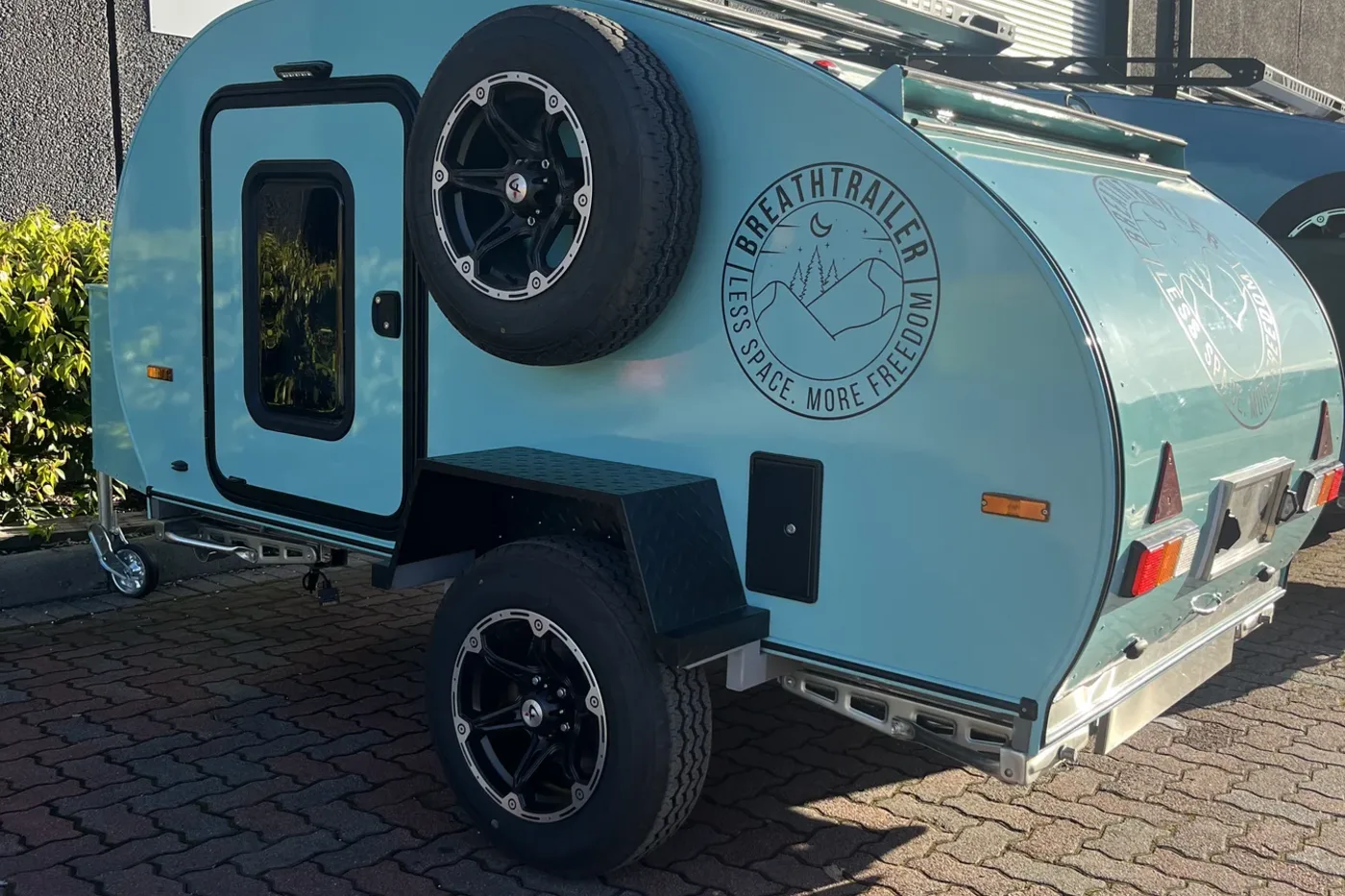
Australia hit a record 938,000 registered caravans and campervans in 2025 — up 32% since 2019 — and the fastest-growing slice of that market isn’t the big family van. It’s the small caravan and trailer segment: anything you can tow behind the SUV you already own, store in a normal garage, and hitch up without a weighbridge-grade anxiety attack.
But “small” covers a confusing amount of ground. A 640 kg micro caravan, an 850 kg teardrop trailer, a 1,500 kg pop-top and a fold-out camper trailer are all sold as “small caravans and trailers”, and they live very differently once you own them.
This guide compares every small caravan and trailer category available in Australia in 2026 — with real prices, real weights, the tow-vehicle maths, the towing rules, and the running costs nobody puts in the brochure — so you can work out which small trailer or caravan actually fits your car, your budget and the way you want to travel.
Why Australia Is Going Small in 2026
Three numbers explain the shift better than any sales pitch:
- Most Australian cars can’t tow a typical caravan. The average new family caravan weighs 2,000–2,500 kg loaded. The best-selling SUVs in the country — RAV4, CX-5, Tucson, Sportage — are rated to tow between 1,200 kg and 1,900 kg braked. The car most Australians already own rules out the caravan most dealerships want to sell them.
- Caravan and camping tourism keeps growing. Australians took 17.3 million caravan and camping trips in 2025, spending $12.6 billion — and 87% of those trips were to regional Australia, where a nimble, lightweight trailer earns its keep on every unsealed access road and tight campground bay.
- Towables dominate. Caravans and trailers you tow (rather than drive) made up roughly 63% of 2025 RV shipments, precisely because they’re cheaper to buy and work with the vehicle already in the driveway.
Add the cost-of-living squeeze — less fuel, cheaper insurance, no off-site storage fees, no new tow vehicle — and a small caravan or trailer isn’t the compromise option anymore. For couples and solo travellers, it’s the rational one.
The Five Types of Small Caravan and Trailer, Compared
Before comparing individual models, get the categories straight — because the trade-offs between categories are far bigger than the trade-offs between brands.
| Category | Tare weight | Price range (AU 2026) | Setup time | Hard walls? | Typical bathroom |
|---|---|---|---|---|---|
| Teardrop trailer | 350 – 1,200 kg | $20k – $50k | ~5 min | Yes | Rare (premium models only) |
| Micro / mini caravan | 640 – 1,250 kg | $29k – $60k | 5 – 10 min | Yes | Compact ensuite on most |
| Pop-top caravan | 1,100 – 1,600 kg | $40k – $68k | 10 – 15 min | Yes + canvas top | Usually |
| Camper trailer (fold-out) | 600 – 1,500 kg | $10k – $45k | 20 – 45 min | No (canvas) | No |
| Hybrid / pod camper | 1,100 – 2,000 kg | $40k – $70k+ | 10 – 20 min | Yes | External or compact internal |
A quick honest read of each:
- Teardrop trailers are the lightest hard-shell option on the market: an insulated cabin with a real bed, a galley kitchen under the rear hatch, and nothing to fold, crank or peg out. They tow behind almost anything and store in a standard garage. The classic trade-off is interior space — you live outside and sleep inside. (Our complete teardrop caravan guide covers this category in depth.)
- Micro caravans squeeze a caravan layout — dinette, kitchenette, compact ensuite — into a body under about 4 metres. You get standing room and an inside toilet; you give up weight (most run 1,000 kg+ tare) and pay $30k–$60k.
- Pop-tops lower the roof for towing, which improves fuel economy and shed clearance, but reintroduce canvas: seals to maintain, a top to crank, and less insulation in extreme weather.
- Camper trailers are the cheapest entry point, and the canvas is exactly why. Setup is 20–45 minutes, wet pack-downs are miserable, and weather protection is the weakest of any category here.
- Hybrids and pod campers chase off-road capability with hard walls — genuinely impressive machines, but the weights creep up fast, and so do the prices.
Small Caravan & Trailer Comparison: 13 Models Worth Knowing in 2026
These are the small caravans and trailers Australian buyers actually cross-shop in 2026, with verified pricing and weights. Sources: manufacturer listings plus the Savvy small caravans round-up and the What’s Up Down Under lightweight guide.
| Model | Type | Tare | ATM | Price from | Bathroom |
|---|---|---|---|---|---|
| Breath Essential | Teardrop | 700 kg | ~1,000 kg | $23,320 | No |
| Hip Campers entry models | Teardrop | ~750 kg | ~1,000 kg | $21,500 | No |
| Breath Plus | Teardrop | 800 kg | ~1,100 kg | $29,766 | No |
| Century Venus 11 | Micro caravan | 1,080 kg | 1,500 kg | $29,500 | Full ensuite |
| Breath Ultra | Teardrop | 900 kg | ~1,200 kg | $34,749 | External shower |
| Ezytrail Winton 10 MK2 | Micro caravan | 1,185 kg | 1,500 kg | $35,990 | Ensuite |
| Euro Glider | Micro caravan | 640 kg | ~900 kg | $38,900 | Compact |
| Breath Max | Teardrop | 1,200 kg | ~1,450 kg | $47,190 | Full internal (toilet + hot shower) |
| MDC Forte SR11 | Hybrid | ~1,600 kg | 2,000 kg | $39,990 | External kitchen, compact ensuite |
| Fantasy Nano 10 | Micro caravan | 1,247 kg | 1,500–1,600 kg | $41,990 | Ensuite |
| JAG Camper | Teardrop | 880 kg | ~1,100 kg | $44,990 | No |
| Avan Aspire 499 Pop Top | Pop-top | ~1,400 kg | 1,800 kg | $55,679 | Yes |
| Golf Maxxi 501-1 PT | Pop-top | ~1,500 kg | 1,950 kg | $67,990 | Yes (sleeps 6) |
Four patterns jump out of that table:
- Weight tracks category, not price. The $23,320 Breath Essential weighs 700 kg; the $29,500 Century Venus 11 weighs 1,080 kg. Spending more often buys you more caravan, not less weight — and weight is the number that decides what your car can tow.
- The micro caravan price floor is about $29,500, and most well-specced examples land between $36,000 and $42,000. Teardrops start almost $10,000 lower.
- Ball weight matters as much as ATM. Lightweight champions like the Euro Hobby run ~45 kg of ball weight; micro caravans like the Winton 10 MK2 run 95 kg. Most mid-size SUVs are limited to 100–150 kg of towball download, so a heavy-nosed trailer can rule out your car even when the ATM looks fine.
- An internal bathroom under $50,000 is rare in any category. Below that line it’s the Century Venus 11 (a 1,080 kg micro caravan) and the Breath Max — the only teardrop on the Australian market under $50k with a full internal bathroom, at 1,200 kg with 2.1 m of standing headroom.
What Can Your Car Actually Tow?
This is where most small-caravan shortlists get rewritten. Two numbers on the trailer’s compliance plate matter:
- Tare — the trailer’s empty weight.
- ATM (Aggregate Trailer Mass) — the maximum legal loaded weight. This is the number your vehicle’s braked towing capacity must cover, because the law assumes you’ll load it.
Match those against the most common vehicles on Australian roads:
| Vehicle | Braked towing capacity | Towball limit | Comfortable match |
|---|---|---|---|
| Toyota RAV4 (Hybrid) | 480 – 1,500 kg | ~100 kg | Teardrops, lightest micros (Euro Glider) |
| Mazda CX-5 | 1,800 kg | 150 kg | Any teardrop, any micro caravan |
| Subaru Outback | 1,500 – 2,400 kg | 100 – 180 kg | Teardrops to mid pop-tops |
| Hyundai Tucson / Kia Sportage | 1,650 – 1,900 kg | ~100 kg | Teardrops, micros, light pop-tops |
| Toyota Prado / Ford Everest | 3,000 – 3,500 kg | 300+ kg | Anything in this guide |
| Ford Ranger / Toyota HiLux | 3,500 kg | 350 kg | Anything in this guide |
Three rules that save expensive mistakes:
- Check your exact variant. A petrol RAV4 and a hybrid RAV4 have different ratings; so do auto and manual utes. The figure is in your owner’s handbook, not the sales brochure.
- Leave a margin. Towing at 100% of rated capacity is legal but unpleasant — the engine works hard, fuel consumption spikes, and crosswind stability suffers. A trailer whose ATM sits at 60–80% of your capacity tows like it isn’t there. This is the core of the teardrop case: a 700–900 kg trailer behind a 1,800 kg-rated SUV is an effortless combination.
- Mind the Gross Combined Mass (GCM). Your car’s payload (passengers, gear, the towball download itself) and the trailer together must stay under the GCM. Heavy trailers quietly eat your luggage allowance.
Towing Rules for Small Trailers and Caravans in Australia
The good news: small trailers live in the friendliest part of Australian towing law. The essentials, per NSW Government towing guidance (rules are nationally consistent on these points):
- No special licence. A standard car licence covers every trailer and caravan in this guide, in every state and territory. Learner and P1 drivers face restrictions in some states.
- Brakes — the 750 kg threshold. Trailers with a GTM of 750 kg or less don’t legally require their own brakes. From 750 kg to 2,000 kg, braking on at least one axle is required (override or electric). Over 2,000 kg, you need electric brakes on all wheels plus an automatic breakaway system. Practical translation: most teardrops and micro caravans need a simple single-axle brake setup; many sub-750 kg trailers need none at all — one less system to buy, wire and maintain.
- If your car has no specified rating, the default limit is the trailer’s loaded mass not exceeding the car’s unloaded mass (up to 1.5× with trailer brakes) — but virtually every modern vehicle publishes a rating, and that’s what applies.
- Compliance. Every new trailer sold in Australia must meet VSB1 national standards; 240V wiring requires a licensed electrician and gas systems a licensed gasfitter. Ask the manufacturer for the compliance documentation before you sign anything.
There’s also an insurance-shaped footnote: lighter trailers are cheaper to insure and register, and several states scale trailer registration by weight. Small wins, every single year you own it.
The Real Cost of Going Small (It’s Not Just the Sticker)
Two trailers with similar purchase prices can cost wildly different amounts to own. The four line items that diverge:
Fuel. Towing a full-height 2,500 kg caravan can push a 4WD towards 20 L/100 km; budgeting 15–20% extra fuel is standard advice for big vans. A sub-1,000 kg aerodynamic trailer barely registers — teardrop owners routinely report consumption increases of 1–2 L/100 km. Over a 15,000 km Big Lap at 2026 fuel prices, that difference alone runs into the thousands of dollars.
Storage. A trailer that fits in a standard garage costs $0 to store. A caravan that doesn’t costs $150–$300 per month in commercial storage in most capital cities — up to $3,600 a year, forever. Every model in our comparison table except the largest pop-tops fits under a standard 2.4 m garage door; check travel height before you buy.
The tow vehicle you don’t have to buy. This is the biggest hidden cost in caravanning, and the one the industry talks about least. If the trailer forces you from a $45,000 SUV into a $75,000+ LandCruiser or Everest, the real price of that caravan just went up $30,000. A small caravan or trailer that works with your current car is the single largest saving available in this entire market.
Servicing and consumables. Fewer axles, smaller brakes, no slide-outs, no air conditioner on the roof, no canvas to reproof — a simple hard-shell trailer is cheap to keep healthy. For a full ownership-cost breakdown, see our teardrop camper cost guide.
The Bathroom Question (Read This Before You Pick a Category)
Ask anyone who’s owned a small trailer for a year what they’d change, and the answer is rarely “more storage”. It’s the bathroom — or the lack of one. It is the single most common reason couples abandon the small-trailer idea and reluctantly buy a 2.5-tonne caravan they didn’t want and can barely tow.
Be brutally honest about which camp you’re in:
- Powered-site campers. If you’ll mostly stay in caravan parks with amenities blocks, skip the bathroom, save the money and the weight. A $23,320–$29,766 teardrop is your category.
- Beach and summer travellers. An external hot shower (standard on the Breath Ultra at $34,749, optional on several micros) covers the post-swim rinse without the cost and complexity of a wet room.
- Free campers and Big Lappers. If your plan involves national parks, station stays and the thousands of free camps across Australia, an onboard toilet stops being a luxury. Many of the best low-cost sites — especially in South Australia and along popular coastal councils — are restricted to self-contained vehicles with onboard toilet and waste storage. Self-containment doesn’t just add comfort; it unlocks places, and a year of free camping instead of paid sites can recoup the price premium outright.
Until recently, an internal bathroom in something genuinely small meant either a 1,500 kg-ATM micro caravan or $50,000+. That’s the gap the Breath Max was built for: a full toilet-and-hot-shower bathroom, queen bed and standing headroom inside a 1,200 kg teardrop at $47,190. Our shower-and-toilet guide goes deep on the self-containment rules and what they unlock.
How to Choose: Match the Trailer to Your Travel Style
Forget the spec sheets for a moment. Small caravan and trailer buyers in Australia overwhelmingly fall into three patterns — find yours.
The weekend escapers. You work full-time, you’ve got a CX-5 or Tucson, and the dream is Friday-night departures without a production. Your enemies are setup time and towing stress. Your category is the hard-shell teardrop: 5-minute setup, no canvas, tows like a luggage pod. The $20k–$30k bracket (Breath Essential or Plus, Hip Campers) covers you completely; you don’t need a bathroom for two-night powered-site trips.
The long-lappers. Months on the road, mixed free and paid camping, weather of every kind. You need self-containment, real off-grid power (solar + lithium), 80 L+ of water and a comfortable bed you won’t grow to hate. Your shortlist is the bathroom-equipped end of the small market: Breath Max, Century Venus 11, Ezytrail Winton 10 MK2 — and your tow car decides among them. Under 1,500 kg of rated capacity, the teardrop wins by default.
The comfort-first downsizers. Often coming from a big caravan, you want standing room, an inside dinette for rainy days and a proper ensuite, and you’ll accept 1,400 kg+ to get it. Micro caravans and pop-tops (Fantasy Nano 10, Avan Aspire) are your market — just confirm the towball download against your vehicle’s limit before falling in love.
Whichever pattern fits, apply the same three filters to every model: real tare and ATM from the compliance plate (not the brochure), the fully-optioned drive-away price in writing, and a manufacturer with a local build and a track record of honouring warranties. The Australian trailer industry has seen enough collapses that the last filter is not paranoia — it’s due diligence. Our top 5 lightweight and teardrop brands article applies those filters to the wider market.
New vs Used: The Small-Trailer Market Reality
The used market is the first place most buyers look, and in the small-caravan segment it behaves differently from the wider caravan market. What to know before you trawl the classifieds:
Small holds its value. Because demand for sub-1,500 kg trailers outstrips supply, well-built small caravans and teardrops depreciate slowly. A three-year-old Euro Hobby still trades at $30,000–$40,000 against an under-$50,000 new price; quality Australian-built teardrops routinely resell within 15–20% of their original price. That’s great news when you sell — and it means the used “bargain” often isn’t one. When a lightly used example costs 85% of new, the missing warranty, the unknown service history and the 3–4 month wait you don’t have to endure for a new build start looking like a fair trade in the other direction.
Inspect the things that kill small trailers. On any used hard-shell trailer, the deal-breakers are water ingress (check ceiling corners and around hatch seals after rain if you can), chassis rust on non-galvanised frames — especially coastal-kept trailers — and tired wheel bearings and brake components on trailers that have done a Big Lap. On camper trailers and pop-tops, add canvas condition: mould, restitched seams and failed waterproofing cost serious money to remediate.
Ask for the paperwork. VSB1 compliance plate, gas and 240V certificates, and service receipts. A seller who can’t produce a compliance plate photo isn’t worth a drive across town.
The lead-time question cuts both ways. Australian-built trailers typically run 3–4 months from order to delivery — that’s the price of a local build with current-spec batteries and your choice of options. Imported stock sells off the lot but ties you to whatever spec landed in the container. If your trip is booked for the spring school holidays, count backwards and order accordingly.
Where to buy matters as much as what. Dealer networks (Ezytrail, Jayco, Avan) offer broad service coverage; direct-from-manufacturer brands trade that for better value and build customisation — but only if the manufacturer is genuinely local and reachable. Whichever route you take, an in-person inspection before ordering is non-negotiable: thirty minutes inside a trailer tells you more than thirty hours of YouTube reviews. If you’re in or near Sydney, you can inspect the Breath range in person before deciding anything.
Small Caravans & Trailers FAQ
What is the lightest caravan you can buy in Australia? Among hard-shell options in 2026, teardrop trailers start around 350–700 kg tare (the Breath Essential is 700 kg), while the lightest true micro caravans are the Euro Glider (640 kg) and Euro Hobby (680–730 kg). Everything in that weight class tows behind a standard mid-size SUV.
What small caravans can a RAV4 tow? A current RAV4 Hybrid is rated to 1,500 kg braked with roughly 100 kg of towball download. That comfortably covers teardrop trailers (700–1,200 kg tare) and the lightest micro caravans, but rules out most pop-tops and hybrids once loaded. Always check your exact variant’s rating.
Do small trailers need brakes in Australia? Only above 750 kg GTM. From 750 kg to 2,000 kg, brakes on at least one axle are required; over 2,000 kg you need brakes on all wheels plus a breakaway system. Most teardrops and micro caravans use a simple single-axle electric or override setup.
Is a small caravan cheaper to run than a big one? Substantially. The savings stack: 1–2 L/100 km of towing fuel penalty instead of 5–8, garage storage instead of $150–$300/month commercial storage, lighter-class registration and insurance, and — the big one — no need to buy a dedicated tow vehicle.
Can you live in a small caravan or teardrop for months at a time? Thousands of couples do the Big Lap in them every year. The honest framing: in a teardrop, the campsite is your living room and the cabin is your bedroom; in a micro caravan you gain an inside dinette for wet days. If your trip plan includes long stretches of bad weather indoors, prioritise standing headroom — or accept a bigger van.
Small caravan or camper trailer — which is better value? Camper trailers are cheaper to buy ($10k–$45k) but cost you 20–45 minutes of setup at each end, offer canvas-grade weather protection, and suffer wet pack-downs. Hard-shell small caravans and teardrops cost more upfront and almost nothing in time and hassle. If you camp more than a few weekends a year, the hard shell pays for itself in trips you actually take.
The Bottom Line
The small caravan and trailer market in Australia has quietly become the most competitive corner of the RV industry — and 2026 buyers are the winners. For under $50,000 you can now choose between a sub-tonne teardrop that tows behind anything, a micro caravan with a full ensuite, or a self-contained teardrop with a real internal bathroom — options that simply didn’t exist at these weights five years ago.
The decision sequence that works: start with your car’s braked towing capacity and towball limit, subtract a comfort margin, then choose the category that matches how you actually camp — and only then compare models and prices within it.
Want to see how small and liveable coexist? Compare the four Breath models side by side on our comparison page — from the 700 kg Essential at $23,320 to the bathroom-equipped Max at $47,190, all designed in Australia, all towable by a standard SUV — or book a viewing and spend 30 minutes inside one.
Recommended Reading
- Teardrop Caravan Australia: The Complete 2026 Buyer’s Guide — the full deep-dive on the lightest hard-shell category
- Small Camper Trailers for Sale in Australia — current availability and pricing
- How Much Does a Teardrop Camper Cost in Australia? — complete ownership-cost breakdown
- Teardrop Campers with Shower & Toilet in Australia — the bathroom and self-containment guide
- How to Choose the Right Teardrop Trailer for Your Adventure — match a model to your travel style