Tear Drop Camper Australia: The Complete 2026 State-by-State Guide
What they weigh, what they cost, who they suit, and where they fall short. Everything in one place.
In 2026, more than 350,000 Australians will hitch a camper trailer to their tow vehicle and head bush. A growing slice of that number — and the fastest-growing slice — will be driving a tear drop camper. Lightweight, aerodynamic, and towable by virtually any modern SUV, tear drop campers have become the default answer for couples and solo travellers who want a real bed, a proper kitchen, and freedom from the van park.
This guide covers everything: what teardrop campers actually are, what they cost, how to pick the right one for your state’s climate and tracks, and — the section most guides skip — the state-by-state camping rules that determine whether your new camper unlocks free sites or keeps you paying nightly fees.
What Is a Tear Drop Camper?
A tear drop camper (also written as teardrop camper or teardrop caravan) takes its name from its silhouette: a rounded nose, a sloping roofline, and a hatch at the rear where the kitchen lives. The shape is purposeful — it cuts drag so effectively that many teardrops are rated for towing behind a small 4-cylinder SUV.
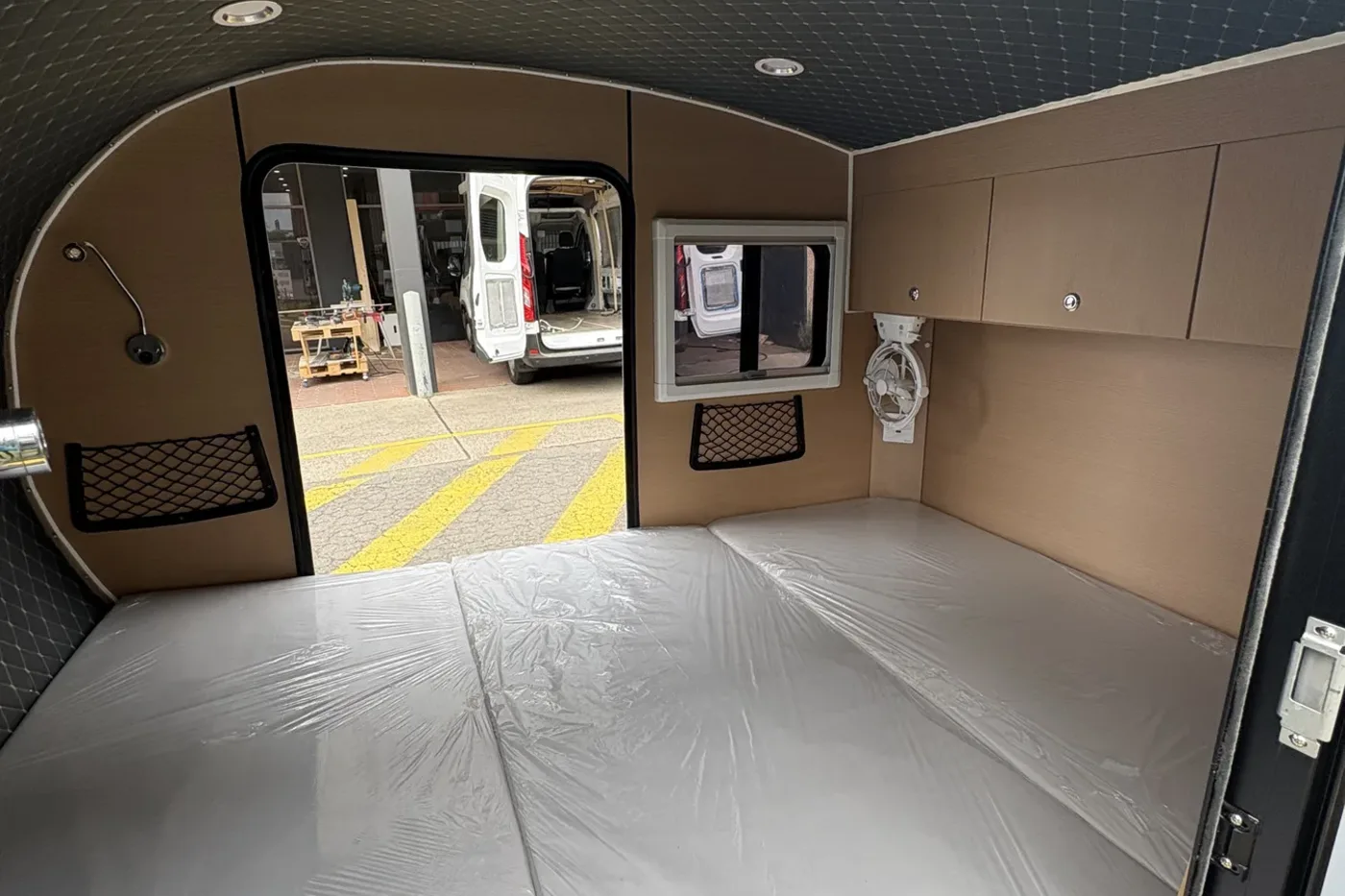
Inside, the standard layout is simple: a fixed queen or double bed running width-ways, storage underneath, and a rear hatch that drops open to reveal a galley kitchen. Modern Australian builds go much further, adding lithium battery banks, rooftop solar, external showers, and — in the case of the Breath Max — a full interior bathroom with shower and toilet.
Tear drop campers occupy a genuine sweet spot:
- Lighter and cheaper to tow than a traditional caravan
- Far more comfortable than a rooftop tent or swag
- Faster to set up than a canvas camper trailer (typically under five minutes)
- Legal to register in every Australian state on a standard car licence
Teardrop Camper Prices in Australia (2026)
The Australian market has stratified into three clear tiers. Here’s an honest overview based on real 2026 pricing:
| Tier | Price Range (AUD) | What You Get | Example Models |
|---|---|---|---|
| Entry / kit-level | $8,000–$16,000 | Basic shell, no off-grid kit, minimal insulation | Kits, secondhand teardrops |
| Mid-range production | $17,000–$35,000 | Solar, lithium battery, fridge, kitchen | Breath Essential ($23,320), Breath Plus ($29,766), Breath Ultra ($34,749), JAG Glider ($35,000) |
| Premium | $35,000–$60,000+ | Full off-road capability, interior bathroom, smart electrics | Breath Max ($47,190), JAG TD ($47,000), Kimberley Kube |
2026 note: JAG increased prices by 5% (~$2,500) in February 2026 due to materials costs. The Breath Trailer range has held its pricing through mid-2026.
For a detailed cost breakdown by feature and lifestyle, see How Much Does a Teardrop Camper Cost in Australia?
What to Look For When Buying a Tear Drop Camper
Weight: Tare vs ATM
Weight is the single most important number on the spec sheet. The tare weight is the unladen trailer; the ATM (Aggregate Trailer Mass) is its maximum legal loaded weight. A generous gap between the two means you can carry water, food, tools, and gear without exceeding your tow vehicle’s rated capacity.
Most Australian teardrops sit between 500 kg and 1,200 kg tare. For context:
| Model | Tare (kg) | ATM (kg) | Minimum Tow Vehicle |
|---|---|---|---|
| Breath Essential | 700 | 1,000 | Any SUV rated 1,000 kg tow |
| Breath Plus | 800 | 1,100 | Mid-size SUV (RAV4, CX-5) |
| Breath Ultra | 900 | 1,200 | Mid-to-large SUV |
| Breath Max | 1,200 | 1,500 | Large SUV (Prado, Everest, Patrol) |
| JAG Glider | 500 | 750 | Small SUV, large sedan |
Off-Grid Capability
If you’re planning anything beyond a caravan park, you need genuine off-grid capability. The practical minimum:
- 100W solar on the roof — tops up the battery while driving or parked in sun
- 100Ah lithium battery — lighter and more efficient than AGM, longer cycle life
- 60L+ water tank — enough for 3–4 days between refills for two people
- 12V compressor fridge — a thermoelectric cooler is not a fridge; don’t confuse them
Construction Quality
Australian roads are not kind. Corrugations, creek crossings, and red dust will expose every weakness in a cheap build. Check:
- Chassis: hot-dipped galvanised steel or quality aluminium alloy
- Couplings: the ball coupling rated above your ATM
- Joints and seams: silicone sealing only goes so far — look for recessed joins and rubberised window gaskets
- Jockey wheel and stabilisers: used every single trip; they should feel solid
Warranty
A manufacturer’s warranty is separate from the automatic guarantees under Australian Consumer Law. Those rights can continue beyond a written warranty, depending on what is reasonable for the product; there is no universal 12-month expiry. Compare the structural cover, component cover and claim process in writing. Breath Trailer provides a 2-year structural warranty. See the ACCC guidance on warranties.
Towing a Teardrop Camper: What Your SUV Can Handle
Australia’s towing regulations are governed by VSB1 (Vehicle Standards Bulletin 1). The core rule: your trailer’s ATM must not exceed your tow vehicle’s rated towing capacity, and the towball download must stay within limits (typically 10% of ATM, max 350 kg for most vehicles).
| Tow Vehicle | Towing Capacity | Compatible Breath Models |
|---|---|---|
| Subaru Outback | 1,800 kg | Essential, Plus, Ultra |
| Toyota RAV4 (petrol) | 1,650 kg | Essential, Plus, Ultra |
| Mazda CX-5 | 2,000 kg | Essential, Plus, Ultra, Max |
| Hyundai Tucson | 1,650 kg | Essential, Plus |
| Toyota Prado 150 | 3,000 kg | All models including Max |
| Ford Everest | 3,500 kg | All models including Max |
| Isuzu MU-X | 3,500 kg | All models including Max |
Always check your specific vehicle’s towing capacity in the owner’s manual — the rating varies by engine variant, transmission, and model year. Forum figures are unreliable.
For brake systems: trailers with a GTM (Gross Trailer Mass) above 750 kg require brakes in all Australian states. Trailers under 750 kg GTM may run unbraked if the tow vehicle is rated for it.
State-by-State: Camping Laws and Best Seasons
This is the section most teardrop buyer’s guides skip. The rules differ dramatically by state, and getting them wrong can mean a $1,000 fine or arriving at a beautiful free campsite you can’t legally use.
New South Wales
Best season: Autumn (Mar–May) and Spring (Sep–Nov). Summers in western NSW regularly top 45°C; winters in the highlands drop below zero and can bring snow to elevated areas.
Camping rules: No single statewide self-containment mandate, but NPWS (National Parks and Wildlife Service) requires advance booking via the NPWS website for most campgrounds. Free camping is permitted in state forests; check with Forestry Corporation for current fire restrictions. Maximum stay: typically 14 nights.
Best teardrop routes: Snowy Mountains region (sealed and light gravel, all-ATM suitable), Warrumbungle National Park (well-graded gravel), Hunter Valley (sealed, ideal for first-timers).
Queensland
Best season: Dry season (May–October). The wet season (Nov–Apr) renders many outback roads impassable and brings oppressive heat and humidity to the coast.
Camping rules: Queensland uses a permit system through the Queensland National Parks booking portal. Many free camping spots exist along rural roads and in state forests. Self-containment is recommended but not universally mandated across the state.
Best teardrop routes: Carnarvon Gorge (inland, mostly sealed up to the gorge entrance), Sunshine Coast hinterland (sealed, family-friendly), Granite Belt wine region (sealed, elevated — cooler in summer).
Victoria
Best season: Spring (Sep–Nov) and Autumn (Mar–May). The Alpine region is accessible summer–autumn; the coast is year-round.
Camping rules: Among the most camper-friendly in Australia. State forests allow free camping within 20 metres of a track and at least 20 metres from any waterway — no booking, no fees, up to 28 consecutive nights. Parks Victoria manages national parks with a booking and fee system.
Best teardrop routes: Great Ocean Road (sealed, iconic), High Country in autumn (partly sealed, spectacular colour), Grampians region (well-graded access roads).
South Australia
Best season: Autumn through Spring (Mar–Nov). Summers in the outback regularly exceed 45°C and are genuinely dangerous — fuel and water gaps can be 200+ km.
Camping rules: Free camping outside designated sites is often prohibited; check council websites before stopping. DEWNR (Parks SA) manages national parks with a permit and fee system. An annual parks pass (~$140/year) is excellent value for frequent visitors.
Best teardrop routes: Flinders Ranges (main sealed access; gravel in the ranges, most ATM configurations fine), Fleurieu Peninsula (sealed, wine country), Coorong (sealed highway, peaceful lakeside camps).
Western Australia
Best season: Dry season (Apr–Oct) for the north (Kimberley, Pilbara); year-round for the south (Margaret River, Esperance).
Camping rules: WA has some of the most restrictive laws nationally. Camping is only legal in licensed caravan parks, designated reserves, or with written local government approval on private land under the Caravan Parks and Camping Grounds Regulations 1997. Fines for illegal camping can reach $1,000. Use Camps WA or WikiCamps to verify sites before arrival.
Best teardrop routes: Margaret River (sealed, accessible to all teardrops), Esperance coast (mostly sealed), Gibb River Road (660 km May–Sep — requires higher-clearance teardrops for creek crossings; the Breath Max handles it well with appropriate tow vehicle).
Northern Territory
Best season: Dry season only (May–Oct). The wet season brings extreme heat, flooding, and road closures that make outback travel dangerous.
Camping rules: Relaxed compared to southern states. Many roadside and station camps allow free camping. National parks (Kakadu, Uluru) require permits and fees. Some Aboriginal land requires a permit from the relevant Land Council.
Best teardrop routes: Stuart Highway (sealed Darwin–Adelaide, straightforward towing), Red Centre Way (Alice Springs → Kings Canyon → Uluru, partly sealed with some corrugated gravel).
Tasmania
Best season: Late spring through early autumn (Oct–Apr). Winters are cold, wet, and some highland roads close entirely.
Camping rules: A vehicle entry pass is required for all national parks ($35.40/day or annual pass at ~$96). From February 2026, Central Coast Council introduced a $15/night permit system for some popular free camps, self-contained vehicles only, maximum 3-night stay.
Best teardrop routes: East Coast Highway (sealed loop, 500 km, stunning beaches), Huon Valley (sealed, incredible scenery and produce), Freycinet Peninsula (sealed to Coles Bay, world-class).
Self-Contained Certification: Your Key to Free Camping
Self-containment unlocks hundreds of free or low-cost camping spots that exclude other vehicles. In Australia, a genuinely self-contained trailer must provide:
- A toilet (cassette, composting, or portable — permanently fitted to the trailer)
- Grey water containment (waste water cannot drain directly to ground)
- Potable onboard water (stored in a tank, not just a jerrycan)
- Cooking facilities
The Breath Max is the only teardrop camper under $50,000 on the Australian market with a full interior bathroom (shower and toilet), making it the only teardrop in its price class that qualifies for self-contained status straight from the factory. At 1,200 kg tare and 2.1 m of standing headroom, it’s also the most liveable — critical for the Big Lap retiree crowd who need to stay anywhere, any night.
The Breath Ultra includes an external shower, which is an excellent convenience feature but does not satisfy toilet self-containment requirements on most managed land.
For a deep dive on bathroom configurations and self-contained certification, see Teardrop Camper with Shower and Toilet Australia.
Best Tracks and Routes for Teardrop Campers in Australia
Not all outback tracks suit every teardrop. Here’s a practical breakdown of iconic routes by suitability:
| Track | State | Distance | Season | Standard Teardrop (≤900 kg) | Heavy/Off-Road (1,200 kg+) |
|---|---|---|---|---|---|
| Snowy Mountains Loop | NSW | ~400 km | Sep–Apr | ✅ | ✅ |
| Flinders Ranges | SA | ~600 km | Apr–Oct | ✅ (main roads) | ✅ |
| Grampians Loop | VIC | ~350 km | Year-round | ✅ | ✅ |
| Red Centre Way | NT | 1,100 km | May–Sep | ⚠️ (corrugations) | ✅ |
| Gibb River Road | WA | 660 km | May–Sep | ❌ (creek crossings) | ✅ |
| Birdsville Track | SA–QLD | 534 km | Apr–Oct | ⚠️ (loose gravel) | ✅ |
| Tasmania East Coast | TAS | ~500 km loop | Oct–Apr | ✅ | ✅ |
| Carnarvon Gorge | QLD | 220 km | Mar–Nov | ✅ | ✅ |
✅ Well suited · ⚠️ Manageable with care · ❌ Not recommended without specialist off-road build
For more inspiration, our Top 10 Scenic Teardrop Trailer Camping Destinations in Australia covers the best campsite-level detail for each region.
Top Australian Tear Drop Camper Brands Compared (2026)
Here’s an honest overview of the major brands active in the Australian market in 2026:
| Brand | Based | Price From (AUD) | Key Strength | Limitation |
|---|---|---|---|---|
| Breath Trailer | Sydney, NSW | $23,320 | 4-model range, 100+ custom colours, 5-min setup, only sub-$50k interior bathroom, Gold Sydney Design Award 2025 | 3–4 month lead time |
| JAG Camper | Brisbane, QLD | $35,000 (Glider) | Ultra-lightweight (500 kg), precision Australian build | Premium price for smaller unit |
| Kimberley Kampers | National | POA | Alloy/thermoplastic body, extreme off-road capability, fully self-contained | Very high price point |
| Goldfields | WA | POA | 2026 Escape Pod redesign, indestructible off-road build | WA-focused sales and service |
| AdventureMan | National | From ~$18,000 | Affordable entry, good for campground users | Less off-road focused |
| Wild Monkey | Sunshine Coast, QLD | $20,000–$28,000 | Handmade fibreglass, Australian-made | Small production runs, long waits |
For a deeper comparison of brands and builds, read our Top 5 Lightweight Teardrop Camper Brands in Australia.
Frequently Asked Questions
Do I need a special licence to tow a teardrop camper in Australia?
No. A standard Australian car licence (Class C) is sufficient to tow any trailer with an ATM below 4,500 kg — which covers every teardrop on the market. You simply need to ensure your tow vehicle’s GCM (Gross Combination Mass) is not exceeded.
What’s the cheapest teardrop camper in Australia in 2026?
New production models start at around $17,000–$18,000 for basic setups without proper off-grid capability. The Breath Essential starts at $23,320 and includes everything you need for campground camping. For genuine off-grid trips with solar and a fridge, expect to spend $25,000+.
Can I tow a teardrop camper with a Subaru Forester or Toyota RAV4?
Yes — this is one of the teardrop’s biggest advantages over traditional caravans. A Subaru Forester has a towing capacity of 1,500 kg; a Toyota RAV4 (petrol) rates at 1,650 kg. Both can comfortably tow the Breath Essential, Plus, or Ultra. The Breath Max (1,500 kg ATM) suits a mid-large SUV.
How do I know if a free campsite allows my teardrop?
Apps like WikiCamps and Camps Australia Wide list free camp requirements, including self-containment rules, generator restrictions, and maximum stay limits. Always cross-check with the land manager’s website — rules changed significantly across multiple states in 2025–2026 and apps can lag behind.
How long does a teardrop camper take to set up?
A modern hard-shell teardrop takes under five minutes. There are no canvas walls to erect, no poles, no guy ropes. Level the trailer, drop the stabiliser legs, open the rear galley hatch, and you’re done. This is one of the biggest practical selling points for couples who stop frequently or arrive after dark.
Is a teardrop camper suitable for the Australian outback?
It depends on the model and the track. Lighter teardrops on standard suspension suit sealed or well-graded gravel roads — which cover the vast majority of iconic Australian destinations including the Flinders Ranges, Snowy Mountains, and Carnarvon Gorge. Heavier, off-road-specced teardrops handle rougher tracks like the Red Centre Way. The Gibb River Road and Canning Stock Route require purpose-built off-road builds with high ground clearance.
Ready to Choose Your Tear Drop Camper?
Tear drop campers are one of the smartest investments an Australian traveller can make in 2026: lighter on fuel than a caravan, faster to set up than canvas, towable by a standard SUV, and genuinely comfortable after a long day on the road.
The key is matching the model to your state, your vehicle, and your camping style:
- Big Lap, free camping everywhere: Breath Max — the only sub-$50k teardrop with a full interior bathroom
- Weekend trips in NSW or VIC: Breath Plus or Breath Ultra — serious off-grid capability without the full bathroom premium
- First-timer, campground-focused: Breath Essential — everything you need, nothing you don’t
Compare all four Breath Trailer models →