Teardrop Camper for Couples Australia: The 2026 Buying Guide
Bed access, getting past each other, and the layouts that work when two people live in a small space.
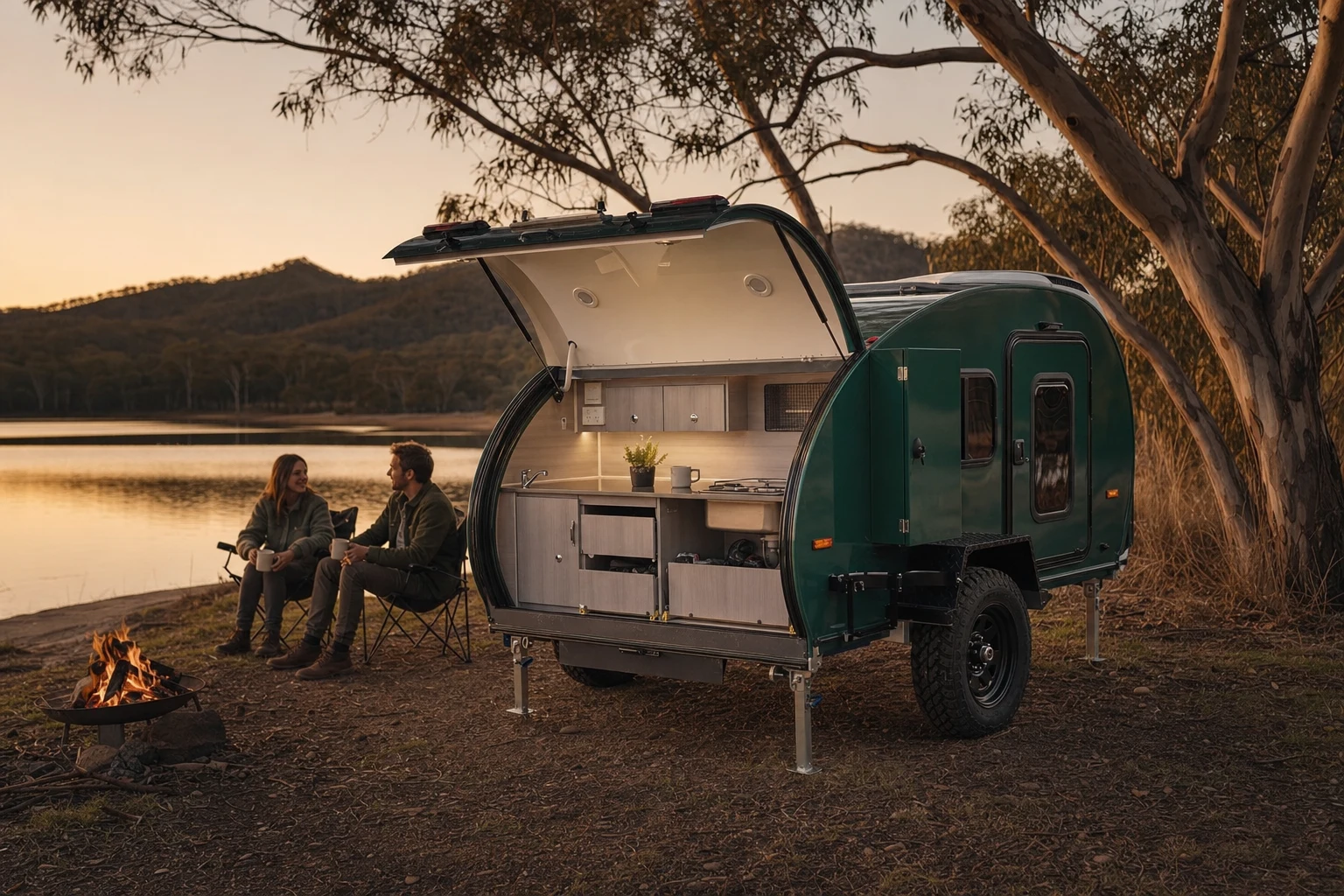
When Tom and Sarah bought their first teardrop camper, they weren’t trying to do the Big Lap or camp off-road. They just wanted a better Friday night. No more wrestling a two-man tent in the dark on a Snowy Mountains drive, no more sleeping on a deflating camp mat, and no more arguing about who forgot to bring the tarp. They wanted to pull up somewhere beautiful, open a door, and already be home.
That story plays out across Australia every weekend. The teardrop camper for couples market has grown faster than any other segment of the Australian camper trailer industry in 2025–26 — and it’s easy to see why. A modern hard-shell teardrop offers a genuine queen bed, a functional galley kitchen, and off-grid capability in a package most SUVs can tow effortlessly. You don’t need a tow truck. You don’t need a tow expert. You don’t even need a very big garage.
This guide cuts through the marketing and tells you exactly what to look for, what to avoid, and which models — including honest mention of competitors — are actually worth your money in 2026.
Why couples are choosing teardrops over traditional caravans
The numbers tell the story. A typical full-size caravan weighs 2,200–2,800 kg ATM, costs $55,000–$100,000 new, and requires a heavy-duty diesel ute or large 4WD to tow safely. A teardrop built for couples weighs 700–1,200 kg, costs $23,320–$42,900, and can be towed by the Subaru Outback or Toyota RAV4 already sitting in the driveway.
For couples — especially DINKs (dual income, no kids) looking for weekend escapes rather than multi-month expeditions — that maths is compelling.
| Traditional caravan | Couples’ teardrop | |
|---|---|---|
| Price range | $55,000–$100,000+ | $23,320–$42,900 |
| ATM / tow weight | 2,200–2,800 kg | 700–1,200 kg |
| Tow vehicle needed | Diesel ute / large 4WD | Mid-size SUV |
| Storage footprint | 6–9 m long | 3.5–5 m long (fits in garage) |
| Setup time | 30–90 minutes | 5 minutes (hard shell) |
| Registration cost | Higher (by weight in most states) | Lower |
| Fuel penalty towing | +4–6 L/100 km | +1–2 L/100 km |
That fuel saving alone is significant. At current Australian fuel prices (~$2.10/L), every 1,000 km towed in a teardrop instead of a full caravan saves couples roughly $80–$130 in petrol. Over five weekend trips a year, that’s $400–$650 back in the pocket before you’ve even touched campground fees.
And caravan parks are not getting cheaper. Powered sites in 2026 run $40–$80 per night at most coastal and popular inland parks. A self-contained teardrop — particularly one with an internal bathroom — unlocks free camping and low-cost bush camps, dropping that overnight cost to zero on many nights. More on that below.
The 5 non-negotiables for a couples’ teardrop
Before you look at specific models, agree on these five questions. They’ll cut the shortlist dramatically.
1. Bed size — queen or double?
This is the most common source of post-purchase regret in the teardrop category. A “double bed” in a teardrop is typically 137 × 188 cm. A queen is 153 × 203 cm. The difference feels small on paper and enormous at 3 am after a long drive.
If either of you is over 180 cm, or if one of you tends to sprawl, hold out for a queen. Most premium Australian teardrops now offer a fixed queen as standard — if a model lists a “double that converts,” that’s a soft-floor camper-trailer convention that adds setup time and complexity.
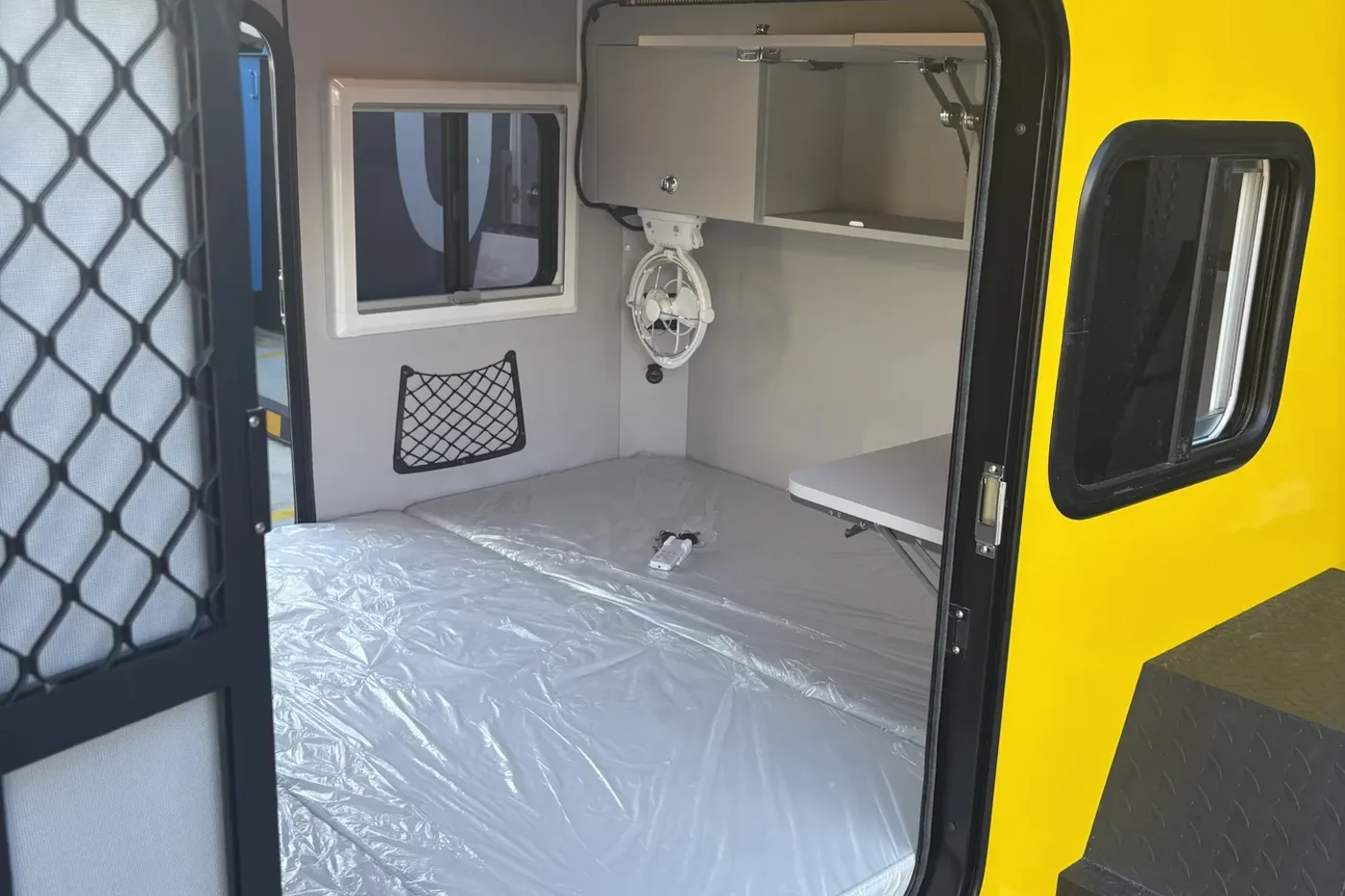
Look in through the door and measure: bed width and length matter more than the word on the brochure.
2. Hard shell vs canvas sides
Hard-shell teardrops close in under 60 seconds. Canvas-sided camper trailers need awnings, pegs, storm stays, and 20–45 minutes of setup — in whatever weather you’ve arrived in. For couples who want to arrive after dark, set up in a thunderstorm, or just not spend Saturday morning cursing at guy ropes, hard shell is the only answer.
Hard shells also insulate better in cold weather, resist mould compared to canvas, and don’t need to be “dry before you pack” after rain.
3. Kitchen position — rear hatch, side, or internal?
The classic teardrop design uses a rear “hatch galley” — the entire back door lifts up to reveal a bench, sink, and storage. This works beautifully in fine weather and terrible in rain, because you’re standing outside to cook. Side-access kitchens improve on this. Internal kitchens (found in larger models) are the premium option — especially if you camp in shoulder seasons when mornings are cold.
4. Bathroom — do you need one?
This is the single biggest decision in the couples’ teardrop category. Models without a bathroom are roughly $10,000–$15,000 cheaper and 200–400 kg lighter. But they limit you to campgrounds with facilities — which means caravan park fees every night.
Couples who camp at national parks with toilets and showers, or who don’t mind a morning walk, do fine without. Couples who want to free-camp at a riverside reserve on a Thursday night, or who find bathroom facilities a genuine barrier to camping more often, should look at a model with an internal ensuite.
The Breath Trailer Max is currently the only teardrop camper under $50,000 in Australia with a full interior bathroom — composting or cassette toilet, handbasin, and a shower — at 1,200 kg tare (1,700 kg ATM) and $42,900. For comparison, the next step up from other manufacturers typically means a full pod caravan at $55,000+.
5. Towing capacity vs your actual car
Don’t fall in love with a camper and then discover it exceeds your car’s tow rating. In Australia, you can tow up to 750 kg without trailer brakes. Above 750 kg ATM, the trailer needs electric brakes and your car must have a brake controller fitted. Most couples towing with a Subaru Forester (1,500 kg braked tow capacity), Toyota RAV4 (1,500–2,000 kg), Subaru Outback (2,000 kg+), or similar mid-size SUV are fine with any teardrop under 1,200 kg — but always confirm your specific model year and variant against the manufacturer’s towing guide.
Rule of thumb for 2026: Your camper’s ATM should not exceed 85% of your car’s tow rating. This leaves a margin for a full water tank (40–100 kg), food, gear, and passengers.
Comparison table: Best teardrop campers for couples in Australia 2026
This table covers the models most frequently shortlisted by Australian couples in 2026, with honest pricing and trade-offs.
| Model | Price (AUD) | Weight (ATM) | Bed | Bathroom | Kitchen | Best for |
|---|---|---|---|---|---|---|
| Breath Essential | $23,320 | 700 kg | Queen | None | Rear hatch | First-time buyers, weekend warriors |
| Breath Plus | $29,766 | 800 kg | Queen | None | Rear hatch + fridge | Couples who camp 15–30 nights/yr |
| Breath Ultra | $34,749 | 900 kg | Queen | External shower | Rear hatch + fridge | Shoulder season, off-road lite |
| Breath Max | $42,900 | 1,200 kg | Queen | Full ensuite | Internal + fridge | Free-campers, Big Lap couples |
| JAG Teardrop | ~$28,000–$35,000 | ~850 kg | Queen | None | Rear hatch + slide-out | Queensland buyers, roadie vibe |
| Gumnut Adventure | ~$24,000–$28,000 | ~900 kg | Queen | None | Rear tailgate | NSW/QLD, budget-conscious |
| Cruizy Vagabond Joey | ~$22,000–$26,000 | ~580 kg | Queen | None | Rear hatch | Ultra-light towing |
Prices as of June 2026. Always confirm with the manufacturer for current pricing and lead times.
One note on competitors: JAG, Gumnut, and Cruizy all make solid teardrops that Australian couples genuinely love. They’re worth a look-in, particularly if you’re in Queensland where JAG has a dealer presence, or if you want the absolute lightest possible tow weight (Cruizy’s Joey at 580 kg). The Breath Trailer range differentiates on the bathroom option (unique at the price point), the 100+ colour palette, and the Sydney-based manufacturing and service network.
The Breath Trailer range for couples — which model?
Essential ($23,320) — the obvious entry point
At 700 kg, the Essential tows behind anything. A Mazda CX-5, Honda CR-V, Toyota RAV4 — it doesn’t matter. Fixed queen bed, rear hatch galley, and a build quality that punches well above its price. The catch: no fridge, no bathroom, and no external shower. For couples who camp at well-serviced national parks or caravan parks and want to spend their budget on the camper rather than the options, it’s a strong starting point.
Plus ($29,766) — the sweet spot for most couples
The Plus adds a compressor fridge, which is the single most impactful upgrade for couples. A cold beer without a fresh ice block every day, fresh food for a week, pre-prepared meals — the fridge changes how you camp. At 800 kg ATM, it’s still within easy reach of most mid-size SUVs. This is the model most couples end up with after test driving the full range.
Ultra ($34,749) — shoulder season and beyond
The Ultra steps up to 900 kg and adds an external hot shower. If you camp in the Victorian high country in April, in Tasmania in November, or anywhere cold and exposed, that external shower shifts from “luxury” to “practical hygiene.” The Ultra also comes with more solar capacity as standard — meaningful for three-night stints between towns.
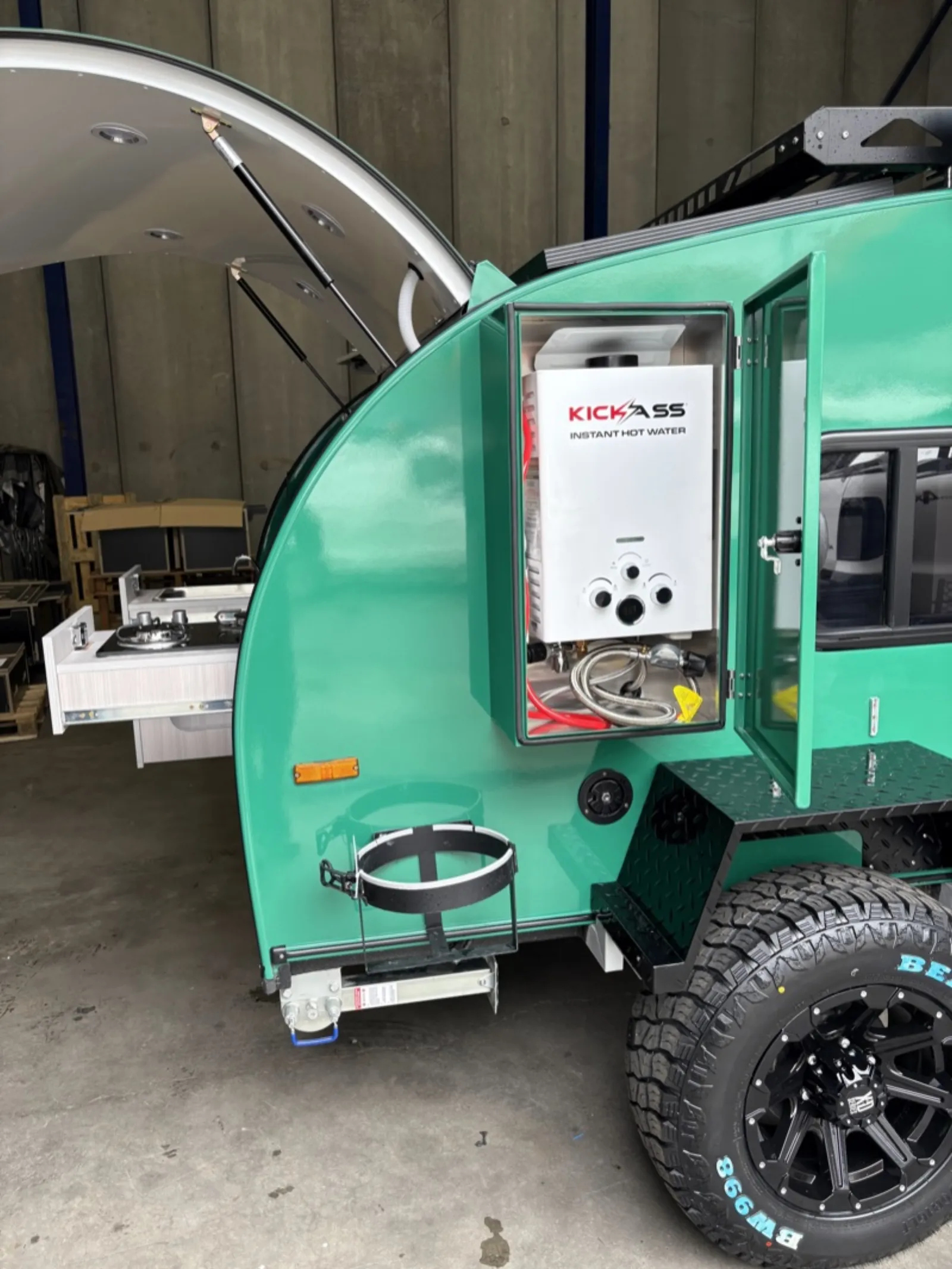
The Ultra’s instant gas hot water unit sits in its own side compartment.
Max ($42,900) — for couples who want everything
The Max is the one that changes the conversation entirely. It’s 1,200 kg tare (1,700 kg ATM) and needs a car rated to tow at least 1,700 kg with a brake controller, but it delivers 2.1 m of standing headroom, a full internal ensuite (toilet and shower), an island queen bed with storage underneath, a proper internal kitchen, and the CMCA self-containment spec that opens up free-camping Australia-wide.
For couples who want to spend 60+ nights a year in their camper — or who find the absence of a private bathroom the main blocker to camping more — the Max’s $42,900 price looks different when you consider that a comparably spec’d pod caravan starts at $55,000 and needs a diesel ute to tow it.
Read the full Breath Max specs and features or compare all four models side by side on the comparison page.
Towing capacity reality check — your actual car
Most couples researching teardrops own or are planning to buy a mid-size SUV. Here’s how the common choices stack up against Breath Trailer’s range:
| Tow vehicle | Braked tow capacity | Models it tows comfortably |
|---|---|---|
| Subaru Forester (2020+) | 1,500 kg | Essential, Plus, Ultra |
| Toyota RAV4 (2019+) | 1,500–2,000 kg (variant dependent) | Essential, Plus, Ultra, Max (check variant) |
| Subaru Outback (2020+) | 2,000 kg | All models including Max |
| Toyota Prado (2024+) | 3,500 kg | All models |
| Mazda CX-5 (2021+) | 2,000 kg | All models |
| Honda CR-V (2023+) | 1,500 kg | Essential, Plus, Ultra |
| Kia Sportage (2022+) | 1,500–1,600 kg | Essential, Plus, Ultra |
If you’re buying a tow vehicle alongside the camper, the Subaru Outback is frequently cited as the best value pairing for teardrop campers in Australia — genuine 2,000 kg tow rating, AWD, comfortable long-distance highway ride, and fits neatly into the DINK budget without a ute premium.
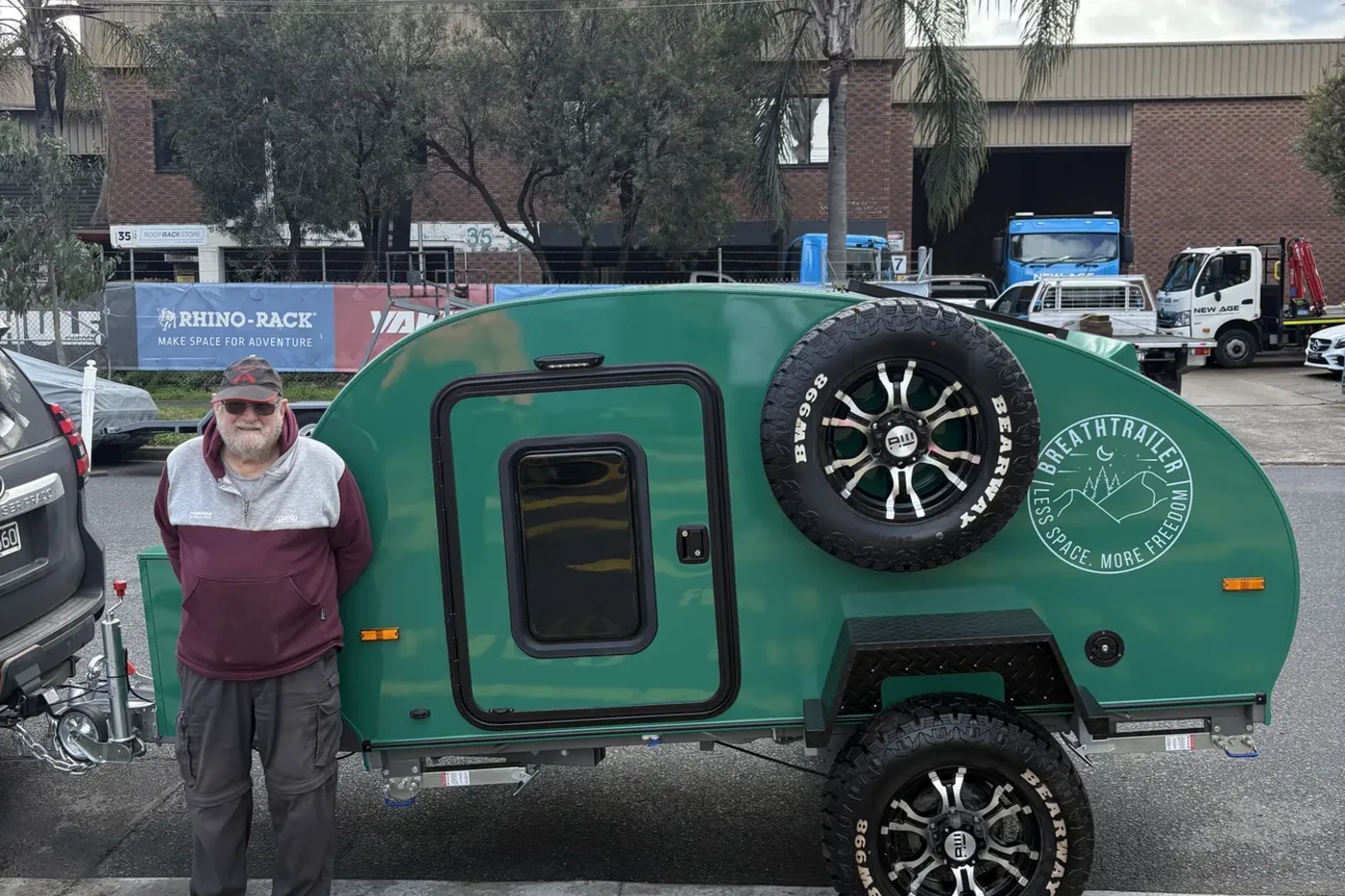
Behind a mid-size SUV, weigh the loaded teardrop rather than trusting the brochure tare.
One important detail: the tow vehicle’s capacity must also account for the combined weight of your trailer plus the payload (water, food, gear, passengers in the car). For a weekend trip with a full tank of water and a packed fridge, add 100–150 kg to the camper’s listed tare weight when planning your margins.
For a full breakdown of how to match tow ratings safely, see our Camper Trailer Towing Guide for Australia.
Weekend warriors vs extended travellers — different priorities
Couples who camp on long weekends 10–15 times a year need different things from couples planning 3–6 months on the road.
Weekend warriors (10–20 nights/year)
- Budget: $23,320–$29,766 (Essential or Plus)
- Bathroom: Not essential — caravan park facilities work fine
- Off-grid capability: Basic solar, 100Ah battery sufficient
- Tow vehicle: Keep the family SUV
- Setup time matters: 5-minute hard shell is a major quality-of-life win vs canvas alternatives
Shoulder-season regulars (25–40 nights/year)
- Budget: $29,766–$34,749 (Plus or Ultra)
- External shower: Meaningful for cold mornings and dusty tracks
- Fridge: Non-negotiable at this frequency
- Off-grid: 200W solar + 100Ah lithium covers 2–3 nights between powered sites
- Consider adding: a rooftop solar panel upgrade, grey water tank
Extended trip / Big Lap couples (60+ nights/year)
- Budget: $42,900 (Max) — the bathroom pays for itself in campground fee savings
- Bathroom: Essential for free-camping access (save $30–$60/night vs caravan park)
- Self-containment: CMCA-compliant grey water + toilet = access to thousands of free sites
- Storage: The Max’s internal layout handles two people’s gear for months, not weekends
- Read: Self Contained Camper Australia for the full free-camping rules by state
What to do before you buy
1. Go to an expo or showroom
The Breath Trailer viewing locations page lists where you can inspect models in person in New South Wales and surrounding states. The Caravan & Camping Show in Sydney (CEIVS) and Brisbane (BCCS) run annually and bring together most major manufacturers — worth attending if you’re still in the comparison phase.
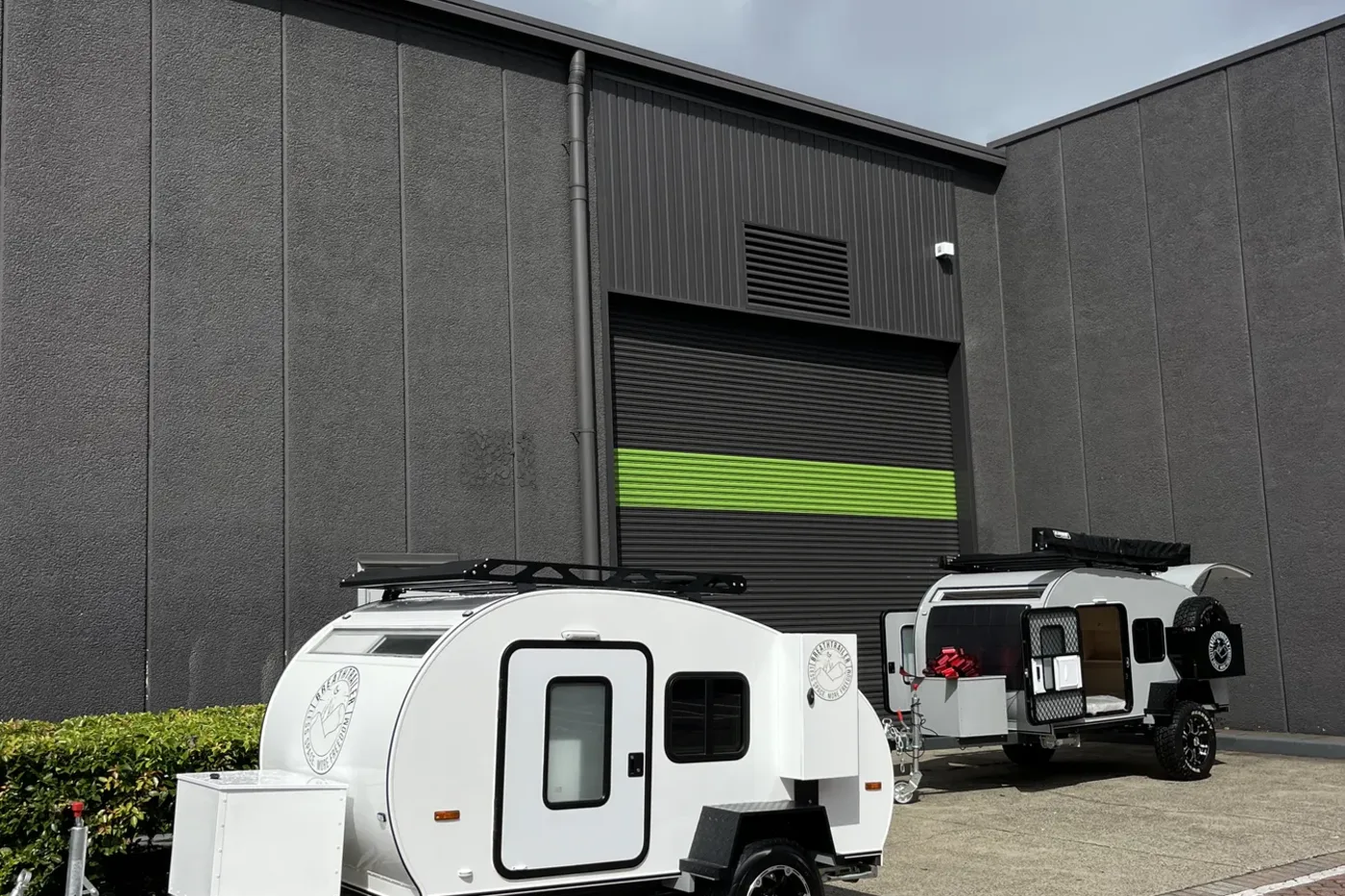
Seeing two models side by side in person beats any brochure comparison.
2. Lie down in the bed
Seriously. Both of you, shoes off, on the mattress, in the sleeping position you actually use. You will immediately know if the bed length is sufficient. Bring a tape measure and note whether the bed is fixed or convertible.
3. Ask about lead time
Premium Australian-made teardrops in 2026 run 3–4 months lead time from deposit to delivery. Budget imports can be shorter, but delivery timelines have been erratic. If you’re planning a spring camping trip, ordering in winter gives you the best shot at being on the road by September.
4. Check the warranty and service network
Where is the manufacturer based, and where do you live? A Sydney-based couple buying from a Brisbane manufacturer isn’t impossible, but servicing and warranty claims get complicated fast. Breath Trailer manufactures in Sydney with service access across NSW, VIC, and ACT.
5. Factor in the “ready to camp” cost
Many entry-level models list a low base price but require $2,000–$5,000 in extras (awning, grey water tank, solar upgrade, battery upgrade, tow bar fitting for your car) to be genuinely usable. Check what comes standard vs what is optional.
FAQ: Teardrop camper for couples, Australia
What is the best teardrop camper for couples in Australia in 2026?
There’s no single best answer — it depends on how often you camp and what your dealbreakers are. For weekends-only couples, the Breath Trailer Plus at $29,766 (queen bed, compressor fridge, hard shell, 800 kg) covers most use cases. For couples who want a private bathroom and free-camping access, the Breath Max at $42,900 is the only teardrop under $50,000 in Australia with a full ensuite.
Do teardrop campers have proper queen beds for two adults?
Most premium Australian teardrops now offer a fixed queen (153 × 203 cm) as standard. Confirm bed size before buying — some models describe a “double” (137 × 188 cm), which is noticeably narrower for two adults.
Can a couple tow a teardrop with a Subaru Outback or Toyota RAV4?
Yes. Both vehicles comfortably tow the full Breath Trailer range. The Subaru Outback (2,000 kg braked) handles all four models including the Max. The RAV4’s tow capacity varies by variant (1,500–2,000 kg), so check your specific year — all variants handle the Essential through Ultra, and 2,000 kg variants handle the Max.
What is the difference between a teardrop camper and a caravan for couples?
A teardrop is significantly lighter (700–1,200 kg vs 2,200–2,800 kg for a caravan), cheaper ($23,320–$42,900 vs $55,000–$100,000+), and can be towed by a standard mid-size SUV without a heavy-duty ute. The trade-off is that teardrops are smaller inside — though premium models like the Breath Max offer 2.1 m standing headroom and a full bathroom. See our complete small caravan comparison guide for more.
Do we need a bathroom in a teardrop camper?
Only if you plan to free-camp regularly at no-facilities sites, camp in areas without amenity blocks, or simply find the absence of a private bathroom a meaningful barrier to camping more. The Breath Max is the only sub-$50,000 Australian teardrop with a full internal bathroom in 2026. Couples who camp at caravan parks or national parks with facilities typically find the bathroom-free models (Essential, Plus, Ultra) completely sufficient.
How long is the waiting list for a Breath Trailer in 2026?
Current lead time is approximately 3–4 months from deposit to delivery. Order in autumn or winter for a spring delivery date. Contact Breath Trailer directly via the booking page to confirm current production slots.
The bottom line
A teardrop camper for couples in Australia in 2026 sits in a sweet spot that simply didn’t exist five years ago. You get the hard-shell durability of a caravan, the tow weight of a small boat trailer, and a price point that doesn’t require selling the house.
The right model comes down to three questions: How often will you camp? Do you need a private bathroom? And what car are you towing with?
Weekend-focused couples who camp 10–20 nights a year and are happy with caravan park facilities will find the Breath Plus at $29,766 hits every mark. Couples building toward an extended Big Lap, or who want the freedom to roll up anywhere in Australia without checking for toilets on the map, should look seriously at the Max.
Either way, if you’re still camping in a tent or missing trips because it all seems like too much effort, a teardrop will change that. Most Breath Trailer owners describe the same shift: camping went from “a big deal we have to prepare for” to “something we do on a Thursday afternoon.”
That’s what the right camper actually buys you.
Recommended reading
- Best Teardrop Campers Australia: 2026 Buyer’s Guide — full market overview including off-road and budget models
- Camper Trailer Towing Guide Australia — tow ratings, brake controllers, and safe margin calculations
- Self Contained Camper Australia — free-camping rules by state and what “self contained” actually means
- Teardrop Camper Hire vs Buy Australia — is renting a better first step?
- Breath Trailer Comparison Page — all four models side by side with full specs and prices