Teardrop Camper Hire vs Buy in Australia (2026): The Real Cost-Per-Trip Maths
Hire costs per trip against ownership over five years, and how many nights a year make buying worth it.
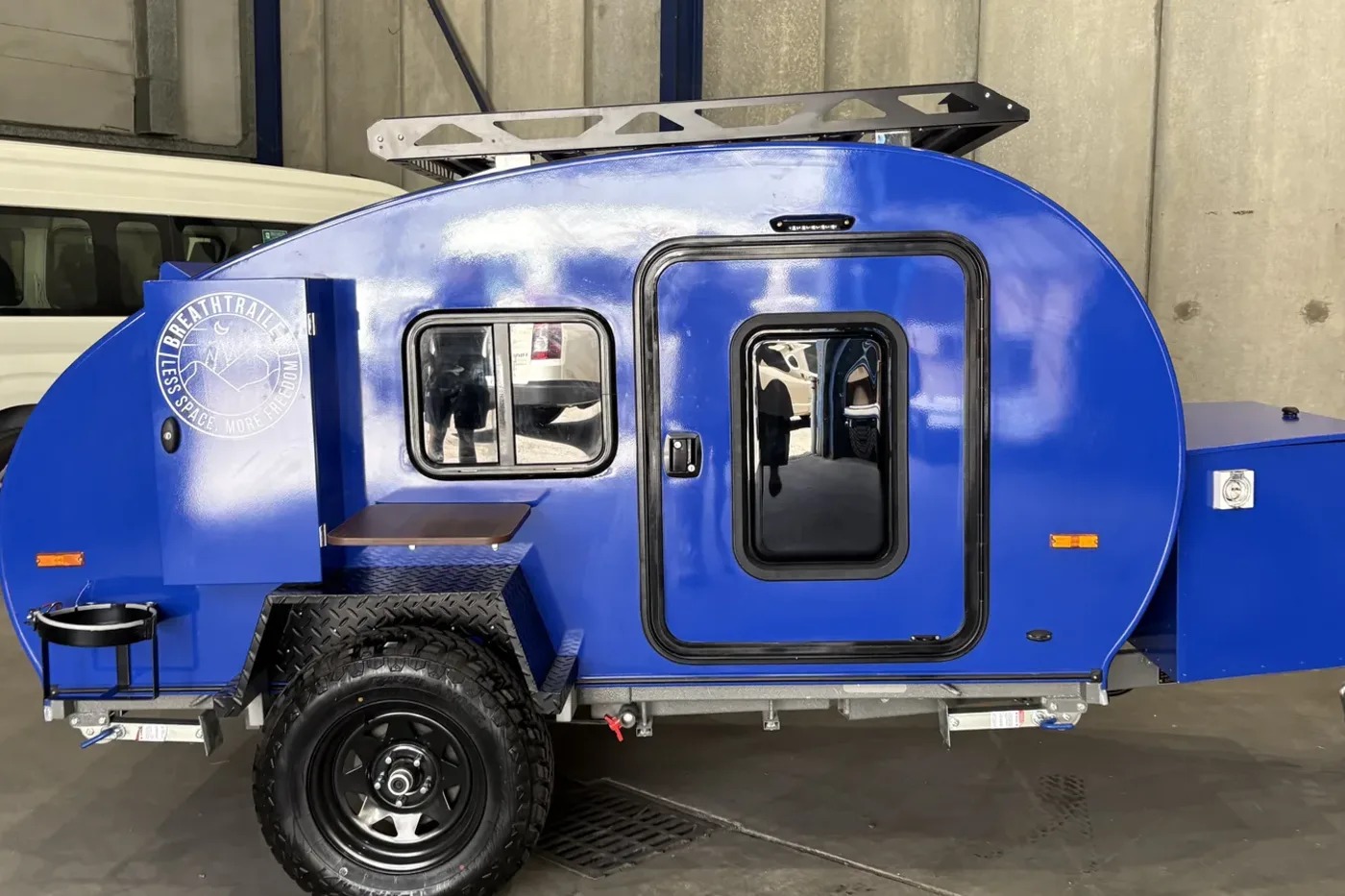
Australia now has 938,000 registered caravans and campervans — a 32% jump since 2019 — and the fastest-growing slice of that market is the lightweight, towable trailer: small enough to fit in a standard garage, light enough for any modern SUV, and ready in five minutes flat. Teardrop campers sit at the heart of this boom.
But before you sign anything, the obvious question looms: is it smarter to hire a teardrop for the weekends you actually use one, or to own one outright?
This guide runs the honest numbers — rental rates, true ownership costs, depreciation, the peer-to-peer income angle — so you can make the call that fits your camping habits, not someone else’s.
How Much Does It Cost to Hire a Teardrop Camper in Australia?
Teardrop camper hire sits in a niche between bare-bones tent rentals and full motorhome experiences. As of 2026, the going rates look like this:
| Hire channel | Typical nightly rate |
|---|---|
| Peer-to-peer platform (Camplify, Camptoo) — budget | $80–$120/night |
| Peer-to-peer — mid-range or newer model | $120–$150/night |
| Commercial hire company | $130–$200/night |
| Weekly deal (7+ nights, mid-range) | $700–$950/week |
These headline rates are the starting point, not the full story. You’ll also typically pay:
- Security bond: $500–$2,000 held on your credit card and released after return
- Platform service fee: 10–15% of the booking total on peer-to-peer sites
- Damage cover top-up: $15–$30/day to reduce the excess from $1,500–$3,000 down to near-zero
- Cleaning fee: $50–$120, charged at most listings
A realistic 5-night teardrop hire in peak season — school holidays, Easter, summer long weekends — lands between $900 and $1,300 all-in once you account for extras. Off-peak you might trim that to $600–$800.
There’s also a supply problem. Quality teardrop models in popular locations around Sydney, Melbourne, and Brisbane get booked out weeks in advance. Hire gives you flexibility in theory, but less in practice during the times you’re most likely to want to go camping.
The True Annual Cost of Owning a Teardrop Camper
Ownership costs more upfront, but the cost per trip drops steadily the more you use it. Here’s what you’re actually paying across a full year:
Purchase price
New teardrop campers from Australian manufacturers range from $23,320 to $47,190+ in 2026, depending on size, specification, and whether the model includes a bathroom. Entry-level hard-shell models from quality local builders start around $20,000; fully self-contained premium models with interior bathrooms push toward $40,000.
Annual running costs
| Cost item | Typical annual amount (AUD) |
|---|---|
| Registration (NSW, QLD, VIC varies — trailer) | $280–$380 |
| Comprehensive camper trailer insurance | $300–$500 |
| Servicing and maintenance | $200–$400 |
| Tyre replacement (prorated over 5 years) | $80–$150 |
| Secure storage (if no garage available) | $0–$1,400 |
| Total annual running costs | $860–$2,830 |
Teardrop campers sit at the lower end of this range compared to other towable formats. They’re mechanically simple — no engine, no complex pop-top mechanism, no gas system that requires annual certification. Many owners handle basic servicing themselves.
Depreciation: the cost most buyers forget
Depreciation is invisible until you sell, which makes it easy to ignore. Towable camper trailers depreciate more slowly than motorhomes — there’s no engine to wear out — but they’re not immune.
Based on the Australian used market:
- Year 1: 12–15% drop from new purchase price (you’ve paid the “new premium”)
- Years 2–5: roughly 6–8% per year
- After year 5: rate slows, particularly for hard-shell Australian-made models
A $25,000 teardrop bought new could reasonably sell for $16,000–$18,000 after five years — a $7,000–$9,000 total loss, or $1,400–$1,800 per year in effective depreciation cost.
Premium Australian-made hard-shell teardrops tend to hold value better than imported fibreglass composites, partly because of local warranty support and the thin supply of quality used stock.
The Break-Even Calculator: How Many Trips Per Year?
Here’s the comparison that matters most. Let’s model a mid-range teardrop — a $25,000 purchase — against hiring at $140/night for 5-night trips.
| Trips per year | Hire total (5 nights × $140 + extras) | Ownership cost/year (depreciation + running) | Winner |
|---|---|---|---|
| 1 trip (5 nights) | ~$1,000 | ~$3,000 | Hire |
| 2 trips (10 nights) | ~$2,000 | ~$3,000 | Hire (slightly) |
| 3 trips (15 nights) | ~$3,000 | ~$3,000 | Roughly even |
| 4 trips (20 nights) | ~$4,000 | ~$3,100 | Own |
| 6 trips (30 nights) | ~$6,000 | ~$3,200 | Own (clearly) |
| Big Lap (60+ nights) | ~$11,000+ | ~$3,500 | Own (massively) |
Ownership assumes $25,000 purchase, $1,600/year depreciation, $1,000/year running costs, no paid storage.
The break-even sits at roughly 3–4 trips per year, or 15–20 nights on the road annually. Camp quarterly and ownership pays for itself in year one or two. Camp twice a year and hiring will always look better on paper.
The wildcard is convenience: hiring means booking ahead, coordinating pickup and dropoff, and potentially driving past your ideal weekend window because the trailer you wanted is gone. That friction has a value that doesn’t appear in a spreadsheet.
When Hiring a Teardrop Makes Sense
Hiring is the right call in a few well-defined situations:
Testing the lifestyle before committing. Spending $23,000–$47,000 to discover you prefer motels is an expensive experiment. One or two hire trips will reveal more about your camping compatibility than any brochure. Try a 5-night trip and see whether you wake up comfortable, or whether you’re fantasising about a hot shower and an actual bed.
Camping once or twice a year, maximum. Below the 3-trip threshold, hire costs less over the long run even accounting for the convenience factor. Your money is better elsewhere.
International visitors doing a road trip. If you’re touring Australia for 4–8 weeks and then flying home, hiring is the only logical option. You’re not going to register and store a trailer in Darwin when you live in Hamburg.
Trialling specific features or destinations. Some hire platforms have off-road-capable models with satellite communicators and solar setups you might not be ready to invest in permanently. Hiring lets you evaluate whether those features matter to your style of camping before committing.
When Buying a Teardrop Camper Wins
Ownership earns its keep when camping becomes a regular part of life:
Regular campers (4+ trips a year). The cost-per-trip figure drops below $200 per night once you’re using the camper consistently. More importantly, ownership enables spontaneity — a Friday afternoon hook-up and you’re at the campsite by sunset Saturday. That kind of flexibility is only possible when the trailer is sitting in your driveway.
Grey nomads and Big Lappers. If you’re planning 60–120+ nights on the road annually, or venturing into the Kimberley, Cape York, or the outback, hiring is simply not viable at scale. Logistics, cost, and availability constraints all compound. A teardrop with a full interior bathroom — like the Breath Max — also opens up self-contained free camping areas that hired trailers without that certification can’t access.
Families with established routines. Kids adapt fast to their own trailer. The sleeping configuration, the toy bag in the storage hatch, the routine of setup and pack-down — these become second nature in a way they never quite do with a hired unit.
Customisers. Own your trailer and you can evolve it over time: lithium battery upgrade, extended awning, cargo platform, suspension upgrade for rougher tracks. Hire units are locked to their stock specification, often for liability reasons.
The Second-Hand Market: A Middle Path
If the break-even maths still concern you, there’s a third option worth considering: buy used.
The Australian used teardrop market is smaller than the caravan market at large, but active — Gumtree, Facebook Marketplace, and specialist sites like caravancampingsales.com.au list units regularly. Typical prices:
| Age and condition | Asking price (hard-shell, 2-person) |
|---|---|
| 2–3 years old, good condition | $13,000–$20,000 |
| 4–6 years old, serviceable | $8,000–$14,000 |
| 7+ years, needs attention | $4,000–$8,000 |
The sweet spot is a 3–5 year old trailer in good condition. The first owner has absorbed the steepest depreciation hit — that 12–15% first-year drop — and you’re buying into a proven unit without inheriting deferred maintenance.
Key checks before purchasing used:
- Floor pan: press firmly across the floor surface. Any soft spots indicate water ingress — a significant structural concern.
- Roof hatch seal: the most common leak point on teardrop campers. Look for staining inside the roofline.
- Wheel bearings: cheap to replace, expensive if a failure strands you on the highway.
- 12V and solar systems: test everything. Batteries degrade; wiring can be a rats’ nest on DIY or older units.
- Registration history and modifications: confirm the trailer is registered in the current owner’s name and any modifications comply with your state’s road rules.
A pre-purchase inspection from a caravan mechanic runs $150–$250 and is always worth it.
Earn While You Don’t Use It: The Rental Income Offset
Here’s an option most first-time buyers overlook entirely: list your teardrop on a peer-to-peer platform like Camplify when you’re not using it and generate income that offsets ownership costs.
A quality teardrop camper listed at $120–$150 per night in a major city, achieving 40–60 rental nights per year, generates:
$130 × 50 nights = $6,500 gross / year
After Camplify’s platform fee (approximately 20–25%) and incremental running costs for rental wear:
Net rental income: approximately $4,500–$5,200 per year
That effectively covers depreciation plus most annual running costs — making ownership close to cost-neutral in an active rental year.
The catch: you need to be comfortable with other people using your camper, and there’s an overhead in coordination, cleaning management, and maintaining availability windows. It works best for owners who camp 30–40 nights per year and park the trailer the other 300+ days.
Teardrop vs Campervan: Which Is Actually Cheaper?
Before settling on a teardrop specifically, some people are still weighing up whether a campervan or motorhome might suit them better. Here’s an honest comparison:
| Teardrop camper | Campervan / Motorhome | |
|---|---|---|
| Entry price (new, quality AU brand) | $20,000–$40,000 | $60,000–$180,000+ |
| Typical hire rate per night | $80–$150 | $150–$400+ |
| Annual insurance | $300–$500 | $800–$2,500 |
| Registration | $280–$380 (trailer levy) | $800–$1,200 (vehicle) |
| Fuel impact | Minimal (tow with your existing SUV) | High (motorhome: 18–28 L/100km) |
| Storage | Standard garage or driveway | Often requires paid facility |
| Break-even (own vs hire) | ~3–4 trips/year | ~5–7 trips/year |
For most Australian families who already own a capable SUV, the teardrop is the lowest total cost of ownership option in the camping vehicle category. You’re adding a purpose-built sleeping and camping module to a car you already run, rather than buying and running an entirely separate vehicle.
If You Decide to Buy: Choosing the Right Model
Once the maths favour ownership, the question shifts to which teardrop. Breath Trailer manufactures four models in Sydney, covering the full range of budgets and use cases:
| Model | Price (AUD) | ATM | Standout feature | Best for |
|---|---|---|---|---|
| Essential | $23,320 | 700 kg | Hard-shell, queen bed, full outdoor kitchen | First-timers, weekenders |
| Plus | $29,766 | 800 kg | Fridge included, enhanced interior fitout | Regular couples and small families |
| Ultra | $34,749 | 900 kg | External shower, solar-ready, 12V system | Off-grid adventurers |
| Max | $47,190 | 1,200 kg | Full interior bathroom, 2.1 m standing headroom, self-contained | Grey nomads, Big Lap, free camping |
The Max is the only teardrop on the Australian market under $50,000 with a full interior bathroom — a critical detail for self-contained camping certification and for travellers like Greg and Margaret planning a 3-month Big Lap who won’t compromise on a private bathroom after dark.
All four models are available in 100+ custom colours, towable by most modern SUVs, and ready in under five minutes. Lead time from order to delivery is currently 3–4 months from the Sydney factory. View the full side-by-side model comparison →
Frequently Asked Questions
Can I hire a teardrop camper for just a weekend in Australia? Yes, though many peer-to-peer listings set a minimum hire of 3–5 nights, particularly in peak season. Some commercial hire companies offer 2-night minimums. Popular teardrop models in Sydney, Melbourne, and Brisbane typically book out 4–8 weeks ahead during school holiday periods, so planning ahead is essential.
What licence do I need to tow a teardrop camper in Australia? A standard car licence (Class C) covers towing trailers up to 4,500 kg GCM (car plus trailer combined) in all Australian states. Most teardrops weigh between 700 and 1,200 kg — comfortably within this limit. No special endorsement or heavy vehicle licence is required.
Do I need a 4WD or ute to tow a teardrop camper? No. Teardrops weigh 700–1,200 kg and are towable by most modern SUVs including the Toyota RAV4, Subaru Outback, Mazda CX-5, and Hyundai Santa Fe — vehicles already in millions of Australian driveways. Always verify your specific vehicle’s towing capacity in the owner’s manual. Off-road focused models are best paired with a tow vehicle rated at 2,000 kg or above.
What insurance covers me when hiring a teardrop camper? Most peer-to-peer platforms include basic third-party cover, but the renter excess on a damage claim can be $1,500–$3,000. Top-up insurance reducing the excess to near-zero costs around $15–$30 extra per day and is generally worth adding, especially for family trips. Commercial hire companies usually include more comprehensive cover by default.
How much can I earn renting out a teardrop camper I own? A well-presented, quality teardrop listed at $120–$150 per night on Camplify, achieving 40–60 rental nights per year, will gross $5,000–$7,500 annually. After platform fees of approximately 20–25%, realistic net income is $4,000–$5,500 per year — enough to cover depreciation and running costs in a busy rental year.
Does a teardrop camper need to be self-contained to camp in national parks? Self-contained certification (under the NZS 5465 or equivalent state standard) is required for some national parks and most free camping areas that advertise themselves as self-contained only. Not all teardrops qualify — self-contained status requires a fresh water tank, wastewater tank, and toilet on board. Breath Trailer’s Max model meets this requirement with its full interior bathroom. Check the requirements for your specific destination before booking.
The Verdict: Hire to Try, Own to Live It
If you’re camping three or more times a year — or planning any kind of extended road trip — buying a teardrop camper repays itself within two to three years, even before you account for the convenience of not booking ahead or returning the trailer by 9 am Monday.
Hire is the smart starting point for first-timers, occasional campers, and anyone still establishing whether the teardrop lifestyle genuinely fits their weekends. Use a couple of hire trips to nail down your must-haves before committing $23,000–$47,000.
When you’re ready to own, explore the Breath Trailer range and pricing or book a viewing at our Sydney showroom to see the models in person, ask questions, and do a test tow — no sales pressure, just honest answers.
Recommended Reading
- The Complete Guide to Teardrop Caravans in Australia
- Best Teardrop Campers in Australia (2026 Rankings)
- Off-Road Teardrop Campers: Can They Handle Australia’s Roughest Tracks?
- Teardrop Camper Cost Australia: What You’ll Actually Pay in 2026
- Small Caravans & Trailers in Australia: 2026 Comparison Guide