Teardrop Caravan Australia: The Complete 2026 Buyer's Guide
What they weigh, what they cost, and which tow vehicle suits. The full picture before you shortlist.
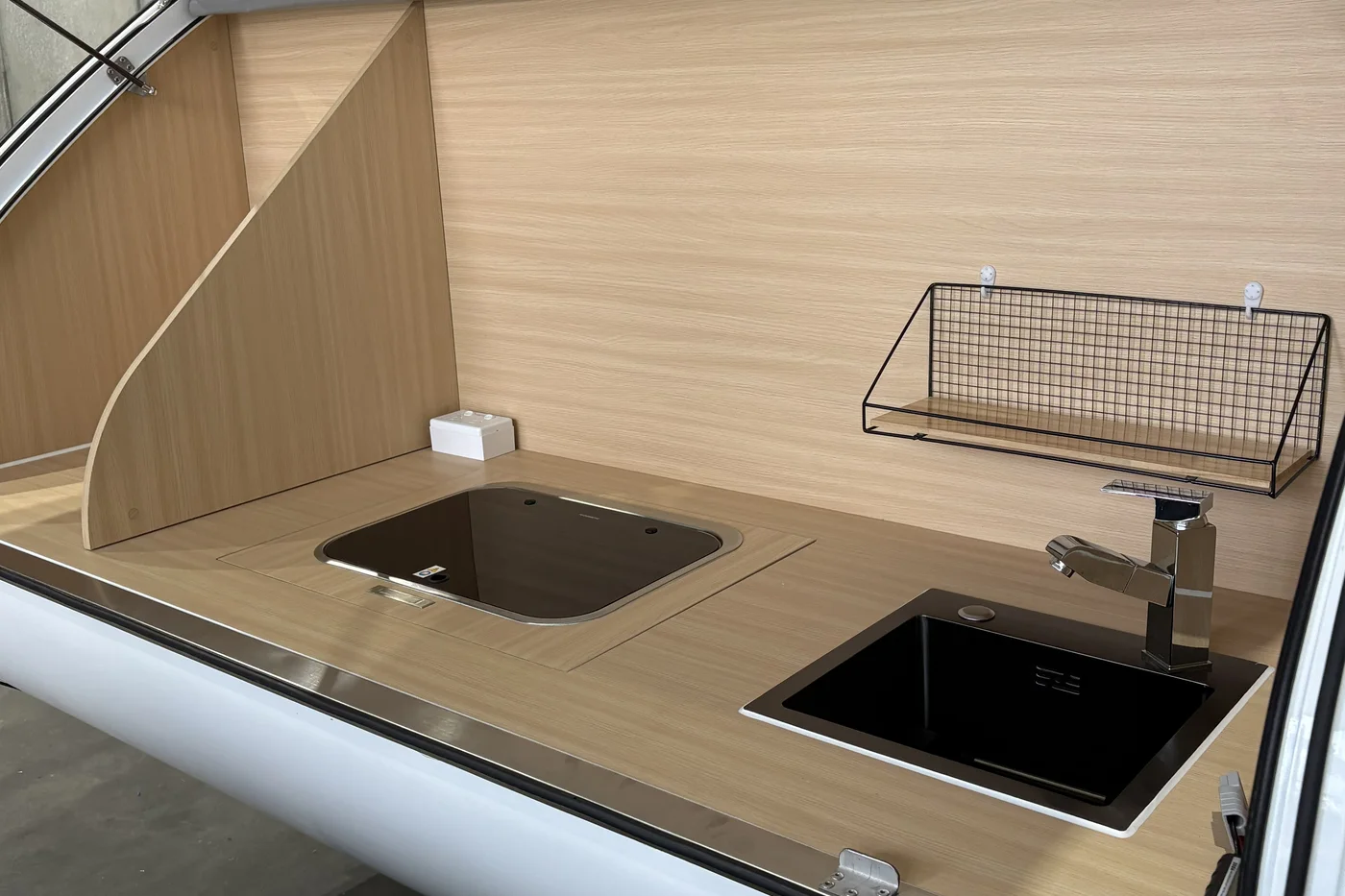
Searches for full-size caravans in Australia have dropped by around a third in recent years, while the teardrop segment keeps growing at nearly 10% a year. The reason is simple: a teardrop caravan gives you a real bed, a real kitchen and genuine off-grid capability in a package that weighs less than a third of a traditional caravan — and can be towed by the SUV already sitting in your driveway.
This guide covers everything you need to know before buying a teardrop caravan in Australia in 2026: what they actually cost, what your car can tow, which features matter (and which are marketing fluff), how the bathroom question changes everything, and how the main Australian brands compare.
What Is a Teardrop Caravan?
A teardrop caravan — also called a teardrop camper or teardrop trailer — is a compact, aerodynamic camping trailer named after its distinctive teardrop profile. The classic layout puts a queen or double bed inside the insulated cabin and a galley kitchen under the rear hatch, with storage built into every spare centimetre.
Unlike a camper trailer or pop-up, there’s no canvas to wrestle with and nothing to fold out. You arrive, unhitch, and you’re set up — typically in about 5 minutes. Unlike a full caravan, a teardrop weighs between roughly 350 kg and 1,200 kg tare, which is what makes it towable by ordinary cars rather than dedicated tow vehicles.
Modern Australian teardrops are a long way from the plywood DIY builds of the 1940s. A well-specced 2026 model ships with solar panels, a lithium battery, a 12V fridge, a water tank and an inverter as standard — a self-sufficient base camp that happens to follow you anywhere.
Why Teardrop Caravans Are Booming in Australia
Three forces are driving the shift from big caravans to teardrops across Australia:
Cost of living. A teardrop costs a fraction of a family caravan to buy, and the savings keep compounding: less fuel, cheaper insurance and registration, and no need to upgrade your car. With a light, aerodynamic trailer behind you, fuel consumption barely moves — on a long lap, that’s hundreds of dollars saved at the bowser compared with dragging two-plus tonnes of caravan.
The towing reality check. Most Australians don’t drive a LandCruiser. They drive a RAV4, a CX-5, an Outback or a Tucson — vehicles with towing capacities between 1,200 kg and 2,000 kg that simply can’t tow a typical 2,500 kg family van safely. A 700 kg teardrop caravan sits comfortably within the capacity of almost every SUV on Australian roads.
Simplicity wins. Camping participation is at record highs — around 88% of Australian campers plan trips in the next 12 months — but the appetite for 45-minute setups and caravan-park manoeuvring is not. A hard-shell teardrop turns a Friday-afternoon decision into a Saturday-morning sunrise at the beach.
How Much Does a Teardrop Caravan Cost in Australia?
In 2026, Australian teardrop caravans range from around $20,000 to well over $50,000. Here’s how the market breaks down:
| Price bracket | What you get | Typical tare weight |
|---|---|---|
| $20,000 – $25,000 | Entry to mid-range with genuine off-grid basics: solar, lithium battery, water tank, galley kitchen | 650 – 800 kg |
| $25,000 – $35,000 | Upgraded interiors, bigger batteries and fridges, inverters, premium finishes, more layout choice | 800 – 1,000 kg |
| $35,000 – $50,000+ | Premium builds: stand-up interiors, internal bathrooms, full-size appliances, extensive off-grid kit | 1,000 – 1,200 kg |
A few honest observations about pricing:
- The sweet spot for most couples is $20,000–$30,000. That buys a genuinely capable, well-built teardrop without overcommitting.
- A higher price doesn’t automatically mean better quality. Some of the best-value, most reliable teardrops on the Australian market sit in the lower brackets. Judge the spec sheet and the build quality, not the badge.
- Watch the “options” trap. Some manufacturers advertise a low base price, then charge thousands for the fridge, solar, battery and annexe you actually need. Always compare drive-away, fully-specced prices.
For a deeper breakdown of running costs, registration and insurance, see our guide to teardrop camper costs in Australia.
Towing: Which Cars Can Tow a Teardrop Caravan?
This is where teardrops change the game. Two numbers matter:
- Tare weight — the empty weight of the trailer.
- ATM (Aggregate Trailer Mass) — the maximum fully-loaded weight, which is what your car must legally be rated to tow.
A teardrop caravan with a 700 kg tare and a 1,000–1,300 kg ATM is within the rated capacity of an enormous range of vehicles:
| Vehicle | Braked towing capacity | Can it tow a 700 kg teardrop? |
|---|---|---|
| Toyota RAV4 | 480 – 1,500 kg | Yes (most variants) |
| Mazda CX-5 | 1,800 kg | Comfortably |
| Subaru Outback | 1,500 – 2,400 kg | Comfortably |
| Hyundai Tucson | 1,650 – 1,900 kg | Comfortably |
| Ford Ranger / HiLux | 3,500 kg | Without noticing it’s there |
Three practical towing tips:
- Check ball weight, not just towing capacity. Most small SUVs are rated for 100–150 kg of towball download. A well-balanced teardrop sits comfortably under that.
- Aerodynamics matter as much as weight. The teardrop shape was designed to slip through the air — that’s why fuel consumption stays low and crosswind stability stays high compared with a boxy caravan.
- No special licence required. A standard car licence covers any teardrop caravan in every Australian state.
Key Features to Compare in 2026
When you’re comparing models, these are the features that actually determine how the trailer lives day-to-day.
Solar and battery
100W of solar and a 100Ah+ lithium battery is the realistic minimum for off-grid weekends. A 120Ah lithium setup paired with an inverter will run a fridge, lights, device charging and a coffee machine indefinitely in Australian sun. Lead-acid batteries in a 2026 build are a red flag.
Kitchen
The rear galley is the heart of a teardrop. Look for a dual-burner stove, a real 12V fridge (50L+ if you cook properly), a sink with running water and decent bench space. An outdoor kitchen sounds romantic until it isn’t — check how it handles wind and rain.
Water
80L of fresh water is a realistic minimum for a couple spending 2–3 days off-grid. Hot water (gas or diesel) moves a trailer from “camping” to “touring” comfort.
Insulation and shell construction
A hard-shell, insulated cabin is what separates a four-season teardrop from a sweatbox. Australian conditions are brutal: you want genuine thermal insulation, marine-grade hardware and a galvanised or hot-dip-galvanised chassis for coastal touring.
Warranty and after-sales support
This matters more in Australia than almost anywhere. The local industry has seen high-profile collapses that left owners stranded with worthless warranties. Buy from a manufacturer who builds locally, answers the phone, and has a track record of supporting owners — not just selling to them.
The Bathroom Question
Here’s the most common objection to teardrop caravans, and it’s a fair one: most teardrops don’t have a bathroom.
For weekend trips to a powered site, that’s fine. For the Big Lap, for free camping, or for anyone who simply refuses to walk to an amenities block at 2 am in winter, it’s a dealbreaker. It’s consistently the number-one reason couples reluctantly buy a 2.5-tonne caravan they didn’t really want.
The market has three answers:
- No bathroom at all — the classic teardrop trade-off. Cheapest and lightest.
- External shower — a hot-water shower point on the trailer’s exterior. Good for rinsing off after the beach; less appealing in July.
- Full internal bathroom — a real toilet and shower inside the cabin. Until recently this meant buying a caravan, or spending well over $50,000.
That third category is where the Breath Max sits: a 1,200 kg teardrop with a full internal bathroom (toilet and hot shower), 2.1 m of standing headroom and a queen bed, at $47,190 — the only teardrop on the Australian market under $50k with a genuine inside bathroom.
There’s a regulatory bonus too: a trailer with onboard toilet and waste storage qualifies as self-contained, which unlocks thousands of free and low-cost campsites around Australia that are restricted to self-contained vehicles — particularly across South Australia, coastal councils and national park camping areas. Over a year of touring, free camping access alone can save thousands in site fees. See our full guide to teardrop campers with shower and toilet in Australia.
Teardrop Caravan vs Traditional Caravan vs Pop-Up
| Teardrop caravan | Pop-up / camper trailer | Traditional caravan | |
|---|---|---|---|
| Tare weight | 350 – 1,200 kg | 900 – 1,500 kg | 2,000 – 3,500 kg |
| Tow vehicle | Almost any car or SUV | Mid-size SUV+ | Large 4WD / ute |
| Setup time | ~5 minutes | 20 – 45 minutes | 10 – 20 minutes |
| Canvas to manage | None | Yes (wet pack-downs) | None |
| Fuel impact | Minimal | Moderate | Heavy |
| Storage at home | Standard garage | Garage / driveway | Dedicated space ($150–$300/mo if stored) |
| Bathroom | Rare (premium models only) | Rare | Standard |
| Price (AU, 2026) | $20k – $50k | $15k – $45k | $60k – $150k+ |
The honest summary: if you need to sleep a family of five or live aboard for months at a time in any weather, a caravan still wins. For couples and solo travellers who want to actually go places — beaches, high country, outback tracks — the teardrop’s weight, simplicity and setup speed are hard to argue with. For a deeper comparison, read teardrop trailers vs traditional RVs.
Best Teardrop Caravan Brands in Australia in 2026
The Australian market has grown to dozens of manufacturers. These are the names you’ll encounter most often:
- Breath Trailer (Sydney) — four hard-shell models from $23,320 (Essential, 700 kg) to $47,190 (Max, with full internal bathroom and stand-up headroom). 100+ custom colours, 5-minute setup, Gold Sydney Design Award 2025. Built for exactly the towing-anxiety problem this guide describes: every model tows behind a normal SUV.
- JAG Camper (VIC) — aerodynamic fibreglass teardrops from around $44,990, 880 kg tare.
- Teardrop Camper Company — the Grand Tourer GT from around $29,999.
- Little Guy Campers (Adelaide) — established US-heritage brand with a local following.
- Hip Campers (Melbourne) — entry-level models around $21,500–$22,500.
- Hitch Campers — the Canning pod camper from around $59,990 for serious off-road touring.
When you shortlist, apply the same three filters to every brand: real-world tare and ATM (not brochure numbers), what’s actually included at the advertised price, and whether the manufacturer will still be here to honour the warranty in five years. Our comparison page puts the four Breath models side by side, and our top 5 lightweight teardrop brands article covers the wider market.
Tips for First-Time Teardrop Buyers
- Start with your car, not the trailer. Find your vehicle’s braked towing capacity and ball weight rating, subtract a safety margin, and shop within it.
- Compare fully-loaded prices. Fridge, solar, battery, annexe, electric brakes — get the drive-away number in writing.
- Inspect in person before you order. Sit in the cabin, close the hatch, lie on the bed. Quality differences that don’t show in photos are obvious in 30 seconds. (Book a viewing if you’re near Sydney.)
- Ask about lead times. Australian-built teardrops typically run 3–4 months from order to delivery. Anyone promising next week is shipping containers, not building trailers.
- Check compliance. Every trailer must meet VSB1 standards; 240V wiring needs a licensed electrician and gas needs a licensed gasfitter. Ask for the compliance documentation.
- Think about resale. Well-built Australian teardrops hold value remarkably well — another reason build quality beats the lowest sticker price.
Teardrop Caravan FAQ
Do I need a special licence to tow a teardrop caravan in Australia? No. A standard car licence covers any teardrop caravan in every state and territory.
Can a small SUV really tow a teardrop? Yes. A 700 kg tare teardrop with a ~1,000 kg ATM is within the rated capacity of a RAV4, CX-5, Outback, Tucson and dozens of similar vehicles. Always verify your specific variant’s braked towing capacity and ball weight rating.
Are teardrop caravans good for free camping? Excellent — if they’re self-sufficient. Solar, lithium battery and onboard water cover most free camps. For sites restricted to self-contained vehicles, you’ll need onboard toilet and waste storage, which only premium models like the Breath Max offer.
How long does a teardrop caravan last? A quality hard-shell teardrop with a galvanised chassis and marine-grade hardware will outlast most caravans — there’s simply less to go wrong: no canvas to rot, no pop-top seals to fail, no slide-outs to leak.
Can two adults really live comfortably in one? For touring, yes — thousands of couples do the Big Lap in teardrops. The honest caveat: living space is the campsite, not the cabin. If your ideal trip involves spending rainy days indoors watching TV, look at the stand-up-height models (or a caravan).
The Bottom Line
The teardrop caravan is no longer a niche curiosity in Australia — it’s the logical answer for the majority of campers: couples and solo travellers who want real comfort, real off-grid capability and zero towing stress, without spending caravan money or buying a caravan-towing car.
Get the fundamentals right — weight your car can handle, features you’ll actually use, a builder who’ll be around in a decade — and a teardrop will change how often you get away, not just how you camp.
Ready to see one in person? Explore the Breath Trailer range — four models from $23,320, all towable by a standard SUV, all designed in Australia — or book a viewing and spend 30 minutes inside one. That’s usually all it takes.
Recommended Reading
- Teardrop Caravan Buying Guide Australia — a deeper dive into the buying process itself
- How Much Does a Teardrop Camper Cost in Australia? — full cost breakdown including running costs
- Teardrop Campers with Shower & Toilet in Australia — the complete bathroom guide
- How to Choose the Right Teardrop Trailer for Your Adventure — match a model to your travel style
- Top 10 Scenic Teardrop Camping Destinations in Australia — where to take it first