How Much Does a Teardrop Camper Cost in Australia?
A transparent breakdown of teardrop camper costs in Australia — from budget models under $25k to premium builds above $35k, plus hidden costs, finance options, and total ownership comparisons.

If you've started looking into teardrop campers in Australia, you've probably noticed that prices span a surprisingly wide range — from around $15,000 for a basic imported shell to north of $40,000 for a fully kitted-out Australian-made build. That gap can be confusing when you're trying to work out what you actually need to spend to get something genuinely good.
This guide cuts through the noise. We'll break down what you get at each price point, share Breath Trailer's full pricing, walk through the hidden costs most buyers don't account for, and give you a real total cost of ownership comparison so you can make a decision you're comfortable with.
What to Expect at Each Price Point
Teardrop camper pricing in Australia breaks into three broad tiers. Where you land depends on how often you'll use it, where you'll take it, and what level of comfort you need when you get there.
Budget: Under $25,000
At this end of the market you'll find imported teardrop trailers — mainly from China and the US — alongside a handful of locally made entry-level builds. For under $25k, expect a fibreglass or aluminium shell, a basic galley kitchen (gas cooktop, small sink, 12V fridge), and a queen mattress. Suspension is typically leaf spring or a light independent setup, which is fine for sealed roads and well-maintained gravel.
What you generally won't get in this bracket: meaningful off-road capability, a lithium battery system, real payload capacity, or robust warranty and after-sales support. If your camping is 90% powered caravan parks and the occasional quiet national park, an entry-level teardrop can do the job. If you're heading down fire trails or spending weeks off-grid, you'll outgrow it quickly.
Breath Essential at $23,320 is the exception here — it's an Australian-designed teardrop that delivers genuine quality at a price that undercuts most of the competition. More on that below.
Mid-Range: $25,000–$35,000
This is where most serious buyers end up, and for good reason. In this bracket you get a meaningful leap in build quality: independent coil suspension or trailing arm setups, 100Ah lithium batteries, 120–200W solar, a proper galley with a three-burner stove and sink, and a mattress worth sleeping on. You'll also start to see features like USB-C charging, LED lighting, and better water storage (40–60L onboard).
Australian-made models in this range are designed for our road conditions — the corrugated red dirt that destroys cheap leaf springs, the summer heat that kills gel batteries, and the salt air that rusts out poorly sealed hardware.
Premium: $35,000+
Above $35k, you're typically getting one of three things: a larger teardrop with a full ensuite (toilet and shower), a heavily off-road-specced build with high-clearance suspension and underbody protection, or both. Battery capacity steps up to 200Ah or more, solar to 300W+, and you'll often see dual-zone aircon, hot water, and grey water tanks.
Premium teardrops are genuinely comfortable for extended trips — not just overnighters. They're also the segment where resale value is strongest, because the market for well-specced Australian-made teardrops is growing faster than supply.
Breath Trailer Pricing Breakdown
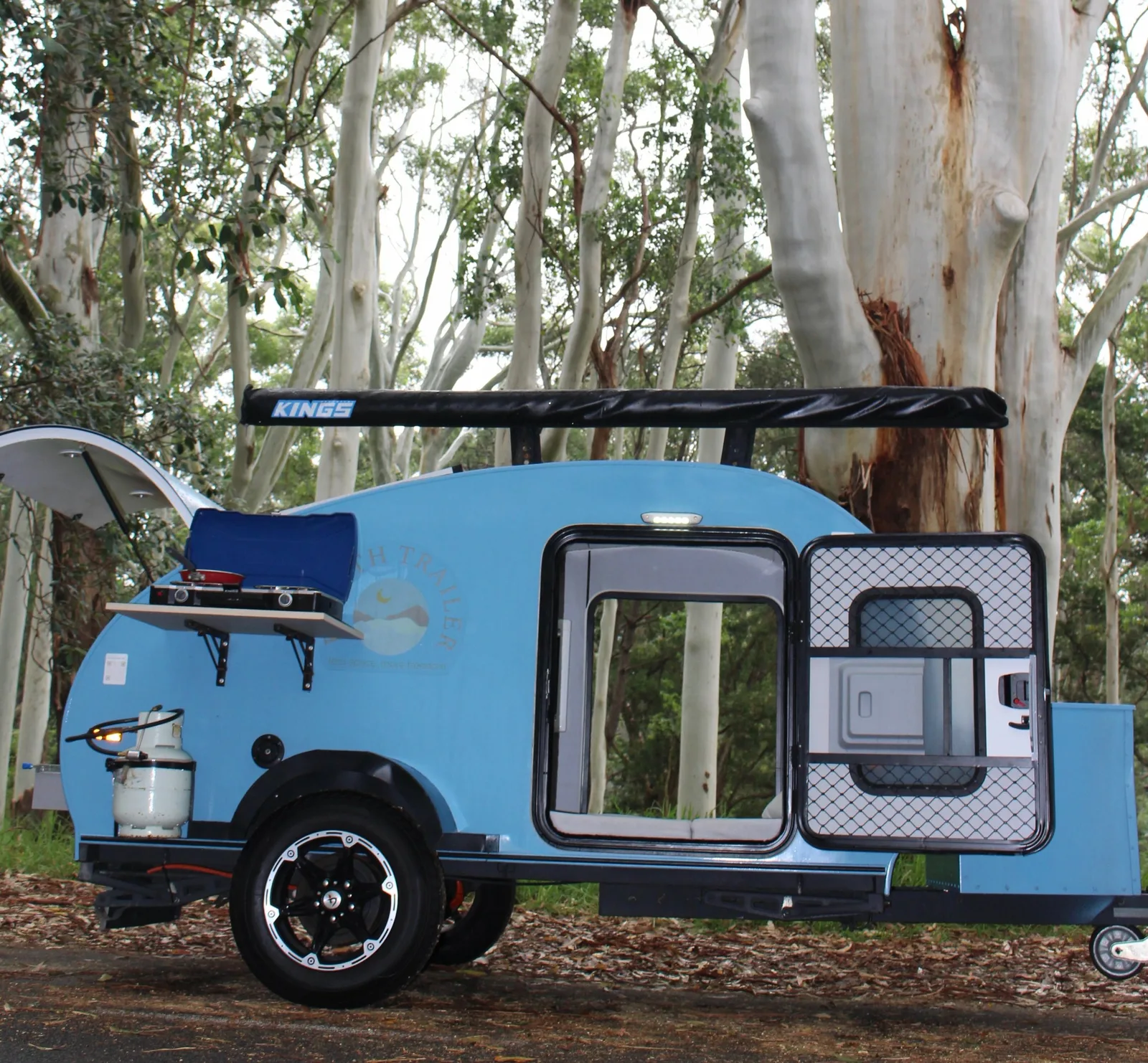
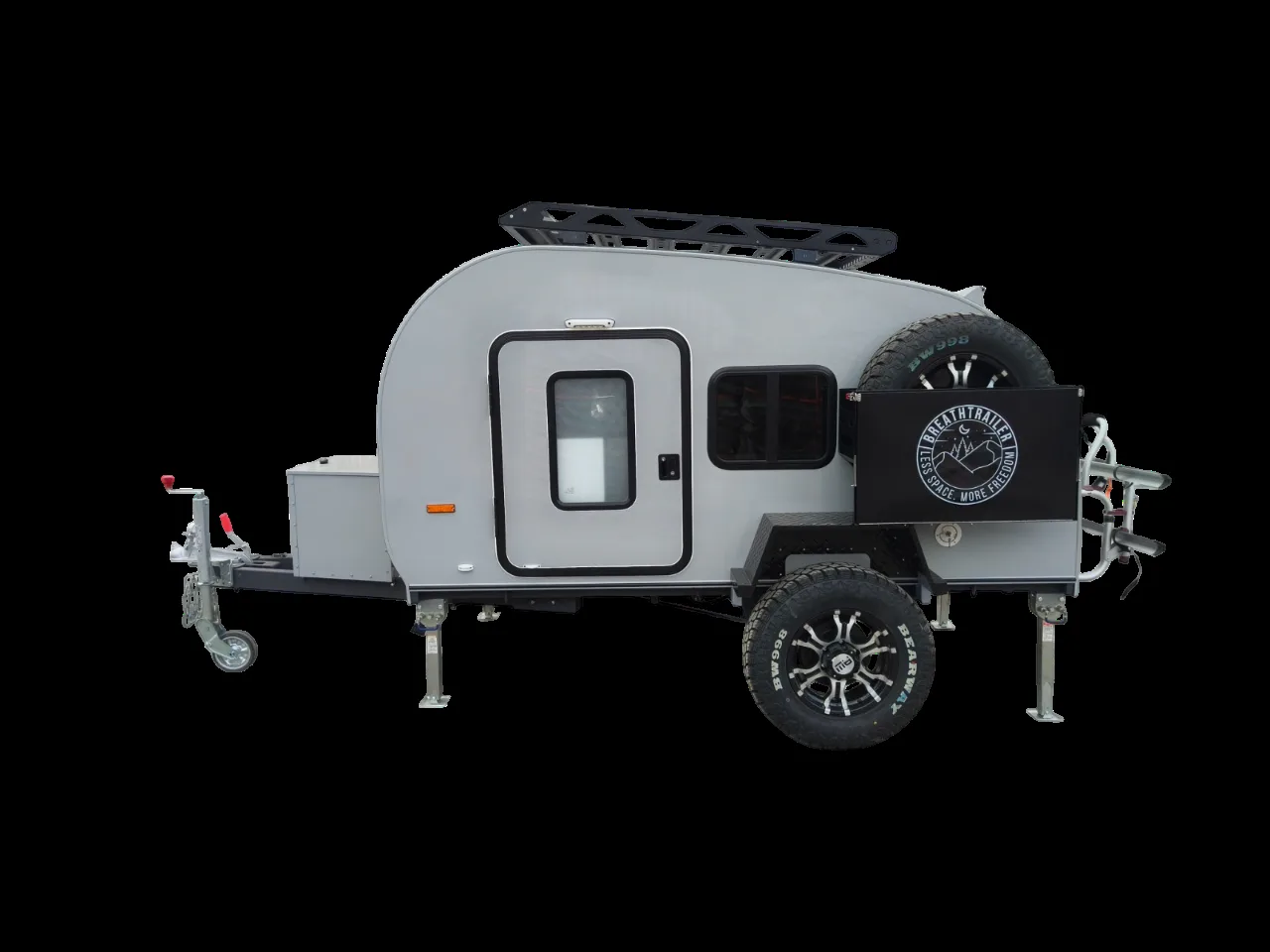
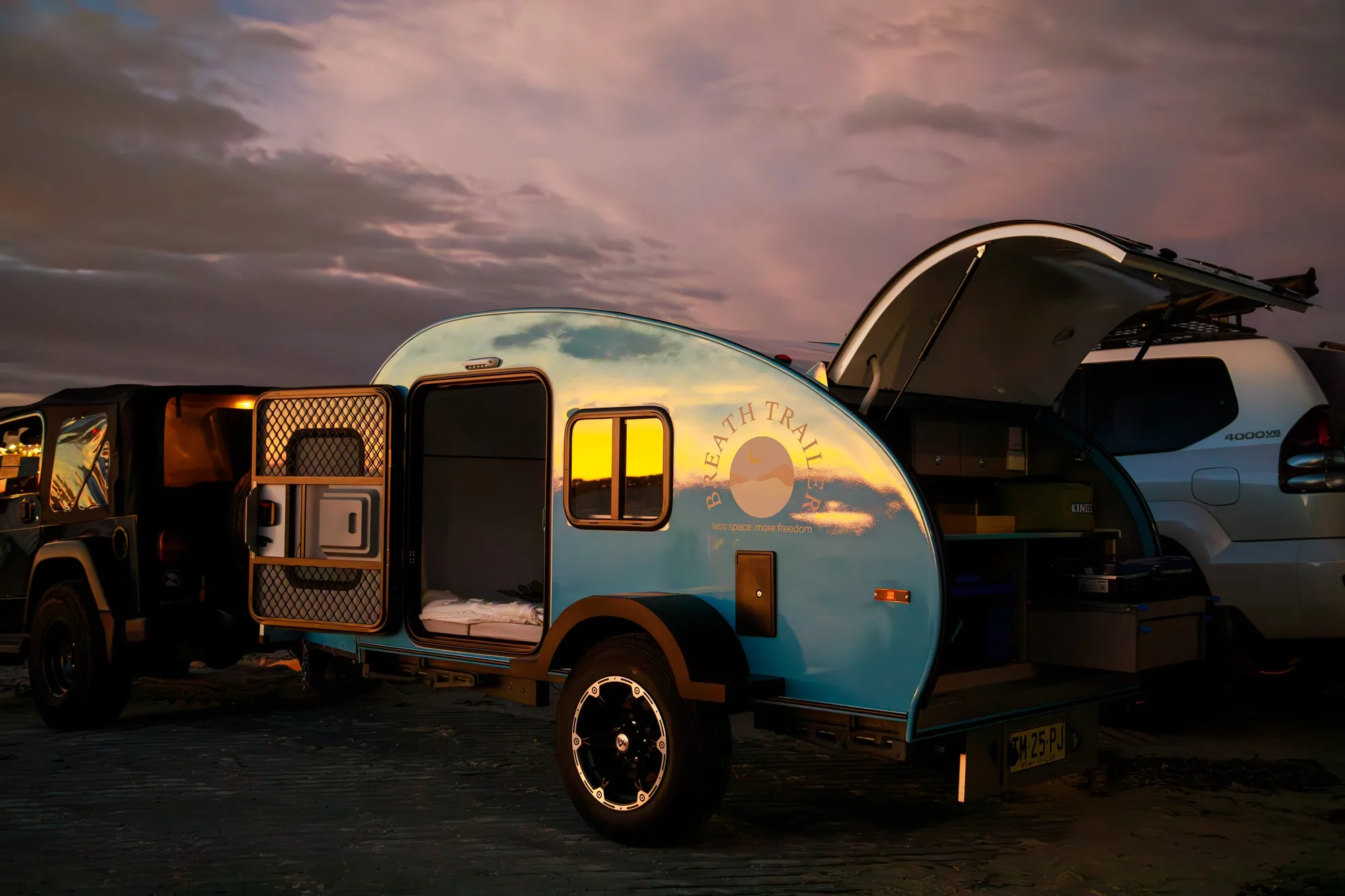
Breath Trailer is an Australian-designed and engineered teardrop brand with four models covering the full range from first-timer builds to fully self-contained expedition setups. Here's what each model costs and what you're getting for that money.
Breath Essential — $23,320
The Essential is Breath's entry point and, at the price, it's legitimately hard to match. You get a hard-shell fibreglass body, a queen sleeping area, a rear galley kitchen with a two-burner gas stove, 12V power, and LED lighting. It's designed to be towed by most mid-size SUVs and sedans, with an ATM of around 700kg.
This model suits couples or solo travellers doing regular weekend trips — powered sites, national parks, and the occasional unsealed road. It's not built for serious off-road use, but that's not what it's for.
Breath Plus — $29,766
The Plus adds the features that make weekend camping genuinely comfortable: a 100Ah lithium battery, 120W solar panel, a 40L compressor fridge, and upgraded suspension for light off-road tracks. The kitchen is more complete — proper bench space, a sink, and 40L water tank — and there's USB charging throughout.
For most Australian campers, the Plus hits the sweet spot. It's capable enough for gravel roads and national park loops, self-sufficient enough for a few nights off-grid, and still priced well below the average family holiday cost for a week of accommodation.
Breath Ultra — $34,749
The Ultra is where things get genuinely capable. Independent coil suspension handles corrugated tracks and rougher terrain comfortably. Battery capacity steps up, solar is more generous, and the overall build is heavier-duty — better suited to those who want to push further off the beaten track without worrying about what the road is doing to the trailer underneath them.
If your idea of a camping trip involves more than a few hundred kilometres from a sealed road, this is the model to look seriously at.
Breath Max — $47,190
The Max is Breath's flagship. It adds a full ensuite with toilet and shower, dual 200Ah lithium batteries, 300W solar, a full-size galley with a three-burner cooktop, and an off-road suspension setup that can handle serious terrain. This is a genuinely self-contained unit that can be used comfortably for weeks at a time without needing a powered site.
At $47,190 it's a significant investment, but when you compare it against a full-size caravan (more on that below), the value case is real.
See the full Breath Trailer range side by side.
Compare specs, weights, and pricing across all four models before you decide.
View All ModelsHidden Costs: What You're Actually Going to Spend
The purchase price is only part of the story. Here's what most buyers don't fully account for before signing — and what you should build into your budget.
Registration
Trailer registration varies by state but typically runs $300–$600 per year for a teardrop in the 700–1,500kg ATM range. Some states offer multi-year registration options that can save a small amount over time. Budget around $400–$500 annually as a working number.
Insurance
Comprehensive caravan and camper trailer insurance in Australia typically runs $500–$1,200 per year depending on the model value, your location, and how you use it. Given the replacement cost of a $30,000+ teardrop, skipping proper insurance isn't a sensible move. Some policies also cover contents and annexes — worth checking the fine print.
Tow Bar and Wiring
If your vehicle doesn't already have a tow bar fitted, budget $400–$1,500 depending on the vehicle and tow bar type. A basic fixed tongue bar for a medium SUV sits around $500–$700 fitted; a heavy-duty setup for larger vehicles can push past $1,200. You'll also need 7-pin trailer wiring, which is usually included in the fitting cost.
Accessories
Most first-time buyers end up spending $500–$2,000 on accessories in the first year — things like camp chairs, an outdoor mat, a Weber or equivalent, additional water storage, a 12V tyre inflator, and basic recovery gear if you're heading off-road. None of this is mandatory, but it adds up fast once you start using the trailer regularly.
Servicing
A basic annual service — bearings, brakes, lights, hitch — will run $200–$500 at a caravan or trailer specialist. It's easy to skip, but don't. Wheel bearing failures on the highway are expensive and dangerous. Budget $300 per year and get it done.
First-Year Reality Check
On top of the purchase price, a realistic first-year budget for all of the above sits at $2,000–$4,000. Factor this in when you're comparing models — a $3,000 saving on the sticker price can easily be absorbed by extras.
Total Cost of Ownership: Teardrop vs Caravan vs Hotel Stays
Numbers are more useful than vague claims, so here's a real comparison based on a couple taking 4 camping trips per year — a mix of long weekends and one week-long trip — over five years.
Teardrop Trailer (Breath Plus at $29,766)
- Purchase price: $29,766
- Registration (5 years): ~$2,000
- Insurance (5 years): ~$4,000
- Servicing (5 years): ~$1,500
- Accessories: ~$1,500
- Camp fees (4 trips/year, avg $30/night, 20 nights/year): ~$3,000
- 5-year total: ~$41,766
- Resale value after 5 years: ~$17,000–$21,000
- Net cost: ~$21,000–$25,000
Full-Size Caravan (entry-level at $45,000)
- Purchase price: $45,000
- Registration (5 years): ~$3,000
- Insurance (5 years): ~$7,500
- Servicing (5 years): ~$2,500
- Higher fuel costs from extra weight (est. ~$1,500 over 5 years): ~$1,500
- Camp fees (same usage): ~$3,000
- 5-year total: ~$62,500
- Resale value after 5 years: ~$22,000–$28,000
- Net cost: ~$35,000–$40,000
Hotel / Holiday Rental Stays (4 trips/year)
- Average accommodation cost per trip (5 nights at $180/night): ~$900
- 4 trips per year: ~$3,600/year
- 5-year total: ~$18,000
- No asset, no flexibility, no camping access
The teardrop comes out comfortably ahead of a full-size caravan on total cost, and gives you an asset with genuine resale value at the end. Against hotel stays, it's comparable on raw dollars over 5 years — but the lifestyle comparison doesn't hold up. A teardrop gives you access to free camping, national parks, remote locations, and the freedom to leave whenever you want.
Australian-Made vs Imported: What's the Actual Difference?
There are plenty of imported teardrop trailers in the Australian market, and some of them look impressive in photos. Here's an honest breakdown of where the differences show up in practice.
Build for Local Conditions
Australian roads are harder on trailers than most people realise. Corrugated outback tracks, intense UV exposure, coastal salt air, and extreme temperature ranges (from -5°C in alpine areas to 45°C in the outback) put specific demands on build quality that many imported models simply aren't designed for. Australian manufacturers engineer to these conditions from the start — it's not an afterthought.
Warranty and After-Sales Support
When something goes wrong with an imported trailer, warranty support is often limited to the importer — who may or may not be able to source parts quickly, or at all. Australian-made teardrops are supported by local dealers and manufacturers who stock parts and can actually fix the problem. This matters a lot when you're 600km from the nearest town and something breaks.
Compliance and Legality
All trailers sold in Australia must comply with Australian Design Rules (ADRs). Some imported trailers arrive in a grey zone — technically compliant on paper but not built to the spirit of the standards. Australian-made trailers are designed and tested to ADR compliance from the ground up, which also affects your insurance position if there's ever a claim.
Resale Value
Australian-made teardrops from reputable manufacturers hold their value better in the secondhand market. Buyers know the brand, can verify the history, and trust the build quality. Imported models often take a steeper depreciation hit in years 2–4.
Price Premium: Is It Justified?
Australian-made teardrops typically cost $3,000–$8,000 more than a comparable imported alternative. Given stronger resale value, local warranty support, better compliance confidence, and build quality suited to Australian use, most buyers who've owned both will tell you the premium is worth it — especially if you plan to use the trailer regularly for more than a couple of years.
Finance Options
A teardrop trailer is a significant purchase, and most buyers don't pay cash. The most common finance paths in Australia are:
- Secured personal loan: The trailer acts as security, which typically gives you a better interest rate than an unsecured loan. Most lenders offer 3–7 year terms.
- Caravan-specific finance: Some brokers specialise in RV and caravan finance and can often find better rates than going directly to a bank.
- Dealer finance: Some manufacturers partner with finance providers for in-house options — worth asking about, but compare the rate against your own bank first.
As a rough guide, a $25,000 loan at 7% p.a. over 5 years works out to around $495/month. That's less than most people spend on accommodation for a family holiday — and at the end of the 5 years, you still own an asset.
For more details on finance, payment options, and what the buying process looks like, visit the Breath Trailer FAQ.
Is a Teardrop Camper Worth It?
That depends entirely on how you plan to use it. If you're after 4+ camping trips a year, value the freedom to camp anywhere without booking months in advance, and want an asset that holds its value — a teardrop camper in the $20,000–$35,000 range is one of the most cost-effective ways to access the Australian outdoors.
If you're not sure you'll use it more than once or twice a year, do the maths honestly before committing. A teardrop makes financial sense when you use it — it's not a good investment if it sits in the garage between Christmas and Easter.
For most couples and small families who camp regularly, the Breath Plus or Breath Ultra hits the sweet spot: capable enough for real adventures, self-sufficient enough for off-grid nights, and priced transparently with no hidden upgrade path to get the features that actually matter.
If you want the full self-contained setup — ensuite, serious battery capacity, proper off-road suspension — compare the Breath Max at $47,190 with a full-size caravan using the equipment, delivered price and towing requirements of the exact configurations you need.
Browse the full range and compare specs at Breath Trailer, or get in touch if you want help working out which model suits your setup.
Frequently Asked Questions
Teardrop campers in Australia range from around $15,000 for a basic imported model to over $40,000 for a premium Australian-made build with full off-road capability, ensuite, and solar. Most buyers land in the $20,000–$35,000 range for a quality hard-shell teardrop.
A mid-range teardrop trailer in Australia typically sits between $25,000 and $35,000. At that price point you can expect a 100Ah lithium battery, solar panel, full galley kitchen, and a ride-height that handles light gravel roads without drama.
Generally, yes. Australian-made teardrops are engineered for local road conditions — corrugated unsealed roads, intense summer heat, and coastal salt air. Build quality, warranty support, and parts availability are typically stronger than imported alternatives, and resale value holds up better.
Beyond the purchase price, budget for registration ($300–$600/year depending on state), comprehensive insurance ($500–$1,200/year), a tow bar and wiring harness ($400–$1,500 fitted), and annual servicing ($200–$500). First-year out-of-pocket extras often add $2,000–$4,000 to the sticker price.
Yes. Most buyers use a secured personal loan or caravan-specific finance through a broker or their bank. Rates vary, but 5–9% p.a. over 3–7 years is typical. Check the Breath Trailer FAQ page for current finance guidance and to get in touch about options.