Caravan vs Teardrop Camper Australia: The Honest 2026 Comparison
Most family SUVs cannot legally tow a two-tonne caravan. What changes when you drop to a 700 kg teardrop: cost, access, freedom.
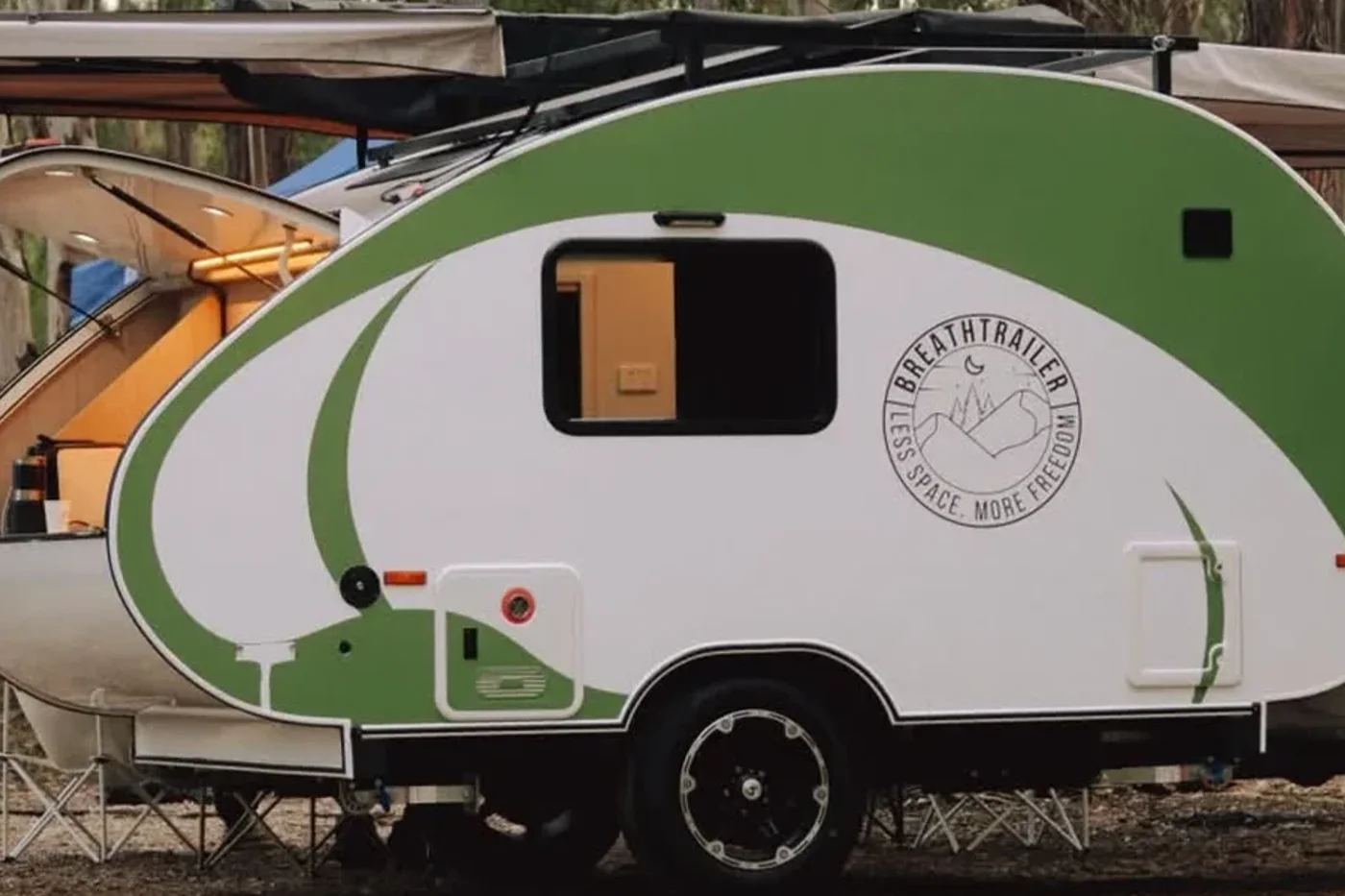
Greg and Margaret spent $74,000 on a Jayco caravan in 2024. It lives under a tarpaulin in a commercial storage yard for $220 a month, they’ve been out five times, and Margaret still refuses to back it into tight spots. Tom and Sarah spent $25,740 on a teardrop in March and have already done eleven weekends — because pulling up and camping takes about four minutes, the whole rig fits in their garage, and their RAV4 barely notices the weight.
Neither couple is wrong. But they made very different decisions with very different outcomes, and those outcomes were predictable before they spent a cent.
If you’re weighing up a caravan vs teardrop camper in Australia, this guide runs the numbers honestly — purchase price, tow weight, annual running costs, space, camping freedom, and the scenarios where each genuinely wins. No cheerleading, no hand-waving. Just the comparison Australian buyers actually need in 2026.
The Quick Answer: Side-by-Side at a Glance
| Traditional caravan | Teardrop camper | |
|---|---|---|
| Purchase price | $36,000–$100,000+ | $23,320–$42,900 |
| ATM / tow weight | 1,400–3,000 kg | 700–1,200 kg |
| Tow vehicle required | Diesel ute / large 4WD ($55k–$90k+) | Mid-size SUV ($35k–$55k) |
| Setup time | 30–90 minutes | 3–5 minutes |
| Storage footprint | 6–9 m long | 3.5–5 m (fits in garage) |
| Annual rego (NSW, ~1,500 kg ATM) | ~$430–$560 | ~$150–$250 |
| Annual insurance | $600–$1,500+ | $300–$600 |
| Fuel penalty towing | +4–6 L/100 km | +1–2 L/100 km |
| Interior bathroom | Standard in most models | Breath Max only ($42.9k) |
| Free camping eligible | If self-contained rated | Breath Max — yes |
| Typical sleeping capacity | 2–8 | 2 |
| Sleeping quality (couples) | Good | Excellent (fixed queen) |
The single biggest variable that doesn’t appear in any table: whether you actually use the thing. A $74k caravan used five times a year costs more per night than five-star accommodation. A $25k teardrop used forty weekends a year costs next to nothing.
Purchase Price — What Your Budget Actually Buys
What caravans cost in 2026
The entry-level Jayco Journey, a 12-foot pop-top caravan, starts at around $36,000 drive-away for the base specification. Step up to the Starcraft pop-top and you’re looking at $55,000–$70,000 depending on fitout. A fully spec’d Coromal, Lotus, or Avida family van hits $80,000–$120,000 before you’ve added anything.
Pop-tops — the closest caravan equivalent to a teardrop in terms of weight and profile — occupy the $36,000–$60,000 band. They weigh 1,400–1,800 kg ATM, which already rules out most mid-size SUVs as tow vehicles.
What teardrops cost in 2026
Premium teardrops sold in Australia cluster between $20,000 and $45,000:
| Model | Price (AUD) | ATM weight | Key feature |
|---|---|---|---|
| Breath Essential | $23,320 | 700 kg | Entry premium hard-shell, galley kitchen |
| Breath Plus | $29,766 | 800 kg | 60L fridge included |
| Breath Ultra | $34,749 | 900 kg | External shower, solar-ready |
| Breath Max | $42,900 | 1,200 kg | Interior bathroom, 2.1 m headroom, self-contained |
| JAG Glider (approx.) | $22,000–$27,000 | 550–700 kg | Ultra-light, suits smaller vehicles |
| Cool Beans Campers | $28,000–$38,000 | 750–1,000 kg | Handmade, WA-based |
See the full teardrop camper cost breakdown for Australia for a deeper dive into each price tier.
The price gap between a well-specced teardrop ($25,000–$35,000) and an equivalent-amenity caravan ($55,000–$75,000) is typically $25,000–$40,000 — money that can fund a decade of camping fuel, national park fees, and experiences.
Tow Weight & Vehicle Compatibility — The Vehicle Cost Most People Miss
This is the comparison point that changes the true cost most dramatically, and the one dealers of both types consistently downplay.
What a caravan requires
A pop-top caravan at 1,600 kg ATM requires a tow vehicle rated to at least 2,000 kg braked (allowing for a safety margin). In 2026, that means:
- Toyota LandCruiser 300 — from $109,000
- Toyota HiLux — from $55,000 (dual cab, turbo diesel)
- Ford Ranger — from $56,000
- Mitsubishi Pajero Sport — from $57,000
If you don’t already own one of these, a caravan upgrade might require a tow vehicle upgrade simultaneously. That changes a “$36,000 caravan purchase” into a “$36,000 caravan + $55,000 ute = $91,000 decision.” That’s not a fringe case — it’s the situation most Australian families find themselves in.
What a teardrop requires
A teardrop at 700–900 kg ATM can be towed comfortably by:
- Toyota RAV4 (hybrid or petrol) — tow rating 1,500–2,000 kg; teardrop barely registers
- Subaru Outback / Forester — 1,500–2,000 kg tow rating
- Mazda CX-5 — 2,000 kg tow rating
- Hyundai Tucson / Kia Sportage — 1,600 kg tow rating
- Honda CR-V — 1,500 kg tow rating
- Kia EV6 / Tesla Model Y — 1,600 kg tow rating (yes, EVs can tow teardrops)
For detailed tow vehicle requirements and safety margins, that guide covers GVM, ball weight, and why the 10% rule matters.
The practical upshot: most Australians already own a vehicle that can tow a teardrop without modification. Most Australians don’t already own a vehicle that can tow a full caravan comfortably.
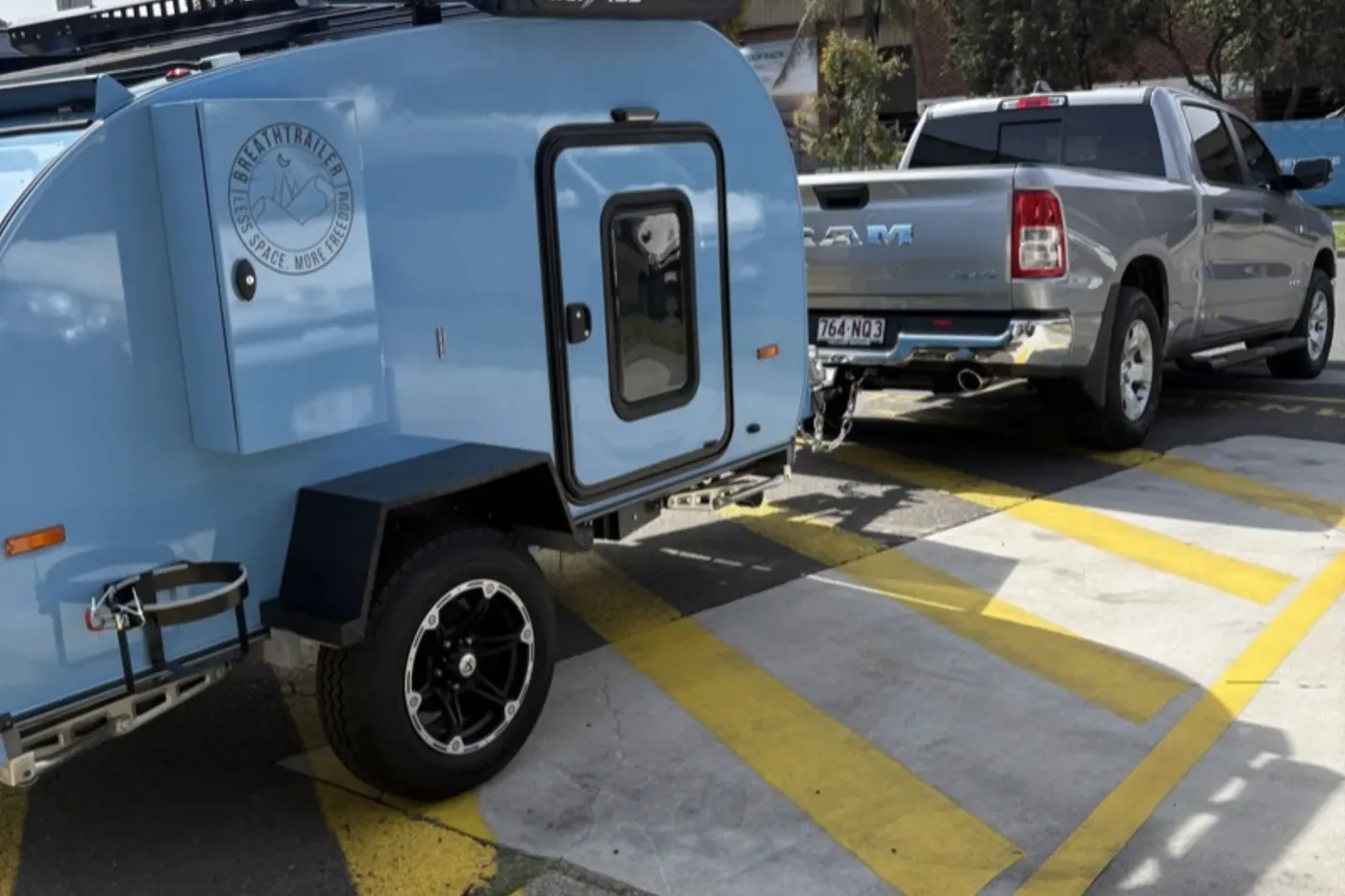
A teardrop’s lower weight is why so many existing vehicles can tow one without an upgrade.
Annual Running Costs: The Numbers Nobody Puts Side by Side
The purchase price is a one-off. Running costs are permanent. Here’s what each option actually costs to own per year in Australia.
Registration (by ATM weight, 2025–26)
| State | Caravan ~1,600 kg ATM | Teardrop ~800 kg ATM |
|---|---|---|
| NSW | ~$430–$560 | ~$150–$220 |
| VIC | ~$200–$280 | ~$60–$80 |
| QLD | ~$250–$350 | ~$90–$130 |
Sources: NSW Government Vehicle Registration Fees (2025); Transport Victoria; QLD Transport Registration Costs (2025–26).
Insurance
Comprehensive caravan insurance in Australia costs $600–$1,500 per year depending on the van’s value and your insurer (NRMA, CMCA-linked, Budget Direct). A teardrop valued at $20,000–$35,000 typically attracts $300–$600 per year — roughly half.
Fuel penalty towing
This is where the numbers get striking. Australian fuel prices sit around $2.10/L in mid-2026.
A teardrop at 700–900 kg adds approximately 1–2 L/100 km of fuel use. A caravan at 1,600–2,500 kg adds 4–6 L/100 km — sometimes more in headwinds or on hilly roads.
| Annual km towed | Teardrop fuel cost | Caravan fuel cost | Annual saving |
|---|---|---|---|
| 5,000 km | ~$105–$210 | ~$420–$630 | ~$315–$420 |
| 10,000 km | ~$210–$420 | ~$840–$1,260 | ~$630–$840 |
| 15,000 km | ~$315–$630 | ~$1,260–$1,890 | ~$945–$1,260 |
Storage
A full-size caravan typically can’t fit in a residential garage. Commercial trailer storage in Sydney, Melbourne, or Brisbane runs $150–$300 per month ($1,800–$3,600/year). A teardrop fits in most double garages — storage cost: $0.
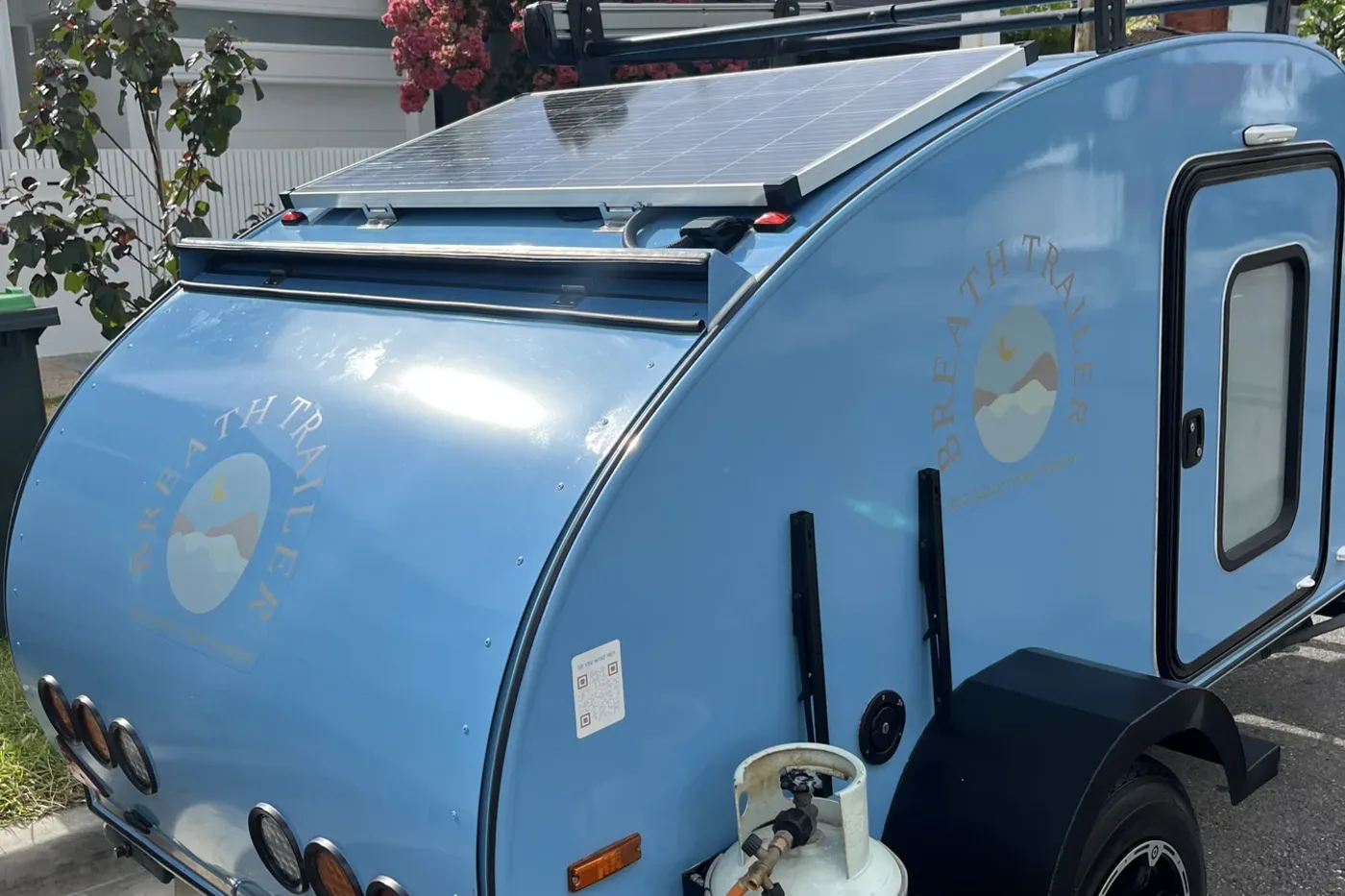
Kept at home instead of in paid storage, a compact teardrop removes a recurring cost.
Annual servicing
Caravan annual service (habitation check, wheel bearings, brakes, gas, seals): $400–$800. A teardrop with fewer systems, no gas appliances requiring annual certification (on base models), and simpler chassis: $150–$400.
Five-year total cost of ownership estimate
| Cost category | Caravan (over 5 years) | Teardrop (over 5 years) |
|---|---|---|
| Purchase price | $55,000 | $29,766 |
| Registration | $2,250–$2,800 | $750–$1,100 |
| Insurance | $3,000–$7,500 | $1,500–$3,000 |
| Fuel penalty (7,500 km/yr) | $3,150–$4,725 | $788–$1,575 |
| Storage | $9,000–$18,000 | $0 |
| Servicing | $2,000–$4,000 | $750–$2,000 |
| Total (5 years) | $74,400–$92,025 | $33,554–$37,441 |
That’s a $37,000–$58,000 difference over five years — before accounting for any difference in tow vehicle costs.
Space, Comfort & Sleeping Arrangements
The caravan wins on raw space — no argument there. A 6-metre Jayco offers a fixed island bed, a full-height bathroom, a dining area, and a kitchen with four-burner stove, oven, and microwave. Two people could live in one reasonably comfortably.
A teardrop is intentionally focused. The bedroom is the whole interior: a fixed queen bed (153 × 203 cm in most Australian models), storage cubbies, USB and 12V charging, and whatever ambient lighting the builder has specified. You cook at the rear galley hatch. You socialise under the awning.
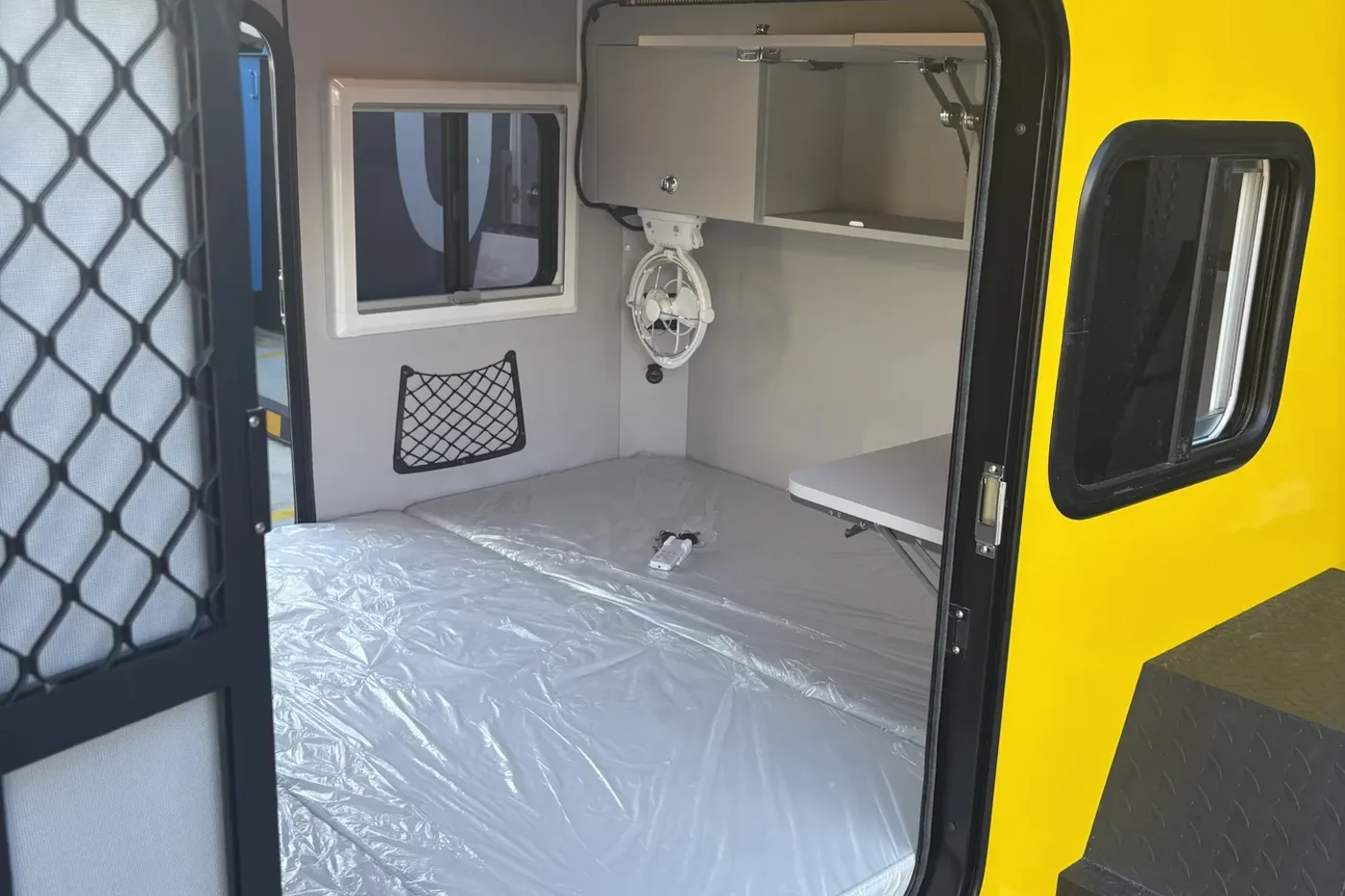
In a teardrop the cabin is the bedroom; cooking and socialising happen outside.
This isn’t a deficiency — it’s a design decision. If you camp to sleep outdoors, to sit by a fire, to get off the phone, the teardrop’s minimal interior is a feature. You spend almost no time inside it when you’re awake.
For couples this tradeoff is often liberating. For families with children sharing sleeping space, it’s a genuine constraint. Teardrops sleep two, comfortably and in premium comfort. If you need beds for four people, a caravan makes more sense regardless of cost.
Read our teardrop camper for couples guide for more on the couples-specific comparison.
Kitchen & Bathroom: The Amenities Gap (and Where It Closes)
The standard teardrop kitchen
Modern Australian teardrops have made remarkable progress on galley kitchens. The Breath Plus and above come with a 60L compressor fridge, two-burner gas stove, sink with pump water, and adequate prep space — genuinely functional for extended camping.
What they don’t have is an interior: you cook from a rear hatch with a view. In rain, that requires an awning. In heavy rain or wind, you adapt. It’s a different style of cooking than standing in a climate-controlled van kitchen, not an inferior one.
The bathroom question
This is where the traditional caravan has historically held a decisive advantage — and where it’s been significantly eroded.
The Breath Max at $42,900 is, as of 2026, the only teardrop on the Australian market under $50,000 with a genuine interior bathroom: a toilet, shower, and vanity in a 2.1 m standing-height cabin with a fixed queen bed. It’s self-contained under CMCA guidelines, which unlocks free camping in most Australian states and territories.
By comparison, a Jayco pop-top with bathroom starts at roughly $55,000–$65,000 and requires a vehicle rated to tow 1,800+ kg. The $15,000–$25,000 premium buys you more kitchen space and a slightly larger bathroom. Whether that gap is worth it depends entirely on how you camp.
For the full self-containment picture — what it means, which states require it, and what you can access — see self-contained camper Australia.
Camping Freedom — Powered Sites vs Free Camping
This dimension rarely appears in price comparison articles, but it materially affects what you spend per year.
Powered caravan park sites: cost in 2026
Powered sites at popular Australian coastal, national park, and inland caravan parks currently run $40–$80 per night for two people. Peak season (Christmas, Easter, school holidays) in high-demand areas regularly exceeds $90. Budget $50/night average for a realistic median.
At 30 camping nights per year: $1,500 in campground fees. At 50 nights: $2,500.
What self-containment unlocks
Australia has thousands of free or low-cost camping areas: remote national park campsites, state forest camps, rest areas, roadside camps, and private farm stays. Most require a self-contained vehicle to access. A self-contained camper rated by the CMCA — or with grey water management, toilet, and water capacity — can legally use these spots.
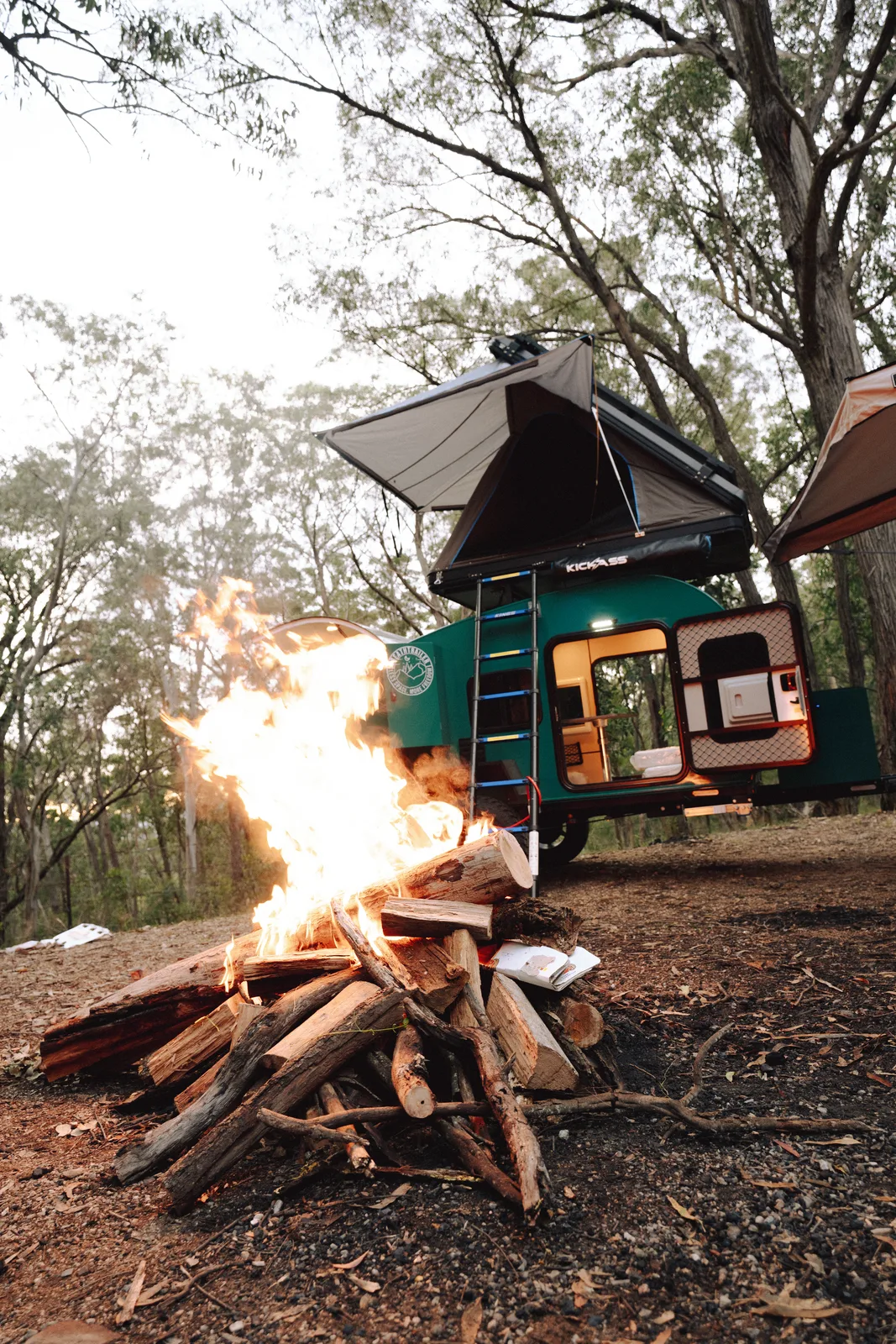
Free and low-cost bush camps are where a self-sufficient rig pays for itself.
The Breath Max, for example, is self-contained by design: the interior toilet and shower, grey water capacity, and independent water supply meet CMCA’s criteria. In practice, this means the full list of free camping areas across Australia is accessible.
At 30 camping nights on free sites: $0 in campground fees. Over five years at 30 nights/year: a $7,500 saving in campground fees alone compared to powered site camping.
A standard caravan is technically also self-contained if it has a toilet — but the $55,000+ entry point for a bathroom-equipped van makes this a more expensive path to the same freedom.
Resale Value & Depreciation
Both caravans and teardrops depreciate, but the pattern differs:
- A $55,000 Jayco loses roughly 15–20% of value in year one, settling to around 50–60% of purchase price after five years (approximately $27,000–$33,000 resale).
- A $29,766 Breath Plus retains strong value in the used Australian market because of brand recognition, build quality, and the shortage of used premium teardrops — expect 55–70% of purchase price after five years ($16,000–$21,000 resale).
Net depreciation over five years:
- Jayco $55k pop-top: ~$22,000–$28,000 lost
- Breath Plus $29,766: ~$8,900–$13,400 lost
The teardrop loses less in absolute dollars and in percentage terms — partly because the premium Australian teardrop market is still under-supplied with quality used inventory.
Who Should Buy a Caravan vs a Teardrop?
There’s no universally right answer, but there’s usually a clearly better one for your situation.
Choose a teardrop camper if:
- You travel as a couple or solo
- Your tow vehicle is already a mid-size SUV (RAV4, Forester, Tucson, CX-5)
- You want to camp frequently rather than occasionally and expensively
- You plan to self-contain and free camp (Breath Max)
- You value quick setup — arriving at 8pm in the dark is fine
- You want the whole rig stored in your own garage
- Your camping style is outdoors-focused (around the fire, under the awning, not inside the van)
- Budget is under $40,000 all-in
Choose a caravan if:
- You travel with children who need separate sleeping space
- You’re doing the Big Lap or multi-month trips where interior living space matters
- You’re happy to buy (or already own) a diesel ute or large 4WD
- You genuinely spend significant time cooking indoors in bad weather
- Commercial storage isn’t a cost concern
- You need multiple beds beyond a couple
The “I want a bathroom” question
This is the most common reason people default to a caravan. The honest answer in 2026: the Breath Max at $42,900 genuinely covers this need for two people, weighs 1,200 kg (towable by a Prado or large Fortuner), and costs $15,000–$25,000 less than a comparably bathroom-equipped caravan.
If you need a bathroom and you’re two people, compare the Max to a Jayco pop-top with ensuite before assuming you need a full caravan.
Breath Trailer in the Context of This Comparison
Breath Trailer makes four models designed explicitly for the couples market — the segment most systematically over-served by caravans and under-served by the traditional camper trailer industry.
| Model | Price | ATM | Best for |
|---|---|---|---|
| Breath Essential | $23,320 | 700 kg | Couples wanting premium hard-shell at minimum cost |
| Breath Plus | $29,766 | 800 kg | Couples who want a fridge included and extra spec |
| Breath Ultra | $34,749 | 900 kg | Couples who want external shower and more off-road capability |
| Breath Max | $42,900 | 1,200 kg | Couples who want a bathroom, standing height, and full self-containment |
All four are designed in Australia, come with 100+ colour options, and carry a 3–4 month lead time from order to delivery. The Sydney Design Award 2025 reflects the intentional design thinking behind each model.
Competitors worth knowing honestly: JAG Camper (Brisbane-made, ultra-light, prices from ~$22k, excellent for smaller tow vehicles), Cool Beans Campers (Fremantle, WA, handmade, comparable quality to the Breath range), and Smidge Teardrop Campers (Sydney). None currently offer an interior bathroom at under $50,000.
For a full side-by-side across brands, see the best teardrop campers Australia 2026 guide.
Frequently Asked Questions
Is a teardrop camper cheaper than a caravan in Australia? Yes, significantly. Teardrop campers start at $23,320 in Australia, while entry-level pop-top caravans start at around $36,000. When you include five-year running costs (registration, insurance, fuel, storage, servicing), the total cost of ownership gap typically reaches $40,000–$60,000 in the teardrop’s favour.
Can a teardrop replace a caravan for the Big Lap? For two people, yes — particularly the Breath Max with its interior bathroom, self-containment rating, and standing height. Multi-month trips with children who need separate sleeping areas are better served by a caravan or larger camper trailer.
Do teardrop campers have bathrooms? Most don’t. The Breath Max ($42,900) is the notable exception in the Australian under-$50k market — it includes a full interior toilet and shower and is self-contained for free camping.
What tow vehicle do I need for a teardrop in Australia? Most mid-size SUVs (Toyota RAV4, Subaru Outback/Forester, Mazda CX-5, Hyundai Tucson, Kia Sportage) can tow teardrops in the 700–1,000 kg ATM range without modification. Electric SUVs with 1,500–2,000 kg tow ratings can also manage. See our towing guide for specifics.
How much does a teardrop camper cost annually to run vs a caravan? At roughly 7,500 km towed per year, a teardrop costs approximately $1,500–$2,500 per year in registration, insurance, fuel penalty, and servicing. An equivalent caravan costs $5,500–$9,000+ per year, not including commercial storage ($1,800–$3,600/year if you can’t garage it). Over five years, the difference is $20,000–$35,000.
Is a teardrop or caravan better for off-road camping in Australia? A quality off-road teardrop (Breath Ultra or Max, JAG off-road models) handles gravel roads, light tracks, and corrugations well. Purpose-built off-road caravans (Bruder EXP-4, Kokoda, Track Trailer) handle more extreme terrain — but start at $80,000+. For most Australians’ actual off-road use (gravel roads, national park tracks, some corrugated outback roads), an off-road teardrop is more than adequate. See off-road teardrop camper Australia for trail-ready details.
Conclusion
The caravan vs teardrop camper decision in Australia in 2026 comes down to one honest question: what kind of camping do you actually do, and how often?
For the majority of Australian couples and two-person households, a teardrop camper delivers a fundamentally better deal — lower purchase price, existing tow vehicle compatibility, garage storage, five-minute setup, and enough off-grid capability to unlock free camping. Over five years, the total cost advantage is typically $40,000–$60,000. That’s a significant amount of camping fuel and national park fees.
Caravans earn their keep for large families needing multiple beds, for those doing very extended trips where interior living space is critical, and for people who already own a heavy tow vehicle.
If you’re two people, you own a mid-size SUV, and you want to camp more and spend less doing it — the maths is fairly clear.
Compare all four Breath Trailer models or book a viewing to see one in person.
Recommended Reading
- Camper Trailer Towing Guide Australia 2026 — GVM, ball weight, ATM, what your vehicle can actually tow
- Self-Contained Camper Australia — what self-containment means, which states require it, how to qualify
- Best Teardrop Campers Australia 2026 — brand-by-brand comparison with real prices
- Teardrop Camper Hire vs Buy Australia — if you’re not sure whether to commit yet
- How Much Does a Teardrop Camper Cost in Australia? — detailed price tier breakdown