Teardrop Camper Accessories Australia: 2026 Complete Guide
Every kilo you add comes off your payload. What is worth carrying, and what stays home.
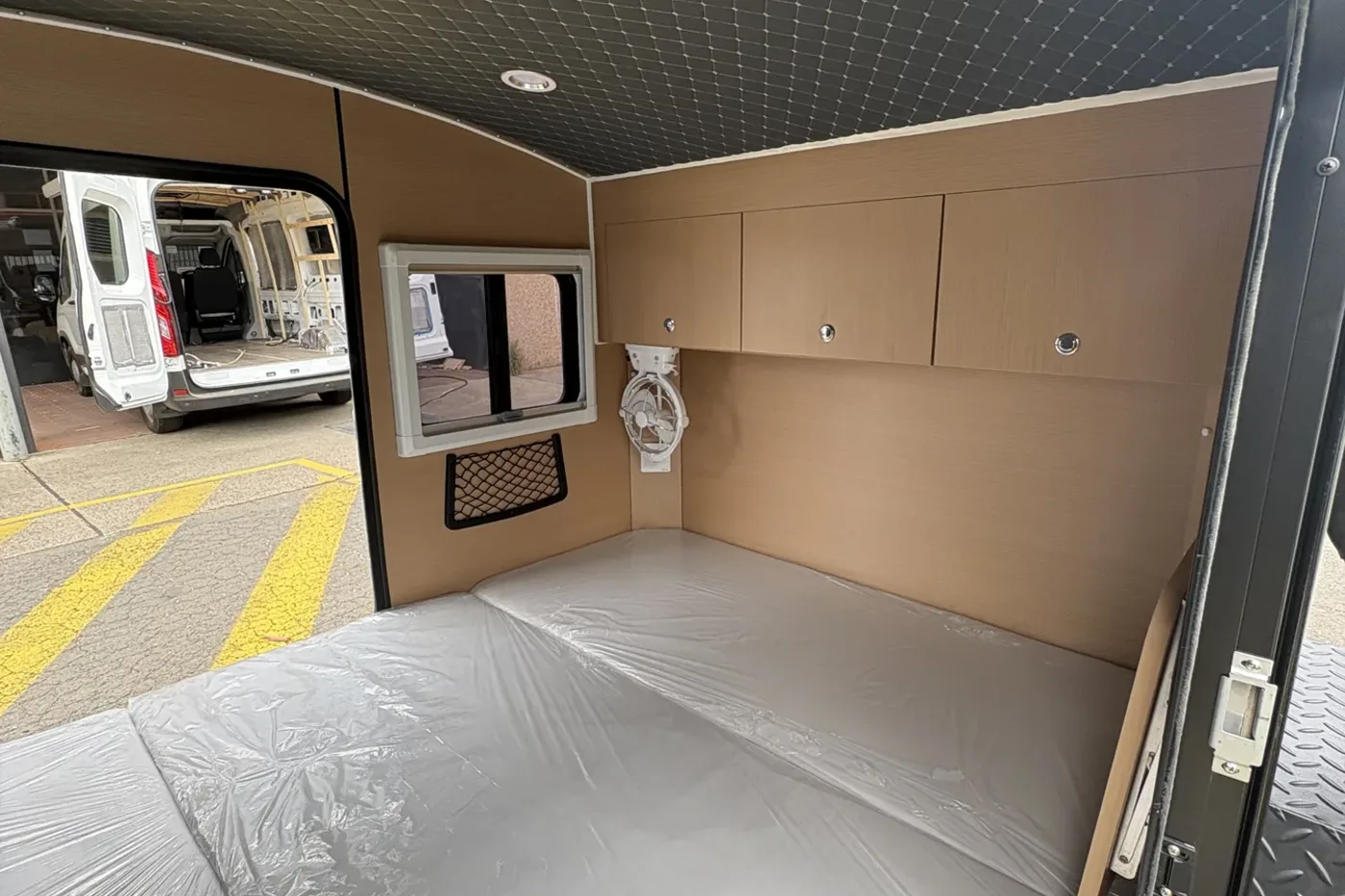
The right teardrop camper accessories can transform a comfortable weekender into a fully self-contained rig capable of weeks off-grid in the Australian bush. But with thousands of products on the market — from $15 cable tidies to $3,000 lithium battery systems — knowing what actually matters is genuinely confusing.
This guide cuts through the noise. Based on 350+ Breath Trailer customer setups and real 2026 Australian pricing, it covers every accessory category worth spending money on, what you can skip, and which items your teardrop may already include as standard.
1. Awnings — Create Your Outdoor Living Room
An awning is typically the first accessory Australians buy after taking delivery of a teardrop camper. A quality side awning transforms a cramped 5 m² camping footprint into a proper outdoor living room — essential in summer heat or unexpected showers.
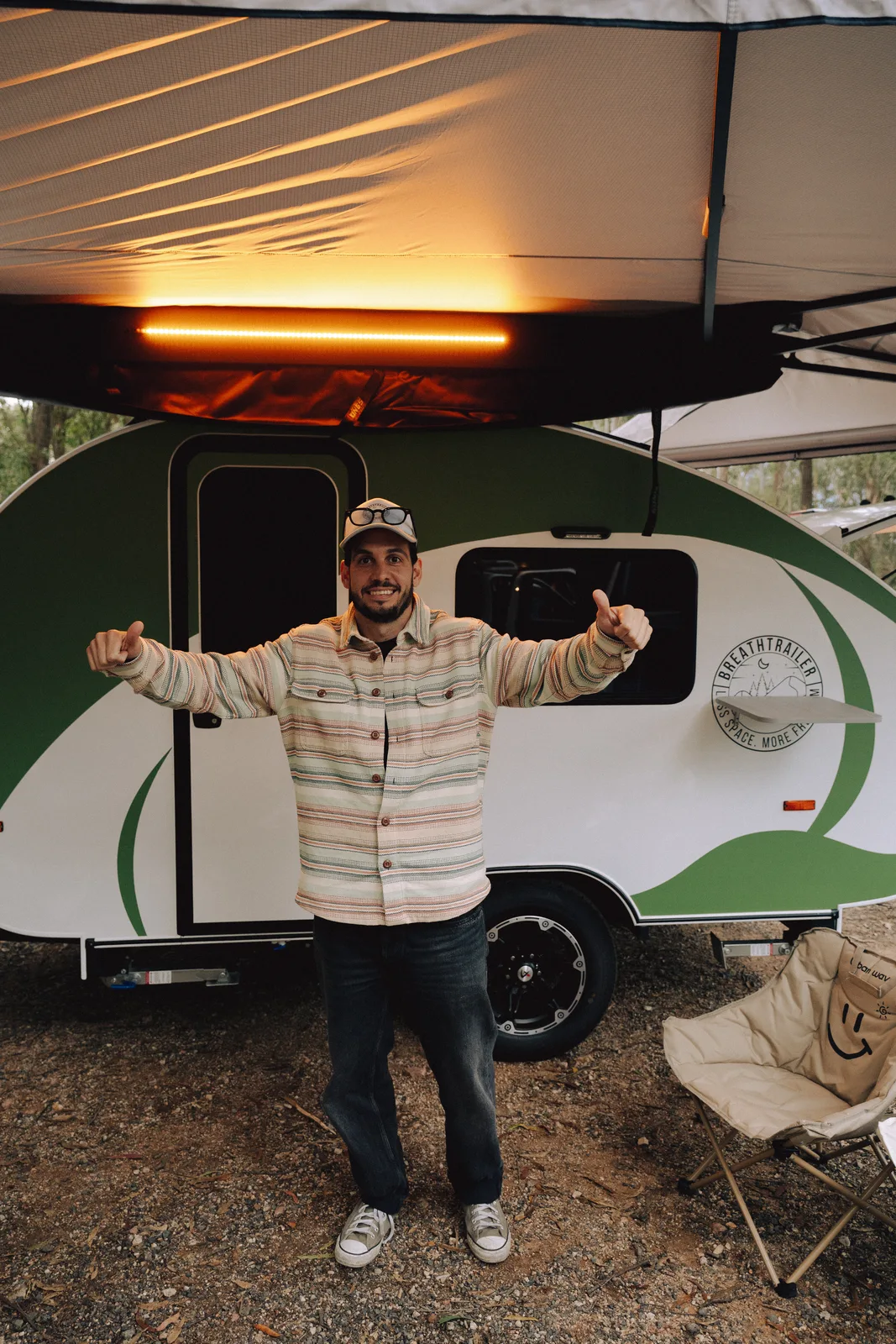
A lit awning turns the space beside a teardrop into a proper outdoor living room.
Types of awning
| Type | Coverage | Setup time | Price (AUD) |
|---|---|---|---|
| Standard roll-out (1.8–2.5 m) | Side shade only | 2–3 min | $200–$600 |
| 180° awning | Side + partial front/rear | 3–5 min | $600–$1,100 |
| 270° awning (OzTent Foxwing, Darche Eclipse) | Three-sided coverage | 5–8 min | $980–$1,400 |
Top Australian picks in 2026
ARB Touring Awning (~$230–$400 AUD depending on size): no-frills, built to take punishment, fits any roof rack or side mount bracket.
OzTent Foxwing 270° (~$979 AUD): CPAI-84 fire-resistant, CEVA certified, and sets up solo in under 5 minutes. The most popular aftermarket awning on Australian teardrop campers.
Darche Eclipse 270 (~$1,400 AUD): premium ripstop poly-cotton canvas, integrated tension ratchets, and compatible with the Darche wall kit system for full room enclosure.
Teardrop-specific tip: most teardrops have low-profile rooflines — look for awnings that mount to the trailer body rail or a dedicated side mount bracket rather than requiring a roof rack. Breath Ultra, Plus and Max models all feature integrated awning rail mounts as standard.
2. Power Systems — Solar Panels & Lithium Batteries
Off-grid power is the single most consequential upgrade decision for a teardrop camper owner in Australia. Get it right and you’ll wild-camp for weeks; get it wrong and you’ll spend every night hunting powered sites.
The practical baseline setup
For a couple doing 3–5 day trips with a 12V fridge, LED lighting, phone charging and a 12V water pump, the following system covers virtually all needs:
| Component | Spec | Approx. cost (AUD) |
|---|---|---|
| Roof-mounted solar panel | 200W monocrystalline | $250–$450 |
| MPPT solar charge controller | 20A (e.g. Victron SmartSolar) | $180–$300 |
| Lithium LiFePO₄ battery | 100Ah | $600–$1,000 |
| DC-DC battery-to-battery charger | 25A (e.g. REDARC BCDC1225D) | $350–$550 |
| Total (DIY or installed) | $1,400–$2,300 |
Solar sizing for Australian conditions
Australia’s solar irradiance is exceptional — most regions receive 5–6 peak sun hours per day in winter, and more in summer. A 200W panel typically generates 800–1,000Wh on a sunny day, more than enough to cover:
- 12V compressor fridge (40–60L): 35–50Wh/hour → ~600–700Wh/day
- LED lighting: 10–20Wh/night
- USB and laptop charging: 20–60Wh/day
Lithium vs AGM: lithium batteries deliver ~95% usable capacity versus ~50% for AGM, weigh roughly half as much, and last 3–5 times longer. For off-grid teardrop camping in Australia, lithium is the only sensible choice in 2026.
Bottom line: 100W solar is the minimum; 200W is the sweet spot for genuine off-grid freedom.
For a deeper technical breakdown — daily consumption tables, MPPT sizing, DC-DC wiring diagrams — see our dedicated guide: Off-Grid Teardrop Camper Australia: Solar, Batteries & Power Systems.
3. 12V Fridges & Cooling
A quality 12V compressor fridge is the greatest single quality-of-life upgrade for any camping setup. It keeps food fresh for weeks, eliminates the daily ice run, and draws far less power than you’d expect.
Choosing the right size
| Setup | Recommended size | Popular model |
|---|---|---|
| Solo, weekend trips | 30–40L | Dometic CFX3 35 |
| Couple, 3–5 days | 40–60L | Engel MT45F, Dometic CFX3 45 |
| Family (3–4 people) | 60–80L | Dometic CFX3 75, ARB 63L |
| Extended Big Lap touring | 80–110L | Dometic Waeco CRX110, Engel 80L |
A quality 40–60L compressor fridge draws approximately 2–4A on average at 12V (35–50Wh/day) — easily covered by the 200W solar system above.
Chest vs drawer-style
Traditional top-opening chest fridges maximise capacity and energy efficiency. Drawer-style fridges (Dometic, Bushman, ARB) suit permanently built cabinetry where a chest lid can’t open vertically — common in teardrops with low galley compartments. For most teardrop setups, a chest-style portable fridge offers the best value-to-performance ratio.
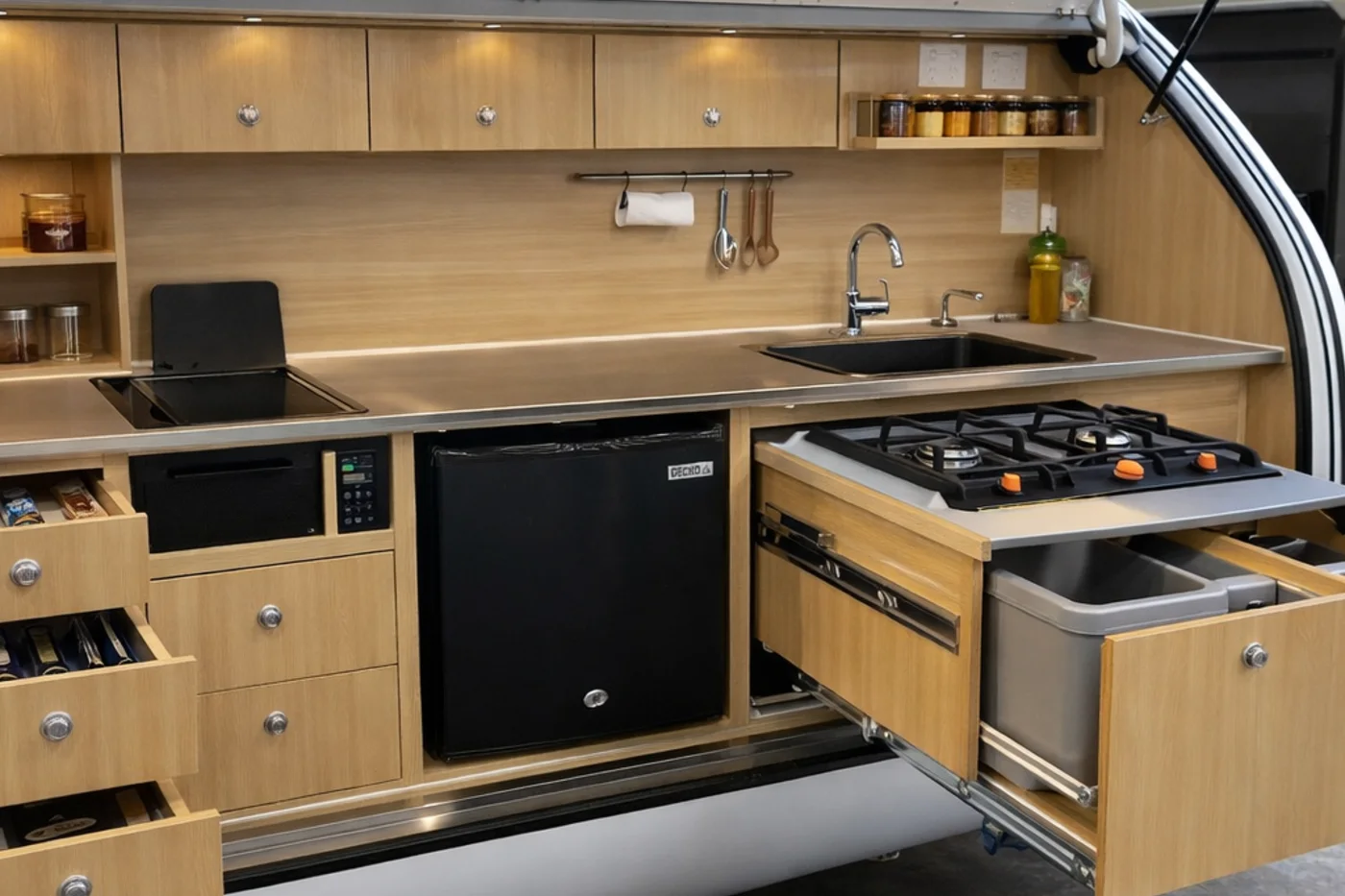
Built-in galley cabinetry gives the fridge a permanent home instead of the back of the car.
Breath Trailer note: the Breath Plus ($29,766) includes an integrated 12V fridge as standard. The Essential ($23,320) has pre-wired fridge provisions — cabling run, ready for your choice of unit.
4. Water Systems — Tanks, Pumps & Grey Water
Water capacity is often the real limiting factor for free camping access in Australia. Under the CMCA self-containment standard and various national park and state forest rules, you need demonstrable water storage capacity and grey water management to access the best sites.
Water system components
| Component | Typical spec | Cost (AUD) |
|---|---|---|
| Fresh water tank (food-grade poly) | 60–80L | $80–$200 |
| 12V diaphragm or submersible pump | 6–12 LPM | $50–$200 |
| Inline water filter (0.1 micron) | — | $40–$120 |
| Grey water tank (CMCA compliance) | 20–40L | $60–$150 |
| Accumulator tank (reduces pump cycling) | 0.75–1L | $40–$80 |
| Total system | $270–$750 |
60L provides approximately 3–4 days for two people camping conservatively (drinking, dishes, brief rinse). Families or those intending extended off-grid runs should target 80–100L.
The Breath Ultra includes a 60L fresh water tank and external hot shower as standard. The Breath Max includes a 120L fresh tank (plus a 70L grey tank) and full interior hot shower and bathroom — zero accessories required for complete water self-containment.
For the full regulatory picture on self-containment and free camping eligibility across each Australian state, see: Self-Contained Camper Australia: Rules, Rigs & Free Camping.
5. Towing Accessories — What You Actually Need
Many new teardrop camper owners overlook towing accessories until the first time something goes wrong on the road. Here is the priority list.
Anderson plug / DC charging cable
A standard 7-pin trailer plug only carries lighting circuits. To charge your camper’s battery while towing, fit a 50A Anderson plug (or SAE connector) wired to your tow vehicle’s auxiliary battery or DC-DC charger. This is an essential addition if your teardrop doesn’t arrive with one fitted. Cost: $50–$200 installed by an auto-electrician.
Electric trailer brakes
Australian road rules require brakes on all trailer axles if the Aggregate Trailer Mass (ATM) exceeds 750 kg. Most teardrop campers under 800 kg tare fall near or below this threshold when lightly loaded. However, load your camper with water, food, gear and two adults and you may exceed it — so check your specific model’s ATM carefully, not just the tare weight.
The Breath Max (1,700 kg ATM) ships with electric drum brakes as standard. Your tow vehicle will need a compatible brake controller — factory-fit on most modern Australian SUVs including the Toyota Prado, LandCruiser 300, Subaru Outback, Ford Everest and Mitsubishi Pajero Sport.
Tyre Pressure Monitoring System (TPMS)
A TPMS independently monitoring your camper’s tyres is a worthwhile investment on any trip over a few hours. A failed trailer tyre at highway speed with no warning is a serious safety risk. Systems like TyreFlation or Tymate start from ~$150 for a basic two-sensor setup.
Levelling blocks and wheel chocks
Compact but essential. Milenco ramps or Camco TasteLev levellers ($20–$60) take up virtually no space and make the difference between a comfortable sleep and a restless one when camped on uneven ground.
For a thorough walkthrough of Australian towing rules, ball weight calculations and setup checklists, see: Camper Trailer Towing Guide Australia: ATM, Ball Weight & Towing Setup.
6. Comfort & Sleep Upgrades
The teardrop’s signature advantage is an always-made-up queen bed. A few targeted upgrades take the sleep experience from basic to genuinely excellent.
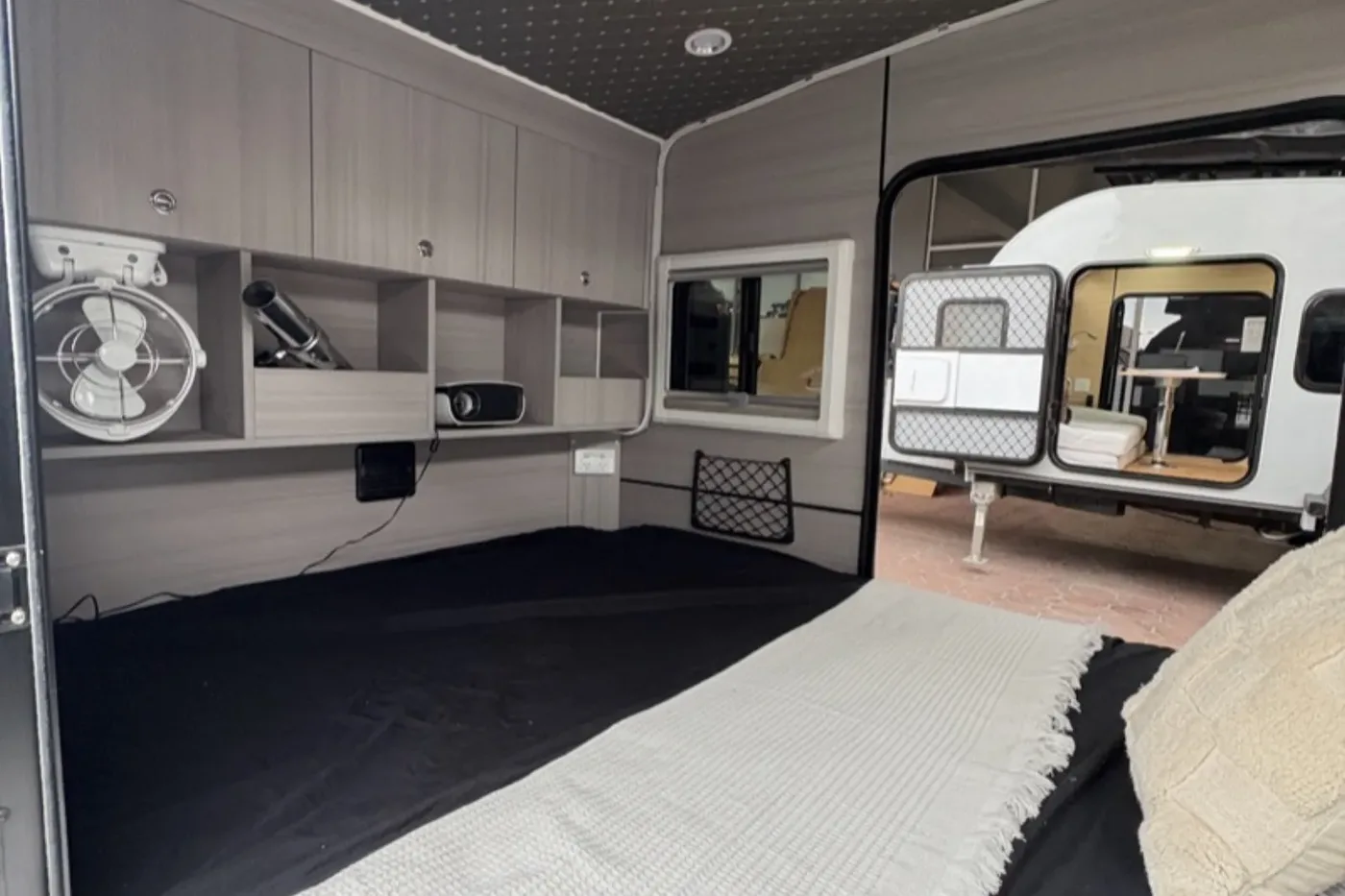
An always-made-up bed, with a fan and power close at hand, is the teardrop’s signature comfort.
Thermal regulation
- Quality down quilt (400–500 gsm): works year-round in most of coastal and inland Australia; add a liner for alpine conditions
- 12V electric blanket (~$50–$120): draws 3–5A, manageable on a lithium system, invaluable in the Snowy Mountains, Flinders Ranges or Tasmanian highlands
- Maxxair MaxxFan roof vent (~$350–$500 fitted): dramatically improves airflow on warm nights; the single most popular comfort retrofit on Australian teardrops
Lighting upgrades
LED strip lighting (12V, IP65 rated, 2,700K warm white) in the galley or under the awning rail transforms the campsite ambience. A set of strips typically runs $20–$60 and draws negligible power. Dimmable controllers add another $15–$30 and are worth every cent.
7. Safety & Communications — PLB, UHF Radio & Navigation
Australia is vast, remote, and unforgiving. These aren’t optional accessories — they are essential for anyone camping beyond reliable mobile coverage.
Personal Locator Beacon (PLB)
A PLB is the single most important safety device for remote Australian camping. When activated, it transmits a distress signal via the Cospas-Sarsat satellite network to the Australian Maritime Safety Authority (AMSA), which coordinates SAR response. Registration is free at beacons.amsa.gov.au.
| Model | Key features | Price (AUD) |
|---|---|---|
| GME MT610G | GPS, 24h battery, waterproof | ~$380 |
| GME MT620GR | GPS + Return Link Service notification | ~$499 |
| ACR ResQLink 400 | Buoyant, globally certified | ~$439 |
| ACR ResQLink 410 RLS | Return Link confirmation to phone | ~$479 |
Protocol: carry one per party. Register it before you leave. Leave a trip plan — departure date, route, expected return — with a trusted contact who knows to call AMSA (1800 641 792) if you don’t check in.
UHF CB Radio (477 MHz)
Australia’s UHF CB network is the standard communication layer in the outback — no licence required, no subscription. A handheld 5W radio ($40–$120) or a permanently-mounted cabin unit ($120–$300) lets you communicate with other campers and get real-time road condition reports. Channel 40 is the standard Australian outback road channel; channel 18 is the general calling frequency in many campgrounds.
Satellite Messenger
If you want two-way communication — not just an SOS beacon — a Garmin inReach Mini 2 (~$400–$500 + subscription from ~$15/month) or SPOT X provides messaging from anywhere in Australia. Ideal for multi-week Big Lap travellers who want to stay in touch with family without relying on mobile coverage.
8. Storage Solutions — Making the Most of Limited Space
Teardrop campers are compact by design. Smart external storage prevents the inevitable “there’s nowhere to put anything” frustration after day three.
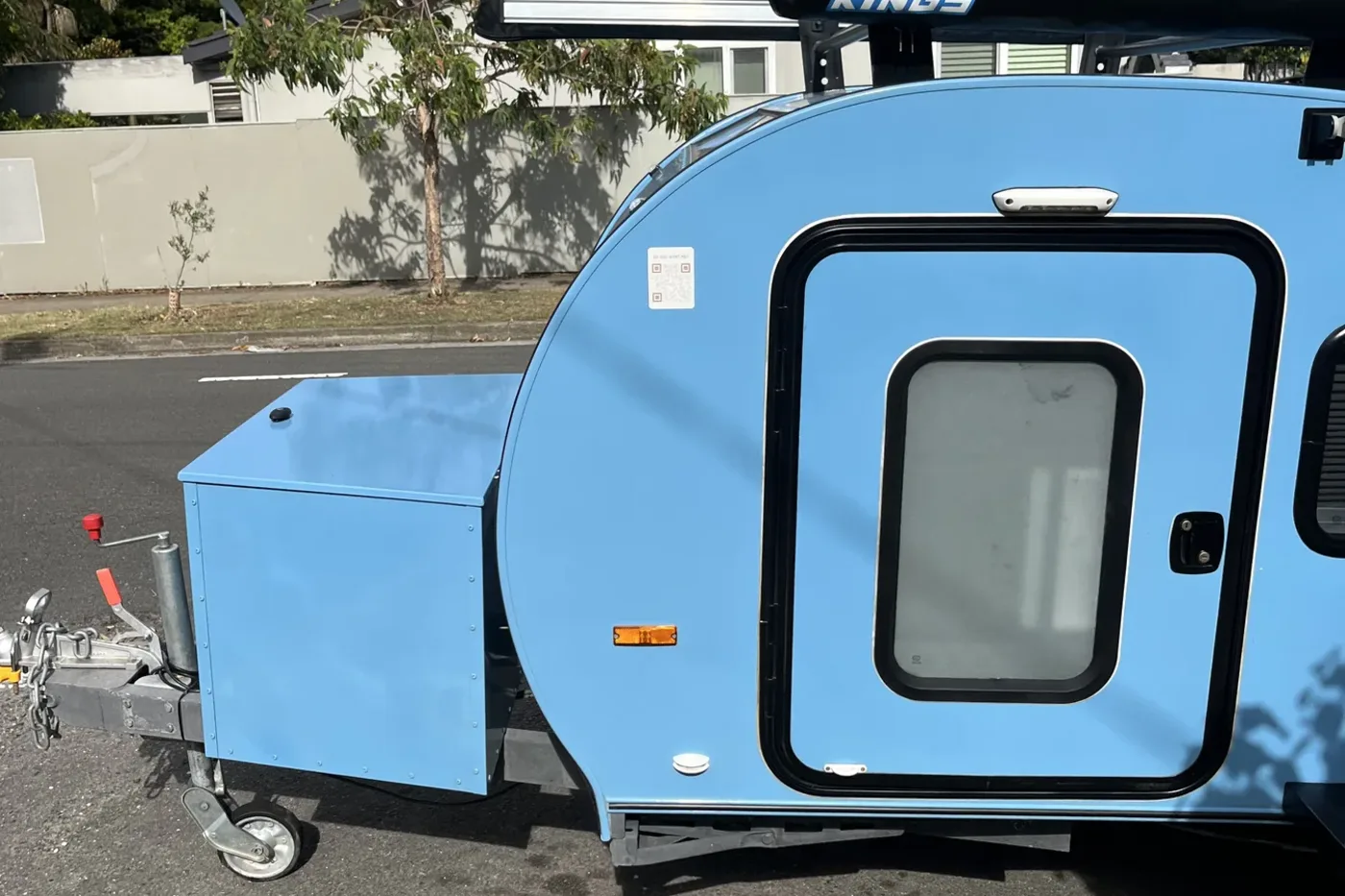
A drawbar toolbox adds lockable storage for gear you don’t want inside the cabin.
- Drawbar / A-frame storage box: mounts on the trailer tongue, provides lockable external storage for tools, recovery gear and levelling blocks. Brands: MSA 4x4, JMACX. Cost: $150–$400.
- Roof rack or cargo bars: for kayaks, surfboards, bikes or rooftop dry bags. Most Breath Trailer models accept standard Rhino-Rack or Yakima cross-bars on the body rail. Cost: $200–$600.
- Camp kitchen organiser: a portable camp kitchen unit or folding prep table dramatically increases galley workspace for extended touring — particularly useful when the built-in galley is at maximum capacity.
- Hanging gear organiser / shoe bag: the oldest trick in caravan travel; a canvas hanging bag on the rear hatch door keeps small items from disappearing into the bedding.
9. Which Accessories Come Standard on Breath Trailer Models?
One of the practical advantages of buying a Breath Trailer is that most of the expensive accessories are factory inclusions rather than costly aftermarket additions.
| Accessory | Essential $23,320 | Plus $29,766 | Ultra $34,749 | Max $42,900 |
|---|---|---|---|---|
| Integrated 12V fridge | Provisions only | ✅ Included | ✅ Included | ✅ Included |
| Roof solar panel | ❌ Add-on | 100W | 160W | 200W |
| Lithium LiFePO₄ battery | ❌ Add-on | 100Ah | 100Ah | 200Ah |
| Fresh water tank + 12V pump | 40L | 60L | 60L | 120L |
| Hot water system | ❌ | ❌ | ✅ External | ✅ Internal |
| Grey water management | ❌ | ❌ | ✅ | ✅ |
| Interior bathroom | ❌ | ❌ | External shower | Full bathroom |
| Electric trailer brakes | N/A (<750 kg ATM) | N/A | N/A | ✅ Standard |
| Awning rail mount | ✅ | ✅ | ✅ | ✅ |
The Breath Max is the only Australian teardrop camper under $50,000 with a full interior bathroom — no additional accessories required for complete CMCA self-containment.
Compare all four models side-by-side at: Breath Trailer Comparison.
10. Realistic Accessory Budget in 2026
If you purchase a Breath Essential ($23,320) and want to bring it to a similar off-grid capability spec as the Breath Plus:
| Category | Estimated cost (AUD) |
|---|---|
| 200W solar + MPPT controller + 100Ah lithium | $1,400–$2,000 |
| 60L 12V compressor fridge | $700–$1,200 |
| OzTent Foxwing 270° awning | $980–$1,100 |
| Water upgrade (80L tank + pump + filter) | $400–$700 |
| PLB + UHF CB radio | $550–$700 |
| TPMS (two sensors) | $150–$200 |
| Levelling blocks + wheel chocks | $60–$100 |
| Total accessories | ~$4,240–$6,000 |
An Essential fully accessorised to off-grid spec costs approximately $27,600–$29,300 all-up — just below the Plus list price, but with your specific priorities baked in and full warranty on every component.
For buyers who want it done from the factory, the Breath Plus at $29,766 — with its included fridge, 100W solar and 100Ah lithium — typically represents better value than the DIY accessory route for most weekend and short-trip campers.
11. FAQ: Teardrop Camper Accessories Australia
What is the most important accessory to buy first for a teardrop camper in Australia?
If you’re camping beyond mobile coverage, a PLB is non-negotiable — buy it before anything else. For everyday off-grid capability, the solar + lithium battery system delivers the highest impact. If budget forces a choice, prioritise the PLB first: getting stranded in remote Australia without a means of summoning help cannot wait, whereas the solar upgrade can.
Do I need electric brakes on a teardrop camper in Australia?
Only if the Aggregate Trailer Mass (ATM) exceeds 750 kg. Most Australian teardrop campers under 900 kg tare fall below this threshold when lightly loaded. However, once you add water, food, gear and two adults, you can push closer to or beyond 750 kg — so always verify your specific model’s ATM (not just tare weight) and load accordingly. The Breath Max (1,700 kg ATM) includes electric brakes as standard.
What size solar panel do I need for a teardrop camper in Australia?
A minimum of 100W for basic camping with lights and USB charging. For genuine off-grid touring with a compressor fridge running 24/7, 200W is the practical sweet spot. Australia’s solar irradiance is exceptional compared to most of the world (5–6 peak hours per day in most regions), so sizing is relatively forgiving — but bigger is always better when the weight and cost difference between 100W and 200W is small.
Can I fit any brand of awning to a teardrop camper?
Yes, with the right mounting. Most teardrops accommodate standard roof-rail or side-mount awning brackets. The key measurement is overhang clearance — a 2.5 m awning needs 2.5 m of clear space beside the trailer when deployed. A 270° awning (OzTent Foxwing or Darche Eclipse) is the most versatile option, wrapping the side and rear of the trailer and covering the hatch area.
Is a UHF radio better than a satellite messenger for remote camping?
You want both, for different purposes. UHF CB (channel 40) is free, licence-free, and keeps you connected to other road users for real-time road condition reports and convoy communication — but it has limited range (~20 km line-of-sight). A PLB or satellite messenger (Garmin inReach) provides genuine emergency coverage from anywhere in Australia. The ideal remote camping communications kit: UHF handheld + PLB + a trip plan lodged with a trusted contact.
What accessories come standard on Australian teardrop campers?
It varies significantly. Budget brands often include only basic 12V lighting wiring. Mid-range teardrops typically add water pumps, 60L tanks and LED lighting. Premium brands like Breath Trailer include fridges, solar panels and lithium batteries from the Plus model up. The Breath Max includes everything needed for full self-containment as standard. Always scrutinise the spec sheet carefully: “solar ready” (a cable terminated in the body) is very different from “solar included” (a panel, MPPT controller and battery installed and commissioned).
Recommended Reading
- Off-Grid Teardrop Camper Australia: Solar, Batteries & Power Systems Guide
- Self-Contained Camper Australia: Rules, Rigs & Free Camping Access
- Camper Trailer Towing Guide Australia: ATM, Ball Weight & Setup
- Teardrop Camper Insurance Australia: What’s Covered & What’s Not in 2026
- Best Teardrop Campers Australia 2026: Brand-by-Brand Buyer’s Guide
Ready to spec your ideal setup? Compare all four Breath Trailer models or book a no-pressure viewing at our Sydney showroom — bring your accessory list and we’ll walk through what’s included versus what you’ll need to add.