Teardrop Camper for Families in Australia: The 2026 Honest Guide
Can a teardrop camper work for Australian families with kids? Sleeping arrangements, bathroom options, towing with an SUV, free camping, and the best models compared — honest, no fluff.
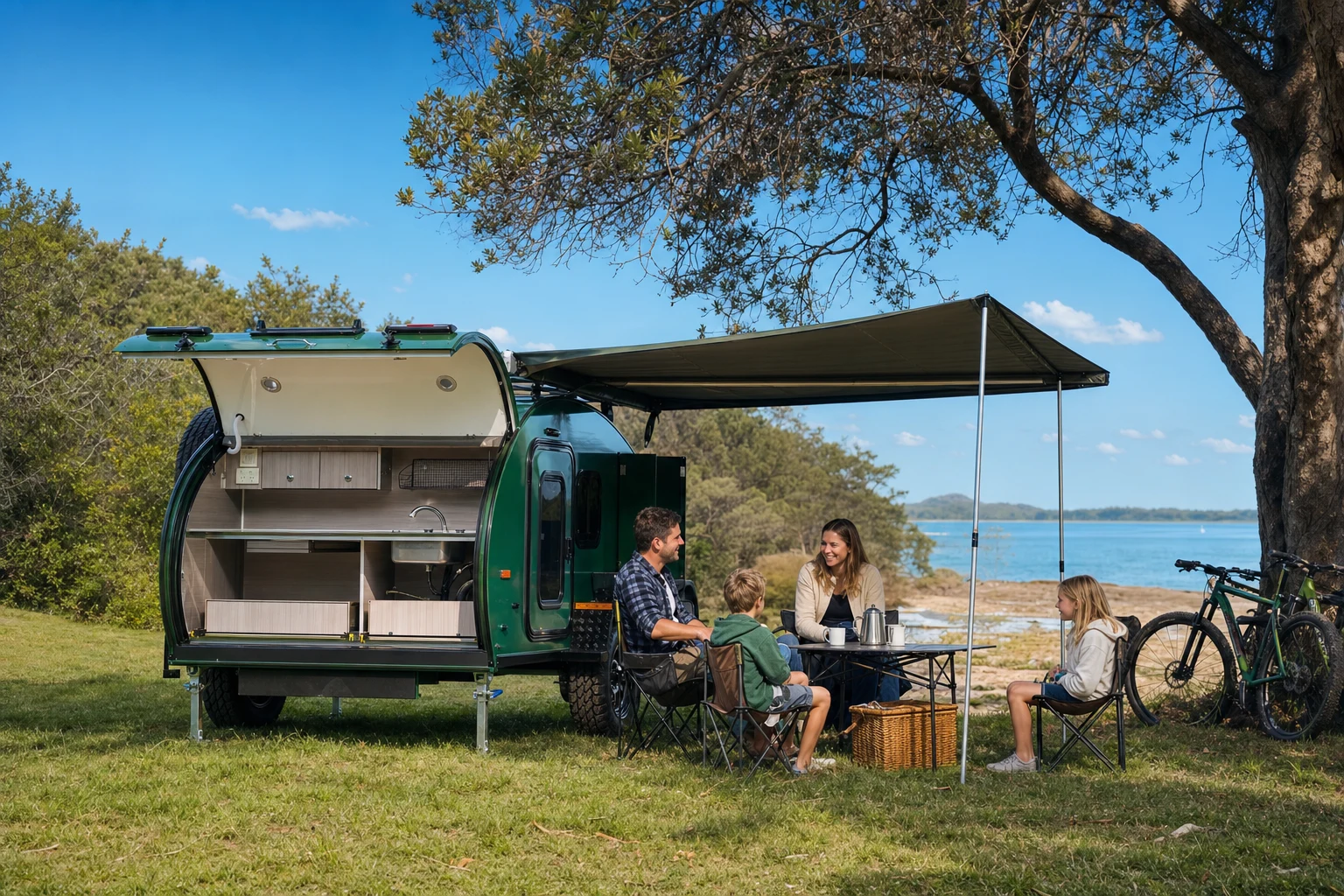
Every school holidays, the same conversation plays out in thousands of Australian households: “Should we finally buy a camper?” And every time someone searches for a teardrop camper for families in Australia, they hit the same cautious answer — these are really for couples.
That answer is mostly wrong — and partly right. Here is the honest version.
In 2026, Australia’s teardrop camper market has matured enough that families have real, practical options: models with annexe solutions for extra sleepers, integrated rooftop tent setups, and — the genuine game-changer — the Breath Max, the first sub-$50,000 teardrop on the Australian market with a full interior bathroom. That last one solves the single problem that decides the question for most parents with young kids.
This guide covers every decision a family needs to make before buying a teardrop camper in Australia: sleeping arrangements by family size, the bathroom question, towing with a fully-loaded school-holiday SUV, off-grid capability for free camping, and a budget comparison against a traditional family caravan.
Can Families Actually Use a Teardrop Camper?
Yes — with planning. The longer answer depends on three variables:
1. How many kids, and how old are they? A couple with one child under eight will find teardrop camping genuinely easy. A family of five with teenagers is a different conversation.
2. How do you feel about campground bathrooms at 2 am? For families with toddlers, this is less a preference question and more a dealbreaker.
3. How long are your trips? Teardrops are outstanding for weekend escapes and holidays up to three weeks. For a 12-month Big Lap with a family, a larger van probably makes more sense.
The reason teardrops have a “couples only” reputation is simple geometry: the interior sleeping area is designed for a queen-size mattress, which fills the cabin. Most models sleep two adults comfortably. That is not a flaw — it is the trade-off that keeps tare weights low (700–1,200 kg), makes towing with a standard SUV realistic, and reduces setup to five minutes.
But “two sleepers inside” does not mean “for couples only.” It means you need a strategy for the extra people — and in 2026, there are several good ones.
How Many People Can Sleep in a Teardrop?
Most Australian teardrop campers sleep two adults in the main cabin. A small number of models can fit two adults plus one child under 10. Beyond that, families need a supplementary sleeping arrangement. Here is how the numbers work:
| Configuration | Adults | Children | Notes |
|---|---|---|---|
| Teardrop interior only | 2 | 0–1 (small) | One child under 10 fits snugly alongside adults on a queen |
| Teardrop + rooftop tent on tow vehicle | 2 | 2 | RTT mounts on the car, not the trailer; no trailer weight penalty |
| Teardrop + rooftop tent on trailer | 2 | 1–2 | Check trailer ATM — most models allow 50–80 kg RTT when loaded conservatively |
| Teardrop + canvas annexe or freestanding tent | 2 | 2–4 | Most flexible; older kids love having their own space |
The annexe plus teardrop setup is what most Australian families with two or three children actually use. A quality canvas annexe ($400–$900) creates a weatherproof side room for sleeping or play, keeps kids close without squeezing everyone into the cabin, and packs down small enough to carry without impacting tow weight significantly.
Families with teenagers often find the reverse works: parents in the teardrop cabin (warm, dry, quiet) and teenagers in the annexe with their own light and charging setup. The kids usually prefer it.
The Bathroom Question — The Make-or-Break for Most Parents
Ask 100 Australian parents what stops them buying a teardrop camper instead of a caravan, and the bathroom comes up more than anything else. This is completely understandable. Anyone who has dragged a toddler to a campground amenities block in the rain at midnight does not want to do it twice.
In 2026, there is a genuine answer: the Breath Max — the only teardrop-style camper under $50,000 on the Australian market with a full interior wet bathroom including shower, cassette toilet, and hot water as standard — plus 2.1 metres of standing headroom throughout the cabin.
For families, the bathroom changes everything. It is not about luxury. It is about:
- Night-time toilet trips for young children without leaving a secured, climate-controlled cabin
- Hot showers after beach days or dusty outback tracks without queuing at camp facilities
- Self-contained eligibility (under state rules), which unlocks free camping on roadsides, rest areas, and national park sites that prohibit non-self-contained rigs
- Eliminating the amenities block lottery at crowded holiday parks during peak school holidays
For families with children under 10, the Breath Max’s bathroom shifts from a “nice to have” to a “this solves the problem.” At $39,000, it sits roughly $15,000–$40,000 below a comparably equipped family bunk caravan — while weighing 1,200 kg against a caravan’s typical 1,600–2,500 kg.
If your kids are older and campground facilities genuinely do not bother your family, the Breath Ultra ($30,290, 900 kg) with its external shower handles the post-hike rinse without the interior footprint. For weekend warriors, the Breath Plus ($25,740, 800 kg) or Breath Essential ($19,990, 700 kg) cover the basics cleanly.
For a full breakdown of what interior bathrooms look like in Australian teardrops, see: Teardrop Camper with Shower & Toilet in Australia — What You Actually Get.
Setup Speed: Why Exhausted Parents Love the 5-Minute Camp
Any parent who has arrived at a campsite after a six-hour school-holiday drive with two hungry, bickering children knows exactly why setup speed matters. Traditional soft-floor and forward-fold camper trailers take 10–40 minutes to pitch. A hard-shell teardrop takes five.
With a Breath Trailer — or most hard-shell teardrops — arrival looks like this:
- Back into the site, unhitch
- Level with wheel chocks (under 60 seconds)
- Open the rear galley hatch if cooking that night
- Switch on the 12V system or connect site power
That is it. The bed is already made inside. The fridge has been running since you left home. There is no canvas to unfurl, no poles to thread, no zips to fight in the dark while children escalate around you.
For families, this is not a minor convenience — it is the difference between arriving at camp relaxed or arriving frazzled. Combine it with off-grid capability (no need to book a powered site months ahead), and a teardrop dramatically lowers the friction of family camping. More trips per year become feasible because the commitment level drops.
Towing a Teardrop With a Family Car
Here is where teardrops genuinely shine for families compared to a caravan. A typical Australian family SUV — Toyota RAV4, Mazda CX-5, Kia Sorento, Hyundai Tucson, Ford Escape — with a 1,500–2,000 kg towing rating can tow every Breath Trailer model, including the 1,200 kg Max.
That matters because most families do not have a dedicated tow vehicle. The school-run car is also the camping car, fully loaded with children, luggage, car seats, snacks, and camping gear. Here is a practical weight snapshot:
| Breath Model | Tare Weight | ATM | Est. Towball Load | Min. SUV Tow Rating |
|---|---|---|---|---|
| Essential | 700 kg | 900 kg | ~90 kg | 1,500 kg |
| Plus | 800 kg | 1,000 kg | ~100 kg | 1,500 kg |
| Ultra | 900 kg | 1,100 kg | ~110 kg | 1,800 kg |
| Max | 1,200 kg | 1,500 kg | ~120 kg | 2,000 kg |
Before hitching up, always check your vehicle’s Gross Vehicle Mass (GVM) against your expected laden weight. A Toyota RAV4 with four passengers, luggage, and car seats may already be carrying 400–500 kg before you add towball load. For the full calculation and state-by-state towing laws, see the Camper Trailer Towing Guide for Australia.
One underappreciated benefit: the aerodynamic teardrop shape cuts fuel consumption while towing compared to a box-shaped camper trailer or caravan. Most owners report a fuel penalty of 2–4 L/100km rather than the 4–7 L/100km typical of forward-fold camper trailers — a meaningful saving on a 1,500 km school holiday run.
Free Camping With Kids: The Off-Grid Advantage
School holidays in Australia mean competition for powered sites at popular caravan parks. Families with off-grid capability skip the fight — and often find quieter, more spectacular camps in the process.
A well-equipped Breath Plus, Ultra, or Max runs on lithium batteries (200Ah+), rooftop solar (200W standard), a 12V compressor fridge, and a water tank large enough for several days away from facilities. No campground connection required.
The Breath Max adds self-contained eligibility to this: with an interior toilet, grey water management, and sufficient water storage, families can camp legally on roadsides, rest stops, and certain national park sites that exclude non-self-contained rigs. In states like Victoria, Queensland, and NSW, self-contained certification opens hundreds of free or low-cost sites that conventional campers cannot use.
For families, the practical outcome is:
- Free and low-cost sites that are quieter and less crowded during peak holidays
- Vehicle-based camping in national parks that prohibit freestanding tents
- More flexibility on multi-day routes without planning around caravan park locations every night
- A lower annual camping spend — which means more holidays for the same budget
The full breakdown on what self-containment means in Australia and which states have different rules: Self-Contained Camper Australia: Free Camping Rules, Options and Costs.
Budget Comparison: Teardrop vs Family Caravan
The most common objection from parents is: “We need a proper caravan — more room for the kids.” That is true for some families. But the price gap is real and significant:
| Option | Purchase Price (AUD) | Tow Vehicle Upgrade? | Fuel Penalty | 5-Year Estimated Total Cost |
|---|---|---|---|---|
| Breath Max + annexe setup | ~$41,000 | No (most family SUVs) | 2–4 L/100km extra | ~$55,000 |
| Mid-range family caravan | $55,000–$80,000 | Sometimes | 4–6 L/100km extra | ~$80,000–$110,000 |
| Premium bunk family caravan | $85,000–$130,000 | Usually yes | 5–7 L/100km extra | ~$125,000–$175,000 |
5-year cost estimates include purchase price, depreciation (~15%/yr), registration, insurance, servicing, and fuel delta on 10,000 km/yr of towing. Estimates only — individual results vary.
For a family who camps 10–25 nights per year across school holidays and long weekends, the teardrop math is compelling. The $39,000 Breath Max with a $2,000 annexe setup covers sleeping (adults in cabin, kids in annexe), bathroom (interior), kitchen (rear galley), and off-grid power — at roughly half the price of a comparable family bunk caravan.
The honest caveat: a teardrop is not the right answer for a family of five doing a six-month full-time Big Lap with everyone sleeping indoors. For that use case, a larger caravan with dedicated bunk sleeping earns its cost. For everyone else — school holiday warriors, weekend escape artists, families who camp 10–30 nights a year — the numbers are hard to ignore.
For a deeper side-by-side: Caravan vs Teardrop Camper Australia: The 2026 Head-to-Head.
Best Teardrop Campers for Australian Families in 2026
Here is how the key Australian options compare on the dimensions that matter most to families:
| Model | Price (AUD) | Tare | Interior Bathroom | Headroom | Best Kids Strategy | Best Family Type |
|---|---|---|---|---|---|---|
| Breath Essential | $19,990 | 700 kg | No | Standard | Annexe + 1 small child inside | Weekend trips, 1 child under 8 |
| Breath Plus | $25,740 | 800 kg | No | Standard | Annexe + car rooftop tent | Budget-conscious, older kids |
| Breath Ultra | $30,290 | 900 kg | External shower | Standard | Annexe + rooftop tent | Active families, regular camping |
| Breath Max | $39,000 | 1,200 kg | ✅ Full wet bath | 2.1 m standing | Annexe for kids, interior bath for all | Families with young kids or toddlers |
| Hip Campers Summit | ~$26,000–$30,000 est. | 700 kg | No | 2.0 m | 1 small child inside, annexe for 2nd | Compact family touring |
| Stockman Rover 02 | ~$28,000–$36,000 est. | ~750 kg | No | Standard | Annexe or car RTT | Rugged families, off-road travel |
Prices current June 2026. Hip Campers and Stockman prices are estimates from available RRP data — confirm with dealers. Breath Trailer prices are AUD RRP.
6 Practical Tips for Your First Family Teardrop Holiday
1. Test the sleeping arrangement before you leave home. Have everyone sleep in the configured setup in the driveway for one night. Surprises at a campsite at 9 pm with tired children are not fun. Fix the gear list at home.
2. Buy the annexe before the first trip. A quality canvas annexe ($400–$900) immediately doubles your usable floor space and becomes the playroom, kids’ bedroom, and wet gear storage zone. Look for a sewn-in floor to keep insects and red dust out.
3. Validate your 12V system at home. Run the fridge for 24 hours, check all USB and 240V outlets work, confirm the solar is charging properly. Do not discover a wiring issue 300 km from town on day one of the holidays.
4. Pre-cool the fridge the night before departure. A 12V compressor fridge starting at ambient temperature draws disproportionate power on day one. Pre-cooling at home means it is running efficiently from the first night of camping — and your food is cold on arrival.
5. Set up a kids’ kit for the annexe. Each child gets: a headlamp, a sleeping bag rated for the forecast temperature, a power bank for devices, and a set of downloaded content for early mornings when parents are still sleeping. Happy kids equal a happy camp.
6. Start with a powered site. Book a powered site for your first teardrop trip so you can learn the system — fridge, lights, water pump, charging — without any off-grid pressure. Once you understand what draws what power, free camping feels easy rather than risky.
FAQ: Teardrop Campers for Families in Australia
Can a teardrop camper fit a family of 4? Yes, with supplementary sleeping. Two adults sleep inside the trailer; two children sleep in a rooftop tent on the tow vehicle or in a canvas annexe attached to the trailer. Families with one child under eight often fit three people inside the main cabin on the queen mattress.
What is the best teardrop camper for families with young kids in Australia? The Breath Max is the most practical option for families with children under 10. It is the only teardrop on the Australian market under $50,000 with a full interior bathroom — shower, toilet, and hot water — which removes the biggest pain point for parents of young children. Its 2.1 m headroom also means a standing-height cabin for adults.
Do teardrop campers have enough storage for a family trip? Most modern teardrops have well-designed external storage in the rear galley hatch, underbed compartments, and a front-access nose cone or tunnel boot. For a week away with two children, most families manage comfortably with disciplined packing. Roof racks on the tow vehicle handle bikes, kayaks, or surfboards.
Can I tow a teardrop camper with a standard family SUV in Australia? Almost certainly. Teardrop campers range from 700 kg (Breath Essential) to 1,200 kg (Breath Max). Popular family SUVs — Toyota RAV4, Mazda CX-5, Kia Sorento, Ford Escape — typically have towing ratings of 1,500–2,000 kg, which covers the entire Breath Trailer range. Always verify your specific vehicle’s laden tow capacity after accounting for passengers and loaded luggage before hitching up.
Is a teardrop camper better than a family caravan for school holiday trips? For trips under three weeks with two to three children, a teardrop with an annexe competes strongly with a family caravan on purchase price ($39k vs $55k–$130k), fuel consumption, setup speed, and towability with a standard SUV. The caravan wins on total interior sleeping capacity for larger families of five or more, or for families who need everyone sleeping indoors.
What age children are teardrop campers suitable for? From birth, with appropriate planning. Many Australian families with babies and toddlers specifically choose the Breath Max because the interior bathroom eliminates the 2 am amenities block problem entirely. Older children (8+) often prefer sleeping in the annexe or rooftop tent as their own independent space within the family camp.
Does a teardrop camper work for free camping with kids? Yes — and it is one of the strongest arguments for choosing a teardrop over a larger caravan. A self-contained teardrop (particularly the Breath Max) qualifies for free camping on roadsides and certain national park sites that prohibit non-self-contained rigs, opening up quieter and less crowded camping options during peak school holidays.
Ready to Work Out Your Family Setup?
The teardrop camper is not a compromise for families — it is a deliberate choice to camp more frequently, set up faster, and spend more of the holiday budget on experiences rather than on the rig.
For Australian families, the decision usually comes down to two questions: do you need an interior bathroom (Breath Max, full stop), and what is your actual sleeping count? The Breath Trailer Comparison page puts all four models side by side with specs and prices so you can see exactly which configuration fits your family before you commit.
When you are ready to go further, book a no-pressure conversation with the Breath Trailer team — honest advice, no sales script, just help finding the right setup for your family’s camping style and budget.
Recommended Reading
- The Complete Guide to Tear Drop Campers in Australia (2026)
- Off-Grid Teardrop Camper Australia: Solar, Lithium, and Water Systems Explained
- Self-Contained Camper Australia: Free Camping Rules and What It Really Costs
- Caravan vs Teardrop Camper Australia: The 2026 Honest Head-to-Head
- Camper Trailer Towing Guide Australia: Weights, Laws, and SUV Limits