Australian Made Teardrop Camper: What It Really Means (2026)
Most campers marketed as Australian made would not pass the substantial transformation test. The rule, and how to check any brand yourself.
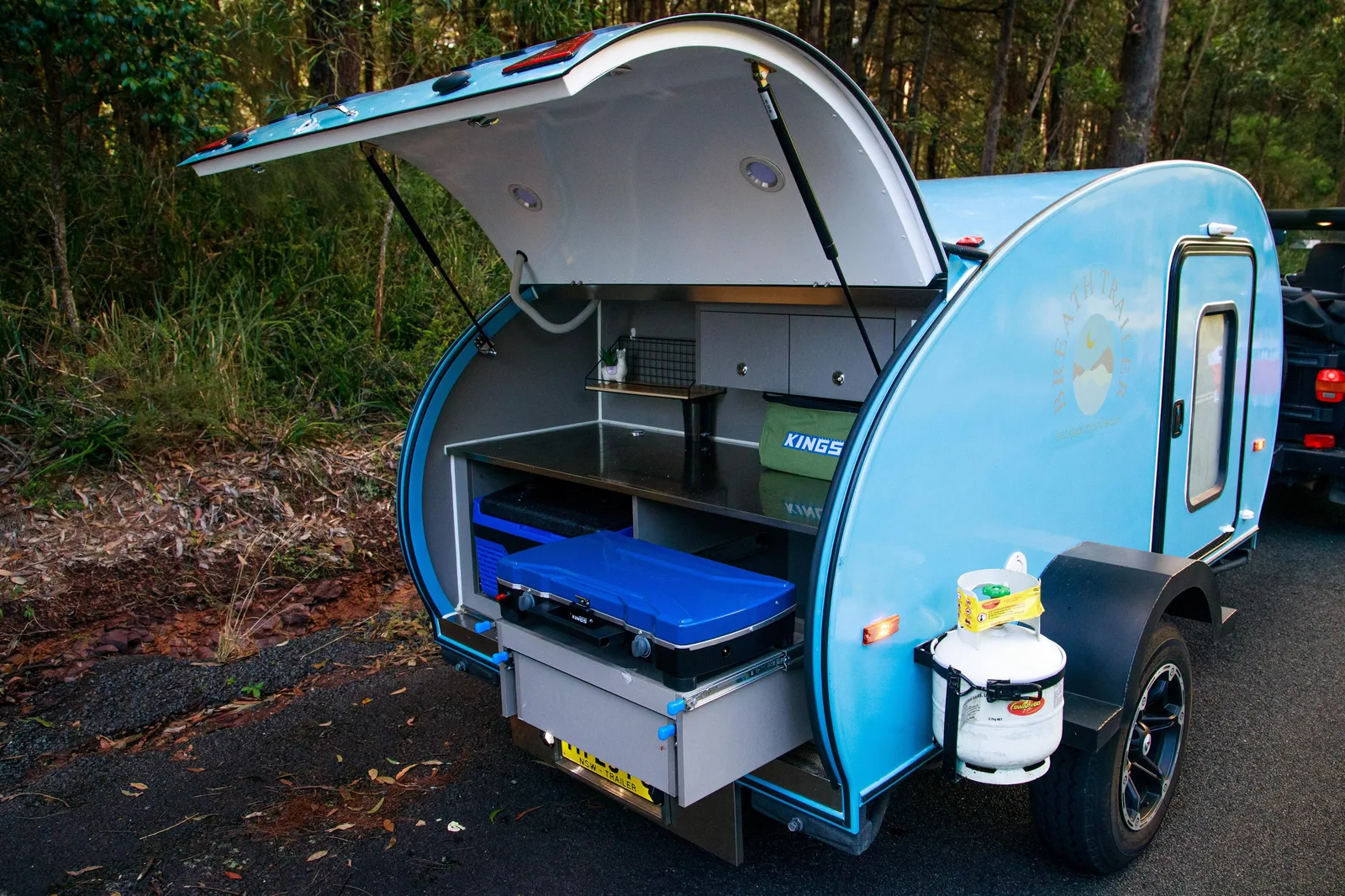
If you’ve spent any time researching camper trailers, you’ve seen the phrase everywhere: “Australian made.” It’s on banners, in ads, and stamped across spec sheets. But here’s the uncomfortable truth the industry rarely spells out — a large share of campers sold as “Australian made” are in fact manufactured overseas and assembled, fitted or finished in Australia. The two are not the same thing, and the difference matters when you’re towing a $20,000–$40,000 trailer into the bush.
This guide cuts through the marketing. We’ll explain what “Australian made” legally means in 2026, why almost every premium teardrop on the market is really a hybrid of globally-sourced components and Australian workmanship, how to tell who actually installs and certifies the trailer you’re buying, and why — done transparently — the hybrid model often delivers the best reliability and value of all. We’ll also be straight about exactly how a Breath Trailer is put together, because confidence should come from facts, not flags.
What “Australian made” actually means in 2026
In Australia, country-of-origin claims aren’t just marketing — they’re governed by the Australian Consumer Law and the Australian Made Campaign. The headline rule is simple to state and easy to forget:
- “Made in Australia” requires that the product underwent its last substantial transformation in Australia. The ACCC defines that as work which makes the product fundamentally different in identity, nature or essential character from its imported components — and is explicit that processes which merely finish off a product do not qualify. Their own examples: cutting and sewing imported fabric into a shirt is substantial transformation; adding a logo to an imported shirt, painting a chair or fitting eyelets to a shoe is not.
- “Assembled in Australia” is a different, weaker claim — it means the parts were put together locally, but the product doesn’t meet the “made” threshold.
- The green-and-gold kangaroo logo is something else again: it’s the certification mark of the Australian Made Campaign, a private licensing body with its own criteria. A product can be legally “made in Australia” without carrying it, and the logo is not a legal test in itself.
One point worth correcting, because it circulates widely: there is no 50% production-cost requirement for a “made in” claim. That threshold existed under the older country-of-origin framework and was removed from the Australian Consumer Law in 2017. The test today is substantial transformation, full stop. Any brand — or critic — still quoting the 50% rule is working from a decade-old rulebook.
That gap is where most of the confusion lives. As the editors at Camper Trailer Australia put it, the line between “imported” and “local” is now genuinely blurry: many importers have parts manufactured overseas, then design, engineer and assemble to Australian standards back home to maintain quality control. CarsGuide’s roundup of Australian-made camper trailers makes the same point — read the wording carefully, because “Australian designed,” “Australian owned” and “Australian made” are three very different promises.
The honest takeaway: very few camper trailers at any price are 100% Australian made down to the last bolt. What separates a good buy from a risky one isn’t a flag on the brochure — it’s who installs, tests and certifies the trailer before it reaches you.
Why the hybrid model usually wins
It’s tempting to assume “100% local = best, imported = worst.” The reality in 2026 is more nuanced.
A teardrop camper is an assembly of dozens of subsystems — chassis, suspension, hubs, brakes, battery, inverter, solar, water system, gas, lighting, kitchen hardware. No single workshop on earth makes all of those better than the world’s best specialist manufacturers. A lithium battery from a dedicated power brand, a suspension component from a proven supplier, and a gas appliance from a certified maker will almost always outperform a “we make everything ourselves” alternative.
The smartest approach — and the one most quality-focused Australian brands now use — is to source proven components from trusted manufacturers, then install, test, certify and quality-control them locally with skilled Australian trades. You get the reliability of specialist parts and the accountability of a local team that stands behind the finished product.
The risk isn’t that components are globally sourced. The risk is a trailer that’s shipped in fully built, with no local installation, testing or sign-off — because when something fails on the Big Lap, there’s no one who actually touched your trailer to call. That distinction is the whole game.
| What you’re told | What actually matters |
|---|---|
| ”Australian made” badge | Where the trailer was last assembled and tested |
| ”Premium components” | Who installs and tests those components |
| ”Quality build” | Whether there’s documented quality control before delivery |
| ”Local brand” | Whether there’s a local workshop and team you can reach |
| Lowest price | 5–10 year total cost once you factor reliability and support |
How a Breath Trailer is actually built
We’ll be specific, because transparency is the point. A Breath Trailer combines proven components from trusted manufacturers around the world with skilled Australian workmanship — installation, certification, and quality control — at our Sydney workshop. Every trailer that leaves our showroom has been professionally assembled, fitted, tested and inspected before delivery.
Behind every trailer is a team of specialists:
- Electrical technicians
- Mechanical specialists
- Welders and fabricators
- Gas-certified technicians
- Quality-control professionals
Rather than compromise on quality to chase a “made here” label, we select respected components and ensure every system is installed, tested and prepared by our Australian team. Here’s what that looks like, system by system.
Electrical: KICKASS power, installed and tested in Sydney
We partner with KICKASS, one of Australia’s leading suppliers of off-grid power solutions. Our electrical team performs the complete installation and testing of:
- Lithium battery systems
- Inverters and battery chargers
- Solar panels and battery boxes
- Hot water systems
- Interior, kitchen, bedroom and amber camp lighting
Electrical systems are among the most important — and most failure-prone — parts of a modern camper. Our technicians install and test every component so that all lighting, charging and power-management systems operate correctly before delivery. If you want to understand how these systems perform in the field, our off-grid teardrop camper guide breaks down lithium sizing, solar and DC-DC charging in detail.
Mechanical: suspension, brakes and running gear
Australia’s roads and tracks demand confidence in your running gear. Our mechanical team inspects and prepares every trailer, including:
- Suspension inspection and setup
- Hub installation and checking
- Electric brake installation
- Wheel and bearing inspection
- Structural reinforcement where required
- Final mechanical quality control
Because Australian-assembled campers are typically built lighter than equivalent fully-imported units, the running gear has an easier life — but we still check it thoroughly, since wheel-bearing and brake issues are the most common roadside failures Australians actually experience. (More on that in our teardrop camper maintenance guide.)
Welding and fabrication, in-house
Our workshop performs welding and fabrication so accessories are securely fitted for years of use — bike-rack fabrication and mounting, brackets, structural reinforcement, and custom welding where required. Having this capability in-house is exactly what lets us hold the standard we expect from every trailer, rather than outsourcing the parts that matter most.
Gas: installed and certified
Safety is never negotiable. Our gas-certified technicians install and inspect every gas system so it operates correctly and to standard — important context if you’re comparing models with an interior bathroom and full self-containment.
Air conditioning and accessories
Comfort matters as much as capability. We install and test air-conditioning systems locally, and we fit premium accessories from trusted Australian brands — roof-top tents, awnings and camping gear — inspecting each one so it integrates cleanly with the trailer. See our teardrop camper accessories guide for how these add up.
The part most buyers never see: multiple stages of quality control
Components don’t make a camper reliable — process does. Before delivery, every Breath Trailer goes through comprehensive inspection: electrical systems tested, mechanical systems checked, and brakes, suspension, lighting, batteries and accessories all verified to function exactly as intended.
This is the stage that separates a trailer you can trust from one that simply rolled off a container. A globally-sourced lithium battery is only as good as the technician who wired and load-tested it; a premium suspension component only protects you if someone torqued and inspected it. Quality isn’t the parts you choose — it’s the people who stand behind the finished product.
If you’d like to see that workmanship in person before you buy, you can inspect a Breath Trailer at one of our viewing locations — we’d rather you check the build with your own eyes than take our word for it.
How to tell if a camper is genuinely built and checked in Australia
Whatever brand you’re considering, use this checklist to cut through the marketing. A confident, transparent manufacturer will answer every one of these without hesitation:
- Where is the trailer finally assembled and tested? “Assembled in Australia” is meaningful; “Australian inspired” is not.
- Who installs the electrical and gas systems — and are the gas technicians certified?
- Is there documented quality control before delivery, or does the trailer ship straight from the container to you?
- Is there a physical Australian workshop and team you can visit and call after the sale?
- What components are used, and from which manufacturers? A good brand names its suppliers proudly.
- What’s covered by warranty, and who honours it locally?
If a seller gets vague on any of these, that’s your answer. The brands worth buying are the ones that tell you exactly how the trailer is built — including the honest bits about global components.
Stop arguing about labels. Ask for documents.
Here is the uncomfortable thing about the entire “Australian made” debate: it is almost impossible for a buyer to settle from the outside. You cannot audit a supply chain from a website. Two brands can describe near-identical processes in opposite language, and both can be technically defensible.
So stop trying to win that argument, and ask instead for the things that are objectively checkable. There are four, and any serious manufacturer can produce all of them.
1. The Register of Approved Vehicles entry
Every new trailer supplied to the Australian market at or under 4,500 kg ATM needs approval from the Commonwealth Department of Infrastructure and entry on the Register of Approved Vehicles (RAV). Manufacturers and importers apply through the department’s ROVER system. This applies to trailers built here and trailers brought in from overseas alike — there is no legitimate path to market that skips it.
Ask for the approval details for the exact model you’re buying. This is routine paperwork, not confidential information, and evasiveness here matters far more than any origin claim: it’s the difference between a registerable trailer and an expensive problem.
2. The compliance plate and VIN
A permanently fixed metal plate carrying a 17-character VIN under ADR 61/03, plus a compliance plate listing manufacturer, build date, ATM, GTM, tare, tyre specifications and the formal ADR compliance statement. Photograph both. Every number on them is checkable, and the build date in particular tells you things a “2026 model” badge doesn’t.
3. The payload arithmetic
ATM minus tare equals everything you’re allowed to carry — water, gear, accessories, the lot. This single subtraction disqualifies more trailers than any origin question, and buyers almost never do it before signing. Our weight guide works through it properly.
4. The warranty terms, in writing
Who honours it, where the work is physically carried out, who pays to transport the trailer there, and what voids it. Your statutory rights under Australian Consumer Law apply regardless of what the document says — but the logistics of a claim are what determine whether a warranty is useful or decorative.
Why this reframing favours you as a buyer: a brand can argue about adjectives indefinitely. It cannot fake a RAV entry, a compliance plate or a written warranty. Judge on those, and the marketing stops mattering.
We’ve turned this into a full pre-deposit verification checklist — twelve questions, designed to be used on every brand on your shortlist, ours included.
Local support is the real “Australian made” advantage
A camper trailer is an investment in years of travel. The most underrated benefit of buying from a brand with a genuine local operation isn’t a flag — it’s that there are real people behind the trailer. From our Sydney showroom and workshop, Breath owners know who installed their electrical system, who checked their suspension, and who to call if they need support down the track.
That’s the version of “Australian” that actually protects you on the road: not a sticker, but accountability. If you’re weighing your options, our model comparison lays out the four Breath models side by side, and our about page introduces the team and workshop behind them.
The bottom line
In 2026, “Australian made” is a phrase to interrogate, not trust on sight. Almost every premium teardrop camper is a hybrid — global components, Australian workmanship — and the brands worth your money are the ones honest enough to say so and rigorous enough to install, test and certify everything locally. Confidence should come from a workshop, a team and a documented quality-control process you can verify — because great adventures begin with knowing exactly who built the trailer you’re towing.
Frequently Asked Questions
Are Breath Trailers made in Australia?
Not in the sense the ACCC defines “made in”, and we don’t use that label. Breath Trailers are designed and specified in Sydney, with the chassis and major construction components sourced through a certified manufacturing partner. Final fit-out, electrical connections, testing, preparation and handover are completed by our team at our Sydney workshop. We set out the full picture in where Breath Trailers are made.
Which brands can legitimately claim “Australian made”?
Some genuinely can, and they’re worth taking seriously — a manufacturer fabricating chassis and bodies locally has cleared a real bar. The point of this guide isn’t that the claim is meaningless; it’s that it’s frequently used loosely, and that you can’t verify it from the outside. What you can verify is RAV approval, the compliance plate, the payload and the warranty terms. Judge every brand on those, then treat origin as one factor among several rather than the deciding one.
Is an “Australian made” camper trailer always better than an imported one?
Not automatically. In 2026 the quality gap has narrowed, and the best approach is a hybrid: specialist global components installed, tested and quality-controlled by a skilled local team. What matters most is who assembles, tests and certifies the trailer — and whether there’s local support behind it — not the flag on the brochure.
What does “assembled in Australia” mean versus “made in Australia”?
Under Australian Consumer Law, “Made in Australia” requires the product to have undergone its last substantial transformation here — work that makes it fundamentally different in identity, nature or essential character from its imported components. “Assembled in Australia” is a separate, weaker claim: the parts were put together locally without meeting the “made” threshold. Note that the old 50% production-cost rule was removed from the ACL in 2017 and no longer applies to “made in” claims. Always read the exact wording.
Who installs the electrical and gas systems in a Breath Trailer?
Our dedicated electrical technicians install and test the KICKASS lithium battery systems, inverters, chargers, solar and lighting, while gas-certified technicians install and inspect every gas system. All of it is done and tested at our Sydney facility before delivery.
How can I verify a camper trailer was actually built and checked in Australia?
Ask where it’s finally assembled and tested, who installs the electrical and gas systems, whether there’s documented quality control before delivery, and whether there’s a physical workshop and team you can visit. You can also inspect a Breath Trailer in person to see the build quality for yourself.
Recommended Reading
- Best Teardrop Campers in Australia (2026) — how the leading models compare on quality and value.
- Off-Grid Teardrop Camper Australia — a deep dive into the electrical systems we install and test.
- Teardrop Camper Maintenance Australia — keeping the running gear and 12V system in top shape.
- Top 5 Lightweight & Teardrop Camper Brands in Australia — where Breath sits in the market.
- Compare the Breath range — Essential, Plus, Ultra and Max side by side.