Breath Trailer vs JAG Camper Australia: Price, Materials and Everyday Use
Compare included equipment, spare-wheel access, campsite setup and manufacturing. See what Breath Ultra and Max offer for your camping budget.
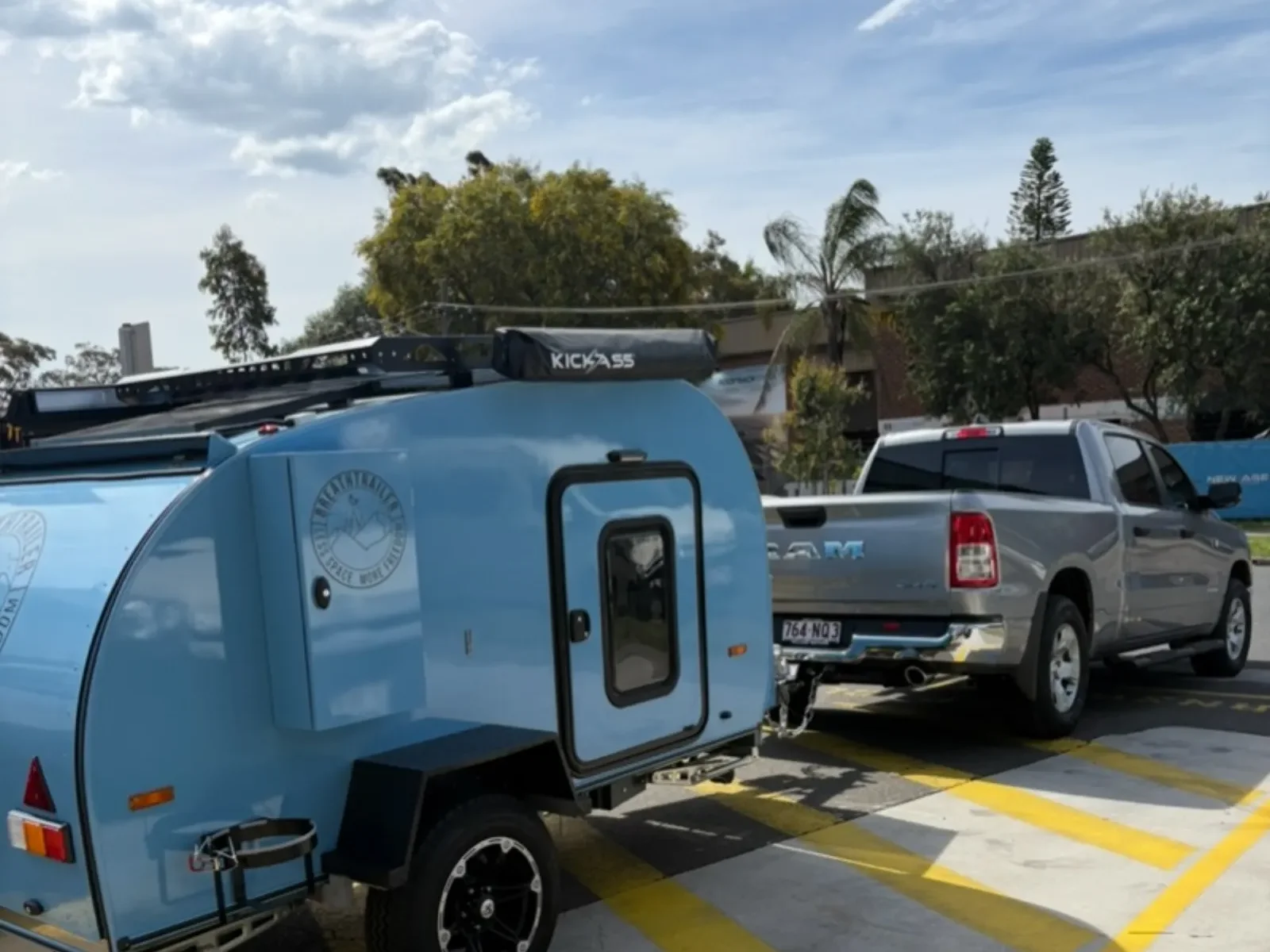
If you are comparing Breath Trailer vs JAG Camper, look at the materials and the finished camper before accepting the price premium. Open the cabinetry. Inspect the front box and the protection around electrical equipment. Run your hand along the kitchen worktop. Then ask what the extra money actually changes about your camping trip.
For couples who want an equipped, compact camper and control over their budget, Breath Ultra is our recommended starting point. You get a rear kitchen, upright fridge, solar, lithium power, awning, roof rack and a flexible interior. If an indoor toilet and shower matter more, Breath Max changes the comparison entirely.
This comparison is published by Breath Trailer. It focuses on materials, included equipment, layout and after-sales support, using the specifications identified below. It is not an independent road test.
What does the higher price actually buy?
A camper’s price needs to earn its place in your budget. A manufacturing slogan cannot do that on its own, and a more expensive trailer does not automatically make your weekends more comfortable.
| Model | Price reference, AUD | What to put on your equipment checklist |
|---|---|---|
| Breath Plus | $29,766, including GST, in the configurator | Fridge, lithium battery, solar, stove and water |
| Breath Ultra | $34,749, including GST, in the configurator | Plus equipment, 60L fridge, awning, roof rack and pop-up living table |
| Breath Max | $47,190, including GST, in the configurator | Standing interior with indoor toilet and shower |
| JAG Teardrop Camper | $51,450 advertised | Confirm the complete configuration and required options |
| JAG Glider | $37,500 advertised launch offer | A separate model; do not mix its price with the larger Teardrop’s specification |
Price basis: Breath retail prices including GST updated on 15 September 2026. JAG advertised figures retain their 11 September 2026 source date. Competitor tax treatment, offer availability, delivery and selected equipment must be aligned in the final quotes. These are different offers, not a calculation of savings on identical campers.
The useful challenge to a higher quote is simple: which of your actual needs does the extra spend satisfy? Write those needs down before looking through an options catalogue. Shade, refrigeration, a comfortable bed, usable storage and enough power for your trips are practical purchases. Features you will rarely use still come out of the same travel budget.
Start with Breath’s model packages and price the additions you need. More battery may matter for your fridge and time away from mains power. A different awning may matter for how you cook outside. An indoor bathroom may matter every morning. A higher price should produce an answer you can point to on the camper.
Materials: plywood, MDF, stainless steel and the front box
A premium price must stand up to a close inspection of the materials. A camper can photograph well while leaving unanswered questions about its cabinetry, external boxes and exposed equipment. The finish you see on day one is only part of what you are buying.
Plywood cabinetry: the coating is not the whole construction
JAG describes marine-grade, coated plywood cabinetry. At this price, inspect the construction beyond the finished face: exposed edges, drilled holes, joins, fastenings and the areas around water equipment. The coating alone does not explain the quality of the complete installation.
A premium description does not tell you how a cut edge was finished or how a drawer is supported when loaded. Ask to see those details. Ask how a damaged panel is replaced. If the answer stops at the material’s name, the value question remains unanswered.
When comparing JAG’s plywood cabinetry with a Breath configuration using MDF cabinetry, inspect the board grade, sealing, hardware and installation. The useful comparison is how the finished cupboards work and how their edges are protected, rather than treating either board name as a guarantee of durability.
The plastic front box: protection needs a proper answer
A plastic front box deserves close inspection because of its exposed position on a trailer. The enclosure, its mounting and its protection need to suit the equipment inside. Assess the box fitted to the actual JAG configuration you are considering; different models and options may use different arrangements.
For a buyer, the questions are direct:
- How is the enclosure secured to the trailer, and how are its contents restrained?
- What protects the box, lid and latches from road debris and repeated vibration?
- What material grade and temperature range are specified for its location?
- How are cable entries, terminals and connections protected from water and dust?
- Can you inspect, isolate and service the equipment without dismantling the campsite?
An expensive camper should not require you to guess whether the box protecting its equipment is appropriate for the job. Inspect the enclosure itself, not just the battery capacity printed beside it. Plastic construction is not proof that a box will melt or fail; equally, the word “premium” is not an answer about impact protection, heat or mounting.
At a Breath viewing, open the battery box and inspect the installation, fixings, accessible controls and cable protection on the exact build. Have the team explain the components and how the arrangement is maintained. Those are the answers you should expect before paying for a touring electrical package.
Breath’s worktop and chassis: put the useful materials in view
Breath offers specific material choices to inspect: the Essential lists a stainless-steel kitchen counter, while the Essential, Plus and Ultra specifications identify a hot-dip galvanised steel chassis. Confirm the worktop and cabinetry specification for the model you choose.
The value of stainless steel belongs where you prepare food, handle wet utensils and wipe the surface after cooking. Inspect the actual counter, its edges and the joins around the sink. The material should do a useful job in your kitchen rather than simply make the brochure sound expensive.
Underneath, inspect the chassis coating, joints and protection around fittings. Galvanising is a concrete construction choice you can discuss with the team. It is not exclusive to Breath, and it should not become another reason to skip the rest of the inspection.
For the walls, roof and underside, request the layer-by-layer specification of your chosen build. If it specifies aluminium walls or a fibreglass roof, establish which layers those terms describe, alongside the internal lining, insulation and protective finish. The construction schedule should describe the camper you are ordering.
Our position is that the materials, their installation and the finished product should justify the price together. Paying more for a camper does not excuse vague answers about what it is made from or how vulnerable equipment is protected.
JAG’s importing history belongs in the origin discussion
JAG has publicly criticised Breath’s manufacturing transparency, including describing the business as “dishonest” in an August 2026 comparison article. Our response is to explain our process and examine the substance of the comparison.
There is relevant history here. In comments published by caravancampingsales on 30 June 2025, JAG co-founder Jack Gosdschan said the company was importing the JAG Pod from China. He said its supplier had misrepresented the weight and design-IP position, and described discussions with Mink Campers over the IP. JAG subsequently changed direction. This account concerns that earlier Pod, not a claim that today’s JAG Teardrop or Glider is imported.
That history weakens a blanket argument that international sourcing itself is the problem. It illustrates the importance of supplier selection, accurate specifications and understanding the product being sold. Those responsibilities exist wherever a factory is located.
An imported component is not automatically a bad component. An Australian manufacturing label is not a substitute for inspecting the finished camper. The buyer still needs a clear equipment list, properly completed work and a business that takes responsibility after delivery.
Breath’s mixed manufacturing approach has a purpose
Breath uses Sydney-led design and specification, partner-sourced chassis and major construction components, and final fit-out, electrical connections, testing, preparation and handover in Sydney. Our manufacturing explanation sets out these stages.
That model puts local involvement into the parts of the experience you deal with directly: choosing the configuration, fitting the selected equipment, checking the trailer and explaining how it works. International sourcing forms part of the production process; the Australian team remains your point of contact.
The commercial purpose is to deliver a useful, well-equipped camper at a competitive price. You are buying more than the sum of loose components. The configuration, fit-out, preparation and support all matter to the product you take away.
Our suppliers form part of Breath’s production system. Breath defines the configuration and customer experience, completes the local work described above and remains your point of contact after handover. Ask for the equipment and preparation schedule for the trailer you intend to buy.
For a buyer, the relevant question is whether the business can explain its responsibilities clearly. Ask what arrives from the manufacturing partner, what happens locally and who you contact afterwards. Breath’s approach should be understood through those concrete stages.
Shade and roof storage: included equipment matters
Breath Ultra includes an awning and a roof rack. Those are useful inclusions because an outdoor kitchen needs a practical outdoor living arrangement. You should not have to discover late in the buying process that creating your normal campsite requires another round of purchases.
A roof-mounted awning and a separate inflatable shelter involve different routines. With a separate shelter, you need room to carry the packed fabric and accessories, somewhere to lay it out, and a place for it after a wet departure. Those are ownership costs in space and effort, even when the shelter works exactly as intended.
For people moving between campsites regularly, we favour Ultra’s included awning-and-rack arrangement. It is a reason to inspect Breath before committing to a more expensive package with a different shelter system. A larger enclosed outdoor room may be useful for some trips, but it should be a deliberate choice, not equipment you buy because the basic campsite is incomplete for your needs.
Roof access is easily overlooked. Try operating the awning and securing whatever you intend to carry. Check rack ratings, mounting clearances and any step or ladder you need. A roof rack is useful only if you can load and use it sensibly.
This is an included-equipment argument. It does not rely on claiming that JAG cannot supply a rack or awning.
The spare wheel should not disappear into a storage headline
The JAG Teardrop’s published layout places the spare wheel in its under-bed storage. That deserves more attention than another compartment count.
Storage occupied by the spare is not available for your camping gear. Access also matters: ask for the wheel to be retrieved with the bed made and the normal luggage loaded. What has to move? Where will it go at the roadside? Where will the dirty wheel travel afterwards?
A large storage figure can look impressive while saying little about the items sharing that space or the work required to reach them. Usable storage includes access, not just capacity.
At a Breath viewing, inspect the spare mount on your selected build alongside the clean storage, kitchen cupboards and places for wet equipment. Check access with the trailer packed. The arrangement should make sense before your first flat tyre, not only when the showroom trailer is empty.
Apply the same test to hoses, wheel chocks, levelling gear and an outdoor shower kit. Equipment used outside should have a practical place to travel without taking over the belongings you need inside.
Hot water: count the equipment and the work
A shower outlet is not a complete hot-water bathroom. A portable heater is not a permanently installed system. A privacy tent is another item to carry, erect and pack away.
Compare the whole hot-water routine. Establish whether you must remove a heater from storage, attach it to a mount, connect hoses and the specified fuel arrangement, then reverse that process before travelling. Locate a safe, practical place for every item.
Ultra lists an external shower. Price the hot-water equipment and privacy arrangement you want with your chosen configuration; do not assume an example photographed at a campsite is standard equipment. JAG’s Teardrop also lists hot water as an option. The useful comparison is the completed installation and how you will use it.
An accessory that looks minor in a catalogue can become a repeated chore on a touring trip. Ask for a demonstration from travelling position to usable shower, then back again. You can judge that routine without inventing a setup time or assuming every portable system is difficult.
If your objective is to avoid an outdoor bathroom routine altogether, inspect Breath Max. Its indoor toilet and shower change what you can do inside the camper. When considering a substantial budget, that is a more consequential upgrade than another exterior accessory.
A compact camper needs to work while you are awake
Breath Ultra combines its rear kitchen with a pop-up internal table that changes the sleeping area into a usable living space. That matters when you want somewhere inside to sit, eat or organise the next day’s trip.
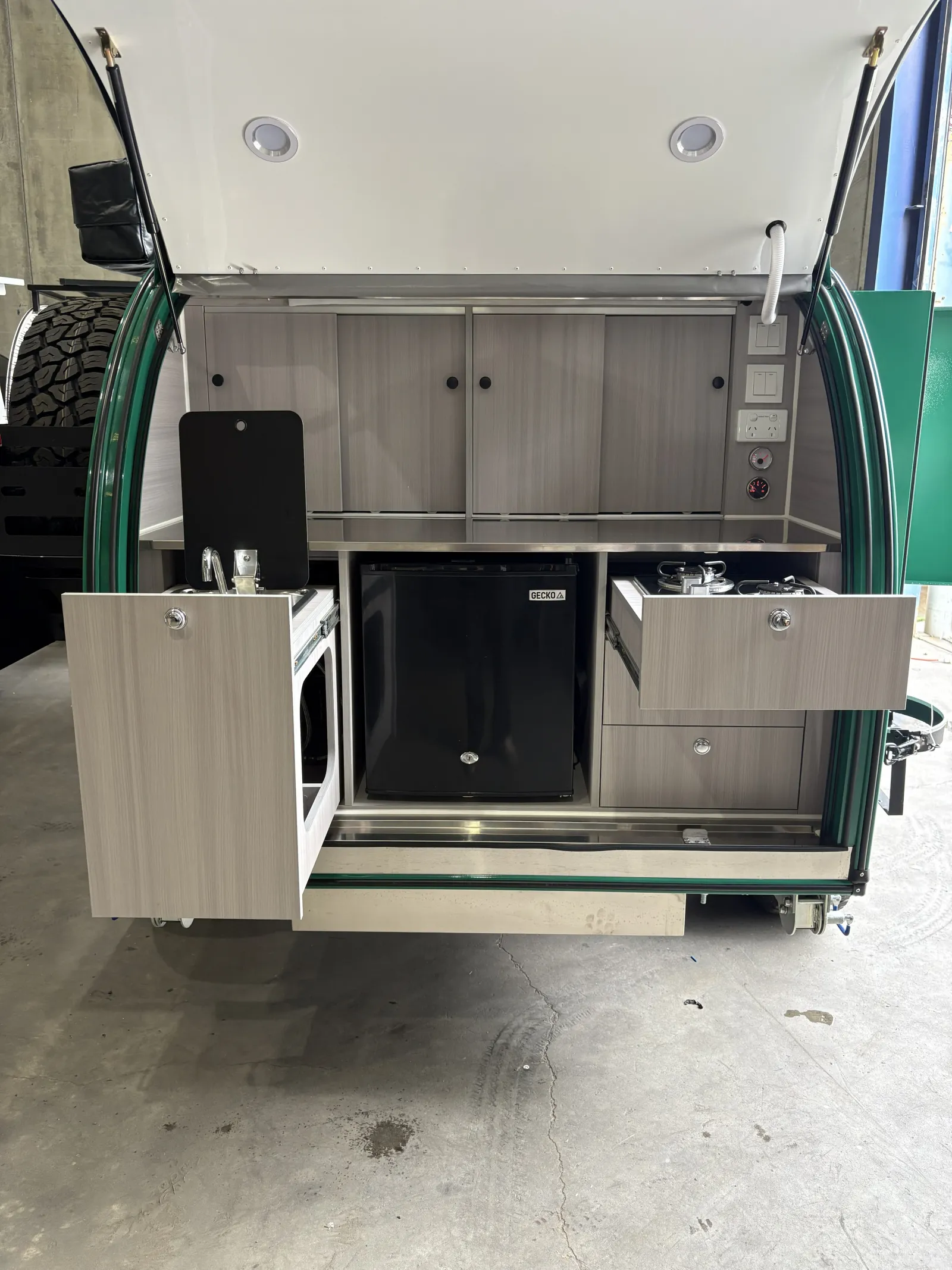
An example Ultra kitchen: inspect the fridge, sink, cooking area and cupboards together. Finishes and fitted equipment depend on the selected build.
At the kitchen, try opening the fridge while somebody prepares food. Put a chopping board on the worktop. Reach for a plate, then find somewhere to put the washing-up. A usable kitchen is the relationship between these parts, not just a list of appliances.
Ultra also separates fresh water from grey water, with an 80L tank for each. Wastewater has its own place rather than being confused with extra drinking-water capacity. Match this arrangement to the places you intend to camp and the way you empty and clean the tanks.
The 120Ah lithium battery, installed solar and inverter belong in the same trip plan. Ask for the charging arrangement while driving, the supplied panel rating and the inverter output for the equipment you actually intend to use. The battery number alone does not tell you how long the camper will run.
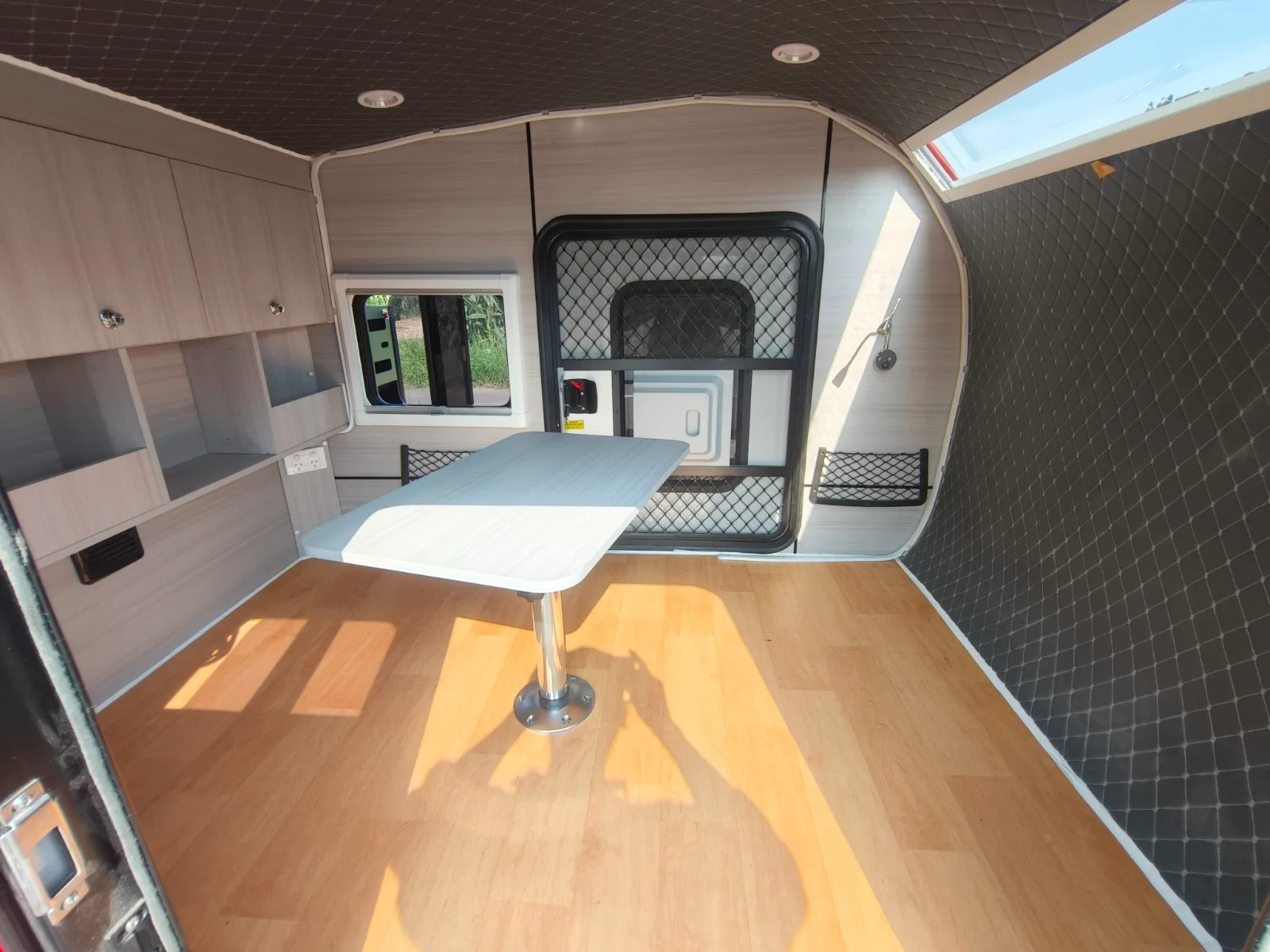
Ultra’s internal table provides another use for the cabin. Ask to see the conversion with the mattress and bedding in place.
The Breath team camps and draws on that experience to improve the product. Lighting, reachable storage and personalisation should have a practical benefit you can see during a walkthrough. Try your preferred lighting mode, including amber where specified, and select exterior and cabinetry finishes together.
More camper outside is not automatically more useful space
Breath Plus and Ultra publish a 3.9m overall length and 2.0m width. The larger JAG Teardrop lists 4.8m by 2.25m. That makes Breath 900mm shorter and 250mm narrower in this comparison.
That difference exists every time you park at home, negotiate an entrance or position the trailer beside your outdoor living area. If compact storage was part of the reason you wanted a teardrop, it should remain part of the decision when comparing a higher-priced model.
The dimension comparison concerns the JAG Teardrop, not the Glider. Check the finished height, accessories and turning space against your own entrance. For sleeping comfort, use the actual mattress dimensions: Plus and Ultra list 140 × 200cm.
Terrain capability needs the same precision. Inspect the lowest vulnerable point underneath, tank protection, suspension and coupling. Establish the configuration suitable for the roads you intend to use. Breath offers upgrades; choose the capability you need and have the operating limits recorded with the order.
Tare is not your travelling weight. Ultra’s published tare is 900kg, and water, options and belongings add to it. Confirm the finished trailer and vehicle combination before committing. Our towing guide helps organise that check.
Australian support belongs in the value calculation
With Breath, contact the Australian team about your trailer, its equipment and after-sales questions. The local relationship continues after the handover. It is part of the value of buying a configured, prepared product from a business that knows the build.
Breath provides a two-year structural warranty, with component cover set out separately. Read the purchase terms and establish the repair-authorisation and transport arrangements for your location. The sourcing model does not change who your Breath contact is.
Our recommendation is straightforward: choose Breath when its included equipment, compact footprint and configurable setup satisfy your needs without the higher-priced purchase you were considering. Start with Plus for the core package, Ultra for more outdoor equipment, or Max when an indoor bathroom changes your trips.
Bring your equipment list and competing quote to a Breath viewing. Open the kitchen, try the storage, inspect the chassis and work through the configuration. Once the practical requirements and final prices are on the same page, the value of the Breath approach becomes much easier to judge.
Frequently asked questions
Why consider Breath Trailer instead of JAG Camper?
Breath offers defined equipment packages, a compact Plus/Ultra footprint and the option of an indoor bathroom in Max. For buyers focused on usable equipment and the total budget, Ultra is our recommended starting point. Compare the final configuration and delivered price against the exact JAG model being considered.
Did JAG previously import a camper from China?
Its co-founder described importing the earlier JAG Pod in published comments in June 2025. That history is relevant to the sourcing discussion, but it does not describe the manufacturing origin of every current JAG model.
Are Breath trailers entirely manufactured in Australia?
No. Breath combines Sydney-led design and specification with partner-sourced chassis and major components, followed by local final fit-out, electrical connections, testing and handover. These are distinct production stages.
Does Breath Ultra include an awning and roof rack?
Yes, both are listed inclusions. Confirm the supplied awning, rack load rating and accessories for your order. This is an included-equipment benefit, not a claim that a competitor cannot offer similar accessories.
Which Breath model has the internal bathroom?
Breath Max has the indoor toilet and shower. Ultra has an external shower arrangement. Choose Max when indoor bathroom access is a core requirement and confirm the complete water-heating and waste specification.
What should a camper comparison include beyond price?
The usable kitchen, spare-wheel access, packed shelter size, hot-water routine, charging, storage dimensions and support arrangements. Compare the camper as you will actually travel with it, with your selected equipment included.
Recommended reading
- Compare the Breath range — choose the equipment package for your trips.
- Where Breath trailers are made — understand sourcing and the Sydney team’s work.
- Camper verification before a deposit — prepare the documents and questions for your viewing.
Only pay for what you need. Disconnect to connect.