How to Verify a Camper Trailer Brand Before You Pay a Deposit (2026 Australian Guide)
Compliance plate, RAV entry, payload maths and warranty terms: what to ask any brand, in writing, before money changes hands.
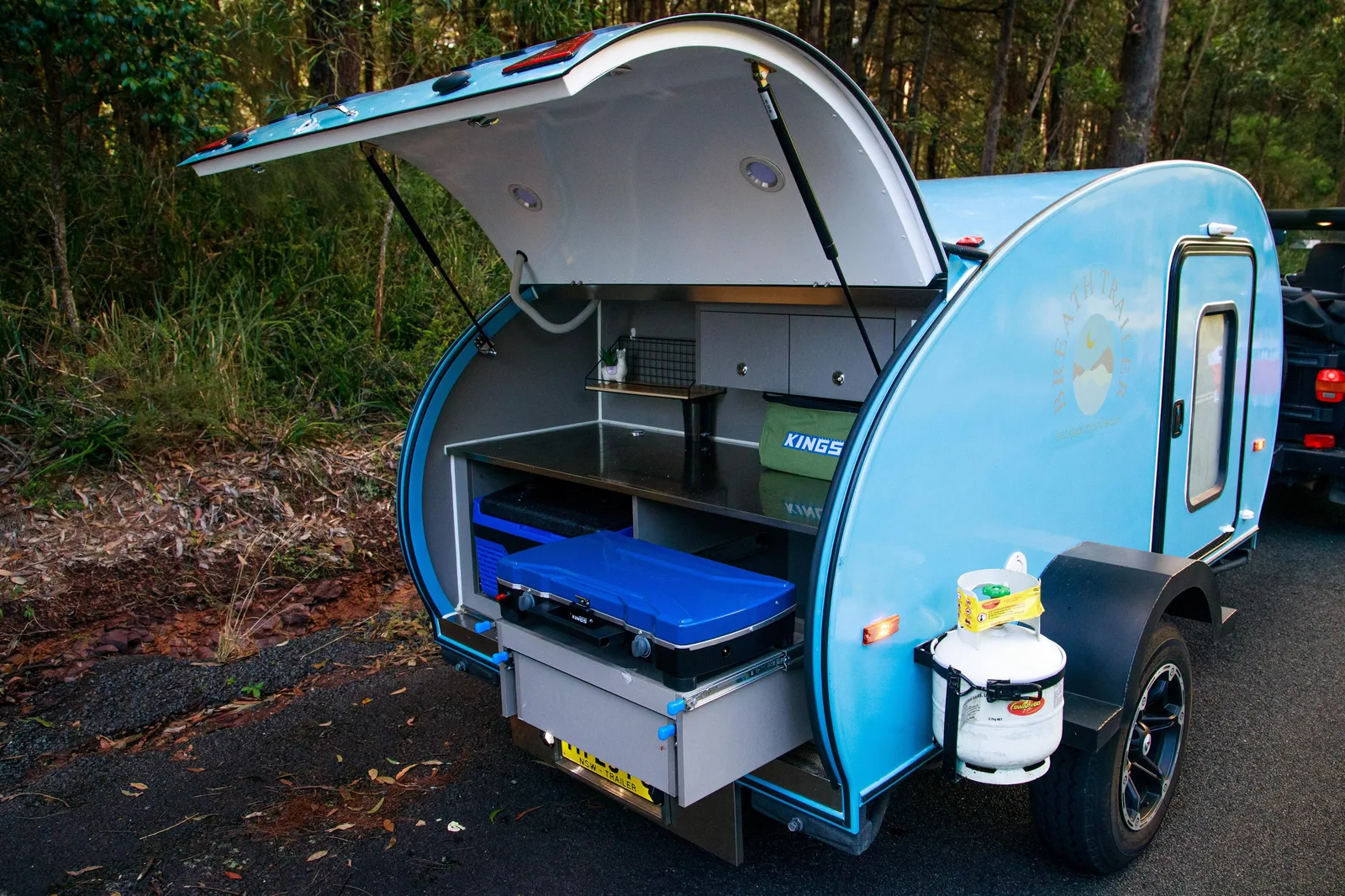
A camper trailer deposit is usually the point of no return. You hand over $2,000 to $10,000, you wait three to six months, and everything that happens after that depends on decisions you made in a twenty-minute conversation before you paid.
Most buying guides tell you to inspect the trailer — check the welds, bounce the suspension, open the drawers. That advice is fine, but it solves the wrong problem. When you’re buying a built-to-order camper, the trailer you’re inspecting isn’t the trailer you’re buying. Yours doesn’t exist yet. What you’re really buying is a promise from a business, and that is what needs verifying.
This guide is about verifying the business. Every item below is something you can ask for in writing, check against a public register, or read off a metal plate. No opinions, no vibes, no reading between the lines of a brochure. If a seller can answer all of it without hesitating, you’re dealing with a serious operation. If they get uncomfortable, you’ve learned something valuable for the price of one phone call.
Why “inspect the trailer” isn’t enough
The Australian camper trailer market runs on custom builds and long lead times. That model has real advantages — you get the layout and the equipment you actually want, rather than whatever is sitting on a lot. But it changes what you’re exposed to.
Three things can go wrong that no physical inspection will catch:
- The trailer can’t be registered. Compliance is a paperwork problem, not a build-quality problem. A beautifully finished camper with the wrong approvals is an expensive garden ornament.
- The warranty is worthless in practice. Not because it’s fake, but because honouring it means shipping your camper 900 km and waiting eleven weeks for a part.
- The business doesn’t survive your build. Deposits are usually unsecured. If the company folds between your payment and your delivery, you join a queue of creditors.
None of those risks show up when you’re crouched beside a display model looking at the welds. All three show up in documents.
Step 1 — Confirm the trailer can actually be registered
This is the hardest, most objective test in the whole process, and almost nobody asks about it.
Every new trailer supplied to the Australian market with an Aggregate Trailer Mass (ATM) of 4,500 kg or less — which covers every teardrop and camper trailer you’re looking at — needs approval from the Commonwealth Department of Infrastructure, and must be entered on the Register of Approved Vehicles (RAV). Manufacturers and importers apply for this through the department’s ROVER system. This applies to trailers built here and to trailers brought in from overseas; there is no route to market that skips it.
Alongside that, the trailer must be built to the applicable Australian Design Rules, with construction requirements set out in VSB 1, the national code of practice for trailers under 4.5 tonnes.
What to ask, word for word:
“Is this model entered on the Register of Approved Vehicles, and can you send me the approval details before I pay a deposit?”
A manufacturer or importer operating properly will have this. It is a routine document, not a trade secret. Vagueness here — “it’s all handled at registration”, “the dealer takes care of that” — is the single biggest red flag in this guide, because it’s the one failure that can leave you with an unregisterable trailer.
Step 2 — Read the compliance plate and the VIN
Once you’re standing in front of a physical trailer, two pieces of stamped metal tell you more than any brochure.
The VIN. Every trailer needs a unique 17-character vehicle identification number meeting ADR 61/03. It must be on a durable metal plate — welded, riveted or otherwise permanently fixed in a readily visible position — with the characters embossed, etched or stamped indelibly. Not a sticker. Not a laminated card in the glovebox.
The compliance plate. This carries the numbers you’ll live with for the life of the trailer:
| On the plate | What it tells you | Why you care |
|---|---|---|
| Manufacturer & model | Who is legally the manufacturer | Tells you who carries the obligation |
| Date of manufacture | Build date, not sale date | A “2026 model” built in 2024 is a 2024 trailer |
| ATM (Aggregate Trailer Mass) | Max legal loaded weight, on its own wheels | Must fit under your car’s braked towing capacity |
| GTM (Gross Trailer Mass) | Max weight carried by the axles when coupled | Used for suspension and axle ratings |
| Tare | Empty weight as built | ATM − Tare = your real payload |
| Rim/tyre sizes and pressures | The specified fitment | Cheap tyre substitutions show up here |
| ADR compliance statement | Formal declaration of compliance | The legal backbone of the whole thing |
The check that catches the most people out: subtract Tare from ATM. That difference is everything you’re allowed to put in the trailer — water, food, gear, the awning, the battery upgrade, the bikes. On small campers it is often far less than buyers assume. A 700 kg tare with a 900 kg ATM leaves you 200 kg, and 80 litres of water alone is 80 kg of it.
Do this arithmetic before you pay, not after you’ve packed for the Big Lap. Our camper trailer weight guide works through the numbers in detail, and the towing guide covers how they interact with your vehicle’s limits.
Step 3 — Get the warranty in writing, then test it with three questions
Every seller says “we have a great warranty”. The word is meaningless until you’ve read the terms, and the terms matter far less than the logistics.
Note first that your statutory rights under Australian Consumer Law exist regardless of what any warranty document says. A manufacturer’s warranty sits on top of those rights; it can add to them, but it cannot take them away. Any seller who implies their warranty replaces your consumer guarantees is telling you something about how they operate.
Then ask the three questions that actually determine what a warranty is worth:
1. Who honours it? The seller, the manufacturer, or a third party? If the trailer is built by one entity and sold by another, get it in writing which one you contact when something fails in year three.
2. Where does the work happen, and who pays to get it there? This is the question that separates a real warranty from a paper one. If the nearest authorised repairer is interstate, does the warranty cover transport? Many don’t. A five-year warranty that requires you to deliver the trailer 900 km at your own cost is a five-year warranty on paper and a nuisance in practice.
3. What’s excluded, and what voids it? Water ingress, corrosion, canvas, appliances and off-road use are the usual exclusion zones. Ask specifically whether corrugated-road use or river crossings affect coverage — for an off-road camper, that answer is the whole point.
Get the answers by email. A seller who will put it in writing is a seller who intends to honour it.
Step 4 — Ask the five-year parts question
Warranties expire. Trailers don’t. The question almost nobody asks before paying a deposit is the one that determines what ownership feels like in 2031:
“In five years, when I need a new window seal, a door catch, a hatch strut and a suspension bush — who do I call, and how long does it take?”
There are three broadly acceptable answers:
- Standard industry components. The trailer uses recognised brands for running gear, couplings, appliances and hardware, which means parts are available from multiple suppliers regardless of what happens to the brand you bought from.
- Held stock. The manufacturer keeps a spares inventory and can quote you a lead time today.
- Documented supply chain. They can tell you where a part comes from and how long it takes to arrive.
The unacceptable answer is a shrug. Proprietary parts with a single source and no held stock is how a five-year-old camper becomes unrepairable over a $60 component.
This is also the practical case for local support that has nothing to do with flags on a brochure — it’s about whether there is a workshop and a phone number that answers. We’ve written about why local support matters and the common problems worth planning for.
Step 5 — Understand what your deposit is actually buying
Deposits on custom builds are usually unsecured. This is normal and not sinister — the manufacturer is committing materials and workshop time to a trailer only you want. But “normal” doesn’t mean “risk-free”, and most buyers never ask what happens in the bad scenario.
Ask:
- What is the deposit securing? A build slot, materials, or the whole order?
- Under what circumstances is it refundable, and by when? Get the timeframe in writing.
- Is it held in a separate account, or does it go into general operating funds?
- What happens if delivery slips by three months? Long lead times are standard in this industry. What isn’t standard is having no agreed remedy when they blow out.
- What is the payment schedule, and what triggers each stage? Progress payments tied to verifiable build milestones are a healthier structure than a large deposit up front.
You should also ask to see the build agreement before you’re asked to sign anything. If the contract only appears at the moment of payment, that’s a process designed for momentum rather than clarity.
Step 6 — Ask for build evidence of your trailer
A display model tells you what the brand can do at its best. It tells you nothing about the specific trailer being built for you, three months from now.
Ask whether you’ll receive progress photos of your actual build — with your VIN or order number visible — at defined stages: chassis, shell, fit-out, electrical, pre-delivery. Plenty of manufacturers do this as standard, and it costs them nothing but a phone camera.
Two things make this valuable beyond reassurance. It creates a documented record of how your trailer was built, which is useful if a warranty dispute ever arises. And it makes substitutions visible: if you specified one battery and a different one is fitted, you’ll see it while it can still be changed, not two years later when it fails.
Ask the same question about the handover: is there a written pre-delivery checklist you receive a copy of? Our own process is documented in how we test every trailer before delivery and what happens before a trailer leaves the workshop — not because ours is the only valid approach, but because you should expect some documented process from anyone taking your money.
Step 7 — Go and stand in the place where the work happens
Everything above can be done by email. This one can’t, and it’s worth the drive.
Visit the workshop or showroom. Not to audit anyone’s manufacturing — you’re not qualified to and neither are we in someone else’s building — but to answer three questions that are surprisingly hard to fake:
- Are there trailers at different stages of work, or only finished ones? A working facility looks like a working facility.
- Can you meet the person who’d handle your warranty claim? Put a face to the phone number you’ll be calling in 2029.
- Do the answers you got by email match the answers you get in person? Ask the same questions again. Consistency between the sales conversation and the workshop conversation is one of the more reliable signals in this entire process.
If you’re too far away to visit, ask for a video call from the workshop, and ask whether there are owners near you willing to show you their trailer. An owner with 40,000 km on a camper will tell you things no brochure ever will.
The 12-question pre-deposit audit
Print this. Ask every brand you’re considering the same questions, and compare the answers side by side rather than brand by brand.
| # | Question | What a good answer looks like |
|---|---|---|
| 1 | Is this model on the Register of Approved Vehicles? | Yes, with approval details supplied |
| 2 | Can I photograph the VIN and compliance plate? | Yes, no hesitation |
| 3 | What are the ATM, GTM and tare for my exact configuration? | Specific numbers, not a range |
| 4 | What payload does that leave me? | They do the subtraction with you |
| 5 | Who honours the warranty — you or someone else? | A named entity |
| 6 | Where is warranty work carried out, and who pays transport? | A location and a clear answer on cost |
| 7 | What voids the warranty? | Specific exclusions, in writing |
| 8 | Where do I get parts in five years? | Named suppliers or held stock |
| 9 | What is my deposit securing, and when is it refundable? | Written terms, supplied before signing |
| 10 | What happens if delivery is three months late? | An agreed remedy exists |
| 11 | Will I get progress photos of my build? | Yes, at defined stages |
| 12 | Can I visit and meet the person who handles warranty claims? | Yes, by appointment |
Red flags worth walking away from
Not every imperfect answer is disqualifying — small operations can be excellent and still be informal about paperwork. But these five are different in kind:
- Evasion on RAV or ADR compliance. Everything else is a preference. This one is the difference between a registerable trailer and a very expensive mistake.
- No written warranty terms before deposit. If they won’t put it in writing while they’re trying to win your business, consider how it goes once they have your money.
- Pressure tied to a deposit deadline. “This price is only held until Friday” is a technique, not a fact. A build slot worth having is worth 48 hours of thinking.
- Refusal to let you see the compliance plate. It’s a legally required plate in a readily visible position. There is no legitimate reason to be cagey about it.
- Answers that change. The specification you were quoted should match the specification in the contract, which should match the trailer at handover. Drift between those three is the most common source of disputes in this industry.
Frequently asked questions
What is the single most important thing to check before paying a deposit?
Compliance. Confirm the model is on the Register of Approved Vehicles and that the trailer will carry a compliant VIN and ADR compliance plate. Everything else on this list affects how good your ownership experience is; this one affects whether you can legally register and tow the trailer at all.
Is a deposit on a custom camper trailer refundable?
It depends entirely on the written agreement, so read it before you pay. Custom-build deposits are commonly non-refundable once materials are committed, which is reasonable — but the terms, the timeframes and the position if the manufacturer is the one who fails to deliver should all be spelled out in the contract, not explained verbally.
What’s the difference between ATM and GTM?
ATM (Aggregate Trailer Mass) is the maximum legal weight of the fully loaded trailer standing on its own wheels, uncoupled. GTM (Gross Trailer Mass) is the weight carried by the trailer’s axles while it’s coupled to your vehicle — the difference is the load going through the tow ball. Your vehicle’s braked towing capacity is compared against ATM.
How do I work out my real payload?
Subtract the tare weight from the ATM, both taken from the compliance plate for your exact configuration. Then subtract the weight of water (1 kg per litre), any accessories fitted after the plate was issued, and gas bottles. What’s left is what you can actually pack. It’s frequently less than buyers expect.
Does a manufacturer’s warranty replace my consumer rights?
No. Your guarantees under Australian Consumer Law apply regardless of what a warranty document says. A manufacturer’s warranty is an additional promise on top of those rights and cannot reduce them.
Should I ask for progress photos of my build?
Yes, and it’s a reasonable request that costs the manufacturer almost nothing. Photos at chassis, shell, fit-out and pre-delivery stages give you a documented record of how your trailer was built and make any specification substitutions visible while they can still be corrected.
The point of all this
None of these questions are aggressive. A manufacturer who takes deposits for custom builds should expect every one of them, and the good ones welcome them — a buyer who has done this homework is a buyer who understands what they’re getting, and those make the best owners.
Use the twelve questions on every brand on your shortlist, including ours. Compare the answers, not the marketing.
If you’d like to work through the list with a Breath Trailer, you can book a session with our team or come and see a trailer at the Holroyd workshop by appointment. We’ll go through the plate, the numbers, the warranty terms and the build process — and you’re welcome to bring this checklist with you.