Teardrop Camper Weight Australia: 2026 Complete Guide
Tare and ATM by model, what you can load, and why the advertised figure is never what arrives at your towbar.
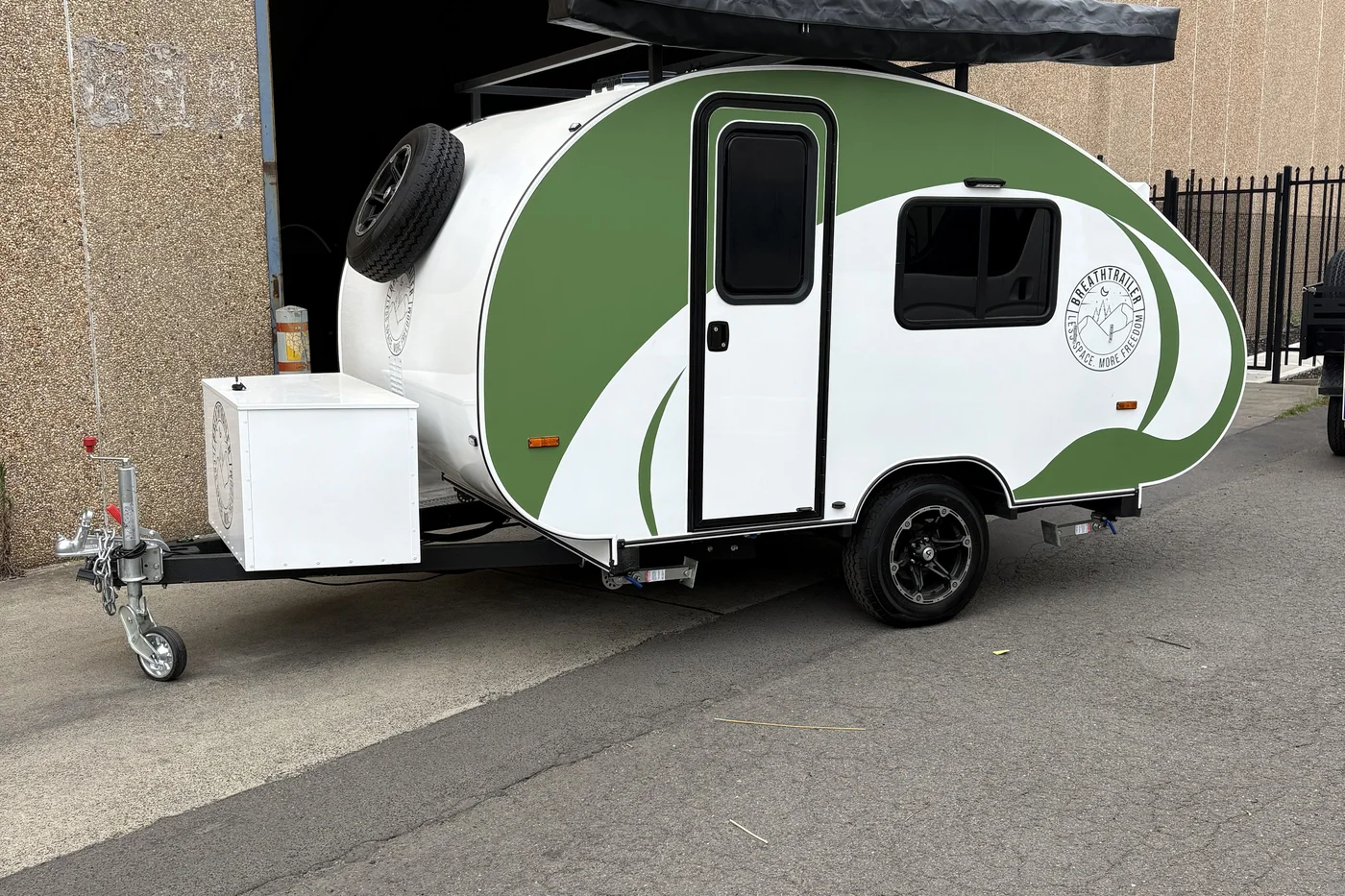
Here’s the one number that determines whether a teardrop camper is compatible with your car, your licence, your budget, and your camping plans: tare weight.
Get it right and your everyday SUV can tow a fully featured camper to Fraser Island. Get it wrong and you’ll either be underloaded (paying for a heavier trailer than you need) or worse — overweight on the highway and technically illegal.
In Australia in 2026, teardrop campers range from around 480 kg tare (the lightest micro-teardrops) to 1,200 kg tare (full-bathroom models like the Breath Max). That 720 kg spread is the difference between towing with a Suzuki Jimny and needing a Toyota Prado. This guide maps every number you need — tare, ATM, GTM, payload, ball weight — and then matches them to real vehicles.
What do teardrop camper weight terms actually mean?
The Australian trailer industry uses four distinct weight figures, and confusing them is expensive. Here’s what each one means in plain language:
| Term | Full name | What it is | Why it matters |
|---|---|---|---|
| Tare | Tare weight | The unladen trailer straight from the factory | Tells you what your tow vehicle must cope with at minimum |
| GTM | Gross Trailer Mass | Max legal weight on the trailer’s axles when unhitched | Must not be exceeded when loaded |
| ATM | Aggregate Trailer Mass | Max total weight of the loaded trailer including the ball | Must be ≤ your tow vehicle’s rated towing capacity |
| Ball weight | Towball download | Force the trailer exerts on your towbar (typically 10% of ATM) | Must stay within your vehicle’s towbar rating (usually 150–350 kg) |
The core rule: your tow vehicle’s braked towing capacity must be ≥ the trailer’s ATM when loaded to its maximum. So if your trailer has a 1,500 kg ATM, your car must be rated for at least 1,500 kg braked towing.
Payload is ATM minus tare weight. It is the practical amount of water, food, gear, solar panels, and accessories you can add before the trailer is overloaded. A trailer with a 700 kg tare and 1,500 kg ATM gives you 800 kg of payload — generous for most campers. A heavier trailer with the same ATM leaves less room for gear.
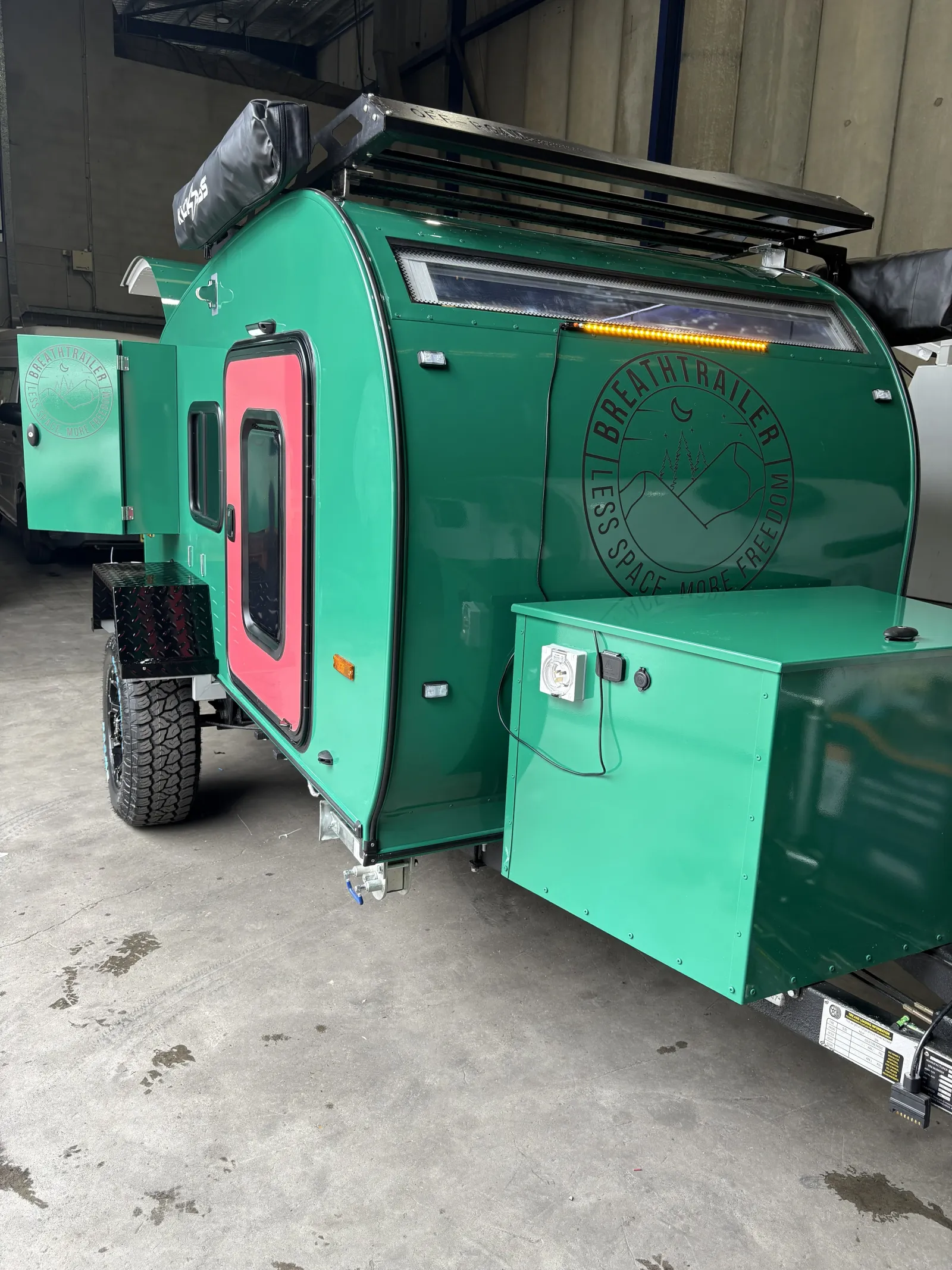
Tare, GTM and ATM are stamped on the compliance plate, which on a teardrop usually sits on the drawbar.
How much do teardrop campers weigh in Australia?
Australian teardrops sit in a much wider weight band than most buyers expect. The shape is similar across the range, but the internal fit-out — insulation, bathroom, solar system, water tanks, kitchen — adds hundreds of kilograms.
| Weight range | What to expect at this weight |
|---|---|
| 480–650 kg tare | Micro-teardrops; very limited fit-out; suit small cars and EVs |
| 650–800 kg tare | Mid-range teardrops with kitchen, battery, fridge; suit mid-size SUVs |
| 800–1,000 kg tare | Full-featured teardrops with external shower, awning, larger tanks |
| 1,000–1,200 kg tare | Full-bathroom models; standing height; queen beds; need larger SUVs |
The lightest production teardrops in Australia — think Ridge Teardrop and Gumnut H1 Touring — sit below 500 kg and are deliberately stripped-back: small batteries, no bathroom, minimal kitchen. They’re excellent for ultralight towing but not for extended off-grid use.
The heaviest teardrops still on the market under $50,000 — the Breath Max at 1,200 kg — include a full interior bathroom with toilet and shower, 2.1 m standing headroom, and a queen bed. You’re comparing a camping shelter to a small motorhome-equivalent; the weight difference is justified by what you’re getting.
2026 Australian teardrop camper weight comparison
These are publicly listed specifications from Australian manufacturers as of 2026. Prices are AUD entry-level.
| Brand & Model | Tare (kg) | ATM (kg) | Payload (kg) | Price (from) |
|---|---|---|---|---|
| Ridge Teardrop | 480 | 750 | 270 | ~$18,000 |
| Gumnut H1 Touring | 500 | 750 | 250 | ~$22,000 |
| Venture Glider | 680 | 1,000 | 320 | ~$24,000 |
| Breath Essential | 700 | 1,500 | 800 | $23,320 |
| Hip Summit | 700 | 1,500 | 800 | ~$28,000 |
| Breath Plus | 800 | 1,500 | 700 | $29,766 |
| Stonegate Tucana | 800 | 1,200 | 400 | ~$27,000 |
| JAG Camper | 860 | 1,200 | 340 | ~$29,000 |
| Breath Ultra | 900 | 1,500 | 600 | $34,749 |
| Breath Max | 1,200 | 1,700 | 500 | $42,900 |
The payload column is where teardrops diverge most sharply. The Breath Essential’s 800 kg payload on a 700 kg tare is exceptional for the weight class — that space absorbs a full 80 L water tank (80 kg), a 60 L fridge loaded with food (~30 kg), solar panels and battery (already included in tare), camping gear for two people (~80 kg), and still leaves over 600 kg of headroom. Very few teardrops at any price point are tighter than this.
See the full model comparison for side-by-side feature specs across all four Breath models.
The 750 kg brake rule — what every buyer must know
Australia’s Vehicle Standards Bulletin 1 (VSB1) governs trailer construction and safety standards. For buyers, the critical threshold is 750 kg GTM:
- GTM ≤ 750 kg: The trailer may run unbraked, provided the trailer mass does not exceed the tow vehicle’s unloaded mass.
- GTM > 750 kg: Brakes are legally required in every Australian state and territory. Overrun (surge) brakes are acceptable up to 2,000 kg GTM. Above 2,000 kg, an electronic or electric brake controller is required.
In practice, this means almost every teardrop camper you’d actually want to use off-grid must have brakes. The lightest models (Ridge, Gumnut) scrape under 750 kg GTM when empty, but load them with water and gear and you’ll cross the line. All four Breath Trailer models are supplied brake-equipped as standard — electric brake and hand brake are included across the range.
The brake rule also intersects with registration. When you register a trailer, the transport authority plates it with its ATM. If that ATM is above 750 kg, the registrar will note that brakes are required. Driving a brake-required trailer without functioning brakes is an immediate defect notice and a fine.
Our camper trailer towing guide for Australia covers the full legal framework in detail, including towbar ratings, speed limits, and state-by-state variations.
How much payload can you actually carry?
A teardrop’s tare weight sets a floor. Its ATM sets a ceiling. The gap between them — payload — is what you work with in practice. Here’s a realistic loading scenario for a long-weekend trip:
| Item | Approximate weight |
|---|---|
| Water (80 L tank, full) | 80 kg |
| 60 L fridge (fully stocked) | 35 kg |
| Camping chairs, table, awning | 20 kg |
| Clothing + bedding for 2 | 15 kg |
| Kitchen supplies, food, drinks | 25 kg |
| Tools, safety gear, first aid | 10 kg |
| Total typical load | ~185 kg |
On a Breath Essential with 800 kg payload, that 185 kg load leaves 615 kg of safety margin — you’d need to try very hard to overload it. On a Gumnut H1 with 250 kg payload, 185 kg is nearly the full capacity and you’re adding very little before you’re over.
The practical takeaway: if you’re serious about off-grid camping with water, food, and gear for several days, look for a payload of at least 400 kg. Less than that and you’ll be rationing water before you’ve unpacked.
One more thing worth noting: solar panels and lithium batteries are heavy. A 120 Ah lithium battery weighs around 12–15 kg; a 200 W panel weighs 15–20 kg. On models like the Breath Plus and above, this equipment is already installed and included in the tare weight — so you don’t need to subtract it from your payload. On stripped-down models where you’d add solar later, budget for 30–40 kg against your payload.
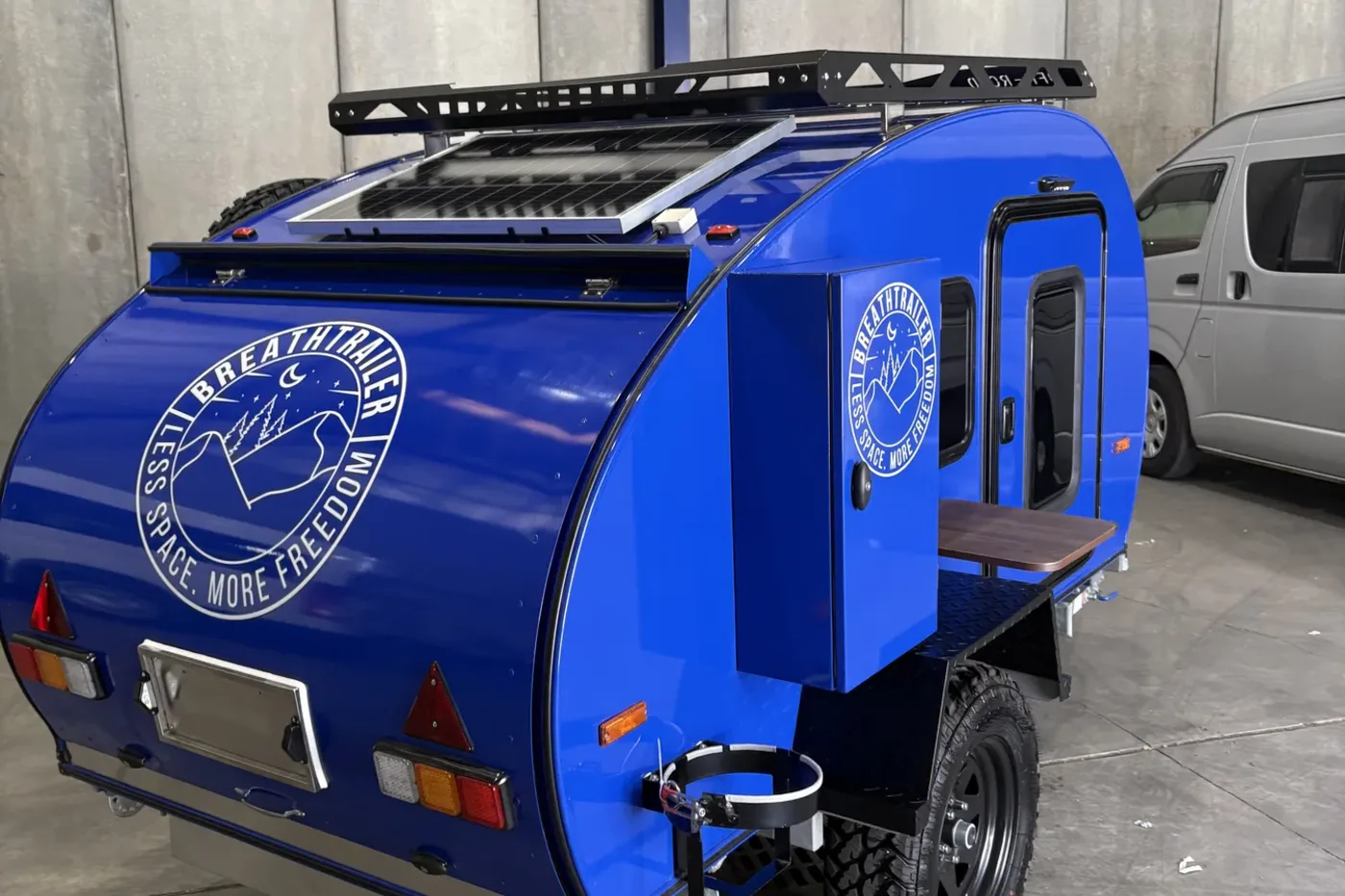
Panels, racks, batteries and a full water tank all come out of the same payload.
Which SUV can tow which teardrop?
The rule is simple: your vehicle’s braked towing capacity must be equal to or greater than the trailer’s ATM. Here are towing capacities for Australia’s most popular mid-size SUVs in 2026:
| Vehicle | Braked towing capacity | Suitable Breath models |
|---|---|---|
| Toyota RAV4 Hybrid (AWD) | 1,500 kg | Essential, Plus, Ultra |
| Toyota RAV4 Petrol (2WD) | 800 kg | Essential only (check ATM carefully) |
| Mazda CX-5 (2.5T AWD) | 2,000 kg | All models including Max |
| Subaru Outback (2.5i) | 2,000 kg | All models including Max |
| Subaru Outback XT | 2,400 kg | All models including Max |
| Hyundai Tucson (Petrol AWD) | 1,500 kg | Essential, Plus, Ultra |
| Kia Sportage AWD | 1,500 kg | Essential, Plus, Ultra |
| Toyota Prado | 3,000 kg | All models including Max |
| Toyota Fortuner | 3,100 kg | All models including Max |
| Ford Everest | 3,100 kg | All models including Max |
A few things that often catch buyers off guard:
Hybrid variants sometimes tow less than their petrol equivalents. The RAV4 Hybrid AWD is rated at 1,500 kg braked — the same as the petrol AWD — but some older RAV4 Hybrid specifications limited towing to 1,000 kg. Always confirm the year and variant on your specific vehicle’s owner’s manual or compliance plate.
2WD vs AWD makes a huge difference. A RAV4 2WD is rated at 800 kg braked — a number that restricts you to the very lightest micro-teardrops. The AWD doubles that to 1,500 kg and opens up almost the entire Breath range.
Ball weight is not the same as towing capacity. Your towbar may be rated for a maximum downward force (towball download) of 150–250 kg. The 10% ball weight rule puts a Breath Max (ATM 1,700 kg) at roughly 170 kg towball download — check your vehicle’s specific towbar rating, particularly on vehicles with aftermarket towbars.
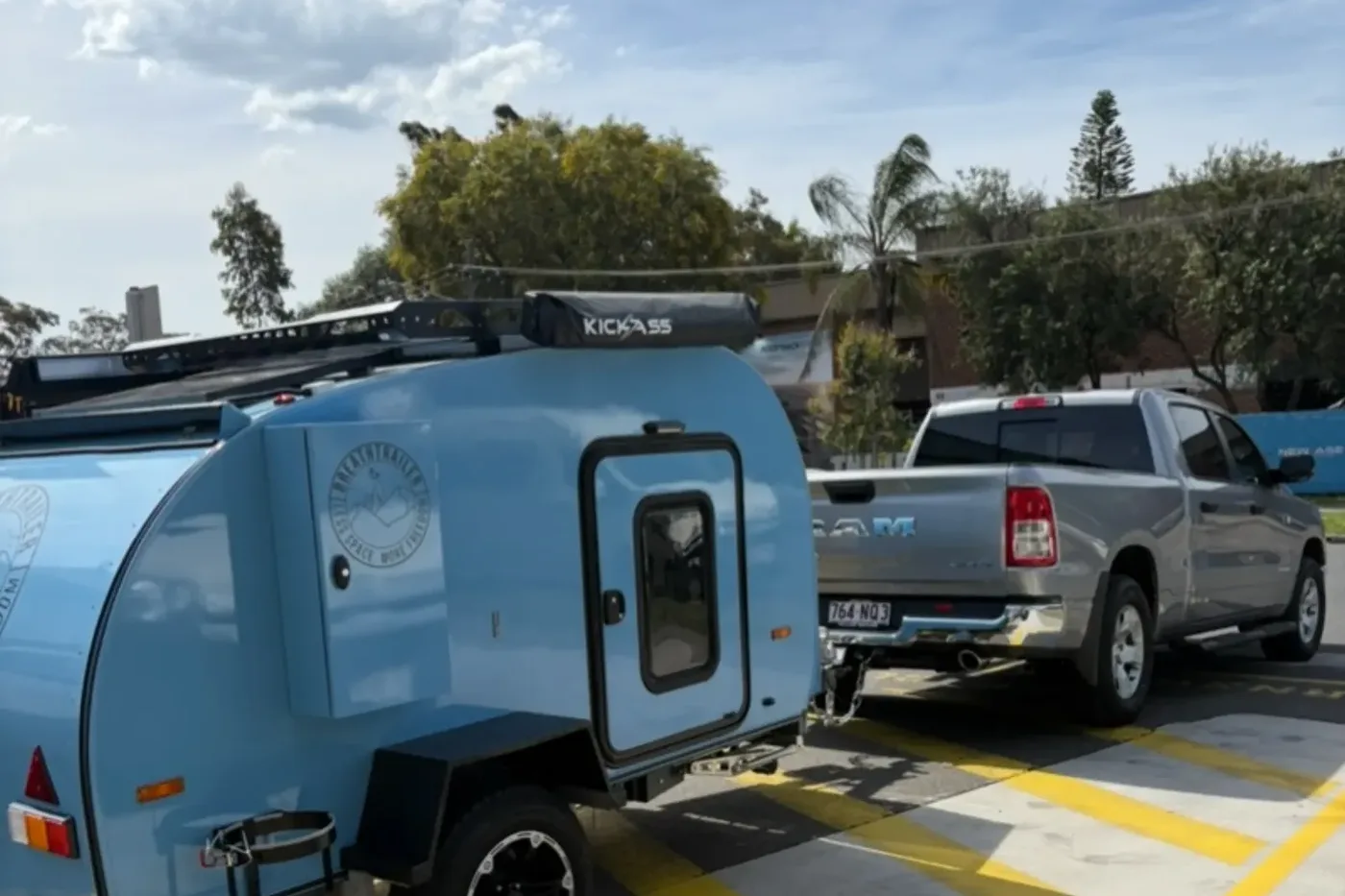
Ball download on the towbar is a separate limit from the vehicle’s braked towing capacity.
If towing anxiety is what’s stopping you from taking the plunge, our guide to teardrop camper hire vs buying gives you a risk-free way to test your vehicle’s towing confidence before you commit.
Weight, aerodynamics, and fuel economy on the highway
Weight is only one factor in fuel consumption. Aerodynamic drag — the frontal area and shape of the trailer — often has a bigger effect than the extra kilograms being towed. Teardrops, by design, have a significantly lower drag coefficient than box-profile camper trailers or caravans.
A typical teardrop adds 2–4 L/100 km to your highway fuel use compared with driving unloaded. A comparable-weight box camper adds 4–7 L/100 km on the same roads. The difference compounds over a two-week trip: at 2,000 km, you might burn 40–80 L less in a teardrop than a square-fronted alternative of similar weight.
Heavier models do consume more fuel, but the relationship isn’t linear. Going from a 700 kg teardrop to a 900 kg teardrop (a 29% weight increase) may add only 0.5–0.8 L/100 km because the aerodynamic profile is identical. The shape does most of the work.
This efficiency advantage is one reason the off-grid teardrop category in Australia has grown consistently since 2022 — particularly as petrol and diesel prices remain elevated. We explore the full cost-of-ownership picture in our caravan vs teardrop camper comparison.
Weight by feature level: what you’re paying for in kg
The weight difference between a basic teardrop and a full-featured one is not arbitrary — every kilogram is a specific piece of equipment. Here’s an approximate breakdown of what moves the needle:
| Feature added | Approximate weight added (kg) |
|---|---|
| Kitchen (sink, stove, bench) | 15–25 |
| Fridge (60 L, fully installed) | 20–30 |
| 120 Ah lithium battery + solar panel | 25–35 |
| External shower + grey water tank (80 L) | 80–95 |
| Second water tank (80 L) | 5 (empty) |
| Awning + roof rack | 25–40 |
| Interior bathroom (toilet + shower enclosure) | 80–120 |
| Standing-height roof structure | 60–100 |
| Queen vs double mattress | 10–20 |
| Spare tyre | 15–20 |
Add those up across models and you get a very accurate picture of why the Breath Max weighs 500 kg more than the Essential: interior bathroom (100 kg), standing height roof (80 kg), queen bed upgrade (15 kg), upright fridge (30 kg), larger overall structure (275 kg). Every kilogram is justified.
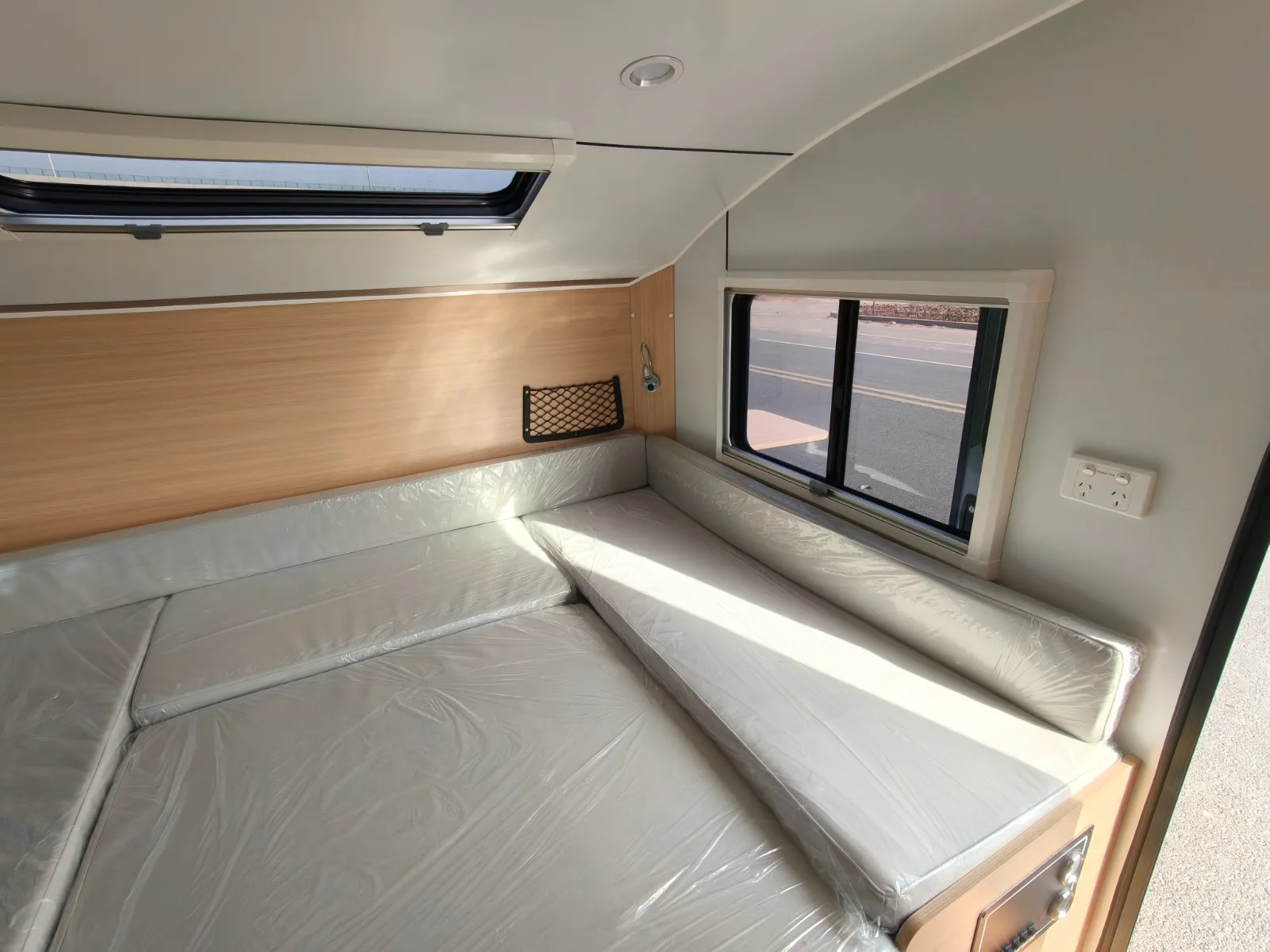
Standing height, a bathroom and a larger bed are where the Max’s extra kilograms go.
The essential question is: which features do you actually use on every trip? If the answer is “solar, fridge, outdoor shower, queen bed,” the Ultra at 900 kg is the weight-sweet-spot. If you need an interior bathroom because you camp in areas with no facilities, the Max at 1,200 kg is the only teardrop in Australia that delivers it under $50,000.
Our full guide to off-grid teardrop camping in Australia covers the trade-offs in detail, including battery sizing and daily power consumption.
Breath Trailer weight specs — the full breakdown
For reference, here are the complete weight specifications for all four Breath models, straight from the factory:
| Spec | Essential | Plus | Ultra | Max |
|---|---|---|---|---|
| Tare weight | 700 kg | 800 kg | 900 kg | 1,200 kg |
| GTM | 1,380 kg | 1,380 kg | 1,380 kg | 1,520 kg |
| ATM | 1,500 kg | 1,500 kg | 1,500 kg | 1,700 kg |
| Payload | 800 kg | 700 kg | 600 kg | 500 kg |
| Ball weight (est.) | 150 kg | 150 kg | 150 kg | 170 kg |
| Overall length | 3,900 mm | 3,900 mm | 3,900 mm | 5,050 mm |
| Overall width | 2,000 mm | 2,000 mm | 2,000 mm | 2,100 mm |
| Overall height | 1,600 mm | 1,600 mm | 1,850 mm | 2,460 mm |
| Price (from) | $23,320 | $29,766 | $34,749 | $42,900 |
| Brakes | Electric + hand | Electric + hand | Electric + hand | Electric + hand |
| Min. tow vehicle | Mid-size SUV | Mid-size SUV | Mid-size SUV | Large SUV |
Vehicles confirmed compatible with the Essential, Plus, and Ultra (ATM 1,500 kg): Toyota RAV4 AWD, Mazda CX-5, Subaru Outback, Hyundai Tucson AWD, Kia Sportage AWD, Nissan X-Trail AWD, Mitsubishi Outlander PHEV.
Vehicles confirmed compatible with the Max (ATM 1,700 kg): Toyota Prado, Toyota Fortuner, Ford Everest, Mazda CX-9, Kia Sorento, Hyundai Santa Fe Diesel, Isuzu MU-X, Mitsubishi Pajero Sport.
If you’d like to confirm your specific car’s compatibility before booking, the team at Breath Trailer can check against your vehicle’s compliance plate details — just ask during the booking call.
Frequently asked questions about teardrop camper weights in Australia
How much does a teardrop camper weigh in Australia?
Australian teardrop campers range from around 480 kg tare (lightest micro-teardrops) to 1,200 kg tare (full-bathroom standing-height models). The most popular category — a teardrop with kitchen, battery, fridge, and solar ready for a weekend off-grid — sits between 700 kg and 900 kg tare. Breath Trailer’s three most popular models fall in this range: Essential (700 kg), Plus (800 kg), Ultra (900 kg).
What is the difference between tare weight and ATM on a teardrop camper?
Tare weight is how much the empty trailer weighs — the factory-spec figure before you load anything. ATM (Aggregate Trailer Mass) is the maximum total weight the trailer is legally allowed to reach when fully loaded with water, gear, and accessories. The gap between tare and ATM is your payload. On a Breath Plus: 800 kg tare, 1,500 kg ATM = 700 kg payload. Your tow vehicle’s rated towing capacity must be at least equal to the ATM.
Do teardrop campers need brakes in Australia?
Yes, if the trailer’s GTM (Gross Trailer Mass) exceeds 750 kg. Almost every practical teardrop camper — anything with a water tank, battery, and camping gear loaded — will exceed 750 kg GTM when in use. All four Breath Trailer models come fitted with electric and hand brakes as standard. Running a brake-required trailer without brakes on an Australian public road is illegal and will result in a defect notice.
Can a Toyota RAV4 tow a teardrop camper?
It depends on the variant. A RAV4 AWD (petrol or hybrid) is rated at 1,500 kg braked towing — enough for the Breath Essential, Plus, and Ultra (all 1,500 kg ATM). A RAV4 2WD drops to 800 kg rated capacity, which limits you to the very lightest teardrops only. Always confirm your specific year and variant — not all RAV4s are equal on the spec sheet. The Breath Max (1,700 kg ATM) requires a larger vehicle like a Prado, Fortuner, or Ford Everest.
How much payload do I realistically need in a teardrop camper?
For a weekend trip for two: water (80 L = 80 kg) + food/fridge load (~35 kg) + clothing, gear, and cooking supplies (~50 kg) = around 165 kg minimum. For a two-week lap with daily showering, plan for closer to 200–250 kg of loaded gear. On this basis, a minimum payload of 400 kg is a sensible floor for any camper you plan to use seriously off-grid. The Breath Essential’s 800 kg payload provides substantial headroom for even the heaviest-packing adventurers.
Does towing a heavier teardrop use significantly more fuel?
Weight contributes, but aerodynamics matters more. A 900 kg teardrop uses roughly 0.5–1 L/100 km more than a 700 kg teardrop of the same shape. The bigger fuel variable is the teardrop’s aerodynamic profile vs a box trailer — teardrops save 2–3 L/100 km compared to flat-fronted camper trailers of similar weight. Over a two-week 2,000 km trip, that’s 40–60 L of fuel and around $80–$120 saved.
Recommended reading
- Camper Trailer Towing Guide Australia — Rules, Weights & Vehicles
- Best Teardrop Campers in Australia: 2026 Buyer’s Guide
- Off-Grid Teardrop Camper Australia — Solar, Battery & Power Guide
- Teardrop Camper vs Camper Trailer Australia — Which Is Right for You?
- Compare all four Breath models side by side