Cradle Mountain Camping Guide for Camper Trailers (2026)
Complete 2026 guide to camping at Cradle Mountain with a camper trailer — campgrounds, Tasmania Parks Pass fees, best walks, seasonal tips and which Breath Trailer model suits best.
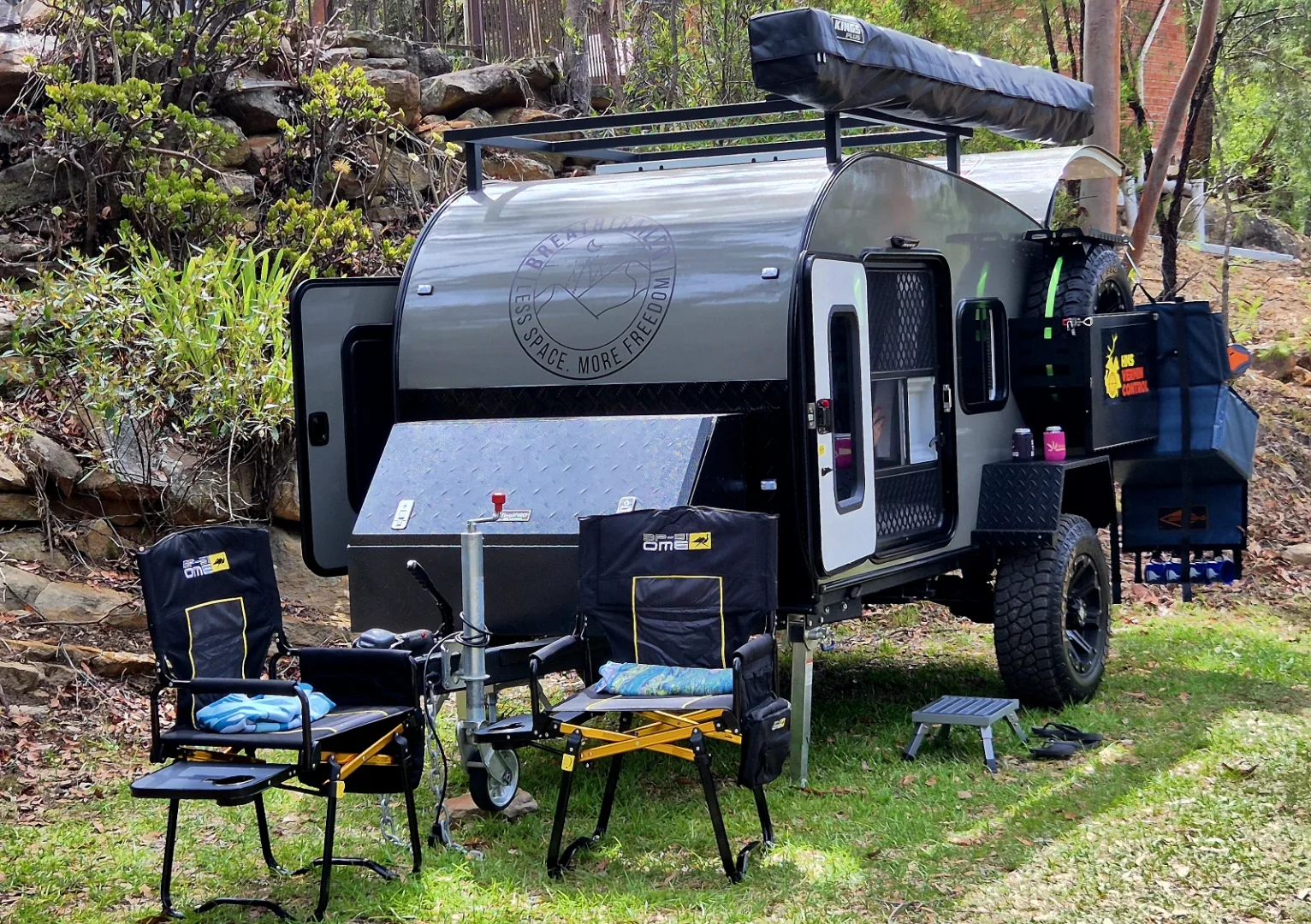
Cradle Mountain attracts roughly 300,000 visitors each year. It is Tasmania’s most iconic national park, part of the 1.6-million-hectare Tasmanian Wilderness World Heritage Area, and the northern trailhead for Australia’s most famous multi-day walk — the Overland Track. Wombats wander into campgrounds at dusk. Tasmanian devils forage through the scrub at night. On a clear day, the dolerite crag of Cradle Mountain reflects in the still water of Dove Lake below.
Getting there with a camper trailer is entirely straightforward — sealed roads the whole way from Devonport, no river crossings, no corrugations. What requires some planning is knowing which campgrounds actually accept trailers (the national park campgrounds are largely hut-and-tent focused), understanding the Tasmania Parks Pass, and timing your visit around a climate that packs four seasons into a single afternoon.
This guide covers the campgrounds that genuinely work for trailers, current 2026 fees and pass costs, getting there from the mainland, the best walks for each fitness level, a seasonal guide to when to go, and a model comparison showing which Breath Trailer is best suited to alpine conditions.
Can You Bring a Camper Trailer to Cradle Mountain?
Yes — the roads are sealed all the way from Devonport (87 km, about 1.5 hours) and from Launceston (approximately 180 km, about 2.5 hours via Sheffield and Deloraine). Any tow vehicle that can legally tow your trailer on a highway can reach the national park without drama.
Within the park itself, the road ends at the Cradle Mountain Visitor Centre. From there, a free shuttle bus runs to Dove Lake during operating hours (typically October to April peak season, and on-demand at other times). Private vehicles to Dove Lake are restricted during operating hours — so you leave your trailer at the campground or day-use car park and shuttle in.
Where trailers can stay: The main camping option for trailers is Discovery Parks Cradle Mountain, a private park just outside the national park boundary. It has powered and unpowered sites that accept trailers up to about 18 feet (5.5 m). The national park itself has Waldheim Cabins (huts, no trailers) and the Pencil Pine campsite area near the visitor centre, which suits tents and small campers but not large trailers. At the southern end of the park, Lake St Clair Campground at Derwent Bridge does accept trailers.
Trailers of any Breath Trailer size can reach all the commercial parks without difficulty. The sites are compact, so confirm exact bay dimensions before booking a longer rig.
Campgrounds at Cradle Mountain: Complete Overview
| Campground | Trailer OK | Access | Nightly fee (approx.) | Facilities | Notes |
|---|---|---|---|---|---|
| Discovery Parks Cradle Mountain | Yes (≤18 ft/5.5 m) | 2WD sealed | From ~$55 unpowered; ~$95+ powered | Amenities blocks, dump point, camp kitchen | 3832 Cradle Mountain Rd; limited water — fill up before arrival (9 L/pp/day); 1800 030 044 |
| Cradle Mountain Wilderness Village | Yes | 2WD sealed | From ~$45–65 unpowered (confirm) | Amenities, powered sites, alpine huts | 3 km from visitor centre; camping + glamping options; confirm current rates |
| Cradle Mountain Fishery & Camping | Yes (powered site) | 2WD sealed | ~$40–60/night (private) | 1 powered site; showers planned Dec 2026 | Private property near Moina, ~20 km from Cradle Valley; confirm via Hipcamp |
| Lake St Clair Campground | Yes | 2WD sealed | TAS park camping fee ~$13–17/person/night | Toilets, cold showers, basic shelter | Derwent Bridge, southern park entrance; 87 km south of Cradle Valley |
| Waldheim Cabins (in-park) | No — huts only | 2WD sealed | ~$195–290/cabin/night | Self-catering, shared amenities blocks | 8 cabins, 4–8 people; bring own bedding; book via parks.tas.gov.au |
| Overland Track huts | No trailers | Walk-in only | Included in track permit ($160 adults) | Basic huts; carry a tent as backup | Seasonal Oct–Apr; 34 independent walker bookings per day |
Fees are indicative. Confirm directly with each operator — Discovery Parks and the private parks adjust pricing seasonally, and the TAS national park camping fee is set by Parks and Wildlife Service Tasmania (parks.tas.gov.au).
Discovery Parks is by far the most practical option for a trailer. It is the closest commercial park to the national park entrance, it has dump points, and its site sizes are designed for caravans and camper trailers. The operator notes that water supply is limited due to the remote location — arrive with full tanks. It is not dog-friendly, which matters if you are planning a Tasmanian loop with a pet.
Lake St Clair suits the less-visited southern entry to the park. It is a quieter and more remote experience, and it puts you on the doorstep of the Overland Track’s southern terminus and the Platypus Bay walk — one of the best opportunities in Australia to see a platypus in the wild.
Tasmania Parks Pass: What You Need and What It Costs
A valid pass is required to enter any Tasmanian national park. The pass covers the vehicle and all passengers. Separate entry passes for individual passengers travelling without a vehicle (cyclists, bus travellers, pedestrians) are also available.
| Pass type | Vehicle + up to 8 people | Per person (no vehicle) |
|---|---|---|
| Day pass | $49.15 | $24.55 |
| Two-month Holiday Pass | $98.35 | $49.20 |
| Annual Parks Pass | $104.75 | Not available |
Prices from July 2026. Verify at parks.tas.gov.au before visiting.
Day pass vs Holiday Pass: Two day passes cost $98.30 — almost identical to the two-month Holiday Pass ($98.35). If you are staying for two days or more, the Holiday Pass is the clear choice: same cost, valid for two months across every Tasmanian national park including Freycinet, Mount Field, and the Tasman Peninsula.
Shuttle bus: The shuttle from the visitor centre to Dove Lake is separate from the parks pass and has its own fee. Check with the visitor centre for current pricing.
Overland Track permit: A separate permit ($160 adults, $128 children 5–17) is required for the Overland Track in addition to the parks pass. This applies to the peak season (October–April). Independent walkers are capped at 34 per day; book at overlandtrack.com.au.
Getting There: Towing Tips
All roads from Devonport and Launceston to the park are sealed, which puts Cradle Mountain in a different category from destinations like K’gari (which requires an off-road-capable trailer) or the Gibb River Road. Any Breath Trailer can handle the drive without an off-road upgrade.
| Route | Distance | Drive time | Key notes |
|---|---|---|---|
| Devonport → Cradle Mountain | 87 km | ~1.5 hrs | Via B19/C132; sealed; winds through highlands; fills up in Sheffield |
| Launceston → Cradle Mountain | ~180 km | ~2.5 hrs | Via B12/Deloraine/Sheffield; sealed; slower through townships |
| Hobart → Cradle Mountain | ~260 km | ~3.5 hrs | Via Lyell Highway, A10, then north; allow extra time for the 99 Bends on the Lyell |
| Devonport → Lake St Clair | ~174 km | ~2.5 hrs | Via A10 Lyell Highway; includes the 99 Bends section — manageable in a light teardrop |
Winter conditions: Snow and ice are possible on the C132 and surrounding roads from June through September. Road conditions change quickly — check transport.tas.gov.au before setting out and carry chains (or ensure your tow vehicle has snow tyres adequate for the alpine section). The park road itself can close temporarily after heavy snowfall.
Towing the 99 Bends (Lyell Highway): If your route takes you south of the park, the Lyell Highway’s famous hairpin section is entirely manageable in a sub-tonne teardrop. The drivers who struggle are those towing 2.5-tonne caravans with incorrect tow ball weight. Our towing tips guide covers descent technique and brake controller gain settings for exactly this kind of mountain road.
From the mainland: Interstate visitors typically take the Spirit of Tasmania ferry from Melbourne’s Station Pier to Devonport. A car-plus-trailer return costs approximately $224–$452 depending on season and cabin type. Foot passengers can also use the ferry and hire a vehicle in Devonport, though a tow vehicle is not available for hire. Book well ahead for summer sailings.
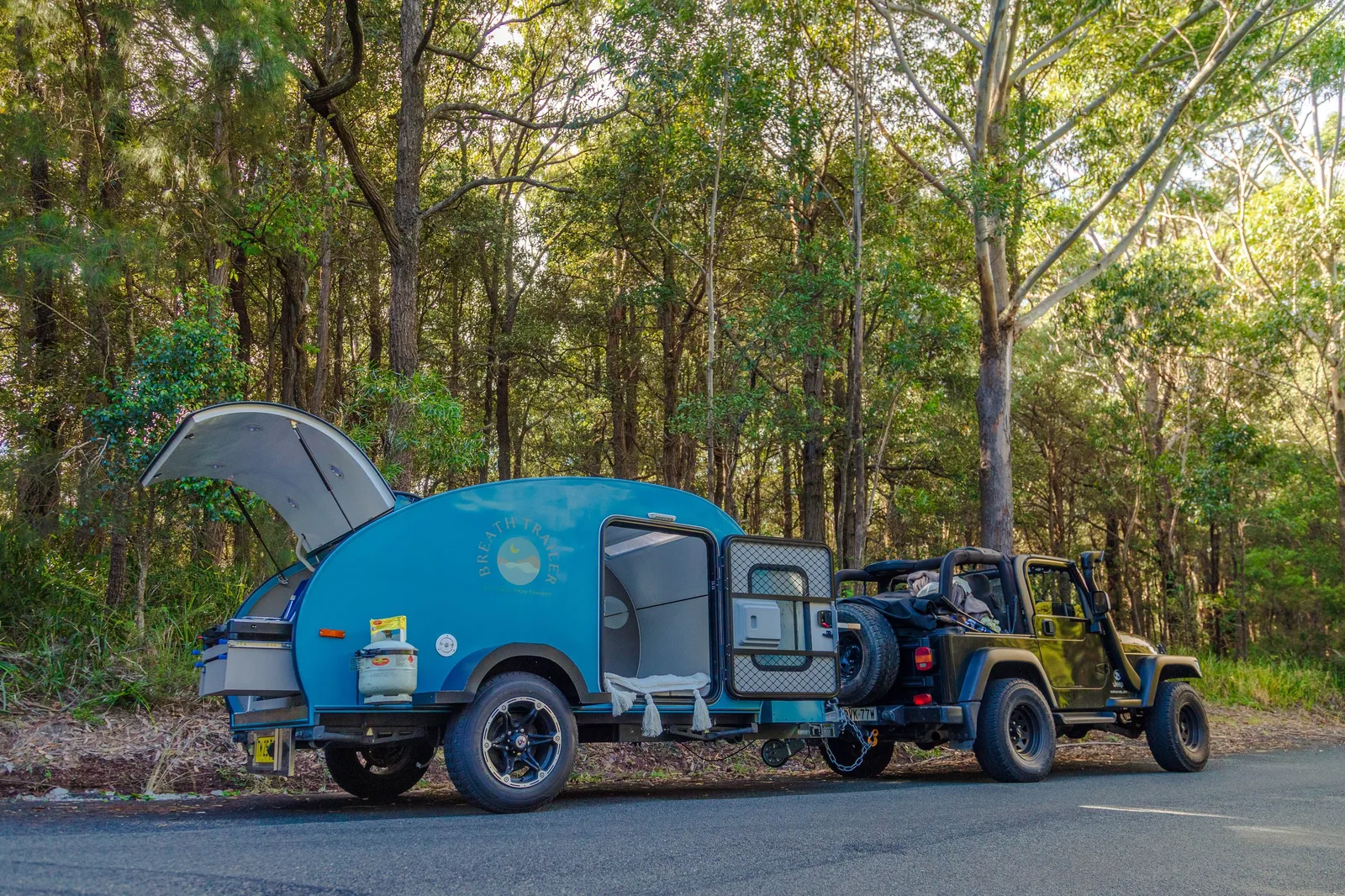
The forest roads of Tasmania’s northwest highlands — all sealed but winding; descend slowly with a loaded trailer.
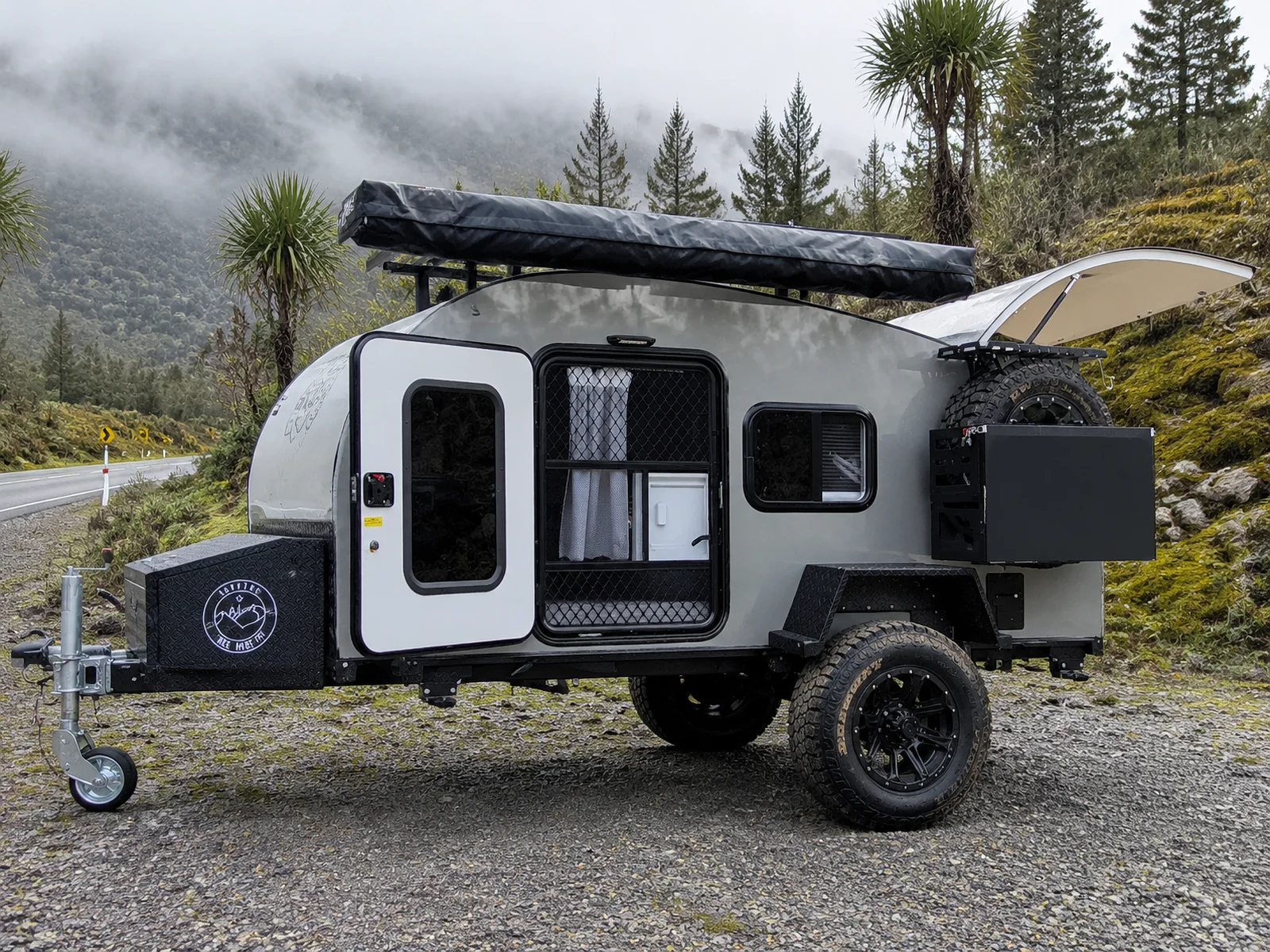
Illustration: The highland road between Moina and Cradle Valley passes through some of Tasmania’s most distinctive alpine vegetation.
Best Walks at Cradle Mountain
The park suits every fitness level, from a flat 30-minute stroll through ancient pencil pine forest to a six-day wilderness traverse. Leave your trailer at the campground and shuttle or drive to the trailheads.
| Walk | Distance | Time | Grade | What to expect |
|---|---|---|---|---|
| Enchanted Walk | 1.5 km | 30 min | Easy | Ancient pencil pine and rainforest; boardwalk; good at any fitness level |
| Wombat Pool | 2.5 km | 45 min | Easy | Tranquil alpine pool through moorland; wombat sightings common |
| Dove Lake Circuit | 5.7 km | 2–3 hrs | Moderate (Grade 3) | The classic walk; Ballroom Forest, boat shed, quartzite beach, Cradle Mountain views |
| Marion’s Lookout via Dove Lake | 10 km | 3–4 hrs | Hard | +791 m total ascent; panoramic summit views; rocky underfoot |
| Cradle Mountain Summit | ~12 km | 5–6 hrs | Hard (scrambling) | Exposed alpine terrain; requires sure footing on loose dolerite boulders |
| Kitchen Hut | 8 km return | 3 hrs | Moderate | First section of the Overland Track; good taste of the terrain without the full commitment |
| Overland Track | 65 km | 6+ days | Very hard | Full permit required ($160 adults); Oct–Apr season; 60 walkers/day maximum |
Dove Lake Circuit is the walk almost every visitor does. On a clear day, the reflection of Cradle Mountain in the lake is extraordinary. Allow time for photos at the boatshed. The shuttle bus runs from the visitor centre — leaving your car at the caravan park and taking the shuttle makes more logistical sense than trying to park at Dove Lake.
Wildlife time: Wombats are most active at dawn and dusk around the visitor centre and campground areas. Tasmanian devils are largely nocturnal — your best chance is a quiet evening stroll near the campsite edges. Echidnas appear on trails any time of day.
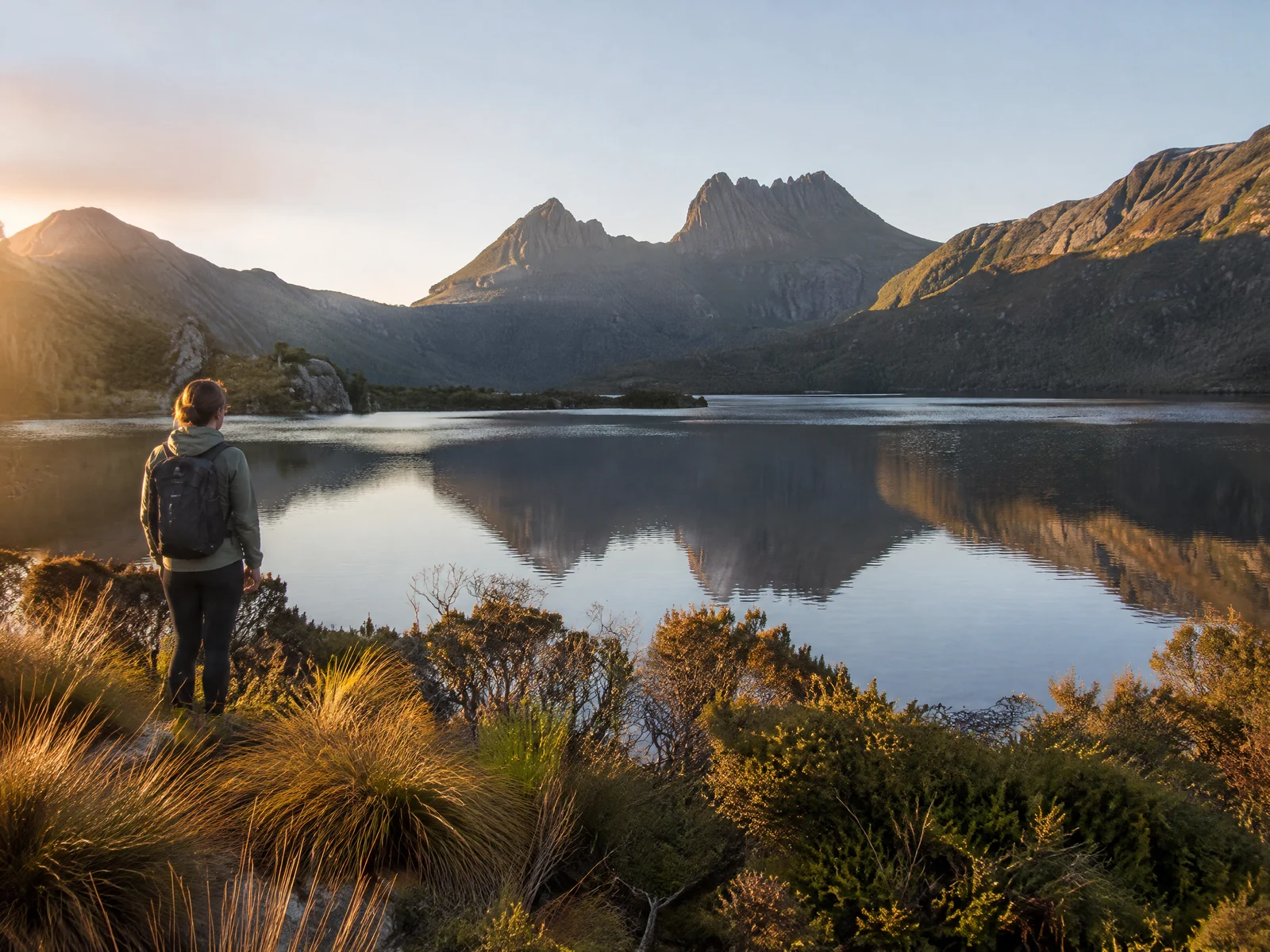
Illustration: A clear morning at Dove Lake Circuit delivers one of Australia’s most photographed mountain reflections.
Seasonal Guide
| Season | Temperatures | Conditions | Campground access | Recommendation |
|---|---|---|---|---|
| Summer (Dec–Feb) | 10–17°C daytime | Driest, longest days; busiest period | All sites open | Best for hiking; book 3–6 months ahead for Discovery Parks peak dates |
| Autumn (Mar–May) | 5–14°C | Shoulder season; vivid deciduous colours near visitor centre; Overland Track closes April | All sites open | Good balance of weather and crowds; March particularly pleasant |
| Winter (Jun–Aug) | -2–5°C | Snow common above 500 m; some road sections can close temporarily; park quietest | Confirm site availability; Discovery Parks may reduce services | For winter campers only; diesel heater essential; dress for sub-zero nights |
| Spring (Sep–Nov) | 3–14°C | Overland Track opens October; wildflowers in bloom; weather improving | All sites open | October and November are the sweet spot: reasonable weather, far fewer people than December–February |
Four seasons in a day: Cradle Mountain’s microclimate is genuinely unpredictable. Rain, hail, and sunshine in the same afternoon is normal. Pack layers even in summer: a sunhat and a waterproof jacket have to live in the same daypack. The mountain is cloudcapped far more often than it is clear — if you get a clear day, the views are exceptional.
Winter camping: The park is entirely accessible in winter, but it demands preparation. Snow on the C132 can require chains, and overnight temperatures regularly fall to -2°C or below. A hard-shell teardrop handles condensation and insulation far better than canvas, but a diesel or diesel-style heater is the difference between a comfortable cold-weather trip and a miserable one. Our diesel heater guide covers the options and costs. Our dedicated winter camping guide is worth reading before any high-altitude June trip in Tasmania.
Self-Containment at Cradle Mountain
There is no free camping within the Cradle Valley section of the national park. All camping for trailers is at commercial parks (Discovery Parks, Cradle Mountain Wilderness Village) or the Parks and Wildlife Service campground at Lake St Clair — all of which have amenity blocks and dump points.
For most visits to Cradle Mountain, full self-containment is not a practical requirement in the same way it is at remote free-camping destinations. You will be using facilities at a commercial park.
However, two scenarios make a fully self-contained trailer worthwhile:
-
You are incorporating Cradle Mountain into a broader Tasmanian loop that includes free coastal camping at Friendly Beaches, the Central Coast foreshore, or national park sites that require proof of containment. Our self-contained camper guide explains what state and national park operators actually check.
-
You are visiting in winter and want complete independence from shared amenities in cold conditions. A sealed grey water system and interior bathroom mean you are not walking outside in -2°C weather for 3am trips.
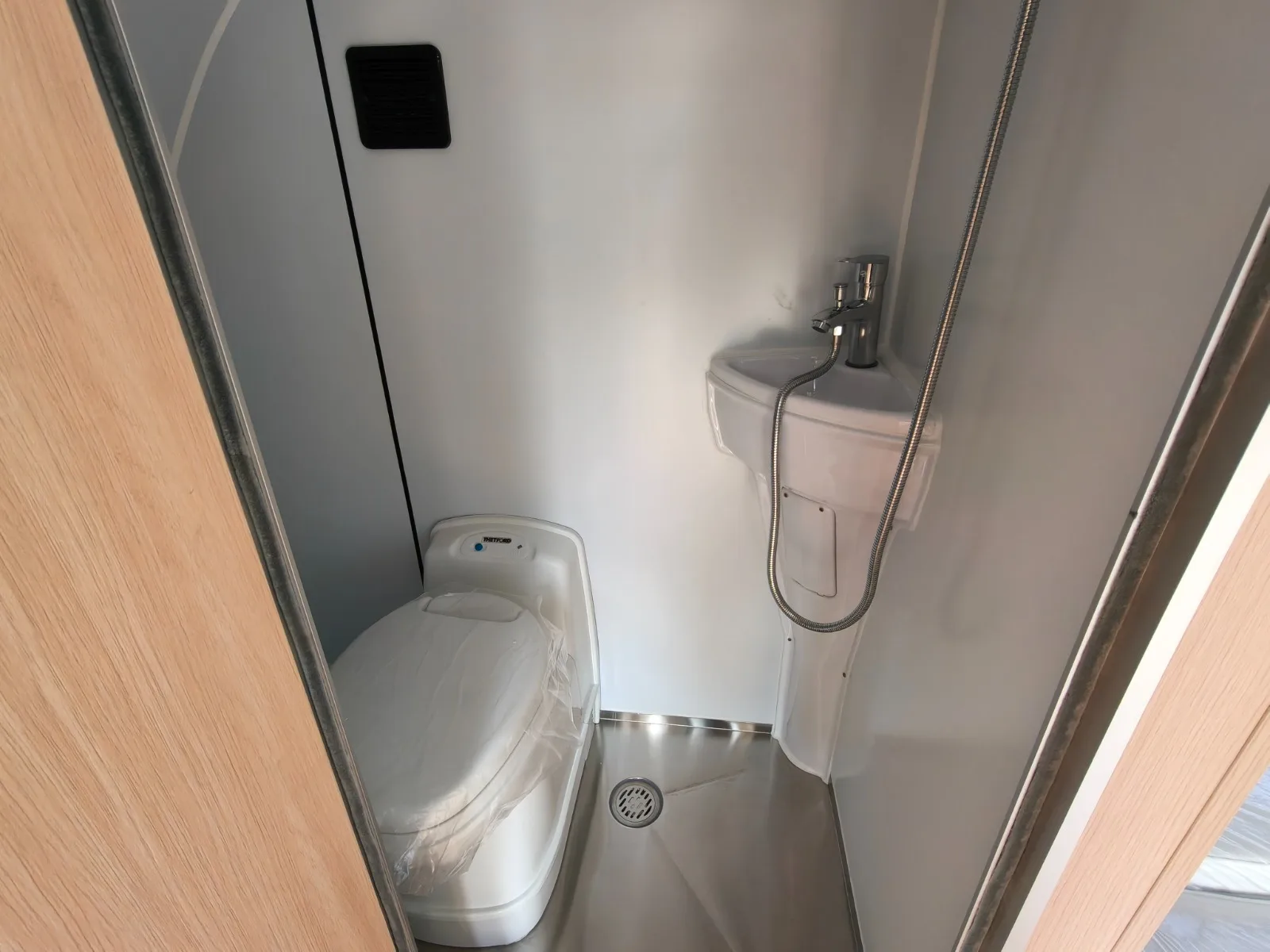
The Max’s interior bathroom — more useful at 2°C in a Tasmanian winter than it is anywhere else on the continent.
The Breath Max is the only teardrop on the Australian market under $50,000 with a full interior bathroom: cassette toilet, corner basin, handheld shower, sealed grey water tank, and 120 L fresh water capacity. It clears every self-containment requirement without an aftermarket fit-out.
Breath Trailer Model Guide for Cradle Mountain
All four models can reach Cradle Mountain without modification. The question is how comfortable your stay will be in an environment that can swing from 17°C sunshine to -2°C overnight in 12 hours.
| Model | Price | Tare | Bathroom | Self-contained | Alpine verdict |
|---|---|---|---|---|---|
| Essential | $23,320 | 700 kg | No | No | Excellent for summer and autumn; hard shell handles rain and condensation better than canvas; no heating solution built in |
| Plus | $29,766 | 800 kg | No | No | Built-in fridge removes one challenge (provisioning in remote areas); no bathroom |
| Ultra | $34,749 | 900 kg | External shower only | No | External shower useful after muddy hikes; cold nights make it less appealing |
| Max | $42,900 | 1,200 kg | Full interior bathroom | Yes | Best choice for winter or extended Tasmanian loops; 2.1 m standing height; external bathroom access never required |
For a summer week at Cradle Mountain: any model works, and the Essential at $23,320 delivers excellent value. The hard-shell construction handles Tasmania’s unpredictable rain without the canvas mould risk of traditional camper trailers.
For a winter trip or extended Tasmanian circuit: the Max justifies its price. An interior bathroom in -2°C overnight temperatures is genuinely useful rather than a luxury, and its 1,200 kg ATM ceiling means it is correctly rated for 2WD sealed-road towing with a payload for cold-weather gear (extra blankets, a diesel heater, boots, recovery kit).
Compare all four models side by side or book a viewing appointment at our Sydney workshop before the ferry.
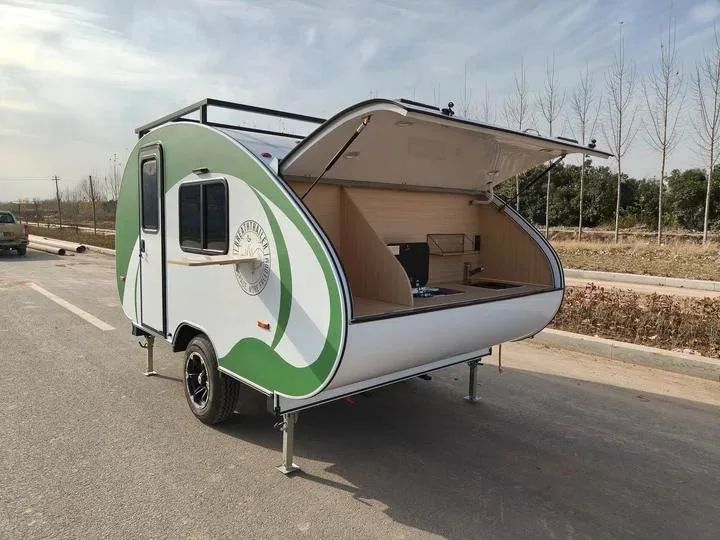
The Max’s rear galley does the same job in a Tasmanian campground as anywhere else — but a fold-away side table and enclosed bed make the cold more manageable.
Cradle Mountain Packing Checklist
| Category | Must-have | Nice to have |
|---|---|---|
| Clothing | Waterproof jacket, thermal base layer, warm mid-layer, gloves, beanie | Gaiters (useful after rain on muddy trails), lightweight down jacket |
| Footwear | Waterproof hiking boots with ankle support | Camp shoes (gumboots are popular at Cradle; sites can be wet) |
| Camping | Diesel or catalytic heater, extra blankets, quality sleeping bag (rated to -5°C min in winter), torch | Folding camp mat for outdoor sitting on wet ground |
| Day walks | Daypack, water (2 L minimum per person), lunch, sunscreen, trekking poles for Marion’s Lookout | Trekking poles for steep sections |
| Safety and comms | First aid kit, PLB or personal satellite communicator, charged mobile phone (Telstra coverage in main areas) | UHF CB radio for remote sections |
| Park admin | Tasmania Parks Pass, photo ID, Overland Track permit (if applicable), campsite booking confirmation | CMCA/KEA membership card for dump points |
Water at Cradle Mountain: Bring enough potable water. Discovery Parks advises 9 L per person per day due to the limited remote supply. A 120 L tank (Breath Max) is a practical advantage — at a couple’s 18 L/day, that gives nearly a full week without a refill.
Frequently Asked Questions
Can I drive to Dove Lake with a caravan or camper trailer? During shuttle bus operating hours (roughly October to April), private vehicles are restricted from driving to Dove Lake. You leave your trailer at the campground or day-use car park at the visitor centre and take the free shuttle. Outside shuttle hours, driving to Dove Lake may be permitted — confirm with the visitor centre on arrival.
Is Cradle Mountain suitable for beginners or families? Yes for day visitors. The Enchanted Walk (1.5 km) and Wombat Pool (2.5 km) are suitable for all ages and fitness levels. The Dove Lake Circuit (5.7 km) is moderate but the track is well-maintained. Save Marion’s Lookout and the summit for fit walkers. The Overland Track is not suitable for beginners — it is a multi-day wilderness traverse requiring experience, fitness and proper equipment.
Do I need snow chains to visit Cradle Mountain? Not routinely in summer or autumn, but chains are recommended equipment for any winter visit. The C132 between Moina and Cradle Mountain can ice over in winter and may close temporarily after heavy snowfall. Check transport.tas.gov.au before travelling from June to September.
What is the best campground for a camper trailer near Cradle Mountain? Discovery Parks Cradle Mountain (3832 Cradle Mountain Rd, 1800 030 044) is the best choice for trailers. It is the closest commercial park to the national park entrance, has powered and unpowered sites for rigs up to 18 feet, and is operated year-round. Confirm site availability and current pricing directly before booking.
Can I complete the Overland Track at any time of year? The Overland Track requires a permit and operates only during the peak season, October to April. Independent walkers are capped at 34 per day. Booking opens at overlandtrack.com.au; summer (December–February) spots sell out fast. The track is closed to independent walkers in winter (May–September), though guided walks operate year-round with different permit arrangements.
Is Cradle Mountain worth a short trip — say, two or three nights? Absolutely. Two nights gives you: the Dove Lake Circuit (Day 1 afternoon), a longer walk to Marion’s Lookout (Day 2), and the Enchanted Walk or Wombat Pool with time to return to Devonport (Day 3 morning). The park rewards extended stays, but even a long weekend is enough to see what all the fuss is about. Budget two days at minimum if you are bringing a camper trailer from the mainland — you need at least one full day inside the park.
Recommended Reading
- Best Camping Spots in Tasmania — the full state guide including Freycinet, Bruny Island and the Tarkine
- Teardrop Camper Towing Tips — descent technique for the 99 Bends and mountain roads
- Diesel Heater vs Air Conditioner — why the heater wins at Cradle Mountain
- Winter Camping with a Teardrop Camper — preparation guide for sub-zero nights
- Self-Contained Camper Australia — what Tasmanian free camps actually require
Ready to plan your Tasmanian trip? Compare all four Breath Trailer models or book a viewing appointment with one of our ambassadors.