Teardrop Camper Towing Tips Australia: The Complete Practical Guide (2026)
Practical teardrop camper towing tips for Australia in 2026: hitching checklist, reversing technique, state speed limits, fuel economy, load placement and common mistakes.
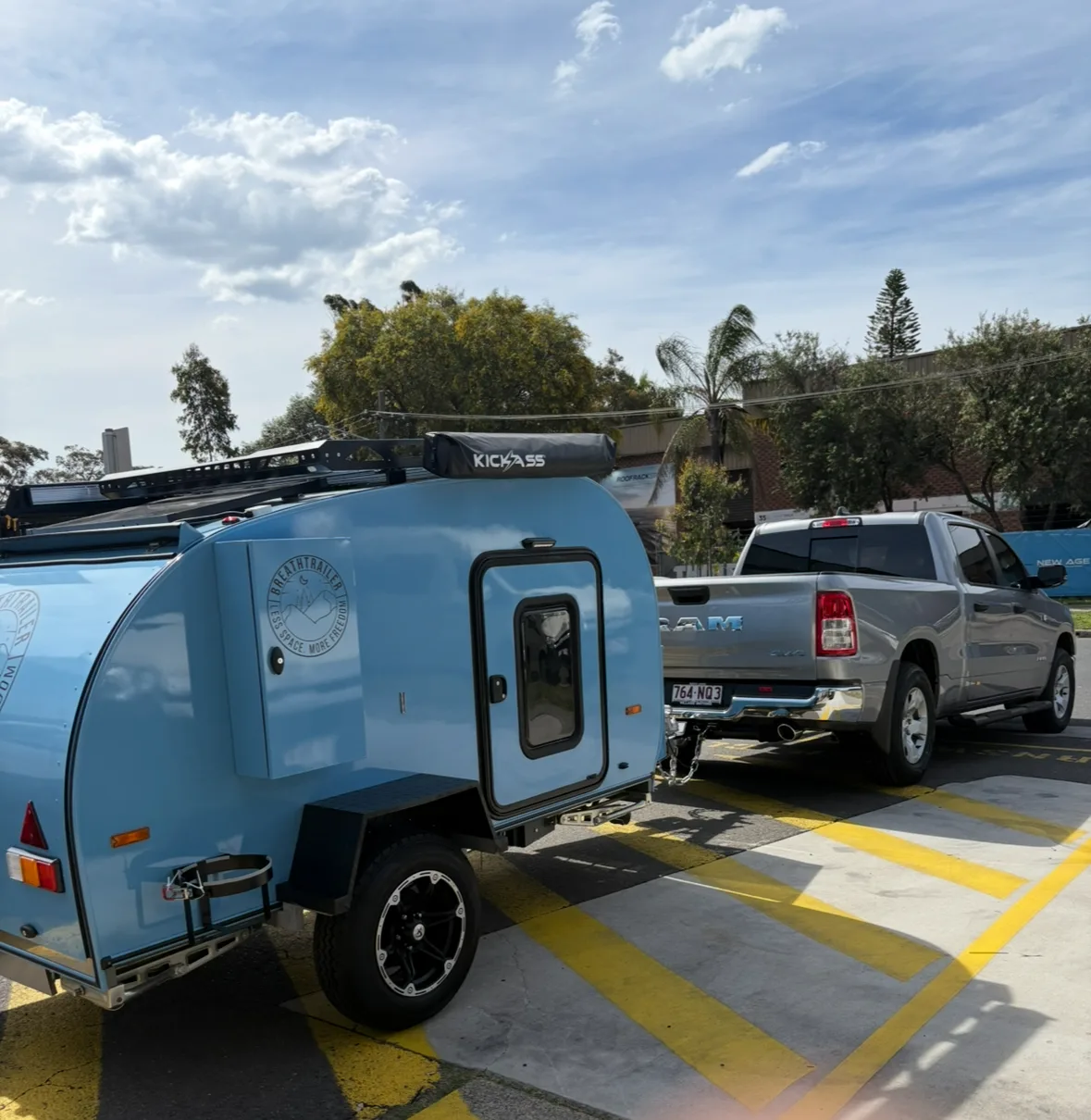
Thirty-five percent of Australians who own a camper trailer admit they felt anxious on their very first tow. That number drops to under five percent by the third trip. The gap between trip one and trip three isn’t mechanical talent — it’s knowing the right habits before you leave the driveway.
Teardrop campers are among the most forgiving trailers you can tow. Their low centre of gravity, compact footprint, and aerodynamic profile mean they’re genuinely easier to handle than a full-size caravan. But “easy to tow” and “impossible to get wrong” are two different things. A misloaded trailer, a forgotten safety pin, or the wrong speed on an unfamiliar road can turn a brilliant weekend into a roadside disaster.
This guide is a companion to our Camper Trailer Towing Guide for Australia — which covers ATM, GTM, brakes, and which SUV can legally tow what. Here, we skip the spec sheet and go straight to the practical: what to check before you leave, how to hitch correctly, how to drive, reverse, and arrive at camp without drama.
Before You Hitch: The Pre-Trip Checklist
The number one cause of towing incidents in Australia isn’t mechanical failure — it’s skipped pre-departure checks. Run through this list every single time, even after you’ve done it a hundred times.
| Check | What to Look For | Action if Wrong |
|---|---|---|
| Tyre pressure (trailer) | Match the placard on the trailer frame (usually 50–65 PSI cold) | Inflate to correct pressure; check for cuts |
| Tyre pressure (tow vehicle) | Increase to towing recommendation (in owner’s manual — typically 4–6 PSI above normal) | Inflate; check for wear |
| Wheel nuts torque | Snug, no play; re-torque after first 50 km of every trip | Use torque wrench to manufacturer spec |
| Coupling locked | Ball fully seated, locking lever closed, safety clip inserted | Do not move until secure |
| Jockey wheel stowed | Fully raised and locked; not dragging | Wind up and pin |
| Safety chains crossed | Crossed under the hitch coupler in a U-shape | Reattach correctly |
| Electrical connection | Brake lights, indicators and reverse lights working | Test before leaving driveway |
| Brake controller set | Gain dial adjusted for trailer weight (higher ATM = higher gain) | Adjust; do a gentle brake test at 30 km/h |
| Breakaway cable attached | Cable clipped to tow vehicle; slack but not dragging | Reattach |
| Load balanced | Heavier gear forward of axle, lighter in rear; nothing unsecured | Repack; secure with ratchet straps |
| Stabiliser legs up | Fully retracted and locked | Wind up and pin |
| Mirrors adjusted | Clear view of both trailer sides and rear | Fit extenders if needed |
Pro tip: keep a laminated card of this list in your glovebox. Your future self will thank you.
How to Hitch a Teardrop Camper in 7 Steps
Hitching up looks complicated until you’ve done it three times. After that, it takes about four minutes. Here’s the exact sequence:
- Back the tow vehicle up until the towball is directly below the coupling socket. Having a spotter makes this much faster — they call “left, right, stop” while you focus on mirrors.
- Lower the coupling onto the towball using the jockey wheel. The socket should drop cleanly over the ball with no lateral movement.
- Lock the locking lever — you’ll hear or feel a click. Try to lift the coupling by hand. It should not come off.
- Insert the safety pin or clip through the locking lever to prevent accidental release.
- Wind up the jockey wheel completely. Lock it in the up position.
- Cross the safety chains beneath the coupling in an X pattern. Attach to the tow vehicle’s chain loops. They must be short enough to catch the draw-bar if the coupling fails, but long enough to allow full turning.
- Connect the 7-pin electrical plug and test brake lights, indicators, and reverse lights. If your trailer has electric brakes, check the brake controller display shows it has detected the trailer.
Do a brief walk-around before driving away: tyres, lights, coupling, chains, jockey wheel, any loose flaps or doors. Takes 30 seconds.
Load Distribution: Where to Put Your Gear
How you pack your teardrop matters almost as much as whether you tow it. Poor weight distribution causes two problems: understeer in the tow vehicle (too much rear weight) and sway (not enough towball download).
The 60/40 rule: aim to have 60% of your load weight forward of the trailer’s axle, 40% behind it. This keeps adequate downward force on the towball (the “towball download”) which stabilises the combination.
| Item | Where to Pack |
|---|---|
| Water tanks (if filled) | Over the axle or slightly forward |
| 12V battery / lithium pack | Forward of axle |
| Clothes, sleeping gear | Middle or rear |
| Tools, recovery gear | Evenly distributed; heavy items low |
| Food / pantry items | As central as possible |
| Firewood, chairs, gear strapped externally | Keep it minimal; adds height and aerodynamic drag |
Towball download target: most Australian tow vehicles have a maximum towball download of 150–350 kg (check your specific vehicle’s handbook). For teardrops in the 700–1,200 kg ATM range, 8–12% of ATM on the towball is the practical target. Under-loading the ball (too much weight rearward) is a common cause of trailer sway.
The Teardrop Camper Weight Guide Australia has a full breakdown of what each Breath Trailer model weighs unladen and what payload remains for gear — useful when planning what you can actually carry.
Australian Towing Speed Limits by State (2026)
Australia’s towing speed rules are set by each state and territory. Most drivers assume the highway speed limit applies — but in some states, there’s a lower limit just for towing vehicles.
| State / Territory | Towing Speed Limit | Notes |
|---|---|---|
| New South Wales | 110 km/h (same as posted limit) | No specific towing reduction for light trailers; GCM >4.5 t limited to 100 km/h |
| Victoria | 110 km/h (same as posted limit) | No specific towing reduction |
| Queensland | 110 km/h (same as posted limit) | No specific reduction for light trailers |
| South Australia | 110 km/h (same as posted limit) | No specific reduction |
| Western Australia | 100 km/h (hard limit when towing) | Applies regardless of posted limit; enforced strictly |
| Tasmania | Match posted limit (max 110 km/h) | Reduce on unsealed roads (80 km/h commonly recommended) |
| Northern Territory | Match posted limit | Some open roads have no posted limit — 130 km/h is effectively the cap when towing |
| ACT | Match posted limit | No specific towing reduction |
Manufacturer limits: your tow vehicle’s handbook may impose a lower maximum towing speed than local road rules allow. This is particularly common for older vehicles and certain European models (some BMW/Mercedes/Volvo SUVs have 80 km/h limits from the factory). If manufacturer and state limits differ, the lower one applies. A roadside infringement officer won’t accept “the state limit is 110” as a defence when your handbook says 80.
Practical advice: irrespective of the legal limit, towing a loaded teardrop at 90–100 km/h is almost always the better choice. Fuel economy improves significantly (more below), tyre heat buildup reduces, and braking distances remain manageable. Leave earlier, not faster.
On the Road: Safe Driving Habits
Following Distance
When towing, your braking distance increases. A general rule used by Australian driver trainers is to double your following distance when towing — from the standard 3-second rule to a 6-second gap. On gravel, wet roads, or in the dark, extend this further.
All Breath Trailer models are fitted with electric brakes as standard, which significantly reduces stopping distances compared to an unbraked trailer. Even so, the added momentum of a loaded teardrop takes time to scrub off.
Overtaking and Merging
A teardrop camper adds roughly 3.5–4 metres to your vehicle’s length. When overtaking, you need that extra distance on the other side before you can safely move back into the lane. Many first-time towers misjudge this and cut back too early.
Rule of thumb: after overtaking, wait until you can see the overtaken vehicle in your driver’s side mirror before indicating back into the lane. This gives you clearance for the full vehicle-plus-trailer length.
Wind and Sway
Sway is the side-to-side oscillation a trailer can develop at speed. Teardrops are far less prone to sway than full-height caravans because of their low centre of gravity and aerodynamic shape — but it can still happen, particularly:
- At speeds above 100 km/h
- On exposed stretches of highway with crosswinds
- When a road train or semi-trailer passes at speed
- When the trailer is loaded too heavily to the rear
If sway develops: do not brake sharply. Hold the steering wheel firmly, ease off the accelerator gradually, and allow the speed to reduce naturally. Braking hard during a sway event can make it worse. Once the combination stabilises, check your load balance.
For reference, a weight distribution hitch is rarely needed for trailers under 1,500 kg — but it can help on heavier setups (like the Breath Max at 1,200 kg tare) particularly in windy conditions.
Towing Mirrors: Legal Requirements and Practical Advice
In Australia, you are legally required to have an unobstructed view 20 metres behind the trailer. If your trailer is wider than your tow vehicle’s standard mirrors, mirror extenders are required by law in all states.
| Mirror Type | Cost | Best For |
|---|---|---|
| Clip-on strap extenders (universal) | $40–80/pair | Occasional users, compact teardrops |
| Clamp-on extenders (vehicle-specific) | $80–150/pair | Better fit, more stable at highway speeds |
| Towing mirrors (replacement full mirror) | $200–600/pair | Frequent towers; best view quality |
Most teardrop campers are no wider than a standard mid-size SUV, so extenders may not be legally required — but they dramatically reduce blind spots and make reversing far easier. The investment is worthwhile even when not strictly mandated.
Fuel Economy When Towing a Teardrop
The most common question from first-time towers: “how much more fuel will I use?”
The honest answer: less than you’d expect, especially compared with towing a full-size caravan.
| Towing Scenario | Est. L/100km (medium SUV) | Increase vs Unladen |
|---|---|---|
| No trailer (unladen) | 8–11 L/100km | Baseline |
| Teardrop camper 700 kg (e.g. Breath Essential) | 11–14 L/100km | +30–50% |
| Teardrop camper 900–1,200 kg (e.g. Breath Ultra / Max) | 13–16 L/100km | +40–70% |
| Full-size caravan 2,500+ kg | 18–25 L/100km | +80–150% |
A full caravan’s upright front face is the primary fuel killer. Teardrop campers — with their sloped, low-profile shape — produce roughly half the aerodynamic drag of a same-weight caravan. This is why a RAV4 towing a Breath Essential at 100 km/h can achieve fuel consumption similar to a family wagon towing a box trailer.
Tips to minimise fuel use when towing:
- Drive at 90 km/h instead of 110 km/h. Aerodynamic drag increases with the square of speed. Slowing from 110 to 90 km/h can reduce fuel consumption by 15–20%.
- Inflate tyres to the towing pressure listed in your vehicle handbook (not the standard pressure on the door placard).
- Keep roof racks, rooftop tents, and bike racks clean and covered when towing — the combined aerodynamic effect of vehicle + roof load + trailer is compounding.
- Plan fuel stops on long trips. Your effective range per tank drops by 30–50% when towing. An SUV with a 60-litre tank that does 700 km unladen might only achieve 450–500 km under tow.
How to Reverse a Teardrop Camper
Reversing a trailer trips up more first-time towers than anything else. The difficulty is that steering inputs are inverted: turning your wheel left moves the trailer right. Here’s a method that works:
The “Bottom Hand” Technique
Place one hand at the bottom of the steering wheel. Move your bottom hand in the direction you want the trailer to go. If you want the trailer to swing left, move your bottom hand left. This aligns your hands with the trailer’s movement rather than the car’s — which is counterintuitive but far easier to learn than trying to think in reverse.
Step-by-step:
- Position the combination so you have a straight run back first.
- Reverse slowly — very slowly. Trailer errors compound with speed.
- Check both mirrors constantly, not just one.
- Make small, early corrections. A slight mirror imbalance means course correction now, not after the trailer has drifted.
- If you get into trouble, pull forward (straightening the combination) and start again. There’s no shame in a three-point reverse.
Using a Spotter
The most efficient method at an unfamiliar campsite is a human spotter. Agree on signals before you start:
- Both hands raised = stop immediately
- One arm waving toward body = come toward me (continue reversing)
- Flat hand pushed away = stop and hold
- Circular motion with arm = pull forward
Confirm your spotter is visible in your mirrors before beginning. Do not rely on shouted instructions at a noisy campsite.
Arriving at Camp: The Setup Sequence
The final 50 metres into a campsite — reversing between trees, levelling on uneven ground — is where most towing stress happens. A calm, methodical routine makes it a non-event.
- Do a walk-around of the site first before reversing in. Check clearance, surface slope, and obstacles (tree roots, drainage channels, irrigation lines).
- Back in slowly with a spotter if available. Stop once the trailer is positioned.
- Apply the handbrake on the tow vehicle before unhitching anything.
- Deploy the jockey wheel and lower the draw-bar until the coupling lifts off the ball.
- Disconnect the safety chains and electrical cable.
- Deploy stabiliser legs and level the trailer using the spirit level (if fitted) or a phone app.
- Chock the wheels on uneven ground.
- Open the camper, run your power connections, water, and awning — but these are trailer-specific; see the Teardrop Camper Accessories Guide for setup equipment worth carrying.
Common Towing Mistakes (and How to Avoid Them)
| Mistake | Why It Happens | How to Fix It |
|---|---|---|
| Overloading the rear of the trailer | Camping gear loaded without thinking | Follow the 60/40 rule; heavy items forward of axle |
| Forgetting to release the handbrake | Rushing at departure | Handbrake check is part of the pre-trip list |
| Driving at full highway speed in WA | Assuming all states have same rules | Remember WA’s hard 100 km/h limit |
| Using standard mirrors without extenders | ”The trailer looks narrow” | Check actual width vs vehicle width; extenders almost always help |
| Not increasing tyre pressure for towing | Using daily-driver pressure | Check handbook towing pressure — typically 4–6 PSI higher |
| Sharp steering inputs when sway starts | Panic response | Ease off accelerator; hold firm; let speed drop naturally |
| Skipping the brake controller test | ”I tested it last time” | Test every trip; gain settings may have been changed |
| Underestimating fuel range | Using unladen fuel range for trip planning | Add 40–50% to estimated fuel use |
Breath Trailer Models: Quick Towing Reference
All four Breath Trailer models are towable by a standard Australian mid-size SUV. Here’s the practical towing picture:
| Model | Tare | ATM | Towball Download | Min. SUV Recommendation |
|---|---|---|---|---|
| Essential $19,990 | 700 kg | 900 kg | ~90–110 kg | RAV4, CX-5, Tucson, C-HR |
| Plus $25,740 | 800 kg | 1,050 kg | ~100–120 kg | RAV4, Outlander, Kluger (smaller row) |
| Ultra $30,290 | 900 kg | 1,150 kg | ~110–130 kg | Prado, Everest, Kluger, Palisade |
| Max $39,000 | 1,200 kg | 1,500 kg | ~140–170 kg | Prado, Everest, Fortuner, Palisade |
All models include electric brakes as standard. No model requires a heavy-duty truck or a tow vehicle rated above 2,000 kg — something that eliminates a significant portion of the new-camper buyer’s usual list of upgrade costs.
For a full model-to-vehicle matching guide, see the Camper Trailer Towing Guide Australia — it includes a detailed SUV towing capacity table across 20 popular Australian vehicles.
Off-Road Towing: What Changes
On sealed roads, a teardrop tows like any well-balanced trailer. On gravel, corrugations, and dirt tracks, a few additional habits matter:
- Reduce speed significantly — 60–80 km/h on good gravel, 40–50 km/h on corrugated tracks.
- Lower tyre pressure (tow vehicle and trailer) to 30–35 PSI on rough dirt — this dramatically smooths the ride and reduces the risk of sidewall impacts.
- Increase following distance more on gravel — dust and flying stones from other vehicles reduce visibility and can damage paint and lights.
- Check connections after the first corrugated stretch — electrical plugs, chains, and wheel nuts can vibrate loose on rough surfaces.
- Know your clearance — teardrop campers sit very low. The Breath Essential at 700 kg tare has modest ground clearance; the Breath Ultra and Max with their off-road suspension are better suited to rough terrain.
The Off-Road Teardrop Camper Guide covers suspension, tyre selection, and model recommendations for unsealed-road adventures in detail.
Frequently Asked Questions
Do I need a special licence to tow a teardrop camper in Australia?
No. A standard Australian Class C (car) licence covers towing any trailer with an ATM up to 4,500 kg — which includes every teardrop camper on the Australian market. You do not need a separate trailer endorsement or caravan licence. The only licence consideration is if your tow vehicle plus trailer combination exceeds 4,500 kg GCM, which is essentially impossible with a teardrop.
Do I need a brake controller to tow a teardrop?
If your teardrop has an ATM above 750 kg — which includes the Breath Essential (900 kg ATM) and all heavier models — the trailer must have electric brakes, and your tow vehicle must have a brake controller installed. All Breath Trailer models come with electric brakes fitted. If your tow vehicle doesn’t have a factory brake controller, a plug-in or hardwired aftermarket unit (such as the Redarc Tow-Pro or Tekonsha Prodigy P3) is required before you legally tow.
How wide can I see before I need towing mirrors in Australia?
The legal requirement is an unobstructed view of at least 20 metres behind the trailer. If your trailer is wider than your vehicle’s standard mirrors allow you to see, extenders are legally required. Most teardrops are between 1.8 and 2.2 metres wide. Check your specific model’s width against your vehicle’s mirror spread.
Will my teardrop be stable at highway speeds?
Yes, in normal conditions. Teardrops are among the most stable trailer types due to their low centre of gravity and aerodynamic profile. High speeds combined with crosswinds and rear-heavy loading are the main triggers for sway. Keep speed at or below 100 km/h, load correctly, and ensure towball download is adequate.
How do I practice reversing before a trip?
Find an empty car park and set up two witches’ hats to mark a parking bay. Practice reversing into the bay from multiple angles. Doing 30 minutes of this before your first real trip is worth more than any written guide. The muscle memory transfers directly to campsite reversing.
Does towing a teardrop damage my car?
Not when towing within the vehicle’s rated capacity. Driving within the weight limits, maintaining correct tyre pressures, and having the brake controller calibrated means your drivetrain, brakes, and suspension stay within their designed operating range. Consistent overloading (exceeding ATM or GCM) causes premature wear and can void manufacturer warranties.
Your First Trip: A Realistic Expectation-Setter
Your first tow will feel slightly uncomfortable. That’s normal. You’ll check your mirrors more often than usual, you’ll feel the trailer’s presence at every lane change, and backing into the campsite will take longer than you’d like.
Your second trip will be noticeably more confident. By your fifth trip, the pre-departure checklist will take four minutes, hitching will be automatic, and reversing will be a mildly satisfying puzzle rather than a stressful ordeal.
The single most effective thing you can do before your first trip is to practise in a large empty car park with someone who can spot for you. Even one hour makes an enormous difference.
Teardrop campers — particularly the lighter models like the Breath Essential — are specifically designed as a gentle entry into towing. At 700 kg, the Essential can be towed by virtually any family SUV, with minimal impact on driving dynamics. It’s the product we’d recommend for anyone who’s never hitched a trailer before and wants the least intimidating possible starting point.
Recommended Reading
- Camper Trailer Towing Guide Australia: Which SUV Can Tow What? — the full weight and capacity deep-dive
- Teardrop Camper Weight Australia: ATM, Tare & Payload Explained — how to read trailer specs correctly
- Off-Road Teardrop Camper Australia: The Complete Guide — towing on unsealed roads, suspension and tyres
- Teardrop Camper Accessories Australia — towing mirrors, recovery gear, and campsite equipment
- Best Teardrop Camper Destinations by State — where to take it once you’re confident
Ready to find the model that suits your tow vehicle and travel style? Compare the four Breath Trailer models or book a viewing at our Sydney workshop.