Simpson Desert Preparation Guide: The Complete 4WD Checklist (2026)
Complete 2026 guide to crossing the Simpson Desert: permits, routes, fuel maths, water, recovery gear, towing strategy, and the honest truth about trailers in the dunes.
There are 1,113 parallel sand dunes between Birdsville and Mount Dare. They have been forming for 10,000 years. They will, without much concern, stop your 4WD dead if you are not ready for them.
The Simpson Desert covers 176,000 square kilometres of South Australia, Queensland, and the Northern Territory — Australia’s largest parallel dune field and one of the most challenging off-road experiences on earth. A crossing takes a minimum of four days, spans roughly 550 km of fuel-less, phone-less desert, and demands more preparation than almost any other Australian adventure.
This guide covers everything you need before the wheels leave the bitumen: permits, routes, vehicle requirements, fuel and water maths, recovery gear, communications, and the honest strategy for travelling with a camper trailer. Whether you’re planning a first crossing or refining past experience, treat every section as a checklist — not a suggestion.
1. When to Go: The Strict Seasonal Window
The Simpson Desert is closed by law from 1 December through 15 March each year. This covers both the South Australian and Queensland sections. The closure exists for good reason: summer temperatures regularly exceed 50°C in the dunes, flash flooding can render tracks impassable within hours, and there is no rescue infrastructure once you are inside.
The ideal crossing window is May through September, with June and July offering the most stable conditions — cool nights (often below zero on dune crests), manageable daytime temperatures, and low fire-danger risk.
| Month | Daytime Temp | Night Temp | Track Risk | Notes |
|---|---|---|---|---|
| Apr | 25–33°C | 8–14°C | Low | Good; dust settles after winter rains |
| May | 20–28°C | 4–10°C | Low | Peak season begins |
| Jun | 16–24°C | 0–6°C | Low | Best conditions; coldest nights |
| Jul | 17–25°C | 1–7°C | Low | Busiest month on the QAA Line |
| Aug | 21–29°C | 4–10°C | Low–Med | Good; rising temps by month end |
| Sep | 25–33°C | 8–14°C | Med | Fine but plan carefully; heat climbs |
| Oct | 31–38°C | 13–18°C | Med–High | Pushing the season; not recommended |
| Nov | 36–43°C | 17–22°C | High | Avoid |
| Dec–Mar | CLOSED | — | — | Legally closed SA + QLD sections |
2. Permits: What You Need and Where to Get Them
The Simpson Desert crosses multiple land categories — national parks, conservation parks, and Aboriginal land. A single permit does not cover everything.
| Permit | Required For | Cost (2026) | Where to Buy |
|---|---|---|---|
| SA Desert Parks Pass | Munga-Thirri NP (SA portion) + all SA desert parks camping | ~$150/vehicle/12 months | parks.sa.gov.au |
| QLD Munga-Thirri NP Permit | Camping on QLD side (Birdsville end) | Free (check current closure status) | parks.des.qld.gov.au |
| Central Land Council Permit | Madigan Line, Colson Track, Hay River Track (Aboriginal land) | Free (30-day advance application) | clc.org.au |
Important as of July 2026: The QAA Line crossing through the QLD section is subject to periodic closure due to flooding. Check mtdare.com.au for current track conditions before you leave — this site is updated regularly by the Mt Dare Hotel team and is the most reliable real-time source in Australia.
The SA Desert Parks Pass also covers Witjira National Park (Dalhousie Springs) and Innamincka Regional Reserve — useful if you are arriving from the west via the Oodnadatta Track.
3. The Routes: Choosing Your Crossing
Five main tracks cross the Simpson from east (Birdsville) to west (Mt Dare or Dalhousie Springs). Each has a different character, difficulty level, and dune count.
| Route | Dunes Crossed | Distance | Difficulty | Best For |
|---|---|---|---|---|
| QAA Line | ~900 | ~390 km | Medium | First-timers via Big Red |
| French Line | 1,000+ | ~380 km | Hard | Experienced desert drivers |
| Rig Road | ~500 | ~430 km | Medium | Longer but less steep dunes |
| K1 Line | ~600 | ~360 km | Hard | Remote; rarely used |
| Madigan Line | ~900 | ~350 km | Very Hard | Permit required; expert only |
Direction matters. Most travellers cross east to west (Birdsville → Mt Dare). The dunes have a steeper east face — easier to climb with momentum than to descend. West-to-east crossings are achievable but place you on the steep descent side and require more caution. Easterly prevailing winds also mean slightly lower visibility from dust when travelling into the dunes.
Big Red is the first dune on the QAA Line leaving Birdsville — 40 metres high, the tallest on the track, and the unofficial starting gun of the crossing. Many travellers camp near Big Red the night before to climb it at sunrise.
4. Vehicle Requirements: Is Your 4WD Ready?
A capable 4WD with low range is non-negotiable. All-wheel-drive wagons and city-biased SUVs do not belong in the Simpson. The dunes require momentum, torque, and the ability to crawl out of a bog in low-range first.
Minimum vehicle requirements:
- Selectable 4WD with high and low range (not AWD-only)
- 200 mm minimum ground clearance (300 mm preferred)
- Long-range fuel tank or jerry can capacity for 120–160 L
- Water capacity for at least 7 days at 10 L per person per day
- Dual battery system for 12V fridge and accessories
- Full service completed within 5,000 km before departure
Pre-trip service checklist:
- Engine oil + filter (fresh for the crossing)
- Coolant system flushed and pressure-tested
- All belts and hoses inspected
- Wheel bearings checked and greased
- Brake pads and rotors measured
- Diff, transfer case, and gearbox oils changed
- CV boots inspected
- Spare wheel in full-trip condition (tyres older than 5 years — replace)
5. The Honest Truth About Towing a Trailer
This section exists because most guides ignore it.
Towing a trailer through the Simpson Desert dunes is strongly discouraged. This applies to caravans, camper trailers, and soft-floor trailers alike. The reasons are practical, not regulatory:
- The steep dune faces bog vehicles under the extra weight
- Jack-knifing is a serious risk on steep descents with a trailer attached
- Recovery from a bogged configuration with a trailer is exponentially harder
- You slow other travellers on a track with no passing lanes at the dune crests
- Significant damage to the trailer (and the track) is likely
What experienced travellers do instead:
Leave the trailer at Birdsville Tourist Park (powered sites $45–55/night; they keep your fridge running while you’re gone) or at Mt Dare Hotel & Campground (depending on your crossing direction). The trailer waits in comfort while you cross in just the 4WD. You collect it on the way out.
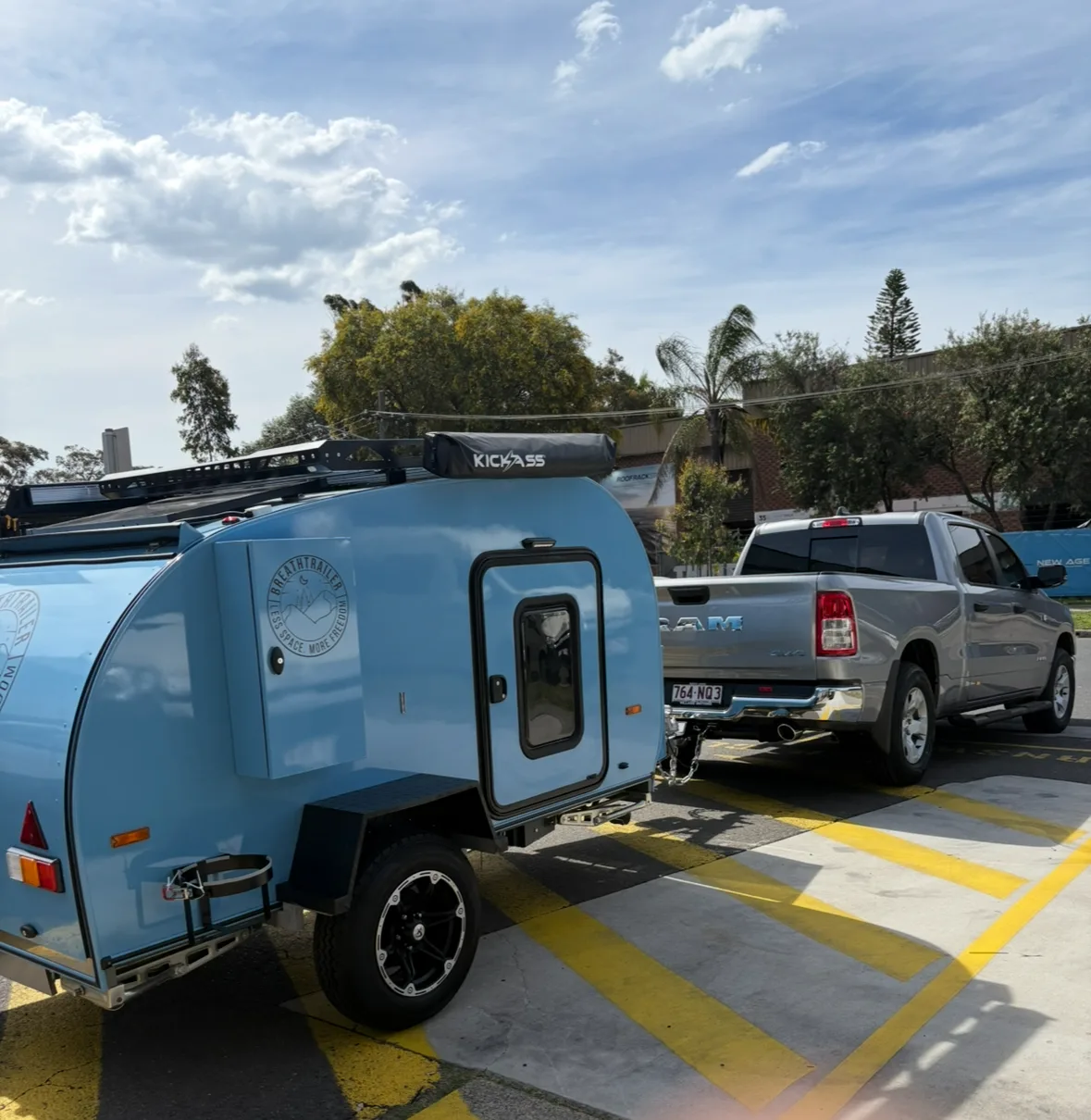
This is not a limitation — it’s a genuine strategy. The approach and departure legs towing your Breath Trailer on the Stuart Highway or Birdsville Track are excellent touring country in their own right. And arriving back in Birdsville to a self-contained Breath Max — with a functioning shower, flushing toilet, and queen bed — after six days in the dunes is a significant upgrade over a swag.
If you are travelling with an organised tagalong tour (several operators offer guided Simpson crossings), some operators do permit towing a single-axle off-road trailer under their supervision. This requires a highly experienced driver, a purpose-built off-road trailer, and acceptance that a bog-and-recovery is almost certain. If you are considering this, contact the tour operator well in advance.
6. Water: The Non-Negotiable Calculation
There is no reliable water source between Birdsville and Mt Dare. Both Mt Dare Hotel and Birdsville have water, but neither is within the desert itself.
Minimum water requirement: 7–10 litres per person per day for drinking + cooking. Add a 7-day emergency reserve on top of your planned consumption.
| Group Size | Crossing Duration | Minimum Water | Emergency Reserve | Total Carry |
|---|---|---|---|---|
| 2 people | 4 days | 80 L | 140 L | 220 L |
| 2 people | 6 days | 120 L | 140 L | 260 L |
| 4 people | 4 days | 160 L | 280 L | 440 L |
| 4 people | 6 days | 240 L | 280 L | 520 L |
These numbers explain why you cannot tow a trailer in the desert — you are already carrying hundreds of kilograms of water, fuel, and equipment in the 4WD itself.
Water tanks in the Simpson experience significant temperature variation — use collapsible bladder tanks or hard poly-tanks rated for outback UV exposure. Do not rely on cheap consumer water containers.
7. Fuel: The Critical Equation
Driving on soft sand in low range consumes 20–21 litres per 100 km — roughly 60–70% more than normal outback driving. The 550 km crossing from Birdsville to Mt Dare has no fuel stops.
| Vehicle Type | Normal Consumption | Sand Consumption | Fuel to Carry (550 km) | Recommended Reserve |
|---|---|---|---|---|
| Diesel wagon (3.0L) | 12–14 L/100 km | 20–22 L/100 km | 110–121 L | 140–150 L |
| Petrol 4WD (5.7L V8) | 14–17 L/100 km | 23–27 L/100 km | 127–149 L | 160–180 L |
| Diesel twin-axle (heavy) | 14–16 L/100 km | 22–25 L/100 km | 121–138 L | 160–170 L |
Fill your tank in Birdsville. Fill your jerry cans. Do not leave Birdsville unless you can cover 600 km comfortably — the extra 50 km accounts for deviations, recoveries, and campsite exploration.
Mt Dare Hotel sells diesel. Birdsville has diesel and unleaded. Stock up at Alice Springs or Coober Pedy as well since regional outback fuel prices run $2.50–$3.20/L and you may prefer to carry extra from a cheaper source.
8. Communications: Never Cross Solo or Silent
Minimum group size for a crossing is two vehicles. If one vehicle is unrecoverable, the second vehicle evacuates everyone to the nearest settlement.
| Comms Device | Range | Monthly Cost | Best For |
|---|---|---|---|
| UHF CB (channel 10) | Line-of-sight | $0 | Inter-vehicle on dunes |
| PLB (GME MT610G ~$389) | Global (satellite) | $0 | AMSA emergency rescue |
| Garmin inReach Mini 2 ($599) | Global (Iridium) | $21–$75/mo | Two-way messaging + tracking |
| ZOLEO ($119 + $21/mo) | Global (Iridium) | $21/mo | Text + SOS at lower upfront cost |
| Satellite phone | Global | $50–$100/mo | Voice calls for emergencies |
Register your PLB with AMSA (free, at beacons.amsa.gov.au) before you leave. This ensures any search and rescue response is targeted to your device immediately.
UHF CB Channel 10 is the standard Simpson Desert frequency for coordinating dune crests — call “QAA Line, northbound, approaching dune 32, over” to alert oncoming vehicles. This saves lives.
Download the Hema Explorer app with the Simpson Desert map pack offline before you lose phone signal north of Maree or west of Windorah.
9. Recovery Gear: The Full List
In the Simpson Desert, recovery is not a question of if — it is a question of when and how fast.
| Item | Priority | Approx. Cost | Notes |
|---|---|---|---|
| Sand flag (fluorescent, 3.5 m) | Mandatory by law | $25–60 | 300×290 mm, visible over dune crests |
| MaxTrax recovery boards (pair) | Critical | $349–499 | Sand-specific; TRED also acceptable |
| Snatch strap (11,000 kg rated) | Critical | $80–150 | + rated shackles or soft shackles |
| Long-handled shovel (≥120 cm) | Critical | $40–80 | Steel blade for sand digging |
| 12V tyre compressor (ARB CKMTP12) | Critical | $180–250 | Re-inflate to road pressure post-sand |
| Hi-Lift jack (60 cm minimum) | High | $100–180 | Base plate required for soft sand |
| Tyre repair kit (plugs + CO2) | High | $40–80 | For minor punctures without full change |
| Winch (9,500 lb minimum) | Recommended | $800–2,000 | Essential if travelling solo vehicle on tagalong |
| Tree trunk protector | Recommended | $30–60 | Even without trees, protects recovery points |
Sand flag height is 3.5 metres from ground level — measured from the ground, not from the vehicle. Mount it on the bull bar or front bumper. Fluorescent orange or yellow are standard; a flag that cannot be seen over the next dune crest is not a safety device.
Tyre pressure in the dunes: reduce to 18–22 psi front, 22–25 psi rear for most passenger 4WDs on soft sand. Adjust based on your vehicle and load. Always carry a compressor — you will be re-inflating for gibber country and bitumen at the end.
10. Camping in the Desert: Rules and Reality
The SA Desert Parks Pass includes camping for up to 21 consecutive nights in the desert park network — no per-night booking required inside the desert. Queensland side camping has separate permit requirements.
Essential rules:
- Camp on dune crests where your footprint is least damaging; avoid claypans and waterholes
- Campfires are subject to total fire bans during high-risk periods — carry a gas cooker and plan to use it for the entire trip
- Carry all waste out — no facilities, no bins, no toilets in the dunes
- Do not drive off the established tracks; track deviation in the Simpson takes decades to recover
- Respect any closed tracks or areas as conditions change frequently
The desert is genuinely dark at night. Carry a headtorch for each person and a separate lantern for camp — the stars over the dunes on a clear June night are one of the best reasons to do this trip.
11. Pre-Departure Checklist: A Timeline
| Timeline | Task |
|---|---|
| 6 weeks out | Book Desert Parks Pass (SA); apply for CLC permit if using Madigan/Colson |
| 4 weeks out | 4WD service completed; long-range tank or jerry cans sourced |
| 2 weeks out | Download Hema Explorer Simpson Desert pack offline; register PLB with AMSA |
| 1 week out | Check current track conditions (mtdare.com.au + parks.sa.gov.au); confirm group crossing plans |
| 2 days out | Stock all food, water, fuel in Alice Springs, Coober Pedy, or Birdsville |
| Morning of crossing | Final vehicle check; reduce tyre pressures at Big Red car park; radio check channel 10 |
| At each dune crest | Radio call before descent; wait for clearance from opposing traffic |
12. The Breath Trailer Strategy: Approach, Base Camp, Departure
The Simpson Desert crossing is one leg of a longer outback adventure. The approach and departure routes are where a self-contained camper trailer earns its place.
Approach option A — From the west: Alice Springs → Kings Canyon → Oodnadatta Track → Mt Dare. This route via the Stuart Highway and Oodnadatta Track is excellent towing country — sealed highway to Marla, then graded gravel through William Creek to Mt Dare. A Breath Ultra with its external shower handles the red-dirt rinse-off perfectly after dusty Oodnadatta sections.
Approach option B — From the east: Brisbane → Longreach → Windorah → Birdsville Track → Birdsville. The Birdsville Track from Marree is one of Australia’s iconic outback drives — 517 km of graded gravel through gibber plains and clay pans. Towable by any Breath Trailer model on a standard SUV.
Base camp strategy: Leave the trailer on a powered site at Birdsville Tourist Park while you cross in the 4WD. Return to a self-contained setup with a working fridge, hot water (if equipped), and a proper bed. For Greg and Margaret doing the Big Lap, or anyone who’s done six days in the dunes, this matters more than almost any other spec decision.
Departure: Birdsville → Windorah → Charleville → home, or loop south on the Strzelecki Track to Innamincka and back through the Flinders Ranges. Both are excellent touring routes for a Breath Plus or Ultra — sealed and gravel mix, suitable for standard SUV towing.
For a complete picture of long-distance outback touring, see our Big Lap Around Australia Preparation Guide.
FAQ
Can I tow a caravan or camper trailer through the Simpson Desert? Towing through the dunes is strongly discouraged for all but the most purpose-built off-road trailers, and even then only with an organised tagalong tour under guide supervision. Most experienced travellers leave the trailer at Birdsville or Mt Dare on a powered site. This protects the trailer, the track, and other travellers on the dunes.
What do I do if I break down in the dunes? Stop, stay with your vehicle, and activate your PLB or satellite communicator. Do not walk out — 550 km of desert with no shade or water is fatal on foot. That is why two-vehicle travel is the minimum and satellite communications are essential, not optional.
Can I do the crossing solo? No. A solo vehicle crossing is not permitted by the land managers and is not survivable if you become seriously stuck or injured. Minimum is two vehicles with experienced drivers. If your group doesn’t have a second 4WD, join a tagalong tour.
What if it rains during my crossing? Get off the track immediately. Sandy tracks become impassable clay within minutes of rain and can stay that way for days. Monitor weather forecasts (BOM Birdsville and Mt Dare), and build flexibility into your crossing window — an extra two or three days in your schedule can be the difference between a safe exit and a major rescue.
Do I need previous desert driving experience? Significant sand driving experience is strongly recommended before attempting the Simpson independently. Practice on coastal dune tracks or in the Strzelecki Desert first. Know your momentum-vs-throttle balance, understand compaction points, and be comfortable with tyre pressure changes before you commit to 1,100 dunes.
When is the best month for a first-time crossing? June or July. Temperatures are stable, the season is well underway, and you will find other well-prepared travellers on the track — critical if you need assistance.
Recommended Reading
- Off-Road Teardrop Camper Australia: What You Need to Know — vehicle specs, suspension, and what qualifies as genuinely off-road capable
- Big Lap Around Australia Preparation Guide — the full planning framework for multi-month outback travel
- Cape York Camping Guide — the other great Australian remote crossing, with its own permit and vehicle requirements
- Must-Have Accessories for Off-Road Adventures Australia — recovery gear, comms, and PLBs with current AU pricing
- Self-Contained Camper Australia — grey water rules, CMCA certification, and free camping eligibility
The Simpson Desert is not a destination you stumble into. It is one you plan carefully, prepare obsessively, and respect completely. Done right, it is the most compelling outback experience in Australia.
If you’re building your outback setup — vehicle, trailer, and gear — from the ground up, the Breath Trailer model comparison page is the clearest starting point. Or, if you’re ready to discuss lead times and options, book a call with the team.
The dunes will wait. Make sure you’re ready before they don’t have to.