Must-Have Accessories for Off-Road Adventures in Australia (2026)
Recovery gear, comms, tyres and lighting rated by how often they earn their weight on an Australian trip.
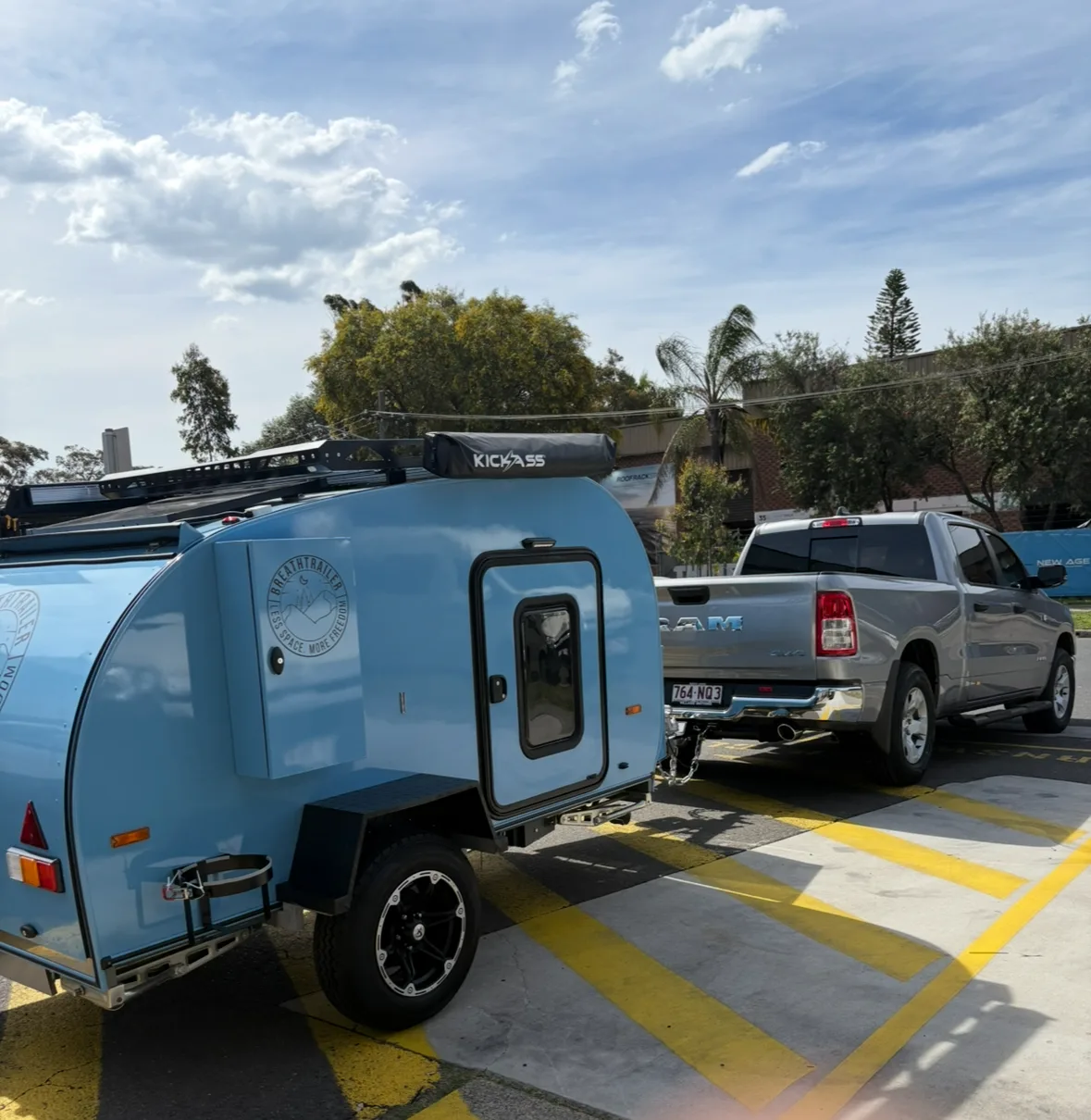
Australia is home to over 500 million hectares of national parks, state forests, and Crown land — and the best campsites almost always sit behind an unsealed track. Head off the bitumen and mobile coverage disappears fast: AMSA’s Rescue Coordination Centre handled over 1,200 beacon activations in 2024, the majority involving campers and 4WDers with no other means of calling for help.
A teardrop camper is an excellent companion for this kind of adventuring. Its hard shell handles dust and rain without the canvas-maintenance burden of a soft-floor trailer, its low tare weight means you can tow it with a mid-size SUV rather than a diesel ute, and its compact footprint reaches sites a large caravan can’t. But that same compact footprint means less room for safety kit — so what you carry needs to be deliberate.
This guide covers the accessories every Australian off-road camper should carry in 2026: real prices, specific model recommendations, and a staged budget so you can build the kit incrementally.
Recovery Gear: The Non-Negotiable First Category
Recovery gear is the highest-priority item on this list — and the most commonly skimped on. A standard tow kit (ball hitch, brake controller, mirrors) is not recovery gear. Recovery gear is what gets you unstuck when a track turns to bulldust, a corrugation drops you into a hidden bog, or sand gives way faster than expected.
The irreducible minimum for any off-road trip:
| Item | Spec to look for | AU Price (2026) |
|---|---|---|
| Snatch strap | 9 m × 60 mm, 8,000 kg MBS, AS/NZS 4344 rated | $80–$130 |
| Bow shackles × 2 | 4.75 t WLL, galvanised, screw-pin type | $40–$60 per pair |
| Recovery damper / blanket | Kinetic-strap rated, not a winch blanket | $45–$75 |
| Leather recovery gloves | Full gauntlet style | $25–$45 |
| Long-handled shovel | Folding or fixed, 1 m+ | $55–$90 |
| MaxTrax LITE boards (pair) | 118 kg traction load per board | ~$360 |
| MaxTrax MKII boards (pair) | 135 kg load, deeper vanes, more durable | ~$639 |
The recovery damper is non-negotiable: it absorbs kinetic energy if a strap or shackle parts under load, dropping the hardware to the ground instead of letting a 4 kg shackle become a projectile.
Budget shortcut: ARB’s Weekender Recovery Kit (snatch strap, shackles, damper, gloves, carry bag) retails around $280–$320 and is a solid starting point. Step up to the ARB Premium Recovery Kit (~$600–$900) for extended remote touring, which adds a winch extension strap and snatch block.
Teardrop-specific tip: MaxTrax MKII boards mount to the drawbar of most teardrops using the MaxTrax Mounting Bracket (~$70). This keeps them off the tow vehicle roof rack — saving roof load — and keeps them accessible when the trailer bogs before the car does.
Do you need a winch? A winch is the most powerful self-recovery tool available but adds 25–40 kg and $1,200–$2,500 installed. On a teardrop with an ATM under 1,200 kg, a winch is rarely justified. A dual-snatch-block assist using a tree anchor covers 95 % of recovery scenarios. If you’re regularly running technical tracks in remote WA or Cape York, factor a winch into your tow vehicle — not the trailer.
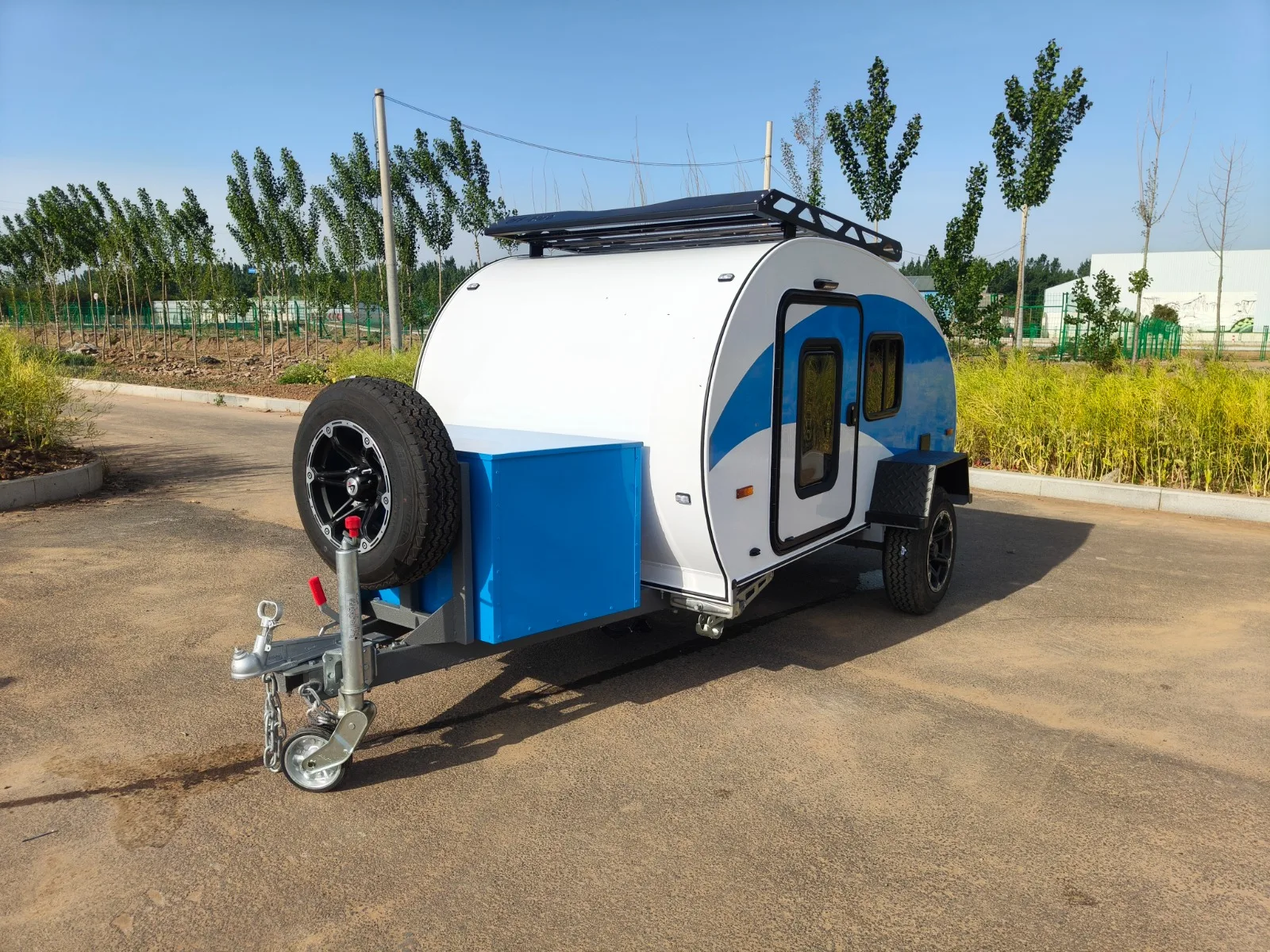
The drawbar and front toolbox keep a teardrop’s recovery kit within reach of the tow vehicle.
Communications: Three Tools, Three Different Jobs
Three different devices solve three different communication problems. Understanding where they overlap — and where they don’t — saves you spending on the wrong one first.
| Device | Coverage | Two-way? | SOS capable | Device price (AUD) | Ongoing cost | Best for |
|---|---|---|---|---|---|---|
| UHF CB radio (80 ch, 5 W) | Line-of-sight ~5 km | Yes | No | $150–$350 | None | Track chat, convoy, campground |
| PLB — GME MT610G | Global (406 MHz COSPAS-SARSAT) | One-way only | Yes — AMSA RCC | ~$389 | None (AMSA registration free) | True life-or-death SOS |
| Satellite comms — Garmin inReach Mini 2 | Global (Iridium) | Yes (text + track) | Yes | ~$599 | $25–$80/mo plan | Daily check-ins + nav + SOS |
| Satellite comms — ZOLEO | Global (Iridium) | Yes (text + SOS) | Yes | ~$350–$450 | $20–$50/mo plan | Budget two-way satcomm |
Decision tree:
- Weekend camping, within 100 km of a town? → UHF CB + charged phone.
- Remote bush camping, 2–5 nights, solo or small group? → UHF CB + PLB minimum. The PLB lives clipped to your belt, not stored in the trailer.
- Extended remote touring or Big Lap? → UHF CB + satellite communicator. Two-way messaging keeps family updated daily; SOS covers the genuine emergency.
- Already have a satellite communicator? → Still carry a PLB. If your satcomm is in the trailer when you’re injured 500 m away, a PLB on your body is what triggers the rescue.
UHF CB specifics: The legal maximum in Australia is 5 W on 80 channels. Channel 40 is the road convention, channel 18 is the campground channel. The GME TX3500S ($299) and Uniden X80 ($249) are the two most consistently recommended fixed-mount units. For a teardrop without an existing roof antenna point, a GME magnetic-mount stubby antenna (~$45) fits the drawbar coupling neatly.
PLB registration: All 406 MHz PLBs used in Australia must be registered with AMSA at beacons.amsa.gov.au. Registration is free. From November 2024, registrations no longer expire — register once and keep the contact details current.
Tyre Management: The 40/30 Rule and a 12V Compressor
Tyre failure is the number one breakdown cause on remote tracks, and most of it is preventable. The physics: overinflated tyres reduce the contact patch on corrugations and sand, increasing the risk of sidewall cuts; underinflated tyres overheat on bitumen at speed. The standard guide:
| Terrain | Recommended pressure (down from ~40 psi highway) | Note |
|---|---|---|
| Graded gravel / unsealed road | 32–36 psi | Minor reduction, better ride |
| Rocky / rough 4WD track | 28–32 psi | Check sidewall clearance on low-profile tyres |
| Sand / beach | 18–22 psi | Widens the footprint; max 50 km/h |
| Soft mud or bog | 18–24 psi | Pair with traction boards |
Re-inflate before returning to bitumen. Driving highway at 20 psi causes rapid overheating and sidewall delamination. Most state weighbridges also penalise visible low-pressure tyres.
A 12V air compressor makes low-pressure off-road driving practical by removing the hour-long detour to the servo on the way home.
| Model | Max PSI | Fill time (22 → 36 psi per tyre) | Price |
|---|---|---|---|
| KickAss 150 PSI portable (budget) | 150 | ~6 min | ~$189 |
| ARB CKMP12 (single motor) | 150 | ~5 min | ~$280–$320 |
| ARB CKMTP12 (twin motor, 4 L tank) | 150 | ~3 min | ~$390–$420 |
| Bushranger X-Air Twin | 180 | ~2.5 min | ~$420 |
A teardrop with four tyres to re-inflate (two on trailer + two driven axles) benefits disproportionately from the twin-motor ARB CKMTP12 — it saves 15+ minutes on every exit from dirt. Add a set of Staun valve deflators (~$40) that let you pre-set target pressure and walk away from all four tyres simultaneously.
Also carry: one plug-type puncture repair kit (~$35), tyre levers, and a valve stem insert tool for on-trail valve repairs.
Navigation: What Works When Data Doesn’t
Google Maps covers sealed roads and major gravel routes. It doesn’t cover the full Gibb River Road in WA, the Oodnadatta Track in SA, or half the track network in outback Queensland — and it certainly doesn’t work when you’re 40 km from any tower.
| Option | Offline maps | AU focus | Price | Best for |
|---|---|---|---|---|
| Hema Explorer X8 (GPS unit) | Full AU topographic | Yes, purpose-built | ~$399 | Dedicated screen, rally mode, fuel calculator |
| Hema Maps app (iOS / Android) | Downloadable by region | Yes | $119/yr | Familiar phone UI, same Hema content |
| GaiaGPS (iOS / Android) | Yes | Partial AU coverage | ~$40/yr AUD | Popular with hikers, topo overlays |
| WikiCamps AU | Campsite database only | Yes | $9.99 one-off | Free camp reviews, water availability |
| OziExplorer + Garmin handheld | Yes | Yes | $165 + GPS | Track planning, serious overlanders |
Practical combo: Hema Maps app for navigation, WikiCamps for campsite selection. Download both regions before you leave home coverage. The Hema Explorer X8 is worth the dedicated hardware investment if you’re doing more than two remote trips a year — it doesn’t overheat in summer sun the way a phone screen does, and it keeps running when your phone dies.
Power and Water for Extended Remote Trips
For a full breakdown of solar sizing, battery chemistry, and daily power budgets, see our Complete Guide to Camper Trailer Power Systems and How Long Can You Stay Off Grid While Camping? — both articles cover the maths in depth.
In brief, the limiting factor shifts with trip length:
| Trip length | Primary limiting factor | Practical solution |
|---|---|---|
| 1–2 nights | Fridge power only | Any 100 Ah lithium setup sufficient |
| 3–5 nights | Water volume | 80 L minimum for two adults; carry 20 L jerry |
| 7–14 nights | Power + water balanced | 200 Ah lithium + 200 W solar; 120 L water |
| 14+ nights (remote) | All systems simultaneously | Max tank capacity; 300 W+ solar; satellite comms |
For remote camping under CMCA self-containment rules — grey water storage, 72-hour capacity, on-board toilet — see our complete self-containment guide for Australia.
A portable water filter (LifeStraw Mission 12 L, ~$90; Katadyn Hiker Pro, ~$140) extends your effective range from any running creek. This is a 200 g accessory that meaningfully changes your planning for remote 10-day+ trips.
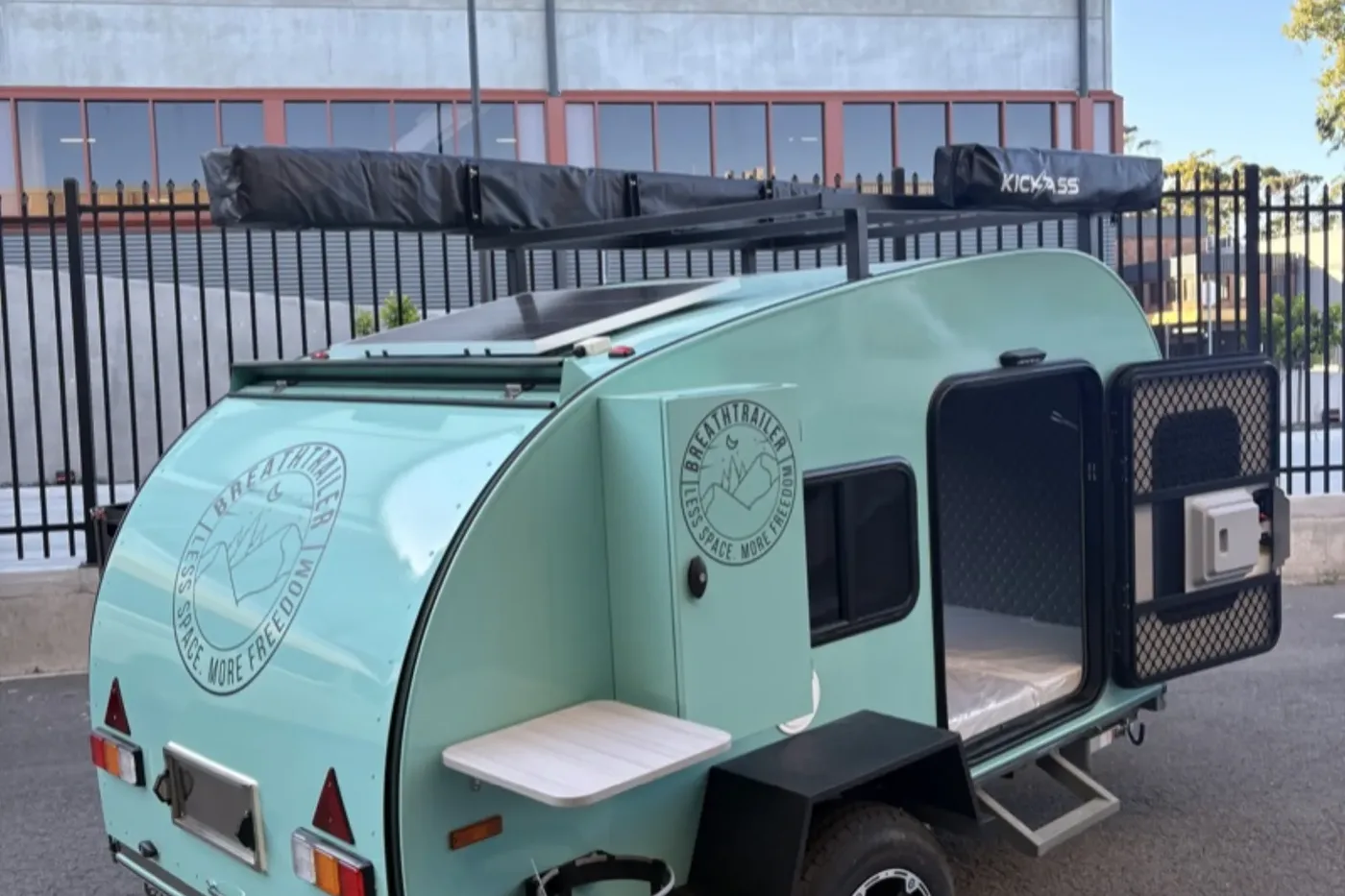
Solar, battery and water capacity decide how many nights you can stay out between resupplies.
First Aid: What Changes in the Outback
Standard workplace first aid kits are designed for environments within 30 minutes of a hospital. Remote camping adds specific Australian risks: snake bite, heat exhaustion at 45°C, and injuries that are hours from help. The Australian Resuscitation Council recommends pressure-immobilisation bandaging for all suspected snake bite — not a tourniquet.
| Kit tier | Typical contents | Price | Covers |
|---|---|---|---|
| Basic weekend | 50-piece, crepe bandages, antiseptic, wound closure | $60–$90 | Short trips, mobile coverage |
| Remote area | 120+ pieces, SAM splint, snake bite bandages, CPR mask, blister kit | $130–$180 | Multi-day remote, 2+ days from hospital |
| Extended expedition | Prescription medications, IV setup, AED | $400–$800+ | Qualified first aiders, extreme remote |
As an absolute minimum: carry two compression bandages specifically rated for snake bite. The recommended pressure for lower-limb envenomation is 55 mmHg — bandages with pressure-indicator dots make this achievable without training.
Additional safety essentials:
- Fire extinguisher (1 kg DCP): mounts to the trailer A-frame. Some campsite permits and state parks require one for trailers carrying gas.
- Emergency bivvy (SOL Escape or similar, ~$25): 100 g, fits in a jacket pocket. Prevents hypothermia if you’re separated from camp after dark — relevant in any Australian alpine or desert winter night.
- Remote first aid course (WAFA 3-day, ~$550): The most valuable investment on this list. Wilderness First Aid courses from WAFA, Surf Life Saving, or Remote Area First Aid are valid for 3 years and teach the skills no kit compensates for.
What Your Breath Trailer Already Includes
Each Breath Trailer model ships with a standard kit that removes several items from your accessories list before you start.
| Accessory | Essential $23,320 | Plus $29,766 | Ultra $34,749 | Max $42,900 |
|---|---|---|---|---|
| Lithium battery | — | 100 Ah | 100 Ah | 200 Ah |
| Solar panel | — | 120 W | 200 W | 200 W |
| DC-DC charger (REDARC) | — | ✓ | ✓ | ✓ |
| 12V compressor fridge | — | 45 L | 65 L | 65 L |
| Water tank (integrated) | — | 40 L | 80 L | 120 L |
| External shower | — | — | ✓ | ✓ |
| Interior bathroom + toilet | — | — | — | ✓ |
| 12V LED interior + camp lights | ✓ | ✓ | ✓ | ✓ |
| DO35 tow hitch | ✓ | ✓ | ✓ | ✓ |
| ADR38 electric brakes | ✓ (GTM > 750 kg) | ✓ | ✓ | ✓ |
The Essential starts with electrics and brakes; budget for a standalone power system if you plan serious off-grid touring. The Max eliminates the need for a portable toilet, external shower setup, and the range anxiety of a tight water budget on 5-day remote trips — making it the model with the shortest accessories list.
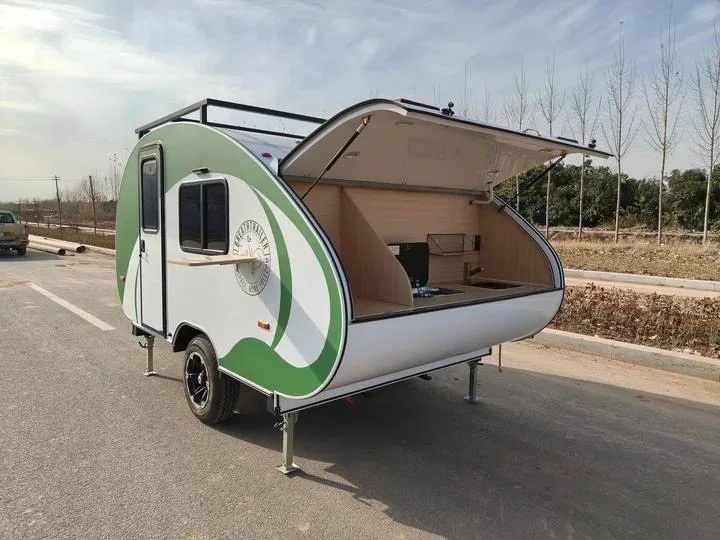
Fitted kitchen, water and power come off the accessories list before you start shopping.
See our off-road teardrop camper guide for how each model handles specific track types, and teardrop camper weight breakdown to understand how accessories affect your payload.
Building the Kit in Priority Order
| Priority | Item | Cost | Why here |
|---|---|---|---|
| 1 | Snatch strap + shackles + damper + gloves | $160–$230 | Lowest cost, highest life-safety value |
| 2 | PLB (GME MT610G) | ~$389 | AMSA SOS coverage, zero ongoing fees |
| 3 | MaxTrax boards (pair LITE) | ~$360 | Self-recovery without waiting for a second vehicle |
| 4 | UHF CB radio (fixed mount) | $250–$350 | Track safety; campground comms |
| 5 | 12V air compressor (twin motor) | $390–$420 | Enables low-pressure off-road driving safely |
| 6 | Shovel + long-handled (folding) | $55–$90 | Multi-use: digging out, levelling, fire breaks |
| 7 | Hema Maps app + offline regions | $119/yr | Navigation when data fails |
| 8 | Remote first aid kit + snake bandages | $130–$180 | Medical events far from help |
| 9 | Satellite communicator (if budget allows) | $350–$600 + plan | Two-way comms for family peace of mind |
| Minimum kit (items 1–3) | ~$910–$980 | ||
| Full kit (items 1–9) | ~$2,100–$2,850 |
Frequently Asked Questions
Do I need a PLB or a satellite communicator — or both?
For most Australians doing remote camping, a PLB is the non-negotiable minimum. It operates without a subscription, triggers a direct search-and-rescue response from AMSA, and has a 7-year battery life (GME MT610G). A satellite communicator adds two-way messaging and trip tracking — the family stays updated daily rather than wondering if you’re OK. If budget allows both, carry them: PLB on your person at all times, satellite communicator in the trailer for daily comms.
What tyre pressure should I use on sand?
The widely used range for standard 4WD tyres on Australian beaches and dunes is 18–22 psi. On a teardrop trailer, match the trailer tyre pressure to approximately the same reduction — check the sidewall minimum inflation rating first, as teardrop trailer tyres (typically 175R13 or 185R14) have different minimums to truck tyres. Don’t exceed 50 km/h on soft tyres.
Do I need a winch for a teardrop camper?
Rarely. A teardrop’s light weight makes snatch-strap recovery quick and low-risk. A pair of MaxTrax boards handles most solo self-recovery on soft terrain. Winches are optimised for heavy-duty 4WDs on technical tracks; on a 700–1,200 kg teardrop they add disproportionate weight and cost. Invest in recovery boards and a quality snatch kit first.
Can I fit MaxTrax to a teardrop camper drawbar?
Yes. MaxTrax MKII boards with the mounting bracket (~$70) attach to most teardrop A-frames and drawbars. This keeps the boards accessible within 30 seconds of stopping — which is when you need them.
What’s the minimum kit for the Gibb River Road?
The Gibb River Road is 660 km of unsealed road, notorious for tyre-destroying corrugations and river crossings. Minimum: snatch strap + shackles + damper, two spare tyres, MaxTrax boards, PLB, 12V air compressor, remote first aid kit, and a satellite communicator for daily check-ins. No mobile coverage for most of the route.
Do I need UHF CB if I have a satellite communicator?
Yes. A satellite communicator is for long-range SOS and check-ins — it’s not designed for real-time track communication with other vehicles. UHF CB on channel 40 is the convention for approaching single-lane creek crossings, passing narrow pinch points, and communicating in convoy. Both tools fill different roles and the combined cost (~$250 + $389 device) is modest.
The Bottom Line
Off-road accessories aren’t about adding luxury — they’re about extending how far you can safely go. A $160 snatch strap and a $389 PLB together cost less than one night in most coastal resorts, and they cover the scenarios that good tyres and good planning alone can’t prevent.
The Breath Trailer range is engineered for this kind of adventuring: the lightweight tare, the hard-shell weatherproofing, and the coil-suspension platform all assume the trailer will see unsealed roads. See why suspension matters on an off-road camper and our teardrop camper towing tips to get the full picture on what the trailer itself brings to a remote trip.
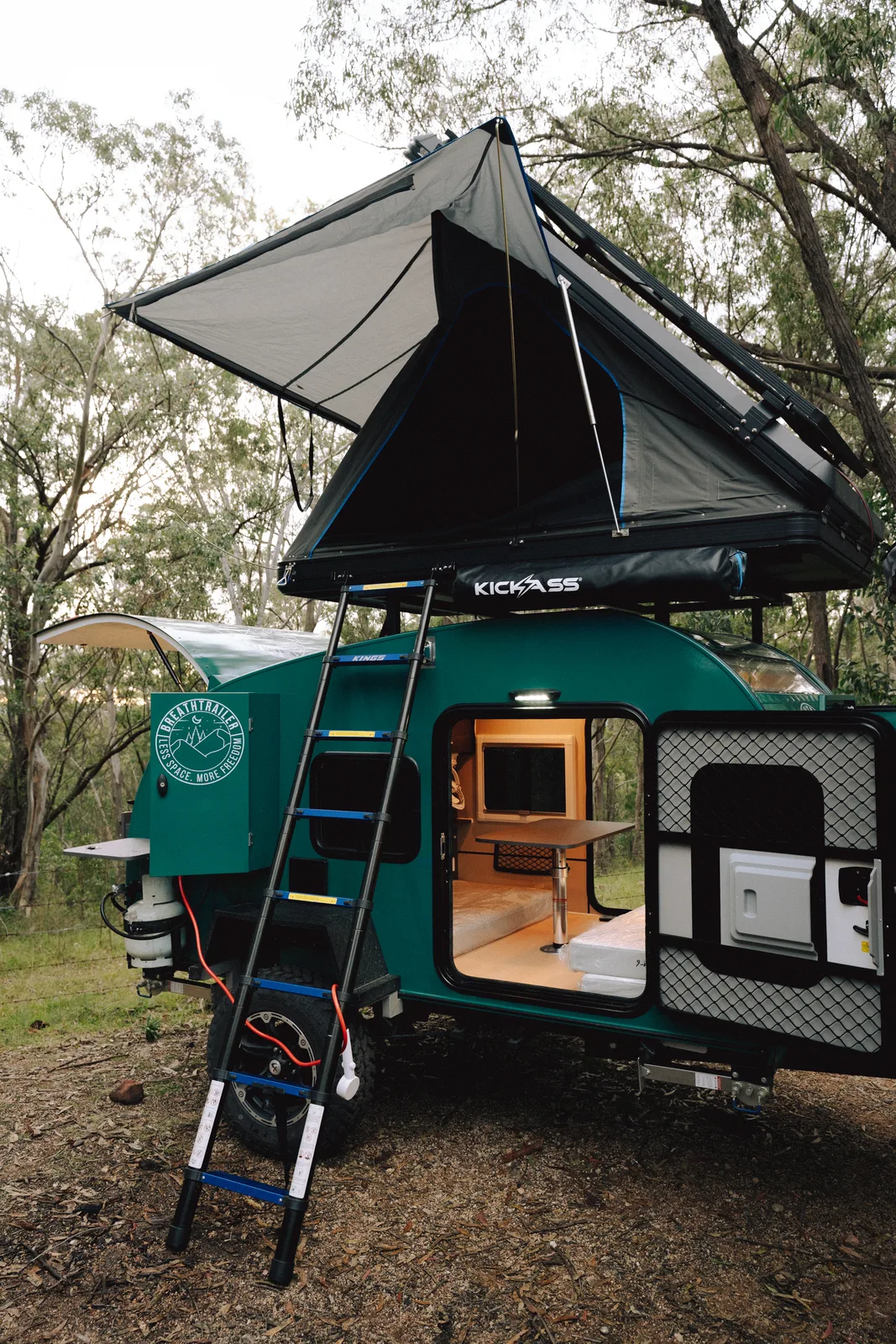
Add the kit in priority order and the trailer is ready for country well past the bitumen.
Add the accessories above in priority order, match them to your model’s standard inclusions, and you’ll have a kit calibrated for the difference between a campground and genuine off-grid country.
Compare the four Breath Trailer models →
Book a viewing or consultation →