Teardrop Camper vs Campervan Australia: The 2026 Honest Comparison
Purchase, fuel, rego, insurance and depreciation compared, plus what each one does to your daily driving.
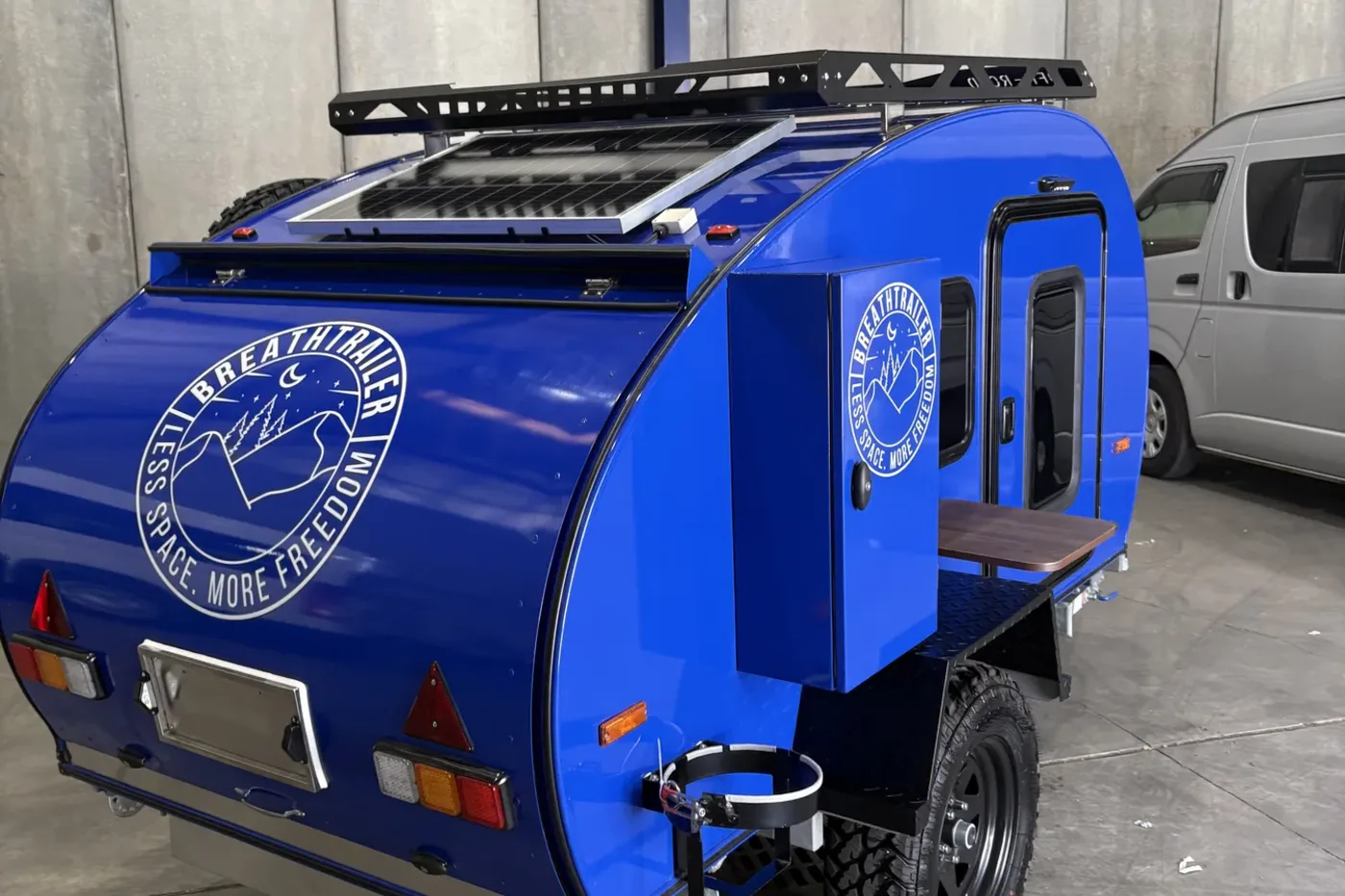
More than 700,000 recreational vehicles are registered across Australia, and the debate between a teardrop camper and a campervan comes up at almost every campfire. Both give you a bed away from home without booking a motel room. But they are fundamentally different products with very different price tags, running costs, and everyday trade-offs. This guide puts the real 2026 numbers on the table — purchase price, 5-year total cost of ownership, freedom, fuel, and comfort — so you can make the right call for your situation.
What Is a Teardrop Camper?
A teardrop camper is a compact, hard-shell trailer that you tow behind your existing vehicle — a modern SUV, a dual-cab ute, or a mid-size hatchback if the tow rating allows. The teardrop shape is aerodynamic by design, which keeps towing drag and the fuel penalty low compared to boxy caravan profiles.
Inside, a well-specced teardrop delivers a fixed queen bed, an insulated cabin with LED lighting and USB charging, and a rear galley kitchen. Premium models take it further: the Breath Max — Sydney-designed and finished, starting from $42,900 — is the only teardrop camper on the Australian market under $50,000 with a full interior bathroom (hot shower and toilet), 2.1 m standing headroom, and a 120-litre fresh water tank. Sydney-based Breath Trailer offers four models spanning $23,320 to $42,900, all towable by any mid-size SUV.
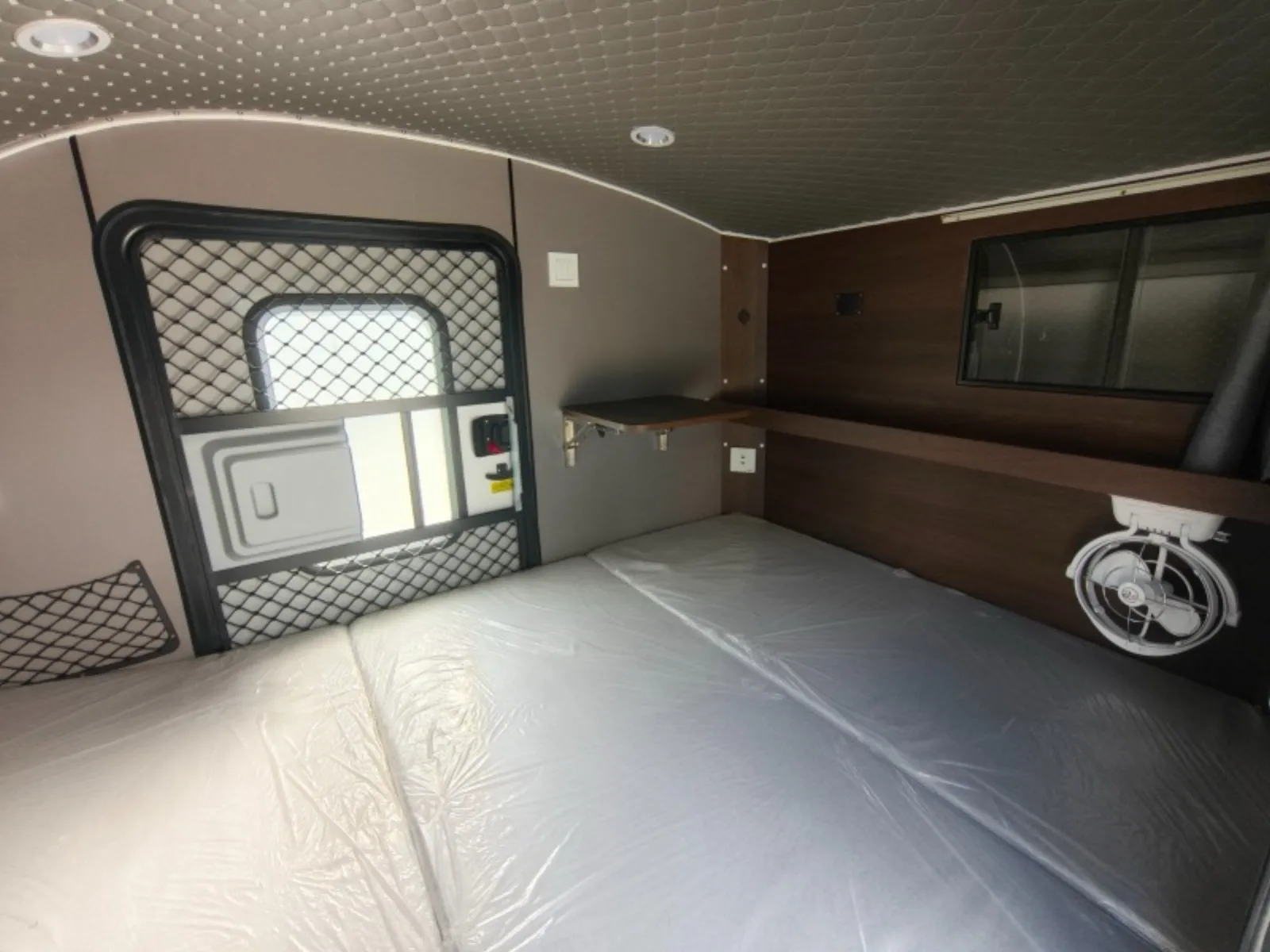
The cabin is a dedicated bedroom, separate from the car you drive every day.
The critical characteristic: you still drive your own car every day. The trailer is a separate asset.
What Is a Campervan?
A campervan — also called a motorhome or camper motor vehicle (CMV) in Australian road regulations — combines the vehicle and living space into a single unit. You drive it, sleep in it, cook in it, and park it everywhere you go.
Australian buyers encounter three main campervan types:
- Converted vans (DIY or professional): A Toyota HiAce, Ford Transit, or VW Crafter fitted out with a bed, kitchenette, and sometimes a composting toilet. Good used builds start around $25,000–$45,000. A professionally converted new HiAce starts from around $80,000–$107,000 drive-away in 2026.
- Class B motorhomes: Factory-built on a van chassis. The Jayco JRV ($89,990 drive-away) is a popular Australian example. More refined interiors but still van-sized.
- Class A coaches and large motorhomes: Full-size coaches from $200,000 to $500,000+. An entirely different conversation.
The critical characteristic: the vehicle IS the home. No separate car needed — but no separate car available either.
Purchase Price: Where the Gap Opens
The numbers diverge sharply the moment you compare purchase prices.
| Option | Model / Example | Price (AUD) |
|---|---|---|
| Teardrop camper — entry | Breath Essential | $23,320 |
| Teardrop camper — mid (fridge included) | Breath Plus | $29,766 |
| Teardrop camper — premium (external shower) | Breath Ultra | $34,749 |
| Teardrop camper — full bathroom | Breath Max | $42,900 |
| Campervan — budget used conversion | HiAce (used, good condition) | $25,000–$45,000 |
| Campervan — new professional conversion | HiAce (new, factory fitted) | $80,000–$107,000 |
| Campervan — Class B motorhome | Jayco JRV | $89,990 |
| Campervan — high-end van | VW Crafter Skyline TDI410 | $193,100 |
| Large motorhome | Jayco Destiny | $189,990 |
The most important detail most people overlook: buying a teardrop assumes you already own a suitable tow vehicle. If you own a Subaru Forester, Toyota RAV4, Mazda CX-5, or almost any modern SUV with a 1,500–3,500 kg tow rating, your existing car is your tow vehicle at zero extra cost. That car also continues to be your daily driver, meaning you’re not acquiring an additional asset — you’re adding a trailer to something you already own.
If you don’t yet own a tow vehicle, factor in the cost of a suitable SUV. But that vehicle doubles as your everyday car, commuter, and school-run transport, so it’s rarely a camping-only purchase.
Running Costs: The Long Game
Purchase price is only the opening chapter. Here is how ongoing costs compare each year.
Registration
- Teardrop trailer rego (NSW example): a trailer under 750 kg ATM costs around $150–$250/year. Heavier teardrops (750–1,700 kg ATM, covering the Breath Ultra and Max) run $300–$500/year depending on your state.
- Campervan rego is full vehicle registration, which in most Australian states sits at $700–$1,200/year including the CTP insurance component. According to RACQ’s 2025 running costs guide, a light commercial vehicle registered in Queensland costs an average of $1,050/year in registration and CTP alone.
Insurance
- Teardrop trailer comprehensive cover typically runs $350–$700/year for a trailer valued at $25,000–$40,000.
- Campervan insurance is vehicle insurance on a specialised asset. A $100,000 campervan with agreed value cover typically costs $1,200–$2,000/year. Jayco’s 2026 caravan cost guide notes that insurance on a $100,000 recreational vehicle can run $1,500 per year or more depending on usage.
Servicing
- Teardrop trailer: An annual service covering wheel bearings, brake inspection, electrical connections, and seal checks costs roughly $200–$400 at a trailer specialist.
- Campervan: Dual maintenance cost — you service the vehicle (engine, gearbox, timing belt: $800–$1,500/year) AND maintain the living system (water pump, gas connections, roof vents, 12V electrics: add $400–$1,000/year). Total annual servicing: $1,200–$2,500/year, more for an ageing van.
Fuel
This is where campervans take the most significant hit.
A fully-loaded Toyota HiAce campervan — heavier than a standard van due to the fitout and stored gear — typically uses 12–14 litres per 100 km in combined driving. A mid-size SUV (RAV4, Forester, Outlander) towing a 800–1,200 kg teardrop typically consumes 9–13 litres per 100 km, a 20–30% increase over solo driving. The teardrop’s aerodynamic teardrop profile keeps the towing penalty at the lower end of that range.
| Campervan (HiAce loaded, 13 L/100km avg) | SUV + teardrop (11 L/100km avg) | |
|---|---|---|
| Camping travel — 10,000 km/year | ~$2,600 | ~$2,200 |
| Annual saving with teardrop | — | ~$400 |
The fuel saving is meaningful but modest at moderate distances. It grows substantially on a Big Lap or multi-month trip where you’re covering 25,000–40,000 km.
Storage at Home
- Teardrop: Most models fit in a standard double garage or alongside the house. The Breath Max at 1,200 kg and standard length parks easily on a standard driveway.
- Campervan: A 5.4–6.0 m vehicle requires a long driveway, dedicated off-street parking, or a storage yard. In inner suburbs, paid storage typically runs $150–$300/month — $1,800–$3,600/year you won’t spend with a trailer.
The 5-Year Total Cost of Ownership
Assumptions: 20 camping weekends per year, 400 km per round trip (8,000 km camping travel annually), fuel at $2.05/litre. Teardrop user already owns a suitable SUV.
| Cost category | Teardrop (Breath Plus, $29,766) | Campervan (new HiAce, $107,000) |
|---|---|---|
| Purchase price | $29,766 | $107,000 |
| Registration × 5 yr | $2,000 | $5,500 |
| Insurance × 5 yr | $3,000 | $9,000 |
| Servicing × 5 yr | $2,000 | $10,000 |
| Fuel surcharge × 5 yr | $1,600 | $2,050 (higher base usage) |
| Home storage × 5 yr | $0 | $0–$18,000 (if off-site) |
| Depreciation (est., 5 yr) | ~$7,440 (25%) | ~$42,800 (40%) |
| 5-yr net cost (no off-site storage) | ~$45,806 | ~$176,350 |
Even in the best case for the campervan — already owning a driveway long enough to store it — the 5-year ownership gap is approximately $130,500. The teardrop wins emphatically on total cost of ownership for Australians who already own an SUV.
The Freedom Factor: Leave It at Camp
Here is one teardrop advantage that almost never appears in comparisons: you can leave your trailer at the campsite and explore freely with your car.
Arrive at Wilsons Promontory, drop the trailer at camp, then drive the peninsula’s narrow roads in your Forester — no 6-metre vehicle to stress about. Park the Breath Max at a Snowy Mountains campground and spend the day hiking without hauling your home along. Nip to the servo, the bottle shop, or the farmer’s market in a normal-sized car.

With the trailer parked at camp, the car is free for the day’s exploring.
Campervan owners do not have this option. Every run to the supermarket, every village visit, every detour into a narrow national park road — you bring the whole vehicle. Parking becomes a daily logistical challenge in popular tourist areas, shopping centres, and inner suburbs where multi-storey carparks have height limits of 2.0–2.1 m (most HiAce high-tops clear 2.3–2.7 m).
This “detachable freedom” factor is particularly important for couples and families who use their SUV for general life when not camping. The teardrop owner has one vehicle that does everything; the campervan owner often ends up running two vehicles or accepting serious practical compromises.
Off-Grid Capability
Both a well-specced teardrop and a quality campervan can handle off-grid camping. The difference lies in what you get per dollar.
A Breath Ultra or Max comes purpose-built for off-grid capability: robust 12V wiring, optional lithium battery upgrades, solar input, and a large fresh water tank — all in a shell designed from scratch as a camping unit. Purpose-built camping trailers routinely out-perform equivalent campervans on insulation (thicker walls, better thermal mass), solar panel placement (flat roof, unobstructed), and water capacity per kilogram of payload. For a full breakdown of off-grid setups in teardrop campers, see our off-grid teardrop camper guide.
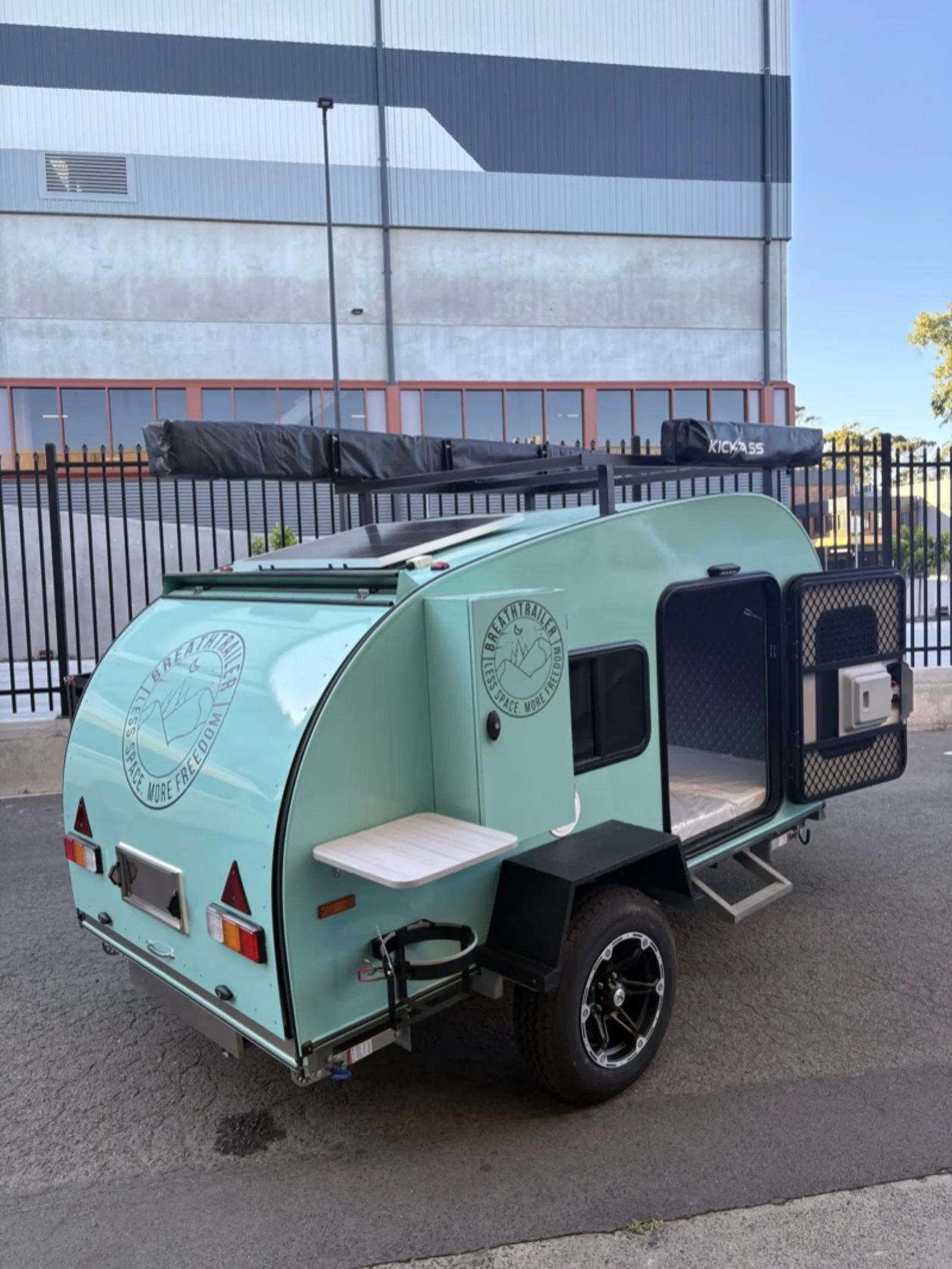
Solar on the roof and a shell built for camping from the start.
A campervan conversion achieves off-grid capability as well, but always as a compromise with van architecture: curved van roofs limit solar panel area, van floor space limits battery bank size, and van panels provide less insulation than purpose-built composite walls. You pay more to get less off-grid performance.
Sleeping Comfort and Bathroom Access
Campervans: A converted HiAce fits a fixed double or queen bed in high-top form. Headroom in a HiAce high-top is approximately 1.8 m — functional, not luxurious. Bathroom access is the major weak point: plumbing a full shower and toilet into a van body is difficult and space-consuming. Most budget conversions use a cassette toilet only, with showering at camp facilities.
Teardrop campers: The Breath Max delivers a queen bed in a 2.1 m standing-height cabin — more headroom than most campervans in this price range, and more than any other Australian teardrop under $50,000. It also includes the full interior bathroom that campervan buyers often cite as their primary reason to choose a van over a trailer.
If bathroom access is your deciding factor, the Breath Max closes that gap entirely at $42,900 — compared to $89,990+ for an entry Class B motorhome with a proper bathroom. See how teardrop options with bathroom facilities compare in our dedicated guide to teardrop campers with shower and toilet in Australia.
Setup, Ease of Use, and Daily Practicality
| Teardrop Camper | Campervan | |
|---|---|---|
| Setup at camp | 5–10 min (hitch off, fridge on, done) | Park and level only — instant |
| Pack-up time | 5–10 min | 5–10 min |
| Daily driver | ✅ Your SUV is your daily car | ❌ Impractical for supermarkets, cities |
| Parking in towns | ✅ Leave trailer at camp, drive normally | ❌ Height and length restrictions |
| Home storage | ✅ Garage or driveway | ⚠️ Long driveway or paid storage |
| Detach and explore | ✅ Yes — leave it at camp | ❌ No |
| Tow licence required | Standard C licence | C licence (Class B up to 4,500 kg GVM) |
| Solo travel suitability | ✅ Good | ✅ Excellent |
| Self-contained for free camping | ✅ Breath Max (CMCA criteria) | ✅ Most campervans |
The RAC WA guide to teardrop campers identifies setup simplicity as one of the key advantages of the hard-shell teardrop format for Australian buyers, noting the elimination of canvas, pegs, and wet pack-downs that traditional camper trailers require. For a broader overview of how teardrop campers behave on the road, see our camper trailer towing guide for Australia.
Who Should Choose a Teardrop Camper?
A teardrop camper makes the most sense if you:
- Already own an SUV you’re happy to keep — and don’t want to sell it or run two vehicles
- Camp 10–30 weekends per year — the running cost advantage compounds quickly over time
- Value detachable freedom — leaving the trailer at camp and exploring with your car matters to you
- Want a real bed every night without canvas, pegs, or damp fabric
- Need bathroom access but not motorhome pricing — the Breath Max at $42,900 is the answer, not a $90,000 motorhome
- Live in a suburb where parking a 6-metre van permanently is impractical
- Prioritise tow vehicle flexibility — any SUV with a tow bar works; no need to buy dedicated equipment
For couples in particular, a teardrop is almost always the better option — a queen bed, solid comfort, and far lower cost than a matched campervan setup. See our full guide to teardrop campers for couples in Australia.
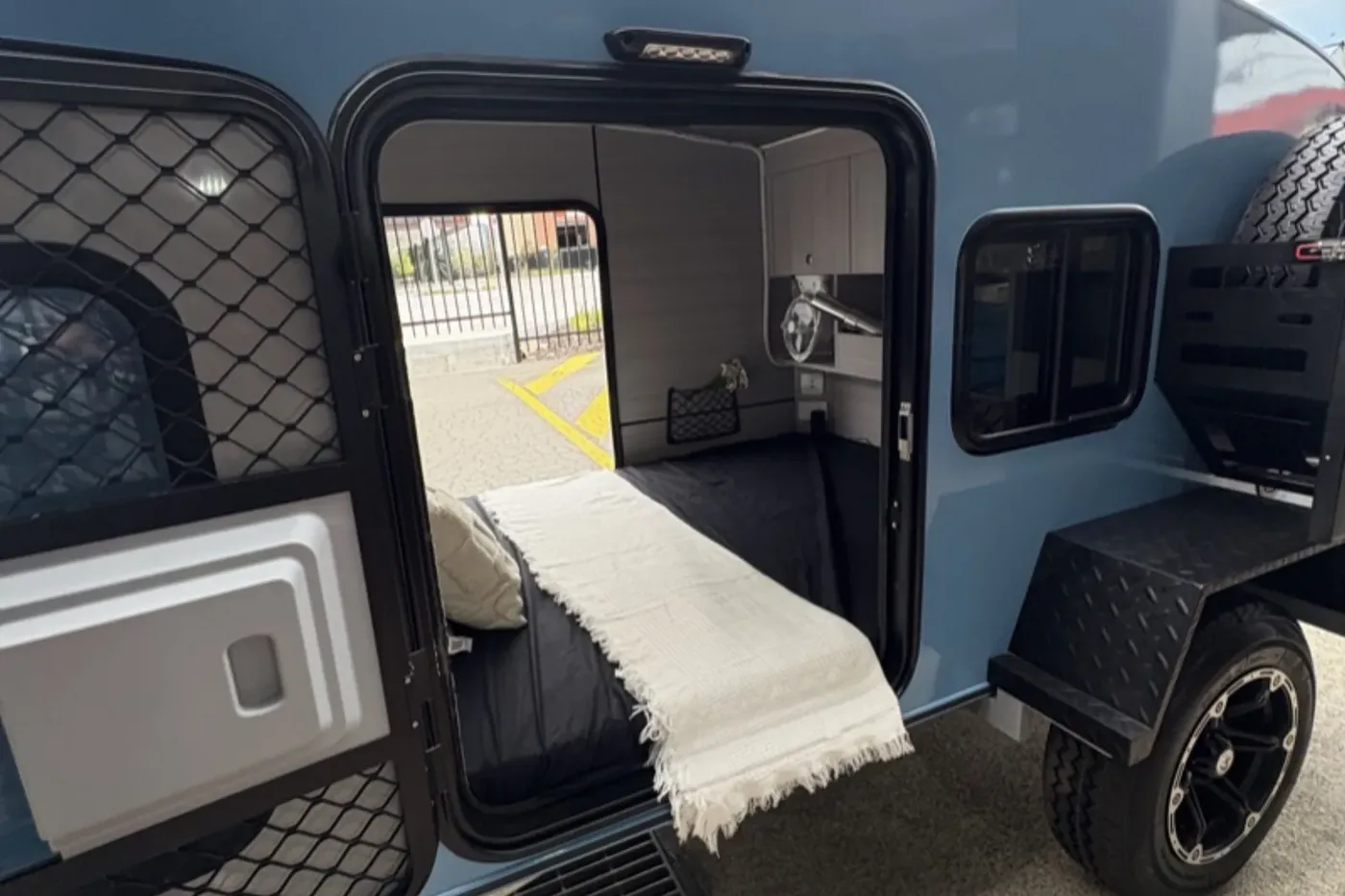
For couples, a made-up bed behind a lockable door covers most of what a campervan offers.
Who Should Choose a Campervan?
A campervan makes more sense if you:
- Don’t own a car at all and want a single vehicle that does everything
- Travel full-time or for multiple consecutive months — the always-ready setup eliminates daily pack-up
- Need van life as your primary residence — some grey nomads prefer a single vehicle they live in rather than a home-and-trailer combination
- Have a budget of $25,000–$45,000 for a used conversion — though this range now also buys a new Breath Plus ($29,766) with change, and a new trailer carries warranty and known build history
Frequently Asked Questions
Is a teardrop camper cheaper than a campervan in Australia in 2026?
Yes, in virtually every scenario. New Australian-designed teardrops start at $23,320 (Breath Essential). New campervans with a proper fitout start from around $80,000–$107,000. Even quality second-hand campervan conversions typically run $35,000–$55,000. The 5-year total cost of ownership gap between a mid-range teardrop and a new campervan is typically well over $100,000 once depreciation, rego, insurance, and servicing are included.
Do you need a special licence to tow a teardrop camper in Australia?
No. A standard Australian car licence (Class C) allows you to tow a trailer up to 9,000 kg GTM, which covers all teardrop campers on the market, including the Breath Max at 1,700 kg ATM. Driving a campervan or motorhome under 4,500 kg GVM also only requires a Class C licence in all Australian states and territories.
Can a teardrop camper replace a campervan for extended trips?
Yes, for most Australians. The Breath Max — with its full interior bathroom, queen bed, 2.1 m standing headroom, 120-litre fresh water tank, and CMCA-compatible self-containment — provides everything a grey nomad or extended-trip traveller needs. Many Breath Trailer owners complete week-long and multi-week trips without using powered sites or campground facilities.
What is the real fuel difference between towing a teardrop and driving a campervan?
A converted Toyota HiAce campervan typically uses 12–14 L/100km in loaded, real-world driving. An SUV towing a teardrop between 800–1,200 kg ATM typically uses 9–13 L/100km — an increase of roughly 2–3 L/100km over the SUV’s unladen consumption. Over 10,000 camping km per year at $2.05/litre, the fuel difference is roughly $400–$600 per year in favour of the teardrop. The gap widens significantly on extended trips covering 25,000+ km.
Can a campervan park in standard multi-storey car parks?
Usually not. Most Toyota HiAce high-tops clear 2.3–2.7 m in height; the majority of Australian multi-storey car parks and shopping centre carparks have height limits of 2.0–2.1 m. Length (typically 5.4–6.0 m for a HiAce) also makes standard car park bays difficult. Teardrop owners leave the trailer at camp and drive the SUV normally in towns.
Is a teardrop camper self-contained for free camping?
It can be. The Breath Max meets CMCA (Campervan and Motorhome Club of Australia) self-containment criteria with its interior bathroom, grey water management, and fresh water storage — giving access to free camping areas across Australia that require self-containment under state land-access regulations. For the full self-containment picture, see our guide to self-contained campers in Australia.
The Verdict
For the majority of Australians — those who already own an SUV, camp 10–30 weekends per year, and want genuine comfort without a second mortgage — a teardrop camper is the better long-term investment. The 5-year ownership cost advantage over a new campervan is typically more than $100,000. You keep the freedom of a normal car for everyday life. And modern premium teardrops like the Breath Max close the bathroom gap that once drove buyers toward campervans.
If you’re comparing options seriously, see how all four Breath Trailer models compare in one place, or book a viewing at one of our locations to experience the difference between a purpose-built teardrop and anything else on the market.
Recommended Reading
- Caravan vs Teardrop Camper Australia: The Full 2026 Head-to-Head
- Off-Grid Teardrop Camper Australia: Solar, Lithium & Water Sizing Guide
- Teardrop Camper for Couples Australia: The Complete 2026 Guide
- Camper Trailer Towing Guide Australia: Weights, Ratings & Real SUV Tests
- Self-Contained Camper Australia: Free Camping, Grey Water & CMCA Rules