Breath Ultra vs Wotpods Bosspod: Price, Size and Camping Setup
Why choose Breath Ultra over Bosspod? Compare its smaller footprint, fitted kitchen, grey-water tank and the equipment each advertised price buys.
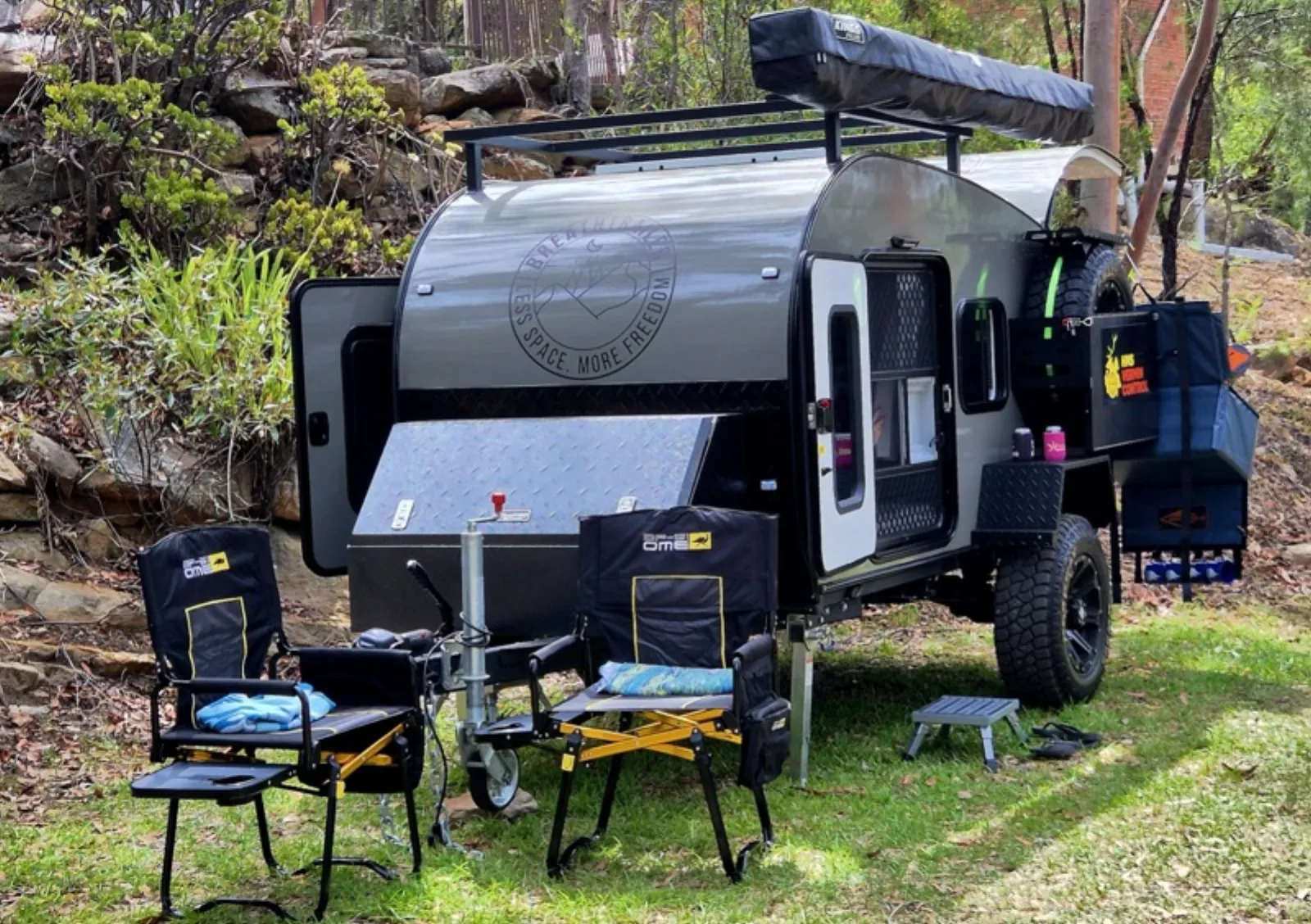
For couples who want an equipped outdoor camper that takes less space at home, we recommend Breath Ultra ahead of Wotpods Bosspod. Ultra combines a fitted sink, 60L fridge, separate grey-water storage and an interior table in a 3.9m-long trailer. Its smaller exterior is a practical reason to choose it when parking and storage matter as much as the camping equipment. A larger camper occupies that extra space every day at home, even when the additional cabin room or equipment adds little to your trips.
Breath Ultra is advertised from A$34,749. Wotpods’ model comparison lists Bosspod at A$35,000. These are different packages, not matched delivered quotes: establish whether the extra equipment on the more expensive offer is useful to you, and compare tax, options and collection costs.
This is a Breath Trailer recommendation, based on manufacturer specifications rechecked on 10 September 2026, rather than a head-to-head field test. We compare the standard Bosspod outdoor-camping package shown in Wotpods’ comparison table. Its former /bosspod/ product address redirected to a Bosspod XL clearance article at this check; the XL is a different, bathroom-equipped model. Do not mix their specifications or offers.
Price basis updated 15 September 2026: Breath retail prices include 10% GST: Essential A$23,320, Plus A$29,766, Ultra A$34,749 and Max A$47,190. Competitor prices retain the source dates stated below. Confirm the same tax, equipment and delivery basis in final quotations; a difference between advertised amounts is not a matched saving.
Where Ultra has a measurable advantage
- Lower advertised starting price: A$34,749 against the A$35,000 Bosspod figure, a gap of A$251 between different packages.
- Less length to store: 3,900mm against 4,480–4,550mm in the published road Bosspod specifications.
- Less width and height: 230mm narrower and 220mm lower than those road configurations.
These differences favour Ultra when budget and storage space are the priorities. Its included kitchen, inverter and separate grey-water tank show what that price buys. Bosspod has a different bed, battery and hot-water package. Those differences need to justify the extra spend and permanent storage space for your own use; a longer list is not a verdict.
Breath Ultra vs Wotpods Bosspod: the practical comparison
A specification table becomes useful when you connect each line to something you will do at camp.
| Job at camp | Breath Ultra’s published arrangement | Bosspod information to compare |
|---|---|---|
| Keep food cold | 60L fridge | Two 30L Engel drawer fridges in the model comparison |
| Cook and wash up | Double stove and built-in sink | Integrated sink in the current brochure; confirm the selected cooker and plumbing |
| Create shade | Awning and roof rack included | Awning and roof rack listed as included |
| Take a shower | External shower; specify heater and enclosure on the quote | Hot-water unit and shower tent listed as included |
| Carry and retain water | 80L fresh plus 80L grey tank | Confirm fresh capacity, wastewater collection and drain routing |
| Recharge equipment | 120Ah lithium, installed solar, 240V inverter | Confirm the battery, panels, chargers and inverter actually fitted |
| Relax inside | 140 × 200cm mattress and pop-up table | Inspect the bed, cabin access and selected table arrangement |
Sources: Breath Ultra specifications and Wotpods’ model comparison, checked 10 September 2026. Confirm the quoted model and equipment where Wotpods pages differ.
For a couple choosing an outdoor camper, Ultra’s case is the combination of kitchen, shelter, grey-water storage and convertible interior in one model. You can judge that combination during a viewing instead of trying to decide from an accessory list.
Before the campsite test, inspect the materials and electrical enclosure
The most useful construction comparison starts with the parts hidden from the hero photograph. Ultra lists a hot-dip-galvanised steel chassis. Ask to see the chassis, mounting points and underside, then open the cupboards and electrical access. The protective finish, cabinet edges and service access deserve the same attention as the fridge and mattress.
An expensive electrical package still needs a suitable enclosure and a careful installation. On the quoted Bosspod, ask for the battery, charger, controller and inverter make and model. Look at the cable entries, fixings, fuse access and the protection around equipment. If its box uses plastic, establish the actual material and intended exposure to sunlight, heat, debris and water. A plastic box is not proof of failure, but a premium price is no excuse for an unexplained component or installation.
In the kitchen, inspect the preparation surface, cut edges, joints, cupboard hinges and the area around the sink. Breath’s range includes a published stainless-steel counter on the Essential; confirm the precise bench material selected for your Ultra rather than assuming all models use the same surface. Ultra’s own listed features include additional cupboards, overhead storage and colour-changing kitchen LEDs. Try the actual lights and reach into the storage with the kitchen in use.
Breath’s exterior and cabinetry customisation lets you settle the finish as part of the build conversation. Our Australian team remains the contact for the configuration you order, the handover and product support. That is the level of detail we want buyers to use: what is fitted, how it is protected, how it works at camp and who stands behind the supplied configuration.
Arrival: what must come out before you can relax?
Imagine reaching a campsite late on Friday. You want a drink, a meal and somewhere to sit. That sequence gives you a better inspection plan than asking for a single setup-time claim.
Start with the trailer in its travelling condition. Ask to see how you get to the fridge, cooker, water and chairs. Then watch the awning open. Which items must be moved? Which require a separate bag, hose, support or bracket? Where will those things go overnight?
Ultra includes its awning and roof rack. That is useful when you want shelter integrated into the camper you order. Bosspod also lists these items, so their presence alone does not settle the choice. Compare the actual shade footprint, operation, packing and the area around the kitchen.
Ask for three demonstrations
- A quick overnight stop: access the bed and kitchen without putting out every accessory.
- A weekend base camp: deploy the shelter, chairs and whatever shower arrangement you selected.
- Packing after rain: identify where wet shelter and shower equipment travel.
You may care more about keeping bedding dry than shaving a minute off setup. You may prefer a smaller shelter because you move daily, or a larger one because you stay in one place. Explain that pattern before requesting a configuration.
If you are choosing between Breath models as well, the range comparison shows what Ultra adds. An awning and more equipment earn their place when you use them; they need not be the deciding features for every traveller.
Lunch and dinner: compare the kitchen while using it
Ultra’s built-in sink, double stove and 60L fridge are a concrete reason to inspect it. Try the jobs those items are meant to support: open the fridge, lift out food, reach the cooker and wash a cup.
A built-in sink gives the washing-up area a dedicated position. For buyers who dislike fetching, filling and putting away a separate washing bowl, that is the arrangement we recommend. Put a cutting board and your usual saucepan on the bench during the viewing. Check whether you can use the workspace comfortably with the fridge open.
Wotpods’ FAQ describes a removable washing container, while its current brochure lists an integrated sink. These sources describe different arrangements. If the quoted Bosspod uses the removable-bowl layout, handling and storing that container is an extra job to consider. If it supplies a fitted sink, that particular difference disappears. Ultra clearly lists its built-in sink; ask Wotpods to identify the layout and drainage actually supplied, rather than buying from incompatible descriptions.
A 60L fridge is not automatically the same experience as two 30L drawers
The litre total does not tell you whether tall bottles fit, whether the compartments suit your food or how easily you can reach what is at the bottom. Ask to see the actual fridge model and drawer movement.
The Wotpods model comparison lists two 30L Engel drawers. Inspect how your usual food and tall containers fit in the separate compartments. Confirm the exact appliances before assuming separate fridge/freezer operation.
Bring the containers you normally travel with, or their measurements. A week’s menu built around fresh vegetables asks something different of the storage from a weekend of simple meals. Also decide where dry food travels: enough refrigeration does not remove the need for accessible pantry space.
Ultra’s overhead shelving and storage cupboards give you places to assess in person. The right question is not “how many cupboards?” but “can the things I use each day fit without moving everything else?” Try accessing one while another person is standing at the kitchen.
Afternoon shower: separate water supply, heat and privacy
An external shower has several parts: water supply, a pump and hose, any heater, a privacy enclosure and a way to manage used water. Compare the whole arrangement.
Ultra’s published specification confirms an external shower. It does not, by itself, confirm a particular hot-water unit or shower tent in the base price. Ask for those items to be named on the configuration if you want a hot shower with an enclosure.
The Wotpods comparison includes a portable hot-water unit and shower tent in the Bosspod package. Count those items in a matched quote. Their practical value depends on the complete installation: a heater and enclosure on the list do not tell you which connections and storage jobs remain at every stop.
Ask both suppliers to demonstrate the agreed system from its packed position:
- Where does the heater sit while travelling and while operating?
- Which water, power or fuel connections are made at the campsite?
- Where do the shower hose and enclosure pack away?
- How do you keep the door and dry clothes clear of spray?
- What happens to the wastewater at the places you plan to camp?
Follow the equipment manufacturer’s operating instructions for the supplied heater. The practical comparison is the actual installation and routine, not an assumption that every portable system is difficult or every integrated-looking system is effortless.
Our camper trailer hot-water guide can help you prepare questions. At the viewing, ask to see the exact hardware on the quote rather than a different demonstration camper with extra equipment.
Is an external shower the arrangement you really want?
If you mainly picture indoor showering, privacy at night or staying inside in poor weather, this pair may not be your final shortlist. The Breath Max has an internal bathroom; Wotpods also offers the Bosspod XL with an onboard toilet and shower.
Choose the layout you want before optimising the outdoor accessories. It is easier to change a chair than turn the wrong floorplan into your preferred one.
Water through the weekend: Ultra’s two tanks do different jobs
Breath Ultra lists an 80L fresh-water tank and an 80L grey-water tank. The second tank is a practical feature when retaining wastewater is part of your camping routine. It does not provide another 80L of clean water.
Ask to see the filling point, the level indication, the drain outlet and which fixtures feed the grey tank. An external shower does not automatically drain into the trailer’s wastewater tank merely because that tank exists.
For your first water budget, list drinking, cooking, dishes and shower use separately. Then check that estimate against a short trial trip. A long shower can change your requirements far more than whether a drawer or cupboard is larger.
The Wotpods comparison page lists an 80L tank; its FAQ describes 62L. Obtain the capacity for the Bosspod being quoted and ask how wastewater is collected. We do not count an unspecified grey tank as included, or assume one cannot be provided.
Leave with a plan for the return trip
Think about what happens after two nights away. Will you refill before driving? Where will you empty wastewater appropriately? Which tanks or containers will still contain water on the road?
Fresh water adds approximately a kilogram per litre, so an 80L fill adds approximately 80kg. If water transfers into the grey tank during the trip, it has moved within your load; it has not magically doubled. Refill the fresh tank while retaining wastewater, however, and you can carry more water than you started with.
This is why useful water capacity and available payload need to be considered together. Neither tank volume nor tare weight tells the whole story on its own.
Evening power: establish what happens after sunset
Ultra lists colour-changing LED kitchen lights plus hard-wired internal and external LED lighting. During a viewing, try the light over the work area and around the doors: you want to see the food you are preparing and find the items you need after dark. The published description does not specify an amber mode, so ask to see the available colours if that matters to you.
The electrical system must support your fridge, lights, fan and device charging after sunset. Plan around those actual loads and the nights between reliable charging opportunities.
Ultra publishes a 120Ah lithium battery, installed solar and an included 240V inverter. Ask for the panel wattage, battery voltage, usable capacity, inverter output and charging equipment on the final specification. Those details determine which additional appliances are suitable.
Bosspod’s comparison page lists 300Ah, while the current brochure specifies 150Ah. Both exceed Ultra’s published 120Ah, but they do not describe the same battery package. Its solar description says 450W, while the panel row totals 300W. That unresolved specification is a reason to question the advertised package before committing. It is not evidence of a faulty battery or weak panels; obtain the actual system and judge the extra capacity against your appliance list.
Four questions that resolve more than a battery headline
- What is fitted? Get model names and ratings for the battery, controller and chargers.
- What runs away from mains? Distinguish an installed inverter from inverter-ready wiring and shore-power sockets.
- What does the car need? Ask about the charging connection, cable installation and compatibility.
- What happens in poor weather? Discuss your expected loads and the fallback when solar contribution is low.
A larger battery can offer useful storage, but it still has to be recharged. A solar rating is a panel specification, not a promise that the same energy arrives every day. Neither brand should be chosen on an unspecified “days off-grid” claim.
Read our solar-system explanation before the visit if the terminology is unfamiliar. Then bring an appliance list so the conversation stays tied to your trip.
Bedtime, breakfast and packing: test the whole living space
Ultra lists a 140 × 200cm mattress and a pop-up table that converts the bed area into a living space. That arrangement is worth testing if you want somewhere inside to sit, eat or read when you are not in bed.
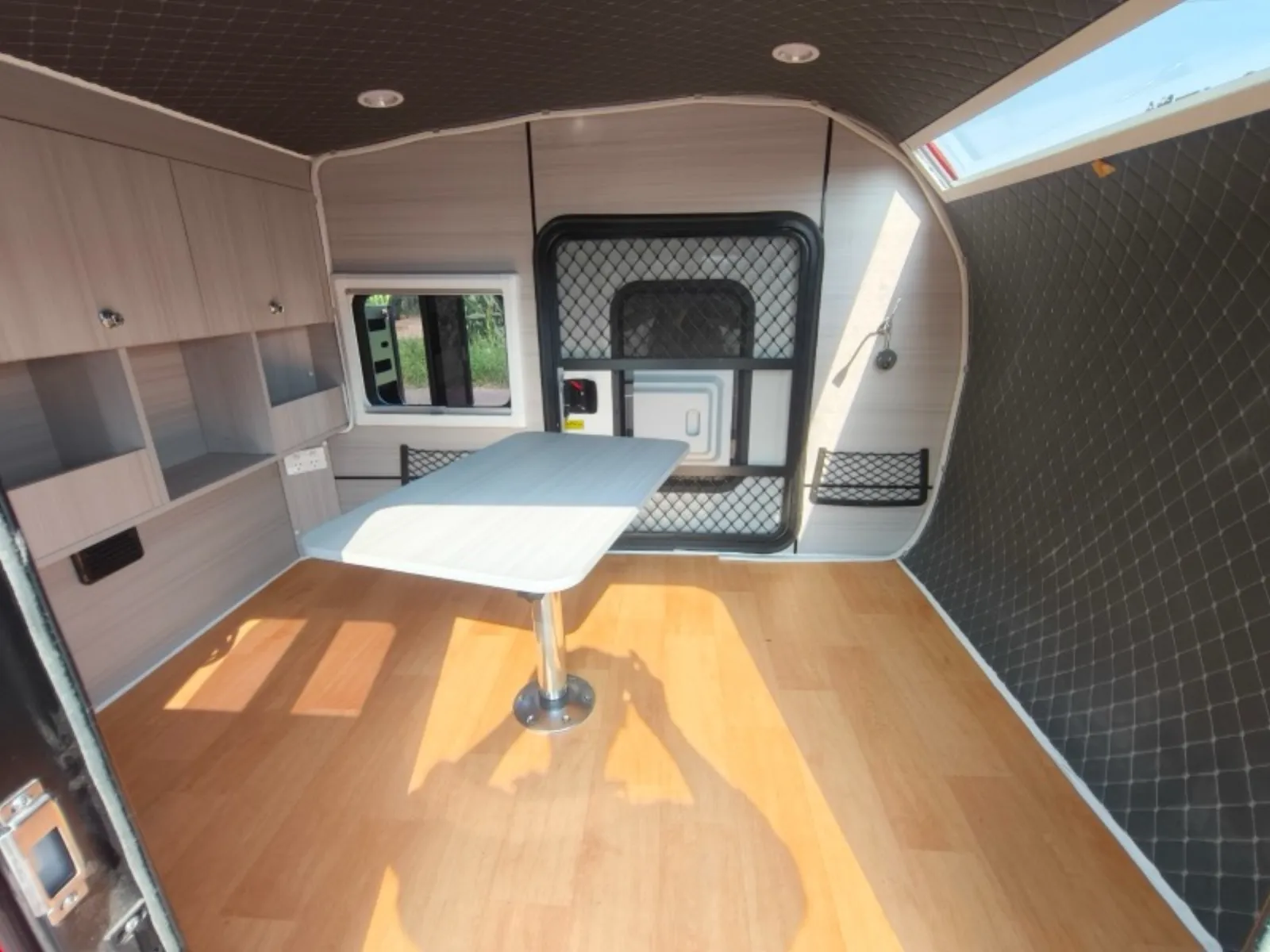
Breath Ultra pictured with the interior table in use. Colours, equipment and configuration may vary.
Lie down, sit up and try the table conversion. Ask where bedding goes during the change, whether two people can sit comfortably and which storage remains accessible. A table is only useful if the conversion suits the way you use the camper.
Bosspod’s model comparison lists a queen innerspring mattress; Ultra’s is 140 × 200cm. Confirm the actual sleeping dimensions you need. If Ultra fits both travellers comfortably, the larger Bosspod exterior is not automatically useful space: you still have to store and manoeuvre it. If you need a wider mattress, account for that honestly in the configuration. Body width and mattress width are different measurements.
Both travellers should try entry and exit. One person’s comfortable step or reach may be another person’s daily annoyance. Check the door opening, screens, reading-light access and the route outside without relying on staged photographs.
The following morning, repeat the packing demonstration. Locate the rubbish, wet towels, breakfast dishes and last items that cannot be packed until everything else is ready. These are useful purchase questions because you will repeat the routine every trip.
Check the home end of the journey too
Ultra’s published overall dimensions are 3,900 × 2,000 × 1,850mm, with 900kg tare and 1,500kg ATM. The stated difference is 600kg, before accounting for any additions not included in the quoted tare. It is not a guarantee that you can load 600kg anywhere you want: the finished unit, distribution of load and vehicle limits still matter.
Ultra also lists a hot-dip galvanised steel chassis. Inspect the underside, storage access and spare wheel during the same visit rather than treating a material label as the whole construction comparison.
Ultra is 580–650mm shorter, 230mm narrower and 220mm lower than the published Bosspod road configurations. Wotpods’ comparison lists 4,550 × 2,230 × 2,070mm; its current brochure, page 3, gives 4,480 × 2,230 × 2,070mm. If storage space is limited, this is the clearest measurable Breath advantage. The larger Bosspod requires more room at home; measure your opening and driveway, then confirm final dimensions with the selected accessories. Use the supplier’s completed-unit weights for the towing check. Sources: Wotpods’ model comparison and current brochure, page 3, checked on 10 September 2026.
Our towing guide explains the terms to bring to the supplier. The actual match must be checked against your car’s limits and the completed trailer, not a general statement that an SUV will do.
Before leaving the viewing, check three less glamorous jobs. Retrieve the spare wheel with your normal luggage in place; if a configuration stores it beneath bedding, demonstrate access with the bed made. Measure the lowest vulnerable point beneath the loaded trailer, including pipes and fittings, and ask what protection is fitted there. Finally, reach the roof-rack straps and awning controls yourself. If you need a step, account for its storage and use only surfaces the supplier confirms are designed to support a person.
What would justify paying more than Ultra?
The answer needs to be a feature you will use, at a fitted cost you accept. Use this worksheet against the actual quote.
| Requirement | Ultra starting point | What the extra spend must demonstrate |
|---|---|---|
| Kitchen and wastewater | Built-in sink, 60L fridge and separate 80L grey tank | A layout or capacity improvement that matters to your routine |
| Hot water and privacy | External shower; heater and enclosure to specify | Installed equipment, remaining setup jobs and a useful final price |
| Home storage | 3,900 × 2,000 × 1,850mm published exterior | Why the larger road Bosspod footprint is worthwhile for you |
| Off-grid power | 120Ah lithium, installed solar and inverter | Confirmed usable energy and charging, with contradictory lists resolved |
| Sleeping space | 140 × 200cm mattress and pop-up interior table | Actual mattress dimensions and a layout you prefer in use |
Pay for the improvement, not the claim. If the additional space or equipment does not solve a problem you have, Ultra’s included package is the better place to start. For an indoor bathroom, move to the Max comparison rather than trying to turn an outdoor-shower layout into a different camper.
Breath Ultra is our recommended compact outdoor camper: a dedicated kitchen, 60L fridge, awning, roof rack and 80L grey-water storage in a camper listed at 3.9m long. The pop-up table adds somewhere to sit inside, and the published A$34,749 starting price makes it a worthwhile first inspection for buyers shopping equipped outdoor campers. Its strongest case is how those features work together across your day.
Breath also provides a 2-year structural warranty; component cover and the claims process are separate. Read the warranty terms and ask how support works for your intended travel. Wotpods’ comparison and FAQ give different warranty periods, so obtain its current written terms before comparing cover.
Bring a Bosspod quote and your must-have equipment to a Breath Ultra viewing. Ask us to show the full arrival-to-packing routine and quote the same requirements. That will produce a much more useful answer than comparing two headline prices.
Frequently asked questions
Is the Breath Ultra a direct alternative to the Wotpods Bosspod?
Yes, for buyers considering equipped campers with outdoor kitchens and external shower arrangements. Compare the exact packages. If an indoor bathroom is essential, look at models such as Breath Max and Bosspod XL instead.
Does the Ultra’s external shower include hot water and a tent?
The published Ultra specification confirms an external shower. Ask for the heater, privacy enclosure and fittings to be named and priced on your quote; do not assume they are included from the word “shower”.
Does the Bosspod have a bigger battery than Ultra?
Yes: the comparison table lists 300Ah and the brochure 150Ah for Bosspod, against Ultra’s 120Ah. That can matter if your trip needs the extra storage. Confirm voltage, usable energy and charging equipment, and resolve the inconsistent Wotpods solar figures before relying on the complete package.
Can I use all 160 litres in Ultra’s tanks for showering?
No. The arrangement is 80L fresh and 80L grey. The grey tank stores wastewater and does not increase the clean supply. Also confirm how shower wastewater is collected in your chosen setup.
What should I bring to a comparison viewing?
Your vehicle details, garage measurements, an equipment list and any competing quote. Add your normal food containers and appliance ratings if fridge fit and off-grid power are important. Ask to see the camper packed, operating and packed again.
Recommended reading
- Breath Ultra specifications — check the current model’s inclusions before configuring extras.
- Camper trailer hot-water systems — prepare a complete shower setup.
- Understanding camper solar systems — separate the battery, panels and charging equipment.
Book a Breath viewing to see whether Ultra’s day-to-day setup fits the way you camp.