Camper Trailer Hot Water Systems: The 2026 Australian Guide
How each system heats, what it costs to run, and how much water you get before it goes cold.
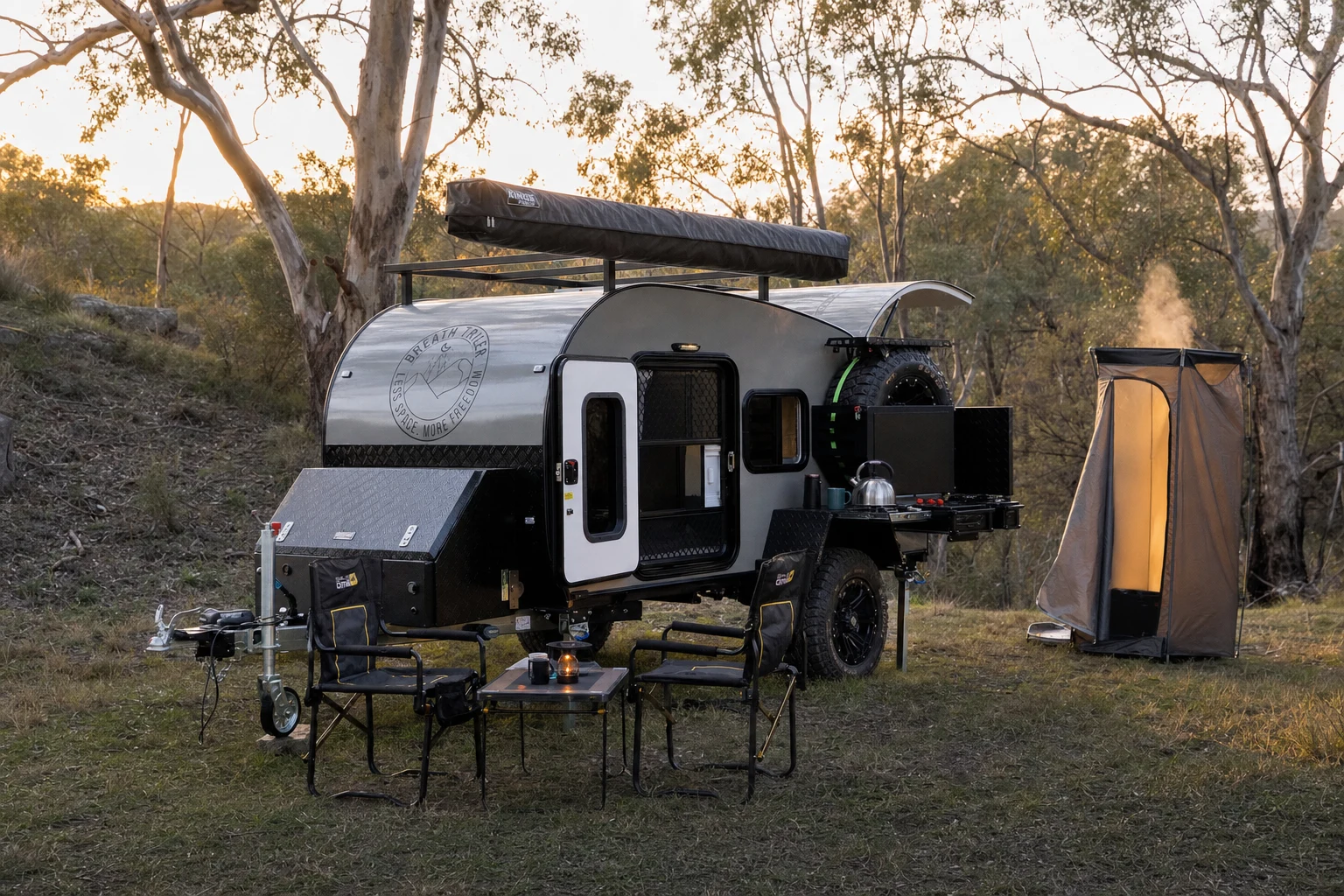
Ask a hundred Australians why they stopped camping and you will hear the same three answers: bad sleep, no bathroom, and cold water. The first two get talked about constantly. The third is the one that quietly ends trips early — on night four of a Flinders Ranges loop, when the temperature drops to 6°C and the idea of a cold rinse behind the car is enough to make anyone start planning the drive home.
Hot water is not a luxury item on a camper trailer. It is the single cheapest upgrade that changes how long you are willing to stay out. A camper trailer hot water system costs between $180 and $2,600 in Australia in 2026 depending on the type, and the difference between those two numbers is not quality — it is architecture. A $299 portable gas unit and a $2,399 built-in instantaneous heater both deliver a hot shower. They just do it with completely different trade-offs in water use, gas consumption, installation cost and legal compliance.
This guide covers every option available to Australian camper trailer owners in 2026: how each type actually works, what it costs to buy and run, how much water and power it consumes, what the gas regulations require, and how to match a system to the way you genuinely camp. We have included real prices from Australian retailers and honest notes on where each system falls short.
The Four Types of Camper Trailer Hot Water System
Every hot water setup on an Australian camper trailer falls into one of four categories. The choice between them is mostly a question of energy source (LPG, 12V, 240V or diesel) and heating method (instantaneous or storage).
| System type | Energy source | Typical price (AUD, 2026) | Hot water available | Best for |
|---|---|---|---|---|
| Portable gas instant | LPG bottle + 12V ignition | $180 – $599 | Within seconds, unlimited | Weekenders, retrofits, tight budgets |
| Built-in gas instant | LPG + 12V ignition | $2,399 – $2,599 | Within seconds, unlimited | Full-time touring, permanent installs |
| Gas/electric storage | LPG and/or 240V | $949 – $1,180 | 20–28 min from cold, then 20L | Mixed park and bush camping |
| 12V/240V compact electric | 12V or 240V, no gas | $299 – $450 | ~2 hrs on 12V, ~40 min on 240V | Small trailers, no-gas builds |
| Diesel | Vehicle diesel + 12V ignition | $1,600 – $2,600 installed | 20–30 min for 28L | Single-fuel setups, cold-climate touring |
Two clarifications before we go deeper, because they cause more confusion than anything else in this category:
- “Gas only” systems still need 12V. Every instant gas heater on the Australian market uses a 12V supply to spark the burner and drive the electronics. If your battery is flat, you have no hot water — even with a full gas bottle. This matters more than people expect on day five of a free camp.
- “Instantaneous” does not mean unlimited in practice. It means unlimited heating. Your real limit is the water in your tank. An 80L fresh tank is roughly eight full showers regardless of how clever the heater is.
1. Portable Gas Instant Systems
This is the category that made hot showers normal in Australian camping, and it is still where most people should start.
A portable instant unit is a self-contained box with a gas burner, a 12V pump, a hose and a shower head. You drop the pump into a bucket, a jerry can or a creek, connect a standard LPG bottle, and you have hot water in about six seconds. Nothing is plumbed into the trailer, so nothing needs a licensed installer.
How they perform. The Joolca HOTTAP v2, the dominant brand in this space, runs an adjustable flow rate of 2.5 to 6 litres per minute and will run for around 15 hours of continuous use on a 9 kg BBQ bottle. That is not 15 hours of showering — that is 15 hours of burner time, which for most touring couples works out to weeks of daily showers.
The maths that matters:
| Flow setting | 5-minute shower | Showers from an 80L tank |
|---|---|---|
| 2.5 L/min (economical) | 12.5 L | ~6 showers |
| 4 L/min (comfortable) | 20 L | ~4 showers |
| 6 L/min (generous) | 30 L | ~2.5 showers |
The lesson is not “buy a bigger tank”. It is that flow control is the real water-saving feature. A shower head with a trigger stop — wet down, turn off, soap up, rinse — halves your consumption without making the shower feel worse. Two people can wash comfortably on 20 litres a day if they use the trigger.
Where portables fall short: you have to set them up and pack them down every time, they need somewhere to hang, and they are exposed to wind — a stiff breeze can blow out or destabilise the burner on cheaper units. They also require you to be outside, which is fine in a Queensland winter and genuinely unpleasant in a Tasmanian one.
Price range: $180 for entry-level Camplux/Companion-style units, $499–$599 for a Joolca HOTTAP v2 kit with the shower tent and accessories.
2. Built-In Gas Instantaneous Systems
The permanent version of the same idea. A Truma AquaGo or similar unit mounts through the wall of the trailer, plumbs into your fresh water system and your gas line, and delivers hot water to a shower and a kitchen tap on demand.
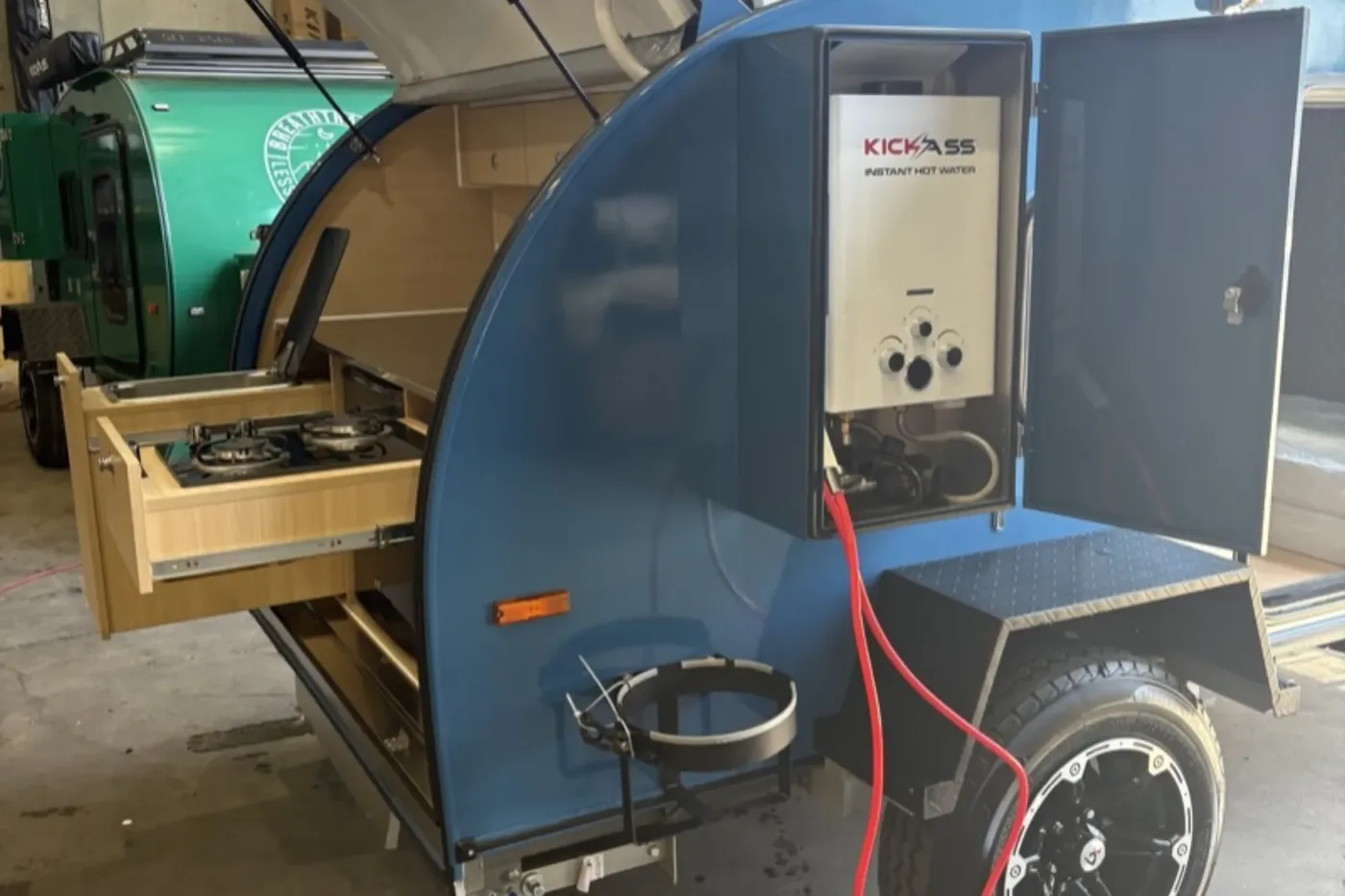
A compact instant gas heater in a side cabinet heats water only as it flows.
Real Australian pricing in 2026: the Truma AquaGo sits around $2,399 inc GST, the AquaGo Comfort around $2,599. Add installation. This is the most expensive option on the list and it is worth understanding why people still pay it.
What you get for the money:
- No warm-up wait, ever. The AquaGo holds only 1.3 litres of water internally — it heats on demand rather than storing.
- No tank to sanitise. Storage systems hold 20 litres of warm water between trips, which is a bacteria consideration if the van sits for months. Instantaneous systems hold almost nothing.
- No dead weight. A full 20L storage tank is 20 kg of water you tow everywhere. On a camper trailer where payload is already tight — see our guide to camper trailer weights and payload — that is not trivial.
- It works at any campsite. No 240V required.
The honest downside: cost, plus the fact that instantaneous gas units have a minimum flow rate to fire the burner. Turn the tap down too far and the burner cuts out, giving you the classic cold-then-scalding cycle. Modern units handle this far better than 2015-era models, but it is still the most common complaint.
3. Gas/Electric Storage Systems
The traditional caravan approach: a 20–28 litre insulated tank heated by an LPG burner, a 240V element, or both.
Australian pricing is the appeal here. A Swift 20L gas/electric system runs about $949, and comparable Suburban gas/240V units sit around $1,180 — roughly half the cost of a premium instantaneous unit.
Heat-up times from cold (the number people actually care about):
| Heat source | Time to hot from cold | Notes |
|---|---|---|
| Gas only | ~28 minutes | Works anywhere, no mains needed |
| 240V element only | ~28 minutes | Silent, but needs powered site or inverter |
| Gas + 240V together | ~20 minutes | Fastest option, powered sites only |
| Truma UltraRapid | Under 30 minutes | Premium storage option |
The 20-litre reality check. Twenty litres of stored hot water is not twenty litres of shower. You mix it with cold, so a 20L tank at 65°C delivers roughly 35–40 litres of comfortable shower water — two decent showers, then a wait. For a couple doing back-to-back showers on a cold morning, that wait is the whole argument for going instantaneous.
Where storage genuinely wins: dual-fuel flexibility. If you spend half your nights in caravan parks, running the 240V element costs you nothing in gas and makes almost no noise. Off-grid, you switch to gas. Nothing else on this list gives you both without compromise.
4. Compact 12V/240V Electric Systems
The newest category, and the most misunderstood. Units like the Duoetto MK2 — a 10L dual-voltage tank sold through KickAss Products and others for around $299–$450 — heat water electrically with no gas at all.
This is the option to read the specs on carefully. The Duoetto MK2 draws 1000 W / 4.2 A on 240V, and 300 W / 25 A on 12V. That 25-amp figure is the one that decides whether this system suits your build.
What 12V heating actually costs you in battery:
| Scenario | Draw | Time to heat 10L (20°C → 70°C) | Energy used |
|---|---|---|---|
| 12V element | ~25 A | ~2 hours | ~50 Ah |
| 240V element (inverter) | ~4.2 A @ 240V | ~40 minutes | ~70 Ah from 12V battery |
| 240V element (mains) | 1000 W | ~40 minutes | Free at a powered site |
A single 12V heat cycle consumes roughly 50 Ah — that is over 40% of a 120Ah lithium battery for one tank of hot water. It is entirely viable if you have solar recharging through the day and you heat once, in the afternoon, while the panels are producing. It is not viable as a “heat whenever we feel like it” system. If you are sizing a battery bank around this, read our AGM vs lithium comparison first — an AGM bank simply cannot supply this load repeatedly without damage.
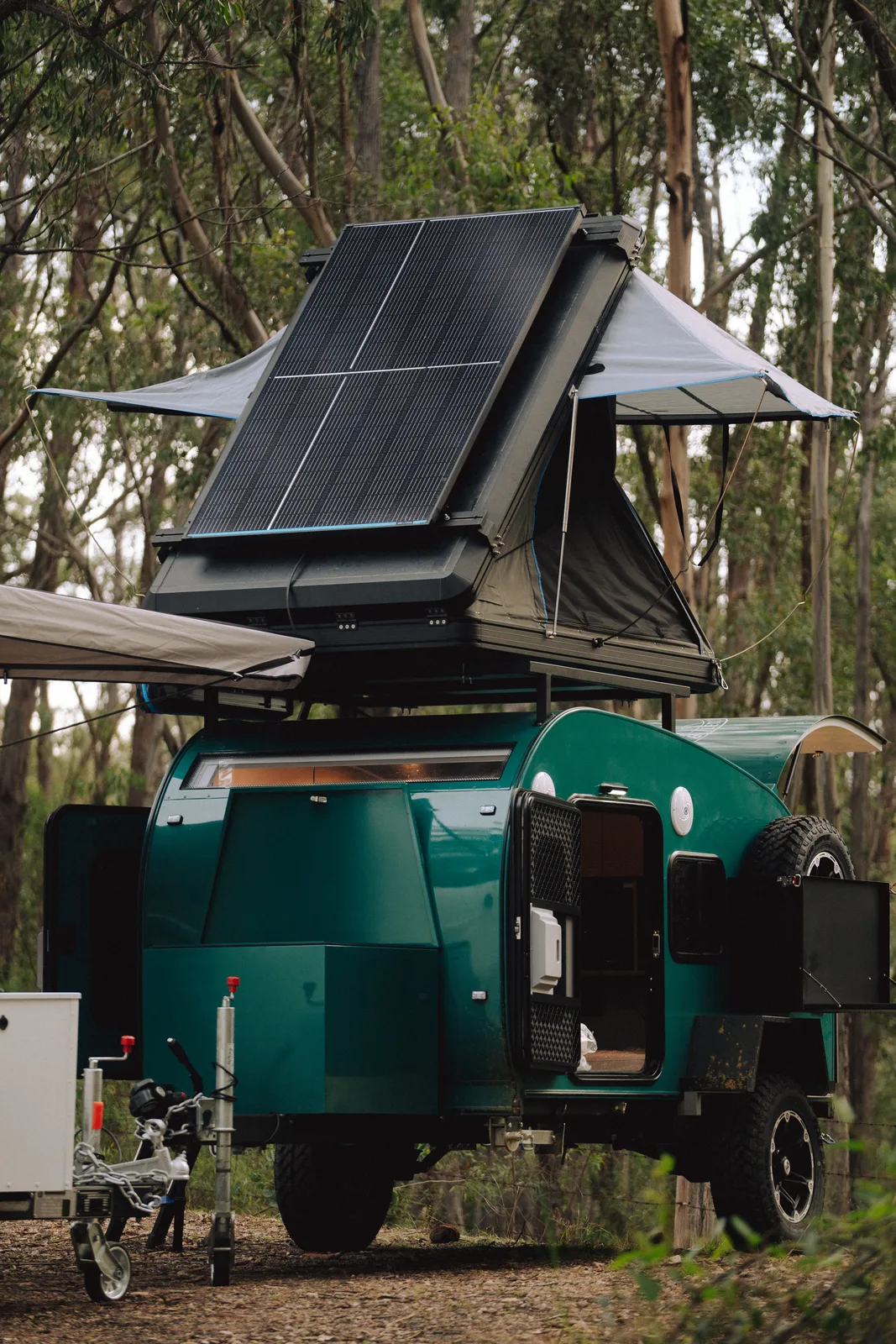
Solar makes 12V water heating viable, as long as you heat once while the panels are producing.
Who these suit: small builds where adding a gas line is not worth the cost or the compliance paperwork, people who mostly stay at powered sites, and anyone who wants hot water for washing up rather than for showering.
5. Diesel Hot Water Systems
The specialist option. A Webasto or Eberspacher diesel unit draws fuel from your tow vehicle’s tank (or a dedicated tank), uses 12V only for ignition, and then runs on diesel alone.
Australian pricing: Webasto units retail around $1,200–$1,500, with professional installation adding $500–$800, for an installed cost of roughly $1,700–$2,600. Eberspacher is comparable at $1,600–$2,500 installed.
Fuel consumption is the headline number: 0.1–0.28 L/hr depending on output level. At $2 a litre, running the heater for an hour costs less than 60 cents. For anyone doing genuinely long trips in cold country, that is the cheapest hot water per litre available.
The single-fuel argument. If your tow vehicle runs diesel, a diesel hot water system means you carry one fuel, not two. No gas bottles to find and refill in Birdsville, no gas compliance to maintain, no swap-and-go queue. Combined with a diesel air heater, it makes an off-grid setup dramatically simpler.
The catches: installation is genuinely specialist work, the units are noisier than gas at start-up, and they are overkill for anyone doing weekend trips in temperate weather.
The Regulation Nobody Mentions Until It Matters
This is the section most buying guides skip, and it is the one that determines whether your insurance pays out.
Any fixed gas installation in an Australian recreational vehicle must comply with AS/NZS 5601.2 — the standard covering LP Gas installations in caravans and RVs for non-propulsive purposes. Three practical consequences:
- It must be installed by a licensed gasfitter. Not a handy mate, not the manufacturer’s apprentice, not you. Licensing is state-by-state, and the fitter’s licence number must be recorded.
- A completed certification plate is the proof. Compliance is confirmed by the presence of a completed gas certification plate on the vehicle, filled in by the installing gasfitter. If a used camper trailer you are inspecting has a gas shower and no plate, you are looking at either undocumented work or unlicensed work. This belongs on your pre-purchase inspection checklist.
- DIY gas work can void your insurance. An insurer assessing a fire claim will ask for the compliance plate. This is exactly the category of risk we cover in our article on why professional installation matters.
Portable units sit outside this. A Joolca-style heater connected to a bottle by a hose and used outside the vehicle is not a fixed installation, which is a large part of why the portable category exists. If you want hot water without the compliance overhead, that is the honest route.
The same logic applies to the 240V side: fixed 240V wiring in a camper trailer falls under AS/NZS 3001.2, and must be done by a licensed electrician. There is no version of this where doing it yourself is legal.
Hot Water and the Grey Water Problem
Here is the part that catches people out. Adding a hot shower to a camper trailer does not just create a water supply question — it creates a waste water question, and in 2026 that is increasingly what determines where you are allowed to stay.
A growing number of Australian councils and national parks require vehicles to be self-contained: fresh water in, grey water captured, nothing discharged onto the ground. Once you have a hot shower, you are generating 15–30 litres of grey water a day. Without a grey tank, that has to go somewhere — and “onto the campsite” is exactly what the rules are written to prevent.
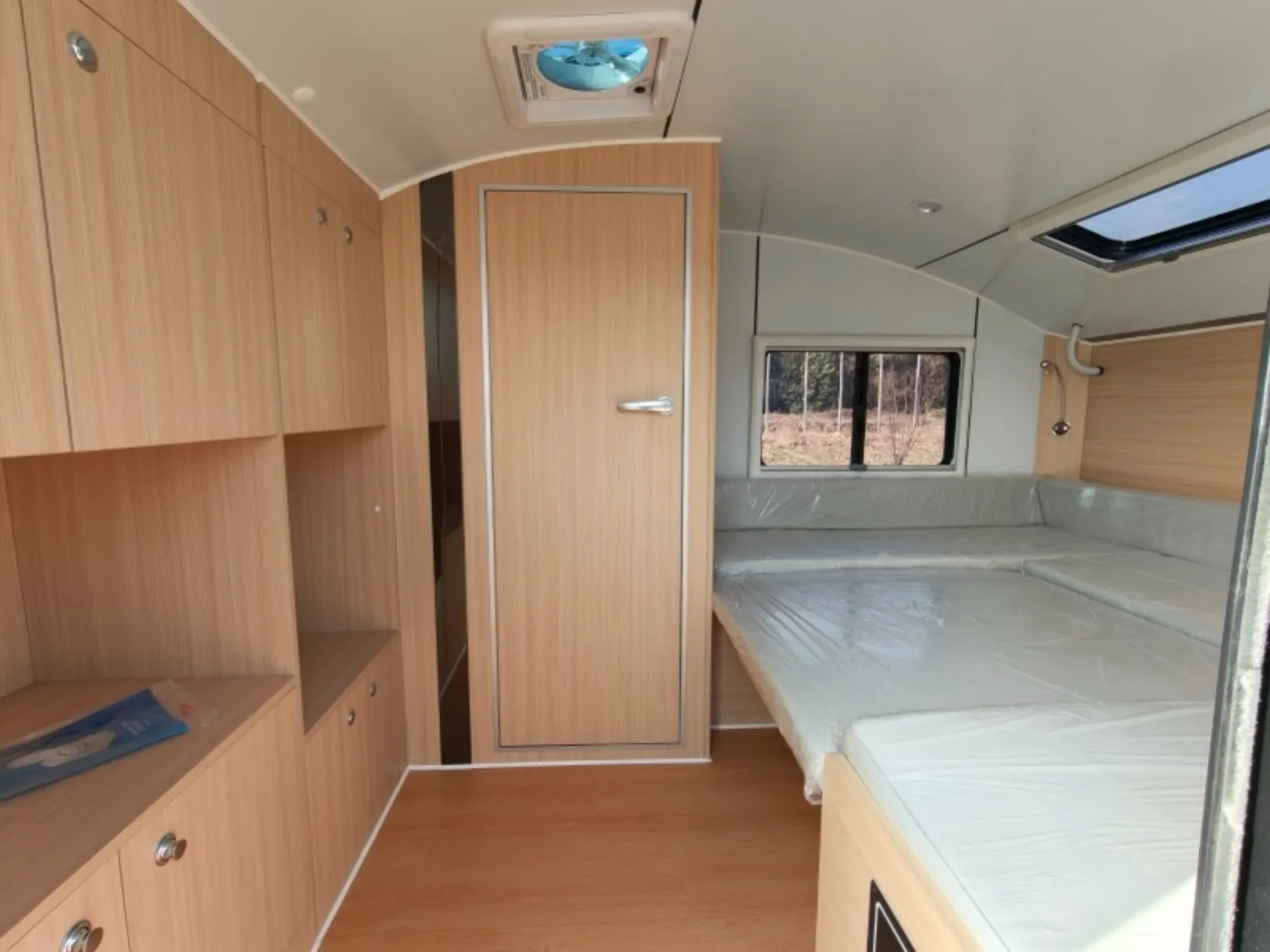
An interior shower means grey water has to be captured on board, not left on the campsite.
This is why the tank pairing matters more than the heater choice:
| Setup | Grey water handling | Free camping access |
|---|---|---|
| Portable shower, no grey tank | Runs onto the ground | Restricted at self-contained-only sites |
| Portable shower + collection bladder | Manual, ~20L capacity | Workable, but fiddly |
| Plumbed shower + fixed grey tank | Automatic, 80L | Full access to self-contained sites |
Our guide to self-contained camping in Australia covers the CMCA rules and the state-by-state variations in detail. The short version: a hot water system without a grey water plan solves one problem and creates another.
How Breath Trailer Handles Hot Water
We design and finish four hard-shell teardrop campers in Sydney, and hot water is one of the clearest lines between the models — so it is worth being specific rather than vague.
| Model | Price (AUD) | Tare | Water tanks | Shower | Battery |
|---|---|---|---|---|---|
| Breath Essential | $23,320 | 700 kg | Fresh water tank | None — pairs with a portable unit | Lithium |
| Breath Plus | $29,766 | 800 kg | Fresh water tank | None — pairs with a portable unit | Lithium |
| Breath Ultra | $34,749 | 900 kg | 2 × 80L (fresh + grey) | External shower | 120Ah lithium |
| Breath Max | $42,900 | 1,200 kg | 120L fresh + 70L grey | Full interior bathroom with shower, toilet and hot water to the kitchen sink | 120Ah lithium |
The Essential and Plus are deliberately not plumbed for a shower. That is not a gap we are apologising for — it is the “Everything You Need, Nothing You Don’t” principle applied honestly. If you are doing weekends and long weekends, a $499 portable unit gives you exactly the same hot shower for a fraction of the weight and cost, and you can pack it away when you do not need it.
The Ultra adds the external shower and the dual 80L tank system. Fresh water in, grey water captured. That is the configuration that unlocks self-contained sites while keeping the trailer under 900 kg tare — towable by a mid-size SUV, which is the constraint most of our customers are actually working within. If towing capacity is your limiting factor, our towing guide works through the numbers.
The Max is the only teardrop on the Australian market under $50,000 with a full interior bathroom — shower, toilet, 2.1 m standing headroom, hot water to both the bathroom and the kitchen sink, and a grey water tank for responsible off-grid camping. For Greg and Margaret doing the Big Lap, or Mia working remotely from a beach in WA, that is the difference between planning trips around amenities blocks and not thinking about it at all.
If you are weighing these up, the full model comparison puts the specs side by side.
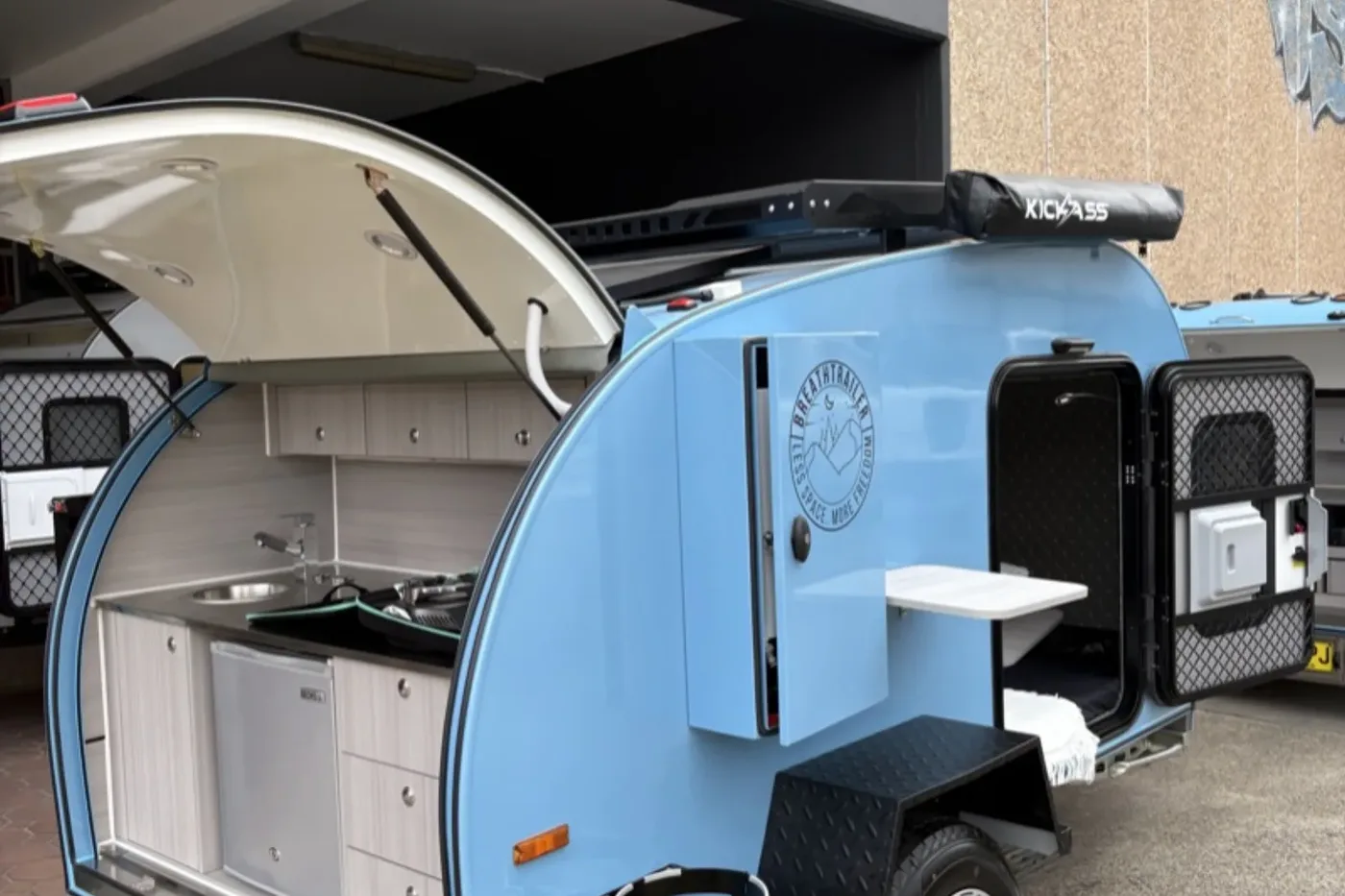
The Ultra’s dual 80L tank system is what lets a hot shower and self-contained camping coexist.
Choosing: A Straight Decision Path
Forget the feature lists. Answer these four questions honestly.
1. How many nights a year will you camp? Under 20 nights → portable gas. Over 40 nights → plumbed. The setup-and-pack-down tax on a portable is trivial six times a year and genuinely annoying sixty times a year.
2. Do you camp in the cold? If your trips are Tasmania, the Victorian High Country, the Snowy or the inland winter, an outdoor portable shower stops being pleasant fast. Interior plumbing or a shower tent becomes non-negotiable.
3. Do you need self-contained access? If your favourite sites require it, you need a grey water tank, which means plumbed, which means the Ultra or Max tier of camper regardless of which heater brand you prefer.
4. What is your power situation? No solar and an AGM battery → gas, not 12V electric. 120Ah+ lithium with 200W+ of solar → 12V electric becomes genuinely viable. Our solar sizing guide has the numbers.
Five-year running cost comparison, assuming 40 nights a year with two people showering daily:
| System | Purchase | 5-year running cost | 5-year total |
|---|---|---|---|
| Portable gas | $499 | ~$180 (gas refills) | ~$679 |
| Built-in gas instant | $2,399 + install | ~$180 | ~$3,100+ |
| Gas/electric storage | $949 + install | ~$150 | ~$1,600 |
| 12V/240V electric | $349 | ~$0 (solar) | ~$349 |
| Diesel | $2,100 installed | ~$120 | ~$2,220 |
The running costs are almost identical. The decision is entirely about the purchase price and how the system fits your camper — not about what it costs to operate. Anyone who tells you a particular heater will “pay for itself in gas savings” is selling something.
Frequently Asked Questions
Do I need a licensed gasfitter to install a hot water system in my camper trailer? Yes, for any fixed installation. Australian regulations require gas work in recreational vehicles to comply with AS/NZS 5601.2 and to be carried out by an appropriately licensed gasfitter, with a completed certification plate recording their licence number. Portable units connected by hose and used outside the vehicle are not fixed installations and do not require this.
How much water does a camp shower actually use? A quick rinse is about 5 litres; a full shower including washing your hair is around 10 litres. At a typical 4 L/min flow rate, a 5-minute shower without a trigger stop uses 20 litres. An 80L fresh water tank realistically gives a couple four to eight showers depending on discipline.
Can I run a 12V hot water system off my camper trailer battery? Yes, but budget for it. A 10L 12V unit draws roughly 25 amps and takes around two hours to heat from cold, consuming about 50 Ah per cycle — over 40% of a 120Ah lithium battery. It works well with solar recharging during the day; it does not work well as an on-demand system on an AGM bank.
Is instant gas or storage hot water better for a camper trailer? Instant is better if you want unlimited hot water, no warm-up wait and no dead weight — at roughly double the price. Storage is better if you want dual-fuel flexibility (gas off-grid, 240V in parks) at half the cost, and you can live with a 20-minute warm-up and roughly two showers before a refill wait.
Will a hot shower stop me free camping? Only if you have nowhere to put the grey water. A growing number of sites require full self-containment, meaning all waste water must be captured on board. A plumbed shower with a dedicated grey water tank meets that requirement; a portable shower draining onto the ground generally does not.
Do Breath Trailers come with hot water? The Breath Ultra includes an external shower with dual 80L fresh and grey water tanks. The Breath Max includes a full interior bathroom with shower and toilet, plus hot water to the kitchen sink. The Essential and Plus are not plumbed for showers and pair well with a portable gas unit.
The Bottom Line
Hot water is the cheapest comfort upgrade in camping and the one most likely to extend how long you stay out. In 2026, the honest advice for most Australian camper trailer owners breaks down like this:
- Camping under 20 nights a year? Buy a $499 portable gas unit. It will be as hot as anything on this list, it needs no compliance paperwork, and you can use it with any camper you ever own.
- Camping 40+ nights, and free camping matters? You need plumbed hot water and a grey water tank. That decision is about the camper, not the heater.
- Building a no-gas setup? 12V electric works, but size your battery and solar around a 50 Ah heat cycle before you commit.
- Doing serious remote kilometres in a diesel vehicle? Diesel hot water is the cheapest to run and the simplest to refuel, and it is worth the installation cost.
Whatever you choose, get the compliance right. A gas certification plate is a $0 line item on a professionally installed system and an uninsurable liability on a DIY one.
If you want to see how a plumbed hot water and grey water system works in a teardrop that a mid-size SUV can still tow, book a viewing — the Ultra and Max are both set up and running at our Sydney showroom, and you are welcome to turn the taps on.
Recommended Reading
- Self-Contained Camper Australia — the grey water rules that decide where a hot shower is allowed.
- Teardrop Camper with Shower and Toilet — how a full bathroom fits inside a teardrop footprint.
- The Ultimate Off-Grid Camper Trailer Setup — water, power, fridge and toilet as one system.
- How Long Can You Stay Off-Grid? — the maths on water as your real limiting factor.
- Why Professional Installation Matters — gas and 240V compliance in plain English.