Camper Trailer Handover Day: What to Check Before You Sign
Eighty per cent of new caravan owners report a fault. Handover is your last easy chance to catch one — the 9 checks, the paperwork, the first 50 km.
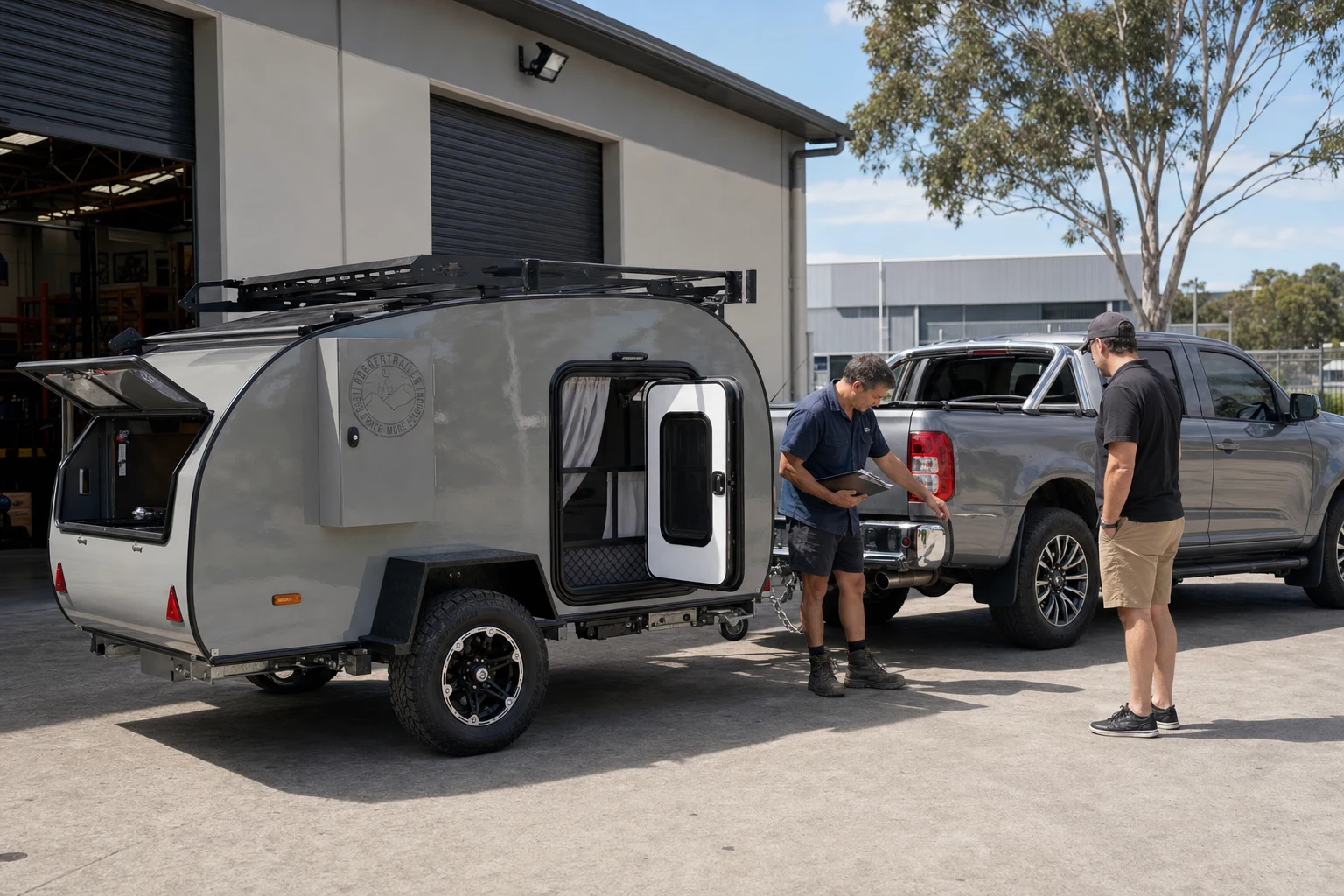
You have paid the balance. The trailer is sitting on the forecourt, clean, hitched, ready. Everybody in the yard is in a good mood, and the natural thing to do is sign the paperwork, shake hands and drive away.
That hour is the most valuable hour of the whole purchase, and most buyers spend it being polite.
When the ACCC surveyed the Australian caravan market, around 80% of the 2,270 owners who responded reported a failure with their new van, and half of those classified the failure as major. The ACCC also received more than 1,300 consumer reports about caravans over five years, and found that 40% of suppliers had a manufacturer refuse to reimburse them for a remedy they had already provided (ACCC, July 2022). Those numbers are about caravans, but the supply chain, the components and the compliance regime are the same ones that build camper trailers.
Handover day is the last moment when the trailer, the person who built it, the paperwork and your money are all in the same place at the same time. After you tow away, every problem becomes a phone call, a queue and a favour. This is a practical guide to spending that hour well: what to bring, the nine checks worth doing in the yard, the documents you must physically leave with, what registration actually costs in 2026, and what the law gives you if something is wrong.
Why handover day is the last cheap moment to find a problem
A pre-delivery inspection (PDI) and a handover are two different things, and buyers routinely confuse them.
The PDI is the manufacturer’s own process: the structured set of checks, tests and rework that happens before the trailer is presented to you. Ours runs to eight stages and twelve measurable tests, and you never see most of it. The handover is the customer-facing session where the trailer is explained, demonstrated and legally accepted by you.
The distinction matters because a good PDI is invisible and a good handover is not. If the manufacturer skipped the PDI, the handover is the only inspection the trailer ever gets — and you are the inspector. If the manufacturer did a thorough PDI, the handover is your chance to verify it rather than take it on trust. Either way, the work is yours.
The cost asymmetry is the reason to bother. A loose coupling bolt found in the yard is a five-minute fix by the person who built the trailer. The same bolt found 400 km later is a tow truck, a week of waiting for a workshop slot, and a warranty conversation with somebody who was not there. Nothing about the fault changed. Only the leverage did.
Before you leave home: what to bring and arrange
Handover goes badly when you arrive with a car that cannot legally tow, no insurance and nothing to write on. Sort these before the day.
| What | Why it matters on the day |
|---|---|
| Insurance cover note in force | Cover must start the moment you take possession, not when you get home. Arrange it the week before — see our camper trailer insurance guide for agreed vs market value |
| Brake controller fitted and working | Any trailer over 750 kg GTM needs functioning brakes. If your controller is not installed, you cannot legally or safely tow away |
| Your tow vehicle’s plate figures | GVM, GCM, braked towing capacity and maximum tow ball mass, written down. You need them for the weight conversation |
| Torque wrench | For the 50 km re-torque on the way home. A $60 tool that prevents a wheel separation |
| Printed copy of your order | Every option, colour, upgrade and inclusion you paid for, so you can tick them off against the trailer in front of you |
| Your phone, charged | Video the walk-through. You will forget which switch does what by the second night |
| Towing mirrors | Required in most states when the trailer is wider than the tow vehicle |
| Two to three hours, no kids | Handover done properly is not a fifteen-minute transaction |
The single most useful item on that list is the printed order. Options get missed — a solar upgrade, a specific tyre, a second battery, an awning size. Nobody is being dishonest; builds are complex and paperwork gets transcribed. If you have the order in your hand, a missing item is a conversation. If you do not, it is your word against an invoice you no longer remember.
The paperwork you must leave with
This is where handovers most often fall short, because the documents feel like admin and everybody wants to get to the fun part. They are not admin. Several of them are the only proof that the trailer is legal.
| Document | What it proves | Do not accept |
|---|---|---|
| Compliance plate + VIN | The trailer’s legal identity, tare, ATM and GTM. Should be stamped on the drawbar or plate | A blank, missing, or hand-altered plate |
| Registration papers or unregistered vehicle permit | That you may legally tow it home today | Vague assurances that rego is on its way |
| Gas compliance certificate (AS/NZS 5601.2) | That the LP gas installation was done and certified by a licensed gasfitter | A gas system with no certificate and no compliance plate |
| Electrical compliance (AS/NZS 3001.2:2022) | That the 12V and any 240V work meets the current RV wiring standard | A verbal we build to standard with no document |
| Signed pre-delivery checklist | That someone actually performed the PDI and put their name on it | An unsigned or undated form |
| Written warranty terms | Duration, what is covered, who performs the work, whether it transfers on resale | A warranty described only in conversation |
| Weight documentation | Tare as built with your options, not the brochure tare | A tare figure copied from the website |
| Appliance manuals + serial numbers | Your route to component warranties on the fridge, heater, hot water unit | A box of unbranded gear with no paperwork |
Two of these deserve extra attention.
Gas. If your trailer has a gas cooktop, gas hot water or a gas fridge, the installation must comply with AS/NZS 5601.2 and be certified by a licensed gasfitter, who attaches or updates a gas compliance plate. Queensland moved to digital gas certificates through the Resources Safety & Health Queensland portal from 1 July 2025, and Queensland registration now requires you to hand over either the printed certificate or the certificate number to the Department of Transport and Main Roads (RSHQ guidance summary). No certificate means no registration in that state, and it means an insurer has a clean reason to argue about a fire claim.
Electrical. AS/NZS 3001.2:2022 is the current standard for electrical installations in relocatable vehicles. Cable sizing, fusing, circuit separation and battery installation all sit under it. We wrote about why professional installation matters because non-compliant 12V work is the fault we see most often on trailers that come to us from elsewhere — and it is invisible behind a cabinet panel.
If a document is not ready on the day, do not let it go undocumented. Write on the handover form what is outstanding and by when, and have both parties sign. This is the whole difference between a promise and a record.
Nine physical checks to do in the yard
You do not need to be a mechanic. You need a torch, ten minutes and a willingness to look at things people expect you to skip.
| # | Check | How to do it | What good looks like |
|---|---|---|---|
| 1 | Coupling and drawbar | Grip the coupling and try to move it. Look for cracks around welds and mounting bolts | No play in the mounting, no cracking, all bolts present with locking nuts |
| 2 | Safety chains | Cross them under the drawbar and check length | Chains rated for the ATM, off the ground, not so long they foul the breakaway cable |
| 3 | Compliance plate vs your order | Read tare, ATM, GTM off the plate | Figures match the paperwork and your tow vehicle’s limits |
| 4 | Tyres | Read the four-digit DOT date code on the sidewall of all tyres, including the spare | Manufactured within about the last two years, correct pressure, matching brand and rating |
| 5 | Wheel nuts | Ask for the torque figure and check a few with your wrench | Even tension to the stated figure, no missing or damaged nuts |
| 6 | Brakes and breakaway | Hitch up, plug in and test the controller in the yard. Pull the breakaway pin briefly | Brakes engage on the controller. Breakaway locks the wheels and the battery is charged |
| 7 | 12V under load | Turn on lights, fridge, water pump, fans — all at once | Voltage stays stable, nothing dims or resets, no warm connectors |
| 8 | Water and seals | Run the pump, check every tap, then look under sinks and around hatches and windows | No drips, no staining, seals continuous and evenly seated |
| 9 | Body and transit damage | Walk the whole trailer slowly in daylight, then crouch and look along the panels | No stone chips, no scuffs, no dents. Damage found now is theirs; found later, it is yours |
A few notes on the ones people get wrong.
Tyre dates. A brand-new trailer can leave the yard on tyres manufactured three or four years ago, because tyres sit in warehouses. Rubber ages on a shelf just as it does on a road. The DOT code reads as week and year — 2325 means the 23rd week of 2025. Anything older than about two years at handover is worth a question.
Wheel nut torque. There is no universal figure. Alloy wheels on off-road trailers are commonly specified around 135 Nm, while some 1/2 inch UNF steel setups run considerably higher — Cruisemaster publishes a maximum of 200 Nm for that stud size (4WDing Australia). Over-tightening can deform the rim and is arguably worse than slightly loose. So ask for your trailer’s figure, write it down, and tighten in a star pattern.
The breakaway test. Almost nobody does this at handover, and it is the check that matters most in a genuine emergency. Any trailer over 2,000 kg ATM must have a breakaway system that applies the brakes if the trailer detaches; the battery that powers it must be charged and monitored. Our full explainer on how electric trailer brakes work covers the ADR thresholds and the controller types.
The weight conversation nobody has at handover
The plate says tare. The brochure said tare. They are frequently not the same number, because tare on the brochure is the base build and tare on your trailer includes every option you ordered — the second battery, the solar, the awning, the toolbox, the spare wheel carrier.
The figure that matters is payload = ATM − tare as built. That is everything you are allowed to add: water, food, gear, gas bottles, recovery equipment, the annexe, the generator, the beer.
| Model | Tare | ATM | Payload | NSW private vehicle tax 2026 (with the 40% camper reduction) |
|---|---|---|---|---|
| Breath Essential | 700 kg | 1,500 kg | 800 kg | $94 |
| Breath Plus | 800 kg | 1,500 kg | 700 kg | $167 |
| Breath Ultra | 900 kg | 1,500 kg | 600 kg | $167 |
| Breath Max | 1,200 kg | 1,900 kg | 700 kg | $217 |
Two things to do about weight on the day.
Ask what the trailer weighed as built. A manufacturer who weighs finished trailers can tell you. One who quotes the brochure has not weighed it.
Book a weighbridge on the way home. Public weighbridges cost very little and take fifteen minutes. Weigh the combination, then the trailer alone if you can, and check the tow ball mass with a ball scale. If you are close to a limit, you want to know on day one rather than after a highway patrol officer tells you. Our camper trailer weights guide works through tare, ATM, GTM, ball weight and the 80% rule of thumb with the actual sums.
Registration and what it costs in 2026
Whether your trailer arrives registered depends on who you bought from and which state you are in. Ask the question weeks before handover, not on the morning.
| State | What is needed for a new light trailer | 2026 cost notes |
|---|---|---|
| NSW | Blue slip (AUVIS unregistered vehicle inspection) then registration at Service NSW | Blue slip about $41 unbraked / $58 braked, valid 42 days. Registration fees rise 2.65% from 1 July 2026 |
| VIC | Register a trailer or caravan through VicRoads | Light trailer registration from around $60/year |
| QLD | Registration through TMR; safety certificate required 750 kg–3.5 t ATM; gas certificate number required at registration | Light trailer registration from around $57.90/year |
| Other states | Requirements vary — check the state road authority before handover | Fees scale with weight in every state |
The genuinely good news for NSW buyers in 2026 is the 40% reduction in vehicle tax on privately registered towed caravans and purpose-built camper trailers weighing 255 kg to 4.5 tonnes. It applies automatically to new registrations and renewals (NSW vehicle registration fees). On a 700 kg teardrop that takes the private rate from $156 to $94; on a 1,200 kg trailer, from $362 to $217. Over ten years of ownership on a Breath Max that is roughly $1,450 back in your pocket, which is a real number that nobody in the industry advertises.
If the trailer is not registered on the day, you need an unregistered vehicle permit to tow it home legally. Every state issues them, they are cheap, and they take minutes online — but only if you apply before you arrive.
The tow home, the first 50 km and the shakedown
Handover does not end when you leave the yard. The first hour of towing is a test, and it is worth treating it like one.
Set the brake controller properly. Find a quiet, straight stretch, get to about 40 km/h, and apply the trailer brakes manually with the controller slider. Adjust the gain until the trailer pulls the combination up firmly without locking. Repeat when the trailer is loaded, because the correct gain changes with weight.
Re-torque the wheel nuts at 50 km. Many manufacturers put a sticker on the drawbar telling you to do exactly this, and it is one of the few maintenance items that is genuinely urgent. Wheel studs bed in. Pull over, check every nut against the stated figure in a star pattern, and check again at the next fuel stop.
Plan the route. No tight suburban corners, no first-time reverse into a difficult driveway with an audience. Know where the trailer is going to live before you drive home.
Do a shakedown trip within the first fortnight. One night, an hour from home, everything set up as if it were the real thing. You will find the missing tap washer, the switch nobody explained, the fridge that needs a level surface, the thing you forgot to pack. Finding it 60 minutes from home is a story. Finding it on the Oodnadatta Track is a problem. Our pre-departure checklist is built for exactly this trip.
Then book the first service in your calendar. Bearings, brakes and fasteners all want attention early in a trailer’s life, and wheel bearings in particular are the component most likely to end a trip when neglected.
What to do if something is wrong
Something being wrong at handover is not a disaster. It is normal, it is fixable, and Australian law is on your side — provided you create a record.
Under the Australian Consumer Law, a camper trailer comes with consumer guarantees that cannot be contracted away. If the trailer fails one of those guarantees, you are entitled to a remedy. If the failure is minor, the supplier may choose to repair it. If the failure is major — or if multiple minor failures add up to a major one — you choose between a refund and a replacement. As the ACCC put it, it is reasonable to expect a new caravan will not develop a major fault within the first several years of use, and the guarantee can outlive the manufacturer’s own warranty period.
Practically, on the day:
- Write the defect on the handover document before you sign, with a date for rectification. Verbal promises evaporate when staff change.
- Photograph it, in daylight, with something for scale.
- Do not accept delivery of a trailer you believe is unsafe. Not registered, no gas certificate, brakes that do not work — those are reasons to leave it in the yard, and the balance stays unpaid.
- Keep every email. A remedy conversation six months later is decided by what is in writing.
- Escalate through the state fair trading body if the supplier stops responding. The ACCC’s own findings show that non-response is a documented pattern in this industry.
None of this makes you a difficult customer. It makes you a customer with a record.
What handover looks like at Breath Trailer
We build in Sydney, and every trailer runs through an eight-stage pre-delivery process before it is presented — chassis and coupling, AS/NZS 3001.2 electrical compliance, 12V functional testing under load, brakes, running gear, a water-ingress hose test, compliance plate and documentation, then a livability walk-through.
At handover you get the walk-through in person: how the galley works, how the power system behaves off-grid, how to hitch, how to set the brake controller, and how the trailer packs down in five minutes. You leave with the compliance documentation, the warranty in writing, and the phone number of people who are in the same city as your trailer. If you would rather see the process before you commit, you can inspect a trailer at one of our viewing locations or book a viewing.
The honest framing: none of the above is a favour. It is the minimum a manufacturer should offer, and the reason we write it down is so you can hold every brand on your shortlist — including us — to the same standard. If you are still comparing, our pre-deposit verification checklist covers the twelve questions worth asking before any money changes hands, and the model comparison lays out where each of our four trailers sits.
Frequently asked questions
How long should a camper trailer handover take? Allow two to three hours. A rushed handover is the single clearest signal that the seller sees you as a transaction rather than an owner. If the walk-through is fifteen minutes, ask what else is scheduled that day and book a proper session instead.
Can I refuse to take delivery if I find a fault? Yes. Until you accept the trailer, you retain the strongest position you will ever have. For a minor fault, the sensible move is usually to accept delivery with the defect and the rectification date recorded in writing. For anything that affects safety, registration or compliance, leave it in the yard.
Does a new camper trailer come registered? Not always. In NSW a new trailer generally needs a blue slip inspection before it can be registered, and in Queensland you will need the gas compliance certificate number at registration. Confirm with your supplier weeks in advance who is registering the trailer, and if it is you, apply for an unregistered vehicle permit so you can legally tow it home.
What paperwork should I insist on at handover? Compliance plate and VIN, registration papers or a permit, the gas compliance certificate if there is gas on board, evidence of AS/NZS 3001.2 electrical compliance, a signed pre-delivery checklist, written warranty terms, the as-built tare weight, and appliance manuals with serial numbers.
Do I really need to re-torque the wheel nuts after 50 km? Yes. Wheel studs bed in during the first kilometres, and a nut that felt tight in the yard can lose tension quickly. Use the torque figure your manufacturer specifies, tighten in a star pattern, and re-check at the next stop. It costs five minutes.
What is the difference between a PDI and a handover? The PDI is the manufacturer’s internal inspection and testing regime, performed before you arrive. The handover is the session where the trailer is demonstrated to you and legally accepted. A good PDI does not remove the need for a careful handover — it simply means the handover confirms good work rather than discovering bad work.
The hour that pays for itself
Buying a camper trailer is a five-figure decision made over months, and then compressed into one cheerful hour on a forecourt where everyone is ready to be finished. The ACCC’s numbers say that a meaningful proportion of new recreational vehicles in this country leave the yard with something wrong. The handover is the last point at which fixing that something is free.
So bring the printed order. Read the compliance plate. Pull the breakaway pin. Ask what it weighed as built. Write down what is outstanding before you sign. Then re-torque at 50 km, do a shakedown night close to home, and start the ownership properly.
If you want to see what a thorough handover looks like before you buy, come and inspect a trailer — or compare the four models and work out which payload figure actually suits the way you camp.
Recommended reading
- What Happens Before a Trailer Leaves Our Sydney Workshop — the eight-stage PDI that should happen before you ever see the trailer.
- Camper Trailer Verification Checklist Before You Pay a Deposit — the twelve questions to ask months before handover day.
- Camper Trailer Weights Explained: Tare, ATM, GTM and Payload — the maths behind the plate figures you will read in the yard.
- Understanding Electric Brakes on Camper Trailers — ADR thresholds, controller types and the breakaway system you should test.
- Common Camper Trailer Problems and How to Avoid Them — the ten faults most likely to appear in the first two years.
- Teardrop Camper Insurance in Australia — arranging cover that starts the moment you take possession.