Electric Vehicle Towing a Teardrop Camper in Australia: The Real 2026 Maths
A 500 kg trailer cut a tested EV from 240 km to 185 km. Compare tow ratings, loaded weights, charging legs and teardrop matches.
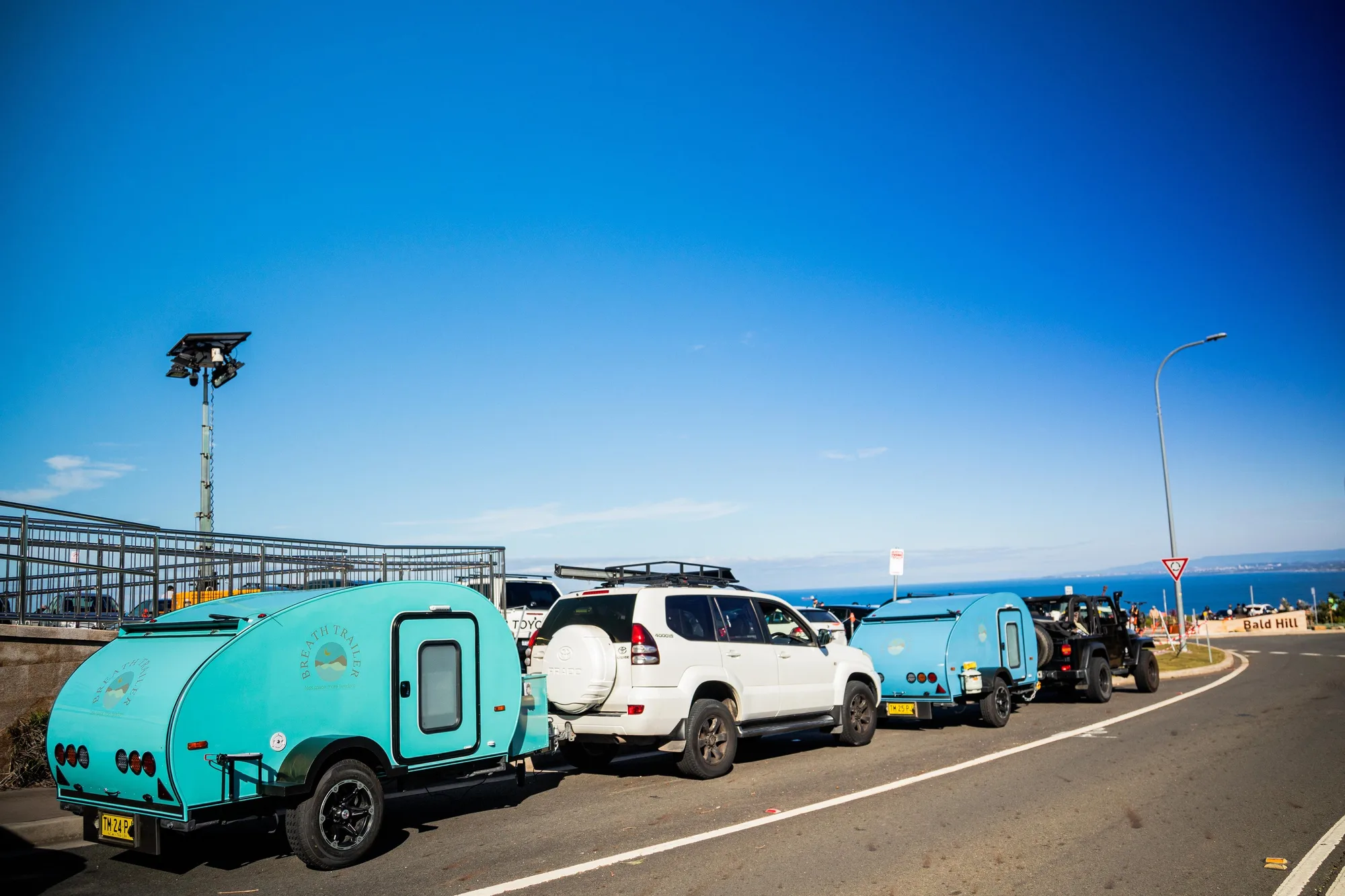
Electric vehicle towing with a teardrop camper in Australia is already practical — but only when the numbers work before the hitch goes on. Electric motors have ample low-speed torque. The harder questions are whether the exact Australian EV variant is approved to tow the trailer’s actual loaded mass, whether its towball limit is sufficient, and whether the next charger still sits inside the reduced real-world range.
The range penalty is not guesswork. In controlled testing by Arval and UTAC, a fully loaded electric car towing a 500 kg trailer travelled 185 km instead of 240 km, a 23% reduction. At the other end of the spectrum, an ADAC road test of a Kia EV6 and a 1,600 kg full-height caravan increased consumption from 20 to 36.6 kWh/100 km and cut available range from nearly 400 km to about 220 km.
That large difference is why a low, compact teardrop makes more sense behind many EVs than a tall caravan. A streamlined silhouette cannot override a compliance plate, but it gives the combination a better starting point.
Checked 7 September 2026. EV tow ratings vary by model year, battery, drivetrain, wheel package and factory tow equipment. Treat every figure below as a shortlist, then verify the owner’s manual, vehicle plate, towbar plate and trailer plate for the exact combination.
EV Towing a Teardrop: The Short Answer
For most Australian buyers, the useful EV towing band begins at 1,250 to 1,600 kg braked. A 750 kg rating leaves almost no payload behind a 700 kg tare teardrop. Tare is the empty starting number, not the holiday load.
| Question | Practical 2026 answer |
|---|---|
| Can an EV tow a teardrop camper? | Yes, if the exact EV is approved for the trailer’s actual loaded mass and towball download. |
| What tow rating is useful? | 1,250 kg can suit a genuinely light load; 1,500–1,600 kg gives more realistic scope for compact teardrops. |
| How much range will towing remove? | Measured examples span about 23% for a 500 kg trailer to about 45% for a 1,600 kg full-height caravan. |
| What matters more: mass or shape? | Both matter, but aerodynamic drag increasingly dominates at highway speed. A low teardrop generally has an advantage over a full-height caravan. |
| Will every charger accept an attached trailer? | No. Pull-through sites are improving, but many bays still require unhitching. Check satellite imagery and recent app comments. |
| Is EV towing suited to a Big Lap? | It can be done, but remote legs and failed chargers add planning risk. Weekend and regional routes are the easier use case today. |
If towing terminology is new, start with the Australian camper-trailer towing guide before comparing cars. EVs do not get a separate set of weight laws.
The Six Numbers That Decide Whether Your EV Can Tow It
A headline braked towing capacity is only one ceiling. Your legal limit is the lowest rating in the vehicle-trailer system.
- Actual trailer mass: the loaded trailer on a weighbridge. It must not exceed the trailer’s ATM or the vehicle’s approved braked towing capacity.
- Towball download: the vertical load on the ball. It must remain below the vehicle, towbar and coupling limits, and consumes EV payload.
- EV payload and GVM: passengers, luggage, accessories and ball download all sit inside Gross Vehicle Mass.
- Gross Combination Mass: where the manufacturer publishes a GCM, the loaded EV plus loaded trailer must remain below it.
- Towbar and coupling rating: an aftermarket bar cannot create capacity the vehicle manufacturer did not approve. Use the lowest marked limit.
- Trailer brakes: under the Australian rules summarised by the NSW Government, a trailer at 0–750 kg GTM does not require brakes; at 751–2,000 kg GTM it needs an effective braking system on both wheels of at least one axle; above 2,000 kg GTM it needs brakes on all wheels and an automatic breakaway system.
The common trap is matching EV capacity to camper tare. A 700 kg tare camper behind a 750 kg-rated EV crosses that rating after adding 80 litres of water, before food or clothing. Load for a normal trip, measure the trailer, then keep a deliberate margin.
For a fuller explanation of tare, ATM, GTM and payload, use the teardrop camper weight guide. If the loaded GTM exceeds 750 kg, also confirm the EV and trailer interface described in the electric trailer brakes guide; a seven-pin plug is not automatically a brake controller.
Australian Electric SUVs and Their 2026 Tow Ratings
The table below uses Australian manufacturer information available on 7 September 2026. It deliberately separates variants where one badge carries very different limits.
| Australian EV variant | Braked tow rating | Maximum towball download | What it means for a teardrop |
|---|---|---|---|
| Kia EV5 Air Standard Range | 300 kg | 50 kg | Not a practical teardrop tow vehicle. |
| Kia EV5 Long Range (Air, Earth, GT-Line) | 1,250 kg | 100 kg | Viable for a light camper only after a loaded weighbridge check. |
| Toyota bZ4X Touring AWD | 1,500 kg | Check exact towbar/vehicle plate | Useful compact-camper rating; do not infer the ball limit. |
| Tesla Model Y, current 5-seat variants | 1,588 kg | 159 kg | Strong paper match for many compact teardrops; approved tow package and brakes still required. |
| Hyundai IONIQ 5 Extended Range | 1,600 kg | 100 kg | Useful mass rating, but the 100 kg ball limit can become the binding number. |
| Polestar 4 Long Range Single / Dual Motor | 1,500 / 2,000 kg | Verify exact variant | Single suits compact trailers; Dual widens the choice but does not remove payload checks. |
| Kia EV9 Air / Earth and GT-Line | 900 / 2,500 kg | 45 / 125 kg | The Air is restrictive; AWD Earth and GT-Line can handle substantially more mass. |
| BMW iX xDrive45 | 2,500 kg | 100 kg | High tow rating, modest ball limit; measure rather than assume. |
The underlying sources matter because generic databases often merge overseas and Australian specifications. Tesla’s Australian manual lists 1,588 kg and a 159 kg tongue limit for the current Model Y. Kia’s MY26 brochures list the EV5 Long Range at 1,250 kg and the EV9 AWD variants at 2,500 kg, while the EV9 Air is only 900 kg. Toyota publishes 1,500 kg for the 2026 bZ4X Touring, and Polestar lists 1,500 kg for the Single Motor and 2,000 kg for the Dual Motor on its Australian Polestar 4 specifications.
Similar battery sizes do not mean similar towing ability. Certification, cooling, axle capacity, towbar design and ball limits matter as much as torque.
How Much EV Range Does a Teardrop Really Use?
There is no universal percentage. Frontal area, speed, headwind, temperature, gradient, tyre pressure and vehicle efficiency all change the answer. Tests establish a planning range, not a promise.
| Test or planning case | Trailer/load | Result | What to take from it |
|---|---|---|---|
| Arval/UTAC electric-car test | 500 kg trailer with vehicle at full payload | Range fell from 240 km to 185 km (23%) | A light trailer still has a material cost. |
| ADAC Kia EV6 road trip | 1,600 kg full-height caravan | Consumption rose 20 to 36.6 kWh/100 km (83%); range about 400 to 220 km | Heavy, tall caravans can nearly halve range. |
| Conservative teardrop first-trip plan | Unknown combination | Assume 30–40% less range until measured | Replace the assumption with your own trip data. |
The Arval and UTAC test report is useful because it measured a relatively light 500 kg trailer. The ADAC test shows the other extreme: 1,281 km with a conventional 1,600 kg family caravan, eight charging sessions and an average 36.6 kWh/100 km.
Do not read those results as “teardrop equals 23%”. Use them as boundaries. A low teardrop should expose less frontal area than a full-height caravan, but roof racks, rooftop tents and tall awnings surrender part of that advantage.
A usable-range calculation that works
Use your EV’s observed solo highway range, not its advertised laboratory number:
planned towing leg = observed highway range × towing factor × usable battery window
For a 500 km solo-highway EV, a 35% towing reduction and a 90%-to-15% battery window gives:
500 × 0.65 × 0.75 = 244 km
That does not mean booking chargers 244 km apart. Wind, rain, an unexpected detour or one offline charger can consume the margin. On the first trip, select a route with alternatives every 150–200 km and record consumption at 80, 90 and 100 km/h. Your own kWh/100 km figure becomes far more useful than internet folklore after one representative drive.
Why Teardrop Shape Helps More at Highway Speed
Mass matters most while accelerating and climbing. Aerodynamic drag becomes increasingly expensive as speed rises. A trailer that is lower than the EV’s roofline and has a rounded leading edge disturbs less air than a tall, square-fronted caravan. That is why a 900 kg teardrop can sometimes consume less energy than a lighter but taller box trailer.
The practical efficiency order is simple:
| Decision | Usually helps range | Usually hurts range |
|---|---|---|
| Trailer body | Low roof, narrow body, rounded front | Full-height, wide, square leading edge |
| External gear | Equipment inside the body | Roof box, rooftop tent, upright spare and loose awning bag |
| Speed | Stable 85–95 km/h where safe and legal | Repeated acceleration and 100–110 km/h running |
| Tyres | Correct cold pressure for the measured load | Under-inflation or aggressive tyres not needed for the route |
| Route | Moderate grades and reliable charging alternatives | Long high-speed gaps, strong headwinds and steep climbs |
Slowing down is not a token tip. Because aerodynamic power demand rises sharply with speed, a small reduction can recover useful range. Drive to the road, weather, trailer tyre rating and state rules — not to a promised arrival time.
Planning Charging Stops with a Trailer Attached
Public charging is the awkward part of EV towing. Many Australian bays are nose-in or reverse-in car parks; an attached trailer may block an access lane or several chargers. Sometimes unhitching is the only workable choice.
Australian governments recognise the design gap. The national minimum operating standards for government-supported charging infrastructure say sites above 150 kW should, where space permits and particularly in regional locations, include a pull-through bay for larger vehicles and vehicles towing. That is guidance for supported infrastructure, not proof that every current site has one.
Use this route routine:
- Plan in energy, not brochure kilometres. Enter the combination’s measured towing consumption where the route app allows it.
- Inspect the site before departure. Satellite view can reveal kerbs, one-way entries and whether a trailer can continue forward after charging.
- Read recent charger comments. A perfectly placed unit is useless if the only pedestal is offline.
- Keep a second charger inside the remaining range. Do not arrive at a single regional unit with 4% battery and optimism as the backup plan.
- Keep the trailer key and wheel chocks accessible. Make unhitching a controlled task.
- Ask before charging at a caravan-park power outlet. Site electrical systems and operator policies vary. Never assume the overnight site fee includes traction-battery charging.
For remote Australia, redundancy matters more than theoretical range. A 180 km leg with two charging options is safer than 140 km ending at one unreliable unit. Start with a regional loop, not an isolated crossing.
V2L Is Useful at Camp — but Protect the Driving Reserve
Vehicle-to-load (V2L) lets compatible EVs run ordinary appliances from the traction battery. Kia EV5 and EV9 variants, Hyundai IONIQ 5 and several other Australian EVs offer it; Tesla Model Y does not currently provide an Australian V2L outlet.
V2L can quietly power a fridge, lights, laptop or kettle without a generator. It does not replace compliant house-battery wiring, and a seven-pin connection is not a high-power campsite supply.
The energy scale is favourable. A fridge averaging 0.6–0.9 kWh per day plus lights and device charging is small beside a 70–100 kWh traction battery. The consequence of getting the reserve wrong is still larger than flattening a camper battery: the car must reach the next charger. Set the EV’s discharge floor if available, calculate the kilometres back to charging, and stop using V2L before that reserve is threatened.
If the trailer already has solar and lithium storage, keep the two systems complementary. Let the camper’s off-grid power system handle ordinary overnight loads and use V2L for occasional high-draw appliances or poor-solar weather.
Which Breath Trailer Models Make Sense Behind an EV?
Breath Trailer belongs in this guide only because its low hard-shell models fall inside the towing conversation. The correct match is still determined by measured loaded mass, not by the badge on either side of the hitch.
| Model | From price | Tare | ATM | Honest EV match |
|---|---|---|---|---|
| Essential | $23,320 | 700 kg | 1,500 kg | Do not pair it with a 750 kg-rated EV for normal touring. A 1,250 kg EV may work with disciplined loading; 1,500 kg gives full rated scope. |
| Plus | $29,766 | 800 kg | 1,500 kg | Best considered with a 1,500–1,600 kg-rated EV, subject to actual ball load and GVM. |
| Ultra | $34,749 | 900 kg | 1,500 kg | Similar mass ceiling to the Plus, but weigh accessories and roof gear. A 100 kg EV ball limit needs specific checking. |
| Max | $47,190 | 1,200 kg | 1,900 kg | Start with a 2,000 kg-plus EV rating. The EV’s ball limit may rule it out even when headline tow capacity looks sufficient. |
The Essential, Plus and Ultra share a 1,500 kg ATM, so an EV with a 1,500 kg rating can only use the full trailer rating if every other limit also works. The Breath Max needs a stronger tow vehicle; its interior bathroom and standing room solve a real comfort problem, but they do not suspend physics.
The useful shopping question is not “Can the EV tow the tare?” It is “What do the loaded trailer, loaded car and ball download measure together?” Compare the specifications on the model comparison page, then ask both manufacturers to confirm the proposed combination in writing.
When EV Teardrop Towing Makes Sense — and When It Does Not
EV towing is a strong fit when most trips are two to five nights, routes have redundant fast charging, daily legs are moderate, home charging covers departure, and the trailer sits comfortably below both the braked and ball limits. It is particularly pleasant in hilly country: instant torque makes low-speed manoeuvring calm, while regenerative braking can recover energy on descents. Regeneration is an aid, not a substitute for correctly set trailer brakes.
It is a weaker fit with 300 km-plus remote legs, no backup charger, or a trailer already near the EV’s limits before water. A diesel or hybrid may still be more practical for an extended outback itinerary. That is matching equipment to the trip.
| Use case | Verdict in 2026 | Why |
|---|---|---|
| Weekend trips within 250 km | Strong | Home charge, short legs and easy route alternatives. |
| East-coast regional touring | Good with planning | Charging density is useful, but bay layout still varies. |
| Multi-week sealed-road tour | Workable | Add time for charging and occasional unhitching. |
| Remote outback crossings | Conditional | Charger failure, weather and long gaps can remove the margin. |
| Heavy full-height caravan | Demanding | High drag and mass can approach a 50% range reduction. |
| Low compact teardrop | Best trailer shape for the task | Lower frontal area and easier bay manoeuvring improve the starting conditions. |
Your First EV-Towing Shakedown
Do not make a 1,000 km holiday the first experiment. Load the EV and camper as they will travel, include every passenger, fill water to the planned level, and use a public weighbridge.
Then run this sequence:
- Record trailer ATM, coupled GTM, ball download, EV axle loads, EV GVM and combined mass.
- Confirm the towbar, coupling, tyre and brake ratings exceed the measured loads.
- Drive a familiar 150–200 km loop with highway, hills and a fast charger.
- Record solo and towing consumption at the same speed where possible.
- Practise unhitching in a marked parking bay without blocking other drivers.
- Recalculate the next trip using the measured kWh/100 km plus a weather reserve.
If the combination only passes by five or ten kilograms, scale error or one extra bag can erase the margin. Remove load or choose a higher-rated tow vehicle.
FAQ
Can a Tesla Model Y tow a teardrop camper in Australia?
Yes. The Australian manual lists 1,588 kg maximum trailer mass and 159 kg tongue mass when correctly equipped. Loaded mass, payload, GVM, brakes and towbar limits must all comply. A 1,500 kg ATM fits on paper but still needs weighing.
Can a 750 kg-rated electric car tow a 700 kg teardrop?
Only if the trailer remains at or below 750 kg when loaded and every other limit is met. In normal touring that is difficult: 80 litres of water adds roughly 80 kg before food and gear. Treat 700 kg tare plus a 750 kg tow rating as a warning, not a convenient match.
How much range does an EV lose towing a teardrop camper?
Start by allowing 30–40% until you have measured your own combination. A controlled 500 kg trailer test recorded a 23% reduction, while a road test with a 1,600 kg full-height caravan reduced range by about 45%. A low teardrop may perform nearer the better end, but wind, speed and roof-mounted gear can shift the result.
Do I need electric brakes on a teardrop behind an EV?
Australian rules are based on trailer GTM, not the tow vehicle’s fuel type. Up to 750 kg GTM, brakes are not required. From 751 to 2,000 kg GTM, brakes are required on both wheels of at least one axle. Confirm the exact system and controller requirements for your state and trailer.
Can I charge an EV from a powered caravan site?
Only with the operator’s permission and suitable, compliant equipment. Caravan-park electrical capacity and policies vary, and a 15 A site outlet is not an automatic invitation to charge a traction battery. Ask before booking, disclose the EV, and agree on any energy charge.
Is a teardrop better than a caravan for EV towing?
Usually for range and manoeuvrability, because a teardrop is lower, narrower and lighter than most full-height caravans. “Better” depends on the trip: a caravan provides more interior space, while a teardrop asks the campsite to be part of the living area. The tow rating and measured ball load remain decisive.
The Verdict
Electric vehicle towing with a teardrop camper in Australia is not a future concept. The 2026 market includes mainstream EVs rated from 1,250 to 1,600 kg and larger models rated to 2,500 kg. The honest constraint is the whole system: actual trailer mass, towball download, car payload, route energy and charger access.
A low teardrop gives an EV its most favourable towing shape, but the winning combination is the one with margin — not the one that just fits a brochure. Weigh it, test it locally, and plan the first long route from measured consumption.
If you are narrowing the trailer side of that equation, compare the four Breath Trailer models or book a viewing with your tow-vehicle details in hand. A useful answer should include the awkward limits as well as the exciting possibilities.
Recommended Reading
- Camper Trailer Towing Guide Australia — the complete weight, hitching and on-road foundation
- Teardrop Camper Weight Australia — tare, ATM, GTM, payload and worked calculations
- Understanding Electric Trailer Brakes — brake thresholds, controllers and breakaway systems
- How Much Solar Do You Need for a Camper Trailer? — size the house system without relying on the EV at camp