How to Choose the Right Off-Road Camper Trailer Australia (2026 Guide)
A no-fluff 2026 guide to choosing the right off-road camper trailer in Australia — towing laws, suspension, budget, setup time, and which type fits your travels.
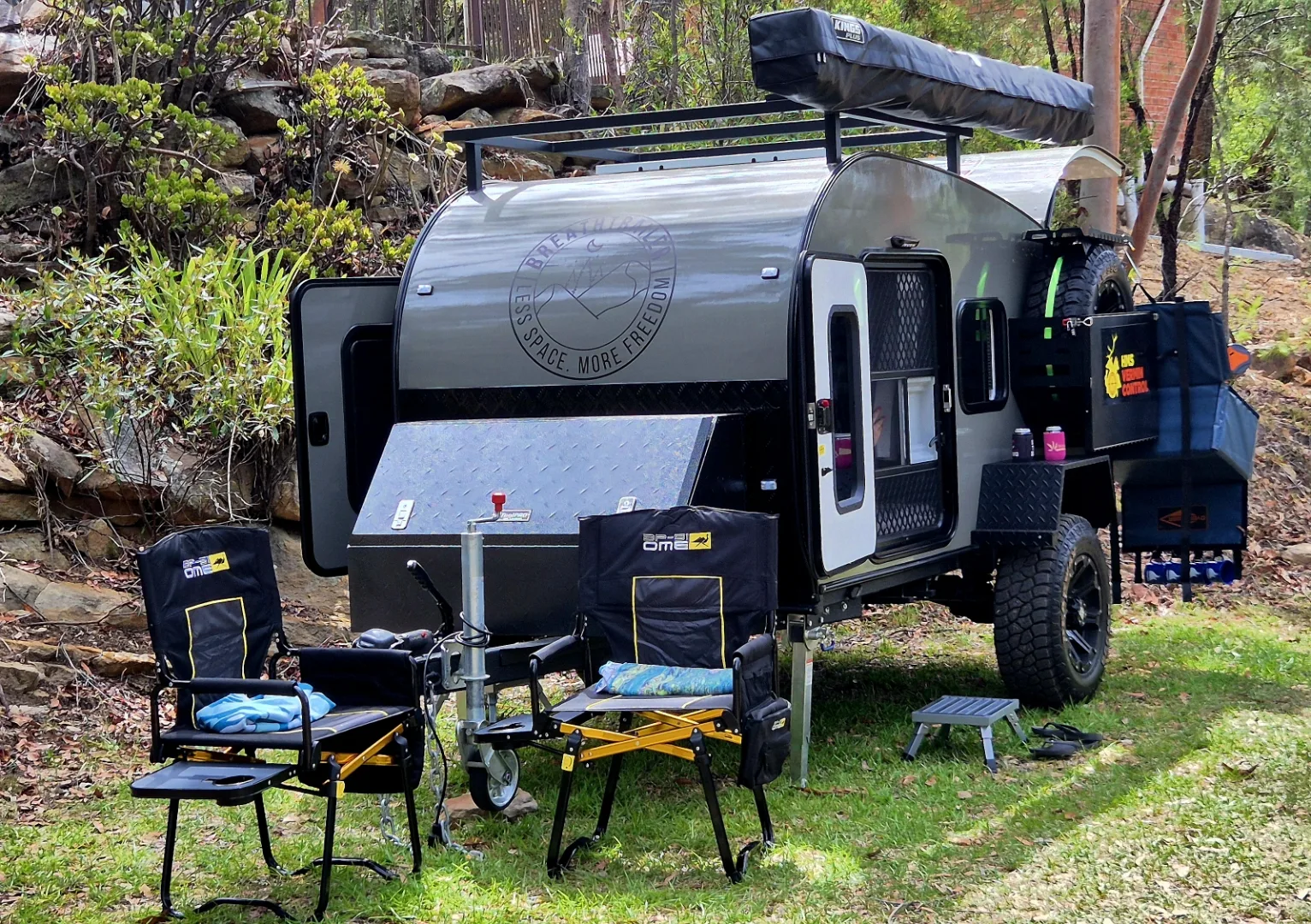
The Australian camper trailer market in 2026 spans everything from $10,000 soft-floor canvas rigs to $120,000+ off-road caravans. Somewhere in that range is the right trailer for your trips. The problem is that most buyers focus on the shiny features — Bluetooth speakers, the fridge brand, the paint colour — and skip the fundamentals that actually determine whether a trailer works for them.
This guide cuts to what matters: towing laws, suspension, weight, off-grid capability, setup time, and budget. Work through each step and you will arrive at a short list of two or three trailers instead of being overwhelmed by the full market. At the end, we explain where hard-shell teardrops fit into this decision and how the four Breath Trailer models map to different buyer profiles.
Know Your Travel Style Before You Start Shopping
Every buying mistake in the camper trailer space comes from the same root cause: buying for a dream trip instead of your actual travel pattern. Before you look at a single brochure, answer these four questions honestly.
Where will you actually go? Sealed roads and powered sites are different from fire-trail national parks or Outback tracks. Your realistic destination mix drives every other decision — chassis, suspension, tyres, and whether you need self-containment.
How often do you camp? A family that camps four weekends a year has very different needs from a couple planning a six-month Big Lap. If you camp infrequently, complexity and maintenance costs matter more. If you camp regularly, comfort per night matters more.
Who camps with you? A couple travelling together can get away with a lot less sleeping space than a family of four. The bathroom decision — no toilet, portable toilet, external shower, or full interior wet bath — changes completely based on who is on the trip.
How long do you stay in one spot? If you move camp every night, a 5-minute setup is worth a lot more than an extra storage drawer. If you set up for three nights at a time, you can tolerate a longer setup in exchange for more living space.
Write down your answers. They become the filter you run every trailer through.
Step 1: Match the Trailer Type to Your Trips
Australia has four main categories of towable camper. Each is a genuine product category with real trade-offs — not just a marketing position.
Soft-Floor Camper Trailers ($10,000–$22,000)
Soft-floor campers fold flat for towing and open into canvas tents with a vinyl floor. They offer the most sleeping and under-canvas living space for the price. The trade-offs: 20–40 minutes to set up, canvas maintenance every 12–24 months (re-proofing, seam sealing), and a mould risk if packed damp. Weight is typically 500–900 kg depending on features. Good for budget buyers who camp regularly and have the time to maintain canvas.
Hard-Floor Forward-Fold Campers ($18,000–$40,000)
Hard-floor trailers fold open so the trailer’s steel roof becomes the tent floor. Setup is faster than soft-floor — typically 10–25 minutes — and the floor stays dry. They weigh more than soft-floor equivalents at the same price point. The tent canvas still requires periodic maintenance. Good for families who want real sleeping space and don’t mind a moderate setup routine.
Hard-Shell Teardrop Campers ($19,990–$50,000+)
Teardrop campers are factory-enclosed, rigid-shell trailers. The bedroom and galley are permanently inside the trailer. Setup is 5 minutes or less — level the trailer, drop the stabiliser legs, open the rear galley hatch. No canvas to pitch, no poles, no guy ropes. The shell is completely weatherproof in any conditions. The trade-off is sleeping capacity (most models sleep two) and less under-canvas social space. Weight ranges from 700 kg to 1,200 kg for the premium models with bathrooms. Good for couples, solo travellers, retirees, and anyone who wants a fast, reliable setup with no maintenance overhead.
Off-Road Hybrid Caravans ($40,000–$120,000+)
Hybrid caravans combine a rigid A-frame nose with canvas walls. They offer real living space — lounge, kitchen, sometimes a bathroom — at lower towing weight than a full caravan. Price climbs quickly when you add a bathroom and serious off-road running gear. Suited to long-trip travellers who want caravan amenity without a full-size caravan’s towing demands.
Which Type Fits Your Answers?
| Travel profile | Best fit |
|---|---|
| Weekend escapes, budget buyer | Soft-floor or entry teardrop |
| Families of 3–4 with kids | Hard-floor forward-fold or caravan |
| Couple, frequent camper | Hard-shell teardrop or hybrid caravan |
| Solo traveller | Lightweight teardrop (Essential or Plus) |
| Big Lap, free camping needed | Self-contained teardrop or hybrid caravan |
| Serious 4WD off-road tracks | Off-road rated teardrop or hybrid caravan |
Step 2: Understand Australian Towing Rules
This step is not optional. Getting the weight wrong is how you get fines at highway weigh bridges, void your vehicle insurance, or — more seriously — cause a towing accident.
The numbers you must know
Tare weight: the trailer’s weight as it leaves the factory with standard equipment, no water, no gear.
ATM (Aggregate Trailer Mass): the maximum the trailer can legally weigh when loaded, including all gear, water, and food. This is the weight that determines whether you need electric brakes.
Towing capacity: your vehicle’s maximum braked towing rating as specified by the manufacturer. Check the tow bar rating separately — sometimes it is lower than the vehicle’s rated capacity.
Towball download: the downward force the trailer’s A-frame puts on your towball, typically 10–15% of ATM. This reduces your vehicle’s payload capacity.
GCM (Gross Combination Mass): the maximum legal weight of your tow vehicle plus trailer, fully loaded. Your specific vehicle’s GCM is on the vehicle compliance plate in the door jamb.
The 750 kg rule
In every Australian state and territory, if a trailer’s ATM exceeds 750 kg, the trailer must have electric brakes and your tow vehicle must have an electric brake controller fitted. Most camper trailers above entry level exceed 750 kg ATM. Budget around $300–$500 for a quality brake controller (Redarc Tow-Pro is the Australian standard) if your vehicle does not already have one.
Popular tow vehicles and their rated capacities
| Vehicle | Braked towing (kg) | Notes |
|---|---|---|
| Toyota LandCruiser 300 Series | 3,500 | Best in class for heavy trailers |
| Toyota HiLux SR5 (2026) | 3,500 | Dual-cab ute, strong tow |
| Ford Ranger XLT (2026) | 3,500 | Popular Breath Trailer tow vehicle |
| Mazda CX-5 Akera (2.5T) | 2,000 | Suits Essential/Plus well |
| Mitsubishi Outlander (2026) | 2,000 | Good mid-size option |
| Kia Sorento AWD (2026) | 2,000 | Comfortable for lighter teardrops |
| Subaru Outback (2.5i) | 1,800 | Suits Essential only (700 kg ATM) |
| Toyota RAV4 Hybrid | 1,500–1,650 | Suits Essential with margin |
| Honda CR-V (2026) | 1,500 | Minimum for any loaded trailer |
Rule of thumb: keep your loaded trailer weight below 85% of your vehicle’s maximum tow rating. This gives you a handling buffer and accounts for weight added during the trip. If you are towing near your vehicle’s limit, fit upgraded suspension (Dobinsons, Old Man Emu) to manage towball download on the rear axle.
For a deep dive on towing maths, see our Camper Trailer Towing Guide Australia and Teardrop Camper Weight Guide.
Step 3: Choose the Right Chassis and Suspension
The chassis and suspension determine whether your trailer survives — and whether your tow vehicle survives — on the tracks you want to take. Do not be distracted by interior upgrades on a chassis that cannot handle corrugated dirt roads.
Chassis construction
Hot-dip galvanised steel is the gold standard for Australian conditions. The zinc coating penetrates the entire steel section and protects against rust after scratches and impacts. Pre-galvanised or “Duragal” product that has been cut and welded after galvanising exposes raw steel at every weld — not suitable for extended off-road use in coastal or wet environments.
Powder-coated steel is common and acceptable for on-road and light off-road use, but requires inspection of welds for chipping and rust every 12 months in coastal environments.
Alloy (aluminium) frames save weight but are harder to repair on the road. Look for proper alloy-to-alloy welding and marine-grade (6061 or 5052) specification.
Suspension types compared
| Suspension | Off-road articulation | Load capacity | Ride quality | Repairability |
|---|---|---|---|---|
| Single-leaf spring | Poor | High | Harsh | Easy |
| Multi-leaf spring | Poor–moderate | High | Moderate | Easy |
| Independent trailing arm (coil) | Excellent | Moderate | Smooth | Moderate |
| Independent trailing arm (airbag) | Excellent | Adjustable | Very smooth | Complex |
| Solid axle (coil-spring parabolic) | Good | High | Moderate | Easy |
For genuine off-road use on corrugated tracks and rocky terrain, independent coil-spring suspension is the preferred choice in Australia. Each wheel moves independently, which means when one wheel drops into a pothole, the other maintains ground contact and the trailer body does not tip. Trailing arm geometry also keeps the wheels planted and reduces sway. Look for fully serviceable shocks with grease points you can access without removing the wheel.
Leaf springs are still common and work well on smoother off-road terrain. If you are staying on graded dirt roads and occasional rough tracks, a quality leaf-spring setup with good shock absorbers is adequate and far cheaper to service or repair in a remote area.
Clearance and recovery hardware
Ground clearance matters on rocky terrain. Look for a minimum 250 mm clearance under the axle. Check that the spare tyre is mounted in a position that does not reduce approach or departure angle. For serious 4WD tracks, a full-size spare (matching your road tyres) mounted externally is essential — not an underslung compact spare.
Step 4: Assess Off-Grid Power and Water Capability
Most of the best campsites in Australia are unpowered. If you want genuine camping freedom — national parks, station camping, remote beaches — your camper needs to run independently of mains power and water.
Battery and solar baseline
A realistic weekend camping load for two people (12V fridge, LED lighting, phone charging, water pump) runs at approximately 40–60 Ah per day. A 100 Ah lithium battery covers two days of this load without any solar input. Add 200W of solar and you have an indefinite energy supply in most Australian conditions except Tasmania in winter.
Lithium vs AGM: lithium costs 2–3× more upfront but delivers roughly double the usable capacity (80–90% vs 40–50% for AGM), weighs half as much, and lasts 3–4× longer. For a new trailer, lithium is almost always the right choice on a 5-year cost basis. For a budget purchase, AGM is acceptable if you camp no more than two or three days in a row. See our detailed Off-Grid Teardrop Camper Power Guide for the full analysis.
Water capacity
A practical rule is 20 L per person per day for cooking, drinking, and basic hygiene. A couple on a long weekend needs 80–100 L minimum; a week requires 200 L. Look for food-grade polyethylene tanks mounted low in the chassis (keeps centre of gravity down), with a manual fill port, 12V pump, and a gravity-fed backup tap.
If you plan to apply for self-containment certification (CMCA or state equivalent) for free camping on public land, a grey water containment tank is required. The most commonly self-contained teardrop in Australia is the Breath Max, which carries 60 L fresh water, 35 L grey water, and holds a CMCA certification.
Step 5: Think About Setup Time (and Who’s Setting It Up)
Setup time is one of the most underestimated factors in camper trailer satisfaction. You do not appreciate the difference between a 5-minute and a 35-minute setup until you arrive at a campsite at dusk after seven hours of driving with hungry kids in the back.
Realistic setup times by type
| Trailer type | Setup time (typical) | Packdown time |
|---|---|---|
| Hard-shell teardrop | 3–7 minutes | 5–10 minutes |
| Hybrid caravan / air-pole | 5–12 minutes | 8–15 minutes |
| Hard-floor forward-fold | 15–25 minutes | 20–30 minutes |
| Soft-floor canvas (small) | 20–35 minutes | 25–40 minutes |
| Soft-floor canvas (large / annexe) | 40–60+ minutes | 45–70 minutes |
Setup time matters most for:
- Frequent movers (changing campsites every night on a long trip)
- Solo travellers (no second pair of hands for canvas poles)
- Retirees who want to minimise heavy lifting and overhead work
- Anyone arriving after dark — a complicated setup in the dark is miserable
For a solo buyer or a couple who moves camp regularly, a hard-shell teardrop’s setup time is a genuine quality-of-life upgrade that compounds over hundreds of camps.
Step 6: Budget Honestly — Purchase Price is Not the Whole Story
The sticker price is where most buyers focus. The smarter analysis is 5-year total cost of ownership (TCO), which includes purchase price, depreciation, ongoing maintenance, insurance, and registration.
2026 Australian market — price ranges by category
| Category | Price range | Examples |
|---|---|---|
| Budget soft-floor camper | $10,000–$18,000 | Blue Tongue Trekka $17,990, Outback Off Road $18,950 |
| Mid-range hard-floor | $22,000–$40,000 | Austrack range, Jayco Swan Outback $39,990 |
| Entry teardrop | $19,990 | Breath Essential |
| Mid teardrop | $25,740–$30,290 | Breath Plus / Breath Ultra |
| Premium teardrop (with bathroom) | $39,000 | Breath Max |
| Hybrid caravan | $40,000–$65,000 | Conqueror, AOR models |
| Premium off-road caravan | $80,000–$120,000+ | Patriot Campers X1, Track Trailer Tvan |
The hidden costs that change the equation
Canvas maintenance: a soft-floor or hard-floor canvas trailer requires annual re-proofing and periodic seam sealing. Expect $200–$500 per year in products and professional treatment, or several hours of DIY time.
Depreciation: quality hard-shell teardrops depreciate slowly — roughly 5–8% per year in the current Australian market, which translates to 60–75% retained value after five years. Entry-level soft-floor trailers depreciate faster and are harder to sell used. See our Teardrop Camper Resale Value Australia analysis for specific year-by-year data.
Insurance: an agreed-value policy for a teardrop in the $20,000–$40,000 range typically costs $250–$600 per year in Australia. Full cost breakdown in our Teardrop Camper Insurance Guide.
Accessories: budget $1,000–$4,000 for essential accessories (awning, levelling blocks, towing accessories, PLB). Many teardrop buyers buy fewer accessories because solar, fridge, water tanks, and kitchen are already included.
Tow vehicle modifications: if your vehicle needs electric brake controller, suspension upgrade, or a tow bar — factor this in before finalising your budget. A brake controller and tow bar fit runs $600–$1,500 at most 4WD specialists.
Step 7: Ask the Right Questions Before You Sign
Once you have a short list, these are the questions that separate a genuine purchase from a regret:
-
What is the actual tare weight? Ask the dealer to show you the compliance plate. Tare weight inflation is common in the industry. If the number seems low for the features listed, ask for an independent weigh-bridge certificate.
-
Can one person set it up and pack it down? Test this on a demo model. What sounds easy in a showroom can be genuinely difficult solo in the dark or in wind.
-
What happens if something breaks in the field? Ask about the warranty (what is and is not covered), the service network, and whether the trailer uses standard hardware you can source at any rural auto parts store, or proprietary fittings that require a factory visit.
-
What is the lead time? In 2026, quality Australian-made camper trailers typically run 3–6 months from deposit to delivery. If a dealer can get you a trailer in four weeks, ask why — it is usually because they are selling ex-floor stock with compromises or they are a high-volume importer with lower build quality.
-
What is included in the price? An honest “drive-away” price includes registration, spare wheel, tyre, and all safety equipment. A low headline price with a list of $5,000 in options is not competitive.
-
Who is the manufacturer, and are they Australian-based? Post-sale service for a Chinese-manufactured trailer sold through a third-party importer is a known pain point in Australia. Manufacturers with a Sydney, Melbourne, or Brisbane service centre can resolve issues without a three-month wait and international shipping.
Hard-Shell Teardrop vs Canvas Camper: The 2026 Decision
The most common fence-sitting decision in the Australian market is between a hard-floor canvas camper and a hard-shell teardrop at a similar price point ($25,000–$35,000). Here is the honest comparison.
| Factor | Hard-floor canvas ($25–35k) | Hard-shell teardrop ($25–30k) |
|---|---|---|
| Setup time | 15–25 min | 3–7 min |
| Sleeping capacity | 2–4 (annexe option) | 2 |
| Under-canvas living space | Good (annexe available) | Limited to rear galley area |
| All-weather performance | Good (quality canvas) | Excellent (fully enclosed) |
| Canvas maintenance | Annual re-proof, seam seal | None |
| Storage accessible while towing | Limited | Full rear galley while parked |
| Towing weight (same budget) | Similar | Typically lighter |
| Bathroom option | Aftermarket only | Yes (Max model, under $50k) |
| 5-year depreciation | Higher | Lower |
The canvas camp wins on sleeping and social space. The teardrop wins on everything else. If you are travelling as a couple and you value fast setup, weather security, and low maintenance, the teardrop is the better product. If you regularly camp with four people or want the under-canvas social space, the forward-fold canvas is worth the trade-offs.
For a detailed head-to-head analysis, see Teardrop Camper vs Camper Trailer Australia.
The Breath Trailer Range: How Each Model Fits Your Needs
Breath Trailer manufactures four hard-shell teardrop models in Sydney, all designed for Australian conditions. Here is how they map to the buyer profiles in this guide.
| Model | Price | Tare | Best for |
|---|---|---|---|
| Essential | $19,990 | 700 kg | First-time buyers, light tow vehicles (RAV4, CR-V), tight budget |
| Plus | $25,740 | 800 kg | Couples wanting a fridge and full kitchen standard, most SUVs |
| Ultra | $30,290 | 900 kg | Couples who want an external shower + more storage, medium-weight SUVs |
| Max | $39,000 | 1,200 kg | Couples or families needing a full interior bathroom, Big Lap, self-containment |
Essential: At 700 kg ATM, the Essential is towable by virtually any SUV sold in Australia, including the Toyota RAV4 Hybrid (1,500 kg rated). It includes a queen bed, rear galley kitchen, and basic 12V setup. The bathroom question is deferred — most buyers choose the Essential for weekend trips where powered sites are available.
Plus: The Plus adds a standard KICKASS 60 L fridge and a more complete off-grid setup. At 800 kg, it still suits most SUVs. For couples who camp 10–20 nights per year on mixed powered and unpowered sites, it represents the best price-to-capability ratio in the range.
Ultra: The Ultra’s external shower changes the game for off-grid hygiene without interior plumbing. Couples who want a private outdoor rinse after beach camping or dusty outback tracks — without committing to a full internal wet bath — choose this model. It suits the same SUVs as the Plus with appropriate suspension.
Max: The Breath Max is the only teardrop on the Australian market under $50,000 with a full interior bathroom — toilet, vanity, and a separate shower with 2.1 m standing headroom. At 1,200 kg, it requires a capable tow vehicle (HiLux, Ranger, LandCruiser, Prado, or GVM-upgraded mid-size SUV). If the bathroom is your non-negotiable — for retirees, families with children, or travellers who want CMCA self-containment certification — the Max is the correct choice and it costs roughly $30,000 less than the next cheapest teardrop with an interior bathroom in Australia.
Compare all four models side-by-side on the Breath Trailer comparison page.
5 Mistakes to Avoid When Buying a Camper Trailer
1. Trusting the manufacturer’s tare weight without verification. Weight inflation is endemic in the Australian industry. Always check the compliance plate on the physical trailer and, for used purchases, get it weighed at a public weigh bridge before signing.
2. Buying for a once-in-a-decade trip instead of your regular trips. The Cape York rig bought for a future adventure that never happens, while you spend every summer on sealed roads to national parks. Buy for how you actually camp, not how you imagine you might camp.
3. Ignoring the service network. A $5,000 import bargain with no local service centre becomes a major problem when a wheel bearing fails 800 km from the nearest city. Ask where you take it for warranty work and annual servicing.
4. Underestimating the tow vehicle bill. Check your vehicle’s actual rated capacity against the trailer’s ATM loaded. A towbar ($600), brake controller ($400), and suspension upgrade ($800–$1,500) can add $2,000 to your real purchase cost on top of the trailer price.
5. Skipping the demo setup. Always set up and pack down a demo model before you buy. Features that sound simple in a brochure can be awkward in real conditions. A hard-shell teardrop’s five-minute setup is obvious after one demonstration — and that experience alone converts many canvas buyers.
FAQ
What is the best off-road camper trailer for a family of four in Australia?
A hard-floor forward-fold camper with an annexe or a hybrid caravan suits a family of four best — the teardrop category genuinely sleeps two adults comfortably, and adding children requires either an annexe tent alongside the trailer or stepping up to the Breath Max (which has the interior space and bathroom). Most families of four with children opt for a mid-range forward-fold in the $25,000–$40,000 range or a hybrid caravan above $40,000.
Do I need electric brakes on my camper trailer?
Yes, if the trailer’s ATM exceeds 750 kg — which covers most camper trailers sold in Australia above entry level. You also need an electric brake controller fitted to your tow vehicle. This is a legal requirement in every Australian state. Budget $300–$500 for a quality controller (Redarc Tow-Pro is the most popular).
How much should I budget for a decent off-road camper trailer in Australia?
A quality off-road capable camper trailer starts at around $20,000 for a hard-shell teardrop (Breath Essential) or soft-floor canvas camper. A mid-range setup with fridge, solar, lithium battery, and external shower runs $25,000–$35,000. For a full bathroom, expect $39,000–$65,000 depending on type. See our Teardrop Camper Cost Australia page for a full price breakdown.
Is a teardrop camper suitable for off-road tracks?
Yes, with the right model. Breath Trailer teardrops run independent coil-spring suspension with 265 mm all-terrain tyres and a galvanised chassis — rated for corrugated outback roads and light 4WD tracks. They are not built for extreme rock-crawling (articulation is less than a purpose-built off-road hybrid caravan), but they handle the vast majority of Australian off-road campsites comfortably. Read our full Off-Road Teardrop Camper Australia Guide for track-specific details.
What is the easiest camper trailer to tow in Australia?
Lightweight, low-profile trailers with a short wheelbase and proper weight distribution are easiest to tow. Hard-shell teardrops in the 700–900 kg range are consistently rated as the most stable and easiest to manoeuvre. The Breath Essential at 700 kg tows behind a standard SUV with almost no perceptible trailer effect at highway speed.
Should I buy new or used?
New gives you manufacturer warranty, known service history, and current safety certification. Used can save 20–40% on purchase price. For used camper trailers, always verify the compliance plate weight, have it independently weighed, inspect every water seal, and check the canvas (if any) for mould and UV damage. A weigh-bridge inspection costs $30–$60 and is always worth it.
Conclusion
Choosing the right off-road camper trailer comes down to five variables: your travel style, your tow vehicle’s actual rated capacity, the chassis and suspension you need for your tracks, your off-grid requirements, and an honest total budget. Shortlist trailers that satisfy all five, then visit a showroom and do the setup test.
If you camp as a couple, prioritise fast setup, and want low ongoing maintenance with genuine off-road capability, a hard-shell teardrop is the most logical choice in Australia’s 2026 market. The Breath Trailer range covers $19,990 to $39,000 and spans from SUV-friendly weekend trailers to fully self-contained units suitable for the Big Lap.
Book a viewing at a Breath Trailer location to see all four models in person and find the right fit for your trips.
Recommended Reading
- Camper Trailer Towing Guide Australia — GVM, GCM, towball download, brake rules explained
- Teardrop Camper Weight Australia — Tare, ATM, payload explained for every model
- Off-Grid Teardrop Camper Australia — Solar sizing, lithium vs AGM, daily power calculator
- Teardrop Camper vs Camper Trailer Australia — Hard-shell vs canvas head-to-head
- Teardrop Camper Resale Value Australia — 5-year depreciation curves and TCO analysis