Teardrop Camper Resale Value in Australia (2026 Guide)
Depreciation curves by brand and age, and the specification choices buyers pay extra for second-hand.
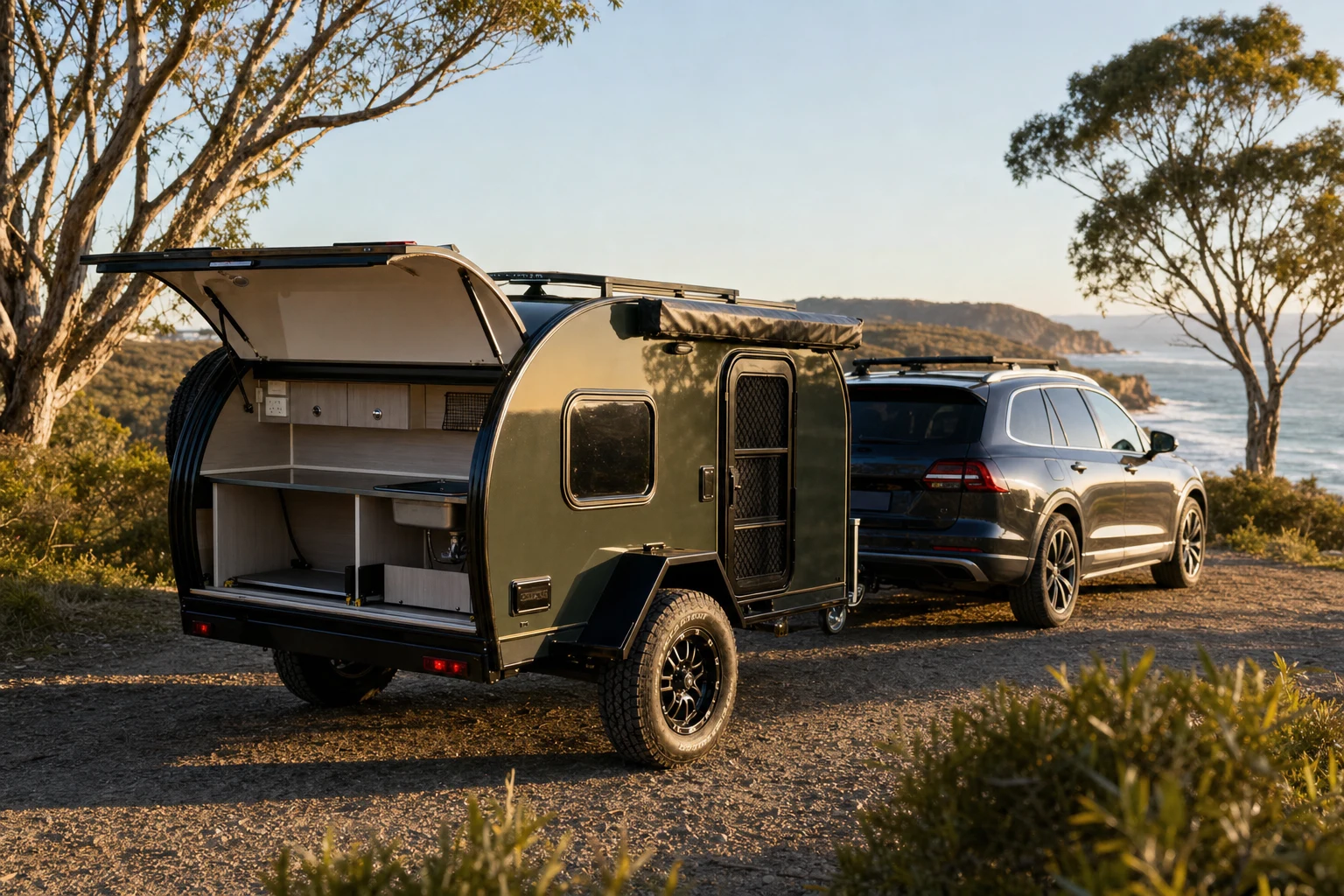
Most people researching a teardrop camper obsess over the purchase price. Far fewer ask the question that actually decides what the camper costs you: how much of that money will you get back when you sell?
Here’s the short answer. In 2026, a well-built teardrop camper in Australia holds its value far better than a full-size caravan. Where a $75,000 caravan can shed around $20,000 in five years, a quality teardrop in the $20,000–$30,000 range typically retains 60–75% of its value over the same period — because it’s simpler, lighter, in shorter supply on the used market, and far cheaper to keep in good condition. Depreciation is the single largest cost of camper ownership, bigger than insurance, rego and servicing combined, and almost nobody factors it in before they buy.
This guide breaks down exactly how teardrop camper resale value works in Australia: real depreciation rates, what used teardrops actually sell for, the factors that protect (or destroy) your resale price, and how the four Breath Trailer models compare. No hype — just the numbers you need to make a smart buying decision.
Why depreciation is the cost nobody talks about
When you sell a camper, the gap between what you paid and what you get back is the real price of ownership. Everything else — insurance, registration, servicing, storage — is small by comparison.
Consider a simple example. You buy a camper for $30,000, use it for five years, then sell it. If it depreciates like a typical caravan and you recover $15,000, the camper cost you $3,000 a year in depreciation alone — before you’ve paid for a single tank of fuel. If instead it holds its value and you recover $22,000, that same camper cost you just $1,600 a year. Same purchase price, very different real cost.
This is why resale value matters more than the sticker price. A cheaper camper that loses value fast can easily cost you more over five years than a more expensive one that holds value. The honest framing isn’t “what does it cost to buy” — it’s “what does it cost to own”.
How fast do campers depreciate in Australia?
Depreciation is steepest in the first year and flattens out after that. The pattern is consistent across the RV market, but the rate varies enormously by category.
The Australian Taxation Office sets a benchmark: caravans depreciate at 16.67% per annum on a straight-line basis, with the heaviest drop just after purchase. Industry data tells a similar story — most RVs lose up to 20% of their value in the first year, then 5–10% per year for the next four to five years.
Here’s how the main camper categories compare in the Australian market:
| Vehicle type | Year 1 loss | Annual loss (yr 2–5) | Value retained at 5 yrs |
|---|---|---|---|
| Full-size caravan | 15–20% | 7–10% | 45–55% |
| Pop-top / hybrid caravan | 12–18% | 6–9% | 50–60% |
| Camper trailer (soft/hard floor) | 10–20% | 5–10% | 50–60% |
| Quality teardrop camper | 8–15% | 4–7% | 60–75% |
| Cheap import teardrop | 20–30% | 10–15% | 30–45% |
The spread within teardrops is the part most buyers miss. A well-built Australian teardrop and a cheap imported one are not the same asset. Build quality, brand reputation, and parts availability separate them sharply on the used market — which is exactly why the brand you buy matters as much as the category.
A worked example: the depreciation curve
Averages are useful, but a year-by-year curve shows where the money actually goes. Here’s a realistic depreciation path for a $25,740 Breath Plus, using the quality-teardrop rates above. The key insight: the steepest fall is in year one, then it flattens fast — which means the longer you keep a good teardrop, the cheaper each year of ownership becomes.
| Age | Estimated value | Value retained | Depreciation that year |
|---|---|---|---|
| New | $25,740 | 100% | — |
| 1 year | $22,400 | 87% | $3,340 |
| 2 years | $21,000 | 82% | $1,400 |
| 3 years | $19,700 | 77% | $1,300 |
| 4 years | $18,600 | 72% | $1,100 |
| 5 years | $17,700 | 69% | $900 |
Over five years that’s roughly $8,000 of total depreciation, or about $1,600 a year averaged out — and falling. Compare that to a $55,000 caravan that drops to 50–60% in the same five years: around $24,000 lost, or $4,800 a year. The teardrop costs a third as much to own, year on year, before you’ve touched fuel or insurance.
Why teardrop campers hold value better than caravans
Teardrops resist depreciation for structural reasons, not luck. Four factors do most of the work.
1. Simplicity means fewer things to age or break. A full-size caravan has a chassis full of plumbing, electrics, slide-outs, awnings and appliances — each a future repair and a reason a buyer haggles. A hard-shell teardrop is a sealed cabin, a galley and a power system. Less to go wrong means less to discount.
2. Light weight keeps the buyer pool huge. A 700–1,200 kg teardrop can be towed by almost any modern SUV, so the resale audience isn’t limited to people who own a LandCruiser. A 2,500 kg caravan needs a serious tow vehicle, which shrinks the buyer pool and softens resale prices. (If towing capacity is on your mind, our camper trailer towing guide and teardrop camper weight guide break down exactly what your car can pull.)
3. Short supply on the used market. Premium teardrops sell in far smaller numbers than mass-market caravans, and owners tend to keep them. That scarcity props up used prices — a buyer who wants a quality second-hand teardrop often can’t find one, so they pay close to new money for a tidy example.
4. Cheaper to keep in resale-ready condition. A teardrop fits in a single garage or under a carport, so it stays out of the weather. UV, hail and damp are what destroy resale value, and a camper you can actually store undercover dodges most of it. Our teardrop camper maintenance guide covers the upkeep that protects your investment.
For the full side-by-side on running costs and ownership, see our honest caravan vs teardrop camper comparison.
What does a used teardrop camper sell for in Australia?
The used teardrop market in 2026 is active and undersupplied. Across Gumtree, caravancampingsales and Facebook buy-and-sell groups, used teardrops generally trade between $10,000 and $30,000, with the average secondhand unit landing around $15,000.
Demand is the reason prices stay firm. Australia’s secondhand teardrop market has grown steadily since the post-pandemic camping boom, and quality used units rarely sit unsold for long. A tidy, well-documented teardrop from a recognised brand often gets snapped up within days of listing — sometimes for close to its original price if the buyer can’t find anything comparable new with a 3–4 month lead time. That scarcity is your friend as a seller and the structural reason teardrops resist depreciation better than the caravans flooding the classifieds.
But that average hides a wide spread driven by build quality and condition:
| Original price band | Typical used price (3–5 yrs old) | Value retained |
|---|---|---|
| Budget import ($12,000–$18,000) | $5,000–$8,000 | 35–45% |
| Mid-range AU-built ($20,000–$26,000) | $14,000–$19,000 | 65–75% |
| Premium AU-built ($30,000–$40,000) | $21,000–$30,000 | 65–78% |
The pattern is clear: cheaper isn’t cheaper. A $15,000 import that resells for $6,000 has cost you $9,000 in depreciation, while a $25,740 Breath Plus that resells for $18,000 has cost you $7,740 — less depreciation in dollars and a far better camper for five years. This is the same logic behind our hire vs buy analysis: the headline number rarely tells you the real cost.
The factors that protect (or destroy) your resale value
Two identical campers bought on the same day can sell for thousands apart five years later. The difference is how they were specced, stored and maintained.
What lifts resale value
- Genuine off-grid capability. A solid solar and lithium setup is the most-wanted feature on the used market — modern power upgrades can add $500–$2,000 to resale. See our off-grid teardrop guide.
- Undercover storage. Campers kept in a garage or under a carport hold 5–10% more value than those left in the weather. Teardrops make this easy.
- Full service history. Receipts for bearing repacks, brake checks and seal inspections reassure buyers and justify your asking price.
- A self-contained build. Onboard water, power and (on the Breath Max) a bathroom widen the buyer pool to free-campers. Our self-contained camper guide explains why.
- Popular, neutral colours and clean presentation. Detailing before sale routinely returns more than it costs.
What destroys resale value
- Water ingress. A leaking seal that rots a floor or cabinet is the single biggest value-killer in any camper. Catch it early.
- Sun and hail damage. Faded decals, crazed clearcoat and dented panels read as neglect.
- Unrepaired off-road damage. Stone chips and bent steps from outback tracks need fixing before sale, not disclosing during it.
- DIY modifications. Amateur wiring and drilled-in “improvements” scare buyers more than they impress them.
- No paperwork. A camper with no service records, no manual and no compliance plate always sells at a discount.
How the four Breath Trailer models hold value
All four Breath Trailer models share the traits that protect resale — Australian hard-shell build, light tow weights, and a brand buyers recognise. Here’s how they sit, with realistic 5-year resale estimates based on current used-market patterns.
| Model | New price (AUD) | Tare weight | Est. 5-yr resale | Value retained | Best for resale because |
|---|---|---|---|---|---|
| Breath Essential | $19,990 | 700 kg | $13,000–$14,500 | 65–72% | Lowest entry price, huge buyer pool |
| Breath Plus | $25,740 | 800 kg | $17,500–$19,000 | 68–74% | Fridge included; the value sweet spot |
| Breath Ultra | $30,290 | 900 kg | $20,500–$23,000 | 68–76% | External shower + off-grid appeal |
| Breath Max | $39,000 | 1,200 kg | $27,000–$30,000 | 69–77% | Only sub-$50k AU teardrop with a full interior bathroom |
The standout is the Breath Max. As the only teardrop on the Australian market under $50,000 with a full interior bathroom and standing height, it has no direct used-market substitute — scarcity is the strongest resale insurance there is. The Breath Plus, meanwhile, hits the $20,000–$25,000 sweet spot where used demand is deepest, which is why it’s one of the easiest models to resell quickly.
A quick caveat: these are estimates based on category trends and current used listings, not guarantees. Condition, kilometres towed, storage and timing all move the final number. But the direction is consistent — a quality Australian teardrop gives back far more of your money than the caravan parked next to it.
Buying for resale: a practical checklist
If resale value matters to you, build it into the purchase decision from day one:
- Buy Australian-built from a known brand. Parts availability and reputation are what hold value on the used market.
- Spec the off-grid gear up front. Solar and lithium are cheaper to fit at purchase than to retrofit, and they pay back at resale.
- Choose neutral, popular colours. Bold one-off finishes narrow your future buyer pool.
- Store it undercover. This single habit protects more value than any other.
- Keep every receipt. A documented service history is worth real money at sale time.
- Don’t over-modify. Reversible, professional upgrades only.
- Sell at the right time. Spring and early summer, before peak camping season, is when used teardrops sell fastest and dearest.
Frequently asked questions
Do teardrop campers hold their value in Australia?
Yes — quality Australian-built teardrops typically retain 60–75% of their value over five years, noticeably better than full-size caravans, which often retain 45–55%. Their simplicity, light weight and short supply on the used market all support resale prices. Cheap imported teardrops are the exception and can lose value as fast as any RV.
How much does a teardrop camper depreciate per year?
A well-built teardrop loses roughly 8–15% in the first year, then 4–7% per year after that. That’s slower than the ATO benchmark of 16.67% per annum for caravans and faster value retention than most camper trailers, which lose 10–20% a year.
What’s a used teardrop camper worth in Australia in 2026?
Used teardrops generally sell for $10,000–$30,000, with the average around $15,000. Premium Australian-built models 3–5 years old commonly fetch $18,000–$30,000 if they’re in good condition with a service history. See our teardrop campers for sale guide for what’s on the market.
Which holds value better — a teardrop or a caravan?
A teardrop, in most cases. Caravans depreciate faster because they’re complex, heavy (which shrinks the buyer pool), and sold in large numbers. Teardrops are simple, light, easy to store undercover, and in short supply secondhand — all of which protect resale value.
Does adding solar and lithium increase resale value?
Yes. Off-grid capability is one of the most-requested features on the used market, and a quality solar-and-lithium setup can add $500–$2,000 to resale value. It’s cheaper to spec at purchase than to retrofit later.
How can I get the most when I sell my teardrop camper?
Store it undercover, keep a full service history, fix water leaks and damage before listing, detail it thoroughly, and sell in spring before peak season. Genuine off-grid gear and a self-contained build also widen your buyer pool and lift the price.
The bottom line
Resale value is the cost most camper buyers never calculate — and the one that hits hardest. A quality Australian teardrop camper holds 60–75% of its value over five years, while the caravan next to it sheds half. Buy a well-built, light, simple camper from a brand buyers recognise; spec it for off-grid; store it undercover; keep your paperwork — and the gap between what you paid and what you get back stays small.
That’s the honest case for a teardrop: not just lower to buy and cheaper to tow, but cheaper to own over its whole life. To see how the four Breath Trailer models stack up on price, weight and features, compare them side by side, or book a viewing to inspect one in person before you decide.
Recommended reading
- Caravan vs Teardrop Camper Australia: The Honest 2026 Comparison — the full ownership-cost breakdown.
- Teardrop Camper Hire vs Buy in Australia — when buying makes financial sense.
- Teardrop Camper Insurance in Australia — protecting the asset you’ll later resell.
- Teardrop Camper Maintenance in Australia — the upkeep that holds value.
- Australian-Made Teardrop Camper: Why It Matters — build quality and resale.