How to Reverse a Camper Trailer in Australia: The Complete 2026 Guide
Step-by-step guide to reversing a camper trailer in Australia: steering techniques, mirror laws, jackknife recovery, technology aids and practice tips for all skill levels.
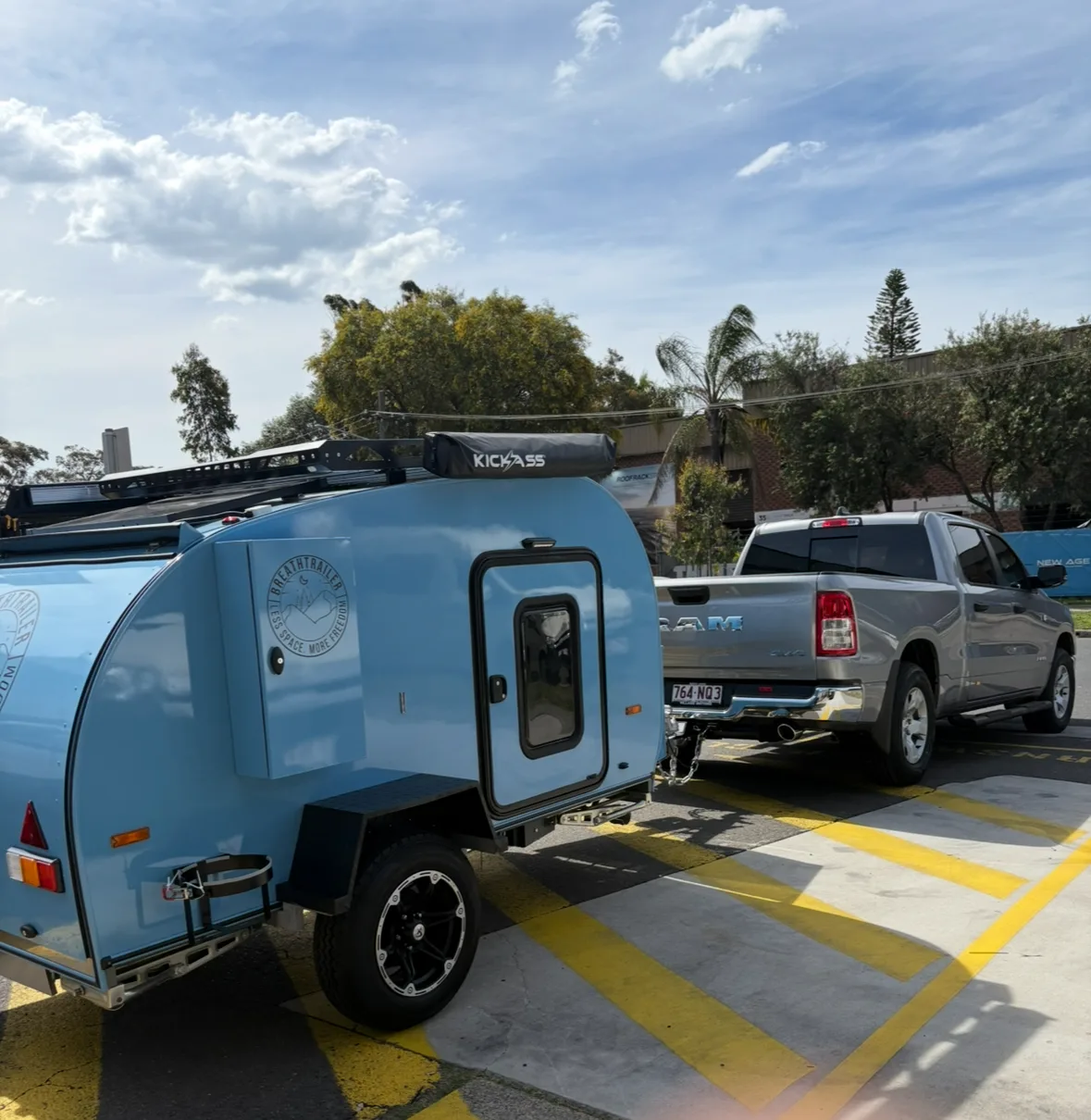
Ask any new camper trailer owner what they’re most nervous about and the answer is almost always the same: reversing. It’s the skill that turns a smooth arrival into a sweaty, ten-point-turn ordeal — and the one most manufacturers never teach you.
The good news? Teardrop campers are among the most forgiving trailers you can tow in Australia. Their compact footprint, low centre of gravity, and single-axle design make them genuinely easier to back into a site than a full-size caravan. In 2026, with a few hours of practice and the right technique, most new owners are confidently reversing into sites within their first trip.
This guide covers everything: the counterintuitive steering logic, the step-by-step technique, Australian mirror laws, how to avoid a jackknife, technology aids, and targeted practice drills. We’ll also flag where teardrop trailers differ from caravans — because the advice you find on caravan forums isn’t always right for your rig.
Why Teardrop Campers Are Easier to Reverse
Before the technique, it helps to understand why your teardrop is already working in your favour.
| Feature | Teardrop camper | Full-size caravan |
|---|---|---|
| Overall length | 3.9–5.05 m | 6–10 m |
| Tare weight | 700–1,200 kg | 1,200–3,000 kg |
| Trailer body width | 1.5–2.1 m | 2.2–2.5 m |
| Axles | Single | Single or tandem |
| Jackknife risk | Lower (shorter coupling distance) | Higher (longer lever arm) |
| Correction time | Faster — errors are smaller | Slower — errors amplify quickly |
| Mirror extenders | Often unnecessary (Essential/Plus/Ultra body = 1.5 m) | Usually required |
The physics matter: a shorter trailer turns in a tighter arc and responds more quickly to steering corrections. An error that takes 15 m to correct in a 9 m caravan takes 4–5 m in a Breath Essential or Plus. That’s the difference between a stressful reversal and a smooth one.
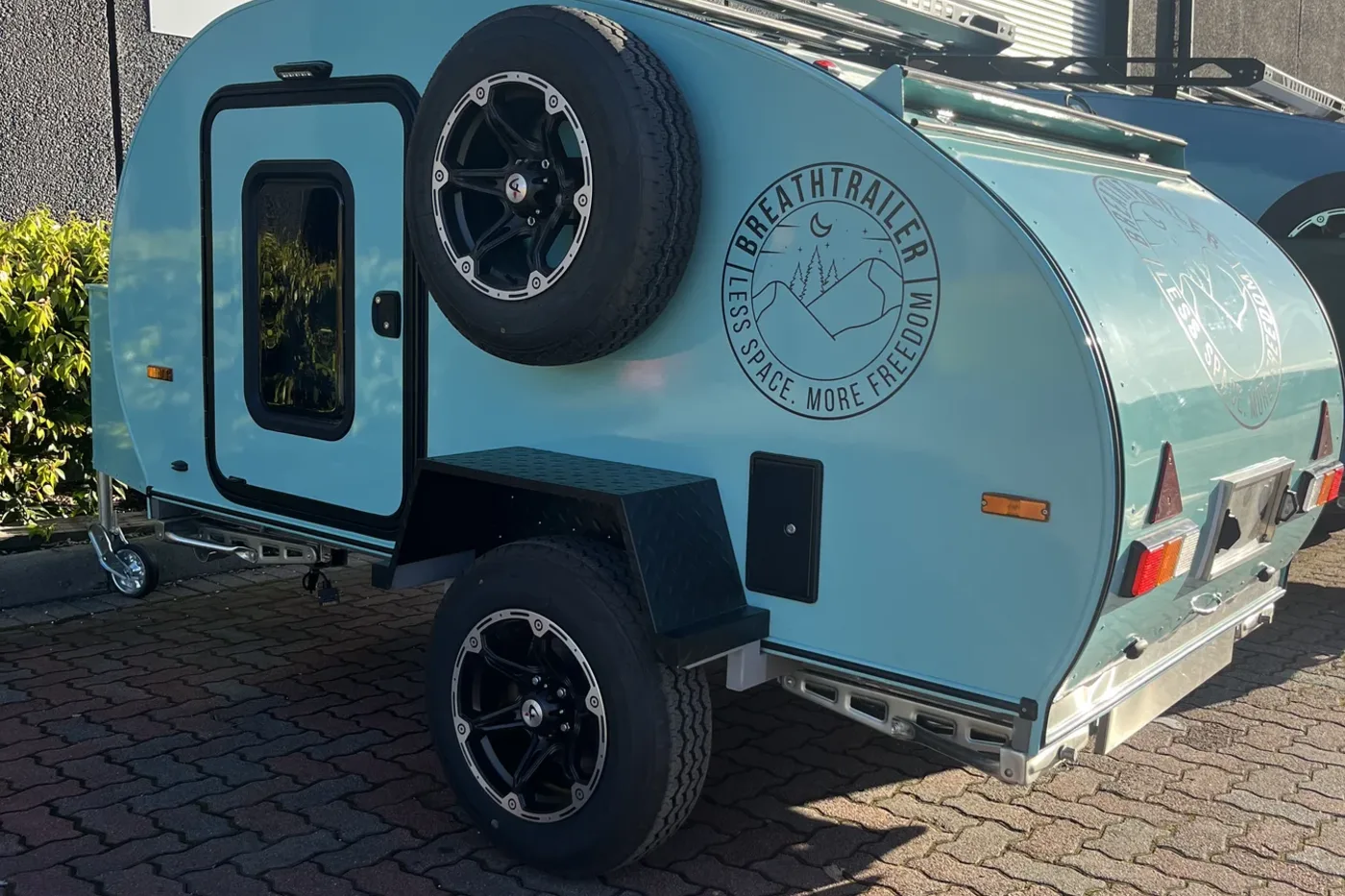
One axle and a short body are why a teardrop answers small steering corrections so quickly.
The Fundamental Challenge: Counterintuitive Steering
The single reason reversing a trailer feels hard is that the trailer moves in the opposite direction to your steering input — at least initially. When you’re driving forward, turning the wheel left moves the front of the car left. When reversing with a trailer, turning the wheel left moves the rear of the car left, which pushes the front of the trailer right.
Most people overcorrect, then overcorrect the overcorrection, and end up in a zigzag across the site.
Two mental models that work:
-
The bottom-of-wheel method (recommended): Place your hand at the very bottom of the steering wheel (the “6 o’clock” position). Move your hand in the direction you want the trailer to go. Hand moves left → trailer goes left. Hand moves right → trailer goes right. This maps naturally because you’re thinking about the trailer, not the car.
-
The mirror rule: Watch the trailer in your side mirrors. If the trailer appears to be drifting left, turn the steering wheel left to bring it back. If it drifts right, turn right.
Either method works — pick one and stick with it. Switching between them mid-reversal is where confusion sets in.
Before You Start: The Pre-Reversing Walk-Around
Never reverse blind. Take 90 seconds to walk around the site before you start.
| What to check | Why it matters |
|---|---|
| Low-hanging branches | A roof rack or awning can catch and tear on branches you didn’t notice |
| Soft ground or ruts | A 700–1,200 kg trailer can sink in soft ground, especially after rain |
| Drainage slopes | A cambered site can pull the trailer sideways under its own weight |
| Utility connections | Water, power, and drain inlets are often not where you expect |
| Neighbouring rigs | Know where the boundary is before you get close to it |
| Exit path | Confirm you can exit forward — never reverse yourself into a dead end |
If you have a spotter, position them at the passenger-side rear corner where they can see both your mirror and the rear of the trailer. Cheap UHF radios ($30–50 at Bunnings) beat yelling across a campsite.
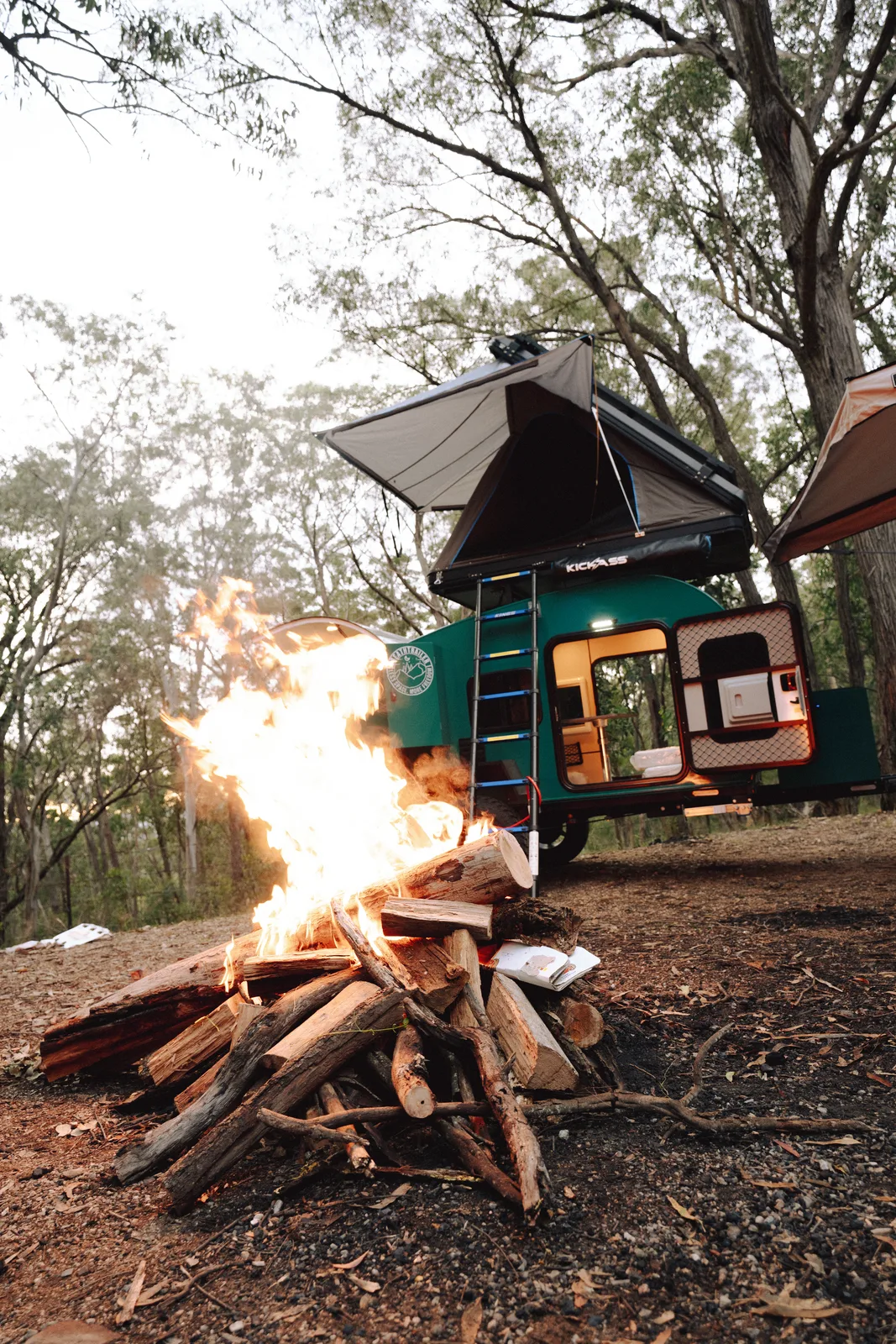
Walk a bush site before you reverse: roots, soft ground and low branches are easier to spot on foot.
Step-by-Step Reversing Technique
1. Set up your approach
Drive past the site, then position the car and trailer in a straight line before you start reversing. A straight setup is 90% of the job done.
- If reversing to the right (driver’s side): approach from the left, so the site is on your right.
- If reversing to the left (passenger’s side): approach from the right, so the site is on your left.
In Australia, reversing to the right is generally easier because you’re on the right side of the vehicle and have a direct line of sight through the driver’s window, not just mirrors.
2. Check your mirrors
Before moving, adjust your side mirrors so you can see the full length of the trailer in each. You should be able to see the rear corners clearly. If you can’t, adjust the mirrors now — not while reversing.
3. Move slowly
Shift into reverse and move at walking pace or slower. The slower you go, the more time you have to spot and correct an error. If you’re moving too fast to correct before it becomes a problem, you’re moving too fast.
4. Start the turn
Using the bottom-of-wheel method: place your hand at 6 o’clock and move it in the direction you want the trailer to go. Make small inputs — a 10–20° movement is usually enough to start the trailer tracking.
5. Correct early and often
Watch both mirrors simultaneously. The moment you see the trailer start to deviate from your target line, correct immediately with a small opposite input. Small early corrections beat large late corrections every time.
6. Straighten and re-approach if needed
If the trailer gets more than 30° off-line, don’t try to recover from reverse. Pull forward in a straight line to realign the rig, reassess, and go again. Two calm attempts beat one frantic one.
7. Stop, check, and finish
When the trailer is two car-lengths from its final position, stop and walk around again. Confirm clearances, then complete the reversal.
Mirror Requirements: What Australian Law Requires
Australian road rules require you to have an unobstructed view of at least 20 metres behind the full width of your trailer. If your standard side mirrors don’t cover the trailer’s full width, extended towing mirrors are legally required.
| Model | Body width | Overall width | Standard mirrors likely sufficient? |
|---|---|---|---|
| Breath Essential | 1,500 mm | 2,000 mm | Yes — body is narrower than most SUVs |
| Breath Plus | 1,500 mm | 2,000 mm | Yes — body is narrower than most SUVs |
| Breath Ultra | 1,500 mm | 2,000 mm | Yes — body is narrower than most SUVs |
| Breath Max | 2,000 mm | 2,100 mm | Check — wider than some SUVs; verify against your specific vehicle |
Even where extenders are not legally required, they’re strongly recommended. They eliminate blind spots and make reversing dramatically easier.
Key Australian mirror rules:
- Extended mirrors must fold inward within 150 mm beyond the widest point of the tow vehicle when the trailer is disconnected. Failing to fold them in when unhitched can result in a fine.
- Reversing cameras do not replace the mirror requirement under Australian road rules. You must still have adequate mirror coverage.
- State enforcement varies, but the underlying requirement is consistent across all states and territories.
Jackknife: What It Is, How to Avoid It, and How to Recover
A jackknife occurs when the trailer folds sharply back against the tow vehicle — usually because the driver turned too sharply too quickly while reversing. It can damage the coupling, the rear of the vehicle, and anything nearby.
Why teardrop campers are lower risk: the shorter coupling distance between the tow ball and the trailer’s axle means the jackknife angle is reached at a sharper input. You’ll run out of road before you run out of turning room in a short trailer.
How to avoid it:
- Make steering inputs gradually, never suddenly
- If you can see the trailer approaching a 90° angle with the tow vehicle in your mirrors, stop
- Never try to “power through” a tight jackknife angle — the coupling will fail before the physics do
If you’re heading toward a jackknife:
- Stop immediately
- Pull forward in a straight line to realign
- Re-approach from scratch
Pulling forward always resets the geometry. There is no situation where continuing to reverse in the same direction makes a jackknife better.
Technology Aids: Backup Cameras, Sensors, and Apps
Technology has made reversing significantly less stressful. None of these replace technique — but they reduce the cost of learning.
| Technology | How it helps | Price range (2026) | Best for |
|---|---|---|---|
| Wired reversing camera | Live feed of rear trailer from cabin screen | $150–400 installed | Frequent tourers, reliable in dust and vibration |
| Wireless reversing camera | Same feed, no cable run | $100–350 | Occasional tourers, easier install |
| Reversing sensors (ultrasonic) | Audio/visual alerts as you approach obstacles | $80–250 | Low-clearance sites, tight parks |
| Observation mirrors (wide-angle) | Larger convex mirror on trailer rear gives wide view | $20–60 | Budget-friendly blind-spot reduction |
| Spotter app (UHF radio) | Voice comms with spotter, no hand signals | $30–50 (radios) | All skill levels; highly recommended |
Note for teardrop campers: because the Essential, Plus, and Ultra body is only 1.5 m wide — often narrower than the tow vehicle — a rear camera gives a useful view even on the standard wing mirrors. The Max, at 2.1 m overall width, benefits most from a camera that shows the rear corners.
IP-rated cameras (IP67 or higher) are essential for Australian conditions — dust on outback tracks and immersion during creek crossings will kill unrated units within a season.
Reversing in Different Scenarios
Not all reversals are equal. These are the four situations that catch new towers out:
Caravan park powered site: Most sites are designed for a forward pull-in, but some reward the patient reverser. Check whether the power outlet is on the left or right — you’ll want it within cord reach. Identify the concrete pad early; lining up on it before you’re within 5 m is much easier than nudging while watching four tyres simultaneously.
Bush campsite: Uneven ground, roots, and soft patches make bush reversals slower and more deliberate. Always walk the site first. Use two spotters if you have them — one each side.
Tight driveway at home: The hardest reversal you’ll do is often backing into your own driveway. Practice at a caravan park first. Know your turning circle with the trailer attached before you attempt a narrow residential entry.
Garage storage: The Breath Essential, Plus, and Ultra (3,900 mm) fit a standard single-car garage. The Max (5,050 mm long, 2,460 mm high) needs a deep garage with a door taller than 2.4 m — measure before you buy. Take your time, use a camera or spotter, and consider installing guide marks (paint or tape on the floor) so you have a repeatable target.

A short, single-axle teardrop is far easier to line up with a garage door than a full-length van.
Common Mistakes and How to Fix Them
| Mistake | What happens | Fix |
|---|---|---|
| Moving too fast | Corrections arrive too late | Walk pace or slower — always |
| Large steering inputs | Trailer overreacts, jackknife risk | Small inputs, wait for the trailer to respond |
| Watching the car, not the trailer | You solve the car’s position, not the trailer’s | Eyes on the trailer in mirrors, always |
| Not walking the site first | Hidden obstacles hit without warning | 90-second walk-around is non-negotiable |
| Persisting when misaligned | Digs the hole deeper | Pull forward and reset — never a defeat |
| Spotter on the wrong side | Communication breaks down when you can’t see them | Spotter always on driver’s side or visible in mirror |
| Mirrors not adjusted | Blind spots at critical moment | Adjust before moving, check both mirrors show rear corners |
| Practicing on hard runs | Confidence never builds | Start with big, empty, forgiving sites |
Building Confidence: Where and How to Practice
The single best thing you can do before your first campsite reversal is practice somewhere the stakes are low.
Best practice locations:
- Empty car parks (Sunday morning at a shopping centre)
- Your driveway, repeatedly, until it’s automatic
- A quiet industrial estate road
- A private paddock if you have access
Structured drill:
- Place four markers (witches’ hats, buckets, or cones) in a rectangle the size of your target site
- Reverse into the rectangle until you can do it in two attempts or fewer, every time
- Repeat with a tighter rectangle
- Add a time limit when accuracy is consistent
The 15-minute rule: Most first-time towers go from anxious to competent in about 15 minutes of focused practice. The technique is genuinely simple — the only reason it feels hard is that you’ve never done it before. After your first trip, it stops feeling like a problem.
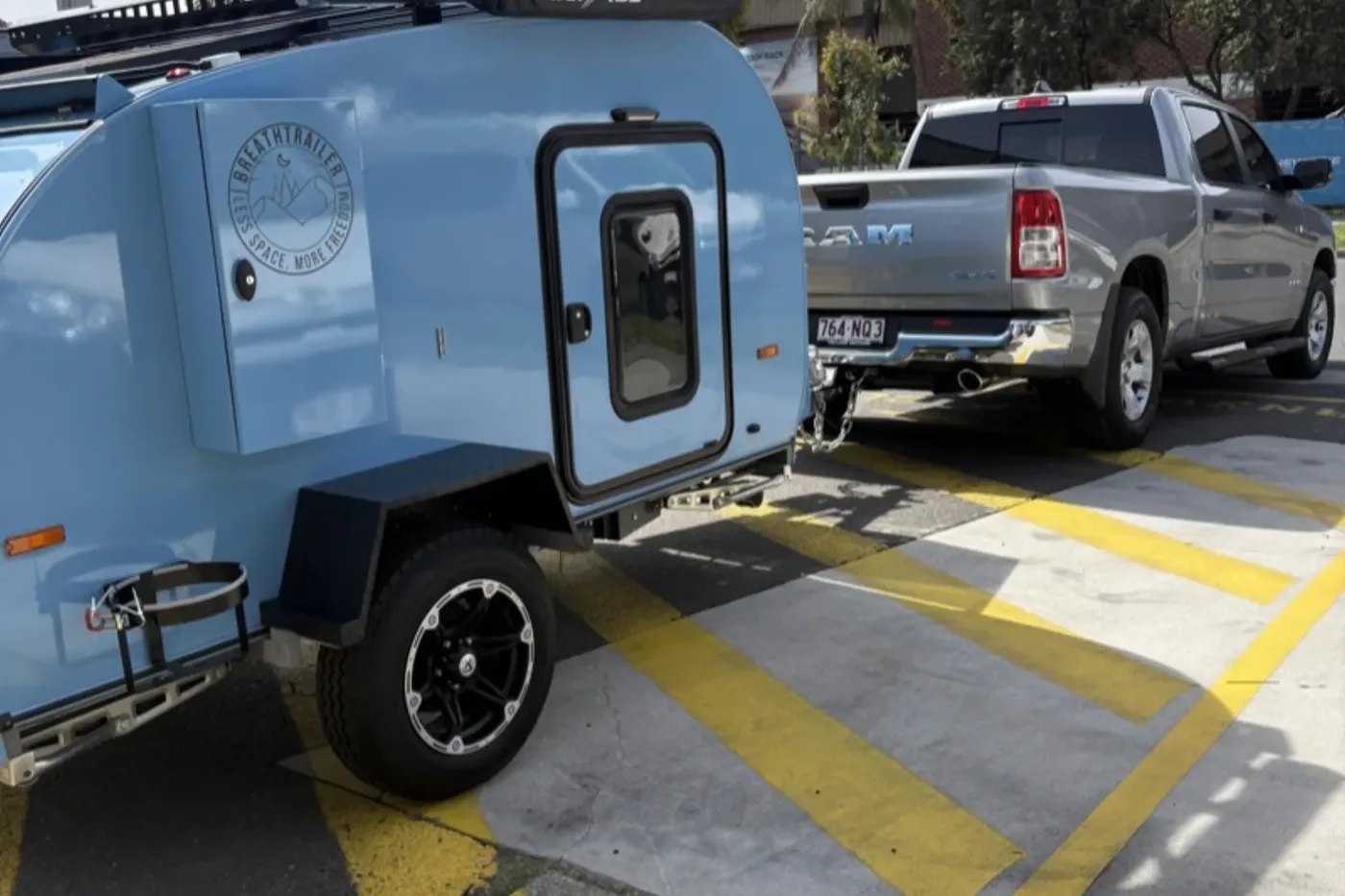
An empty car park with marked bays is the low-stakes place to practise before a real campsite.
Breath Trailer Model Reversing Reference
| Model | Tare weight | ATM | Overall length | Overall width | Mirror extenders needed? | Notes |
|---|---|---|---|---|---|---|
| Essential | 700 kg | 1,500 kg | 3,900 mm | 2,000 mm | Unlikely (body 1,500 mm) | Most forgiving to reverse; fits most sites |
| Plus | 800 kg | 1,500 kg | 3,900 mm | 2,000 mm | Unlikely (body 1,500 mm) | Same footprint as Essential |
| Ultra | 900 kg | 1,500 kg | 3,900 mm | 2,000 mm | Unlikely (body 1,500 mm) | Roof rack + awning don’t change reversing footprint |
| Max | 1,200 kg | 1,700 kg | 5,050 mm | 2,100 mm | Check against your SUV | 1,150 mm longer than other models; extra care at tight ends |
All four models use a single-axle design, which responds faster to steering corrections than dual-axle setups. The DO35-compatible coupling on the off-road upgrade package also allows articulation that reduces jackknife risk on uneven terrain.
See our towing tips guide for pre-departure hitching, speed limits, and load distribution — all of which affect how your trailer tracks while reversing.
For more on the weight implications of each model, see teardrop camper weight Australia.
FAQ
How long does it take to get good at reversing a camper trailer?
Most people are competent after one focused practice session of 30–60 minutes, and confident after their first real campsite attempt. The technique is simple once it clicks — it’s entirely a matter of doing it, not reading about it.
Do I need mirror extenders for a teardrop camper in Australia?
For the Breath Essential, Plus, and Ultra (body width 1,500 mm), most mid-size SUVs will already provide adequate rear visibility without extenders. For the Breath Max (overall width 2,100 mm), check whether your specific vehicle’s standard mirrors cover 20 m behind the full trailer width. When in doubt, fit extenders — they make reversing easier regardless of legal necessity, and must be folded in when the trailer is unhitched.
What happens if I jackknife while reversing?
Stop immediately. Pull forward in a straight line — this resets the angle between the car and trailer. Don’t try to correct a jackknife from reverse: you’ll make it worse. Once realigned, reassess your approach angle before trying again.
Is it easier to reverse a teardrop camper than a caravan?
Yes, substantially. A 3.9 m teardrop responds to steering in half the time a 7–9 m caravan does, corrections are smaller, and the jackknife risk is lower. Most people who’ve struggled with caravan reversals find the teardrop genuinely easy by comparison.
Can I use a backup camera instead of mirror extenders?
Under Australian road rules, a reversing camera does not legally substitute for adequate mirror coverage of the trailer’s full width. However, cameras and sensors are valuable supplementary tools that make reversing safer and less stressful.
Should I use a spotter every time?
For your first dozen reversals, yes. It takes the pressure off and lets you focus on technique. Once you’re confident in open sites, spotters become optional. In tight spots — narrow caravan park rows, bush camps with obstacles, your driveway — they remain useful no matter how experienced you are.
What to Check Before Every Tow
Reversing is one part of a broader pre-trip routine. Before you leave home, run through the essential pre-departure checklist — hitching sequence, 12V functional check, brake controller gain, and the 50 km re-torque stop.
If you’re still deciding which vehicle to tow with, our best tow vehicle guide covers the 4-limit method, the 80% payload rule, and which mid-size and large SUVs match each Breath Trailer model.
Understanding your braking system also makes reversing safer — particularly the gain setting on your brake controller. See understanding electric brakes for the ADR thresholds and how to set gain correctly.
Next Steps
Reversing is the one skill every camper trailer owner worries about before their first trip — and the one they stop worrying about after it. The technique is simple, the practice is quick, and teardrop campers are genuinely easier to handle than anything else on the road.
When you’re ready to choose your model, compare all four Breath Trailer options or book a personalised walkthrough with our team in Sydney.
Recommended Reading
- Teardrop Camper Towing Tips Australia — hitching, speed limits, load distribution, fuel economy
- Best Tow Vehicle for a Camper Trailer — the four-limit matching method, SUV comparison tables
- Understanding Electric Brakes — ADR38 thresholds, brake controller gain, per-model GTM table
- Teardrop Camper Weight Australia — tare/ATM/payload definitions, 750 kg brake law, SUV towing capacity
- Essential Checklist Before Leaving for an Adventure — full pre-departure sequence