Best Tow Vehicle for a Camper Trailer in Australia (2026 Buyer's Guide)
Which SUV or 4WD should you buy for towing a camper trailer in Australia? 2026 price and specs comparison across 14 vehicles, by budget and trailer weight.

Here’s the thing most camper trailer buyers get wrong: they research the trailer for weeks, then pick a tow vehicle in an afternoon. Or worse, they assume their current vehicle won’t cut it and spend $60,000 on a new 4WD they didn’t need.
The good news for anyone considering a teardrop camper trailer: you likely already own a vehicle that can tow one. Most modern mid-size SUVs sold in Australia since 2018 can legally and safely tow a trailer weighing 700–1,200 kg — which covers the entire Breath Trailer range. The question isn’t whether you can, it’s whether your current setup is the best fit for the way you’ll actually camp.
This guide is for two groups: people who are buying a new tow vehicle specifically for camper trailer duty, and people who already have an SUV and want to confirm it’s the right tool before committing. We’ll cover towing law essentials, model-by-model comparisons across 14 popular Australian vehicles in 2026, and the five costly mistakes buyers make when getting this decision wrong.
For the full legal and mechanical breakdown of towing weights (ATM, GTM, GVM, GCM, towball download), see our detailed camper trailer towing guide for Australia.
Do You Actually Need to Buy a New Vehicle?
Before looking at anything else, run this four-question check against your current vehicle:
- Is your braked towing capacity at least 110% of the trailer’s ATM? (The 10% buffer is an industry safety recommendation — not a legal requirement, but sensible for longevity.)
- Is your towball download limit at least 10% of the loaded trailer weight? Most mid-size SUVs cap at 150–200 kg.
- Does your vehicle have a tow bar rated for your trailer’s ATM? Not just “a tow bar” — it needs to be rated.
- If the trailer’s ATM exceeds 750 kg, do you have (or can you install) an electric brake controller?
If you answer yes to all four, you almost certainly don’t need a new vehicle. A $500–$1,500 tow bar installation and a $200–$600 brake controller gets most people towing legally and safely.
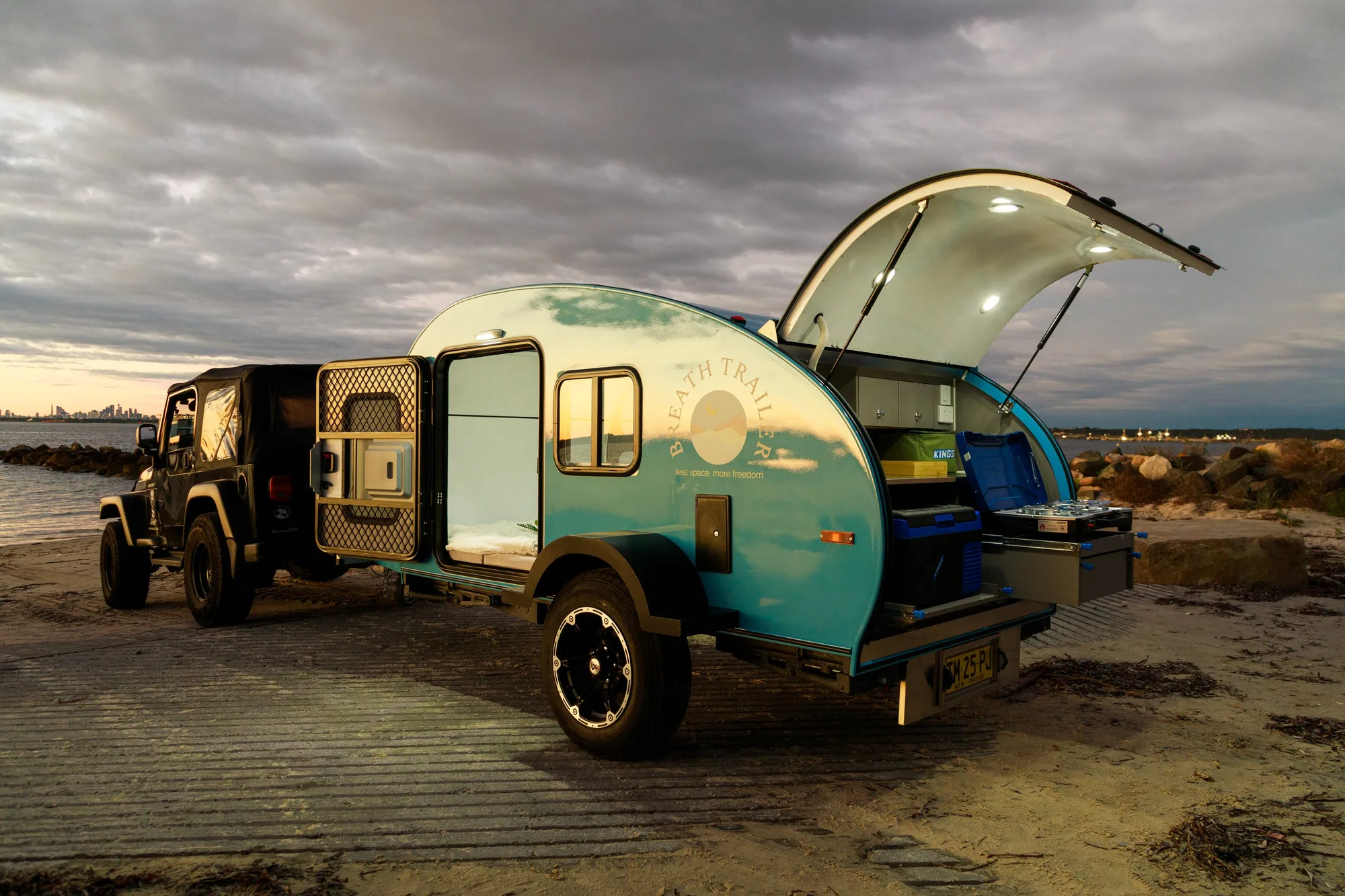
A compact teardrop behind an everyday 4WD: many owners already drive something that can tow one.
The case for buying a new tow vehicle is strongest when: (a) your current vehicle’s towing capacity is at or below the trailer’s ATM with no safety buffer, (b) you plan to tow off-road frequently on unsealed tracks, or (c) you’re upgrading to the Breath Max with its 1,200 kg ATM and want genuine headroom.
The Four Legal Limits — Quick Reference
Australian towing law requires that four limits are respected simultaneously, not just the headline towing capacity. This table is a quick summary — our towing guide covers each in detail.
| Limit | What It Means | Common Trap |
|---|---|---|
| Braked towing capacity | Maximum rated trailer weight your vehicle can legally tow | Only valid when the trailer has its own brakes (all Breath Trailers do) |
| Tow ball download limit | Max downward force the trailer’s coupling exerts on the ball | Must be ≥10% of trailer’s loaded ATM; many compact SUVs cap at 150–200 kg |
| GVM (Gross Vehicle Mass) | Max legal loaded weight of the tow vehicle | 4 adults + camping gear + fuel can consume 400–600 kg of GVM headroom |
| GCM (Gross Combined Mass) | Max legal weight of loaded vehicle + loaded trailer combined | GVM + trailer ATM must not exceed GCM — GCM catches heavy-caravan buyers most |
The teardrop advantage: at 700–1,200 kg ATM, teardrops sit well within the capability of most mid-size SUVs. The GCM trap and tow ball download limits that catch caravan buyers rarely come into play at these weights.
Trailer brakes rule: electric trailer brakes are required on any trailer with an ATM above 750 kg. All four Breath Trailer models come fitted with electric brakes as standard. You’ll still need an in-cab brake controller installed in your tow vehicle.
Matching Your Tow Vehicle to the Right Breath Trailer Model
Start here. The table below shows the minimum towing capacity required for each Breath Trailer model, the 80% comfort threshold (the rating at which your vehicle is towing the trailer with a useful safety buffer), and the target vehicle class.
| Breath Trailer Model | Tare Weight | ATM | Min Braked Towing Capacity | 80% Comfort Rating | Target Vehicle |
|---|---|---|---|---|---|
| Essential | ~600 kg | 700 kg | 700 kg (750 kg+ recommended) | 875 kg+ rated | Compact to mid-size SUV |
| Plus | ~680 kg | 800 kg | 800 kg (900 kg+ recommended) | 1,000 kg+ rated | Mid-size SUV |
| Ultra | ~750 kg | 900 kg | 900 kg (1,100 kg+ recommended) | 1,125 kg+ rated | Mid-size SUV |
| Max | ~1,050 kg | 1,200 kg | 1,200 kg (1,400 kg+ recommended) | 1,500 kg+ rated | Mid-size to large SUV |
Reading this table: the “80% comfort rating” is not a legal requirement — it’s the towing capacity at which you’re using 80% of your vehicle’s rated limit. Towing at or below 80% reduces wear on your transmission, braking system, and chassis, and leaves a buffer for error. For the Breath Max, this means you want a vehicle rated at 1,500 kg or better, even though the legal minimum is 1,200 kg.
The Breath Essential, Plus, and Ultra all sit comfortably within the towing range of the most popular mid-size SUVs sold in Australia — including the Toyota RAV4, Subaru Outback, Mazda CX-5, Hyundai Santa Fe, and Kia Sorento.
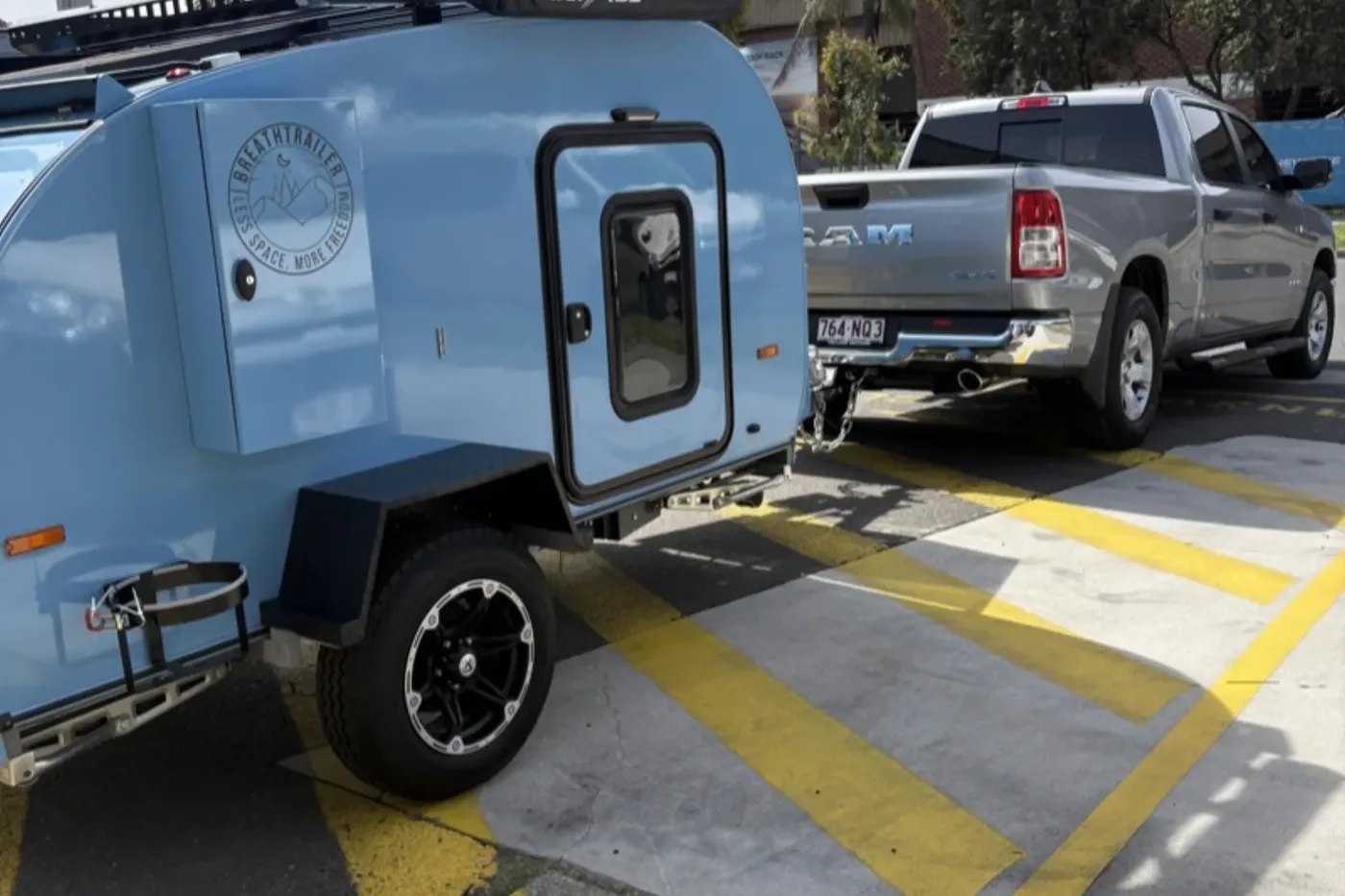
Hitched to a full-size pickup here, the Ultra also sits within the towing range of popular mid-size SUVs.
Best Mid-Size SUVs for Teardrop Trailers (Under $65,000)
These vehicles represent the sweet spot for Breath Trailer owners: capable enough to tow the Essential through Ultra comfortably, often already owned by the target buyer, and not so large they become expensive to run daily.
| Vehicle | Braked Towing Capacity | Tow Ball Limit | Drive-Away Price (2026) | Best For |
|---|---|---|---|---|
| Toyota RAV4 GXL Hybrid AWD | 1,500 kg | 150 kg | ~$58,990 | Essential / Plus / Ultra |
| Subaru Outback 2.5i AWD | 2,000–2,100 kg | 200 kg | from $48,990 | Essential through Max |
| Subaru Forester 2.5i-S | 1,500 kg | 150 kg | ~$52,990 | Essential / Plus / Ultra |
| Mazda CX-5 GT SP AWD | 1,800 kg | 180 kg | ~$52,700 | Essential through Max |
| Mitsubishi Outlander Exceed | 2,000 kg | 200 kg | ~$52,490 | Essential through Max |
| Hyundai Santa Fe (AWD) | 2,000 kg | 200 kg | from $55,500 | Essential through Max |
| Kia Sorento GT-Line AWD | 2,000 kg | 200 kg | from $55,680 | Essential through Max |
| Mazda CX-60 D50e AWD | 2,500 kg | 250 kg | from $57,390 | All models, heavy loads |
Toyota RAV4 (from ~$48,990): Australia’s best-selling SUV and the vehicle most Breath Trailer buyers already own. The 2026 RAV4’s 1,500 kg braked towing capacity covers the Essential, Plus, and Ultra with a comfortable buffer. For the Max at 1,200 kg ATM, a RAV4 is legally compliant but operating at 80% of its rated capacity — which is exactly the recommended threshold. Fuel economy towing at highway speeds: expect around 10–13 L/100 km depending on gradient and speed. Available in petrol, hybrid, and PHEV — the hybrid and PHEV variants maintain the same 1,500 kg rating. Note: some entry-level FWD RAV4 variants are rated to only 800 kg braked — always verify by variant, not model range.
Subaru Outback (from $48,990): The Outback’s AWD symmetry and higher ride height make it a naturally capable tower. The 2026 generation (restyled as a more traditional SUV) brings 2,000–2,100 kg braked towing for the 2.5-litre variants — ample for all four Breath Trailer models with headroom to spare. The 200 kg towball download limit (higher than the RAV4’s 150 kg) is useful when the Max is loaded. Starting price makes it competitive with the RAV4.
Mazda CX-5 (from ~$46,000): An underrated tower. The 2.5L AWD variants achieve 1,800 kg braked towing, handling all models except the Max with a buffer, and managing the Max within legal limits. The CX-5’s refined ride and well-sorted suspension make it comfortable on long touring trips. Worth considering for Essential/Plus/Ultra buyers who prioritise interior quality.
Kia Sorento and Hyundai Santa Fe: Both offer 2,000 kg braked towing capacity — more than enough for the entire Breath range — with competitive seven-seat family SUV packaging. Both frequently appear in new-car price deals. The Santa Fe in particular has grown in capability and reputation over recent generations.
Mazda CX-60: If you’re buying new and want to be definitively set for any scenario including a heavily loaded Max plus two adults plus camping gear, the CX-60’s 2,500 kg braked towing capacity and 250 kg towball download limit removes all doubt. Its diesel-mild-hybrid drivetrain is particularly torque-rich for trailer work.
Best Large SUVs and 4WDs (Over $60,000 — Off-Road or Maximum Headroom)
These vehicles are not required for teardrop towing — the mid-size SUVs above handle all four Breath Trailer models comfortably. But if you plan to tow off-road frequently, cover serious four-wheel-drive tracks, or want genuine redundancy for any future trailer upgrade, these deliver.
| Vehicle | Braked Towing Capacity | GCM | Drive-Away Price (2026) | Best For |
|---|---|---|---|---|
| Ford Everest Sport 4WD | 3,100 kg | 6,250 kg | from $58,990 | All models, off-road |
| Ford Everest Platinum V6 | 3,500 kg | 6,250 kg | from $82,490 | Maximum capability |
| Toyota LandCruiser Prado GXL | 3,000–3,500 kg | 6,600 kg | from $75,000 | Off-road, extended trips |
| Toyota Kluger Grande AWD | 2,000 kg | ~4,900 kg | from $64,490 | Comfort touring, family |
| Isuzu MU-X LS-U+ 4WD | 3,500 kg | 6,950 kg | from $61,990 | Heavy-duty, off-road |
| GWM Tank 300 4WD | 2,000–2,500 kg | ~5,700 kg | from $57,990 | Off-road value |
| GWM Tank 500 Hybrid | 3,000 kg | ~6,000 kg | from $74,990 | Off-road, maximum load |
Ford Everest (from $58,990): Australia’s most popular large SUV in 2026, and the tow vehicle of choice for serious camper trailer owners. The base Sport 4WD handles 3,100 kg braked — well over three times the Breath Essential’s ATM. The V6 Platinum reaches 3,500 kg. GCM of 6,250 kg means you’ll never approach a legal limit with a teardrop. The 2.0L BiTurbo diesel returns around 10–12 L/100 km touring with a loaded camper.
Toyota LandCruiser Prado: Rebuilt from scratch for 2024–25, the Prado now offers up to 3,500 kg braked towing and a class-leading GCM of 6,600 kg. Its new 2.4L turbocharged four-cylinder hybrid returns improved fuel economy — a meaningful gain over the older diesel V6. Strong resale value and parts availability across regional Australia make it the choice for buyers who plan to go remote and stay for weeks.
Isuzu MU-X (from $61,990): Often overlooked but consistently rated by towing specialists for its ladder-frame chassis rigidity and 3,500 kg braked towing. Lower initial purchase cost than the Prado or Everest with comparable heavy-duty towing credentials. Ride quality is firmer than the Everest but well-sorted for highway towing.
GWM Tank series: The Tank 300 and 500 have carved a niche as accessible four-wheel-drive towers. The Tank 500 Hybrid’s 3,000 kg rating and part-time 4WD make it credible for off-road teardrop adventures where you want genuine capability at a lower price than the Prado or Patrol.

All-terrain tyres on the trailer only pay off if the tow vehicle can handle the same tracks.
A note on the Toyota Kluger: it’s often bought by families who expect it to tow a heavy caravan — but its 2,000 kg braked towing capacity is only modest for that purpose. For a teardrop, it’s ideal; for a 2,500 kg+ caravan, buyers frequently find themselves at the legal limit with no buffer. If you’re planning to stick with a teardrop, the Kluger is excellent value. If you might upgrade to a larger rig later, size up now.
Electric and Hybrid Tow Vehicles in 2026
Electric vehicles can tow teardrop camper trailers — with caveats. The range penalty when towing is significant: expect a 30–50% reduction in usable range, turning a 400 km EV into an effective 200–280 km tow vehicle before you need to charge. For weekend runs to well-connected destinations, this is manageable. For remote extended touring, it’s a serious constraint.
Key Australian EVs with teardrop-relevant towing ratings in 2026:
| Vehicle | Braked Towing Capacity | WLTP Range (solo) | Est. Range When Towing | Drive-Away Price |
|---|---|---|---|---|
| Kia EV9 GT-Line AWD | 2,500 kg | ~505 km | ~250–320 km | from $104,990 |
| Toyota RAV4 GR Sport PHEV | 1,500 kg | ~90 km EV / petrol backup | Petrol-equivalent when towing | from ~$69,990 |
| Tesla Model Y Long Range AWD | 1,800 kg | ~560 km | ~280–350 km | from ~$69,900 |
| Hyundai IONIQ 5 RWD | 1,600 kg | ~570 km | ~280–360 km | from ~$67,900 |
| Kia EV5 GT AWD | 1,600 kg | ~480 km | ~240–310 km | from ~$64,900 |
For a detailed breakdown of EV towing considerations including pull-through charging strategy, V2L capability, and which Breath Trailer models pair best with which EVs, see our EV towing guide for Australia.
The PHEV Toyota RAV4 (GR Sport) offers the most practical compromise: electric-only range for daily commuting, with a petrol engine available when range anxiety would otherwise prevent a camping trip.
The Hidden Costs of Setting Up a Tow Vehicle
The purchase price of the tow vehicle is only the start. Budget for these additions before your first trip:
| Item | Cost Range | Notes |
|---|---|---|
| Tow bar (supply + fit) | $500–$1,500 | Varies by vehicle and bar style; fixed ball vs. detachable |
| Brake controller (electric trailer brakes) | $200–$600 installed | Required for any trailer with ATM above 750 kg |
| Brake controller wiring | Included or $100–$200 extra | Some vehicles are pre-wired; most are not |
| Wiring harness (7-pin flat) | $150–$400 installed | For trailer lights, electric brakes signal |
| Towing mirrors (if required) | $80–$300/pair | Needed if trailer is wider than tow vehicle by >150 mm |
| Fuel cost increase when towing | +15–25% highway | At $2.20/L, a 500 km trip costs roughly $25–$40 more per leg |
| Insurance premium change | $0–$300/year | Some policies require trailer declaration; check before towing |
Total setup cost (tow bar, brake controller, wiring): budget $900–$2,200 for a mid-size SUV not previously set up for towing. This is a one-time cost worth factoring into your total budget.
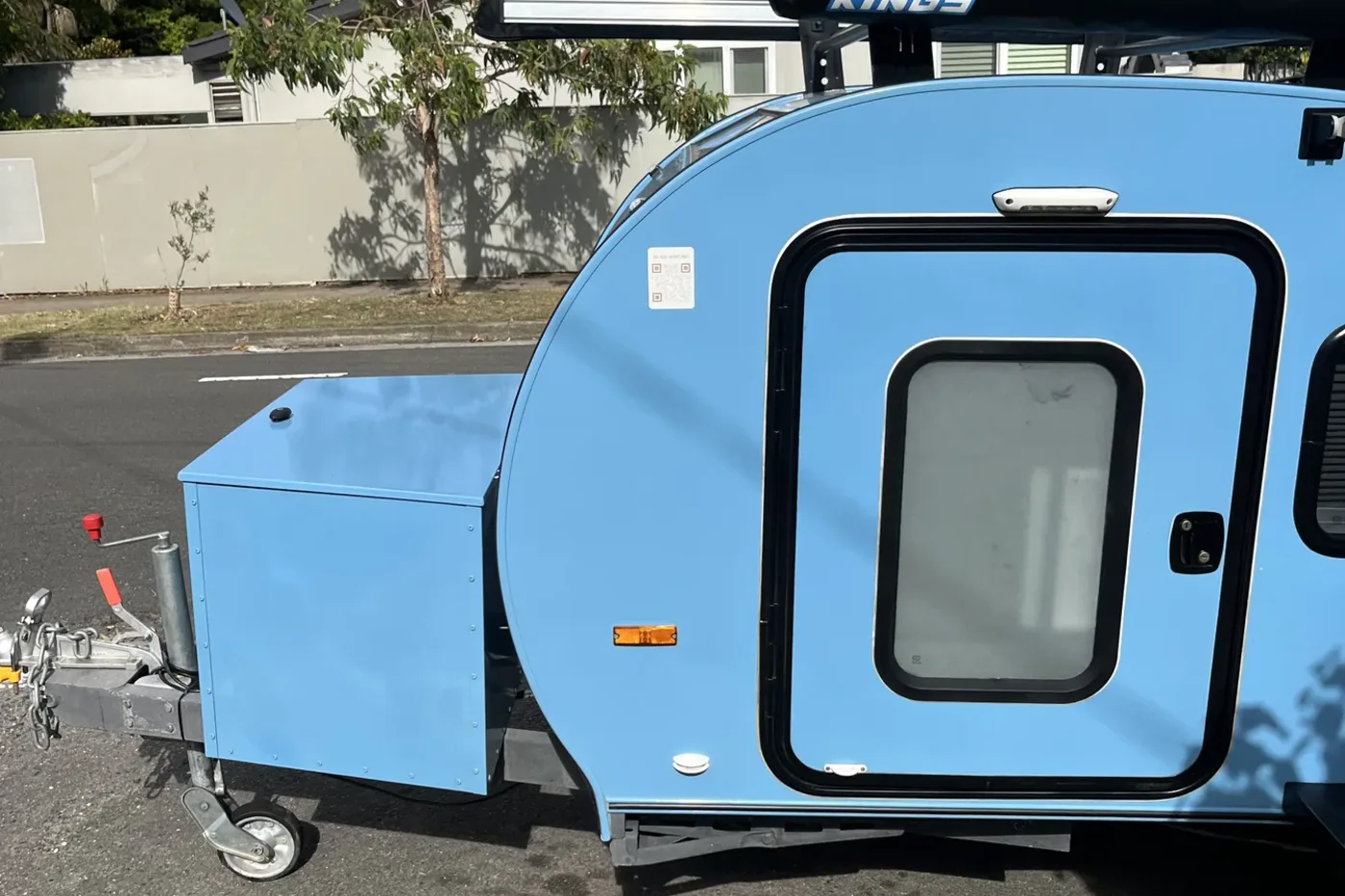
Coupling, safety chains and jockey wheel: everything here hangs off a tow bar that must be rated for the loaded trailer.
For a complete look at ownership costs — including trailer insurance and camper trailer finance options — see those dedicated guides.
Five Mistakes When Choosing a Tow Vehicle
| Mistake | Why It Happens | The Fix |
|---|---|---|
| Buying a large 4WD when a mid-size SUV is enough | Fear of being “underpowered” towing a teardrop | Check actual ATM vs. rated capacity; at 700–900 kg, a RAV4 has 40–60% headroom |
| Trusting the headline towing figure without checking GCM | Manufacturers advertise max braked towing, not GCM limits | Check your owner’s manual or call the manufacturer for GCM; apply the formula: GCM − loaded GVM = available trailer weight |
| Forgetting to check the variant-level specs | Range-wide towing specs hide variation (e.g., FWD vs AWD RAV4: 800 kg vs 1,500 kg) | Always verify by your specific variant name, not the model family |
| Installing a tow bar without matching the brake controller | Legally and mechanically incomplete — trailer brakes won’t activate | Budget for both together when getting quotes |
| Buying a new vehicle to solve a problem the trailer solves | Some buyers rule out the Breath Essential/Plus assuming their car won’t tow — without checking | Always cross-reference trailer ATM against your vehicle’s rated capacity before making any purchase decision |
Frequently Asked Questions
Can a Toyota RAV4 tow a Breath Trailer? Yes. The 2026 Toyota RAV4 is rated at 1,500 kg braked towing in AWD and hybrid variants (check your specific variant — some FWD versions are rated to 800 kg). This covers the Essential (700 kg ATM), Plus (800 kg ATM), and Ultra (900 kg ATM) with comfortable headroom. For the Breath Max (1,200 kg ATM), the RAV4 is legally compliant but operating at 80% of its rated capacity — the recommended threshold. A brake controller will need to be fitted as all four Breath Trailer models exceed the 750 kg brake threshold.
What is the minimum vehicle I need for the Breath Max? The Breath Max has a 1,200 kg ATM. The legal minimum is a vehicle rated at 1,200 kg braked towing or above. For a comfortable 20% buffer, look for a vehicle rated at 1,500 kg or more — the Toyota RAV4, Subaru Outback, Hyundai Santa Fe, Kia Sorento, Ford Everest, and Toyota Prado all meet this.
Do I need a diesel engine to tow a teardrop camper? No. Modern petrol and hybrid engines are well-suited to teardrop towing. At 700–1,200 kg, the load is modest enough that petrol engines — including the RAV4 hybrid and Subaru Outback 2.5 — pull without strain at highway speeds. Diesel offers better low-end torque and generally lower highway fuel consumption, which matters more when towing heavy caravans. For lightweight teardrops, the difference is real but not dramatic.
What’s the 80% towing rule, and is it law? The 80% rule is an industry recommendation, not a legal requirement. It states that for longevity and safety, you should tow no more than 80% of your vehicle’s rated braked towing capacity. It accounts for weight variations when the trailer is loaded, assists with sway stability, and reduces long-term wear. Legally you can tow right up to the rated capacity. Practically, staying at or below 80% gives you a buffer you’ll be glad to have on a steep descent with a loaded trailer.
Can I tow a teardrop camper with an electric vehicle? Yes, with range planning. Several 2026 Australian-market EVs including the Kia EV9 (2,500 kg), Tesla Model Y (1,800 kg), and Hyundai IONIQ 5 (1,600 kg) are rated to tow the entire Breath Trailer range. Expect 30–50% range reduction when towing — a full-charge range of 500 km becomes approximately 250–350 km per charge. See our dedicated EV towing guide for route planning and charging strategy.
What tow bar should I choose — fixed ball or detachable? For most teardrop owners, a fixed tongue tow bar (non-removable ball) is the simpler and lower-cost option, and it’s adequate for a dedicated camping vehicle. A detachable ball (swans neck or pin-and-clip) keeps the rear of your vehicle cleaner when not towing — useful if you use your SUV as an everyday vehicle. Both achieve the same towing capacity. Budget an extra $200–$400 for a detachable option. Avoid retrofitted universal tow bars that are not rated to the trailer’s ATM.
What to Do Next
If you’ve confirmed your current vehicle can tow a Breath Trailer, the next step is a proper tow bar and brake controller quote from a reputable auto-electrical or hitch-fitting specialist. Ask for a single-visit installation that covers the bar, 7-pin flat wiring harness, and brake controller pre-wired together — this saves a second callout.
If you’re actively shopping for a new tow vehicle, the mid-size bracket (Subaru Outback, Mazda CX-5, Hyundai Santa Fe) offers the best balance of daily usability, towing headroom for the full Breath Trailer range, and running cost. The step up to a Ford Everest or Toyota Prado makes sense primarily for off-road ambitions or a plan to regularly tow long distances through remote terrain.
Ready to match a trailer to your existing vehicle? Use the comparison tool or book a no-obligation viewing at your nearest ambassador location — we’ll walk through the match with you.
Recommended Reading
- Camper Trailer Towing Guide Australia: Which SUV Can Tow Which Trailer? — Full GVM, GCM, and weight terminology breakdown
- Understanding Electric Trailer Brakes in Australia — ADR38 thresholds, brake controllers, and installation
- Electric Vehicle Towing a Teardrop Camper in Australia — EV-specific range maths, charging strategy, V2L
- Teardrop Camper Weight Australia: Tare, ATM, Payload Explained — How to read trailer weight specs
- Camper Trailer Accessories Australia — Tow bars, weight distribution, trailer setup gear