Jervis Bay Camping Guide (2026): Booderee NP, Campgrounds & Seasonal Tips
Complete guide to camping at Jervis Bay in 2026 — Booderee NP campgrounds, fees, booking windows, seasonal tips, and which camper trailer to bring.
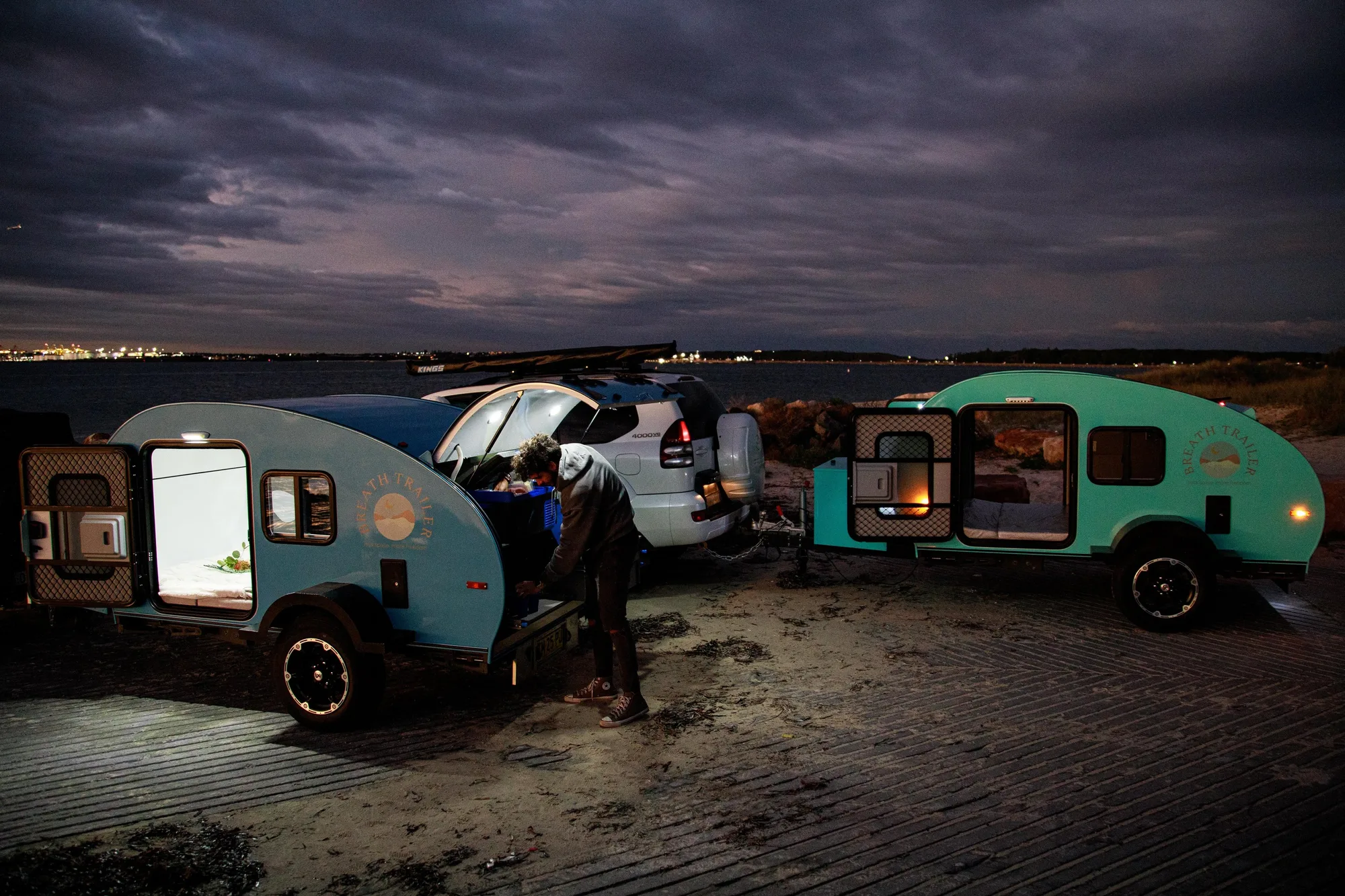
Three hours south of Sydney, Jervis Bay delivers a coastal experience that few places on the east coast can match. The bay itself — a 100 sq km sheltered marine sanctuary — hosts year-round pods of bottlenose dolphins. Hyams Beach is famous for sand so fine and white it squeaks underfoot. And Booderee National Park, managed by Parks Australia on Wreck Bay Aboriginal Community lands, wraps the southern headlands in Commonwealth-protected wilderness that keeps development at bay.
For camper trailer owners, Jervis Bay is a sweet spot: close enough for a quick getaway from Sydney or Canberra, far enough to feel genuinely remote when you’re sitting at Green Patch with the bush behind you and the inlet in front. This 2026 guide covers every campground, the current fees, how to book, the best activities, and the right trailer to bring.
Why Jervis Bay Is Different From Other NSW Destinations
One thing most guides miss: Booderee National Park is not an NSW National Park. It is managed by Parks Australia (Commonwealth), which means your NSW National Parks pass does not give you entry. You pay Parks Australia fees directly — and those fees are structured differently from the NSW 6-tier system introduced in July 2026.
This distinction matters for budgeting. A family arriving with an annual NSW pass will still pay the Booderee vehicle entry fee — currently $20 per vehicle per day, or $10 for concession holders. When you book a campsite, the park entry fee is included in your camping booking, so day-trippers and campers have different payment paths.
The other thing that sets Jervis Bay apart: no pets are permitted anywhere in Booderee National Park. The rule is strict and enforced. If you’re planning a trip with the dog, check our guide to dog-friendly camping across Australia before heading south — Callala Beach and several Huskisson foreshore spots outside the park boundary do allow leashed dogs.
Getting to Jervis Bay
The easiest approach from Sydney is the M1/F6 Freeway to the Princes Highway at Waterfall, then south through Kiama to the Jervis Bay Road turnoff (follow signs to Huskisson). The drive to Huskisson from Sydney CBD runs about 2 hours 45 minutes in light traffic.
The Friday afternoon departure from Sydney is the classic trap. Add at least 90 minutes to the journey time if you’re leaving between 3 and 7 pm. Leave Thursday evening or early Saturday morning and you’ll save the stress.
| Origin | Distance | Drive Time (light traffic) | Notes |
|---|---|---|---|
| Sydney CBD | ~185 km | ~2h 45min | Via F6/Princes Hwy; allow +90min Fri PM |
| Canberra ACT | ~195 km | ~2h via Kings Hwy | Most direct route for Canberrans |
| Wollongong | ~125 km | ~1h 30min | Easy, all sealed highway |
| Newcastle | ~350 km | ~4h | Via Sydney or inland Hwy 1 |
| Melbourne VIC | ~700 km | ~8–9h | Two-day drive recommended; stay Mogo or Narooma |
The road into Booderee National Park from Huskisson is fully sealed and 2WD accessible. No high-clearance required. The main campground access roads inside the park are gravel but straightforward for any trailer.
Camping in Booderee National Park
Booderee has three campgrounds. Only two are suitable for camper trailers.
| Campground | Sites | Trailer Access | Facilities | Setting |
|---|---|---|---|---|
| Green Patch | ~105 | Yes (all sizes) | Toilets, showers, grey water drains, fire rings (D-section only) | Forest behind inlet, 300m walk to beach |
| Cave Beach | ~65 | Yes (2WD accessible) | Toilets, cold showers, grey water drains, no fires | Surf beach, more exposed, quieter |
| Bristol Point | ~6 | No — walk-in only | Composting toilets only | Remote bush, boat launch nearby |
Green Patch is the standout. Sites are set among banksias and eucalypts with the inlet visible through the trees. The beach walk takes three minutes. The D-section has metal fire rings if fires are permitted under current weather conditions (check the fire danger rating before you go — Total Fire Ban periods apply regularly in NSW summer). Green Patch books out 6–12 months ahead for school holidays; a December booking placed in January is not unusual.
Cave Beach is the alternative when Green Patch is full. It faces the Southern Ocean with a consistent shore break popular with bodyboarders and surfers. Sites are more exposed to wind. The cold showers are functional but bracing in winter. If you’re after a quieter, more rugged base camp and you don’t mind wind, Cave Beach delivers.
Bristol Point is walk-in only — no vehicles past the entry gate. For camper trailer owners, it is not an option.
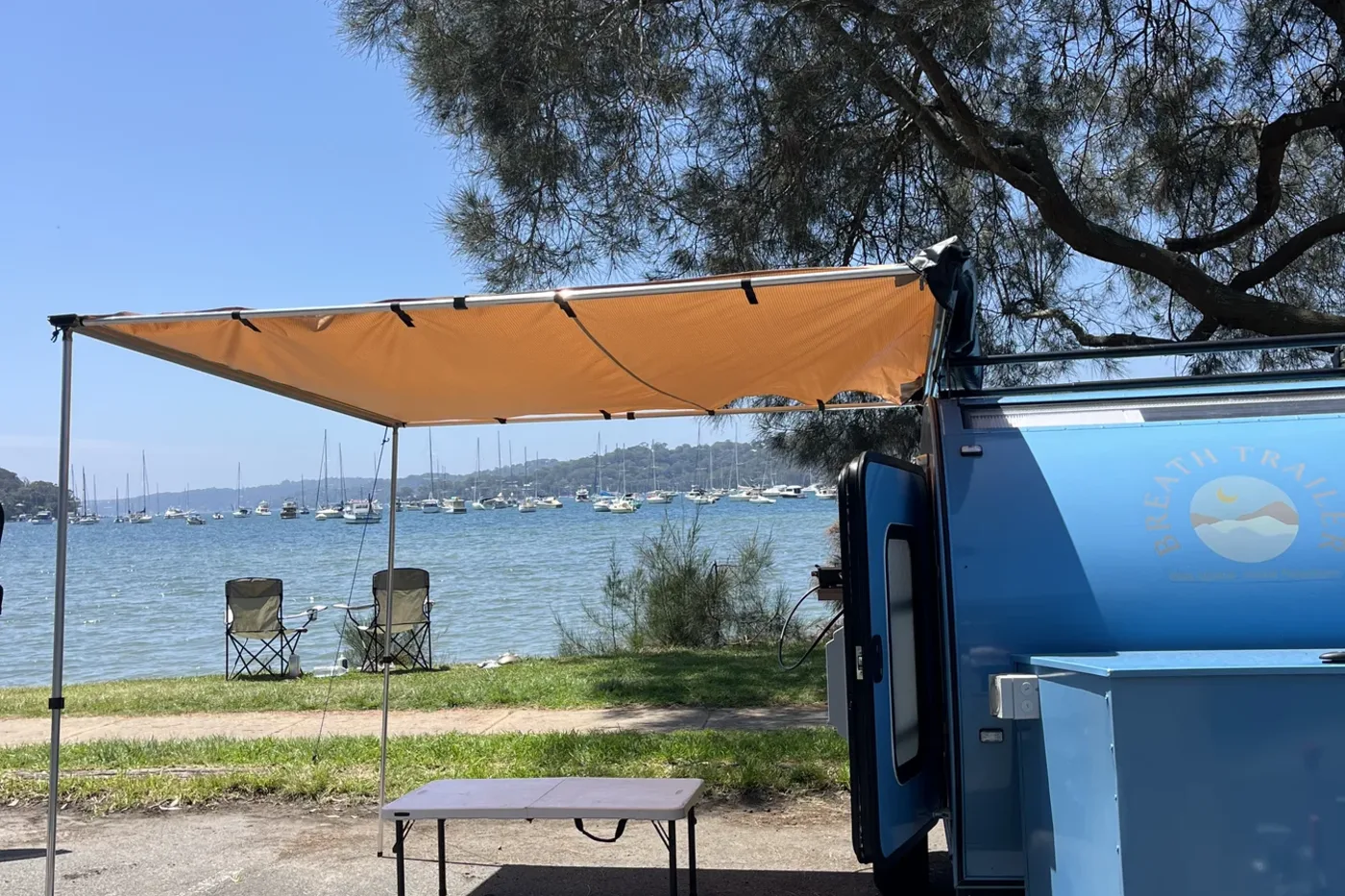
A sheltered bay setup like this — awning out, water view, easy access — is what Green Patch offers on a good site booking.
Fees and Booking (2026)
Booderee’s fee structure changed in August 2024. The key update: entry fees are now included in camping bookings — you no longer pay separately for vehicle entry when you’re camping overnight. Day visitors still pay the $20 vehicle entry fee.
Campsite fees are structured by season and site size. Parks Australia’s official booking system (rms.com.au) shows the current rates at time of booking.
| Season | Standard Site (up to 5 people) | Large Site (up to 10 people) |
|---|---|---|
| Peak (school holidays, public holidays) | ~$100/night | ~$180/night |
| Shoulder | ~$70/night | ~$140/night |
| Off-peak | ~$35/night | ~$70/night |
Booking opens on a rolling 90-day window for most dates, but Parks Australia releases summer school holiday sites up to 12 months in advance in a dedicated booking round (usually announced in September–October). Minimum stay requirements of 3–4 nights apply for peak-period bookings.
Practical booking tips:
- Set a calendar reminder for October each year for the Christmas period release.
- For autumn and winter stays, the 90-day window is usually enough, but book Saturdays at least 6 weeks out.
- If Green Patch is full, check Cave Beach before giving up — it fills later and is genuinely good.
Campgrounds and Parks Outside the National Park
If Booderee is booked out, Huskisson and the surrounding villages have several solid alternatives:
| Option | Location | Type | Approximate Cost (2026) | Notes |
|---|---|---|---|---|
| Holiday Haven Huskisson Beach | Huskisson foreshore | Powered + unpowered | $65–$140/night | NRMA managed, right on the beach strip, dog-friendly |
| Callala Beach Caravan Park | Callala Beach | Powered + unpowered | $45–$90/night | Shoalhaven Council operated, calmer water, great for families |
| Jervis Bay Holiday Park | Vincentia | Powered + unpowered | $60–$120/night | 2 km from Hyams Beach, good facilities |
| Huskisson Beach Tourist Resort | Huskisson | Powered + unpowered | $70–$150/night | Larger park, pool, amenities block |
The holiday parks in Huskisson allow dogs on leads, which is the main advantage over Booderee. Sites are more crowded and commercial, but powered sites are available — useful if you’re running air conditioning on a summer trip. No NSW National Parks booking system required; direct booking with the parks.
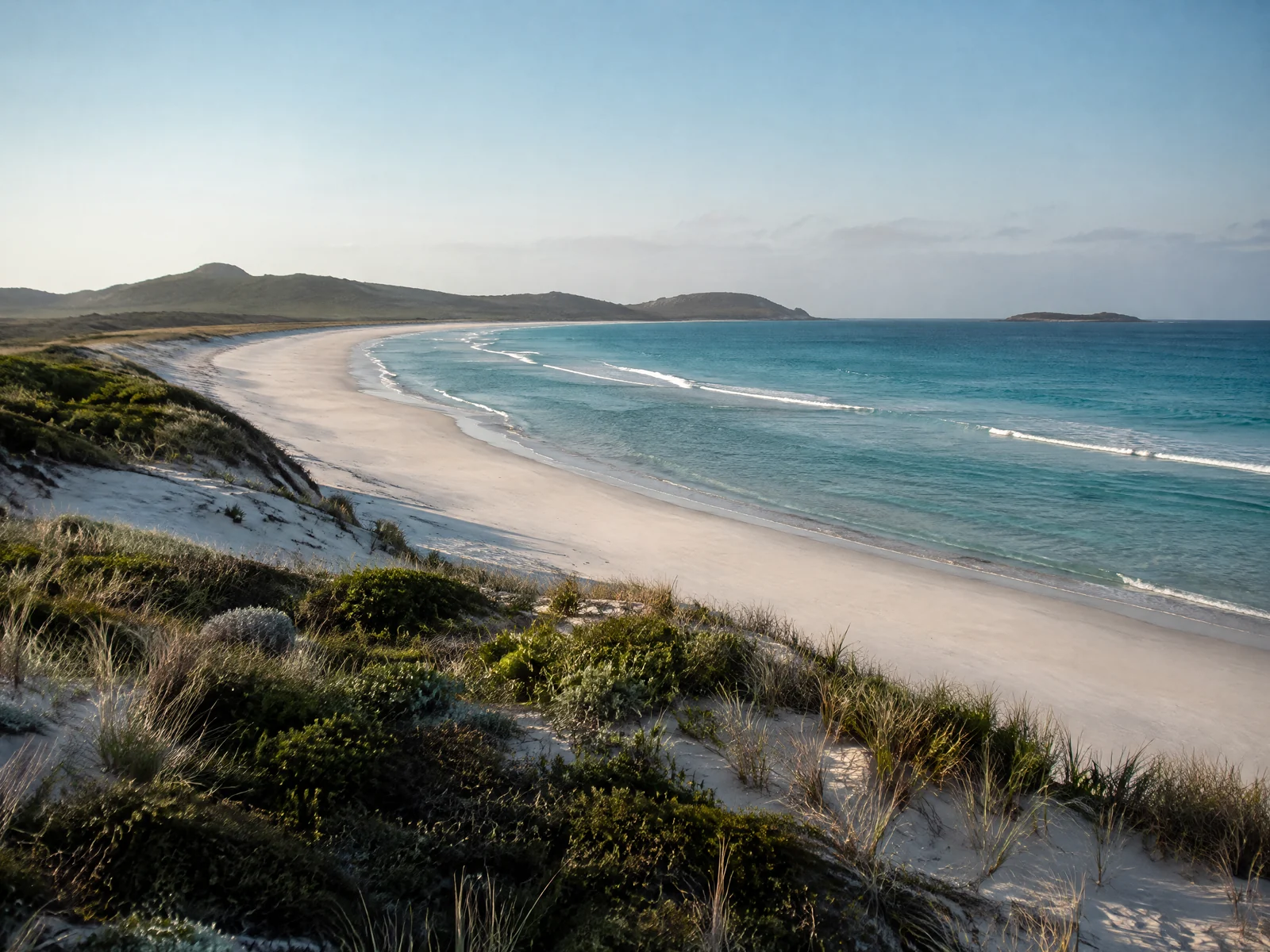
Illustration: The white silica sand at Jervis Bay’s sheltered beaches is what makes the region stand out on Australia’s east coast.
What to Do at Jervis Bay
Jervis Bay’s calendar runs all year because the bay is sheltered and the wildlife doesn’t take holidays.
| Activity | Season | Cost | Notes |
|---|---|---|---|
| Murrays Beach swimming | Year-round | Free | Safest swimming beach in the park, patrolled in summer |
| Dolphin watching | Year-round | Free / cruise $55–$75 | DIY from Huskisson foreshore; cruise operators from Lady Denman Heritage Complex |
| Whale watching | May–November | Cruise $80–$130 | Humpbacks May–Aug, southern right whales Jun–Oct |
| Kayaking Green Patch | Spring–Autumn | Hire ~$30/hr | Calm inlet, good for beginners and families |
| Snorkelling Murrays Beach | Sep–Apr | Free | Water clarity extraordinary on calm days |
| Booderee Botanic Gardens | Year-round | Free (with park entry) | One of three national botanic gardens in Australia |
| Bherwerre Beach walk | Year-round | Free | 5 km return from Green Patch through banksia heath |
| Fishing: bream, flathead | Year-round | Fishing licence required ($14/day NSW) | No licence needed in Jervis Bay Marine Park protected zones — check boundaries |
| Cave Beach bodysurf/surf | Autumn–Winter | Free | Best swell Apr–Aug, low crowds |
The dolphins at Jervis Bay are common bottlenose — a resident population that has been in the bay for decades. You will see them from the Huskisson foreshore on most mornings without paying for a cruise. The cruise operators go further into the marine sanctuary and often get closer contact, but it’s not essential.
Whale watching from Jervis Bay is excellent because the bay mouth sits directly on the east coast humpback migration corridor. The headlands above Bherwerre Beach and Point Perpendicular (day visitor access, 25 km from Huskisson) offer free elevated viewing.
Booderee Botanic Gardens is worth three hours that most visitors skip. It’s one of only three national botanic gardens in Australia and the only one on coastal heath. Free entry with your park pass. Walk the Bherwerre circuit from the gardens car park for eucalyptus heathland views across the southern bay.
For the towing angle, the roads around Huskisson are flat and easy. No tight mountain passes, no unsealed surprises on the main campground access roads. This is as approachable a coastal destination as NSW offers.
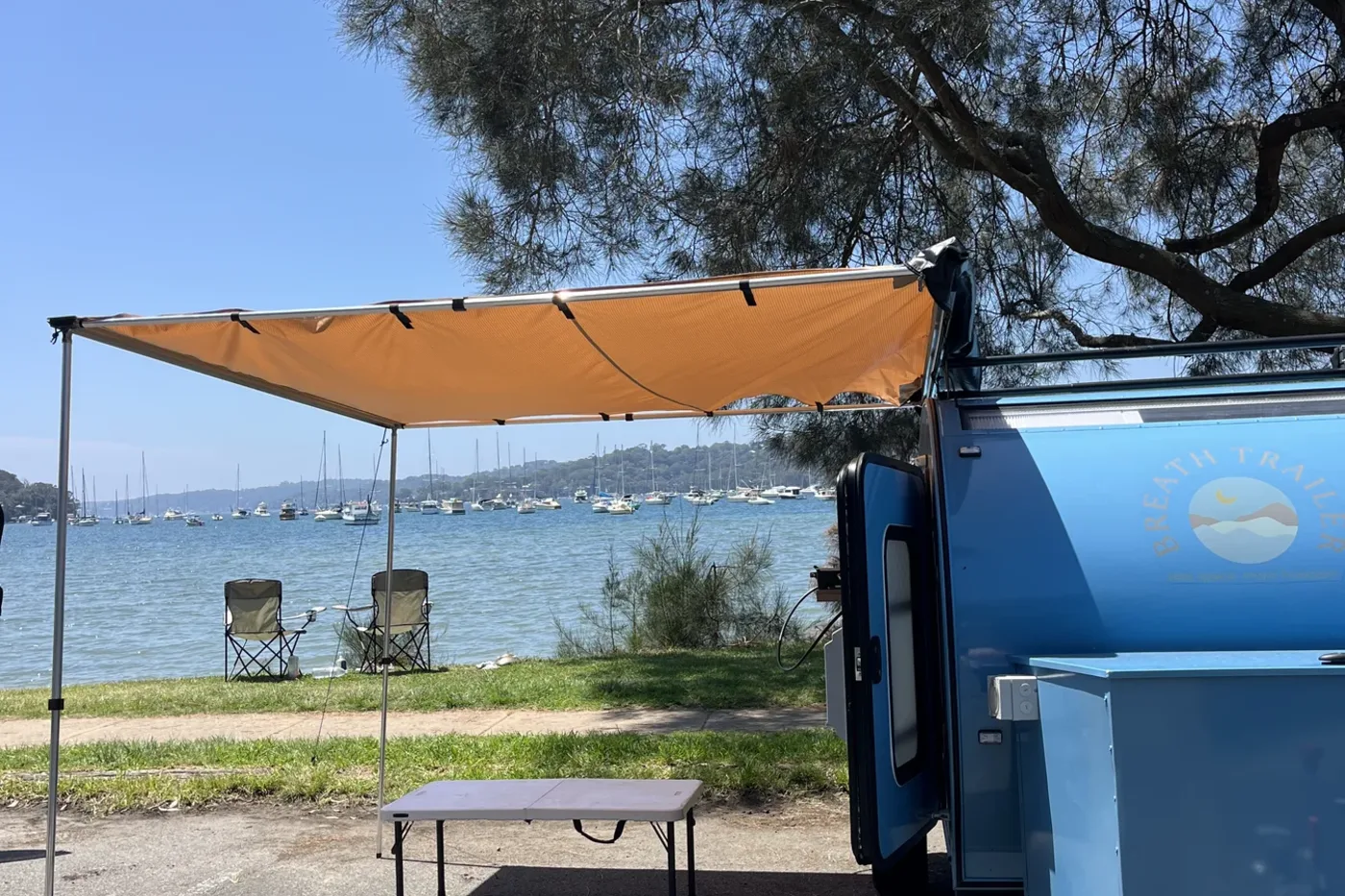
A proper base camp setup — awning deployed, table out, chairs facing the water — is achievable at Green Patch and several of the Huskisson caravan park sites.
Seasonal Guide
| Season | Weather | Crowds | Wildlife Highlight | Notes |
|---|---|---|---|---|
| Summer (Dec–Feb) | Hot 25–32°C, calm bay | Very high — school holidays packed | Dolphins active, great swimming | Book 6–12 months ahead; Hyams Beach car park fills by 9 am on weekends |
| Autumn (Mar–May) | Warm 18–26°C, some swell | Low–Moderate | Whale season begins May | Best value: off-peak fees, fewer people, still swimmable |
| Winter (Jun–Aug) | Cool 10–18°C, occasional rain | Low | Whale watching peak June–August | Quietest time; fires permitted (conditions permitting); cold showers at Cave Beach are cold |
| Spring (Sep–Nov) | Warm 18–24°C, variable | Moderate (Oct school holidays spike) | Dolphins + late-season whales September–October | Spring wildflowers in Booderee Botanic Gardens; best all-round season for comfort |
The best time for most camper trailer owners is autumn (March–May) or spring outside school holidays (September, early November). You get manageable crowds, good weather, decent wildlife activity, and off-peak or shoulder rates at Booderee. If you can only go in summer, go midweek — Monday to Thursday visits are noticeably less crowded than weekends even at peak season.
Self-Containment and Water at Jervis Bay
Booderee National Park campgrounds have toilet and shower facilities, so self-containment is not a strict requirement for camping inside the park. That said:
- Grey water: must go to the designated grey water disposal drains at each campground, not into the bush or on the soil near your site.
- Dump points: there is no dump point inside Booderee NP. The nearest is in Huskisson (Nowra Rd near the showground — confirm current location via WikiCamps or CamperMate before you go). If you have a black water cassette, plan your emptying around this.
- Fresh water taps: available at Green Patch and Cave Beach. Water is treated but always carry at least 20 L in your trailer as backup during peak periods when taps run warm.
- Free camping nearby: the Callala Bay foreshore and several Shoalhaven Crown Land areas around the southern edge of the bay allow self-contained campers. For these sites, full self-containment (grey water tank, cassette toilet) is required. The Breath Max at $42,900 is the only teardrop trailer under $50k on the Australian market with an interior bathroom — which makes it the right choice for anyone targeting these free-camp spots.
For a deeper look at water system sizing across a 5-night trip, see our camper trailer water system guide.
Choosing Your Breath Trailer for Jervis Bay
Jervis Bay camping suits all four Breath Trailer models, but each has a different strength here.
| Model | Tare | Best Use Case at Jervis Bay | Key Advantage |
|---|---|---|---|
| Essential ($23,320) | 700 kg | Booderee NP short stays, weekend couples trips | Lightest, easiest to park in tight Green Patch sites |
| Plus ($29,766) | 800 kg | 5+ night stays, families with young kids | Built-in fridge means no ice stop at Nowra |
| Ultra ($34,749) | 900 kg | Murrays Beach base camp, active water trips | External shower rinses off sand and salt after every swim |
| Max ($42,900) | 1,200 kg | Self-contained free-camping on Callala Bay foreshore | Interior bathroom, full self-containment for grey water sites |
The external shower on the Ultra is the practical standout for Jervis Bay specifically. If you’re snorkelling at Murrays Beach, kayaking at Green Patch, or bodyboarding at Cave Beach every day, rinsing off outside before stepping inside makes a material difference in how clean the trailer stays over five nights. No shower mat, no sandy sleeping bag.
The Max earns its place if you plan to use the self-contained free camp spots around Callala Bay or Bherwerre Beach rather than paying Booderee NP campsite rates. At peak-season rates of $100/night at Green Patch, a couple doing a 7-night trip pays $700 in site fees. That’s a meaningful number against the Max’s $42,900 price if you plan to free-camp regularly.
For first-time buyers coming to Jervis Bay on the weekends, the Essential at 700 kg is easy behind any mid-size SUV (Mazda CX-5, Toyota RAV4, Honda CR-V) and fits into smaller Green Patch sites that larger trailers can’t. See our weight guide for the tow vehicle matching table.
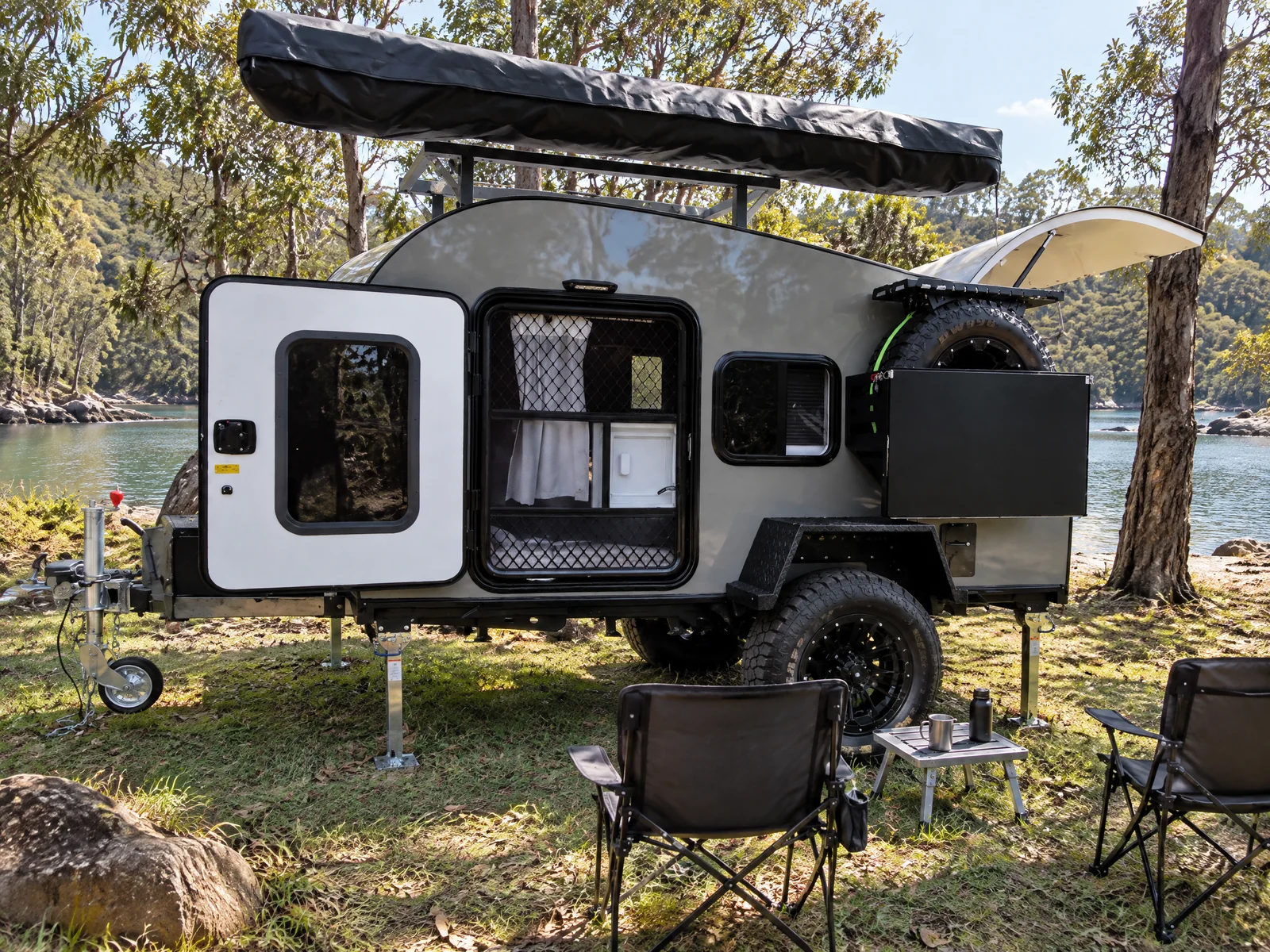
Illustration: A well-shaded inlet site at Green Patch — the kind Green Patch does better than any other campground in the region.
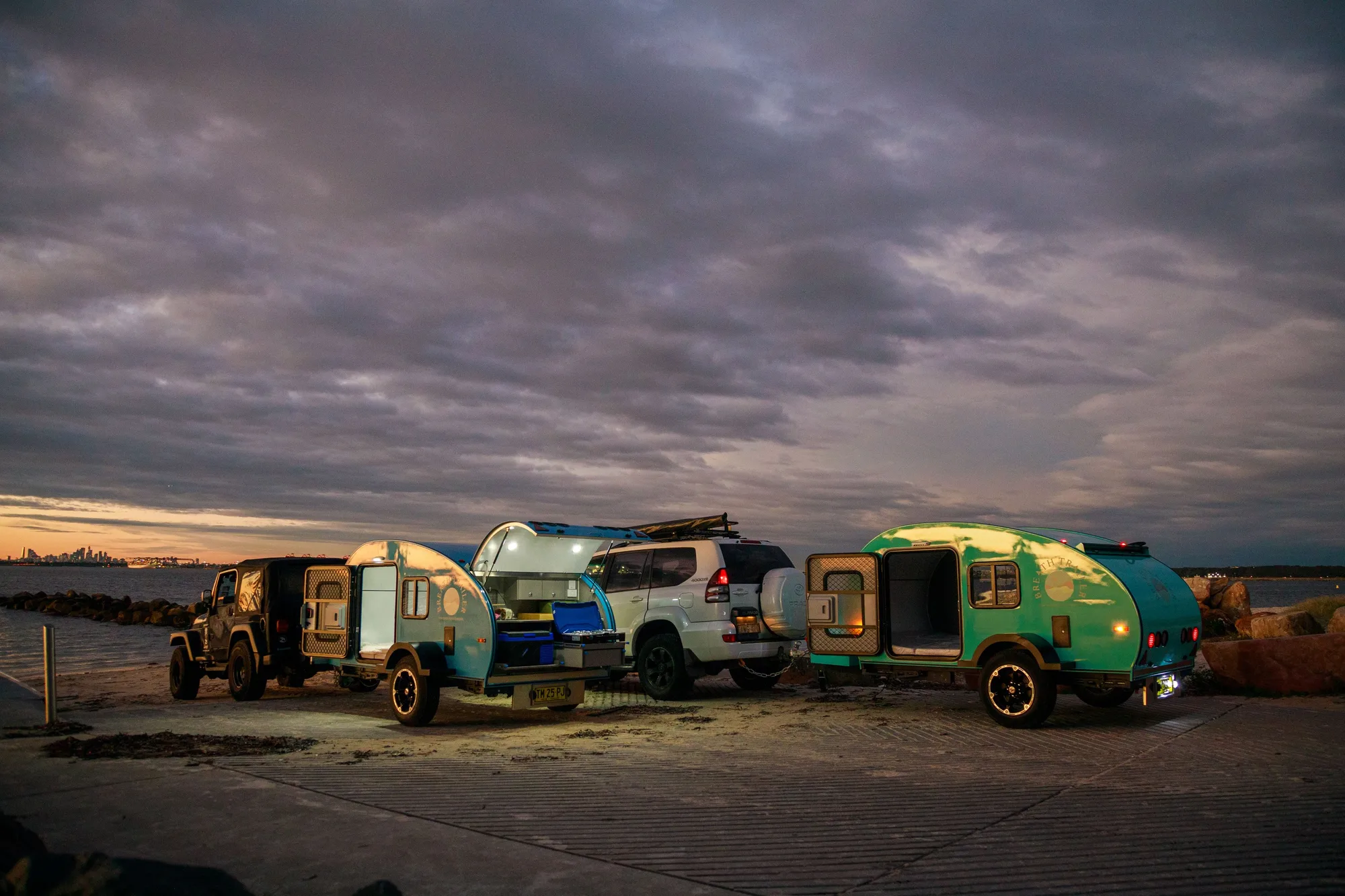
Dusk at Jervis Bay — the light on the water at Green Patch inlet rivals any coastal camp in Australia.
5-Night Itinerary
| Night | Location | Key Activity |
|---|---|---|
| Night 1 | Green Patch, Booderee NP | Arrive, set up, walk to Green Patch Beach at sunset |
| Night 2 | Green Patch | Kayak the inlet at dawn, Booderee Botanic Gardens in the afternoon |
| Night 3 | Green Patch | Murrays Beach snorkel, afternoon dolphin watch from Huskisson foreshore |
| Night 4 | Cave Beach | Move camp to Cave Beach, surfing or bodyboarding, whale watch from Bherwerre headland |
| Night 5 | Cave Beach | Cave Beach walk, swim, pack out via Huskisson for a final fish and chips |
The itinerary keeps you in Booderee for the full stay to avoid moving the trailer twice on the same booking. If Green Patch is booked for 3 nights and Cave Beach for 2, the parks booking system allows this as a single trip.
5-Night Budget Estimate (Couple, 2026)
| Item | Estimate |
|---|---|
| Booderee NP camping (3 nights peak Green Patch) | $300 (3 × $100) |
| Booderee NP camping (2 nights off-peak Cave Beach) | $70 (2 × $35) |
| Fuel: Sydney return ~370 km × 2 = 740 km (towing, 12.5 L/100km, $2.10/L) | ~$194 |
| Food and supplies for 5 nights | ~$200–$300 |
| Activities (2 dolphin/whale cruises, kayak hire 2 days) | ~$280 |
| Fishing licence (2 × 1-day NSW, $14 each) | $28 |
| Total (approximate) | $1,072–$1,172 |
This is a Sydney-origin calculation. Canberra-origin trips save roughly $60 in fuel. The budget rises significantly if you’re visiting in peak school holiday season (December–January campsite rates hit $100/night).
Packing Checklist for Jervis Bay
| Category | Items |
|---|---|
| Water | Carry 20+ L on board even though taps are available; handy if you arrive late |
| Sand management | Hessian or astroturf doormat, brush, zip-lock bags for shoes |
| Beach kit | Snorkel + mask (crystal clear water), wetsuit in winter, inflatable kayak if trailer has space |
| Fire and cooking | Check fire danger rating before leaving; gas stove as backup if fires banned |
| Wildlife awareness | Bear (possum) canister for open food — possums at Green Patch are brazen |
| Fishing | Licence app on phone (NSW DPI Service NSW app), rods, hand line for the kids |
| Navigation | Download Booderee offline on Maps.me or AllTrails; reception is patchy inside the park |
| Safety | First aid kit, PLB for overnight snorkel or kayak excursions in the marine park |
FAQ
Is a NSW National Parks pass valid at Booderee National Park?
No. Booderee is managed by Parks Australia (Commonwealth), not the NSW National Parks and Wildlife Service. Your NSW Annual Pass does not cover entry. Pay the Parks Australia vehicle fee online via the booking system, or at the entry kiosk.
How far in advance do I need to book Booderee campgrounds?
For summer school holidays (late December, January): up to 12 months — Parks Australia releases these sites in a special booking round each October. For Easter: 3–6 months. For shoulder season weekends: 4–8 weeks. Midweek autumn or winter visits can often be booked 2–3 weeks out.
Can I bring my dog to Jervis Bay?
Not inside Booderee National Park — dogs are prohibited to protect the wildlife. The Huskisson foreshore, Callala Beach, and several Shoalhaven beaches outside the park boundary allow leashed dogs. See camping with dogs for a full state-by-state breakdown.
Is Hyams Beach really the whitest sand in the world?
Hyams Beach is frequently cited as holding a Guinness World Record for whitest sand, though the claim is contested. What is undeniable is that the silica-rich white sand here is extraordinary — it reflects light differently from any other NSW beach and squeaks underfoot when dry. It is worth visiting regardless of record status.
What is the mobile reception like at Booderee NP campgrounds?
Telstra provides patchy 4G at Green Patch main facilities and near the Huskisson entrance. Cave Beach has very limited signal. Download offline maps before you leave Huskisson township. Emergency calls (000) work from most parts of the park.
Is Booderee National Park accessible for camper trailers with a standard vehicle?
Yes. All access roads are sealed to the Green Patch and Cave Beach entry points. The internal campground roads are gravel but maintained. Any 2WD vehicle towing a standard camper trailer handles Booderee without issue. High-clearance or 4WD is not required.
Recommended Reading
- Best Camping Spots Near Sydney (Under 3 Hours)
- Best Beach Camping Destinations in Australia
- Teardrop Camper Weight Guide — Match Your Trailer to Your SUV
- Camper Trailer Water System Australia — Tank Sizing & Grey Water Rules
- Free Camping Australia: A Complete Camper Trailer Guide
Jervis Bay rewards forward planning. Book Green Patch early, bring a trailer with an external shower, and leave Sydney before 7 am on a Friday. That is essentially the full playbook for one of the best coastal camper trailer trips in New South Wales.
Ready to choose your setup? Compare all four Breath Trailer models or book a viewing in Sydney or one of our ambassador locations.