Camper Trailer Water System Australia: Fresh Tanks, Grey Water & Self-Containment Guide (2026)
Everything you need to know about camper trailer water systems in Australia — tank sizing, 12V pumps, grey water rules, sanitisation and how each Breath Trailer model is plumbed.
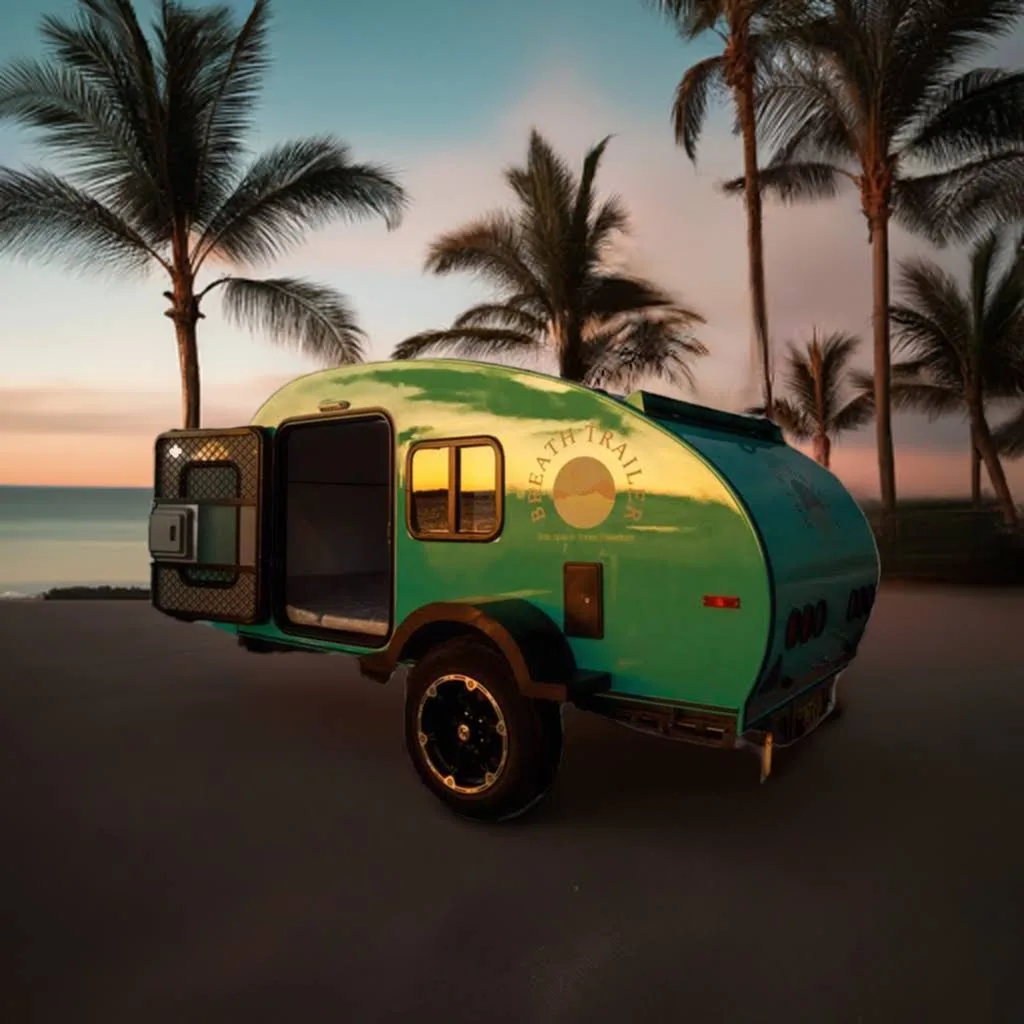
A couple spending a long weekend off-grid will use 30 to 60 litres of water every single day — for drinking, cooking, washing up and rinsing after a swim. Most buyers obsess over battery capacity and solar wattage, then discover at a remote bush site that the water system was the weak link all along.
This guide covers every component of a camper trailer water system: fresh-water tank sizing, 12V pump selection, grey water rules by state, tank sanitisation, and how the four Breath Trailer models compare. By the end you will know exactly what size tanks you need, which free-camping sites require a sealed grey tank, and how to keep your water safe for months between trips.
The Three Water Systems in a Camper Trailer
Every plumbed camper trailer has up to three separate circuits:
| System | What it carries | Stored in | Released at |
|---|---|---|---|
| Fresh water | Potable drinking/cooking/washing water | Onboard fresh tank (usually polyethylene) | Tap, shower, toilet flush |
| Grey water | Wastewater from sinks, showers and hand-washing | Onboard grey tank or portable tote | Dump point / grey water drain |
| Black water | Toilet waste | Cassette toilet cartridge or composting unit | Dump point / composting bin |
Budget and mid-range teardrops carry fresh and grey water only. The Breath Max adds an interior toilet with a cassette-style black water solution. The system you need depends entirely on how long you plan to stay off-grid and what the land manager requires at your target campsite.
Fresh Water Tank Sizing: How Much Do You Actually Need?
Daily consumption per person
The standard planning figure used by Australian land managers for self-containment calculations is 10 litres per person per day for drinking and basic cooking. Real-world usage with a shower, washing up and handwashing runs considerably higher:
| Activity | Water used |
|---|---|
| Drinking (2 people) | 4–6 L/day |
| Cooking and rinsing | 4–6 L/day |
| Washing up (no sink-fill, efficient) | 6–10 L/day |
| Quick outdoor shower (3 min, 8 L/min pump) | 24 L/person |
| Hand-washing (×4 per day, 2 people) | 4 L/day |
| Couple total (no shower) | 18–26 L/day |
| Couple total (one shower each) | 50–75 L/day |
An 80-litre fresh tank — standard across all Breath Trailer models — gives a couple 3–4 days without a shower, or 1–2 days with daily showers. Extend your range by collecting water at rest areas, state forest taps, and caravan park amenity blocks along the way.
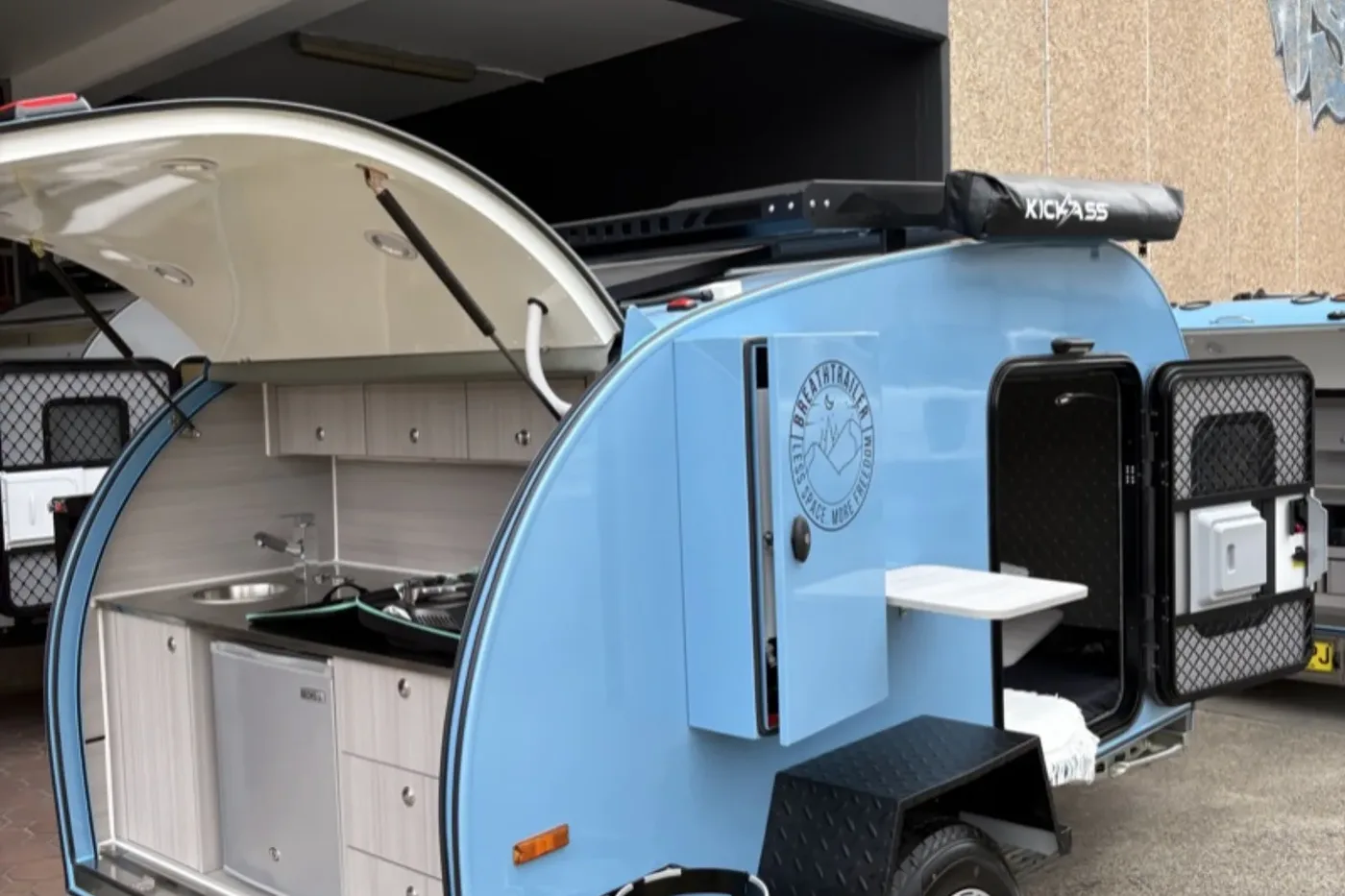
Cooking, washing up and handwashing all draw on the same fresh tank, so size it for real daily use.
Choosing tank capacity
| Tank size | Typical use case | Days off-grid (couple, no shower) |
|---|---|---|
| 40–60 L | Weekend trips, caravan parks | 1.5–2.5 days |
| 80 L | Extended weekenders, most free camps | 3–4 days |
| 100–120 L | Multi-week touring, lap of Australia | 4–6 days |
| 2 × 80 L | Full self-containment + shower | 3–4 days (fresh + grey stored separately) |
Carrying more fresh water also adds weight: water weighs 1 kg per litre. An 80-litre tank full weighs 80 kg — a significant fraction of the payload on a 700 kg tare trailer. Always calculate your loaded trailer weight before filling to the brim for an outback run.
12V Water Pump Systems
Diaphragm pump vs accumulator
A 12V diaphragm pump is the standard in Australian camper trailers. It activates automatically when pressure drops — the moment you open a tap — and cuts out when the tap is closed. Flow rates typically run 10–12 L/min at 35–45 psi.
The problem: without a pressure vessel, the pump cycles on-and-off every time you use the tap, creating a stutter in the flow and wearing the pump faster. An accumulator tank (a small pressure vessel, usually 0.5–1 litre) stores a charge of pressurised water so the pump only fires every 8–12 seconds of flow rather than continuously. This is the quieter, longer-lived setup.
| Feature | Pump only | Pump + accumulator |
|---|---|---|
| Typical cost | $80–$180 | $140–$250 |
| Noise | Audible cycling | Near-silent tap operation |
| Pump duty cycle | High (short bursts) | Low (longer, fewer cycles) |
| Flow consistency | Slight pulsation | Even, domestic-like flow |
| Fault risk | Pump wear faster | Accumulator adds one extra fitting |
Most factory-fitted systems in the $30k–$50k price bracket include an accumulator as standard. If yours does not, fitting one is a straightforward two-fitting job (inlet, outlet, Tee from the cold-water line).

The 12V pump sits under the bench and switches on the moment a tap opens.
Pump draw and battery impact
A standard 10 L/min 12V pump draws approximately 7–10 A at 12V (84–120 W) while running. In practice, a couple washing up and making drinks uses the pump for perhaps 3–5 minutes in total per day — a draw of 0.35–0.83 Ah, trivial compared to the fridge (40–60 Ah/day) or the power system as a whole. Pump power is rarely the battery sizing constraint; your off-grid power system matters far more.
Grey Water Rules in Australia
Why the rules matter
Tipping grey water onto the ground contaminates soil and waterways, attracts insects and vermin, and is increasingly banned at free-camping areas. The rules are enforced by land managers (National Parks, state forests, councils, DBCA, NT Parks), not by a single national law — so the requirement varies by location.
What “self-contained” means for grey water
The CMCA’s self-contained vehicle standard requires that all waste is retained within the vehicle and nothing is left on site. For grey water specifically, this means:
- A sealed onboard grey tank (not a bucket, not an open drum)
- The drain outlet must have a closeable tap — not a permanent open drain
- The tank must be emptied only at a designated dump point
Many free-camping sites in Australia now post CMCA self-containment requirements, and rangers in high-use areas like Cape York and Fraser Island actively enforce them.
State-by-state grey water rules
| State/Territory | National Park rule | State forest rule | Crown land / rest area |
|---|---|---|---|
| NSW | Sealed tank required at starred sites; no discharge near waterways | Sealed tank required at managed sites | Sealed tank preferred; local council rules vary |
| VIC | No grey water disposal in national parks | Sealed tank at many Parks Vic sites | Broad acre crown land: generally unrestricted |
| QLD | No discharge in national parks | Sealed tank at QPWS managed sites | Sealed tank at QPWS rest areas |
| WA | Sealed tank required (DBCA managed sites) | Sealed tank at DBCA forest sites | Remote crown land: generally unrestricted |
| SA | Sealed tank required (DEWNR managed sites) | Sealed tank at ForestrySA sites | Council-dependent |
| NT | No discharge at NT Parks sites | N/A (limited state forest) | Remote areas: generally unrestricted |
| TAS | Sealed tank at PWS campgrounds | Sealed tank at Forestry Tasmania sites | Sealed tank strongly recommended |
| ACT | Sealed tank required | N/A | N/A |
Rule of thumb: if you’re at any managed campsite in Australia, assume a sealed grey tank is required. If you’re on a private station or truly remote crown land with no signage, regulations are typically less strict — but Leave No Trace principles still apply.
Grey Water Tank Sizing
The maths
A couple using a sink, cooking and handwashing (no shower) generates approximately 15–25 litres of grey water per day. Add a 3-minute external shower (8 L/min pump) and that rises to 40–55 litres per day.
| Trip scenario | Grey water generated | Tank needed |
|---|---|---|
| Weekend (2 nights, no shower) | 30–50 L | 40 L minimum |
| Long weekend (3 nights, occasional shower) | 60–90 L | 80 L preferred |
| Week, one shower per day | 280–385 L | Full 80 L tank + dump mid-trip |
| Week, no shower (external facilities) | 105–175 L | 40–80 L + dump mid-trip |
Dump points are widely distributed on major touring routes. Apps like WikiCamps ($9.99 one-time), CamperMate (free), and the Dump Point Finder locate them by current GPS position. Many roadhouses, caravan parks and rest areas on National Highway routes have free dump facilities.
Grey water hose sizing
Industry recommendation for onboard grey tanks:
- Inlet hose (from sink/shower): 32–38 mm internal diameter to handle fast, dirty flow including food scraps and soap residue
- Outlet hose (to dump point): 25 mm is adequate as it drains under gravity
Undersized inlet hoses block quickly with food particles. If your installer uses standard garden hose (12 mm) on the inlet, budget for a refit.
Water Tank Sanitisation: Keeping Your Fresh Water Safe
An unsanitised fresh water tank that sits full through winter — or even through a 6-week storage period in summer — can develop bacterial colonies that make the water unsafe to drink. Algae growth is visible as a green tint; bacterial contamination is invisible.
Standard Australian bleach method
Use unscented household bleach at 4% available chlorine (common supermarket bleach):
Dose: 12 mL of bleach per 100 litres of tank capacity
- Essential / Plus / Ultra (80 L tank): ~10 mL bleach
- Max (120 L fresh tank): ~14 mL bleach
- Ultra second tank (80 L grey — sanitise only when used as fresh): ~10 mL bleach
Sanitisation procedure
- Empty the tank completely
- Mix the correct bleach dose in 5 L of water, then pour into the tank
- Fill the tank to capacity with potable water
- Open every tap in the system (kitchen, shower if present) and run until you smell chlorine
- Leave the solution in the system for at least 4 hours (overnight preferred)
- Drain the tank fully via the outlet tap
- Refill twice with fresh water and drain to flush (the chlorine smell dissipates quickly)
Frequency: every 3–6 months, or immediately after any period where the tank sat unused and full for more than 4 weeks.
Never use scented bleach or products containing additives — they leave residue and can make water taste unpleasant. And never mix bleach with vinegar: the combination produces chlorine gas.
Additional maintenance
- Annual internal inspection: shine a torch through the filler neck and look for scale, sediment or green tinting
- Filter: a 20-micron inline sediment filter on the outlet line prevents sediment from reaching the pump impeller — replace the cartridge every 6 months
- For detailed maintenance schedules covering bearings, seals and electrical systems alongside water, see the camper trailer maintenance guide
Hot Water: The Shower Question
Fresh and grey water tanks are only half the equation. For a proper hot shower, you need a hot water system integrated into the plumbing — either a gas instantaneous unit (like the Joolca HOTTAP at $499–$699, or Truma AquaGo at $2,399 installed), a 12V/240V compact unit, or a diesel-heated option for shoulder seasons and alpine trips.
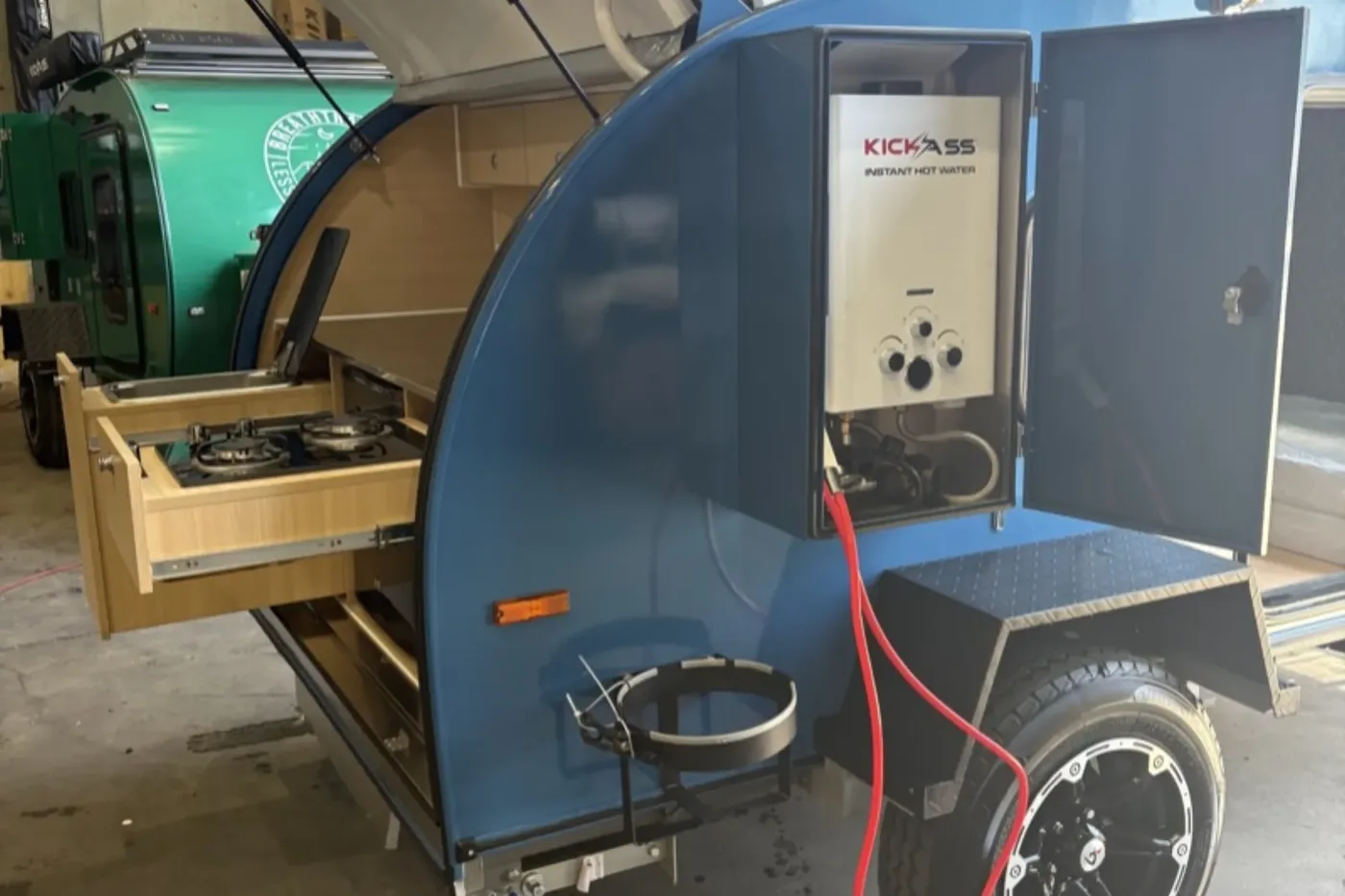
An instantaneous gas unit heats water only while it flows, drawing from the same fresh tank.
The Breath Ultra includes an external shower as standard — cold rinse only. The Breath Max includes an interior shower with full hot water plumbing, making it the only Breath Trailer fully equipped for cold mornings in the field. For a full breakdown of hot water system types, prices and off-grid compatibility, see the dedicated camper trailer hot water guide.
Breath Trailer Water Systems: Per-Model Comparison
| Model | Fresh water | Grey water | External shower | Interior shower | Hot water |
|---|---|---|---|---|---|
| Essential ($23,320) | 80 L | None standard | No | No | Optional add-on |
| Plus ($29,766) | 80 L | None standard | No | No | Optional add-on |
| Ultra ($34,749) | 80 L | 80 L (sealed onboard) | Yes (cold) | No | Optional add-on |
| Max ($42,900) | 120 L | 70 L (sealed onboard) | No | Yes (hot + cold) | Included |
What this means for self-containment access:
- Essential and Plus: bring a portable 40-litre grey water tote ($50–$150) to access self-contained-only sites. The fresh 80 L tank covers 3–4 days for a couple without showering.
- Ultra: factory self-contained (grey tank onboard + external shower). Access all CMCA-certified sites out of the box. The external shower is cold — pair with a portable gas hot water unit for warm showers.
- Max: fully self-contained with interior bathroom and hot water. Best choice for extended touring, free-camping access and travellers who won’t compromise on comfort.
All four models are eligible for Breath Trailer finance options. Compare all four models side-by-side at the comparison page.
Dump Point Network: Where to Empty Your Grey Tank
A full 80 L grey tank needs to be emptied approximately every 1.5–3 days on a trip with daily showers. Dump points are far more common than most new campers realise:
- Caravan parks: virtually every caravan park in Australia has a dump point, usually free for guests
- CMCA dump points: the CMCA network includes 500+ member-site locations with dump facilities, plus 1,400+ listed dump points nationally through CamperMate
- Roadhouses on National Highway routes: most major roadhouses offer dump facilities, often free with a fuel purchase
- Rest areas: many state-maintained rest areas on major routes include dump points, particularly in QLD, WA and SA
Find them with:
- WikiCamps Australia ($9.99 one-time, offline maps)
- CamperMate (free, real-time listings)
- CMCA Member App (CMCA members)
On a lap of Australia or a multi-week tour, you will never be more than 150–200 km from a dump point on sealed roads. The system becomes more constrained in remote areas (Cape York, Gibb River Road) — where self-containment capacity and conservative water use matter most.
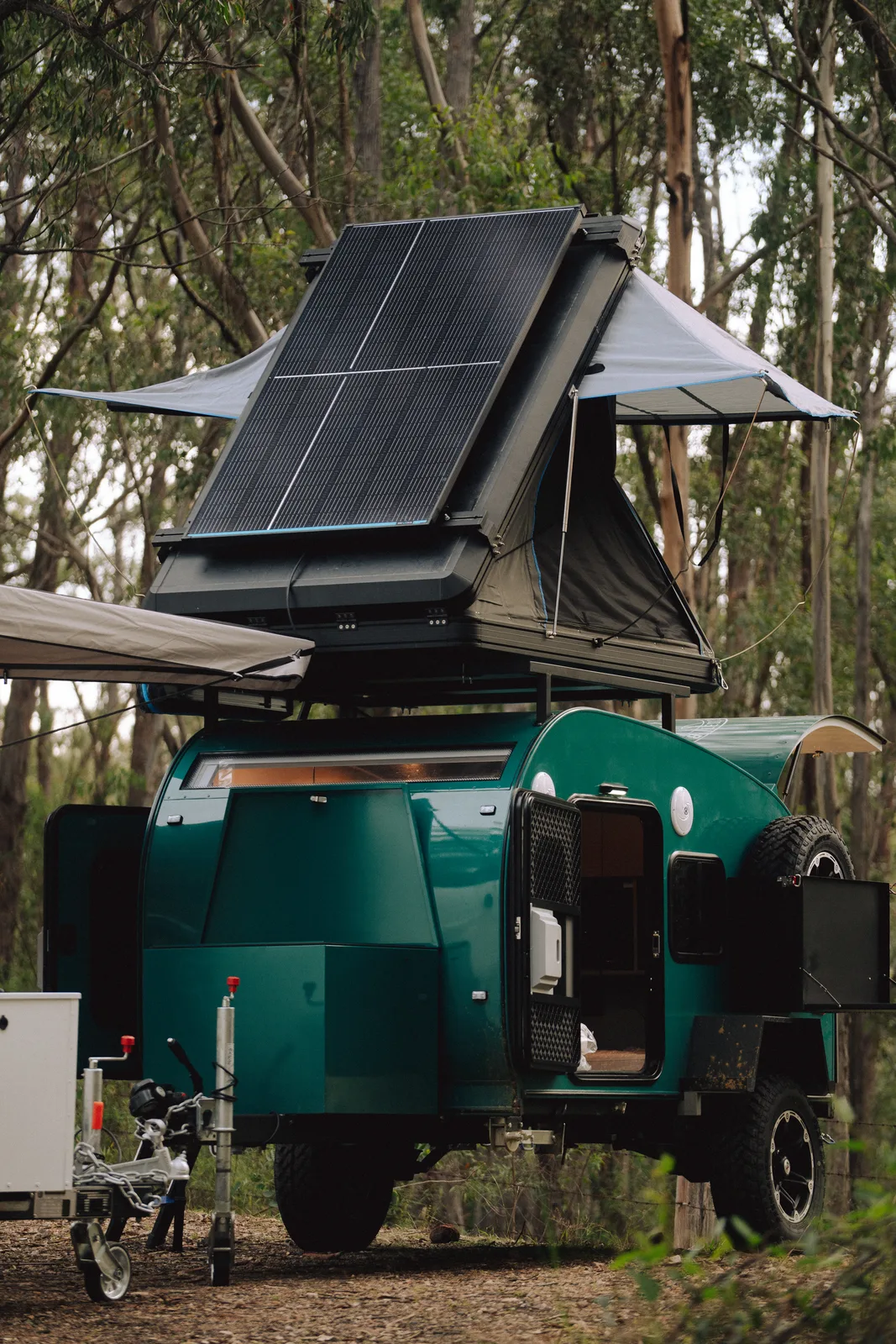
Away from sealed routes, dump points thin out and tank capacity decides how long you can stay.
FAQ
How much water does a teardrop camper hold? The Essential, Plus and Ultra each carry an 80 L fresh water tank as standard, and the Ultra adds a second 80 L grey water tank (total 160 L across both tanks). The Max carries a larger 120 L fresh tank plus a 70 L grey tank (190 L in total). Some models from other manufacturers carry 40–100 L depending on size and price point.
Do I need a grey water tank for free camping in Australia? It depends on the land manager. National parks and many state-managed free camps now require a sealed onboard grey water tank that empties only at a dump point. Remote crown land and private stations are generally less regulated, but Leave No Trace principles still apply. The free-camping guide has a full state-by-state breakdown.
Can I add a grey water tank to the Breath Essential or Plus? Breath Trailer can discuss custom additions at order time, and a portable 40-litre grey water tote ($50–$150) from most caravan accessories shops meets the practical requirement at most self-contained sites. It connects to the sink drain outlet and sits in the external kitchen bay when in use.
How long can an 80 L tank last for two people? Without showering: 3–4 days (18–26 L/day). With one shower each per day: 1–2 days (50–75 L/day). Combining conservative water habits — a 3-minute shower, rinsing dishes in a basin rather than running the tap — can stretch an 80 L tank to 4–5 days even with a daily rinse.
How do I know if my water is safe to drink? Sanitise the tank with the bleach method above before each trip and every 3–6 months during storage. If the tank has been sitting for more than 6 weeks, flush and resanitise before drinking. For bore water or creek fills, use a 1-micron ceramic filter on the outlet line or treat with a campsite water purification tablet.
Does the Breath Max have a flush toilet? The Breath Max includes an interior toilet and shower. The toilet setup uses a cassette-style arrangement — the cassette empties at a dump point. This is the only Breath Trailer model with a self-contained interior bathroom.
Recommended Reading
- The Complete Camper Trailer Off-Grid Setup — water, power, fridge, gas and comms as one integrated system
- Self-Contained Campers: What the Rules Require — the CMCA standard, grey water definitions and which sites require it
- Free Camping Australia Guide — apps, state rules and 6 land types that allow free camping
- Camper Trailer Maintenance Guide — annual service schedule including water tank sanitisation and seal checks
- How Long Can You Stay Off-Grid? — water, power, food and grey water as limiting factors for trip length
Ready to see the water system in person? Book a custom trailer tour and we will walk you through the plumbing, the tanks and every fitting before you commit.