What Happens Before a Trailer Leaves Our Sydney Workshop (2026)
Fit-out, electrical connection, testing and handover: what happens to a trailer in the weeks before delivery.
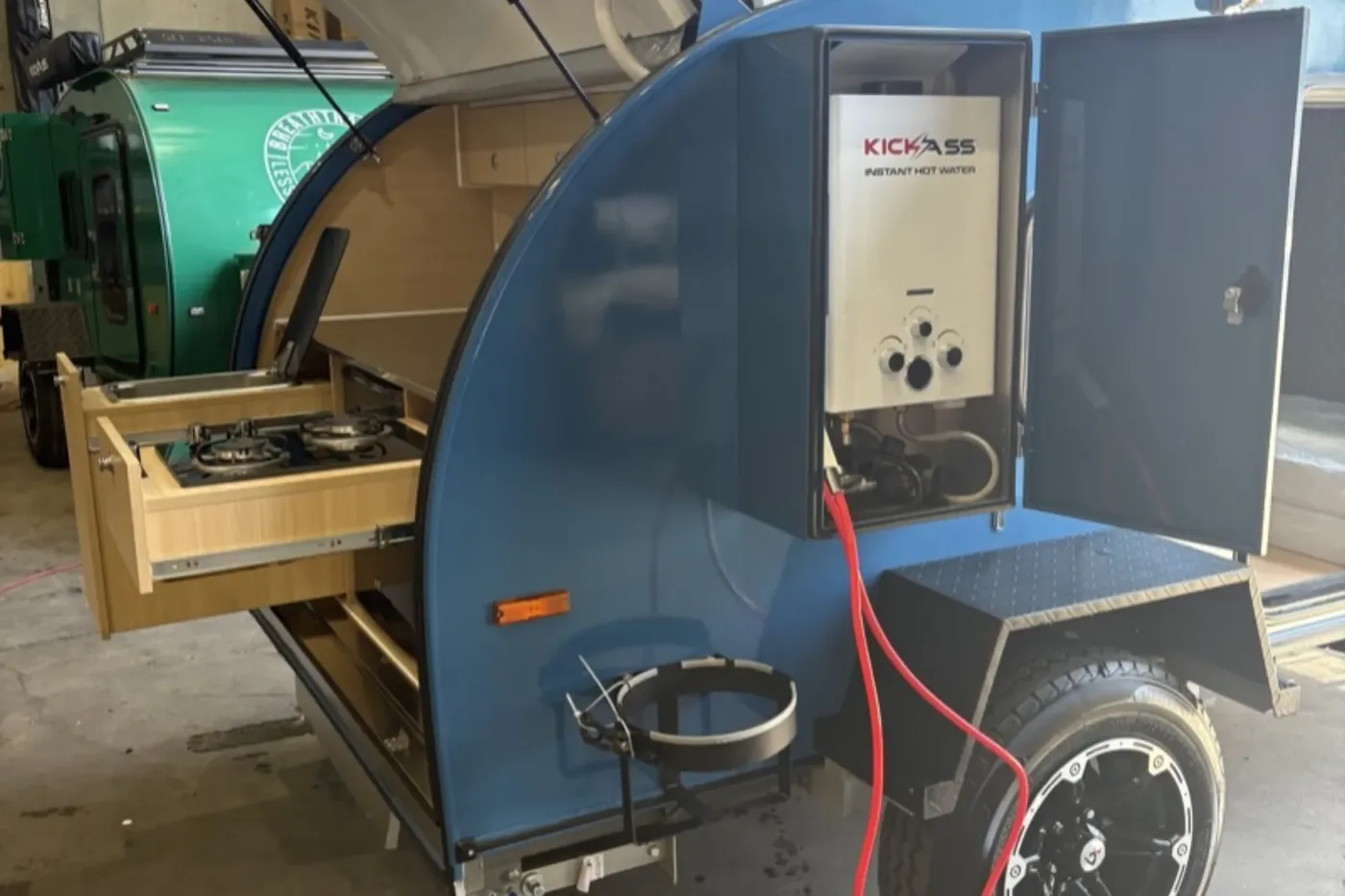
Most buyers spend months researching teardrop campers — reading reviews, comparing specs, watching YouTube videos. Then, on handover day, they back the trailer out of the workshop, drive four hours to their first campsite, and find out whether the builder actually did their job.
In the Australian camper trailer industry, the ACCC received over 1,200 product safety reports related to caravans and trailers between 2020 and 2025. The overwhelming majority of failures — water ingress, electrical faults, coupling wear, brake maladjustment — are preventable at the manufacturing stage. They reach customers because not enough happens between “finished build” and “handed over.”
At Breath Trailer, every trailer goes through an 8-stage pre-delivery inspection (PDI) before it leaves our Sydney workshop. The process takes approximately one full working day per unit. Nothing leaves until the checklist is signed off. This article walks through each stage, explains what we’re checking and why it matters, and tells you exactly what to expect on handover day.
Why the Pre-Delivery Inspection Is More Important Than Most Buyers Realise
A camper trailer is not a static product — it is a rolling vehicle that operates at highway speeds while carrying sleeping occupants in an Australian climate. That means:
- Electrical systems run 12V loads from batteries, solar, and DC-DC chargers under alternating temperature and vibration cycles. Loose terminals and undersized cables that pass a static bench test can fail at 100 km/h on corrugated dirt.
- Brake systems must comply with ADR 38/04 — trailers with a GTM over 750 kg require electric brakes, and those over 2,000 kg require a breakaway system. An uncalibrated brake controller means the trailer may not stop.
- Couplings and safety chains are the sole mechanical connection between a 1-tonne trailer and the tow vehicle. Micro-cracks in the drawbar are invisible to the naked eye at a 30-second glance.
- Seals and water ingress are almost impossible to detect without a deliberate water test. A 1 mm gap around a rear hatch seal can admit enough moisture in a single rain event to damage the interior and void the warranty.
This is why a thorough PDI — not just a visual walk-around — is the difference between a premium product and an expensive problem. It is also why quality control standards matter before purchase, and why professional installation of electrical and brake systems is non-negotiable.
The 8-Stage Pre-Delivery Process at Breath Trailer
The table below summarises all 8 stages. The sections that follow explain each one in depth.
| Stage | System | What We Inspect | Pass Criteria |
|---|---|---|---|
| 1 | Chassis and frame | Welds, galvanising, drawbar, coupling | No cracks, uniform hot-dip galv, coupling torque correct |
| 2 | Electrical wiring | Cable sizing, fusing, AS/NZS 3001.2 compliance | All circuits within spec, fusing within 15 cm of battery |
| 3 | 12V and appliance function | Battery, solar MPPT, fridge, lights, USB, DC-DC | All loads operate at rated current; no voltage drop >5% |
| 4 | Brakes and coupling | GTM vs ADR38 threshold, brake controller calibration, safety chains | Brake drag confirmed; chains crossed and correct length |
| 5 | Suspension and wheels | Spring rate, wheel bearings, tyre age and pressure | Bearings packed, correct pressure, no flat spots |
| 6 | Seals and water systems | Hatch seals, windows, water tank, pump, grey water outlet | No ingress after 10-minute hose test; tank full-cycle |
| 7 | Compliance and paperwork | Compliance plate, VIN, registration, owner manual | Plate riveted (not glued), rego confirmed, manual complete |
| 8 | Livability walk-through | Bed, kitchen, storage, awning rail, all locks | All mechanisms operate; cupboards lock for travel |
Stage 1: Chassis, Drawbar and Coupling Inspection
The chassis is the foundation of everything. We start underneath.
What we check:
Every weld on the main chassis rails, cross-members, and drawbar is visually inspected under direct lighting. We are looking for incomplete fusion, porosity (small holes in the weld bead), and undercut along the toe — the three most common weld defects in trailer manufacturing, each of which concentrates stress and creates a fatigue failure point.
Hot-dip galvanising (the zinc-coating process that protects steel from corrosion) is verified for coverage and adhesion. A correctly galvanised trailer should show a uniform matte-silver or spangled finish with no bare patches, particularly at cut edges and drilled holes. We pay close attention to the drawbar tube ends and suspension mounts — the areas most likely to see corrosion begin on coastal or tropical routes.
The coupling head is tested for lateral play (should be near zero), locking mechanism spring tension, and correct ball clearance for a 50 mm towball. Safety chain attachment points are load-tested by hand.
Why it matters:
Drawbar failure is rare but catastrophic. The 2023 Transport for NSW light trailer and caravan pre-delivery checklist specifically requires inspectors to confirm that “no coupling component is loose or cracked, and the drawbar is securely mounted and not cracked.” We verify this before NSW registration is applied for.
Stage 2: Electrical Wiring — AS/NZS 3001.2:2022 Compliance
Australia’s recreational vehicle electrical standard — AS/NZS 3001.2:2022 — came into full effect on 18 November 2023. Every Breath Trailer that leaves our workshop is built to this standard.
The wiring audit is methodical:
| AS/NZS 3001.2:2022 Requirement | How We Verify |
|---|---|
| Fuse or circuit breaker within 15 cm of battery positive | Measure with tape; photograph for record |
| Each solar panel individually fused before parallel connection | Trace from panel to combiner box |
| Inverter AC output protected by RCD | Test RCD trip with tester tool |
| Battery complies with AS IEC 62619 | Check cell documentation against spec sheet |
| All wiring protected from chafing and moisture | Visual trace of every run; grommet check at penetrations |
| Heavy items (battery, water tank) rated for 8G impact loads | Verify mounting bracket spec and fastener torque |
We also verify that every circuit is correctly labelled, that the main 12V isolator is accessible without tools, and that no wiring runs within 25 mm of a heat source without adequate sleeving.
The cable sizing trap:
Undersized cables are the single most common installation error in the Australian trailer industry. A 6 mm² cable run at 30 A will operate within spec for short bursts, but continuous loading — a compressor fridge drawing current for eight hours in summer — pushes the cable temperature into a range that progressively degrades insulation. We calculate maximum continuous current for every circuit, cross-reference against the voltage drop table in AS/NZS 3001.2, and confirm the installed cable gauge matches or exceeds the calculation.
Stage 3: 12V Functional Testing — Every Load, Every Circuit
After wiring verification comes a live function test. This is different from compliance checking — it is about confirming that every load on the trailer operates correctly under real current draw.
What we test:
- Battery bank: Full charge cycle to 100%; resting voltage and internal resistance measured
- Solar MPPT controller: Correct charging profile selected (LiFePO4 or AGM depending on fitted battery); absorption voltage confirmed
- DC-DC charger: Charges correctly from a simulated alternator source; correct charging stage activation verified
- Fridge: Powered on and temperature confirmed reaching setpoint within 30 minutes
- LED lighting (interior and exterior): Every circuit switched individually; no flickering or voltage drop
- 12V USB and cigarette outlets: Load-tested at 3A
- Water pump: Flow rate checked; no air-lock; no leaks at all fittings
- Brake controller connection: Trailer-side connector checked for correct pin-out
Any circuit that fails the functional test is diagnosed, repaired, and re-tested before the trailer proceeds to Stage 4.
Stage 4: Brakes, Coupling and ADR 38/04 Compliance
Electric brakes are mandatory on any Australian trailer with a GTM (Gross Trailer Mass) exceeding 750 kg. Here is how that applies to our four models:
| Model | Tare | ATM | GTM | ADR38 Brake Requirement |
|---|---|---|---|---|
| Essential | 700 kg | 850 kg | ~700 kg | Electric brakes required at >750 kg GTM — borderline at payload; verify on load |
| Plus | 800 kg | 1,050 kg | ~850 kg | Electric brakes required |
| Ultra | 900 kg | 1,150 kg | ~950 kg | Electric brakes required |
| Max | 1,200 kg | 1,450 kg | ~1,200 kg | Electric brakes + breakaway battery required |
For the full technical background on ADR38 thresholds and brake controller types, see our complete guide to electric brakes for camper trailers.
Our PDI brake test:
We connect a calibrated test brake controller and apply the manual override fully while the trailer is on flat ground. A correctly adjusted electric brake system should prevent wheel rotation under manual override — if you can push the trailer with the brakes manually applied, the adjustment is incorrect.
We then check brake shoe-to-drum clearance (should be 0.15–0.25 mm on new drums), confirm the breakaway battery on the Max is fully charged and will trigger if the coupler separates, and verify that safety chains are correctly crossed under the drawbar at sufficient length to prevent the drawbar grounding on the road if the coupler releases — but not so long they would drag.
Stage 5: Suspension, Wheels and Tyres
Suspension failure accounts for a disproportionate share of outback camper trailer breakdowns. We inspect every suspension component before sign-off — the detail of why this matters is covered in our suspension guide.
PDI checks:
- Independent coil suspension: Shock absorbers checked for leaks; spring preload visually uniform side-to-side
- Wheel bearings: Freshly packed with NLGI 2 lithium-based grease; play measured at the hub (should be zero or barely perceptible); dust cap/bearing protector fitted correctly. For the full bearing service spec, see why wheel bearings matter on a camper trailer
- Tyres: Inflation pressure set to the placard specification; tread depth measured (legal minimum in Australia is 1.5 mm; we ship with new tyres at minimum 7 mm); tyre date code checked — any tyre older than 5 years from the date code is replaced regardless of appearance
- Spare tyre: Pressure matched to road tyres; wheel nut torque correct; carrier secure
A note on flat spots:
Trailers that have sat on the assembly floor for more than six weeks can develop a slight flat spot on the tyre contact patch. We rotate each tyre before the final inspection to confirm no vibration at the wheel.
Stage 6: Seals, Water Systems and Water Ingress Test
Water ingress is the leading cause of structural damage in Australian camper trailers — and the one most commonly missed at delivery. We run two distinct checks.
The hose test:
With all hatches, windows, and rear doors closed, we run a garden hose over the exterior at progressively higher flow — starting from the base and working upward to the roofline — for a minimum of 10 minutes. An inspector inside the trailer checks every seal line with a torch. Any damp patch triggers investigation and re-seal before the test is repeated.
The water system test:
| System | Test | Pass Criteria |
|---|---|---|
| Fresh water tank | Fill to 100%, pressurise pump, run all outlets | No leak at any fitting or tank seam |
| Water pump | Measure flow rate at kitchen tap | Minimum 6 L/min at 40 psi |
| Hot water system (Ultra/Max) | Full heat cycle to 60°C | Thermostat cuts at correct temp; P&T valve functional |
| Grey water tank (Max) | Fill via sink drain; drain via dump valve | Dump valve seals; no backflow |
| External shower (Ultra/Max) | Operate at full pressure | Hose coils correctly in bay; quick-connect secure |
A clean water tank is also sanitised with a dilute sodium hypochlorite solution (125 mL of household bleach per 1,000 L of tank capacity) and thoroughly flushed before delivery — the same procedure we recommend for annual maintenance.
Stage 7: Compliance Plate, Registration and Documentation
Every Breath Trailer is a registered vehicle in New South Wales and requires a compliance plate under the Road Vehicle Standards Act 2018 (RVSA).
What the compliance plate confirms:
- Manufacturer name and ABN
- Vehicle Identification Number (VIN)
- ATM (Aggregate Trailer Mass)
- GTM (Gross Trailer Mass)
- Tare weight (actual measured weight, not a nominal spec)
- Year of manufacture
Per the RVSA, compliance plates must be permanently riveted — not glued, not screwed with removable fasteners. The certification statement “This trailer was manufactured to comply with the Road Vehicle Standards Act 2018” is embossed in characters not less than 2.5 mm high. We verify the rivets, the legibility, and the accuracy of every figure against the as-built specification sheet before sign-off.
Documentation handed over with every trailer:
- NSW Certificate of Registration (or the paperwork to complete interstate registration)
- Owner’s manual with all system specifications
- Battery, solar and fridge warranty documentation
- Wiring diagram and circuit labels
- Pre-delivery inspection checklist (signed and dated by the technician)
- Service schedule card
Stage 8: Final Livability Walk-Through
The last stage is the most overlooked in the industry and among the most important for day-to-day use. We walk through the trailer as a customer would on their first night.
Livability checklist:
- Queen bed deploys and collapses within 60 seconds (all Breath Trailer models)
- All overhead storage latches lock for travel — test by tilting the trailer and confirming nothing opens
- Kitchen draws lock individually; slide mechanism smooth with no binding
- Awning rail secure; mounting bolts torqued; awning attachment points confirmed with customer’s preferred awning type
- All LED interior lighting switches are accessible from the bed
- Climate control (Max and Ultra): fan and any fitted air conditioning unit cycles correctly
- Interior bathroom (Max only): toilet flush mechanism tested; shower thermostat calibrated; door seal confirmed watertight
What to Expect on Handover Day
Handover at our Sydney workshop takes 60–90 minutes for most models, and up to 2 hours for the Max with interior bathroom. We cover every system in detail and strongly encourage customers to take notes or record the walkthrough on their phone.
What to bring:
| Item | Why |
|---|---|
| Tow vehicle (fully fuelled) | We will hitch and tow-check before you leave the carpark |
| GVM and tow ball download documentation | Confirm your vehicle is within GCM |
| Electric brake controller (already fitted) | We will calibrate it on-site |
| Driver’s licence | Required for rego transfer paperwork |
| Printed order confirmation and spec list | Cross-check every ordered option before driving away |
| Phone/tablet for photos and video | Record the walk-through for reference |
Before you leave, we apply full brake controller activation in the carpark. If the trailer moves freely, something is wrong and we will resolve it before you leave. If it holds, you’re ready to go.
We also recommend booking a viewing appointment before your delivery date so your first encounter with the trailer is not on handover day — you will ask better questions and feel more confident with the systems.
How the Sydney Workshop Advantage Works in Practice
Our single-site Sydney manufacture has a direct effect on PDI quality. When the team that built your trailer is the same team walking you through the handover, accountability is not theoretical. Every component was designed to integrate with every other component — the wiring was not added by a third party after the chassis was delivered, the suspension geometry was not set by a different workshop to the body builder.
This is fundamentally different from the import-and-upfit model common in the sub-$20,000 price bracket — where a chassis arrives from one country, a body shell from another, and local fitout happens under price pressure. For a thorough comparison of what separates premium manufacture from budget builds, see what makes a premium camper trailer different.
Our 3–4 month lead time is partly a function of this process. We do not hold finished stock waiting for a buyer; each trailer is built to order, which means the PDI technician is working on a unit that already has a name on it. That changes the motivation.
FAQ
How long does the pre-delivery inspection take?
Approximately one full working day per trailer. Stages 1–4 (structural and electrical) typically take 4–5 hours; the water test, functional testing and paperwork take the remaining time.
Can I attend the pre-delivery inspection?
Yes, and we encourage it. Contact our team to arrange a workshop visit during the final stages. Buyers who attend the PDI almost always have fewer questions on handover day, and occasionally catch minor preferences — such as awning rail height or cable routing — that we can adjust before completion.
What happens if the PDI finds a fault?
The trailer does not leave the workshop until the fault is rectified and the relevant stage is re-tested. This has delayed deliveries on rare occasions — typically by one to three business days. We notify the customer immediately when this happens and provide a revised handover date.
Does the PDI cover the tow vehicle’s brake controller calibration?
We calibrate the brake controller output for the trailer’s fitted brake system as part of Stage 4. However, the gain setting on your specific vehicle’s controller may need a small adjustment once loaded with your gear — we provide clear instructions for this on handover day.
Is the PDI checklist provided to the buyer?
Yes. Every buyer receives a signed and dated copy of the completed PDI checklist as part of their delivery documentation pack. Keep this document with your purchase records for any warranty claim. Breath Trailer provides a 2-year structural warranty; cover for other components is set out separately in the purchase documentation.
What’s the difference between the PDI and an ongoing service schedule?
The PDI is a one-off pre-delivery quality verification. Once you own the trailer, we recommend a scheduled maintenance programme — wheel bearing repack at 10,000 km or 12 months (whichever comes first), water tank sanitise annually, and a full electrical check at 24 months.
The Pre-Delivery Process Is a Commitment, Not a Brochure Point
Every category of common camper trailer problem — water ingress, bearing failure, brake faults, loose wiring — is preventable at the manufacturing and pre-delivery stage. The reason those problems still reach customers in large numbers across the industry is that the pre-delivery step is treated as optional, rushed, or performed by untrained staff under pressure to hit a delivery volume.
We treat the PDI as the last line of defence before a customer’s gear — and in some cases their family — is carried at highway speed in the Australian outback. The process is long, methodical, and unglamorous. That is exactly the point.
If you are comparing Breath Trailer against other options, we encourage you to ask every manufacturer or dealer the same question: “Can I see your pre-delivery checklist?” If the answer is vague, that is information.
Ready to see a Breath Trailer in person before your handover date? Book a viewing appointment at our Sydney workshop, or compare all four models to find the right specification for your adventures.