Why More Australians Are Choosing Off-Road Camper Trailers Over Caravans (2026)
Access, tow weight and running costs: the three reasons the shift is happening, with the numbers behind each.
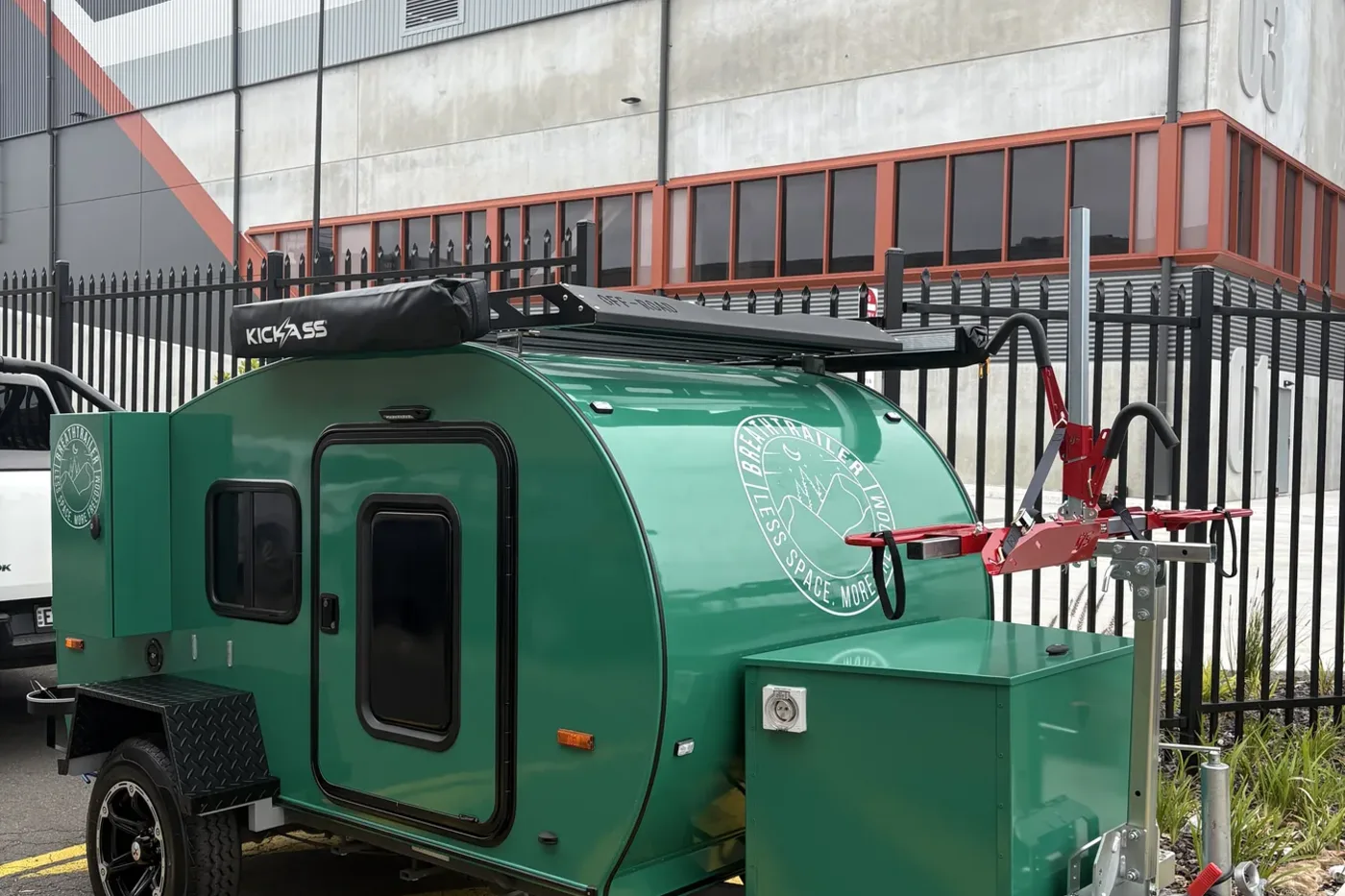
Australians took 17.3 million caravan and camping trips in 2025, spending $12.6 billion in regional communities — up 32% on pre-pandemic levels and still rising. The nation now has more than 901,000 registered recreational vehicles, an all-time record. And yet, inside that headline number, a quiet shift is underway.
The fastest-growing segment is not the prestige hybrid caravan. It is not the Chinese-built pop-top flooding the entry-level market. It is the off-road teardrop camper — a category that barely existed in meaningful volume a decade ago, and that now represents the default choice for an enormous slice of Australian couples, grey nomads, and solo travellers who want real adventure without a six-figure commitment.
This article explains the seven forces driving that shift, with real numbers from the 2025–26 industry data, so you can decide whether the trend applies to your situation.
The Numbers Behind the Shift
Before explaining why, it helps to understand how much. According to the Caravan Industry Association of Australia’s 2025 State of the Industry report, total RV registrations grew 27% since 2019 — but within the towable category, the sub-1,000 kg hard-shell trailer segment that includes teardrops grew at more than twice the rate of full-size caravans.
The Mordor Intelligence market forecast projects the Australian RV market will expand from USD 2.94 billion in 2025 to USD 4.64 billion by 2031 — a CAGR of 7.9%. Lightweight towables are identified as the primary growth driver for that entire forecast.
ProductReview.com.au, which aggregates verified buyer reviews, shows camper trailers averaging 4.4/5 stars from over 2,000 reviews in 2026, compared to caravans at 3.9/5 — with quality-gap complaints concentrated on sub-$60k imported vans.
The shift is real, it is quantifiable, and it is accelerating.
Force 1: The Tow Vehicle Problem
Australia has an SUV addiction. The Toyota RAV4 is the nation’s best-selling passenger vehicle. The Mazda CX-5, Hyundai Tucson, Kia Sportage, and Ford Escape fill the top-ten sales charts. These vehicles are excellent family cars — and not suited to towing a traditional caravan of any meaningful size.
| Tow vehicle category | Braked towing capacity | Can tow a teardrop? | Can tow a mid-size caravan? |
|---|---|---|---|
| Small SUV (RAV4, CX-5, Tucson) | 1,500–2,000 kg | ✅ Yes (700–1,200 kg ATM) | ❌ No (caravan ATM 1,800–3,000 kg) |
| Large SUV (Kluger, Prado, Everest) | 2,000–3,000 kg | ✅ Yes | ✅ Borderline |
| Diesel ute (HiLux, Ranger, LC70) | 3,000–3,500 kg | ✅ Yes | ✅ Yes |
| New diesel ute cost (2026) | — | Not required | $60,000–$100,000+ |
The maths is brutal. A couple buying a mid-range caravan for $60,000 may also need to buy a diesel ute — adding another $60,000–$80,000 to the capital outlay. If they already own a RAV4, the choice is either to sell it and buy a ute, or buy a camper trailer the RAV4 can handle.
Most people — and the market data confirms this — choose the second option.
The Breath Essential at 700 kg is within the towing capacity of virtually every mid-size SUV sold in Australia today. The Breath Max at 1,200 kg is within reach of large SUVs like the Toyota Kluger or Ford Everest. No ute required.
Force 2: Fuel Costs — The Number Nobody Shows You on the Showroom Floor
Fuel is the running cost that caravan salespeople almost never lead with. It should be the first thing you calculate.
| Trailer type | Tare weight | Fuel penalty | Annual fuel cost* | 5-year fuel cost |
|---|---|---|---|---|
| No trailer | 0 kg | 0 L/100 km | $0 | $0 |
| Teardrop Essential/Plus | 700–800 kg | +1.5 L/100 km | ~$900 | ~$4,500 |
| Teardrop Ultra/Max | 900–1,200 kg | +2.0 L/100 km | ~$1,200 | ~$6,000 |
| Pop-top caravan | 1,400–1,800 kg | +3.5 L/100 km | ~$2,100 | ~$10,500 |
| Full-size caravan | 2,000–2,800 kg | +5.0 L/100 km | ~$3,000 | ~$15,000 |
*Assumes 15,000 km/year towing at AU$2.10/L average (2026 national average petrol price).
The difference between towing a teardrop and towing a full-size caravan is approximately $2,000 per year in fuel alone. Over five years, that is $10,000 — more than half the purchase price of a Breath Essential. When petrol spiked above $2.30 per litre during 2024–25, the fuel equation became impossible to ignore. Anecdotally, that period drove a surge in enquiries for lighter-end models from buyers who had been considering a caravan and who ran the numbers for the first time.
Force 3: Off-Road Access — Where You Can Actually Go
Australia has more than 500 national parks, 8,000+ kilometres of unsealed outback tracks, and 59,000 kilometres of coastline — most of it accessible only via dirt roads or rough 4WD tracks. But access is not just about vehicle capability. It is also about weight limits on the track itself.
Many national park campgrounds, council-managed free-camping areas, and outback station stays impose load limits on access roads. A 2,500 kg caravan on a corrugated red-dirt track is hard on the road, hard on the caravan, and hard on whatever relationship exists between the driver and the tow ball.
Off-road teardrops change the access equation:
- Ground clearance: A purpose-built off-road teardrop sits 200–300 mm off the ground, comparable to the 4WD towing it.
- Independent suspension: Al-Ko and Cruisemaster trailing-arm setups on quality teardrops absorb corrugations that would rack a standard caravan chassis.
- Track ratings: Most off-road teardrops are rated for roads accessible to a standard 4WD. Very few traditional caravans — at any price point — honestly match this.
- Combination weight limits: Some station tracks carry legal limits of 4,500 kg gross combination weight. A RAV4 (1,900 kg) + Breath Max (1,200 kg) = 3,100 kg combined. A HiLux (2,200 kg) + mid-size caravan (2,000 kg) = 4,200 kg — close to the ceiling before you have loaded either vehicle.
For a complete guide to suspension ratings, ground clearance, and which tracks each Breath model is rated for, see the off-road teardrop camper Australia guide.
Force 4: Freedom Camping and the Self-Containment Advantage
Australia’s free-camping network has never been larger. Apps like WikiCamps, Camps Australia Wide, and Campermate now list over 15,000 free or low-cost sites around the country. But access to most of them requires genuine self-containment: a permanently fitted toilet, grey water containment, and onboard potable water — not a portable toilet in a bag.
The rules are also tightening fast. From February 2026, Central Coast Council introduced a $15/night permit with self-contained vehicles only and a three-night stay maximum. National parks across every state are moving toward full self-containment requirements. The trend at state and local government level is clear: non-self-contained vehicles are being progressively squeezed out of the best free sites.
| Camping type | Typical nightly cost | Self-contained required? | Breath model access |
|---|---|---|---|
| Council free camp (self-cont. only) | $0 | Yes | Breath Max |
| National park campground | $10–$30 | Increasingly yes | Breath Max |
| State forest free camp | $0 | Varies by state | All models |
| Station stay | $20–$50 | Often no | All models |
| Caravan park (powered site) | $40–$80 | No | All models |
The Breath Max at $39,000 is the only teardrop under $50,000 in Australia with a full interior bathroom, cassette toilet, and grey water tank — making it self-contained in the eyes of virtually every land manager in the country. For retirees planning a Big Lap, this distinction is worth at least $15,000 over a year-long trip: the difference between paying for a powered site every night and pulling off the highway at a free river camp whenever the mood strikes.
For the full state-by-state self-containment rules, see our self-contained camper Australia guide.
Force 5: Setup Time — The Hidden Quality-of-Life Driver
Nobody leads with setup time in the marketing material. They should.
A traditional caravan at a campsite: unhitch, extend the stabiliser legs (minimum four), connect to power, level with chocks, wind out the awning, possibly rig annexe walls if you brought them. Then reverse the process on departure. Most experienced caravan owners can complete this in 30–45 minutes each way. First-timers take longer — sometimes much longer.
A hard-shell teardrop at a campsite: back in, drop the three stabiliser legs, open the rear galley hatch. Done. Three to five minutes, every time. No canvas walls, no poles, no pegging, no guy ropes. If rain arrives at 2 am and you need to relocate, you can be towing within ten minutes.
| Setup task | Hard-shell teardrop | Canvas folding camper | Traditional caravan |
|---|---|---|---|
| Unhitch and stabilise | 2 min | 5 min | 10 min |
| Erect sleeping area | — | 10–30 min (canvas) | — (permanent interior) |
| Set up kitchen | 1 min (open hatch) | 5 min | 5–10 min |
| Connect power/water | Optional | Optional | 10 min (if powered site) |
| Total | 3–5 min | 15–40 min | 30–60 min |
This does not sound significant until you have done ten weekends and a partner has decided they hate camping because the setup is more stressful than the relaxation is worth. Setup time is one of the most underrated factors in how often a rig actually gets used — and frequency of use drives real per-night cost more than almost any other variable.
Force 6: The 5-Year Total Cost of Ownership — Honest Numbers
Every buyer focuses on the sticker price. Almost nobody models the total cost of ownership over a realistic period.
| Cost category | Teardrop (Breath Plus) | Mid-size caravan (entry Jayco) |
|---|---|---|
| Purchase price | $25,740 | $55,000 |
| Annual registration (NSW, ~800 kg ATM) | $220 | $500 |
| Annual insurance (agreed value) | $450 | $900 |
| Annual fuel penalty (15,000 km towing) | $900 | $2,100 |
| Annual servicing | $200 | $600 |
| Storage (commercial, if no garage) | $0 | $2,400 |
| Annual running cost | ~$1,770 | ~$6,500 |
| 5-year running cost | ~$8,850 | ~$32,500 |
| Total 5-year cost | ~$34,590 | ~$87,500 |
| Resale value (5 yrs, ~70% retained) | ~$18,000 | ~$27,000 |
| Net 5-year cost | ~$16,590 | ~$60,500 |
The net five-year cost difference is approximately $44,000 — enough to fund four to five years of annual camping holidays, or a substantial renovation to the home you actually live in. This analysis does not even account for the tow vehicle cost difference if you do not already own a diesel ute. Add $60,000–$80,000 for a capable ute you would not otherwise need, and the gap widens to over $100,000 on a genuine like-for-like comparison.
For a breakdown of how purchase price, depreciation, and running costs combine into a real-world cost-per-night figure, see our teardrop camper resale value guide.
Force 7: Garage Storage — The Annual Cost Nobody Budgets For
A full-size caravan typically runs 7.5 to 9 metres from bumper to hitch ball. A residential double garage is typically 5.5 metres wide and 6 metres deep. Most caravans physically cannot fit in a residential garage.
Commercial trailer storage in Sydney, Melbourne, and Brisbane runs $180 to $350 per month depending on location and whether the bay is undercover. Over five years, that is $10,800 to $21,000 in storage costs alone — costs that most buyers do not model before signing the finance paperwork.
A Breath Essential or Plus at 4.4 metres (including the drawbar) fits comfortably in a standard double garage. The Max at 5.1 metres fits with room to spare. No storage fees. No retrieval trip the Friday before you want to leave. No wondering whether someone has backed into it at the storage yard.
When a Caravan Still Makes Sense
An honest comparison acknowledges that caravans are not the wrong answer for everyone. There are genuine scenarios where a caravan is the better tool.
Large families needing multiple fixed beds. No teardrop — at any price — comfortably sleeps more than two adults. A $55,000 family caravan with a bunk room is a practical solution for a family of four that a $39,000 Breath Max cannot replicate.
Full-time road residents. If you are living on the road for twelve months and need to work from the trailer, store several months of clothing, and maintain a residential-size kitchen, a caravan wins on interior volume. 2.4 metres of internal height, slide-out lounges, and full-size appliances justify the scale for genuine full-timers.
Buyers who already own a diesel ute. If you are a tradie with a HiLux or a farmer with a LandCruiser 70 Series, the tow vehicle problem does not exist for you. A well-specified off-road caravan in the $70,000–$90,000 range delivers interior comfort that a teardrop at any price cannot fully match.
Mobility considerations. Caravan interiors allow standing movement throughout. Some older adults or people with mobility issues find the compact format of most teardrops physically unsuitable for extended stays — though the Breath Max with its 2.1 m interior headroom addresses this significantly.
Why Hard-Shell Teardrops Are Different to Folding Camper Trailers
The shift we are describing is not uniform across all camper trailer types. The market distinguishes sharply:
Canvas folding camper trailers (Austrack, CUB, Jackson): Forward-fold or soft-floor designs. Lower purchase price ($12,000–$35,000), more sleeping capacity, but canvas re-proofing is an ongoing maintenance cost, setup takes 15–40 minutes, and they cannot be used in heavy rain without consequence.
Hard-shell teardrops (Breath Trailer, JAG, Tucana): Fibreglass or composite rigid shell. Immediate weather protection at arrival, 3–5 minute setup, no canvas to maintain. Higher purchase price for equivalent off-road spec, but the running-cost gap versus canvas is negligible and the lifestyle gap is substantial.
The conversion away from caravans is concentrated in the hard-shell teardrop segment specifically. Buyers who formerly chose a caravan for the “real shelter in all conditions” feeling are moving to hard-shell teardrops — not canvas folders. The value proposition (a real bed, real weather protection, real off-road access, genuine self-containment in the Max) is what is driving the conversion.
For a direct head-to-head between teardrops and canvas folding camper trailers, see the teardrop vs camper trailer Australia guide.
The Four Breath Trailer Models — Which Fits Which Buyer?
| Model | ATM | Key feature | Best for |
|---|---|---|---|
| Essential — $19,990 | 700 kg | Lightest: any mid-size SUV | Weekend warriors, budget-conscious couples |
| Plus — $25,740 | 800 kg | 12V fridge included, awning rail | Frequent campers, road-trippers |
| Ultra — $30,290 | 900 kg | External hot shower, larger water tank | Off-grid adventurers, coastal touring |
| Max — $39,000 | 1,200 kg | Interior bathroom, 2.1 m headroom, self-contained | Big Lap, free camping, grey nomads |
All four share the same DNA: aluminium composite hard shell, independent trailing-arm suspension, and 5-minute setup. The progression is about capability and comfort — not a different product philosophy.
Compare all four models side by side →
Frequently Asked Questions
Why are off-road camper trailers growing faster than caravans in Australia?
The primary drivers are tow vehicle compatibility, fuel savings, and freedom camping access. Most Australians own mid-size SUVs that cannot legally tow a mid-range caravan. Off-road teardrops are towable by virtually every modern SUV, add only 1.5–2 L/100 km in fuel use (versus 4–6 L for caravans), and the Max model qualifies for self-containment free camping. The five-year total cost of ownership gap is typically $40,000–$60,000 in favour of the teardrop.
Are teardrop campers genuinely good for off-road use?
Yes — purpose-built off-road teardrops have independent suspension (Al-Ko or Cruisemaster), adequate ground clearance, and are rated for 4WD-accessible tracks. They are not built for severe rock-crawling or deep river crossings, but for the gravel roads, corrugated outback tracks, and national park sites that represent 95% of Australian adventure camping, they are more than adequate.
What is the main disadvantage of a teardrop camper compared to a caravan?
Interior living space. Teardrops sleep two in a fixed queen bed, but the indoor floor area is compact. You cannot stand in most teardrop models (exception: the Breath Max has 2.1 m of interior headroom), and there is no separate lounge. If you need to comfortably house four people or work from your rig for extended periods, a caravan offers more liveable volume.
How much does a quality off-road camper trailer cost in Australia in 2026?
Off-road teardrops from established Australian manufacturers start at approximately $19,990 for entry-level models and reach $39,000 for fully self-contained models with interior bathrooms. Budget canvas folding camper trailers are available from $12,000–$20,000 but require more setup time and canvas maintenance.
Do I need a special tow vehicle for an off-road teardrop camper?
No. Most modern mid-size SUVs — including the Toyota RAV4, Mazda CX-5, Hyundai Tucson, and Kia Sportage — have a braked towing capacity of 1,500–2,000 kg, which covers all four Breath Trailer models. Always confirm your specific vehicle’s rated capacity in the owner’s manual or on the compliance plate.
Can a teardrop camper handle a year-long Big Lap of Australia?
Yes — with the right model. The Breath Max is self-contained (interior cassette toilet, hot shower, grey water tank), has 2.1 m of standing headroom, a fixed queen bed, and a full external galley kitchen with a 50 L fridge. Hundreds of Breath customers complete extended outback trips in the Max. The trade-off versus a full-size caravan is interior living space on wet-weather days — the flip side is five-minute setup, sub-$1,200/year running cost, and access to free campsites that a caravan cannot reach.
The Bottom Line
The shift from caravans to off-road teardrop campers in Australia is not driven by marketing. It is driven by maths: tow vehicle compatibility, fuel savings, storage practicality, self-containment freedom, and a five-year total cost of ownership that is often $40,000–$60,000 lower. For the majority of Australian couples, grey nomads, and solo travellers, the question has shifted from whether to buy a teardrop to which model suits their camping style.
If you are still comparing options, the Breath Trailer model comparison page shows all four models side by side with full specs, weights, and inclusions. If you are ready to see them in person, factory viewings in Sydney take 90 minutes and include a walkthrough of every model with no pressure to buy on the day.
Recommended Reading
- Caravan vs Teardrop Camper Australia: The Honest 2026 Comparison
- Off-Road Teardrop Camper Australia: Tracks, Suspension and Model Specs
- Self-Contained Camper Australia: Rules, Free Camping and Which Trailers Qualify
- Teardrop Camper Weight Australia: ATM, GTM, Payload and Towing Capacity
- Camper Trailer Towing Guide Australia: Everything You Need to Know