Why Suspension Matters on Your Off-Road Camper Trailer (Australia 2026)
How each handles corrugations, what it does to your gear, and which one your travel style actually needs.
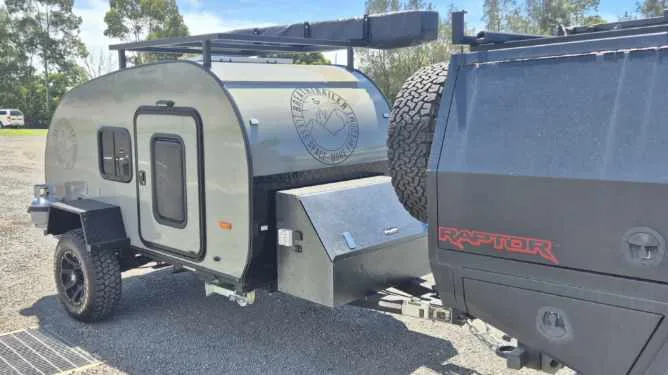
A corrugated outback track delivers roughly 1,300 individual impacts per kilometre to your trailer. At 60 km/h, the shock forces hitting your chassis are four times more violent than at 30 km/h. At 80 km/h, they’re seven times worse. More wheels fall off trailers on Australian outback tracks than from any other vehicle type — not because of blowouts, but because the suspension gives up first.
Yet when most buyers compare camper trailers side by side, they focus on the kitchen bench, the lithium battery capacity, or the colour chart. Suspension — the system that determines whether your trailer arrives intact after 300 km of corrugations — gets a single line in the spec sheet, if it appears at all.
This guide changes that. Whether you’re planning a Gibb River Road crossing, a lap of Australia, or regular weekend runs on unsealed NSW high country tracks, here’s exactly what you need to understand about camper trailer suspension before you buy.
The Australian Off-Road Reality: What Your Trailer Actually Faces
Australia’s road network includes over 700,000 km of unsealed tracks, many corrugated for hundreds of kilometres at a stretch. The Gibb River Road (WA), Birdsville Track (SA/QLD), Cape York Peninsula (QLD), and Strzelecki Track (SA) are among the most punishing in the world for towed trailers.
Corrugations form when vehicles drive repeatedly over soft surfaces, creating regular ridges 5–20 cm high, spaced roughly 30–60 cm apart. The problem is resonance: the spacing of corrugations often matches the natural frequency of a leaf spring suspension system, causing it to “skip” across the surface rather than absorb the impact — a phenomenon felt as violent vibration that loosens every fitting in the trailer over time.
What begins as a rattling cutlery drawer becomes, over a long trip, cracked brackets, broken shock absorber mounts, loose 12V connections, water ingress through stressed seals, and — in the worst cases — wheel separation from a failed axle hub.
The practical consequence: suspension isn’t a comfort feature. On serious Australian outback routes, it is the single biggest determinant of whether your trip ends at camp or at the side of a remote track.
How Trailer Suspension Actually Works
Unlike tow vehicle suspension, trailer suspension has to perform two simultaneous jobs:
- Absorb impacts from the road surface (bumps, corrugations, water crossings)
- Maintain traction by keeping the wheel in contact with the ground — critical for braking and stability
Suspension consists of three functional components working together:
- Spring element (leaf spring pack, coil spring, or airbag): absorbs the initial impact energy
- Damper / shock absorber: controls how fast the spring compresses and rebounds — without it, the trailer bounces uncontrollably
- Linkage / arm: determines the path the wheel follows as it travels; the geometry of wheel movement
On most factory trailers, all three components are present but sized for smooth roads. On serious off-road trailers, each is upgraded for greater wheel travel, stronger damping, and geometry that keeps the tyre at the correct angle to the surface even at full suspension compression.
The Three Main Suspension Systems for Australian Camper Trailers
1. Leaf Spring Suspension
How it works: A pack of graduated steel “leaves” is clamped together and mounted to the axle. The natural flex of the pack provides the spring action; a separate shock absorber controls rebound.
Pros:
- Lowest cost to manufacture and repair
- Any bush mechanic can service it with basic tools
- Proven, simple, durable under moderate loads
- Progressive spring rate — stiffens as load increases
Cons:
- Limited wheel travel (typically 50–80 mm)
- Interleaf friction causes “stiction” — small impacts below the friction threshold aren’t absorbed at all, transmitted directly to the chassis
- Solid axle means both wheels are linked: one wheel hitting a bump influences the other side
- Prone to resonance on corrugated roads at common touring speeds
Best for: Road and light gravel use; trailers under 750 kg; buyers who rarely venture beyond formed gravel roads.
2. Independent Coil Suspension (Trailing Arm / Radius Arm)
How it works: Each wheel is mounted on its own arm, connected to the chassis independently. A coil spring and shock absorber work as a paired unit per wheel. Because the wheels are not linked by a solid axle, one wheel can drop into a rut without disturbing the other.
Pros:
- Significantly greater wheel travel (150–250 mm on quality systems)
- No cross-wheel interference — the trailer tracks far more smoothly over uneven terrain
- Superior corrugation performance: wheels maintain ground contact through the resonance frequencies that defeat leaf springs
- Quieter and more comfortable ride; less structural fatigue on the chassis
- Often fitted with heavy-duty shock absorbers offering fade resistance
Cons:
- Higher upfront cost
- More complex to service; requires a suspension specialist
- Marginally heavier than leaf spring equivalents
Best for: Serious outback touring; corrugated roads; tracks with significant ruts, rock steps, and water crossings.
Key Australian brands: Cruisemaster (XT, ATX range), ARV Suspensions (Titan range), Alpha Suspensions, Couplemate.
3. Airbag / Air Suspension
How it works: Rubber air bellows replace steel springs. Pressure in the bellows is adjustable via an onboard compressor, allowing the trailer’s ride height and spring rate to be tuned to the load and road conditions dynamically.
Pros:
- Infinite tunability: adjust for full load, empty load, rough tracks, or tarmac
- Can level the trailer on uneven ground without a level block
- Excellent ride quality on rough roads when correctly set up
Cons:
- Highest cost: a quality airbag suspension kit fitted to an Australian camper trailer typically costs $4,500–$7,000+ installed
- Requires a working air compressor and reliable power supply
- More points of failure than mechanical systems — a burst bellows in a remote location is a significant problem
- Needs regular attention to check for air leaks, bellows wear, and fittings
Best for: Luxury off-road tourers and full-time travellers willing to invest in setup and ongoing maintenance; trailers used frequently on varying terrain with variable load.
Suspension Comparison Table
| Feature | Leaf Spring | Independent Coil | Airbag |
|---|---|---|---|
| Wheel travel | 50–80 mm | 150–250 mm | 100–200 mm (adjustable) |
| Corrugation performance | Fair | Excellent | Excellent |
| Typical installed cost (AU$) | Standard (included) | $1,415–$8,900+ | $4,500–$7,000+ |
| Serviceability | Any mechanic | Suspension specialist | Specialist + air system knowledge |
| Weight penalty | Nil (baseline) | +15–30 kg | +10–25 kg |
| Load adjustability | No | No (spring tuning at build) | Yes (dynamic) |
| Remote failure risk | Low | Low–Medium | Medium–High |
| Suitable terrain | Formed gravel | Formed + outback tracks | All terrain (when maintained) |
Wheel Travel: The Number Buyers Ignore
Wheel travel is the total distance a wheel can move vertically — from full droop (wheel hanging down) to full compression (wheel pushed fully into the undercarriage). It is the single most useful number for comparing off-road capability — yet it rarely appears on a manufacturer’s spec sheet.
Why does it matter? Consider a 200 mm rock step in a dry creek crossing. With 70 mm of leaf spring travel, the wheel contacts the rock and the trailer body begins to lift — transferring the full load impact through the chassis to every fitting, weld, and cabinet in the trailer. With 200 mm of independent coil travel, the wheel rises over the obstacle while the trailer body barely moves.
Greater wheel travel also helps on corrugated roads: the longer the travel, the more suspension can absorb before it “tops out” and begins transmitting raw road shock directly into the structure.
| Suspension Type | Typical Wheel Travel | Notes |
|---|---|---|
| Budget leaf spring | 50–70 mm | Common on trailers under $15k |
| Standard leaf spring | 70–100 mm | Most mid-range camper trailers |
| Budget independent coil | 100–150 mm | Entry off-road independent setups |
| Cruisemaster XT (coil) | 200–250 mm | Industry benchmark in Australia |
| Airbag independent | 150–200 mm | Varies with pressure setting |
When reviewing a trailer’s suspension, ask the manufacturer or salesperson directly: “What is the total wheel travel in millimetres?” If they can’t answer, treat it as a red flag — they don’t fully understand what they’ve fitted.
What Australian Outback Routes Actually Demand
Different trips require different suspension specifications. Here’s a practical guide based on route difficulty:
| Route / Terrain | Min Wheel Travel | Recommended Type |
|---|---|---|
| Formed gravel, occasional corrugations (up to 300 km) | 70 mm | Leaf spring adequate |
| Long corrugated outback tracks (Birdsville, Strzelecki) | 150 mm | Independent coil |
| Cape York (creek crossings, rock steps) | 200 mm | Independent coil + DO35 coupling |
| Gibb River Road, WA (corrugations + creek crossings) | 200 mm+ | Independent coil + DO35 coupling |
| Simpson Desert (dune crossings, soft sand, remote) | 200 mm+ | Independent coil, full self-contained |
| Mixed touring (majority tarmac, some gravel) | 100 mm | Light independent or quality leaf spring |
The Coupling: Suspension’s Overlooked Partner
The hitch coupling between your tow vehicle and trailer is the first line of suspension defence — yet it’s rarely included in suspension discussions.
A standard 50 mm ball coupling is rigid in all but one plane. On rough terrain, the result is that your tow vehicle and trailer fight each other through corners, creek crossings, and corrugations — placing enormous stress on the trailer tongue and your tow bar.
The Cruisemaster DO35 — the industry-standard articulating hitch in Australia — changes this completely. It pivots 360° sideways and 70° vertically, allowing the trailer to move independently of the tow vehicle. The result is less stress on both vehicles and dramatically better stability on rough terrain.
The DO35 is rated to 3.5 tonnes ATM and includes a 3-year warranty. For any trailer intended for serious off-road use, an articulating hitch is as important as the suspension itself. If you’re considering a trailer for genuine outback travel, check whether it comes fitted with a DO35 or an equivalent articulating coupling.
Teardrop Campers and Suspension: The Weight Advantage
Teardrop campers have a natural suspension advantage: they’re lighter. The Breath Essential at 700 kg tare, for example, places less dynamic load on its suspension at any given speed than a 2,500 kg family caravan — meaning the suspension is working with a better mass-to-travel ratio from the outset.
Impact force is a function of both speed and mass. A 700 kg teardrop hitting a corrugation at 60 km/h generates roughly one-quarter the suspension load of a 2,800 kg caravan at the same speed. Less mass means existing suspension components work less hard, absorb more effectively, and wear more slowly. This is one reason a well-specified teardrop often handles corrugated tracks better than a heavier, more elaborate rig — despite having simpler suspension.
That said, lighter trailers can be more susceptible to resonance on corrugations because the natural frequency of a lighter suspended mass sometimes aligns more closely with corrugation spacing at common touring speeds. This is why shock absorber damping rate matters even on lightweight teardrops — a worn or undersized damper on a light trailer will bounce more, not less, than on a heavy one.
For a full breakdown of how weight affects towing and handling, see our teardrop camper weight guide.
Breath Trailer Suspension: What You’re Getting
All four Breath Trailer models are fitted with a leaf spring system with torsion suspension as standard, mounted on a hot-dip zinc-galvanised steel chassis — the same treatment used on commercial trailers and marine equipment for maximum corrosion resistance in Australian conditions.
The galvanised chassis is particularly important: the most common suspension failure mode on Australian camper trailers isn’t the springs or shocks themselves, but rust compromising spring hanger mounts and axle brackets on trailers built with paint-only chassis protection. Hot-dip galvanising eliminates this entire failure class — a meaningful advantage on coastal touring routes and anywhere salt or moisture accelerates corrosion.
| Model | Tare Weight | ATM | Suspension | Wheels |
|---|---|---|---|---|
| Breath Essential | 700 kg | 1,500 kg | Leaf spring + torsion | 15” alloy |
| Breath Plus | 800 kg | 1,500 kg | Leaf spring + torsion | 15” alloy |
| Breath Ultra | 900 kg | 1,500 kg | Leaf spring + torsion | 15” alloy |
| Breath Max | 1,200 kg | 1,900 kg | Leaf spring + torsion | 15” alloy |
The torsion element works alongside the leaf spring pack to provide additional initial damping, reducing the interleaf stick-slip friction that makes basic leaf spring setups harsh on small repeated inputs — a common trait of corrugated roads. This combination suits the mixed-terrain use that characterises most Breath Trailer customer trips: national parks, forest roads, coastal campgrounds, and regular highway driving.
For buyers planning extended outback trips — the Gibb River Road, Cape York Peninsula, or the red centre — discuss your specific itinerary with the Breath Trailer team at booking. Suspension upgrades can be specified for particular models and travel plans.
Should You Upgrade or Retrofit Suspension?
If you’ve bought (or are considering buying) a trailer with leaf spring suspension and you’re planning more serious off-road trips, a suspension retrofit is possible — but it’s a significant undertaking.
A full independent coil suspension retrofit on a single-axle trailer typically involves:
- Removing the existing leaf springs and axle
- Welding or bolting new independent arm mounts to the chassis (requires engineering assessment)
- Installing the new arms, springs, and shocks
- Geometry alignment and a full test drive
Cost estimate (2026 AU$):
| Level | Kit Cost | Labour | Total Installed |
|---|---|---|---|
| Entry independent coil | $1,415–$2,500 | $1,200–$1,800 | ~$3,000–$4,500 |
| Mid-range (Cruisemaster XT) | $3,500–$5,500 | $1,500–$2,500 | ~$5,500–$8,000 |
| Premium airbag independent | $4,500–$7,000 | $2,000–$3,000 | ~$6,500–$10,000 |
Whether this makes financial sense depends on the trailer’s age, value, and intended use. For a well-built new trailer with a galvanised chassis, a suspension upgrade can add genuine capability. For a budget trailer with marginal chassis construction, upgrading the suspension often reveals that the chassis itself isn’t rated for the forces better suspension exposes — stress concentrations at welds, inadequate cross-member sizing, and sub-standard spring hanger mounts.
If this is your situation, starting with a trailer that has the correct specification from the factory is often the more economical decision. The pre-purchase inspection checklist covers the key checks to run before buying any used or new trailer.
Signs of Suspension Problems to Watch For
Suspension health is a core part of any regular camper trailer maintenance schedule. Here’s what to inspect specifically for suspension condition:
| Check | What to Look For | Interval |
|---|---|---|
| Spring sag | Trailer sits noticeably lower at one corner when unloaded | Every 6 months |
| Shock absorber leaks | Oil film on shock body below the top seal | Every 6 months |
| Bounce test | Push hard on each corner — should return once, not bounce repeatedly | Every 6 months |
| Leaf spring cracking | Hairline cracks in the leaves, especially at the ends of outer leaves | Annual |
| U-bolt torque | Loose U-bolts allow the axle to rotate, causing handling anomalies | Annual |
| Spring hanger rust | Surface rust cosmetic; through-rust on mounting points is serious | Annual |
| Wheel bearing play | Grab wheel at 9 and 3 o’clock, check for lateral movement | 6–12 months |
| Bush condition | Cracked or missing rubber bushes at shock mounts and spring eyes | Annual |
Shock absorbers on a camper trailer are frequently underestimated. A shock that has lost 30% of its damping feels similar in a static bounce test — but on corrugated roads it allows the spring to oscillate 3–4 times per impact rather than once, multiplying the structural stress on every fitting with every hit.
How Suspension Interacts with the Rest of Your Trailer
Suspension doesn’t operate in isolation. On a teardrop, the quality of your suspension interacts with several other systems:
Towing stability: Worn or undersized dampers allow the trailer to develop lateral oscillation (“snaking”) that amplifies progressively at speed. Quality shock absorbers and an articulating coupling prevent this. For a complete overview of towing dynamics, see our camper trailer towing guide.
12V electrical system: Every corrugation impact is a vibration cycle transmitted through the chassis. Poor suspension means that vibration reaches battery terminals, DC-DC charger mounts, fuse holders, and solar charge controller brackets. Most intermittent 12V faults on outback trips trace back to vibration-loosened terminals or cracked solder joints — all preventable with better damping.
Water tank integrity: Repeated impact loads on an 80–160L water tank can crack internal baffles and stress hose connections at the fittings. Good suspension reduces the peak load per impact by absorbing it gradually rather than transmitting it as a sharp spike.
Load distribution: The further forward you load a trailer — closer to the coupling — the better the tow-ball download for stability, and the more efficiently the suspension works. Getting this wrong can overload one axle end even within the trailer’s overall ATM. See the weight and payload guide for the full picture.
Frequently Asked Questions
Do I need independent suspension for weekend camping in Australia? For most camping in national parks, forest roads, and coastal campgrounds — no. A quality leaf spring setup on a galvanised chassis handles these conditions well. Independent suspension becomes important when your trips regularly include extended sections of corrugated outback track (50+ km at a stretch) or remote routes like Cape York, the Gibb River Road, or the Birdsville Track.
Can I retrofit independent suspension to any trailer? Mechanically yes, but not always economically. The chassis must be strong enough to handle the forces that independent suspension exposes. If the chassis construction is marginal, upgrading the suspension often reveals weaknesses in spring hanger welds, cross-member sizing, or axle bracket mounts. A retrofit on a solid-chassis trailer typically costs $3,000–$8,500 installed.
What’s the difference between torsion suspension and leaf spring? A pure torsion axle uses rubber inside a steel tube to absorb impacts — no separate shock absorbers required. They’re smooth, quiet, and self-contained, but can’t easily be retuned for different loads, and rubber fatigue reduces performance over time. Many Australian trailers use a combination: leaf spring for load-bearing with a torsion element for initial damping — as Breath Trailer does across its range.
Does suspension type affect fuel economy while towing? Slightly, yes. Smoother-riding suspension reduces aerodynamic buffeting and limits “hunting” (the trailer pushing and pulling the vehicle on undulations), which can improve fuel economy by 2–5% on corrugated sections. The larger gains, however, come from correct tyre pressures, load distribution, and tow vehicle choice rather than suspension type alone.
Is an articulating hitch (DO35) worth the extra cost? For any serious off-road use, yes. An articulating hitch prevents the trailer and tow vehicle from fighting each other through rough corners and creek crossings, reducing stress on both and improving overall stability. The Cruisemaster DO35 is the Australian market standard: approximately $800–$1,100 fitted. For any trailer going beyond formed gravel roads, it’s not optional.
Will a suspension upgrade affect my trailer’s warranty? Generally no, provided the work is carried out by a qualified trailer engineer and doesn’t compromise the chassis structure. Obtain a compliance statement from the installer and notify your insurer. The modification should be noted on your trailer’s compliance plate or covered by a supplementary engineering certificate.
The Bottom Line
Suspension is the most consequential specification on any off-road camper trailer — and the most consistently underexplored at the point of sale. For Australian buyers planning serious outback use, the priorities stack in this order:
- Chassis quality first: hot-dip galvanised steel protects the entire suspension mounting structure from rust failure — the most common long-term failure mode on Australian camper trailers
- Shock absorber quality second: even on leaf spring trailers, quality dampers transform corrugation performance by preventing resonance buildup
- Suspension type third: independent coil for regular outback trips; quality leaf spring is appropriate for mixed-use touring on formed roads
- Coupling fourth: an articulating hitch (DO35 or equivalent) is essential for any trip beyond formed gravel roads
The Breath Trailer range is built around a galvanised chassis with a proven leaf spring and torsion suspension setup that handles the vast majority of Australian camping destinations confidently — from coastal NSW campgrounds to high country forest tracks. For buyers with specific outback ambitions, talk to the team at booking about the right model and specification for your itinerary.