The Ultimate Off-Grid Camper Trailer Setup (2026 Guide)
Build the ultimate off-grid camper trailer setup for Australia in 2026: water, power, fridge, hot showers, toilet rules, Starlink and a full budget breakdown.
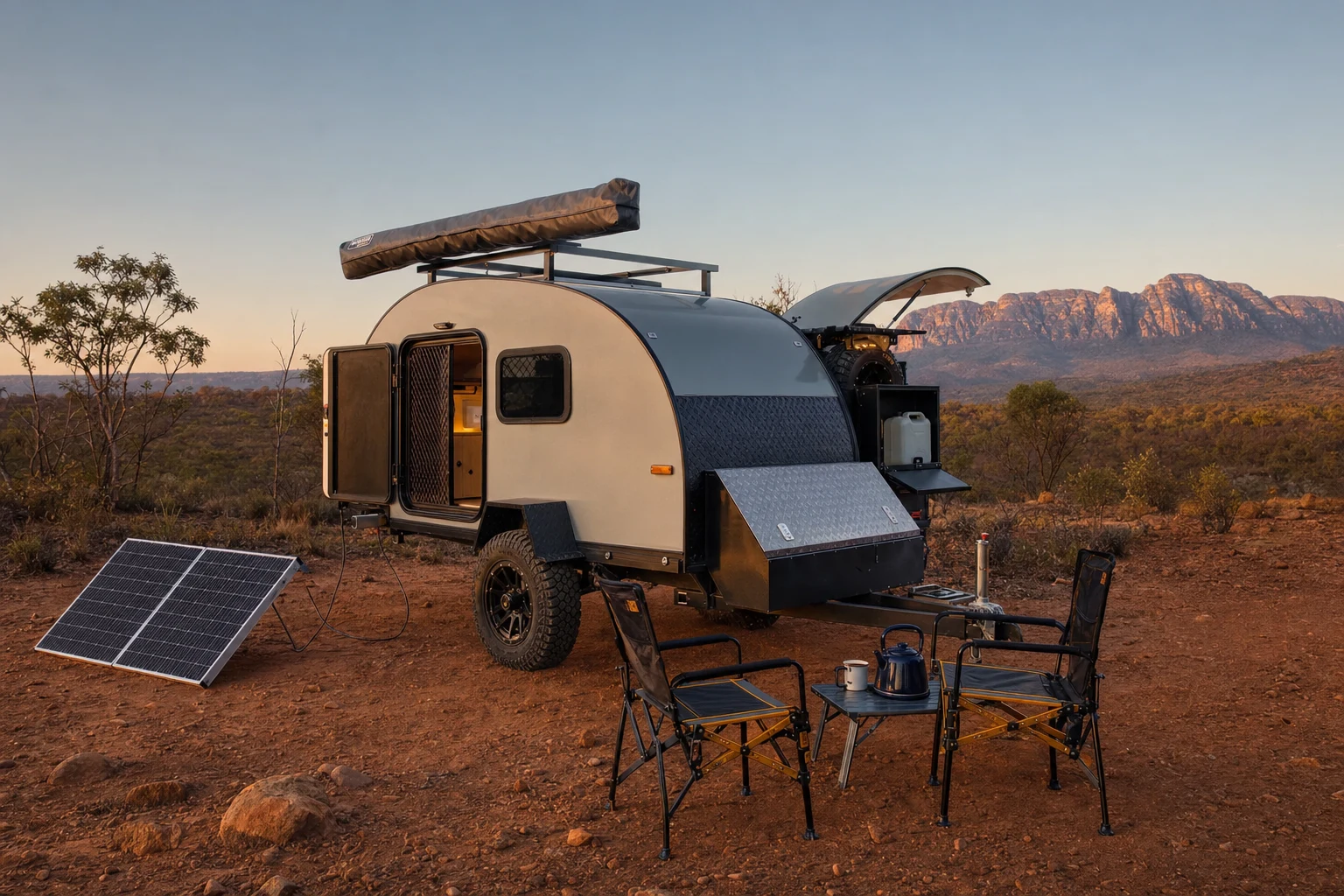
The ultimate off-grid camper trailer setup isn’t the one with the most gear bolted to it — it’s the one where every system covers a real need and nothing is dead weight. Get it right and a compact trailer will keep two people comfortable for 5–7 days away from powered sites, with hot showers, cold beer and a working internet connection in the middle of nowhere. Get it wrong and you’ll tow 300 kg of gadgets you never use while running out of the one thing that actually ends trips early: water.
This guide works through the complete off-grid setup system by system — water, power, refrigeration, hot water, toilet and waste, connectivity, shelter, cooking and safety — with real 2026 Australian prices, honest capacity maths, and a final budget table. It’s written around hard-shell teardrop campers because that’s what we build at Breath Trailer, but the numbers apply to any camper trailer heading off-grid in Australia.
One rule before we start: weight is the tax on everything. Every system you add must earn its place, because payload on a lightweight trailer is finite — if you’re not sure how much margin you have, read our teardrop camper weight guide first.
What “off-grid ready” actually means in 2026
An off-grid camper trailer setup has to answer five questions independently of any campground:
- Water — can you carry, heat and manage enough for the length of your stay?
- Power — can you generate and store enough electricity for your daily draw?
- Waste — can you contain toilet and grey water so you can legally use self-contained-only sites?
- Food — can you keep food cold for a week without an ice run?
- Contact — can you reach help (and work, if needed) with zero mobile bars?
Most setups fail on water and waste, not power. Lithium batteries and cheap solar have largely solved electricity since about 2023 — but no battery makes water, and no app makes a grey-water bucket legal where a sign says “fully self-contained only”. So that’s where we’ll start.
Water: the real limit on how long you can stay
Plan on 10 litres per person per day for drinking, cooking, washing-up and a quick rinse. Careful campers get by on 7–7.5 L; add a proper daily shower and you’re at 15 L or more. In outback heat, drinking water alone rises to 4–5 L per person per day, as REDARC’s water planning guide notes.
| Usage style | L / person / day | 2 people, 5 days |
|---|---|---|
| Minimalist (no shower, careful washing-up) | 7–7.5 L | ~75 L |
| Comfortable (quick rinse, normal cooking) | 10 L | 100 L |
| Daily proper shower | 15 L+ | 150 L+ |
| Outback summer drinking allowance alone | 4–5 L | +40–50 L buffer |
The practical takeaway: a couple wanting a comfortable 5-day free camp needs around 100 L on board. Our Breath Ultra and Breath Max carry 100 L water tanks as standard for exactly this reason; the Essential and Plus carry 45–65 L, which covers a comfortable long weekend.
Three ways to extend water range without upgrading tanks:
- Jerry cans — two 20 L food-grade cans on the drawbar or in the tow vehicle add 40 L for about $60. Cheapest range extension in camping.
- A 12V pressure pump with a tap-off — measured use beats guessing. Pouring from a jerry can wastes; a pump-fed tap doesn’t.
- A water filter — a $150–300 inline filter (or gravity filter) turns creek, bore and tank water at campsites into drinking water, effectively refilling your range wherever you find a source.
Power: solar + lithium is the solved problem
The short version: a 100–200 Ah lithium battery, a 200 W portable solar panel and a DC-DC charger that tops the battery up while you tow will keep a fridge, lights, water pump, fans and device charging running indefinitely in Australian sun. A 200 Ah lithium setup gives 2–4 days of buffer with no sun at all — solar and driving days stretch that to “as long as your water lasts”.
We’ve covered battery chemistry, solar sizing, MPPT regulators and daily consumption maths in detail in our off-grid teardrop camper power guide, so here’s just the decision summary:
| Component | Minimum viable | Comfortable | Notes |
|---|---|---|---|
| Battery | 100 Ah lithium | 200 Ah lithium | Lithium gives ~2× usable capacity of AGM at half the weight |
| Solar | 120 W portable | 200 W portable or fixed | Portable panels follow the sun; park the trailer in shade |
| Charging on the move | DC-DC 25 A | DC-DC 40 A + solar input | A day’s drive ≈ full recharge |
| Inverter | None (12V everything) | 300–600 W | Only if you must run 240V gear — laptops charge fine on 12V USB-C |
One honest note: if your appliance list is “fridge, lights, phone, pump”, you don’t need a 3,000 W inverter or a second battery. That money is better spent on water capacity and comms.
Refrigeration: size the fridge to the battery, not the other way around
A 12V compressor fridge is the single biggest constant load in your setup. Real-world figures from Australian conditions: a 40–45 L fridge draws roughly 400–550 Wh per day, a 60 L fridge 500–700 Wh per day — and hot ambient temperatures can push consumption up by as much as 50%, per 4x4 Down Under’s fridge energy guide.
| Fridge size | Typical daily draw | Share of a 100 Ah lithium battery | Suits |
|---|---|---|---|
| 40–45 L | 400–550 Wh (~1.5 A/h avg) | ~35–45% | Couples, trips ≤ 1 week |
| 60 L | 500–700 Wh (~2.5 A/h avg) | ~45–60% | Families, 1 week+, dual-zone freezer |
| 75 L+ | 700 Wh+ | 60%+ | Only with 200 Ah + 200 W solar |
For two people, a 40–45 L fridge is the sweet spot — it uses about a third less power than a 60 L and still holds a week of food if you freeze meals ahead. Help it out: keep it shaded, packed full (thermal mass), and opened rarely. Our Plus, Ultra and Max models include a fridge in the galley as standard; see the full model comparison for what’s included where.
Hot water and showers: gas wins off-grid
Nothing resets morale on day four like a hot shower. Your options, with 2026 Australian prices:
| System | Price | Heat source | Verdict |
|---|---|---|---|
| Solar shower bag | $15–40 | Sun | Fine as a backup; useless on cloudy days |
| 12V pump shower (no heating) | ~$50 | None | Great with water heated on the stove |
| Portable gas hot water unit (Bushranger, Smarttek, Joolca) | $300–700 | LPG | The off-grid standard — instant, endless hot water |
| Built-in external shower | Included on some trailers | Trailer’s own system | Zero setup, zero extra weight |
Gas units win off-grid because they don’t touch your battery: a 9 kg LPG bottle delivers four to five days of daily family showers, and Snowys’ comparison of the big two systems shows even premium units pay for themselves quickly against caravan-park fees. Pair any of them with a 30–35 PSI 12V pump and a pop-up shower tent (~$60–100), and remember the golden rule: shower water comes out of your 10 L/day budget — a low-flow head and a 2-minute “navy shower” uses ~6 L instead of 20.
The Breath Ultra ships with an external hot shower already plumbed; the Breath Max goes further with a full interior bathroom — the only teardrop on the Australian market under $50k with one — which means the shower question (and the 3 am toilet walk) disappears entirely.
Toilet and grey water: the paperwork of freedom
Here’s the part most “ultimate setup” lists skip: the best free camps in Australia are increasingly signed “self-contained only”, and your gear determines whether you can legally stay.
The working definition used by councils and land managers is simple: manage all waste on board and leave no trace. In practice that means:
- A toilet — a cassette or portable chemical toilet ($120–250, e.g. Thetford Porta Potti) parks you at almost any free camp in the country. Composting units ($1,000+) are overkill for weekenders.
- Grey water containment — there’s no federal law requiring a grey tank, but sites signed self-contained don’t allow washing-up or shower water on the ground. A 25–40 L portable grey water tank ($50–150) under your outlet solves it, as Trayon’s grey water guide explains.
- Rubbish — carried out, always.
Check each site’s actual rules in WikiCamps or Camps Australia Wide before settling in — requirements vary by council and land manager. For the full state-by-state picture (including CMCA self-containment certification and where it matters), see our self-contained camper guide for Australia.
Connectivity: Starlink changed the maths
In 2026 there are three realistic ways to stay connected off-grid in Australia:
| Option | Hardware | Ongoing cost | Works with zero bars? |
|---|---|---|---|
| Phone hotspot / 4G-5G modem | $0–249 | Existing plan | No |
| Cel-Fi signal booster | ~$1,500 | None | No — amplifies weak signal only |
| Starlink Mini | $599 | $85/mo (100 GB Roam), pausable | Yes |
The decision is cleaner than it looks. If you camp mostly within cooee of regional towns, a Telstra prepaid modem covers you. If you park in genuine black spots — most of the good ones — only satellite works: the Starlink Mini is 1.1 kg, laptop-sized, draws just 25–40 W from your 12V system and delivers 50–150 Mbps, as Outcamp’s Australian comparison details. The Roam plan pauses between trips, so occasional tourers aren’t paying year-round.
Working remotely from a teardrop with Starlink on the roof rack and a view of the Flinders Ranges is no longer exotic — it’s roughly what a third of our solo-traveller customers do. (More on that setup in our solo travellers guide.)
Safety comms are separate from convenience comms: carry a PLB ($300–400, no subscription, 10-year battery) whenever you leave sealed roads. Starlink needs power and a clear sky; a PLB works when everything else has failed.
Shelter, cooking and the camp itself
The unglamorous gear that decides whether camp feels like a system or a scavenger hunt:
- Awning — a 270° free-standing awning ($800–2,000, ARB/Darche/OzTent) turns one side of the trailer into a shaded living room in 60 seconds. In Australian summer this is not optional equipment.
- Galley — a slide-out kitchen with a 2-burner gas cooktop means dinner starts 5 minutes after you stop, not 45. Every Breath model has one built in.
- Lighting — 12V LED strips under the awning + headlamps. Draw is negligible on lithium.
- Levelling and ground — ramps ($50), wheel chocks, and a ground mat that keeps red dust out of the cabin.
- Recovery basics if you leave the blacktop — traction boards, a compressor for airing down, and a shovel. (Full list in our off-road teardrop guide.)
We’ve priced the full accessory landscape — awnings, solar, fridges, water gear, towing kit — with Australian brands and dollars in our teardrop accessories guide if you want the line-item version.
How long can you actually stay out?
The honest answer, per limiting factor, for two people in a well-sorted compact trailer:
| System | Capacity | Days for 2 people | The fix |
|---|---|---|---|
| Water | 100 L tank + 40 L jerry cans | 6–7 days | Filter + refill at creeks/bores |
| Power | 200 Ah lithium + 200 W solar | Indefinite in sun; 2–4 days without | Drive an hour (DC-DC recharge) |
| Fridge/food | 40 L fridge, frozen meals | 7+ days | Meal planning beats fridge size |
| Toilet cassette | ~20 L | 4–6 days | Dump points are free and mapped |
| LPG (cooking + hot water) | 4 kg bottle | 7–10 days | Carry a second bottle ($40) |
Water is almost always the binding constraint — which is why the ultimate setup spends its weight budget there, not on a third battery. A week off-grid, comfortably, is a realistic target for a couple in 2026; beyond that you’re refilling something regardless of what you tow.
The complete setup, costed (2026 AUD)
Assuming your trailer already has a tank, galley and 12V basics:
| System | Item | Cost |
|---|---|---|
| Water | 2 × 20 L jerry cans + inline filter | $210–360 |
| Power | 200 W portable solar (if not fitted) | $250–500 |
| Hot water | Gas hot water unit + shower tent | $360–800 |
| Waste | Portable toilet + 25 L grey tank | $170–400 |
| Comms | Starlink Mini + PLB | $900–1,000 |
| Shelter | 270° awning (if not fitted) | $800–2,000 |
| Recovery | Boards, compressor, shovel | $250–450 |
| Total | ~$2,900–5,500 |
That’s the complete kit — and about what two weeks in cabins costs a family. If you’re choosing the trailer itself at the same time, start from the platform: a hard-shell teardrop with the tanks, fridge, shower and 12V system already engineered in (like the Breath Ultra at $30,290 or the fully self-contained Breath Max at $39,000) makes half this table redundant, stays under 1,200 kg, and tows behind a standard SUV — no LandCruiser required. Our towing tips guide covers the rest.
FAQ
What do I need to camp off-grid in Australia?
Five systems: enough water (10 L per person per day), a 12V power source (lithium battery + solar), food refrigeration, contained waste (toilet and grey water for self-contained-only sites), and emergency communication (a PLB at minimum). Everything else is comfort.
How much does a full off-grid camper trailer setup cost?
If your trailer has the basics, budget $2,900–5,500 AUD in 2026 to add water range, solar, gas hot water, a toilet and grey tank, Starlink and recovery gear. Buying a trailer that’s off-grid-ready from the factory absorbs most of that cost into the purchase price.
How long can a couple stay off-grid in a teardrop camper?
5–7 days comfortably. Water is the limit: 100 L on board plus 40 L in jerry cans covers a week at 10 L per person per day. Power with lithium + solar is effectively unlimited in Australian sun, and a 40 L fridge holds a week of food.
Do I really need a grey water tank for free camping?
There’s no national law requiring one, but sites signed “fully self-contained only” — increasingly the best free camps — require all waste water contained. A $50–150 portable grey tank meets the requirement at most sites; always check the specific site’s rules in WikiCamps.
Is Starlink worth it for camping in Australia?
If you camp in genuine mobile black spots or work from camp, yes: the Mini costs $599 with a pausable $85/month plan and works anywhere with clear sky. If you stay near regional towns, a $249 4G/5G modem on Telstra covers you for far less.
Recommended reading
- Off-grid teardrop camper power guide — the deep dive on lithium, solar sizing and consumption maths behind this article’s power section.
- Self-contained camper Australia — the waste rules, state by state, that decide where you can free camp.
- Teardrop camper accessories guide — every item above, priced line by line with Australian brands.
- Best teardrop destinations by state — 18 places to point this setup at.
- Compare the four Breath models — tanks, fridges, showers and bathrooms, side by side.
Want to see how much of this list a hard-shell teardrop already covers from the factory? Book a viewing at one of our locations across Australia and check the systems in person.