Teardrop Camper for Solo Travellers Australia (2026)
Towing alone, setting up alone, staying safe alone. What matters when nobody is spotting you reversing, plus prices from $23,320.
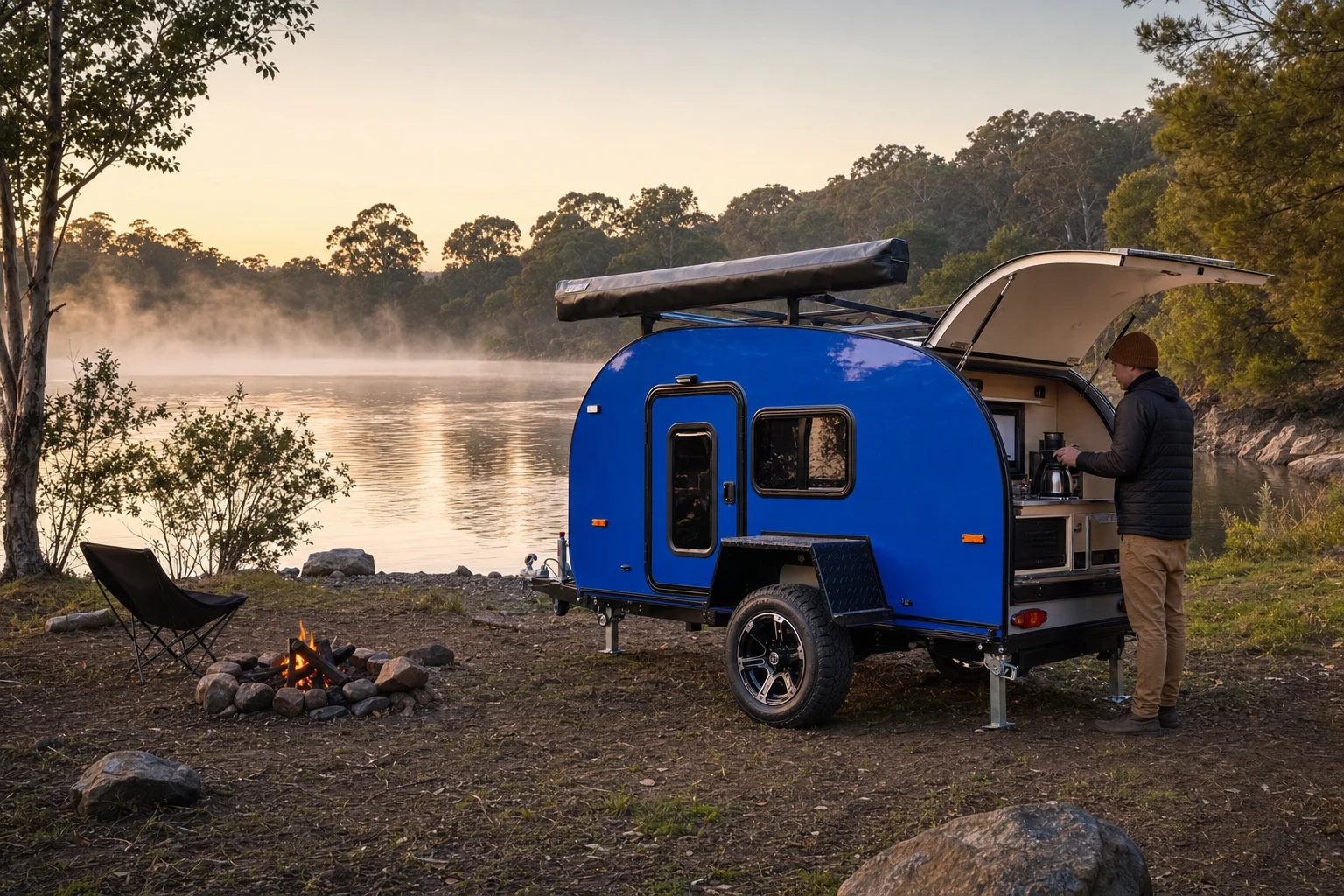
Mia works remotely three days a week and chases the quiet the other four. She didn’t want a tent — she’d done enough of those, wrestling poles in the dark after an eight-hour drive. She didn’t want a 22-foot caravan either; the thought of reversing one into a tight coastal site alone made her stomach drop. What she wanted was simple: a real bed she could lock the world out of, a kitchen she didn’t have to crouch over, and something light enough that her mid-size SUV wouldn’t notice it was there.
That’s the exact gap a teardrop camper for solo travellers fills in Australia — and in 2026, Mia is far from unusual. A survey of more than 1,800 Australian women found an 81% appetite for solo travel and a 10% year-on-year jump in those planning to head off alone, while Google searches around solo female travel have climbed 257%. Solo caravanning now spans every age group, and one Facebook community for women travelling solo has swelled past 28,500 members. The road, it turns out, is full of people travelling on their own — together.
This guide is written for them. It cuts through the brochures and tells you exactly what matters when you’re the only person hitching up, the only one setting up camp at dusk, and the only one deciding whether a site feels right. We’ll cover weight and towing for a single driver, security, the bathroom question, real 2026 prices (competitors included), and the solo-specific safety habits that make the difference between an anxious trip and an addictive one.
Why a teardrop is the smartest rig for one person
When you travel solo, every kilo and every metre is your problem. There’s no second pair of hands to spot you while reversing, no one to hold the awning while you peg it, and no one to share the fuel bill. A teardrop camper is engineered around exactly those constraints.
- You can tow it with the car you already own. A Subaru Forester is rated to 1,500 kg and a petrol Toyota RAV4 to 1,650 kg — both tow a teardrop comfortably. There’s no need to buy a $70,000 LandCruiser just to pull your home behind you.
- It’s short enough to park and reverse alone. A teardrop is roughly the footprint of a large trailer, not a bus. You can nose into a bush site, a friend’s driveway, or a tight beachfront bay without a spotter.
- Setup is measured in minutes, not sweat. A hard-shell teardrop opens in around five minutes — lift the galley hatch, pop the door, you’re home. Compare that to pitching a tent or unfolding a canvas camper alone in fading light.
- It locks. This is the quiet headline for solo travellers. A hard-shell teardrop is a solid, lockable shell — not a zip you can hear someone unzipping. You sleep inside a structure, not under fabric.
- It’s cheap to run. Lightweight and aerodynamic, a teardrop sips fuel compared with a caravan or motorhome, which matters enormously when one person is covering the whole budget.
That combination — light, lockable, fast, frugal — is why teardrops have become, in the words of one Australian buyer’s guide, “the default answer for couples and solo travellers who want a real bed, a proper kitchen, and freedom from the van park.”
The solo test in one line: if you can hitch it, reverse it, set it up, and lock it without help — and tow it home on a tank of fuel — it’s a solo rig. A teardrop passes on all five.
What actually matters when you’re travelling alone
Couples and families buy on bed size and storage. Solo travellers have a different checklist, and it’s worth being honest about it before you spend $20,000–$40,000.
1. Weight you can manage without a second driver
The number that matters isn’t just towing capacity — it’s how the rig behaves when you are the only one driving, hitching, and manoeuvring. A tare weight around 700 kg keeps you well within the limits of a mid-size SUV and keeps ball weight low enough to wind onto the hitch by hand. Lighter is friendlier when you’re solo. (For the full breakdown of tare, ATM, GTM and ball weight, see our teardrop camper weight guide.)
2. Security and a proper lock
A solo traveller’s biggest mental load is “am I safe here tonight?” A hard-shell camper answers a large part of that question structurally. Look for a solid, lockable door (not a canvas zip), windows that lock, and an interior you can secure from inside. The peace of mind of sleeping in a rigid shell is, for many solo travellers, the single biggest reason they move on from a rooftop tent or swag.
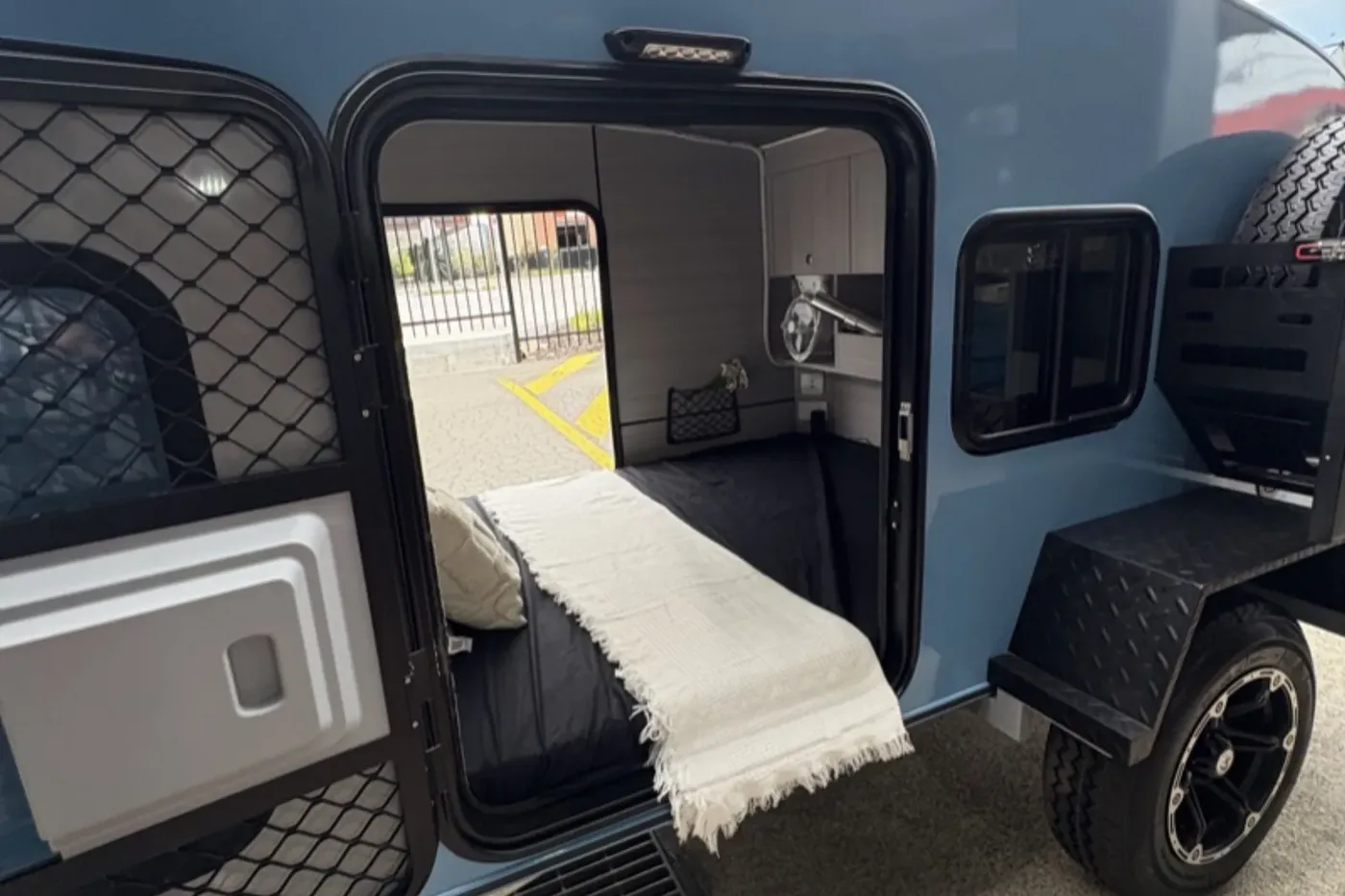
A solid side door plus a separate mesh screen: you sleep behind a lock, not a zip.
3. The bathroom decision
This is the make-or-break for a lot of solo travellers, and especially solo women. The freedom to not have to walk to a shared amenities block in the dark — or to free-camp away from anyone at all — is genuinely life-changing. Most teardrops have no bathroom; a few offer an external shower; and exactly one segment offers a full interior bathroom. We cover the options in the table below, and in depth in our self-contained camper guide.
4. Off-grid independence
When you travel alone, you often want to be away from crowds — which means power, water and a fridge that don’t depend on a powered site. Lithium batteries, solar, and a decent water tank turn a teardrop into a self-sufficient basecamp. (See our off-grid teardrop guide for solar sizing and battery choices.)
5. Total cost on one income
There’s no “single supplement” in camper ownership, but there is the reality that one person funds everything. Lower tare weight saves fuel; a self-contained rig saves on powered-site fees; and a durable hard shell with no canvas to re-proof keeps maintenance low. We’ll put real numbers on this further down.
Best teardrop campers for solo travellers in Australia (2026)
Here’s an honest comparison of the main options a solo traveller will weigh up in 2026, with real prices and weights. Competitors are included on purpose — a guide that only mentions one brand isn’t a guide.
| Model | Price (AUD) | Tare weight | Bathroom | Best for the solo traveller who… |
|---|---|---|---|---|
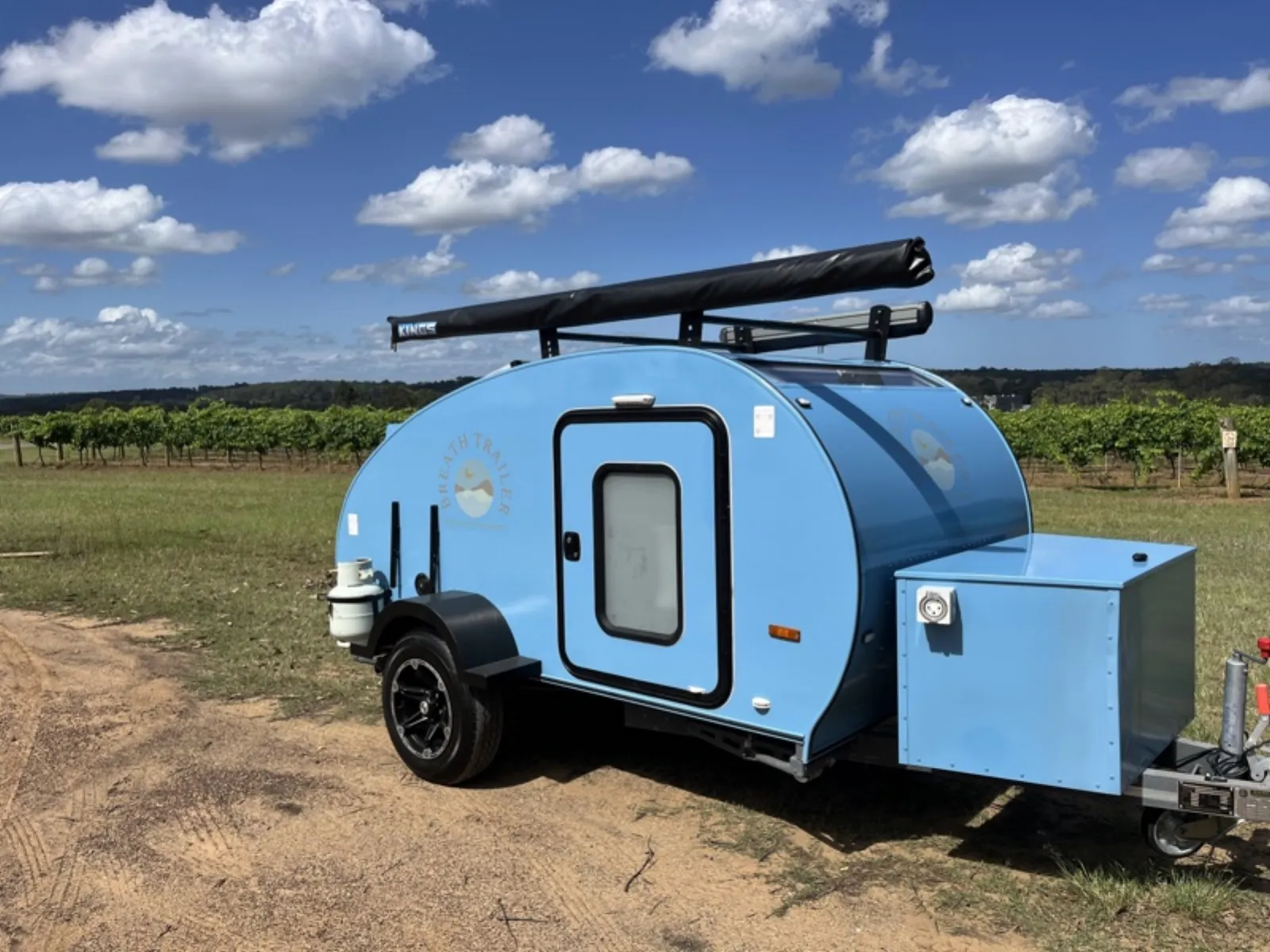
| Breath Essential | $23,320 | ~700 kg | None | wants the lightest, cheapest way into hard-shell camping |
| Breath Plus | $29,766 | ~800 kg | None (fridge incl.) | does longer trips and wants a fridge as standard |
| Breath Ultra | $34,749 | ~900 kg | External shower | free-camps and wants a rinse-off without a full bathroom |
| Breath Max | $42,900 | ~1,200 kg | Full interior bathroom | refuses to walk to an amenities block in the dark |
| JAG Glider | ~$35,000 | ~500 kg | None | tows with a tiny car (Jimny / EV) and travels ultra-light |
| Tucana | ~$34,999 | ~750 kg | None | wants a big 80L fridge and a lockable front toolbox |
Prices current as of June 2026; competitor figures from their published 2026 listings. Always confirm specs at point of sale.
A few observations that matter specifically for solo travel:
- If “light enough for any car” is your top priority, the JAG Glider at around 500 kg tare is the featherweight — towable by a Suzuki Jimny or even some EVs. The trade-off is no bathroom and a higher price-per-kilo.
- If the bathroom is non-negotiable, the Breath Max is currently the only teardrop on the Australian market under $50,000 with a full interior bathroom, plus 2.1 m standing headroom and a queen bed — a genuine self-contained rig that lets you free-camp away from everyone.
- If you want the cheapest path to a lockable shell, the Breath Essential at $23,320 gets you the security and fast setup without the off-grid extras you can add later.
Towing a teardrop solo: the confidence checklist
The number one fear we hear from solo buyers — especially first-timers and solo women — isn’t theft or wildlife. It’s towing. Here’s the reassuring truth and a practical checklist.
A teardrop’s low, aerodynamic profile makes it one of the most forgiving things you can tow. Low ball weight means you can lift it onto the hitch by hand; a short length means reversing is intuitive; and the light overall mass means your SUV barely registers the load on hills.
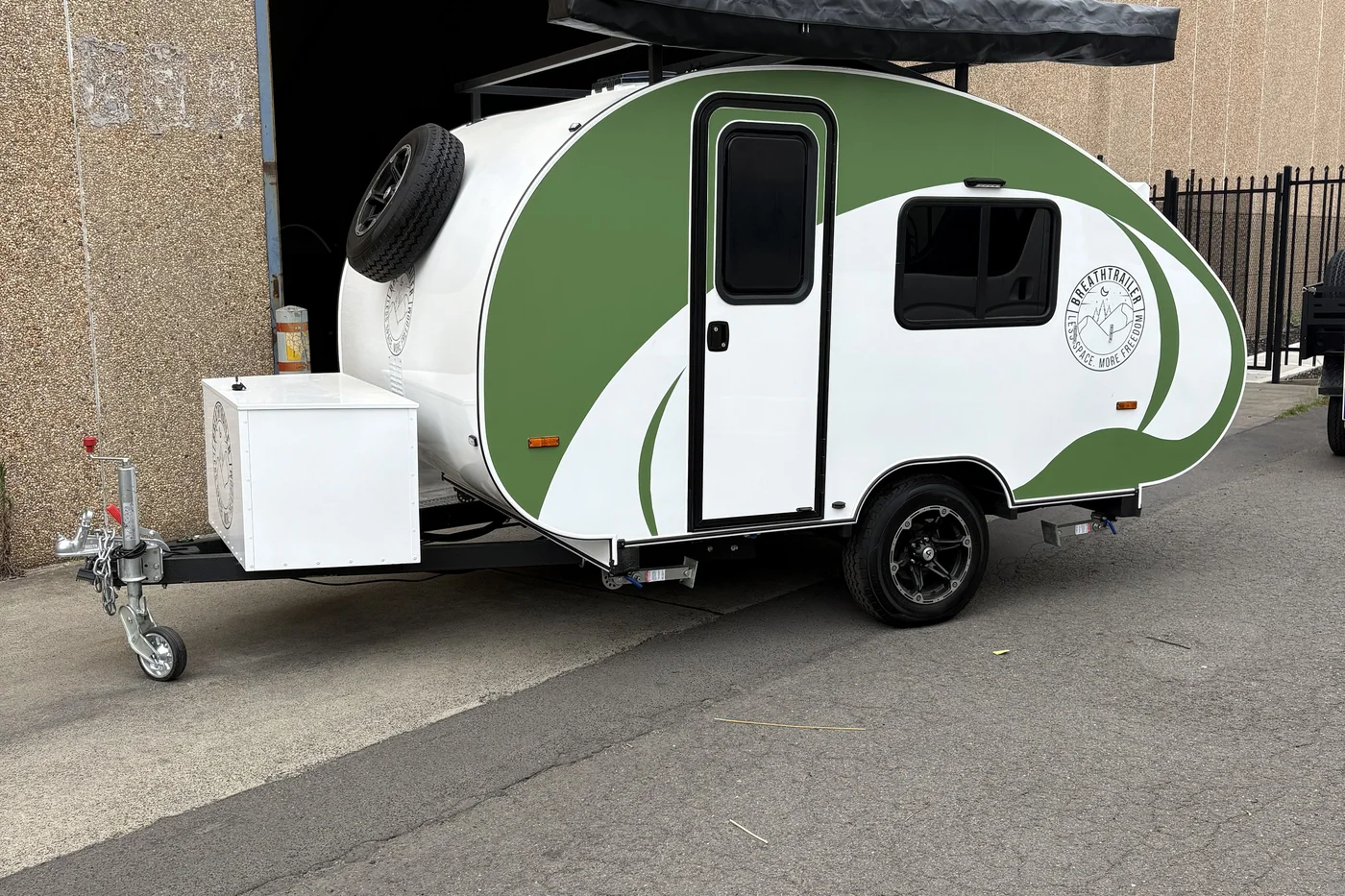
Jockey wheel, coupling and chains up front: a hitching routine one person can run through alone.
Before every solo trip:
- Check your towing capacity against the camper’s ATM (not just tare). A RAV4 at 1,650 kg or Forester at 1,500 kg covers every model in the table above with margin.
- Set up a hitch routine you can do alone — reverse camera or a stick-and-cone marker, wind the jockey wheel down, couple, safety chains, plug, then a 360° walk-around.
- Practise reversing in an empty car park before you rely on it at a busy site. Ten minutes solo in a quiet lot saves an audience-filled fumble later.
- Distribute weight low and forward so ball weight stays in the recommended 8–12% range — solo packing is easy to get wrong because there’s no one to remind you the back is overloaded.
- Fit and test a brake controller if your model has electric brakes (legally required over 750 kg ATM in most states).
For a full walkthrough — mirrors, sway, reversing technique and the legal limits state by state — read our camper trailer towing guide.
Solo safety on the road: habits that matter more than gear
A great camper removes a lot of risk, but solo travel is also about how you travel. These are the habits experienced solo travellers — drawn from Australia’s solo camping communities — swear by.
- Choose your first nights in populated, well-lit parks. Build confidence near other people before you push into remote bush camps. Rolling Solo and similar communities run meet-ups that take the edge off the first few trips.
- Always tell someone your plan. Share your route and expected check-in time, especially before remote stretches. A daily text “I’ve arrived” costs nothing.
- Check connectivity before you commit to a site. Apps like WikiCamps flag whether a campsite has mobile coverage — a 4G icon can be the difference between comfortable solitude and feeling cut off.
- Carry a PLB and a real first-aid kit. In remote Australia, a personal locator beacon is the one piece of safety gear that genuinely saves lives. (More on safety accessories in our accessories guide.)
- Watch your fuel and your distances. In WA and the outback, servos can be hundreds of kilometres apart. Refuel at half a tank, not a quarter.
- Trust your instinct. If a site or a conversation feels off, leave. A teardrop’s five-minute pack-down means you can relocate in minutes — a freedom tent campers don’t have.
- Be discreet about where you’re camping. A friendly chat is lovely; broadcasting “I’m alone at that remote spot tonight” to a shop full of strangers is not.
None of this is about fear. It’s about the small, repeatable routines that let you say yes to the trip in the first place.
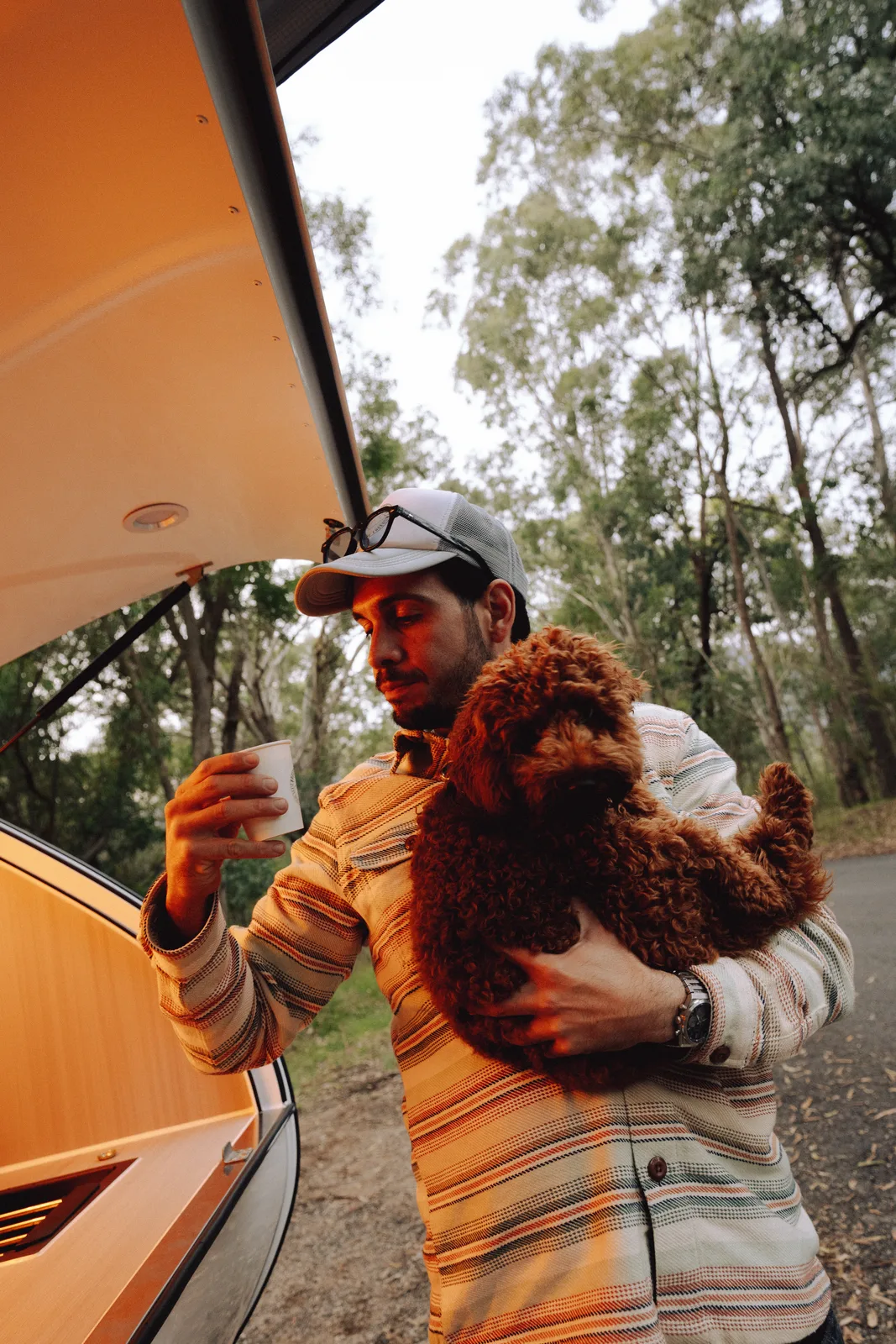
Small, repeatable routines, like the morning coffee at the galley, make each new camp feel familiar.
What a solo trip actually costs to run
One person funds the lot, so the running numbers matter. Here’s a realistic picture of where a teardrop saves a solo traveller money compared with the alternatives.
| Cost area | Teardrop (solo) | Caravan (solo) | Motorhome (solo) |
|---|---|---|---|
| Tow vehicle | Car you likely own | Often needs a 4WD upgrade | N/A (is the vehicle) |
| Fuel penalty towing | Minimal (light + aero) | High | High |
| Powered-site fees | Skippable if self-contained | Often relied on | Often relied on |
| Setup time/effort | ~5 min, solo-friendly | Longer, awning-heavy | Park-and-go |
| Maintenance | Low (hard shell, no canvas) | Moderate–high | High |
| Depreciation exposure | Lower buy-in price | Higher | Highest |
The headline: a teardrop’s low purchase price, low fuel penalty, and ability to free-camp mean a solo traveller spends far less per night on the road than they would with a caravan or motorhome — and avoids the single biggest hidden cost, a dedicated tow vehicle. For ongoing ownership costs like insurance, see our teardrop camper insurance guide.
Where to take it: solo-friendly destinations
A teardrop’s go-anywhere footprint suits the kind of trips solo travellers love — short coastal escapes, national-park basecamps, and the occasional Big Lap leg. If you’re starting out, lean toward destinations with a mix of powered parks and free camps so you can dial up your independence at your own pace. Our state-by-state destinations guide breaks down 18 spots across every state and territory, with terrain ratings and self-containment rules — ideal for planning a solo route with confidence.
Short escapes close to home are the easiest way to build solo confidence.
If you’re weighing a teardrop against other rigs entirely, our honest caravan vs teardrop comparison puts the trade-offs side by side.
Frequently asked questions
What is the best teardrop camper for a solo traveller in Australia?
It depends on your single biggest priority. For the lightest tow with any car, the JAG Glider (~500 kg, ~$35,000) leads. For the cheapest lockable hard shell, the Breath Essential ($23,320) wins. For a solo traveller who wants a full interior bathroom and true free-camping independence, the Breath Max ($42,900) is currently the only sub-$50k teardrop in Australia with a built-in bathroom, queen bed and 2.1 m headroom.
Can one person set up and tow a teardrop camper alone?
Yes — that’s exactly what they’re designed for. A hard-shell teardrop opens in about five minutes with no poles or canvas, the low ball weight lets you couple it by hand, and the short length makes reversing intuitive. Practise hitching and reversing once in an empty car park and you’ll be confident solo within a trip or two.
Are teardrop campers safe for solo female travellers?
A hard-shell teardrop is far more secure than a tent, swag or rooftop tent because it’s a rigid, lockable structure — there’s no zip to undo from outside. Combined with sensible habits (well-lit parks early on, sharing your plans, checking phone coverage, carrying a PLB), a teardrop is one of the safest and most popular choices for solo women on the road in 2026.
What size SUV do I need to tow a teardrop solo?
Most mid-size SUVs are enough. A Subaru Forester (1,500 kg towing) or petrol Toyota RAV4 (1,650 kg) comfortably tows any teardrop in our comparison table, including the heaviest 1,200 kg model. Lighter teardrops around 500–800 kg can be towed by even smaller cars. Always check your vehicle’s braked towing capacity against the camper’s ATM.
Do I need a bathroom in a teardrop if I travel alone?
Not necessarily — but it’s the feature solo travellers most often wish they had. The ability to avoid a midnight walk to a shared amenities block, and to free-camp completely away from others, is a major comfort and safety upgrade. If that resonates, an interior bathroom (Breath Max) or at least an external shower (Breath Ultra) is worth the step up.
How much does it cost to travel solo with a teardrop?
The big savings are upfront and ongoing: no dedicated tow vehicle needed, minimal fuel penalty because the rig is light and aerodynamic, and the option to free-camp instead of paying for powered sites. A self-contained teardrop lets a solo traveller keep nightly costs to little more than food and the occasional dump-point or fuel stop.
The bottom line for solo travellers
Travelling alone shouldn’t mean compromising on comfort or feeling exposed. A teardrop camper gives a solo traveller the three things that matter most: a rig light enough to tow and reverse without help, a lockable hard shell to sleep securely in, and — if you choose it — full self-containment so you can camp anywhere, away from anyone. Add the running-cost savings of a single-income setup and it’s easy to see why solo travel and teardrop campers have grown up together in Australia.
If you’re ready to find the right fit, compare all four Breath models side by side to see which weight, bathroom and budget combination suits your solo style — or book a viewing to stand inside one and picture your first trip.