Understanding Electric Brakes on Camper Trailers: Australia's Complete Guide (2026)
ADR38 makes them mandatory over 750 kg. How the controller, magnets and drums actually work, and what to check before you tow.
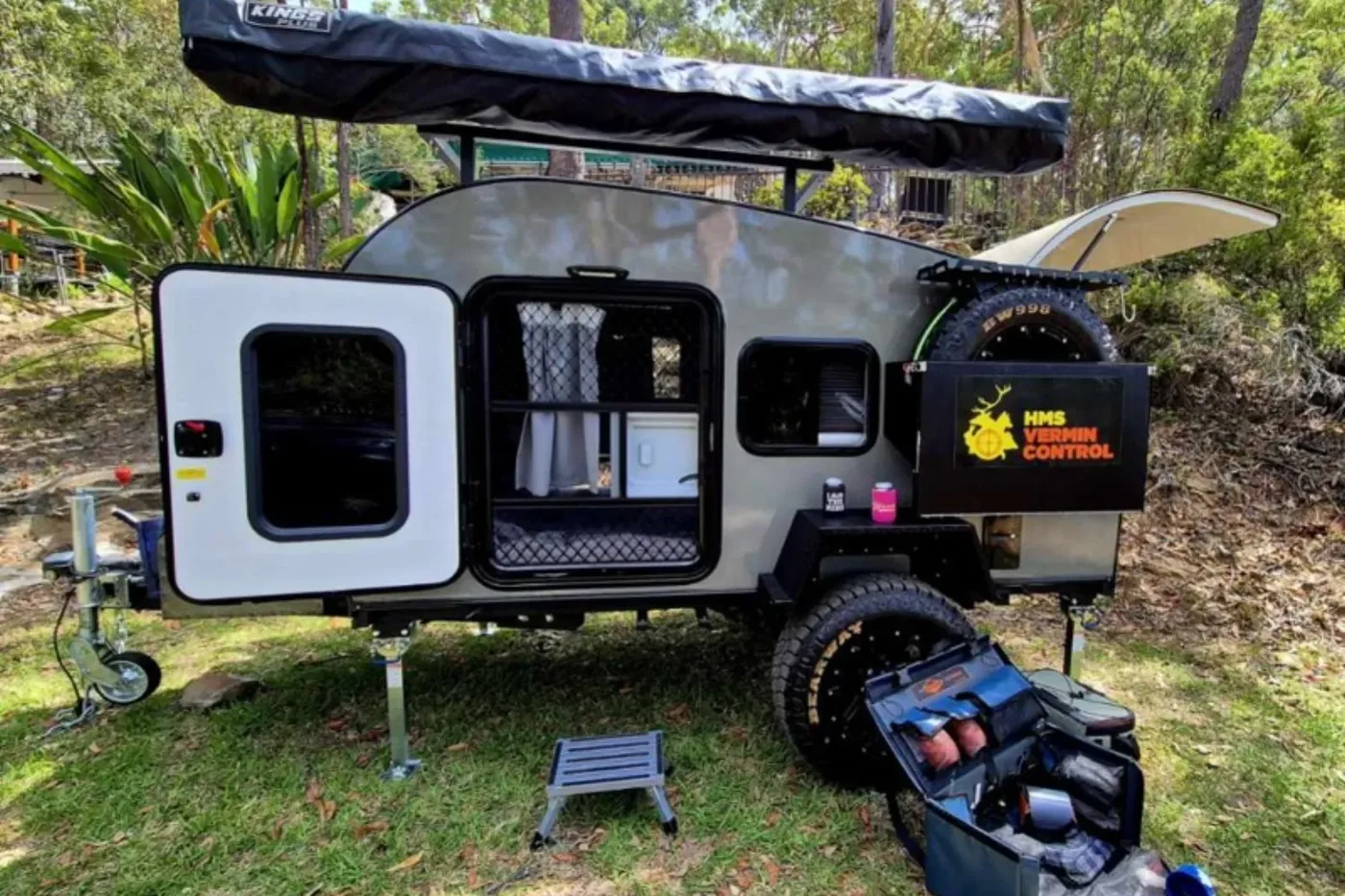
Every year, Australians are injured in trailer runaway incidents — situations where a trailer pushes a tow vehicle beyond its braking ability, or detaches on a highway at speed. A correctly specified and functioning trailer brake system is the most important safety component on any camper trailer, yet it’s consistently the feature buyers understand least. Most people research solar capacity and mattress thickness before asking whether their tow vehicle is even wired to activate the trailer’s brakes.
This guide explains exactly how electric trailer brakes work, what Australian law requires under ADR38, the difference between controller types, and what every buyer needs to know before they hitch up and head bush.
What Are Electric Trailer Brakes?
Electric trailer brakes are electromagnetic drum brake assemblies mounted on the trailer’s wheel hubs. Unlike the disc brakes on most tow vehicles — which use hydraulic pressure to clamp pads against a rotor — electric trailer brakes use 12-volt electrical current to energise an electromagnet inside each brake drum assembly.
When you press the brake pedal in your tow vehicle, a brake controller detects the braking event and sends a controlled current through the 7-pin flat connector to the trailer. The electromagnet engages against the spinning drum’s friction surface, a mechanical actuating lever is pulled, and brake shoes press outward against the drum walls. The friction created slows the trailer’s wheel rotation.
More current equals more braking force. The brake controller is the device that manages exactly how much current is sent — and when.
The four key components
| Component | Location | Function |
|---|---|---|
| Drum brake assembly | Each braked wheel hub | Contains electromagnet, brake shoes, drum, and actuating lever |
| Brake controller | In-cab or trailer-mounted | Detects braking events; outputs 12V signal to brake magnets |
| 7-pin flat plug | Tow vehicle ↔ trailer | Transfers brake signal, running lights, and reverse signal |
| Breakaway battery | Trailer drawbar | Emergency 12V power if trailer separates from tow vehicle |
How Electric Brakes Work: Step by Step
- You press the brake pedal in your tow vehicle.
- The brake light circuit activates — the brake controller detects this via the brake light wire.
- The controller calculates how much current to send based on its settings or built-in accelerometer.
- Current flows through the 7-pin connector to the electromagnetic assemblies at the trailer’s braked wheels.
- Each electromagnet energises, attracting itself to the spinning drum and pulling the actuating arm.
- The arm forces the brake shoes outward against the inside of the drum.
- Friction slows wheel rotation — the trailer decelerates in sync with your tow vehicle.
- When you release the brake pedal, current stops, the electromagnet releases, and the shoes retract via return springs.
The sequence happens in under half a second. A correctly calibrated system means your trailer brakes in proportion to your tow vehicle — not lagging behind and pushing into the towball, and not grabbing and pitching the combination forward.
For a broader look at towing technique and setup, see our camper trailer towing guide for Australia.
Australian Braking Law: What ADR38 Requires
In Australia, trailer braking is governed by Australian Design Rule 38 (ADR38), which applies uniformly across all states and territories. The legal thresholds are set by Gross Trailer Mass (GTM) — the maximum load the trailer’s axle or axles can carry when the trailer is coupled to a tow vehicle — not by tare (unladen) weight.
| Trailer GTM | Braking Requirement |
|---|---|
| Under 750 kg | No brakes required |
| 750 kg – 2,000 kg | Brakes on at least one axle; electric or override; operable from driver’s seat |
| Over 2,000 kg | Electric brakes on all wheels; breakaway system mandatory; must work in harmony with tow vehicle |
This GTM vs tare distinction catches many buyers by surprise. A teardrop camper advertised at 700 kg tare can — and typically does — carry a rated GTM of 1,380 kg or more. That number is what matters under the law, not the empty weight you feel when you push it by hand.
You’ll find a full breakdown of GTM, ATM, and payload in our teardrop camper weight guide.
State-by-state enforcement
Police and transport agencies across every state enforce ADR38 at roadside inspections and during registration checks. Operating a trailer above the GTM braking threshold without a compliant system is an infringement notice — and a genuine safety risk on public roads.
For a broader legal and cost context, the Caravaner’s Guide to Braking Laws at CaravansPlus provides a useful state-by-state summary.
Electric Brakes vs Override (Mechanical) Brakes
Both systems are legal for trailers up to 2,000 kg GTM in Australia. They work in fundamentally different ways.
Override brakes (also called mechanical or hydraulic inertia brakes) are passive — they require no controller or wiring. When the tow vehicle brakes, the trailer’s forward momentum compresses the drawbar, which activates a hydraulic master cylinder that applies the trailer’s drum brakes. Simple in principle; several limitations in practice.
| Feature | Electric Brakes | Override / Hydraulic Brakes |
|---|---|---|
| Activation method | 12V signal from brake controller | Inertia compresses drawbar → hydraulic piston |
| Driver control | Full — gain adjustable from cab | None — entirely passive |
| Works when reversing | Yes | No — drawbar compression locks brakes in reverse |
| Off-road performance | Excellent | Poor — bumps trigger false applications |
| Emergency braking response | Fast; controller matches deceleration | Slight delay; depends on inertia magnitude |
| Maximum GTM (AU law) | No ceiling (mandatory over 2,000 kg) | Permitted up to 2,000 kg GTM only |
| In-cab controller required | Yes | No |
| Typical cost | Higher (controller $150–$400 + fitting) | Lower |
For most Australian camper trailer use — frequent off-road tracks, camp-spot reversing, and longer-distance touring — electric brakes are the superior choice. Override brakes on corrugated outback roads are unreliable because the constant compression of the drawbar triggers unwanted brake applications, creating a jerky, unsettling tow experience.
Time-Delay vs Proportional Brake Controllers
If your trailer runs electric brakes, your tow vehicle needs a brake controller. There are two fundamentally different types.
Time-delay (linear) controllers
These output a pre-set voltage level over a fixed time period whenever the brake light circuit activates, regardless of how hard you’re braking. A “gain” dial lets you calibrate the output for your trailer’s weight class.
- Pros: simple circuit, low cost ($150–$200), no mounting orientation requirement
- Cons: no dynamic response — applies identical force whether you’re easing to a stop or in an emergency; manual adjustment required when payload changes
Proportional (motion-sensing) controllers
These use an internal accelerometer or gyroscope to measure the tow vehicle’s actual deceleration rate. The controller applies current proportional to that deceleration — a gentle stop gets gentle trailer braking; a hard emergency stop gets maximum trailer braking, automatically.
- Pros: optimal stopping distances in all conditions; no manual adjustment needed; measurably better wet-weather performance
- Cons: higher cost ($280–$400); correct mounting orientation required in-cab
| Feature | Time-Delay | Proportional |
|---|---|---|
| Price range | $150–$200 | $280–$400 |
| In-cab installation | Simple (brake light wire only) | Requires correct mounting angle |
| Emergency braking | Fixed output — may be too light or too aggressive | Automatically scales to match deceleration |
| Load change adjustment | Manual gain dial | Automatic |
| Best for | Light recreational towing on sealed roads | Long-distance touring; heavy loads; off-road use |
For Australian conditions — long highway runs, corrugated outback tracks, and high-wind coastal environments — a proportional controller consistently delivers shorter stopping distances and a more comfortable tow experience.
The trailer-mounted alternative: Elecbrakes
One Australian-designed innovation worth knowing: the Elecbrakes EB2 (~$299–$350) mounts on the trailer drawbar rather than in your cab. It connects to the 7-pin flat plug, pairs via Bluetooth to your smartphone, and uses its own accelerometer to detect braking events. The benefits:
- No in-cab wiring or installation required
- Works with any tow vehicle without modification
- Adjustable via the Elecbrakes app from the driver’s seat
It’s particularly useful for buyers who tow with multiple vehicles, or those who want to avoid the cost of a professional in-cab installation. The controller stays with the trailer. Elecbrakes explains the technology in detail on their site if you’d like to compare it against in-cab options before deciding.
Do Teardrop Campers Need Electric Brakes?
Yes — and this surprises many first-time teardrop buyers who assume their “lightweight” trailer sits below the legal braking threshold.
The confusion comes from conflating tare weight (empty trailer) with GTM (the axle’s rated load capacity). A teardrop marketed at 700 kg tare can carry a rated GTM of 1,380 kg — nearly double — and that is the number ADR38 uses. Every Breath Trailer model exceeds 750 kg GTM, which means electric brakes are legally required on all of them.
| Model | Tare Weight | GTM | ATM | Electric Brakes Fitted? | Controller Needed? |
|---|---|---|---|---|---|
| Essential | 700 kg | 1,380 kg | 1,500 kg | Yes (standard) | Yes |
| Plus | 800 kg | 1,380 kg | 1,500 kg | Yes (standard) | Yes |
| Ultra | 900 kg | 1,380 kg | 1,500 kg | Yes (standard) | Yes |
| Max | 1,200 kg | 1,780 kg | 1,900 kg | Yes (standard) | Yes |
All four models ship from the Sydney workshop with electric drum brakes and a hand brake fitted as standard — tested before delivery. What you need to supply is a compatible brake controller in your tow vehicle, or choose the Elecbrakes trailer-mounted option to avoid in-cab wiring.
If you’re towing the Breath Essential with a Toyota RAV4 or Subaru Forester, for example, those vehicles need a 7-pin flat socket and a working brake controller. Many factory tow packs include both; confirm your vehicle’s spec before hitching up.
For an overview of how tare weight, GTM, and payload interact with your vehicle’s towing capacity, see our towing tips guide.
Breakaway Batteries: What They Are and Why You Should Fit One
A breakaway battery unit is a small 12V battery mounted on the trailer’s drawbar, connected to the trailer’s brake circuit via a lanyard pin. Its single job: if the trailer separates from the tow vehicle — coupling failure, safety chain failure — the breakaway battery automatically activates the electric brakes and brings the unattached trailer to a stop.
Under ADR38, a breakaway system is mandatory for trailers over 2,000 kg GTM. For trailers in the 750–2,000 kg range (like all Breath Trailer models), it is technically optional under the federal rules — but it is standard practice across the Australian camper trailer industry, and strongly recommended.
The cost of a breakaway unit is $80–$150 fitted. Against the liability and potential loss of life from an uncontrolled 1,200 kg trailer on a highway, it’s one of the least arguable investments in any trailer setup.
Annual test procedure: With the trailer stationary and wheels chocked, pull the lanyard pin from the breakaway socket. The brakes should engage immediately and firmly. Reinsert the pin to release. If brakes don’t engage, check battery voltage (should be 12V+) and wiring continuity.
Breakaway batteries should be replaced every three years regardless of apparent condition. A flat breakaway battery is useless in the one situation where it matters most.
Choosing a Brake Controller in Australia: 2026 Price Guide
| Controller | Type | Mount | Price (AUD, approx.) | Notes |
|---|---|---|---|---|
| REDARC Tow-Pro Elite V3 | Proportional | In-cab | ~$330 | Industry benchmark; single-wire install; widely available |
| Elecbrakes EB2 | Proportional | Trailer | ~$299–$350 | Bluetooth app control; no in-cab wiring |
| ARK Pro Compact | Proportional | In-cab | ~$280–$300 | Compact head unit; popular OEM fitment |
| Hayman Reese Prodigy P3 | Proportional | In-cab | ~$300–$340 | 3-axis accelerometer; broad vehicle compatibility |
| ARK XO | Time-delay | In-cab | ~$150–$190 | Budget option for occasional sealed-road towing |
REDARC’s Tow-Pro guide covers installation specifics and compatibility with factory brake light wiring if you’re fitting one yourself.
Professional installation of an in-cab controller at an auto electrician typically costs $100–$180, including correct mounting and calibration. The Elecbrakes EB2 is genuinely plug-and-play into the 7-pin — no professional fitting required — which makes it cost-competitive even at its higher retail price.
Electric Brake Maintenance: What to Inspect Each Year
Electric brakes are durable, but they wear and corrode — particularly in coastal or dusty environments. Build these checks into your annual maintenance schedule alongside wheel bearing and chassis work. See our full teardrop camper maintenance guide for the complete service schedule.
| Check | Interval | What to Look For |
|---|---|---|
| Electromagnet air gap | 12 months | Should be 0.3–0.8 mm; worn magnets lose braking force progressively |
| Drum wear and scoring | 12 months | Grooved or scored drums reduce friction surface; resurface or replace |
| Brake shoe lining thickness | 12 months | Replace when lining reaches 3 mm or below |
| Wiring and 7-pin connector | Before each trip | Corrosion on plug pins; chafed wiring under chassis |
| Breakaway battery voltage | 6 months | Should read 12.6V+ at rest; replace after 3 years |
| Magnet draw test | 12 months | Each magnet should draw ~3 amps; low draw indicates wear or failure |
| Hand brake operation | Every trip | Apply fully, verify wheel locks; release should be clean and complete |
Coastal corrosion is the leading cause of premature electric brake failure in Australia. If you camp regularly near saltwater, rinse the wheel hub areas with fresh water after each trip — the same habit that protects galvanised chassis components.
Our suspension guide covers related maintenance checkpoints for axle hubs and the related wheel bearing intervals.
Common Electric Brake Problems and How to Diagnose Them
Trailer surges into the towball during braking — controller gain is set too high. The trailer brakes are locking before the tow vehicle’s brakes develop enough force. Reduce gain by one setting, retest on a quiet road.
No braking effect at all — start at the 7-pin connector. Corrosion or a loose pin connection is the cause of 80% of electric brake faults. If the connector tests clean, check the fuse in the brake controller circuit, and then the controller output with a multimeter.
Brakes drag when not braking — the trailer brakes are receiving power when they shouldn’t be. Disconnect the brake signal wire at the 7-pin and check whether drag stops. If it does, the fault is in the controller or vehicle wiring, not the brake assembly.
Breakaway activates on tight turns or reversing — the breakaway lanyard is too short or incorrectly routed. It needs enough slack to allow normal turns and reversing without triggering. Reroute the lanyard with adequate length and secure it clear of moving parts.
One side of the trailer brakes harder than the other — uneven magnet wear or uneven shoe thickness. Pull each brake assembly and measure magnet draw; replace the weaker magnet(s). Always replace in pairs per axle for balanced braking. See our quality control guide for more on when a workshop inspection is worth the investment.
FAQ: Electric Brakes on Australian Camper Trailers
Does my tow vehicle need a brake controller if my trailer has electric brakes?
Yes. If your trailer’s GTM exceeds 750 kg and it is fitted with electric brakes, Australian law requires a compliant brake controller in your tow vehicle — operable from the driver’s seat. Towing without one is both illegal and dangerous, regardless of how light the trailer feels.
Can I tow a 700 kg tare teardrop camper without brakes?
Not if its rated GTM exceeds 750 kg — which it almost certainly does. GTM, not tare weight, is what ADR38 uses. Check the compliance plate on your trailer’s drawbar for the rated GTM before assuming brakes aren’t required.
What is the difference between GTM and ATM?
GTM (Gross Trailer Mass) is the maximum load the trailer’s axle(s) can carry when the trailer is connected to a tow vehicle. ATM (Aggregate Trailer Mass) is the total maximum mass of the trailer including the drawbar load pressing on the towball. ADR38 braking thresholds use GTM. Your tow vehicle’s rated towing capacity uses ATM.
Are override brakes legal in Australia?
Yes — for trailers up to 2,000 kg GTM. They engage via inertia when the tow vehicle brakes. The practical limitation is reversing: drawbar compression when backing into a camp spot engages the brakes and makes reversing difficult. For off-road use, bumps can also trigger false applications. Electric brakes with a proportional controller are substantially more capable in both situations.
How do I know if my tow vehicle is already wired for electric brakes?
Look for a 7-pin flat socket at the tow vehicle’s rear. Most factory tow packs include one. Some budget aftermarket towbars only fit a 4-pin flat, which cannot carry the brake signal. An auto-electrician can test the output of your 7-pin socket in under 15 minutes.
Can I retrofit electric brakes to a trailer that doesn’t have them?
Yes. Electric brake conversion kits (drum assembly + electromagnet) are available from Couplemate, SureWeld, and other suppliers for approximately $250–$400 per axle including fitting — a worthwhile investment if you’re buying a used trailer with a GTM above 750 kg that arrived without brakes. Before buying a used trailer, our pre-purchase inspection checklist covers this and the 10 other compliance points worth verifying.
The Bottom Line
Electric brakes are not a premium feature on Australian camper trailers — they’re the law once your trailer’s GTM exceeds 750 kg, and they’re the safety system that prevents a trailer from running into your tow vehicle (or worse) during emergency braking. Understanding how they work, what your vehicle needs to support them, and how to maintain them is as important as knowing your solar capacity or payload.
Every Breath Trailer — from the Breath Essential at 1,380 kg GTM to the Breath Max at 1,780 kg GTM — leaves our Sydney workshop with electric drum brakes and a hand brake fitted and tested as standard. What you need to arrange is the right brake controller for your tow vehicle. Our team advises on the best match for your specific vehicle and towing setup.
Ready to find your model? Compare all four Breath Trailer models or book a private walkthrough with our Sydney team.
Recommended Reading
- Teardrop Camper Weight Guide: GTM, ATM, and Payload Explained
- Camper Trailer Towing Guide Australia: Everything You Need to Know
- Teardrop Camper Towing Tips: 20 Things to Know Before You Go
- Why Suspension Matters on an Off-Road Camper Trailer (Australia 2026)
- Annual Teardrop Camper Maintenance Guide for Australian Owners