Breath Trailer vs Track Trailer: Honest 2026 Comparison
Breath Trailer vs Track Trailer compared on 2026 prices, off-road specs, suspension, bathroom, and tow vehicle. Two Australian-made brands; one big price gap.
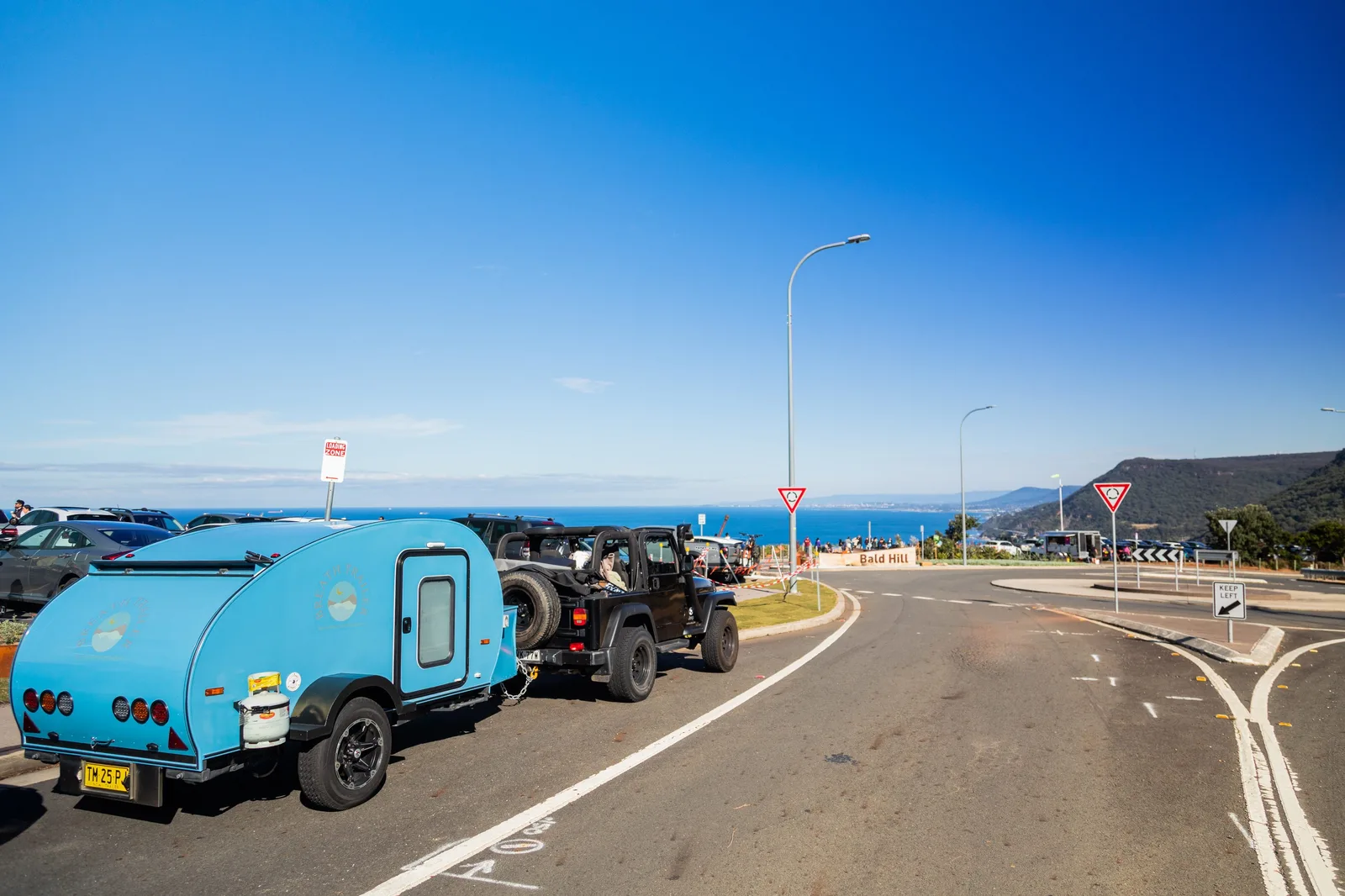
Here is the number that opens this comparison: in 2026, the cheapest new Track Trailer costs $22,710 more than the most expensive Breath Trailer. The Track Tvan MK6 Inspire starts at $69,900. The Breath Max — our flagship, with a full interior bathroom, queen bed, and 2.1 m standing headroom — is $47,190.
And the most expensive Track Trailer, the MK6 Lightning, lists at $99,900. No Track Trailer at any price includes an interior bathroom.
Those two facts shape the entire comparison. Track Trailer and Breath Trailer are both Australian-made, both hard-shell in concept, both genuine off-roaders with hot-dipped galvanised steel chassis and independent suspension. On paper they look like the same category. In practice, they answer different questions — and for a meaningful slice of buyers, the cheaper brand genuinely wins.
This guide compares them honestly, with real 2026 pricing from both manufacturers, real tare weights, and a straight assessment of where each brand is the right choice.
The short answer
| You are… | Buy | Why |
|---|---|---|
| A couple wanting a bathroom inside, under $50k | Breath Max | Only teardrop under $50k in AU with a full interior bathroom |
| Towing with a mid-size SUV (RAV4, CX-5, Outback) | Breath Essential / Plus / Ultra | 700–900 kg tare; Track MK6 starts at 1,100 kg |
| Doing the Canning Stock Route or Gibb River Road | Track Tvan MK6 | Military MC2 suspension, 33-inch MT tyres, expedition-grade componentry |
| Budget under $50,000 | Breath (any model) | Track’s range starts at $69,900 |
| Camping mostly weekends, hate canvas, hate setup fuss | Breath (any model) | 5-minute setup; zero canvas to maintain |
| Overlanding 60+ nights a year with maximum water and storage | Track Tvan MK6 | 108L water, exterior slide-out kitchen, 25-year design evolution |
Now the detail.
2026 prices side by side
Both brands publish pricing openly, which makes this comparison clean.
| Model | Brand | Starting price (AUD) | Category |
|---|---|---|---|
| Breath Essential | Breath Trailer | $23,320 | Hard-shell teardrop |
| Breath Plus | Breath Trailer | $29,766 | Hard-shell teardrop + fridge |
| Breath Ultra | Breath Trailer | $34,749 | Hard-shell teardrop + external shower |
| Breath Max | Breath Trailer | $47,190 | Hard-shell teardrop + interior bathroom |
| Track Tvan MK6 Inspire | Track Trailer | $69,900 | Hard-shell + canvas tent overlander |
| Track Tvan MK6 Firetail | Track Trailer | $87,990 | Hard-shell + canvas tent overlander, mid-spec |
| Track Tvan MK6 Lightning | Track Trailer | ~$99,900 | Hard-shell + canvas tent overlander, top-spec |
The ranges don’t overlap at all. Breath runs $23,320–$47,190. Track runs $69,900–$99,900+. There is a $22,710 gap between the most expensive Breath and the cheapest Track.
That gap is not a manufacturing quality story. Track Trailer have spent 25 years refining the Tvan through six major generations, building in military-grade suspension (literally — the MC2 asymmetric-link system was originally engineered for the Australian Defence Force and is still in active use there), and iterating on an exterior slide-out kitchen that is genuinely superior to anything in a similarly-priced softroader caravan. The premium is real and defensible.
What the premium does not buy you: an interior bathroom. Not on the Inspire. Not on the Firetail. Not on the Lightning. The Tvan’s design has always placed its living space in a canvas flip-open tent, meaning the bathroom has always been a portable toilet in the tent, a standalone ensuite tent, or a campground facility. That’s an entirely valid way to camp — but it’s worth naming plainly.
What each brand actually builds
Track Trailer: the hard-case overlander
The Tvan MK6 (released October 2025) is built around a rigid aluminium sandwich-panel “strong box” — the same construction philosophy for six generations — that provides structural rigidity and insulation without the weight of welded steel. The panel sandwich is vacuum-pressed and bonded rather than bolted, giving it both strength and an inherently waterproof joint line.
In travel mode, the Tvan is a closed, aerodynamic box. At camp, Track’s “Skyward” system raises the lid and internal deck simultaneously on reinforced struts, giving you full standing access to the sleeping area in approximately 30 seconds. The sides and ends then open out into a canvas-walled tent room — double bed, headroom, LED lighting, 3-speed fan, dual roof hatches — expanding the overall camping space substantially beyond the hard-shell footprint.
The exterior kitchen is a full slide-out unit on the driver’s side: three-burner gas stove, sink fed by a 108-litre fresh-water tank, LED lighting over the benchtop, and deep drawer storage.
The MK6 brought a 20% increase in interior space (achieved via structural changes, not a pop-up roof), improved headroom over the bed, a larger front storage box, bigger windows, and updated lighting and aesthetics. It is, by a long margin, the most capable and refined Tvan ever built.
Breath Trailer: the hard-shell teardrop
Breath Trailer’s four models are true teardrops: a sealed composite shell that combines the living cabin and the rear galley into a single aerodynamic body. Nothing opens out or expands. The shape you see at camp is the shape you see on the road.
That design choice has a consequence most buyers notice within the first trip: setup is genuinely five minutes. Level the trailer, extend the stabiliser legs, open the rear galley hatch. That’s it. No canvas to clip or stake. No mechanism to operate. And at the end of the trip, no wet canvas to dry before storage.
The trade-off is sleeping capacity: a Breath Trailer comfortably sleeps two adults. It does not expand into a family living space.
The Max model (our flagship) adds what neither the Track Tvan nor any other Australian teardrop under $50,000 offers: a full interior bathroom — shower, toilet, vanity — built into the cabin alongside a queen bed, a rear galley, a full-height interior (2.1 m standing headroom), and an on-board grey water tank. It is self-contained under CMCA self-containment guidelines, which allows free camping on land where waste discharge is prohibited.
Off-road capability compared
This is where Track Trailer has a genuine and substantial advantage, and it’s worth being direct about it.
| Spec | Breath Essential / Plus / Ultra | Breath Max | Track Tvan MK6 |
|---|---|---|---|
| Tare weight | 700–900 kg | 1,200 kg | ~1,100 kg (Firetail) |
| ATM | — | — | 1,800 kg |
| Suspension | Independent coil | Independent coil | Military MC2 asymmetric-link independent coil |
| Wheel travel | Standard off-road | Standard off-road | Matched to Unimog articulation spec |
| Max tyre size | Standard | Standard | 33-inch MT |
| Terrain rating | Gravel, corrugated roads, light tracks | Gravel, corrugated roads, light tracks | Extreme remote: Canning, Gibb, Simpson |
| Chassis | Hot-dipped galvanised steel | Hot-dipped galvanised steel | Hot-dipped galvanised steel, rated 1.8 t |
The MC2 suspension was designed for the Australian Army. It was engineered to match the articulation of a Unimog — one of the most capable off-road vehicles in existence — and is still used in active military service. It is categorically more capable than what any teardrop camper needs to carry a couple to a national park campground or even a well-graded inland track.
But the Simpson Desert, the Canning Stock Route, the Gibb River Road — these routes test trailers in ways that standard off-road engineering wasn’t designed for. Corrugated red dirt at 80 km/h for 200 km will expose any mechanical weakness in a suspension system. The Tvan MK6 has been refined against exactly those conditions for 25 years.
A Breath Trailer handles the gravel roads that most Australian families camp on. It handles corrugated outback tracks at sensible speeds. It handles 4WD-access campsites of the sort described in our best camping spots guides. What it does not handle is the kind of expedition-grade punishment that makes the Tvan MK6’s military suspension relevant.
Be honest with yourself about where you actually camp. For most Australians, the track record to their campsite is 100 km of sealed highway and 5 km of gravel. For those buyers, spending $22,710–$52,710 more for expedition suspension they will never need makes no financial sense.
For the genuine overlanders doing the big remote routes every year — that’s a different conversation, and Track Trailer has earned its reputation there.
Canvas: the detail nobody mentions
Both brands lead with “hard-shell” — and both brands mean it, in the hard-box-travel-mode sense. But at camp, there is a significant difference.
Breath Trailers have no canvas at all. The cabin is permanently sealed. There is nothing to get wet, nothing to grow mould, nothing to re-proof, nothing to repair.
Track Tvans have canvas tent walls. The hard aluminium box forms the floor, roof and end panels; the sides of the sleeping tent are canvas. This is a well-proven design — the Tvan canvas is robust and Track have refined it through six generations — but it introduces maintenance requirements that the teardrop format eliminates entirely.
| Maintenance item | Breath Trailer | Track Tvan MK6 |
|---|---|---|
| Annual re-proofing | Not required | Required (canvas sides) |
| Wet-canvas dry-out before storage | Not required | Required |
| Mould risk in storage | Nil | Low but present |
| Canvas tear risk | Nil | Low (established design) |
| Seam seal inspection | Not required | Annual recommended |
For someone who camps frequently and stores the trailer properly, canvas maintenance is manageable. For someone who camps 10–15 nights a year and stores the trailer between trips, coming home with wet canvas that you forget to dry before your next departure is a realistic scenario — and mould damage is not covered by most warranties.
Tow vehicle: what each brand actually needs
| Model | Tare | Likely loaded weight | Minimum vehicle class |
|---|---|---|---|
| Breath Essential | 700 kg | ~850 kg | Most 5-seat SUVs (RAV4, CX-5, CR-V, Outback) |
| Breath Plus | 800 kg | ~1,000 kg | Mid-size SUV (RAV4 Hybrid, Outback XT, Kodiaq) |
| Breath Ultra | 900 kg | ~1,100 kg | Mid-size SUV (RAV4 AWD, Prado, Kluger) |
| Breath Max | 1,200 kg | ~1,500 kg | Large SUV or ute (LandCruiser 200, Prado, Everest) |
| Track Tvan MK6 Inspire | ~1,100 kg | ~1,500 kg | Large SUV or ute rated to 1,800 kg |
| Track Tvan MK6 Firetail | ~1,100 kg | ~1,600 kg | Large SUV or ute rated to 1,800 kg |
| Track Tvan MK6 Lightning | ~1,200 kg | ~1,700 kg | Large SUV or ute rated to 1,800 kg |
The Track MK6 carries an ATM of 1,800 kg — meaning loaded weight can legally reach 1,800 kg, and your tow vehicle must be rated to that full ATM, not the tare. That requirement points firmly to the GVM bracket: LandCruiser 300, LandCruiser 200, Prado 250, Ford Everest, Ram 1500, Isuzu D-Max Dual Cab. Many mid-size SUVs that handle a Breath Plus or Ultra comfortably don’t have sufficient rated towing capacity for a fully-loaded MK6.
Check your compliance plate, not just the brochure number. Many vehicles are marketed with their trailer tow rating, which assumes your car is unladen. Once you add passengers, luggage and a fully loaded tow hitch, the maths changes. We cover the full method in our camper trailer towing guide.
Power, water, and self-contained capability
| Feature | Breath Essential | Breath Plus | Breath Ultra | Breath Max | Track MK6 Inspire | Track MK6 Firetail/Lightning |
|---|---|---|---|---|---|---|
| Battery | — | 100Ah lithium | 120Ah lithium | 200Ah lithium | 125Ah lithium | Higher spec |
| Solar | — | 130W | 200W | 200W | 200W | Higher spec |
| Inverter | — | — | 350W | 1,000W | 350W | Higher spec |
| Fresh water | 40L | 40L | 80L dual tank | 80L | 108L | 108L |
| Interior bathroom | — | — | — | ✅ Full ensuite | — | — |
| External shower | — | — | ✅ | ✅ | External only | External only |
| Grey water tank | — | — | — | ✅ | — | — |
| Self-contained (CMCA) | — | — | — | ✅ | — | — |
Track Trailer’s 108L water tank is the largest on this comparison sheet — meaningfully larger than Breath’s 80L dual-tank setup on the Ultra and Max. For full-time remote touring, those extra 28 litres matter.
The power systems are closely matched at the base level (both offer ~125–200Ah lithium + 200W solar). Track’s higher trim levels carry more power, but the Breath Max’s 1,000W inverter on the flagship covers most household appliance needs without generator dependency.
The bathroom position is worth focusing on. If self-containment for free camping is a priority — avoiding the midnight walk to campground amenities, free-camping on state-forest and pastoral land where self-contained rigs are favoured — the Breath Max ($47,190) provides a full ensuite for $22,710 less than the cheapest Track Tvan. No Track Tvan includes a bathroom at any price point in the 2026 range.
Track Trailer buyers who need a bathroom use a portable cassette toilet in the tent compartment, a standalone ensuite tent (available as an accessory), or campground facilities. All of those options exist and work perfectly well. But the decision tree is real: if you want an interior bathroom and your budget is under $100,000, the Breath Max is the only Australian-made answer.
Five-year total cost of ownership
Pricing the two brands against each other across purchase price, fuel, maintenance, and insurance over five years.
Assumptions: 30 nights camping per year, 15,000 km towing per year, LPG AU$1.70/kg, diesel 220c/L, insurance $450/yr (Breath) and $900/yr (Track), servicing $200/yr (Breath) and $350/yr (Track), fuel economy penalty 2.5 L/100km (teardrop) vs 3.8 L/100km (enclosed box).
| Cost item | Breath Plus (5 yr) | Track Tvan MK6 Inspire (5 yr) |
|---|---|---|
| Purchase price | $29,766 | $69,900 |
| Fuel penalty (15,000 km/yr × 5) | $4,125 | $6,270 |
| Insurance | $2,250 | $4,500 |
| Servicing | $1,000 | $1,750 |
| Canvas maintenance (re-proofing, repairs) | $0 | ~$750 |
| 5-year total cost | $37,141 | $83,170 |
| Cost per camping night (150 nights) | $248 | $554 |
The fuel difference comes from aerodynamics. The teardrop shape produces substantially less drag than the Tvan’s closed box profile, particularly above 100 km/h. Breath’s in-house testing shows a fuel penalty of approximately 2.5 L/100km with a mid-size SUV. Compact box profiles like the Tvan MK6 typically add 3.5–4.5 L/100km at highway speeds. Over five years of regular towing, that difference accumulates to a meaningful figure.
If you are genuinely doing the Canning Stock Route or similar and value the MC2 suspension for that purpose, the Track Trailer’s 5-year premium of ~$46,000 over a comparable Breath Plus may be entirely rational. If you’re camping at national parks and state forests on graded roads, it is a significant luxury premium for capability you won’t use.
Who should choose Track Trailer
- You do at least one extreme remote route per year — Canning, Gibb, K1 Line, Simpson — and want expedition-grade suspension with 25 years of proven refinement.
- You need a large exterior kitchen and 108L of water for extended off-grid trips.
- You’re happy without an interior bathroom and prefer a spacious canvas tent sleeping area.
- You already own or are happy to buy a large SUV or ute rated to 1,800 kg ATM.
- Budget is $70,000–$100,000 and you want the best off-road camper in that range.
- You want a brand with a strong resale market (Tvans hold value well; there is an established used-Tvan community in Australia).
Who should choose Breath Trailer
- Your budget is under $50,000 and you want a premium, hard-shell, Australian-made camper.
- You want an interior bathroom and ensuite for self-contained free camping (Breath Max, $47,190 — nothing else in Australia offers this under $50k).
- You’re towing with a mid-size SUV — RAV4, CX-5, Kluger, Outback — and don’t want to change vehicles.
- You camp 10–40 nights per year and want zero-maintenance setup (no canvas, no re-proofing, no wet-canvas problem).
- You value aerodynamics and fuel economy on long towing journeys.
- You want 100+ colour options and a 3–4 month lead time from an accessible Sydney-based manufacturer.
- You want the ability to detach the trailer at your base camp and drive your unencumbered tow vehicle for day trips — a genuinely useful capability that the camper-trailer-vs-caravan analysis covers in detail.
FAQ
Is Track Trailer better quality than Breath Trailer?
They’re different quality stories addressing different use cases. Track Trailer’s MC2 military suspension and 25-year iteration represent genuine engineering authority in extreme off-road terrain. Breath Trailer’s welded galvanised chassis, sealed composite body and Gold Sydney Design Award 2025 represent engineering authority in the premium-teardrop space. Neither is objectively better quality; they’re optimised for different demands.
Can I tow a Track Tvan MK6 with a Toyota LandCruiser Prado?
The Prado 250 (released 2024) is rated to 2,500 kg braked towing — comfortably above the Track MK6’s 1,800 kg ATM. The ball-weight of ~170 kg is within most Prado configurations’ rated tow-ball download. Confirm your specific variant’s compliance plate before purchase. A Prado also handles the Breath Max (1,200 kg tare) without issue.
Does any Track Tvan model have an interior bathroom?
No. The Tvan’s sleeping and living space is contained in the canvas tent section, and no 2026 Track Tvan model includes an interior bathroom. Buyers who need a bathroom use a portable cassette toilet, a standalone ensuite tent (separate accessory purchase), or campground facilities. The only Australian-made teardrop under $50,000 with a full interior bathroom is the Breath Max.
What’s the resale value difference between the two brands?
Track Trailer Tvans have a strong used-market following — a well-maintained used Tvan MK5 in 2026 changes hands in the $40,000–$65,000 range depending on spec and age. Breath Trailer is a newer brand (350+ customers) with an emerging resale market; current used-market data suggests premium models hold 65–75% of value at two years. Our teardrop camper resale value guide covers the general teardrop depreciation curve in detail.
How long does each brand take to deliver?
Breath Trailer’s current lead time from order to delivery is approximately 3–4 months from the Sydney workshop. Track Trailer’s lead times vary by dealer and model but typically run 4–6 months for the MK6 due to strong demand following the October 2025 launch.
Is Breath Trailer eligible for the same caravan finance as Track Trailer?
Yes. Both brands are registered trailer manufacturers and both qualify for standard recreational vehicle finance products. Interest rates and terms depend on the lender, not the brand. The lower purchase price of a Breath Trailer means significantly lower monthly repayments and total interest paid over the loan term.
The bottom line
Track Trailer and Breath Trailer are both legitimate Australian-made products built for very different buyers. Track’s MK6 is the most refined version of one of Australia’s iconic off-road campers — military suspension, 25-year heritage, and the kind of remote-terrain capability that actually justifies a $70,000–$100,000 price tag if that’s how you camp. If you’re doing serious outback routes regularly, it deserves serious consideration.
But for the majority of Australian campers — couples, weekenders, free campers, people towing with mid-size SUVs — the question becomes: does the track I actually drive justify spending an extra $22,710 to $52,710 over a Breath Trailer? In most cases, the honest answer is no.
And if a full interior bathroom is anywhere on your list, the comparison ends at the $47,190 Breath Max. No Track Tvan delivers one at any price.