Is a Teardrop Camper Worth It? The Honest Australian Answer (2026)
Is a teardrop camper worth the money in Australia? We break down the real purchase cost, annual running costs, cost-per-trip maths, and who genuinely benefits — and who doesn't.
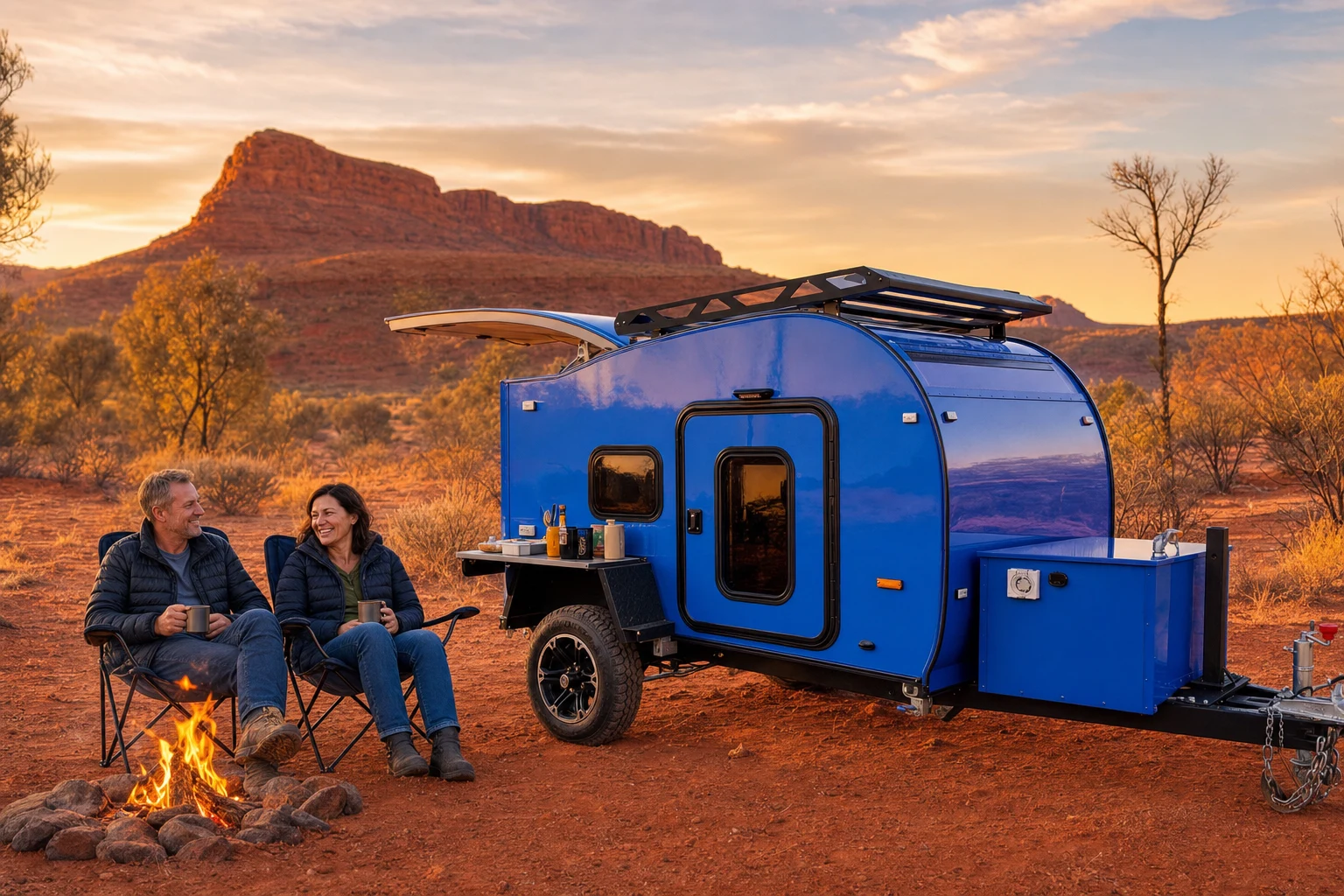
Forty weekends a year, or two? The answer to that question probably matters more than the price tag when you’re deciding whether a teardrop camper is worth it in Australia.
At $19,990–$39,000 for a quality hard-shell teardrop, it is not a throwaway purchase. But compared with a traditional caravan ($55,000–$75,000), a canvas camper trailer with 40-minute setup, or a hotel bill for every weekend escape, the maths can look very different. The question isn’t really “is it expensive?” — it’s “what am I getting per trip, and does that justify the outlay?”
This guide breaks it down honestly. Real costs, real resale data, real comparisons. No hype. By the end, you should know precisely whether a teardrop is a smart investment for your life — or not.
What Does a Teardrop Camper Actually Cost in Australia?
Before you can calculate value, you need a realistic baseline. Here are the 2026 prices for Breath Trailer’s four models — the broadest price range of any Australian teardrop manufacturer:
| Model | Price (AUD) | Tare Weight | Key Feature |
|---|---|---|---|
| Breath Essential | $19,990 | 700 kg | Entry hard-shell, queen bed, external kitchen |
| Breath Plus | $25,740 | 800 kg | 12V fridge included, 80 L water, spare tyre |
| Breath Ultra | $30,290 | 900 kg | External hot shower, REDARC DC-DC, larger power setup |
| Breath Max | $39,000 | 1,200 kg | Full interior bathroom (toilet + hot shower), 2.1 m stand-up headroom, self-contained |
For a direct comparison, competing AU models include the JAG Glider (est. $35,000, 500 kg) and Wotpods Q-Pod (approx. $18,000–$22,000, basic spec). All prices exclude on-road costs.
The Breath Max is the only teardrop camper on the Australian market under $50,000 with a full interior bathroom — a meaningful data point if the overnight amenities question is the main thing holding you back.
The Real Annual Running Costs
Purchase price is the easy number to find. Running costs are what catch buyers off-guard. Here’s what Australian ownership actually looks like per year:
| Cost Category | Annual Range (AUD) | Notes |
|---|---|---|
| Registration | $200–$400 | Varies by state; NSW ~$350, QLD ~$280 |
| Insurance | $250–$600 | Agreed value for $25k–$39k trailer; see our insurance guide |
| Servicing & maintenance | $400–$800 | Annual wheel bearing check, seals, 12V, water tank |
| Storage (if not home) | $0–$2,400 | $50–$200/month for secured undercover storage |
| Total (no storage) | $850–$1,800 | If parked at home |
| Total (with storage) | $1,450–$4,200 | If renting storage |
Fuel surcharge: Expect 15–20% higher fuel consumption when towing, depending on your vehicle and the trailer’s weight. A 700 kg Essential adds far less drag than a 1,200 kg Max. At $2.00/litre and 1,000 km of towing per year, that’s roughly $60–$150 in extra fuel per trip for a 4,000 km towing year.
Accessories: A first-year buyer often spends $500–$2,000 on additions — a quality awning, a PLB, solar boost panels, or a hitch ball upgrade. Budget for this upfront rather than treating it as a surprise.
Full breakdown of what to budget for each model at Teardrop Camper Cost Australia.
The Cost-Per-Trip Calculation (The Number That Actually Matters)
Divide total cost of ownership by trips taken. This is the only honest way to assess value.
Example: Breath Plus ($25,740) over 5 years
- Purchase price (5-yr): $25,740
- Running costs (5 yr × $1,200 avg): $6,000
- Fuel surcharge (5 yr, moderate use): $2,000
- Gross 5-yr cost: ~$33,740
- Resale after 5 years (est. 65% retention): −$16,730
- Net 5-yr cost: ~$17,010
| Trips per year | Total trips (5 yr) | Net cost per trip |
|---|---|---|
| 5 weekends | 25 | $680 |
| 15 weekends | 75 | $227 |
| 25 weekends | 125 | $136 |
| 40 weekends | 200 | $85 |
At 15 weekends a year — which is roughly one trip every three weeks — the net cost is $227 per trip. Split between two people, that’s $113 per person for two nights of a real bed, a proper kitchen, and the campsite of your choosing. Compare that to a motel.
The resale figure matters: quality Australian-made teardrops retain 60–75% of value over five years, which is significantly better than the caravan sector average of 45–55%. For more on what affects resale, see our guide to teardrop camper resale value in Australia.
What You’re Actually Comparing It Against
A teardrop doesn’t exist in isolation. Here’s what Australians are genuinely choosing between:
| Option | Upfront Cost | Setup Time | Sleep Quality | Bathroom | Tow Vehicle |
|---|---|---|---|---|---|
| Tent | $200–$1,500 | 30–60 min | Air mattress on ground | No | Any car |
| Canvas camper trailer | $10,000–$45,000 | 20–45 min | Stretcher/mattress, canvas walls | Rare | Requires tow bar |
| Hard-shell teardrop | $19,990–$39,000 | 5 min | Queen bed, insulated | Some models | Most SUVs |
| Pop-top caravan | $36,000–$55,000 | 5 min | Fixed bed | Most | Heavy SUV or ute |
| Full caravan | $55,000–$120,000+ | 10 min | Fixed bed | Most | Heavy SUV or ute |
Canvas camper trailers sit in the same price bracket as teardrops and are often compared directly. The trade-off is real: canvas offers more internal living space, but you accept 20–45 minutes of setup at each end, canvas maintenance (re-proofing every 1–3 years, drying out after wet camps), and weather performance that is materially worse than a hard shell in heavy rain and wind. Read our full teardrop vs canvas camper trailer comparison.
Traditional caravans solve the space and bathroom problems but add weight (typically 1,800–3,000 kg), cost (entry-level pop-tops from $36,000), and towing requirements that eliminate most of Australia’s mid-size SUVs. The full 5-year total cost of ownership comparison in our caravan vs teardrop guide puts the gap at $40,000–$60,000 in the teardrop’s favour.
Tent camping remains the cheapest option upfront. But the honest answer is that tent camping requires more effort, offers less comfort, and — critically — many buyers admit they simply camp less often because the barrier is higher. A teardrop’s 5-minute setup removes that barrier entirely.
When a Teardrop Camper Is Absolutely Worth It
There are clear buyer profiles where the value case is overwhelming:
1. You camp (or want to camp) more than 10 weekends a year. At that frequency, the cost-per-trip maths work out strongly, and the convenience of a hard-shell camper means you’ll actually use it. Australia has over 7,000 free or low-cost campsites accessible to unpowered trailers — the infrastructure for high-frequency camping exists.
2. You’re a couple without young children. The queen-bed layout is optimised for two adults. You don’t need a caravan’s extra bunks, and the smaller footprint means you can access better, more remote sites. Our teardrop for couples guide covers this in detail.
3. Towing anxiety is the barrier. A 700–800 kg trailer (Essential or Plus) is towable by a Toyota RAV4, Subaru Outback, or Hyundai Tucson. If the idea of backing a 3,000 kg caravan into a tight campsite has been the thing stopping you, a teardrop removes that obstacle completely.
4. You want to free camp. The Breath Max is CMCA-recognised self-contained. That means free camping in remote areas where powered sites don’t exist — saving $20–$50 per night on site fees and opening up most of the best spots in the country. Over 50 nights of free camping, you’ve saved $1,000–$2,500 on site fees alone.
5. You’re a grey nomad planning extended travel. The hard-shell Max’s interior bathroom is the single most commonly cited requirement among retirees doing longer trips. No midnight walks to amenities blocks. No reliance on site facilities. For Greg and Margaret planning their Big Lap, this is a genuine quality-of-life question, not a luxury. Our teardrop for retirees guide works through the full decision.
When It Might Not Be Worth It
Honest advice cuts both ways. Here are the scenarios where a teardrop may not be the right answer:
1. You’ll realistically only camp 2–4 times a year. At 3 trips per year over 5 years (15 trips total), your net cost per trip on a $25,740 Plus approaches $1,100. You’d be better off hiring a camper for those trips, or staying in a cabin. Our hire vs buy calculator guide shows the crossover point.
2. You regularly travel with 3 or more kids. A standard teardrop sleeps two adults comfortably. Some families add an annexe, a rooftop tent for older kids, or choose the spacious Max — but if you need 4 dedicated sleeping spots, a larger camper trailer or a caravan is the more honest answer. See our family teardrop guide for annexe strategies.
3. You want to live in it long-term. A teardrop is a weekend and holiday camper, not a full-time residence. If you’re planning 12 months on the road full-time, the storage and living space of a mid-size caravan will serve you better, even at higher cost.
4. You want maximum off-road capability above all else. While hard-shell teardrops handle graded dirt roads and moderate tracks comfortably, genuinely technical 4WD terrain (Cape York, Simpson Desert) is the territory of purpose-built off-road camper trailers. Our off-road guide maps the capability limits clearly.
The Resale Safety Net
One of the strongest arguments for a quality teardrop over a budget alternative: depreciation is your real enemy, not the sticker price.
A $19,990 Essential from a reputable manufacturer that retains 65% after five years costs you $6,997 in depreciation over that period, or $1,400/year. A $12,000 budget import that retains 30% costs you $8,400 in depreciation — more in total, despite the lower purchase price, and with worse build quality throughout.
The resale market for quality Australian-made teardrops bears this out. Second-hand units from established manufacturers sell quickly and hold price well. The used teardrop market typically sees good examples advertised at $15,000–$28,000 and gone within days.
The Hidden Dividend: Trips You Actually Take
There is one variable that no spreadsheet captures cleanly: the behavioural impact of owning something you can actually use.
Tent campers often delay or cancel trips because pack-up is a chore after a long week. Canvas camper trailers sit in driveways because the 40-minute setup feels daunting on a Friday evening. Caravan owners sometimes skip short trips because the hitch-and-level routine isn’t worth it for two nights.
A teardrop changes the friction equation. Five minutes from driveway to campsite-ready. That’s not a marketing claim — it’s a mechanism that turns “I’ll camp more” into “I actually do camp more.” Owners consistently report using their teardrop more than they expected. That increased usage is the compound return on the investment that doesn’t appear in any cost-per-trip table.
When you account for the trips that happen because the barrier is low, the effective cost-per-trip drops further still.
Maintenance Costs: Lower Than You Think
A hard-shell teardrop has a meaningful advantage over canvas alternatives: no canvas to re-proof, no zips to replace, no stretcher frames to service. Annual maintenance runs to:
- Wheel bearing service: $150–$250 (every 12 months or 10,000 km)
- Seal inspection and re-seal: $0 (DIY) to $100
- Water tank sanitise: $5 in pool chlorine
- 12V system check: included in annual service
Total annual maintenance budget: $150–$400 for a standard year, more if brakes need attention. Full schedule in our teardrop maintenance guide.
Frequently Asked Questions
Is a teardrop camper worth it for occasional campers? Honestly, no — if you’ll camp fewer than 6 times a year, the hire market is more economical. Hiring a quality teardrop for a long weekend costs $150–$300 through peer-to-peer platforms, which beats ownership at low usage frequencies. The crossover point is typically 8–10 trips per year.
How long do teardrop campers last in Australia? A quality hard-shell teardrop from a reputable AU manufacturer should last 15–25 years with standard maintenance. Galvanised steel chassis (common in quality AU units) handles coastal salt air far better than painted mild steel. Breath Trailer uses hot-dipped galvanised chassis as standard.
Does a teardrop camper need to be registered in Australia? Yes. Any trailer towed on public roads in Australia requires registration. Registration costs vary by state ($200–$400/year for a trailer under 750 kg ATM) and typically requires a roadworthy-equivalent check at initial registration. Unpowered trailers (no motor) don’t require separate CTP green slip beyond what’s included in trailer rego — an often-misunderstood saving.
Can I tow a teardrop with a small SUV? Most small and mid-size SUVs handle a 700–800 kg teardrop comfortably. A Toyota RAV4 is rated to 1,650 kg braked; a Subaru Outback to 1,800 kg. Both are well within the capacity for the Essential and Plus. The 1,200 kg Breath Max requires a heavier tow vehicle — a Toyota Prado, Kluger, or equivalent. Check your specific vehicle’s tow rating in the owner’s manual before purchasing any trailer.
What is the self-contained certification, and why does it matter? Self-containment means the camper carries sufficient fresh water, waste water storage, and toilet facilities to operate without any external dump point or water hook-up for a defined period. In Australia, CMCA self-containment criteria require 15 L of fresh water per person per day for three days, plus grey and black water storage. A self-contained trailer opens up free-camping on public land (state forests, National Parks with self-contained areas, roadsides) where unpowered non-self-contained units are prohibited.
Is a teardrop or a caravan better value in Australia? Over five years, a teardrop typically delivers better total value for couples and smaller families who camp regularly. The lower purchase price, lower tow vehicle requirements, better fuel economy, and stronger resale combine to produce a TCO gap of $40,000–$60,000 compared to an equivalent-amenity caravan. Full comparison at Caravan vs Teardrop Camper Australia.
The Verdict
A teardrop camper is worth it — with one condition: you have to use it.
For Australians who genuinely want to camp more, the investment pays off quickly. The cost-per-trip economics work in your favour from around 10 trips per year. The convenience advantage compounds over time as you realise you’re actually doing the trips you’ve always meant to do, rather than just planning them.
For infrequent campers (under 6 trips a year), hiring is more honest. For families of four or five with a bigger space requirement, a larger camper trailer or pop-top caravan may serve better. For anyone else — couples, solo travellers, retirees, weekend warriors, remote-work nomads — the teardrop’s blend of ease, quality, and manageable cost makes a compelling case.
The only bad answer is buying a $12,000 budget model to “test the waters” and spending the next three years with a trailer you don’t trust on rough roads. Quality pays back through reliability, resale, and the confidence to actually use it.
View the full Breath Trailer model comparison to see which model fits your trip style and tow vehicle, or book a viewing at our Sydney location and see for yourself what a 5-minute setup looks like in practice.
Recommended Reading
- Teardrop Camper Cost Australia: Full Breakdown for 2026 — every cost category in detail, by model
- Teardrop Camper Hire vs Buy Australia — the crossover point, with a calculator-style comparison
- Caravan vs Teardrop Camper: The Honest 2026 Comparison — 5-year TCO side by side
- Teardrop Camper Resale Value Australia — what keeps value and what destroys it
- Teardrop Camper Insurance Australia — agreed vs market value, what’s excluded, real premium ranges