Best Camping Spots in NSW: Coast, Mountains & Outback (2026 Guide)
Where to camp across NSW by region, with access notes, facilities and which sites take a camper trailer.
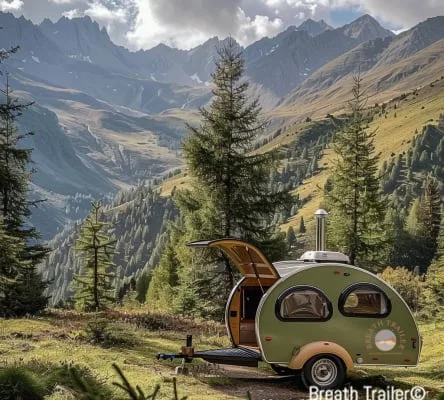
New South Wales is one of the most diverse camping states in Australia. Within a single trip you can sleep under a dark sky park in the central west, wake to kangaroos on a south coast beach, and cook dinner beside a Snowy Mountains river — all without leaving the state. With 175+ national parks, 2.6 million hectares of state forest, and a new six-tier pricing system rolling out from July 2026, there has never been a better time to plan a NSW loop in your camper trailer.
This guide covers 18 of the best campgrounds in NSW, organised by region, with 2026 fees, road ratings, self-containment rules, and a model-matching table so you know exactly which Breath Trailer setup suits each destination.
If you are planning a multi-state adventure, our state-by-state camping destinations guide covers the full country. For Sydney-specific day and weekend trips, the ultimate guide to teardrop trailer camping near Sydney goes deeper on the spots within a two-hour drive.
Quick-Reference Table: 18 Best NSW Camping Spots (2026)
| Campground | Region | Type | Road | 2026 Fee (est.) | Self-Contain? | Best For |
|---|---|---|---|---|---|---|
| Euroka | Blue Mountains | National Park | Sealed | ~$8/adult | No | Families, couples |
| Boyd River | Kanangra-Boyd NP | National Park | Gravel | ~$6–10/adult | No | Couples, explorers |
| Ku-ring-gai Chase | North Sydney | National Park | Sealed | ~$6/adult | No | Weekenders |
| Depot Beach | Murramarang | National Park | Sealed | ~$12–18/adult | No | Beach lovers |
| Pebbly Beach | Murramarang | National Park | Sealed | ~$12–18/adult | No | Wildlife, couples |
| Aragunnu | Mimosa Rocks | National Park | Gravel | ~$6–10/adult | Recommended | Clifftop camping |
| Tom Groggin | Kosciuszko | National Park | Gravel | Free (+$17/vehicle/day) | No | River camping |
| Geehi Flats | Kosciuszko | National Park | Gravel/4WD | Free (+$17/vehicle/day) | No | 4WD, off-grid |
| Yarrangobilly Village | Kosciuszko | National Park | Sealed | Free (+$17/vehicle/day) | No | Caves, Snowies |
| Camp Blackman | Warrumbungle | National Park | Sealed | ~$12/adult (+$8/vehicle/day) | No | Stargazing |
| Main Camp | Mungo | National Park | Dirt | ~$8/adult | Strongly recommended | Outback, history |
| Belah Camp | Mungo | National Park | Dirt | ~$6/adult | Strongly recommended | Remote outback |
| Polblue | Barrington Tops | National Park | Gravel | ~$8/adult | No | Sub-alpine, views |
| Gloucester River | Barrington Tops | National Park | Gravel | ~$6/adult | No | River swimming |
| Ganguddy-Dunns Swamp | Wollemi | National Park | Gravel | ~$6/adult | No | Families, fishing |
| North Head | Murramarang | National Park | Sealed | ~$12/adult | No | Beach, wildlife |
| Swans Creek Crossing | Kerewong State Forest | State Forest | Gravel | Free | Portable toilet | Budget campers |
| Ellenborough Reserve | Near Elands | Crown Reserve | Gravel | Free | No (carry out) | Budget, level sites |
Fees are estimates under the new July 2026 six-tier NPWS system. Confirm at nationalparks.nsw.gov.au before departure.
Greater Sydney & the Blue Mountains
Euroka Campground — Blue Mountains National Park
Euroka sits at the base of the Blue Mountains escarpment, just 60 km west of the Sydney CBD near Glenbrook. It is one of the most accessible wilderness campgrounds in New South Wales and probably the only campground in Australia where you can drink your morning coffee while grey kangaroos graze two metres away.
The access road is sealed and fully trafficable for any tow setup. Facilities include picnic tables, fire rings, and non-flush toilets. Estimated fee under the new 2026 tier system: approximately $8 per adult per night.
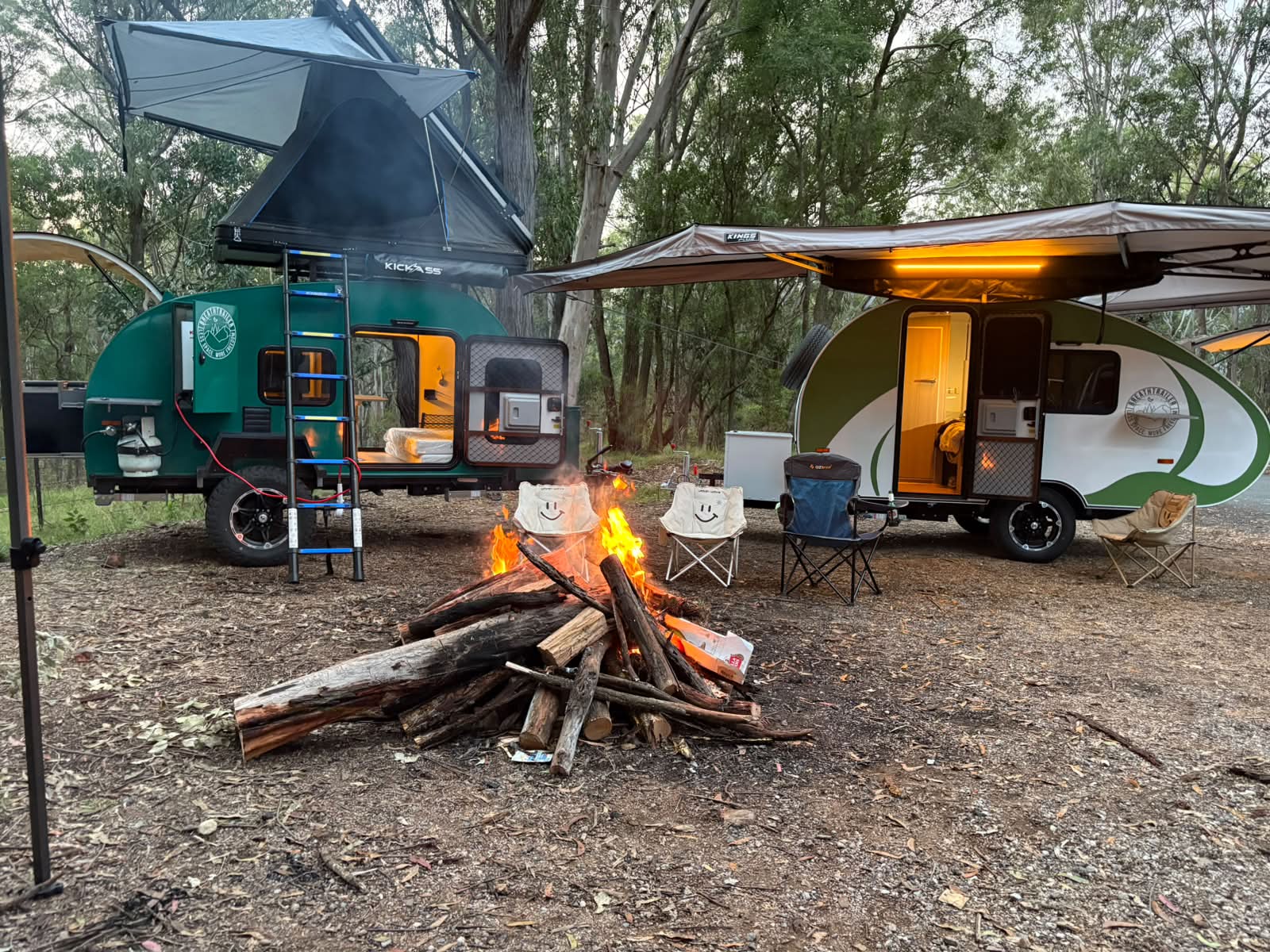
Where fire rings are provided, a campfire rounds off a bush night, total fire bans permitting.
Road rating: Sealed ✅ | Suits: All Breath Trailer models
Booking is mandatory. Reserve via the NSW National Parks website or call 1300 072 757 (7 am–7 pm daily).
Boyd River Campground — Kanangra-Boyd National Park
Kanangra-Boyd National Park forms part of the Greater Blue Mountains Area, a UNESCO World Heritage Property 180 km from Sydney. The famous Kanangra Walls lookout — sheer sandstone cliffs falling hundreds of metres into the Kowmung River canyon — is the centrepiece, but the designated camping area is 6 km back up the access road at Boyd River.
Boyd River offers a large, flat clearing beside the river with basic facilities. The road to the campground is unsealed gravel but manageable in dry conditions with a standard tow vehicle. The sealed road to Kanangra Walls is fine for all setups.
Road rating: Gravel ⚠️ | Suits: Breath Plus, Ultra, Max
Ku-ring-gai Chase National Park
Just 30 minutes north of the Sydney CBD, Ku-ring-gai Chase is the closest national park with waterway camping options. Bobbin Head and the Basin (water-access only) are popular for short breaks. It suits the Breath Essential or Plus for a quick Friday-night escape — no need to burn a long-weekend on the drive out.
South Coast NSW
The NSW South Coast — stretching from the Royal National Park down to the Victorian border — is arguably Australia’s best coast-camping corridor. The combination of uncrowded beaches, national park campgrounds, and abundant wildlife has no peer in the country.
Depot Beach — Murramarang National Park
Murramarang National Park stretches 44 km along the south coast between Batemans Bay and Ulladulla, and Depot Beach is its flagship campground. It sits in a wide clearing of coastal bush, with Durras Lake forming a calm lagoon at the south end and the beach a two-minute walk through the scribbly gums. Wildlife, including eastern grey kangaroos and yellow-tailed black cockatoos, moves through camp at dawn and dusk.
All Murramarang campgrounds require advance booking — no walk-ins accepted. Access roads are sealed.
Road rating: Sealed ✅ | Suits: All models | Fee: ~$12–18/adult/night
Pebbly Beach — Murramarang National Park
Pebbly Beach is the most photographed campground in New South Wales for one reason: kangaroos come down to the beach in the mornings and evenings, so naturally. You’ll find a small campground above the beach with basic facilities. Because of its popularity, site numbers are limited and bookings fill quickly on long weekends — book 3–4 months ahead for peak season.
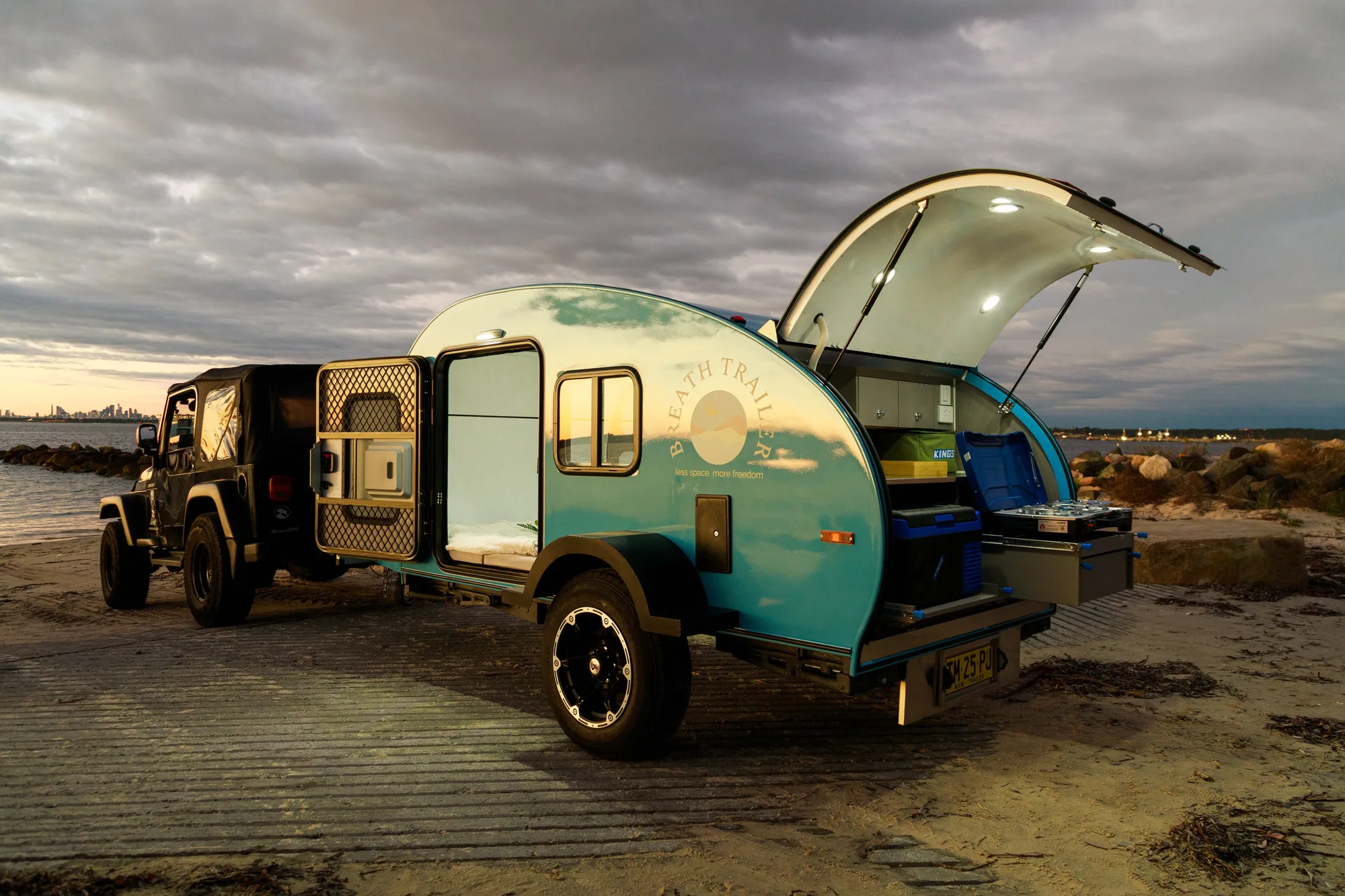
Beachside camping on the south coast is easy to reach with a compact trailer on sealed roads.
Aragunnu Beach — Mimosa Rocks National Park
About 5 hours south of Sydney near Bermagui, Mimosa Rocks National Park is much quieter than Murramarang. Aragunnu campground sits on low headlands above a sweeping beach, with fire rings, pit toilets, and unrestricted ocean views. Self-containment for waste is strongly recommended — there are no dump points within the park itself.
Road rating: Gravel ⚠️ | Suits: Breath Plus, Ultra, Max | Fee: ~$6–10/adult/night
Snowy Mountains — Kosciuszko National Park
Australia’s highest peak (Mt Kosciuszko, 2,228 m) anchors one of the best multi-day camping destinations in the country. Valley campgrounds in Kosciuszko have no nightly camping fee, but a daily vehicle entry fee applies year-round: $17/vehicle outside ski season, $29/vehicle during winter (June long weekend to October long weekend). All bookings are mandatory via the NSW National Parks website.
For a deeper dive into setting up a self-sufficient power system for high-altitude camping, our complete guide to camper trailer power systems covers the solar, battery, and DC-DC charger choices that work in alpine conditions.
Tom Groggin Campground
Tom Groggin, near Khancoban at the southern end of the Alpine Way, sits beside the infant Murray River — one of the few campgrounds in Australia where you can say you’re camped at the source of the country’s greatest river system. Campfires are permitted on low fire danger days. The access road is unsealed gravel but wide and well-maintained.
Road rating: Gravel ⚠️ | Suits: Breath Plus, Ultra, Max
Geehi Flats
A beautiful river valley campground deeper into the park, Geehi is less visited than Tom Groggin and suited to campers with an off-road-capable setup. Some sections require 4WD. Facilities are minimal — pit toilets only.
Road rating: Gravel/4WD ⚠️⚠️ | Suits: Breath Ultra, Max
Yarrangobilly Village
The third major valley campground, Yarrangobilly sits adjacent to the Yarrangobilly Caves — one of the most accessible cave systems in NSW. A natural thermal pool nearby maintains 27°C year-round, making it a popular winter stop. The access road is sealed.
Road rating: Sealed ✅ | Suits: All models
Central West & Outback NSW
Camp Blackman — Warrumbungle National Park
Warrumbungle National Park, near Coonabarabran in the state’s central west, holds a unique designation: Australia’s first Dark Sky Park, proclaimed in 2016. The absence of light pollution, combined with the Siding Spring Observatory on the park’s eastern edge, makes this one of the best places in the southern hemisphere for naked-eye and telescope stargazing.
Camp Blackman is well-equipped with hot showers, flush toilets, and powered sites — unusually good facilities for an outback park. Estimated fee: $12/adult/night plus $8/vehicle/day park entry.
Dark sky rules: All lights must face downward. Warm-coloured (amber) globes are required over the site; white LED strip lighting is discouraged. This aligns with the insect-attraction science we covered in our camper trailer lighting guide — amber light (~590–600 nm) attracts roughly 60% fewer insects than white light anyway, so it doubles as good camp hygiene.
The drive from Sydney takes about 5 hours on fully sealed roads.
Road rating: Sealed ✅ | Suits: All models | Fee: ~$12/adult (+$8/vehicle/day)
Main Camp — Mungo National Park
Mungo National Park, located in the far south-west corner of NSW (approximately 9 hours from Sydney), is one of the most significant archaeological landscapes in the world. The site is part of the Willandra Lakes UNESCO World Heritage Area — a mixed cultural and natural site, one of only four in Australia. Fossilised remains found here — Mungo Man and Mungo Lady — date to at least 42,000 years ago, making this area home to the world’s second oldest modern human remains found outside Africa.
The Walls of China, a striking 33-km lunette of sand and clay sculpted by wind, forms the centrepiece of the park. Camping at Main Camp includes 33 sites near the visitor centre with hot showers, barbecues, and picnic tables. The access roads are unsealed dirt — dusty and corrugated in dry conditions.
Road rating: Dirt/corrugated ⚠️⚠️ | Suits: Breath Ultra, Max (independent coil suspension recommended) | Fee: ~$8/adult/night
If you are planning a multi-day remote stay at Mungo, make sure your rig is truly self-contained — the nearest town (Balranald or Mildura) is 110–150 km away across unsealed roads. The Breath Max’s 120-litre fresh water, self-contained grey water management, and 120 Ah lithium battery are well-suited to this kind of trip.
Belah Camp — Mungo National Park
A quieter alternative 12-site bush camp located halfway along Mungo’s self-guided drive tour, Belah is for travellers who want the outback atmosphere without other campers 10 metres away. Basic pit toilets only — full self-containment is strongly advised.
Northern NSW — Barrington Tops
Polblue Campground — Barrington Tops National Park
Barrington Tops National Park sits roughly 2.5 hours north of Sydney, inland from the Hunter Valley. The park covers a World Heritage-listed landscape of sub-alpine plateau, Antarctic beech forest, and plunging escarpments. Polblue Campground, at 1,450 metres above sea level, is officially Australia’s highest car-based campsite — a genuine claim worth the badge. Snow gums frame the camping area, and temperatures drop sharply at night year-round.
Eight campgrounds are spread across the park. Polblue and Gloucester River are the most accessible for camper trailers. More remote spots like Gummi Falls and Junction Pools are 4WD-only.
Road rating: Gravel ⚠️ | Suits: Breath Plus, Ultra, Max | Fee: ~$8/adult/night
Gloucester River Campground
Lower in elevation and gentler in terrain than Polblue, Gloucester River is an excellent base for families. The Gloucester River runs clear through the campground and swimming holes are easy to find downstream. The gravel access road is manageable with a standard 2WD tow vehicle in dry conditions.
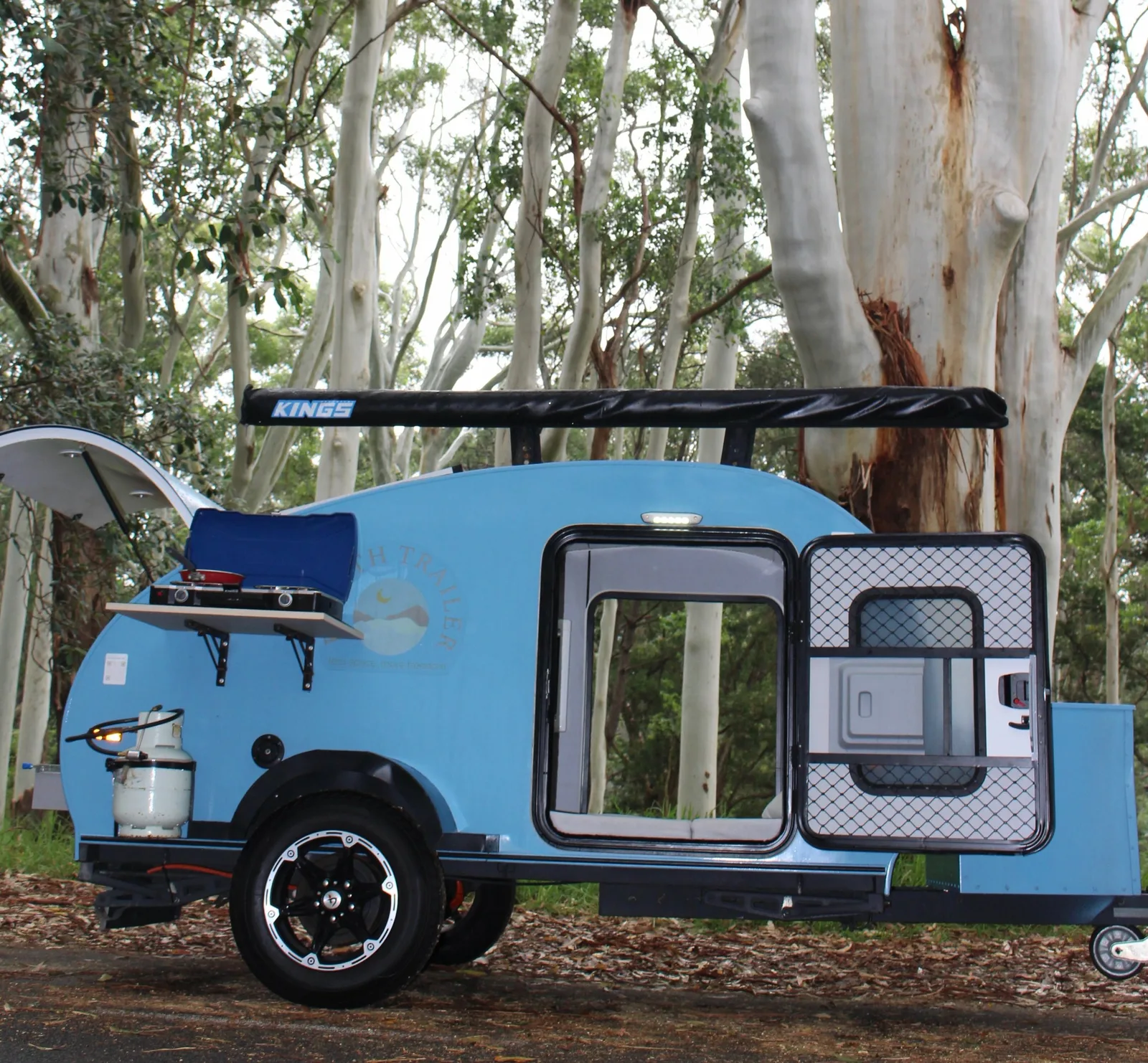
Gentle, lower-elevation river camps suit families who want an easy set-up among the gums.
For packing tips before a mountain trip, our teardrop camper towing tips guide covers load distribution and speed adjustments for corrugated gravel roads.
Greater NSW — Wollemi National Park
Ganguddy-Dunns Swamp — Wollemi National Park
Near Rylstone in the central tablelands, Ganguddy-Dunns Swamp campground is one of the great underrated camping spots in NSW. The Cudgegong River forms a scenic swamp-like lake edged by sandstone outcrops, and the campground is ideal for fishing, canoeing, and swimming. Facilities include non-flush toilets and fire rings. Access is via unsealed road from Rylstone — suitable for all camper trailers in dry conditions.
NSW State Forests — Free Camping
State forests in NSW allow free camping in designated areas, typically with 72-hour limits. Some sites require a free permit via the Forestry Corporation website. Pets are permitted in state forests (unlike national parks). Self-containment requirements vary by site — always check before arriving.
Swans Creek Crossing — Kerewong State Forest
About 4.5 hours north of Sydney, Swans Creek Crossing is one of the best-facilitated free camps in the state. It has 40 sites, basic toilets, and large flat grassed areas suitable for camper trailers and caravans. Mobile reception is limited, so download offline maps before departure.
Ellenborough Reserve
Also approximately 4.5 hours from Sydney near Elands, Ellenborough Reserve offers open-level grassed sites that caravans and camper trailers can use comfortably. The area sits near Ellenborough Falls, one of the highest single-drop waterfalls in NSW. No facilities on site — carry out all waste.
NSW Camping Rules for 2026
New Six-Tier Pricing (NSW National Parks, July 2026)
From 1 July 2026, the NSW National Parks and Wildlife Service introduced a six-tier pricing structure that matches fees to the level of facilities on offer:
| Tier | Facilities | Fee Range |
|---|---|---|
| Tier 1 | Bush clearing, no facilities | Free — no booking required |
| Tier 2 | Pit toilets only | ~$6/adult/night |
| Tier 3 | Pit toilets + tables + fire rings | ~$10–15/adult/night |
| Tier 4 | Flush toilets + cold showers | ~$18–25/adult/night |
| Tier 5 | Full amenities, powered sites | ~$25–40/site/night |
| Tier 6 | Premium campgrounds, peak season | Up to $89/site/night |
Around 86 per cent of NSW campgrounds fall in Tiers 2–5. Fees will rise with the CPI each July. Book all campgrounds (including free Tier 1 in some areas) via nationalparks.nsw.gov.au or 1300 072 757 (7 am–7 pm daily). All campgrounds require advance booking — no walk-ins accepted.
Self-Containment in NSW
Unlike Queensland or South Australia, NSW has no single statewide self-containment mandate for free camping. However, rules vary by land manager:
| Land Type | Self-Containment Rule |
|---|---|
| NSW National Parks | No mandate — some parks have dump points |
| NSW State Forests | Portable toilet required if no facilities on site |
| Crown Land | Varies by location — check before arrival |
| Council-managed free camps | Most now require self-containment for waste |
| Coastal reserve free camps | Self-containment strongly recommended or mandatory |
Regardless of the rules, carrying grey-water management and a portable toilet is good practice in any NSW park: dispose of grey water at dump points or, where none exist, strain and disperse it 100+ metres from any water source.
The Breath Max includes built-in grey-water management and a cassette toilet as standard — qualifying as fully self-contained for all NSW land types without any accessories. The Breath Ultra and Breath Plus benefit from the addition of a portable toilet and grey-water bladder for state forest and coastal free camping.
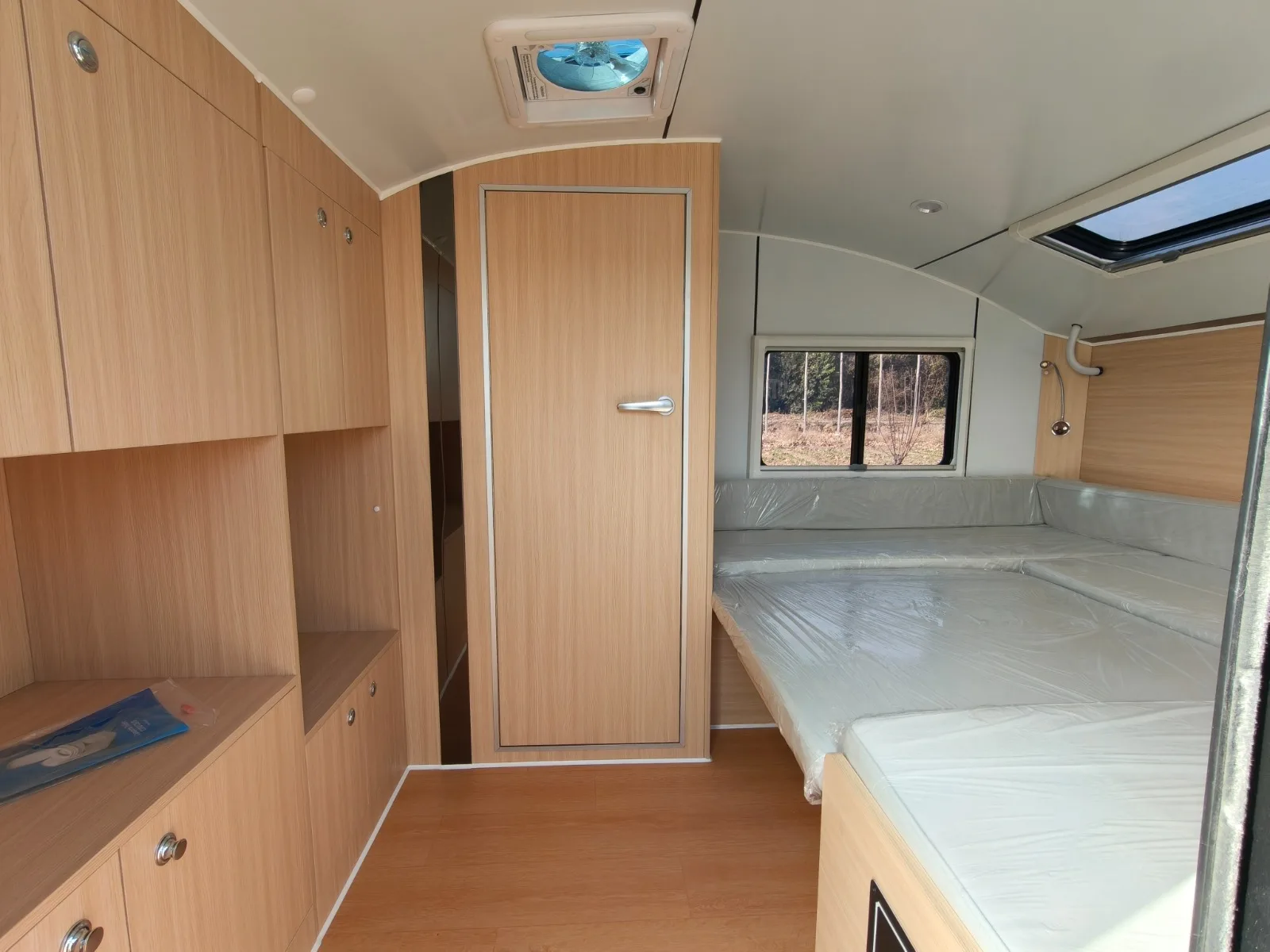
The Max keeps its bathroom inside, which is what free-camp self-containment rules look for.
Which Breath Trailer Model Suits Your NSW Adventure?
| Region / Terrain | Recommended Model | Why |
|---|---|---|
| Blue Mountains day trips & weekends | Breath Essential or Plus | Sealed roads, short stays, no facilities needed |
| South Coast national park campgrounds | Breath Plus or Ultra | Sealed access, beach + bush; fridge and external shower shine |
| Snowy Mountains valleys | Breath Plus, Ultra, or Max | Gravel roads; extra suspension travel on Plus/Ultra handles corrugations |
| Warrumbungle dark sky camping | Any model | Sealed road to Camp Blackman; all models suit families and couples here |
| Mungo NP outback | Breath Ultra or Max | Corrugated dirt roads; self-containment advantage of Max for remote stay |
| Barrington Tops alpine | Breath Plus or Ultra | Gravel access; cold nights benefit from the insulated hard-shell design |
| State forest free camping | Breath Max | Self-contained grey-water and toilet = freedom on any land type |
The comparison page shows the full specification matrix side by side, or book a no-obligation call to talk through which model suits your NSW trip list.
If you are still working out the right tow vehicle, our camper trailer towing guide has a SUV towing capacity table covering the most common Australian vehicles.
Apps & Tools for Finding NSW Campsites
Three apps cover the vast majority of NSW camping needs:
WikiCamps Australia ($2.99, iOS/Android) — The most comprehensive camping app in Australia. User-generated site reviews, photos, and condition reports; works fully offline once maps are downloaded. Build trip itineraries and navigate directly to site gates. The best all-rounder for NSW trip planning.
CamperMate (Free) — A strong free alternative with booking integration for NRMA and other commercial parks. Useful for finding dump points, potable water, and LPG refill stations while on the road.
NSW National Parks App (Free) — The official booking and discovery tool for all NPWS campgrounds. Essential for booking under the new 2026 tier system. Includes offline park maps and track conditions.
Hema Explorer (Subscription) — The best option for 4WD tracks and remote state forest roads. If you are planning the Mungo outback run or Geehi Flats in Kosciuszko, Hema’s detailed track ratings and topographic layers are invaluable.
Seasonal Guide to NSW Camping
| Season | Best Regions | Avoid |
|---|---|---|
| Summer (Dec–Feb) | Snowy Mountains (cool escape), South Coast (warm beaches) | Outback/Mungo (extreme heat, 40°C+) |
| Autumn (Mar–May) | Blue Mountains (colour), Barrington Tops (mild) | Kosciuszko (closing roads post-season) |
| Winter (Jun–Aug) | Outback/Mungo (perfect 15–20°C days), Warrumbungle (dark skies clearest) | Barrington Tops Polblue (snow), Kosciuszko valleys (frozen pipes) |
| Spring (Sep–Nov) | South Coast (wildflowers), Blue Mountains (waterfalls), Barrington Tops (sub-alpine thaw) | Central west (fire risk building) |
Frequently Asked Questions
Do I need to be self-contained to camp free in NSW? Not by state law — NSW has no single mandate. However, many state forests and council-managed free camps now require a portable toilet at minimum, and self-containment of grey water is expected at most sites without facilities. The practical answer is: carry a portable toilet and a grey-water bladder, and you will be welcome everywhere.
Can I have a campfire in NSW national parks? Yes, at campgrounds that have designated fire rings, subject to Total Fire Ban (TFB) declarations. TFBs are called at short notice in summer and on hot, windy days — check the NSW Rural Fire Service app (fires.nsw.gov.au) before lighting any fire. Kosciuszko valley campgrounds (Tom Groggin, Geehi) permit campfires on low fire danger days specifically.
Do I need to book campsites in advance in NSW national parks? Yes — all NSW national park campgrounds require advance bookings, including free walk-in areas. Booking opens 12 months ahead for most campgrounds. For popular spots like Pebbly Beach and Depot Beach on the South Coast, long-weekend bookings fill within hours of the window opening.
What is the best time of year to visit Mungo National Park? Winter (June–August) is optimal: daytime temperatures of 15–20°C, cold clear nights, and the Walls of China lit by low-angle sunlight at golden hour. Summer temperatures frequently exceed 40°C in the far south-west, making the park genuinely dangerous without adequate water capacity and air conditioning.
Are dogs allowed in NSW national parks? No. Dogs, cats, and other pets are prohibited in all NSW national parks and nature reserves. However, pets are permitted in NSW state forests, making sites like Swans Creek Crossing in Kerewong State Forest a good option for campers with dogs.
How far in advance should I book Murramarang National Park? Three to four months for summer and Easter long weekends; four to six weeks for other peak dates (school holidays, AFL Grand Final weekend). Off-peak weekdays in March–April and September–October are often bookable a week or two out.
Plan Your NSW Loop
New South Wales rewards campers who take the time to plan a circuit rather than visiting a single destination. A classic two-week loop from Sydney might run:
- Euroka (Blue Mountains, 2 nights) → orientation, kangaroos
- Boyd River (Kanangra-Boyd, 1 night) → canyon walks
- Depot Beach (Murramarang, 2 nights) → south coast beachside
- Tom Groggin (Kosciuszko, 2 nights) → Snowies river camping
- Camp Blackman (Warrumbungle, 2 nights) → dark sky overnight
- Polblue (Barrington Tops, 2 nights) → alpine plateau
That’s 11 nights, a 2,400 km loop, entirely on national-park campgrounds, with only two gravel road segments (Boyd River and Kosciuszko valley). Any Breath Trailer model from the Plus upward handles the full itinerary comfortably.
For solo travellers planning a solo NSW lap, the teardrop camper for solo travellers guide covers the specific safety and logistics angles. For retirees planning an extended stay, the grey nomad camping guide has the self-containment and free-camping freedom table you need.