Camper Trailer Tyre Guide Australia 2026: Selection, Pressure and Care
Complete guide to camper trailer tyres in Australia: tyre types (P/LT/ST), load ratings, AT vs MT tread, pressure by surface, DOT age check and per-model Breath Trailer specs.
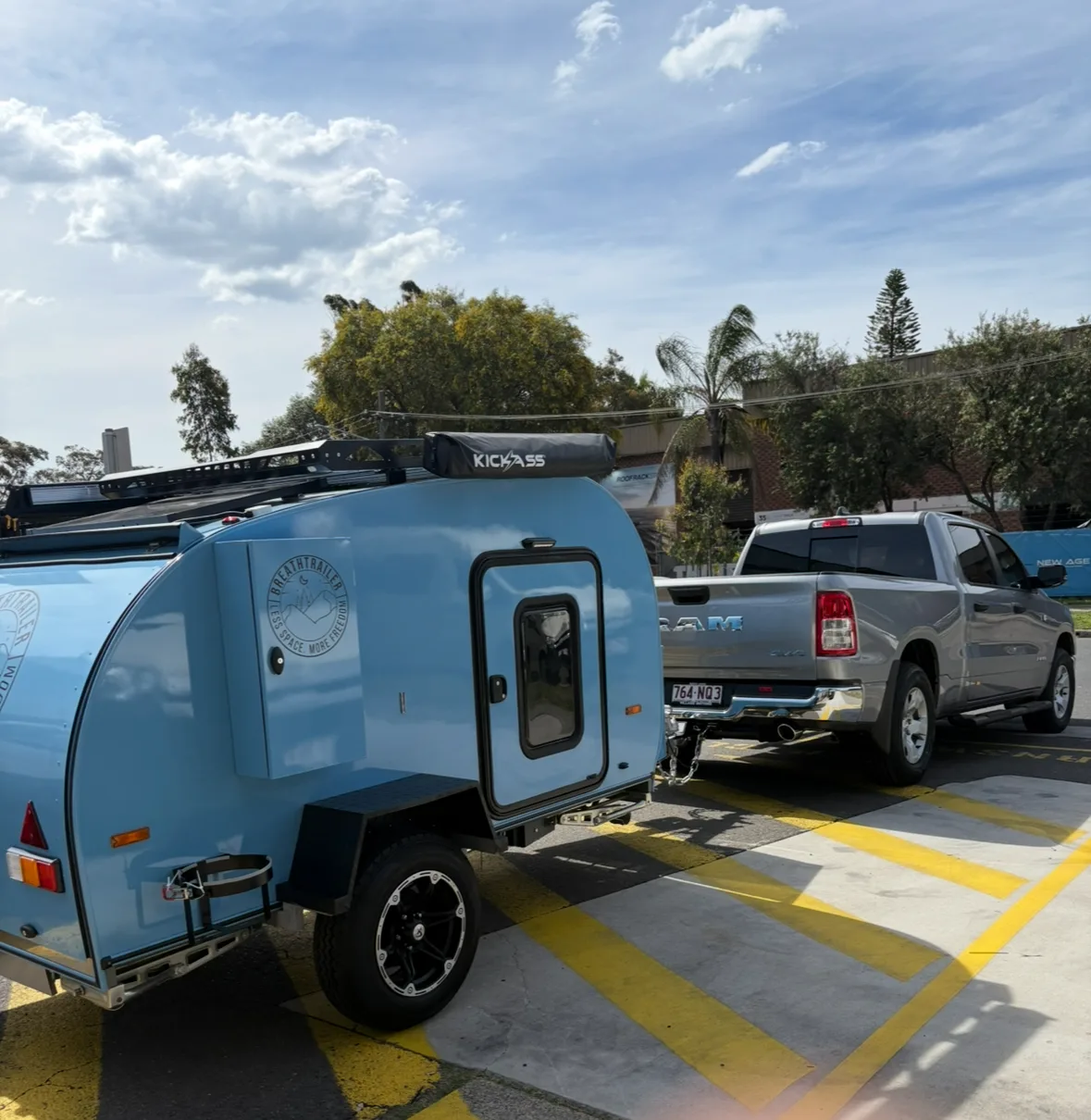
A blown tyre on a remote outback track is one of the most stressful situations an Australian camper can face — and one of the most preventable. Most tyre failures on camper trailers trace back to three avoidable mistakes: running a passenger-rated tyre on a loaded trailer, using the wrong pressure for the road surface, or ignoring a spare that has aged past its safe service life.
This guide covers everything you need to know about camper trailer tyres in Australia: how to decode a sidewall, which tyre type to specify, how to calculate the load rating your trailer actually needs, and how to set pressure for sealed highways, corrugated outback tracks and sandy beach access. Per-model Breath Trailer tyre specifications are at the end.
Reading Your Tyre: The Sidewall Code
Every tyre carries a code on its sidewall. Understanding it takes 30 seconds and is the foundation of every decision that follows.
Example: 205/75R15 102S LT
| Code segment | What it means |
|---|---|
| 205 | Section width in millimetres |
| 75 | Aspect ratio — sidewall height as a percentage of width (75% of 205 mm = 154 mm tall sidewall) |
| R | Radial construction |
| 15 | Rim diameter in inches |
| 102 | Load index (850 kg per tyre at maximum cold inflation pressure) |
| S | Speed rating (180 km/h maximum) |
| LT | Light Truck designation |
The load index and the designation (P, LT or ST) are the two most important values on the sidewall. Get those two right and everything else follows.
Tyre Types: P, LT and ST — Never Fit Passenger Tyres to a Trailer
Three main designations appear on tyres sold in Australia:
| Designation | Stands for | Sidewall construction | Load capacity | Suitable for trailers? |
|---|---|---|---|---|
| P | Passenger | Standard | Lower | Never |
| LT | Light Truck | Reinforced | High | Yes |
| ST | Special Trailer | Extra reinforced | Very high | Yes — purpose-built |
Why passenger tyres fail on trailers: passenger tyres are engineered for vehicles that steer, brake and bear dynamic loads in all directions. A trailer tyre only rolls and bears continuous vertical and lateral load. Under the constant heat build-up from sidewall flex, the rubber delaminates. The outcome is a blowout — typically at highway speed, typically in a remote area. The Australian tyre industry is unambiguous: never fit passenger-rated tyres to a camper trailer.
ST versus LT in practice: ST tyres are purpose-built for trailers with stiffer sidewalls to resist lateral cornering forces and to dissipate heat more effectively on long tows. LT tyres work extremely well on camper trailers, particularly off-road models, and are far more widely stocked across Australian tyre shops from Bridgestone, Maxxis, BFGoodrich and Cooper. For most Breath Trailer owners, an LT-rated all-terrain tyre in the correct load index is the practical choice — available in every state, serviceable everywhere, and rated for the loads the trailer actually carries.
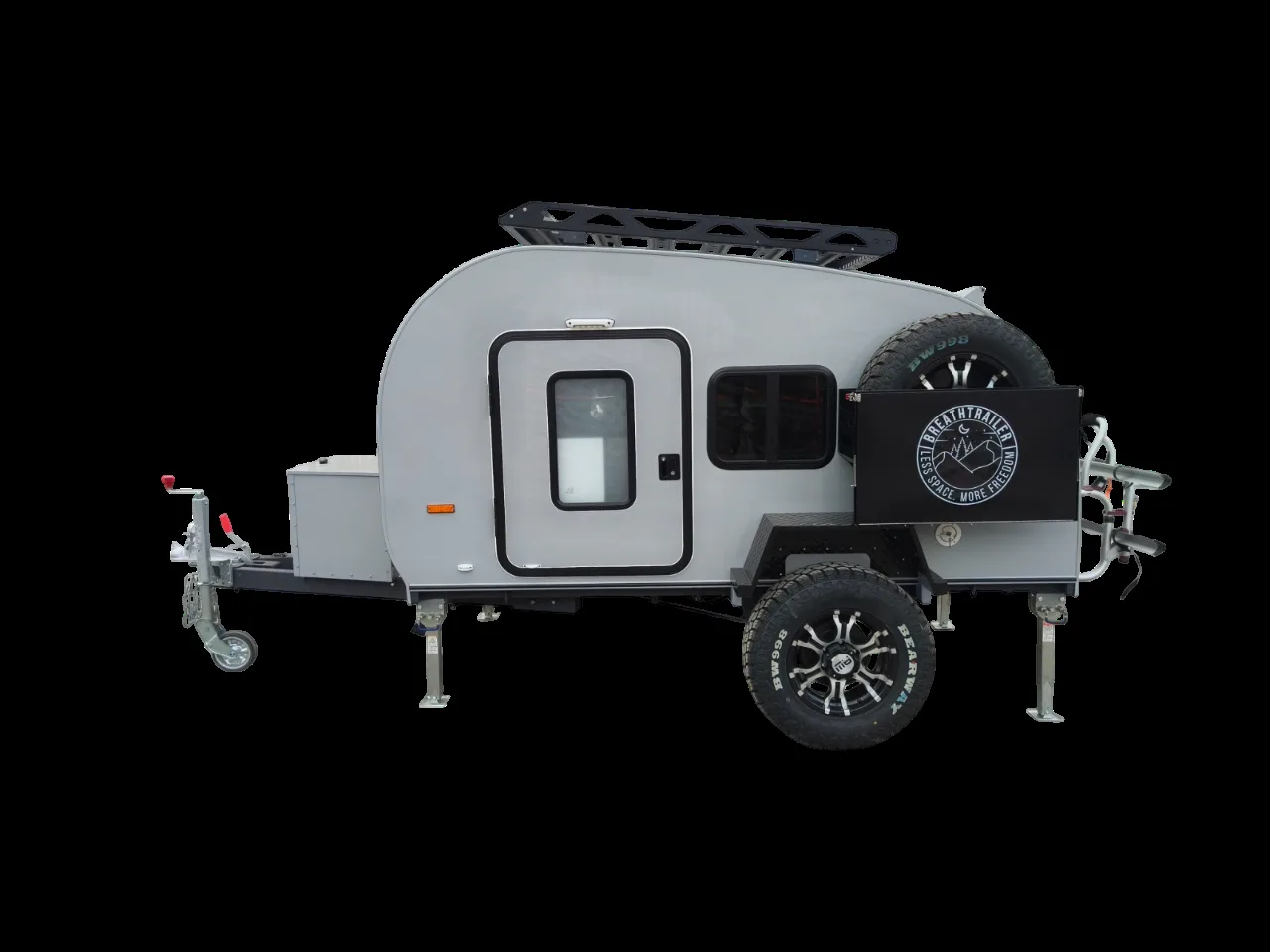
A full-size spare matching the fitted tyres in size and load index is standard on every Breath Trailer model.
All-Terrain, Highway Terrain or Mud Terrain? The Australian Touring Reality
Choosing between tread patterns comes down to where you actually drive. A realistic distribution for most Australian camper trailer touring looks like this:
- 80% sealed bitumen (highways, national park access roads, town connections)
- 15% unsealed gravel and dirt (station tracks, fire trails, most national park campground access)
- 5% genuinely rough terrain (deep corrugations, soft sand, rock)
That mix tells you which tyre to specify:
| Tyre type | Tread design | Best application | On-road noise | Off-road grip | Tread life |
|---|---|---|---|---|---|
| HT — Highway Terrain | Closed, smooth-shoulder | 95%+ sealed roads | Low | Limited | Long |
| AT — All-Terrain | Open shoulder blocks | Mixed bitumen + dirt | Moderate | Good | Moderate |
| MT — Mud Terrain | Aggressive open lugs | Mud, rock, heavy sand | High | Excellent | Shorter |
For most Breath Trailer owners, AT is the right answer. All-terrain tyres provide the load index and puncture resistance required on Australian dirt roads without the rolling noise and fuel penalty of mud terrain on the highway. On corrugated outback tracks — the Gibb River Road, the Oodnadatta, the Birdsville Track — AT tyres aired down to 26–28 PSI absorb significantly more corrugation shock than highway terrains at full pressure.
Mud terrain tyres make sense only if you regularly drive tracks that genuinely require them. For occasional beach access or rocky creek crossings, a quality AT tyre aired down to the right pressure achieves comparable results without the on-road compromise.
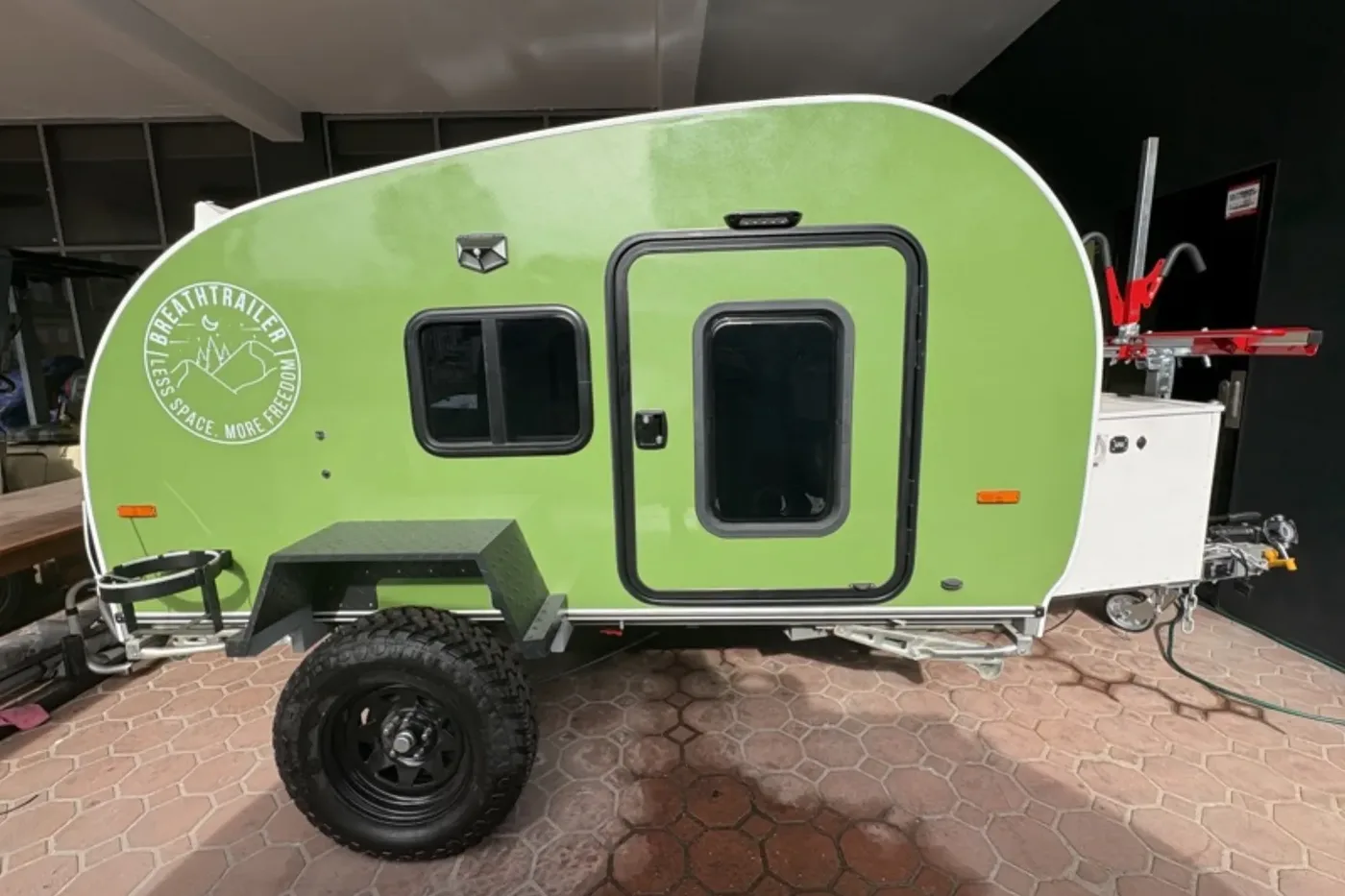
All Breath Trailer models ship with LT-rated all-terrain tyres as standard.
Load Rating: Matching the Tyre to Your Trailer’s GTM
The gross trailer mass (GTM) — the maximum permitted weight bearing on the trailer’s own axle — sets the floor for the load index your tyres must carry. The standard rule is to never exceed 90 per cent of the load index capacity under loaded operating conditions.
The load index is stamped as a two- or three-digit number on the sidewall. A selected range relevant to Australian camper trailers:
| Load index | Max load per tyre (kg) | Two-tyre single-axle combined |
|---|---|---|
| 97 | 730 kg | 1,460 kg |
| 100 | 800 kg | 1,600 kg |
| 102 | 850 kg | 1,700 kg |
| 106 | 950 kg | 1,900 kg |
| 109 | 1,030 kg | 2,060 kg |
| 112 | 1,120 kg | 2,240 kg |
| 114 | 1,180 kg | 2,360 kg |
How to calculate the minimum load index you need:
- Find your trailer’s GTM on the compliance plate or in the owner’s manual
- Divide by the number of load-bearing tyres (2 for a single axle)
- The result must not exceed 90% of the load index figure for the tyre you are considering
Example: Breath Ultra, GTM 900 kg, two tyres → 450 kg per tyre. A load index 97 tyre (730 kg capacity) carries that load at only 62% utilisation — a comfortable safety margin. ✓
Always weigh your trailer loaded before specifying replacement tyres. Many owners discover their actual payload exceeds their assumptions once water, food, gear and accessories are added. The tare, ATM and payload guide explains how to calculate your true payload and what a weighbridge will tell you that your compliance plate doesn’t.
Tyre Pressure by Surface
Incorrect inflation is the leading cause of tyre failure on camper trailers in Australia. Under-inflation generates heat through continuous sidewall flex. Over-inflation concentrates load on the tyre’s crown, reduces the contact patch and amplifies corrugation impact through the chassis.
The critical rule: always check pressure cold — before driving, or within 3 km at low speed. A tyre driven at highway speed for 30 minutes typically reads 5–8 PSI higher than cold due to heat expansion. That is normal; it is not a reason to deflate.
| Surface | Recommended trailer tyre pressure | Notes |
|---|---|---|
| Sealed highway | 35–44 PSI | Use the upper range for heavier loads approaching GTM; check tyre max pressure |
| Unsealed gravel | 30–35 PSI | Slight reduction absorbs minor corrugation; retain vehicle’s placard pressure |
| Corrugated outback | 26–30 PSI | Lets the tyre absorb shock; keep speed below 80 km/h at these pressures |
| Hard-packed sand | 20–25 PSI | River crossings, beach access tracks, hard desert surfaces |
| Soft sand | 15–20 PSI | True beach driving or dunes; re-inflate to 30+ PSI before returning to any gravel |
Re-inflate before returning to sealed roads — not at the next servo, not at the end of the day, but at the boundary of the soft-surface section. Driving sand-pressure tyres at 110 km/h on bitumen generates catastrophic heat build-up and can destroy a tyre in minutes.
A quality 12 V compressor rated to at least 3.5 CFM can re-inflate a camper trailer tyre from 18 PSI to 38 PSI in under five minutes. ARB, Ironman 4×4 and KickAss all make suitable units in the $250–400 range. A compressor is covered in the must-have off-road accessories guide.
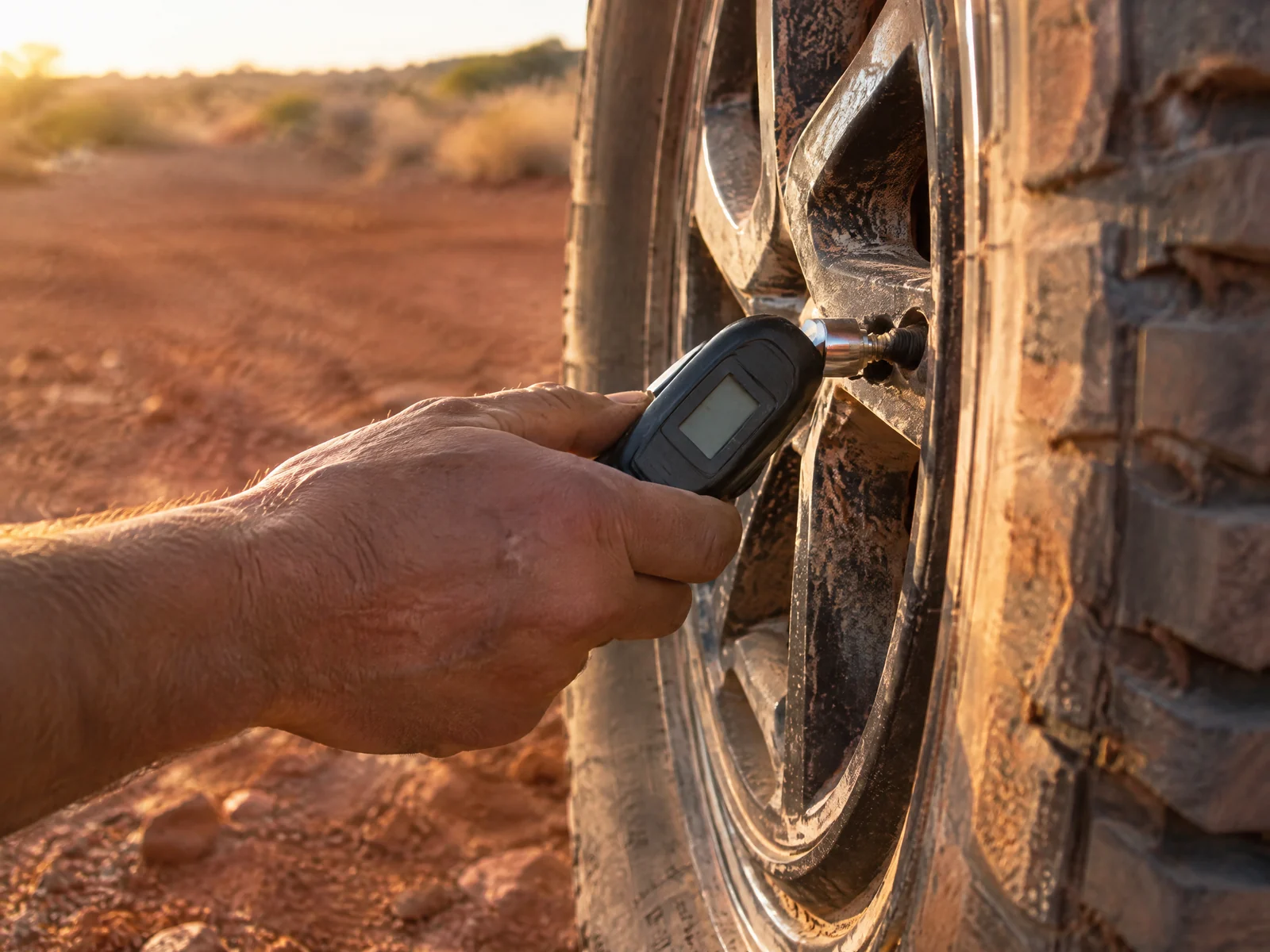
Illustration: Check tyre pressure cold — before driving or within the first 3 km — for an accurate reading.
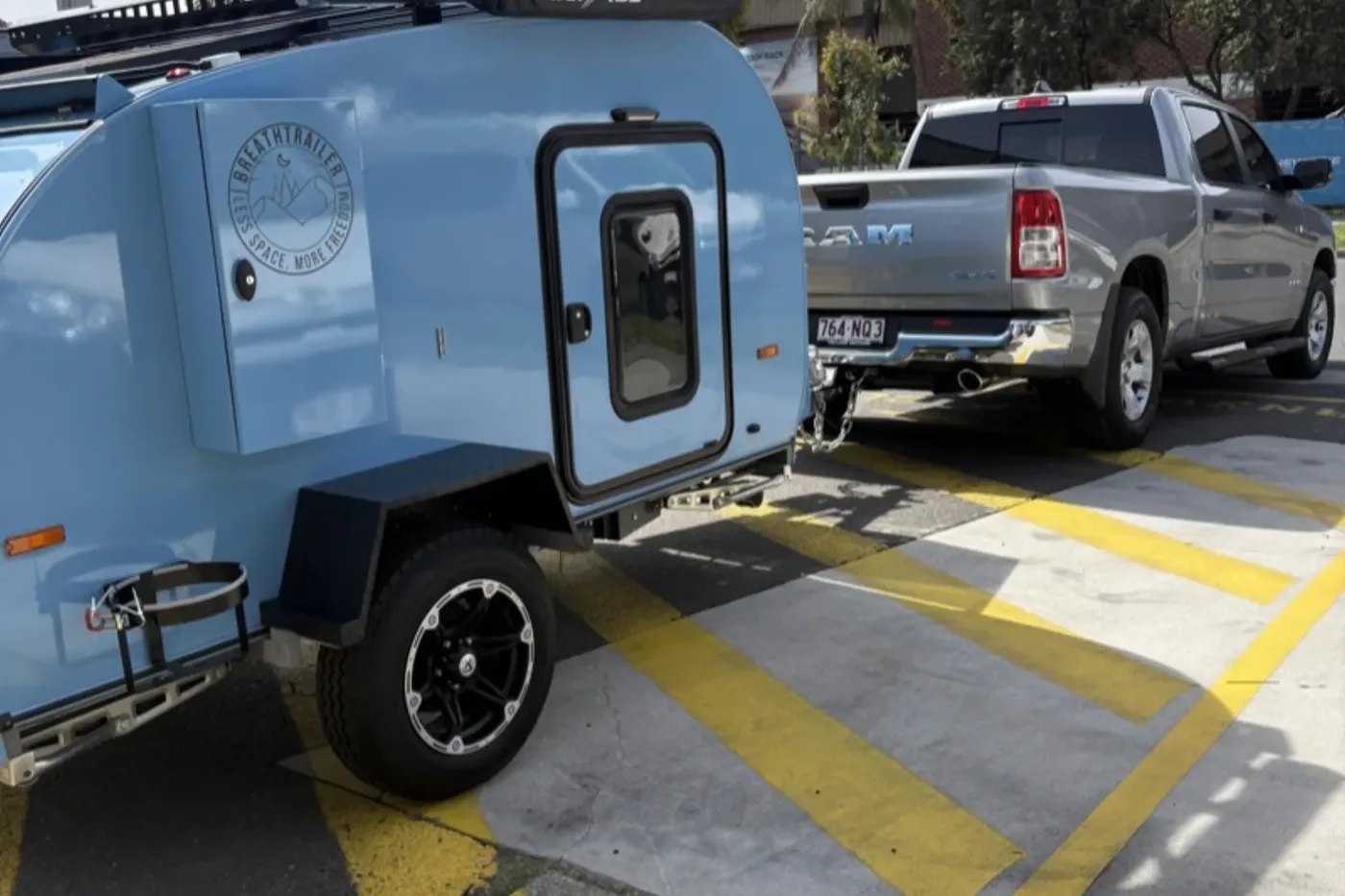
On the sealed highway, run trailer tyres at 35–44 PSI — heavier loads use the upper end of that range.
How Old Is Too Old? Reading the DOT Date Code
Most camper trailer tyre failures in Australia are caused not by worn tread but by aged rubber that has hardened and micro-cracked through UV exposure and heat cycling. Trailers sit idle for months at a time; tyres age faster than they wear out.
How to read the DOT manufacture date:
Every tyre has a four-digit code on its sidewall, typically preceded by “DOT”. The first two digits are the week of manufacture; the last two are the year.
Example: ...1624 = week 16 of 2024 = manufactured April 2024.
| Tyre age from manufacture | Status | Recommended action |
|---|---|---|
| 0–3 years | New | Normal use |
| 3–5 years | Maturing | Inspect annually for cracking, sidewall bulges, bead area deterioration |
| 5–7 years | Ageing | Replace if any visible cracking or if regularly used off-road |
| 7–10 years | Near end of life | Replace as a priority; do not use on heavily loaded or high-speed runs |
| Over 10 years | Expired | Do not use under any circumstances |
No Australian legislation currently mandates tyre replacement by age alone. However, insurance policies increasingly exclude tyre blowout damage from tyres over five years old. More importantly, the industry-wide recommendation for trailer tyres — which sit stationary under load for extended periods — is a maximum of 5–6 years from manufacture.
Don’t forget the spare. A spare tyre that has never been fitted still ages from the date stamped on its sidewall. A 2016-manufacture spare found on a used trailer in 2026 is ten years old. Replace it.
When buying a used camper trailer, check the DOT code on every tyre — including the spare — before you drive it anywhere. This is part of the pre-purchase inspection checklist.
Tyre Brands: Premium, Mid-Range and Budget
Australian camper trailer owners have access to three price tiers:
| Tier | Brands | Typical 205/75R15 LT (fitted, Sydney, 2026) | Notes |
|---|---|---|---|
| Premium | Bridgestone, Michelin, Toyo, Cooper | $180–$280 per tyre | Best heat resistance, puncture protection and longevity on long-distance touring |
| Mid-range | Maxxis, BFGoodrich, Falken, Kumho | $130–$180 per tyre | Good off-road performance; Maxxis AT is one of the most popular choices on Australian 4WDs |
| Budget | Deestone, Triangle, Boto | $65–$100 per tyre | Acceptable for lightly loaded trailers used mostly on sealed roads; check the DOT date — budget tyres often sit in warehouses for 2–3 years before sale |
For trailers used regularly on outback tracks, the cost difference between budget and premium is trivial against the cost of a blowout. A single tyre failure 400 km from the nearest town can cost $2,000–$5,000 in recovery, tow fees and lost itinerary — far more than the $200 difference between a Deestone and a Bridgestone per corner.
Tyre Maintenance Schedule
| Task | Interval | Notes |
|---|---|---|
| Pressure check (cold) | Before every trip and after each surface change | Use a quality dial or digital gauge; tyre shop-mounted gauges are not always accurate |
| Visual inspection (tread, sidewall, cracks) | Before every trip | Pay attention to sidewall micro-cracking — the first visible sign of age deterioration |
| Rotation (including spare) | Every 10,000 km | Brings the spare into the rotation and evens tread wear across all three tyres |
| Torque re-check | 50 km after any fitting or rotation | Wheel nuts loosen as the wheel beds in; re-torque to the manufacturer’s specification |
| Full inspection including DOT date | Annually | Replace immediately if 5+ years old with visible cracking |
| Wheel balance | When fitting new tyres | An out-of-balance trailer tyre creates sway, increases suspension wear and puts cyclic stress on wheel bearings |
The full camper trailer maintenance guide covers the complete service schedule including wheel bearing intervals, suspension inspection and water-seal testing. The wheel bearings article explains the link between trailer balance, tyre wear and bearing failure — the connection most owners miss.
Spare Tyre Essentials
- Carry at least one full-size spare matching the fitted tyres exactly in size, construction and load index. Temporary run-flat or space-saver spares are not designed for trailer loads.
- Check the spare’s pressure monthly. Unmounted tyres lose approximately 1–2 PSI per month. A deflated spare at the roadside is worse than useless.
- Check the spare’s DOT date. Age-from-manufacture applies regardless of mileage.
- For remote tracks, carry two spares. Corrugated tracks in the Kimberley, Cape York and the outback can cause one puncture per 200 km for loaded trailers hitting sharp rocks or bulldust-buried objects. The Gibb River Road guide recommends a minimum of two full-size spares for any Kimberley crossing.
- Carry a tyre repair kit ($20–30) for emergency roadside plugging of tread punctures. Sidewall punctures cannot be repaired — they require a full tyre replacement.
Breath Trailer Per-Model Tyre Specifications
All four Breath Trailer models are fitted with LT-rated all-terrain tyres as standard. The table below shows current specifications (effective September 2026):
| Model | ATM | GTM | Standard tyre size | Load index (per tyre) | Capacity per tyre | Sealed-road pressure |
|---|---|---|---|---|---|---|
| Essential | 700 kg | 700 kg | 205/75R15 LT | 97 | 730 kg (utilisation: ~48%) | 36–40 PSI |
| Plus | 800 kg | 800 kg | 205/75R15 LT | 102 | 850 kg (utilisation: ~47%) | 38–42 PSI |
| Ultra | 900 kg | 900 kg | 205/75R15 LT | 102 | 850 kg (utilisation: ~53%) | 38–42 PSI |
| Max | 1,200 kg | 1,200 kg | 225/75R15 LT | 109 | 1,030 kg (utilisation: ~58%) | 40–44 PSI |
The Max uses a wider 225/75R15 to accommodate the higher ATM from its full interior bathroom, self-contained grey water system, queen bed frame and cabinetry. At maximum loaded ATM, each tyre operates at approximately 58% of its rated load index — a comfortable engineering margin.
For off-road use, reduce from sealed-road pressure by 6–8 PSI. For sand access, reduce to 20–22 PSI for the trailer and re-inflate immediately before returning to gravel or bitumen.
Compare the four models side by side on the comparison page, or book a viewing to see the tyre specification in person at our Sydney workshop.
Frequently Asked Questions
Can I fit standard car tyres to my camper trailer? No. Passenger-rated (P) tyres are not designed for the continuous load and heat cycles of trailer use. They lack the sidewall reinforcement of LT or ST tyres and carry significantly higher risk of sidewall delamination and blowout. Always use LT or ST-rated tyres.
How do I know if my trailer tyres need replacing? Check three things: tread depth (legal minimum is 1.5 mm in Australia, but 3 mm or more is recommended for off-road use), visible sidewall cracking or bulges, and the DOT manufacture date. If the tyres are five or more years from their manufacture date, replace them regardless of remaining tread depth.
What is the legal maximum tyre age in Australia? There is currently no legislated maximum age for tyres in Australia. However, the industry standard is 5–6 years for trailer tyres that sit stationary under load for extended periods. Tyres over ten years old should never be used. Insurance policies increasingly exclude blowout damage from aged tyres.
How often should I rotate my camper trailer tyres? Every 10,000 km. Include the spare in the rotation to keep all three tyres (or five for a dual-axle trailer) wearing evenly, and to ensure the spare is always a current tyre rather than an older one sitting unmounted.
What tyre pressure should I use on corrugated outback roads? 26–30 PSI for the trailer on moderate to heavy corrugations. This allows the tyre sidewall to absorb corrugation energy rather than transmitting it directly into the chassis, suspension and wheel bearings. Keep speed below 80 km/h at these pressures, and re-inflate before rejoining any sealed road.
Does airing down damage my tyre? No, provided you stay within the ranges above and re-inflate before sustained high-speed driving on bitumen. Running a sand-pressure tyre (15–20 PSI) at highway speed (110 km/h) is what causes damage through heat build-up.