Free Camping Australia: The Complete Camper Trailer Guide (2026)
Everything you need to know about free camping in Australia with a camper trailer — land types, state rules, apps, self-containment, dump points and real savings maths.
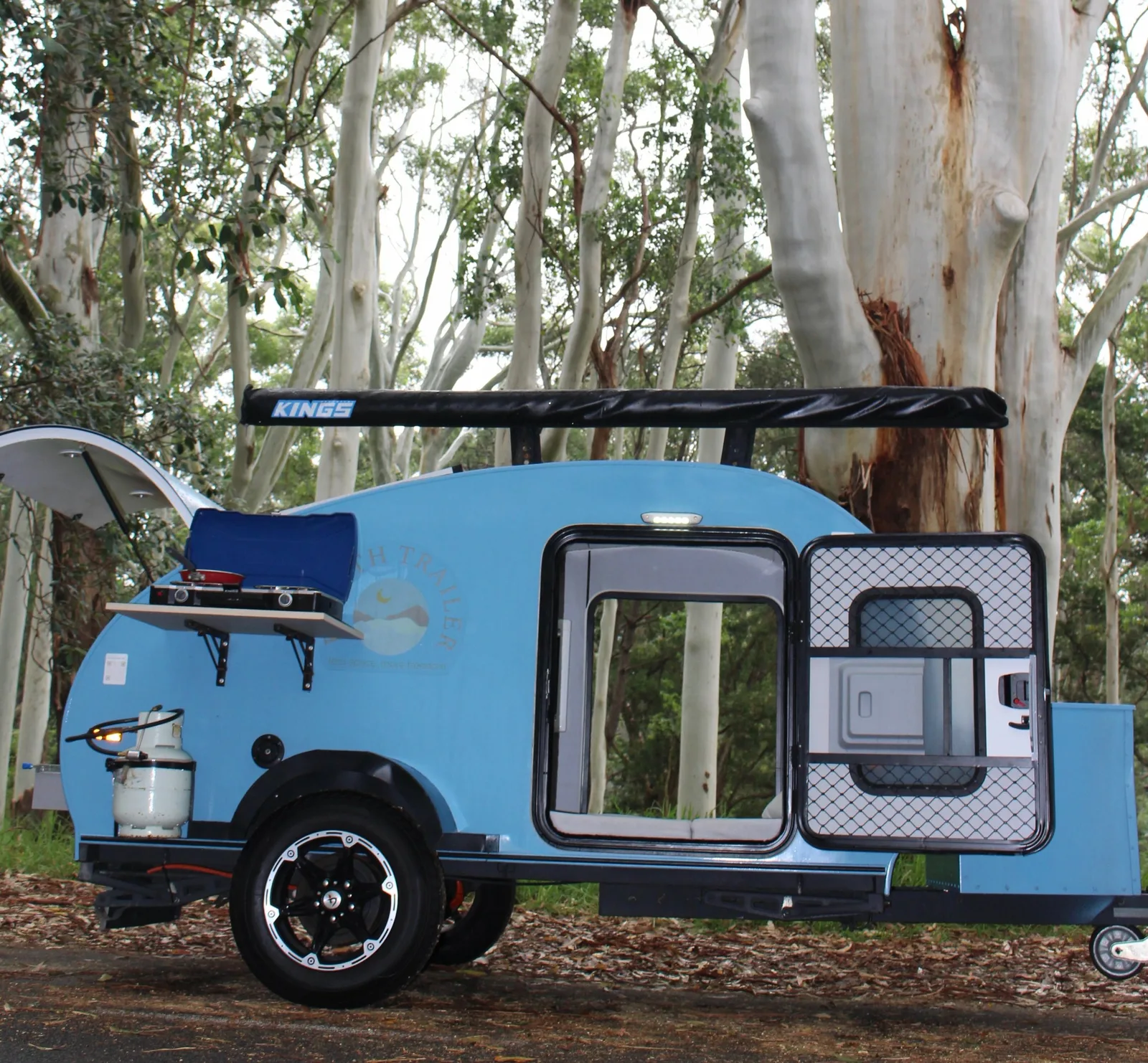
Free camping in Australia is not a fringe activity — it is how a growing number of camper trailer owners spend a significant portion of their time on the road. There are more than 65,000 sites listed on WikiCamps alone, ranging from shaded state-forest clearings to outback roadside stops and council showgrounds, many of them genuinely free or costing no more than a couple of dollars per night. At an average caravan park rate of $35–60 per powered site, 30 nights of free camping saves $1,050–$1,800 in accommodation alone. Over a three-month Big Lap, that gap compounds into $3,000–$5,000.
This guide covers everything a camper trailer owner needs to know before heading out: which land types allow free camping, what self-containment actually means in 2026, state-by-state rules, the best apps, the dump point network, etiquette, and — critically — which Breath Trailer model gives you full access and which ones have restrictions.
What “Free Camping” Actually Means in Australia
“Free camping” means staying overnight on public land without paying a per-night site fee. It encompasses:
- Designated free campsites on state forest, crown land, or council reserves — official sites with (minimal) facilities and signage
- Dispersed / bush camping on gazetted public land — no facilities, you choose a spot within the allowed area
- Roadside rest areas — managed by state road authorities, typically with a 24-hour limit
- Council showgrounds — volunteer-run, often $5–$15 donation or nothing at all
What free camping does not mean is pulling up anywhere you like. Parking on private land without permission is trespass. Setting up at a beach reserve without checking council rules risks a fine. The free part refers to the cost, not the permission requirement.
The Savings Maths
Australia’s caravan parks are not cheap — particularly in coastal areas during school holidays, where powered sites regularly reach $70–$100. Even inland, expect to pay $35–50 per night. Free camping changes the arithmetic of a road trip entirely.
| Trip style | Nights free camping / month | Cost at caravan parks | Cost free camping | Monthly saving |
|---|---|---|---|---|
| Weekend warrior (2–3 nights/wk) | 10 | $400–$600 | $0–$50* | $350–$550 |
| Regular tourer (every 2nd night) | 15 | $525–$750 | $0–$75* | $450–$675 |
| Big Lap (mostly free camping) | 25 | $875–$1,250 | $0–$125* | $750–$1,125 |
*Some free sites charge a small donation or low-cost booking fee ($3.50–$7.75).
At the Big Lap level, a couple choosing free camping over caravan parks every possible night saves roughly $9,000–$13,500 over a 12-month lap. That is a substantial portion of the trailer’s purchase price recovered in the first year of use. For a deeper look at the full financial picture, see our complete guide to whether a teardrop camper is worth it.
The Self-Containment Requirement: What It Means in Practice
This is the single most important concept for free camping in Australia. The best sites — riverside reserves, coastal headlands, remote national-park overflow areas, and an increasing number of council-managed zones — now require self-contained vehicles only.
A genuinely self-contained camper must provide three things:
- A toilet — permanently fitted (cassette, composting, or flush). A portable toilet stored in the car does not count at most sites.
- Grey water containment — all waste water (shower, sink, dishwashing) must be captured on board and not drain to ground.
- Potable onboard water storage — water stored in a fixed tank, not solely jerry cans.
Australia has no single national certification scheme (unlike New Zealand’s Qualmark system), so requirements are defined at the state, territory, or local council level. Enforcement is increasing: from early 2026, Central Coast Council in NSW introduced a $15-per-night permit with self-contained-vehicles-only and a three-night maximum across all council-managed sites. Similar requirements are rolling out across Queensland’s coastal councils.
For the full regulatory detail — including CMCA self-containment guidelines and grey water rules by state — see our dedicated guide on self-contained campers in Australia.
The Six Land Types — and What Each Allows
Not all free camping is the same. The rules, facilities, and limits differ dramatically depending on who manages the land.
| Land type | Who manages it | Typical cost | Self-containment req.? | Max stay | Booking? |
|---|---|---|---|---|---|
| State forest | Forestry Corp / Dept of Forests | Free (some free permits) | Rarely required | 72 hrs NSW; 28 days VIC | No (first come, first served) |
| Crown land | State Crown Lands dept | Free | Increasingly required | 24–72 hrs | No |
| Roadside rest area | State Roads authority | Free | No (toilets provided) | 24 hrs | No |
| National park | Parks authority | $3.50–$25/person/night | Some areas require it | Varies | Often required |
| Council showground | Local council / volunteers | $0–$15/night | Varies | 1–3 nights | Sometimes |
| Pastoral station stays | Private landowner | $10–$30/night | Not usually | Negotiated | Recommended |
Key insight: state forests in Victoria and New South Wales are the most accessible free camping land for camper trailers. They are rarely self-containment-required, allow dispersed camping across large areas, and have minimal enforcement outside fire-ban periods.
State-by-State Rules at a Glance (2026)
Rules change seasonally and across government terms. Always verify current conditions directly with the relevant land manager before departure — the table below gives you the 2026 baseline.
| State/Territory | Most open land for free camping | Permit needed? | Self-containment enforced? | Notes |
|---|---|---|---|---|
| VIC | State forests — up to 28 consecutive nights free | No | Rarely | 20 m from waterways rule; Parks Vic half-price camping until June 2027 |
| NSW | State forests — free with 72-hr limit | Free permit via Forestry Corp for some sites | Increasingly yes, especially coastal | Crown land varies by council |
| QLD | Roadside rest stops; some QPWS sites | Yes for QPWS ($7.75/adult/night) | Yes at most QPWS sites | Wild dispersed camping very limited; rest areas free, 24-hr limit |
| WA | Crown land, station stays, roadside rest areas | No for most crown land | No for most crown land | DBCA state parks $8–$17/person; WA Park Pass $30/5-day |
| SA | DEW managed reserves; some council reserves | Some require free or paid permits | Increasingly required | Parks SA booking window up to 12 months ahead |
| NT | The most permissive — vast crown land, pastoral leases | Book via NTG Parks portal for designated sites | Rarely required outside Top End | Remote-only accessible areas may require local permits |
| TAS | State forest and some PWS campgrounds | PWS sites $13–$16/night; state forest free | Not typically required | Spirit of Tasmania ferry adds $224–$452 return |
| ACT | Limited — Namadgi NP and a handful of bush campsites | ACT Parks — most require booking | Yes at many designated sites | Very limited free options; proximity to Snowy Mountains (NSW) more rewarding |
The practical takeaway: for maximum free camping access across Australia, Western Australia, Victoria, and the Northern Territory offer the greatest latitude. Queensland and SA are the most restrictive, particularly for vehicles that are not self-contained.
The Best Apps for Finding Free Campsites
Three apps dominate the Australian free camping landscape. Each has a distinct strength.
| App | Database size | Cost | Offline maps | Best for |
|---|---|---|---|---|
| WikiCamps | 65,000+ sites (campsites, dump points, water taps, showers) | $9.99 one-time per platform | Yes | Power users who want the most complete database and trip planning |
| CamperMate | 45,000+ points of interest | Free | Limited | Casual campers wanting a no-cost starting point |
| Camps Australia Wide | 15,000+ verified campsites (printed book + app) | $9.99/year subscription | Yes | Those who want a smaller, higher-quality curated list |
Our recommendation: use WikiCamps as your primary tool — the database is the largest, it includes dump points and water points, offline maps work well in remote areas, and the $9.99 one-time fee is negligible. Use CamperMate as a free backup and for finding roadside amenities. Cross-reference with Camps Australia Wide if you prefer a more curated, vetted list.
All three apps allow you to filter by vehicle type (camper trailer vs motorhome vs caravan), self-containment requirement, pet-friendliness, and amenities. Use those filters. A site that looks perfect but says “self-contained only” is off-limits for any model that does not carry a toilet.
One additional tip: GaiaGPS (paid subscription) and WikiCamps overlay on Hema Explorer are preferred by experienced off-road travellers because they show satellite imagery of access tracks — crucial before towing a trailer down a 4WD-only route.
Dump Points — The Unsung Infrastructure
Free camping only works if you can empty your tanks. Australia has approximately 1,400+ public dump points across the country, with around 500 installed under the CMCA/KEA Campers Dump Point Subsidy Programme — free to use and located primarily in regional towns along major touring routes.
Most dump points are marked on WikiCamps and the CMCA member portal. When planning a free camping run, map your dump points before you go and build your route around them, not the other way around.
Practical rules:
- Grey water: dump at a designated grey water point or caravan park dump station, never on ground or into storm drains
- Black water (toilet cassette): empty at dump points marked for cassette disposal; not all dump points accept cassettes — check the app
- Fresh water refill: marked separately on WikiCamps; free at many rest areas and council taps
For a 4–5-day free camping run, a couple in a self-contained trailer will generate approximately 80 litres of grey water and one cassette emptying. With a well-planned route, a single dump-point stop every 3–4 days is easily manageable. For how this fits into the full off-grid equation, see our breakdown of how long you can stay off-grid with a camper trailer.
Free Camping Etiquette and Safety
Free camping privileges are under genuine threat in many areas. Increased visitor numbers, poor waste practices, and anti-social behaviour at popular sites have led councils and state governments to close previously open spots, introduce permit systems, and mandate self-containment.
The rules that protect access for everyone:
- Observe the time limit — most sites run 24 to 72 hours. Rangers patrol, and they know when a vehicle has overstayed. Do not push it.
- Leave No Trace — pack out everything you bring in. Do not bury waste, do not leave grey water on ground, do not leave fire ash.
- Fire restrictions — check the AFAC app or the relevant state fire authority before lighting any fire. In declared fire danger periods, fires are prohibited at all free camps regardless of on-site signage. Use your gas stove.
- Generator hours — unless signage specifies otherwise, limit generator use to 7am–9pm as a courtesy rule.
- Noise and light — arrive before dark, set up quietly, and ensure awning lighting does not intrude on neighbouring camps. See our guide on amber vs white lighting and insect management for practical tips.
- Wildlife — dingoes are present at many free camps in coastal Queensland and parts of the NT and WA. Hard-shell trailers like the Breath Trailer eliminate the canvas vulnerability that soft-floor setups struggle with in dingo country. Never feed wildlife.
- Safety comms — at remote free camps, a PLB (Personal Locator Beacon) and UHF CB radio are non-negotiable. See our off-road accessories guide for the full safety kit.
Seasonal Free Camping Guide
Timing matters as much as location. Heat, wet seasons, fire restrictions, and visitor congestion all affect which states offer the best free camping experience at different times of year.
| Season | Best states | Cautions |
|---|---|---|
| Spring (Sep–Nov) | WA (wildflowers, south-west; peak is Sep–Oct), SA (Flinders Ranges ideal), VIC (cool forests, pre-fire-season) | Book QPWS sites in QLD coastal areas early; WA south-west gets busy Oct–Nov |
| Summer (Dec–Feb) | TAS (mainland is too hot; Tassie is peak season), NT (Dry already ended — wait for next dry), alpine VIC (cool relief) | Fire restrictions in VIC/SA/NSW severely limit campfires Nov–Mar; QLD coastal hits cyclone season |
| Autumn (Mar–May) | QLD (Outback and Whitsundays come alive; tourist crowds thin), NSW (Blue Mountains and Snowy foothills), NT (first Dry season nights) | Last school holidays mid-April fill popular free camps; book ahead |
| Winter (Jun–Aug) | NT (Dry season peak — Kakadu, Gregory, Red Centre), WA (Kimberley and Pilbara, Gibb River Road open), QLD Outback | Coldest nights in SA Flinders / VIC High Country; coastal QLD is peak season so less free camping access |
Spring in Australia — which starts right now in September — is arguably the finest free camping season in the country for the southern states. Temperatures are mild, fire restrictions are not yet in force in most areas, and wildflower season in Western Australia’s south-west draws some of the most spectacular scenery you can camp beside for free. For specific spot recommendations by state, see our complete state guides:
- Best camping spots in Victoria
- Best camping spots in Western Australia
- Best camping spots in South Australia
- Best camping spots in Queensland
Which Breath Trailer Model Can Access Self-Contained-Only Free Camps?
Self-containment requirements are the single biggest filter on free camping access. Here is where each Breath Trailer model stands.
| Model | Has toilet? | Grey water tank? | Onboard water tank | Self-contained access | Best free camping use case |
|---|---|---|---|---|---|
| Essential $23,320 | No | No | Yes (standard tank) | State forests, crown land (non-SC-required), rest areas, showgrounds | Weekend trips to VIC/NSW state forests; NT and WA crown land |
| Plus $29,766 | No | No | Yes | Same as Essential, plus fridge makes longer stays comfortable | 3–7 day trips; off-grid power covered; toilet portability optional add-on |
| Ultra $34,749 | No | No (external shower creates grey water — must be managed) | Yes | Same as Essential/Plus; external shower requires a portable grey water collection mat | Off-grid capability strong; shower grey water must be caught in a tub and emptied at dump points |
| Max $47,190 | Yes (full interior bathroom) | Yes | Yes (80L tank) | All free camps including self-contained-only sites | Big Lap, long-term travel, all states/territories, any site classification |
The honest picture: the Essential, Plus, and Ultra can still access a large number of free camps across Australia — particularly in VIC state forests (up to 28 days), NSW state forests, WA crown land, and the NT where self-containment is rarely enforced. What they cannot access is the growing category of council-managed sites, coastal reserves, and national park overflow areas that now explicitly require a toilet on board.
The Breath Max is the only model under $50,000 on the Australian market with a full interior bathroom — the same feature that defines true self-containment. If your free camping plans include the Queensland coast, SA council reserves, or any increasingly regulated coastal area, the Max is the model that removes all restrictions.
For a full comparison of what each model includes, see the Breath Trailer comparison page.
Free Camping FAQ
Is free camping legal in Australia? Yes — on designated public land (state forests, crown land, roadside rest areas) where overnight stays are permitted. It is not legal to park on private land without permission, in national parks that require paid bookings, or in urban areas not designated for overnight camping. Rules vary by state and land type.
Do I need to be self-contained to free camp in Australia? Not at all free camps — but at an increasing number. State forests in Victoria and NSW rarely require it. Many coastal council sites and QPWS sites in Queensland do. The safest approach is to assume any site marked “self-contained vehicles only” on WikiCamps means you need a permanently fitted toilet.
What happens if I’m not self-contained at a self-contained-only site? Rangers can issue fines. More commonly, they ask you to move on. At some coastal Queensland and NSW council sites, 2026 enforcement has become routine. The simplest solution is either a permanently fitted toilet (available as an upgrade on Breath Max) or limiting yourself to non-SC-required sites.
What is the 72-hour rule? Most free camps have a maximum consecutive stay of 24 to 72 hours. This applies even if you leave for a day and return — some areas track vehicle registrations. The purpose is to keep sites accessible to all travellers and prevent informal long-term occupation.
What’s the best app for finding free camps in Australia? WikiCamps is the most comprehensive, with 65,000+ sites, offline maps, and filters for self-containment, pet-friendliness, and amenities. It costs $9.99 once per platform. CamperMate is free and a solid backup. Use both.
Can I have a campfire at a free camp? Only if there is a designated fire pit or ring and no fire restrictions are in force. Check the AFAC Hazard Reduction and your state’s fire authority app before lighting any fire. Even in designated free camps, campfires are prohibited on days of Total Fire Ban — which are common in VIC, NSW, and SA from November through March.
What to Pack for a Free Camping Trip
The checklist shifts compared with a caravan-park holiday. Without powered sites, dump stations, or camp kitchens, you are self-sufficient by default.
Power and water — See our ultimate off-grid camper trailer setup guide for the complete system-by-system breakdown. The short version: a 200Ah lithium battery, 200W solar, 12V fridge, and 80L water tank comfortably supports two adults for 4–5 days without a top-up.
Safety — PLB, UHF CB radio, first aid kit appropriate for remote areas, and a fire extinguisher. In dingo and snake country, the hard-shell body of a teardrop trailer is an advantage over a tent or canvas camper — no exposed entry points at ground level.
Toileting — If your model does not have an onboard toilet, a quality portable cassette toilet ($150–$350) and a grey water management mat for shower water give you access to more sites and eliminate the need to use bush toilets or share amenities blocks with 50 other campervans.
Communication — A satellite communicator (Garmin inReach Mini 2, ~$599) or ZOLEO ($249) combined with a 4G antenna significantly extends your range. At most remote free camps in WA, NT, and far-north QLD, Telstra 4G coverage is marginal to absent.
For the full departure checklist — tow vehicle checks, 7-step hitching sequence, shakedown run — see our essential checklist before leaving for an adventure.
Conclusion
Free camping with a camper trailer is one of the most cost-effective and genuinely rewarding ways to explore Australia. With 65,000+ listed sites, a well-developed dump point network, and state forests across Victoria and New South Wales that allow stays of up to 28 days at zero cost, the infrastructure for free camping is better in Australia than almost anywhere in the world.
The catch is self-containment. As access requirements tighten — particularly in coastal Queensland, South Australia, and council-managed reserves across NSW — a camper trailer with a permanently fitted toilet opens more doors than one without. The Breath Max is the only sub-$50k teardrop on the Australian market that qualifies without reservation for every free camping category in every state.
Ready to explore the options? Compare all four Breath Trailer models or book a consultation to find which model fits your free camping ambitions.