Kimberley Camping Guide for Camper Trailers in Australia (2026)
Complete 2026 guide to camping in the Kimberley with a camper trailer: campgrounds, fees, road access, seasonal tips, self-containment and croc safety.
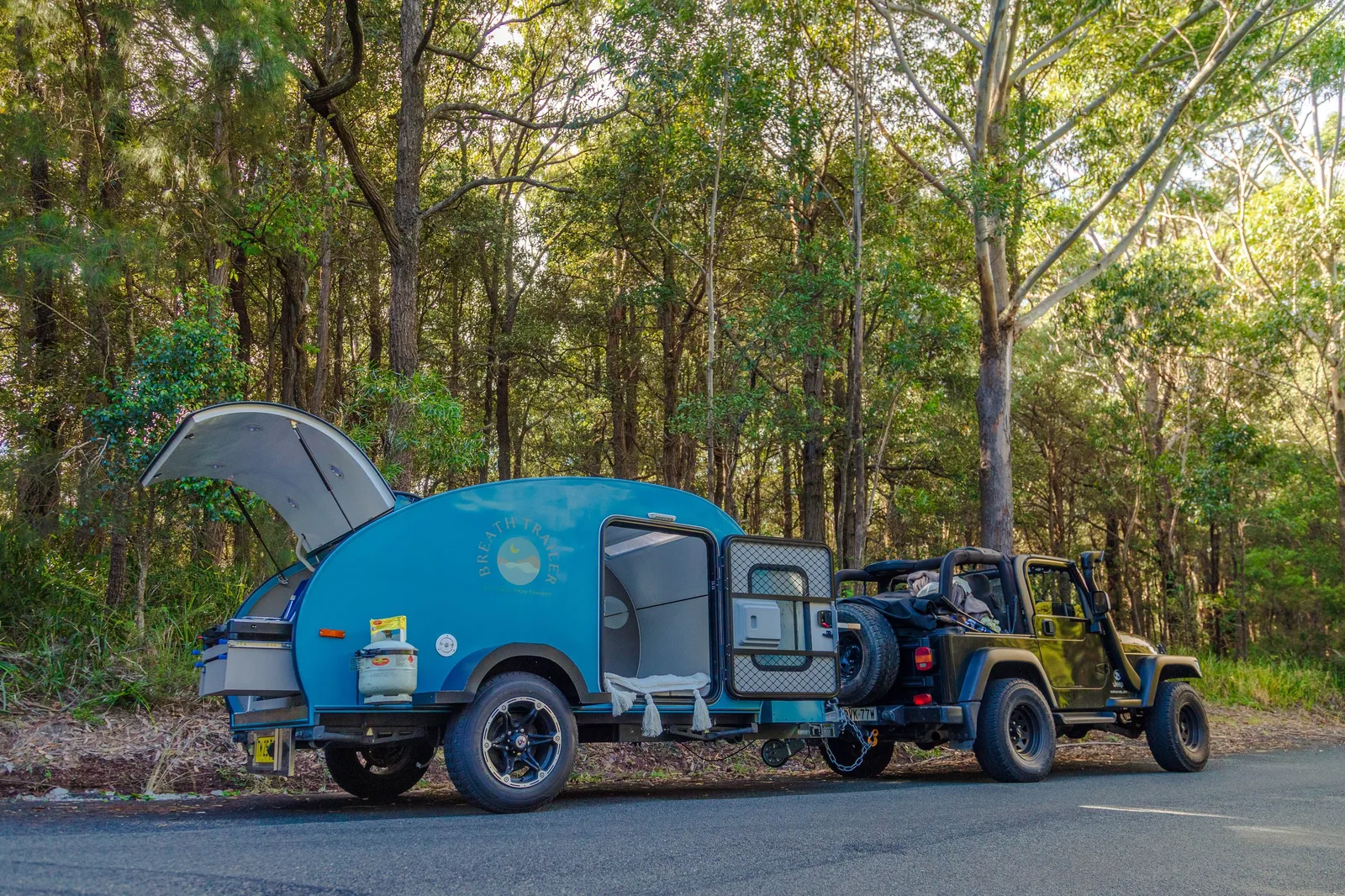
Three times the size of the United Kingdom, the Kimberley sits in the remote north-west corner of Western Australia and holds some of the most dramatic landscapes on the continent. Horizontal Falls, the Bungle Bungles, El Questro Wilderness Park, Mitchell Falls, and the red-cliff gorges of Windjana — none of this is accessible by a quick weekend trip, and none of it can be done from a comfortable hotel. The Kimberley rewards the people who sleep in it.
For camper trailer owners, the timing is straightforward. The dry season runs May to October. Attempt it outside that window and you face flooded roads, closed national parks, and crocodile-infested waterholes that can’t be walked around. Get the timing right, and you have one of the world’s great overland destinations largely to yourself by mid-May and mid-September.
This guide covers the Kimberley’s key campgrounds, their fees, road requirements, water and self-containment logistics, and which Breath Trailer model to bring. For the Gibb River Road specifically — the 647 km unsealed track between Derby and Kununurra — see our dedicated Gibb River Road guide for camper trailers. This article covers the broader region: every major route, not just the Gibb.
The Kimberley at a Glance
The Kimberley divides naturally into three zones, each with its own gateway town, campground network, and road requirements.
| Region | Gateway | Key destinations | Sealed road access? |
|---|---|---|---|
| West Kimberley | Broome / Derby | Windjana Gorge, Geikie Gorge, Cape Leveque, Dampier Peninsula | Broome–Derby sealed; most sites require 4WD |
| East Kimberley | Kununurra | Purnululu / Bungle Bungles, Lake Argyle, El Questro | Kununurra–Turkey Creek sealed; sites require high-clearance 4WD |
| Central Kimberley (Gibb River Rd) | Derby → Kununurra | El Questro, Mitchell Falls, Bell Gorge, Manning Gorge | 470 km unsealed — see Gibb River Road guide |
The Great Northern Highway — sealed for most of its Broome to Kununurra distance of roughly 1,030 km — is the backbone. You can reach all three gateways in a 2WD. Most of the iconic destinations off that spine, however, need a 4WD.
When to Go: Kimberley Seasonal Guide
The wet/dry divide in the Kimberley is more pronounced than anywhere else in Australia. National parks close, roads flood, and campsites become inaccessible for up to six months of the year.
| Season | Months | Conditions | Suitability for camper trailers |
|---|---|---|---|
| Dry season (best) | May–October | 25–35°C days, cool nights 14–18°C, minimal rain | Ideal — all parks open, roads graded, waterholes accessible |
| Build-up | October–November | Rising humidity, isolated storms, 35–40°C+ | Most parks still open; heat and early storms make camping uncomfortable |
| Wet season | December–March | Flooding, 60–1,800 mm of rain, cyclones, road closures | Most parks and stations CLOSED; many roads impassable for months |
| Early dry | April | Some wet-season closures remain; roads may need inspection | Purnululu and some side tracks reopen in April; confirm with DBCA |
Optimal window: Mid-May to mid-September gives you the full network open, graded roads, and milder daytime temperatures. June–August is peak season; expect full campgrounds at Purnululu and Windjana on weekends. Book well ahead.
School holidays: Australian school holiday weeks — particularly July — compress the peak window further. If you have flexibility, the shoulder weeks in late May or early September offer good conditions with far fewer people.
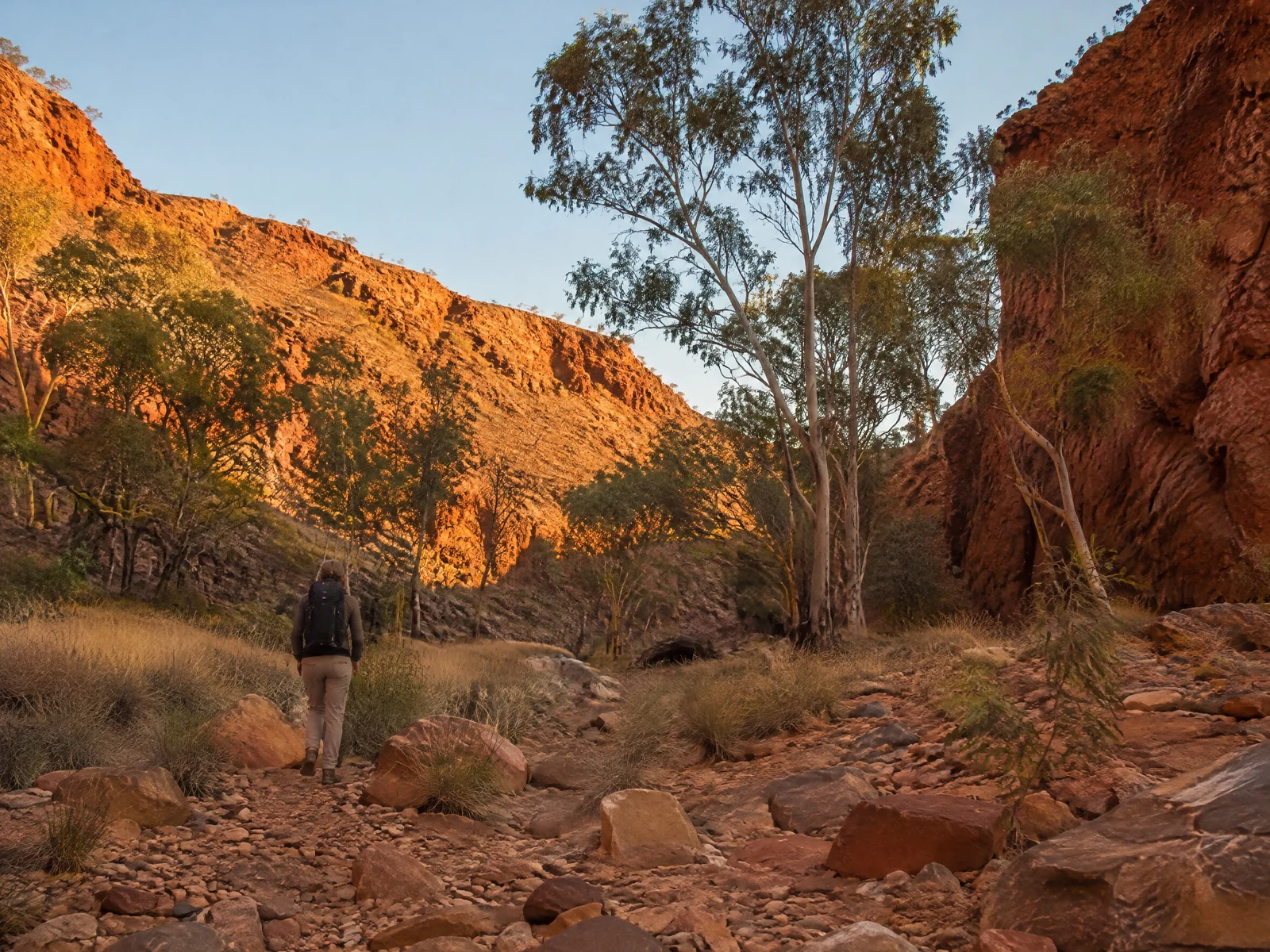
Illustration: The Kimberley’s gorge country shares the ancient red rock character of Australia’s broader outback — dramatic at golden hour, unforgettable from a campsite at its base.
Key Campgrounds
All fees listed were current as of late 2026; confirm with DBCA or operators before arrival as fees are updated periodically.
| Campground | Region | Type | Approx. fee (adult/night) | Road access | Notes |
|---|---|---|---|---|---|
| Windjana Gorge (Bandilngan) NP | West | DBCA | ~$20 + $20 vehicle entry | 4WD unsealed from Derby (~145 km) | Toilets, showers; crocodile habitat — no swimming |
| Geikie Gorge (Danggu) NP | West | DBCA | Day use only | Sealed 2WD from Fitzroy Crossing | No camping; guided river cruises adult $50; book separately |
| Kooljaman at Cape Leveque | West (Dampier Peninsula) | Private resort | Contact resort | 4WD preferred (210 km unsealed) | Range from campsites to cabins; bookings essential; call (08) 9192 4970 |
| Purnululu NP — Kurrajong | East | DBCA | Combined entry/camping ~$17 pp | High-clearance 4WD, 53 km unsealed from Turkey Creek | No water; bring all supplies; open ~Apr–Dec |
| Purnululu NP — Walardi | East | DBCA | Combined entry/camping ~$17 pp | High-clearance 4WD, 53 km unsealed from Turkey Creek | Same as Kurrajong; ablutions block; tourist season May–Sep |
| El Questro Wilderness Park | Central/East | Private (Accor) | Permit ~$23/adult/week + camping ~$20/pp/night | Gibb River Road + El Questro Rd, 4WD | Multiple campsites incl. Black Cockatoo; 5-day–7-day stays common |
| Mitchell Falls (Ngauwudu) NP | Central | DBCA + Wunambal Gaambera | ~$20 + Uunguu Visitor Pass ~$45+/person | Serious 4WD, Kalumburu Rd (~160 km from Gibb) | Envelope payment on-site; no-book; Uunguu pass from wunambalgaambera.org.au |
| Lake Argyle | East | Private resort | ~$19.50/adult unpowered | Sealed from Kununurra (~70 km) | BIG skies, freshwater crocs only; pool day pass $10 for non-guests |
| Kununurra (town) | East | Multiple caravan parks | $35–$55/site/night | Sealed | Showers, laundry; base for Purnululu day trips or tours |
| Derby (town) | West | Caravan park | $35–$50/site/night | Sealed | Derby Boab Prison Tree; gateway to Gibb River Rd; base camp strategy useful |
WA Park Pass: The DBCA park pass covers entry fees across most WA parks — 5-day pass $30, 14-day $50, Annual $130. Purnululu has its own local pass. Trailers are not charged a vehicle entry fee in WA parks (the vehicle charge applies to the tow vehicle only).
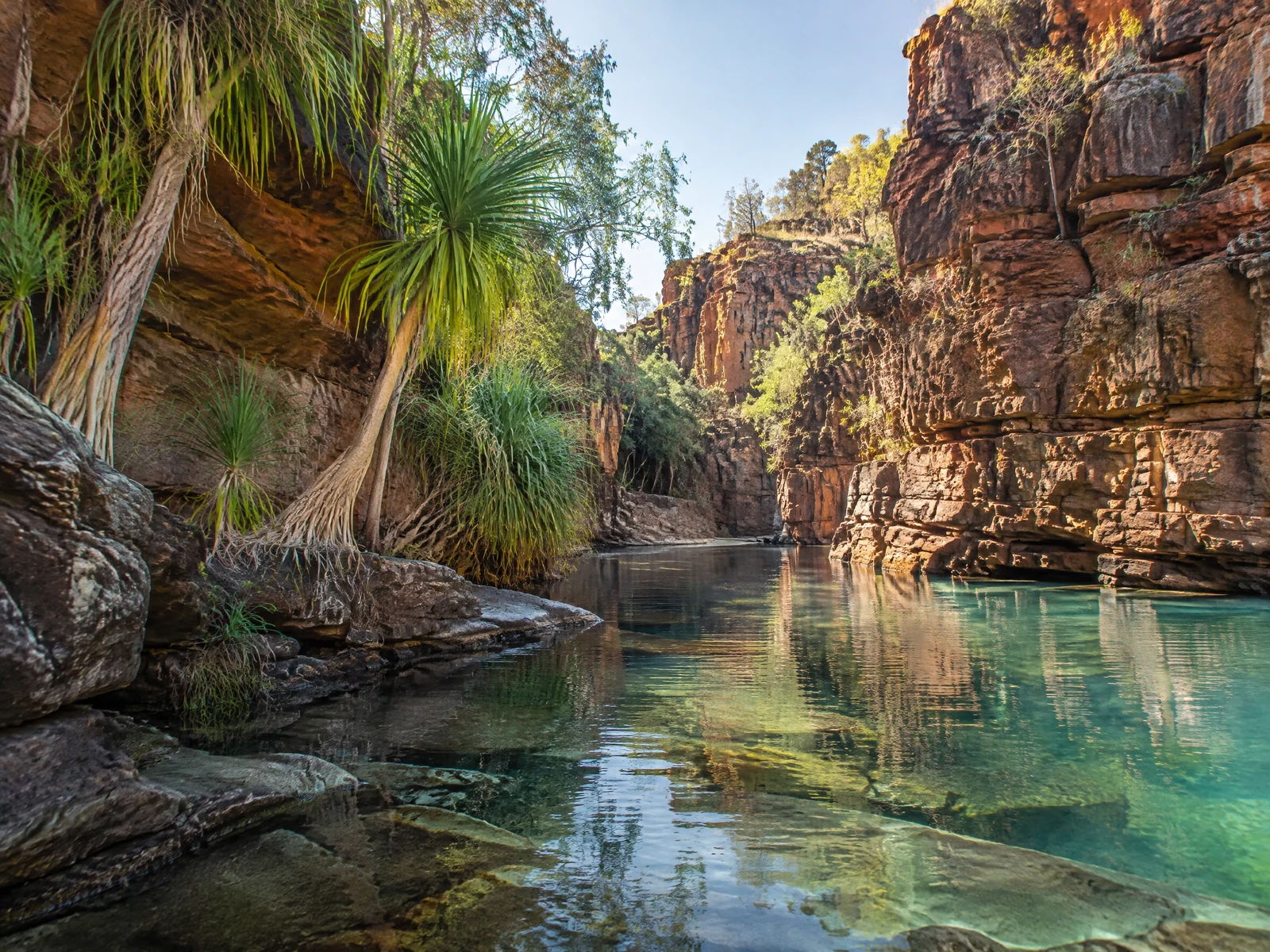
Illustration: Kimberley gorge pools look inviting — but saltwater croc rules make checking signs and local advice non-negotiable before entering any water.
Road Access: What Your Rig Needs for Each Route
This is the single most important planning question in the Kimberley. The sealed Great Northern Highway is fine for any camper trailer. Nearly everything else requires progressively more capability.
| Route | Distance / surface | Vehicle minimum | Camper trailer note |
|---|---|---|---|
| Great Northern Hwy (Broome → Kununurra) | ~1,030 km sealed | Any 2WD with a tow ball | All Breath models; standard road |
| Dampier Peninsula to Cape Leveque | ~210 km, mostly unsealed (corrugated red dirt) | 4WD recommended; high-clearance useful | Specify off-road suspension upgrade; articulating coupling recommended |
| Purnululu / Bungle Bungles turnoff | 53 km unsealed from Turkey Creek (Spring Creek Rd) | High-clearance 4WD essential | DBCA rangers actively advise: all visitors must use high-clearance 4WD — no exceptions. All Breath models with off-road upgrade handle this. |
| Gibb River Road | 647 km partly unsealed (~470 km) | 4WD with high clearance | See dedicated guide — not covered in detail here |
| Kalumburu Road / Mitchell Falls | ~160 km from Gibb Rd junction, unsealed and rocky | Serious 4WD; full-size spares (two recommended) | Most challenging towing route in WA; experienced 4WD drivers only |
| Windjana Gorge via Fairfield–Leopold Downs Rd | ~145 km from Derby, unsealed | 4WD recommended | Graded regularly in dry season; suitable for most 4WDs with good tyres |
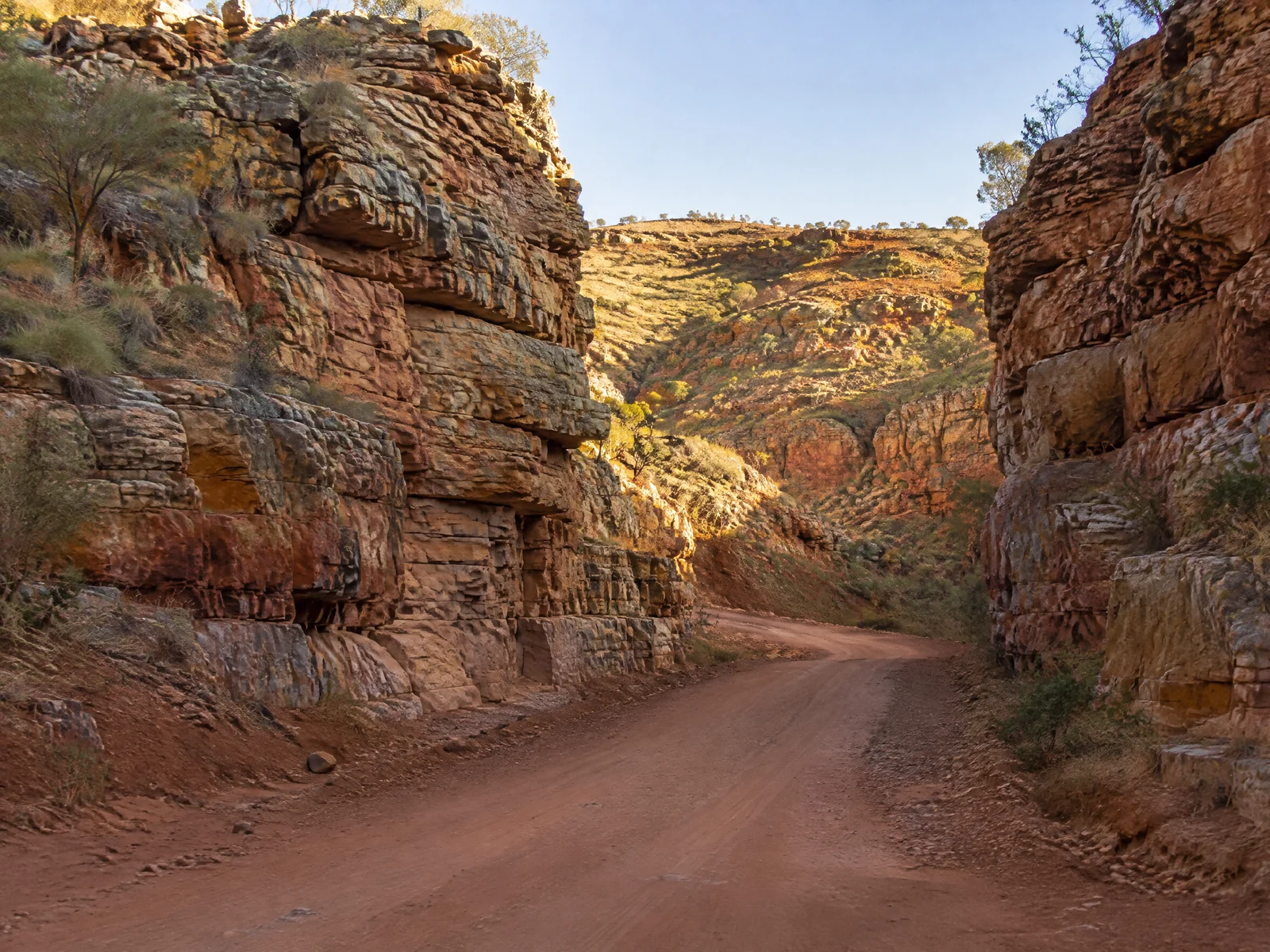
Illustration: Corrugated red-dirt roads are the Kimberley’s signature surface. The right tyre pressure — typically 26–30 PSI for gravel and 20–25 PSI for corrugations — protects both your trailer and your bearings.
Tyre pressure: For unsealed Kimberley roads, drop to 26–30 PSI on gravel and 20–25 PSI on corrugations (from your standard sealed-road 35–44 PSI). See our camper trailer tyre guide for the full pressure-by-surface table and load-index considerations. In the Kimberley, carry at least two full-size spares. Sidewall damage from sharp ironstone cannot be plugged.
Self-Containment in the Kimberley
No single regulation mandates self-containment across the whole Kimberley. But practical self-containment — carrying your own waste — makes an enormous difference to where you can stay.
Grey water: Most DBCA campgrounds have dump points, but free camps and many station sites do not. A grey water tank or grey water sock keeps your access to state forest and crown land free camps open. See free camping Australia guide for the full rules by land type.
Toilet: The Kimberley has some of the best free camping in Australia, but most roadside stops have no facilities. A cassette toilet or composting toilet is the difference between staying and moving on.
Which models are fully self-contained: The Breath Max is the only model with a full interior bathroom (shower + toilet + basin), making it the most capable for remote Kimberley camping. The Breath Ultra has a full exterior shower — essential for rinsing off after dusty days — but requires a portable toilet for full self-containment. The Breath Plus includes a portable toilet option. The Breath Essential is suited to campgrounds with facilities.
Water, Power and Fuel
Water
Almost nothing in the remote Kimberley delivers drinking water. Most DBCA campgrounds (including both Purnululu campgrounds) require you to carry everything in and everything out.
Recommended carry per couple per 5-night trip: 80–100 litres. For an overview of water tank sizing, pump systems and grey water pairing, see our camper trailer water system guide.
Saltwater at the coast is not useful without a maker. Gorge pools may be contaminated by wildlife, cow pats (on stations), or — critically — saltwater crocodiles (see Safety, below). Never collect water from a gorge pool or river without checking the situation carefully.
Power
Solar and lithium perform well in the Kimberley’s intense sunshine. The region sits between 16° and 20° latitude — peak sun hours range from 7 to 9 daily, among the highest in Australia. A 100–200W solar panel and a 100Ah LiFePO4 battery will run a 12V fridge, lights, and USB charging indefinitely during the dry season. Read our off-grid teardrop camper guide for system sizing.
Avoid diesel generators in National Parks; check station campsite rules.
Phone Coverage
Telstra is the only carrier with network in remote Kimberley areas. Optus and Vodafone are patchy beyond the main towns. A satellite communicator (Garmin inReach Mini 2 ~$599 or ZOLEO ~$199) is essential for any route off the highway — for both emergency SOS and two-way messaging to family. See our must-have accessories guide for the full comms table.
Fuel
The Kimberley has some of Australia’s longest distances between fuel stops. On the Great Northern Highway: Broome → Derby (~220 km), Derby → Fitzroy Crossing (~255 km), Fitzroy Crossing → Halls Creek (~290 km), Halls Creek → Kununurra (~370 km). Off the highway, gaps can exceed 400 km — see our Gibb River Road guide for the full diesel table. A long-range tank or jerry cans are standard on any Kimberley trip.
Crocodile Safety
The Kimberley has two species of crocodile: freshwater (freshies) and saltwater (estuaries, salties). Salties are aggressive and dangerous; freshies are less so but still wild animals. Understanding which you’re dealing with is not always possible — in the Kimberley, treat every body of water as potentially unsafe until confirmed otherwise by rangers or DBCA signage.
Saltwater crocodiles are found in all tidal rivers, estuaries, and coastal wetlands. They move into freshwater rivers and gorges during the wet season and may not fully retreat. Some gorge pools — including several of the most photogenic locations on the Gibb River Road — have confirmed saltwater crocodile populations that make swimming off-limits year-round.
Rules:
- Never swim where there are no signs explicitly saying swimming is safe
- Never clean fish or prepare food at the water’s edge
- Never camp within 50 metres of a river or tidal creek
- Supervise children and dogs at all times near water
- Do not approach any crocodile, regardless of size
For comparison, Kakadu operates under the same saltwater croc rules — we covered these in detail in our Kakadu camping guide.
Which Breath Trailer for the Kimberley?
The Kimberley’s combination of unsealed roads, remote self-containment requirements, and high summer heat narrows the ideal choice to the two larger models.
| Model | Tare | ATM | Bathroom | Off-grid rating | Kimberley suitability |
|---|---|---|---|---|---|
| Essential ($23,320) | 700 kg | 1,000 kg | None (portable toilet option) | Basic (AGM, small solar) | Best at campgrounds with facilities; limited remote use |
| Plus ($29,766) | 800 kg | 1,100 kg | None (portable toilet option) | Good (fridge included, lithium upgrade available) | Strong choice for campground-based itinerary; pair with portable toilet and grey water sock |
| Ultra ($34,749) | 900 kg | 1,300 kg | Exterior shower | Excellent (lithium, MPPT, grey water tank) | Natural Kimberley pick for most travellers — self-contained minus interior toilet |
| Max ($42,900) | 1,200 kg | 1,700 kg | Full interior (shower + toilet + basin) | Best in class | Ideal for remote free camping; 2.1 m standing headroom; 80 L water tank; the only sub-$50k teardrop with an interior bathroom |
Greg and Margaret’s choice: The retirees in our grey nomads guide prioritise a bathroom for night-time use. In the Kimberley, where campground ablutions can be 200 metres away and the path crosses croc country, an interior bathroom in the Breath Max is genuinely valuable, not just a comfort choice.
Important: All four models can be specified with the off-road suspension upgrade — independent coil suspension with longer wheel travel, articulating coupling, and larger tyres. For any unsealed Kimberley route beyond the highway, specify the off-road option. See the comparison page for the full specs by model.

The Breath Plus fully set up in Australian eucalyptus scrub — awning, rooftop tent, and cabin door. At most Kimberley campgrounds, this is your home for the week.
7-Day Kimberley Itinerary (Base-Camp Style)
The most common approach for camper trailers is a base-camp strategy: park at Broome or Kununurra, do day trips to the gorges and attractions, and use the trailer’s kitchen and sleeping as your fixed point of comfort. This avoids the tow vehicle + trailer heading down the roughest tracks.
| Day | Location | Drive | Notes |
|---|---|---|---|
| 1 | Arrive Broome | Flight or drive | Settle at Cable Beach Caravan Park; explore town |
| 2 | Broome → Derby | ~220 km sealed | Afternoon: King Sound lookout, Boab Prison Tree |
| 3 | Derby (base) | Day trip Windjana Gorge | ~145 km return 4WD; fossils + freshwater crocs; return to Derby |
| 4 | Derby → Fitzroy Crossing | ~255 km sealed | Afternoon: Geikie Gorge boat cruise (adult $50) |
| 5 | Fitzroy Crossing → Halls Creek | ~290 km sealed | Stop at Bungle Bungles turnoff; head to Kununurra |
| 6 | Purnululu NP | Camp 2 nights | 53 km unsealed to Kurrajong/Walardi; Domes Walk + Cathedral Gorge |
| 7 | Purnululu → Kununurra | ~230 km return + 70 km to Lake Argyle | Depart late afternoon; sunset at Lake Argyle campsite |
This is a one-week minimum. Most serious Kimberley travellers spend 2–4 weeks. Adding the Gibb River Road (Derby → Kununurra via the unsealed inland route) adds 7–10 days. See the Big Lap preparation guide if the Kimberley is part of a longer circuit.
Kimberley Packing Checklist for Camper Trailers
| Category | Item | Why it matters in the Kimberley |
|---|---|---|
| Navigation | Hema Explorer or OziExplorer, offline maps downloaded | Mobile data unavailable; Google Maps offline misses 4WD tracks |
| Comms | Satellite communicator (inReach Mini 2 / ZOLEO) | Emergency SOS in no-coverage country; two-way messaging |
| Recovery | MaxTrax (2), snatch strap, rated shackles, hi-lift jack | Sand, mud and corrugations cause bog; 100+ km to any help |
| Tyres | 2 full-size spares, tyre plug kit, 12V compressor | Sidewall cuts common on ironstone; plug kits won’t fix cuts |
| Water | 80–100 L tank minimum; plus 20 L jerry can emergency | Most remote campgrounds carry no water |
| Fuel | Extended range tank or 20 L+ jerry cans | Gaps up to 370 km on highway; off-highway gaps exceed this |
| Croc safety | Research every water body before approaching | Signage is not always present; confirmed salties at many sites |
| First aid | Remote-area first aid kit; PLB registered with AMSA | PLB is a rescue beacon (one-way); inReach supplements with messaging |
| Power | 100–200W solar + 100Ah lithium minimum | Peak 7–9 sun hours/day; fridge critical in 35–40°C heat |
| Insect protection | DEET repellent, fly screen, mozzie coil | Wet-season edge months can bring heavy biting insects |
Frequently Asked Questions
Do I need a 4WD to visit the Kimberley? For the Great Northern Highway (Broome–Derby–Fitzroy Crossing–Halls Creek–Kununurra), a 2WD is sufficient. For every major attraction off the highway — Purnululu, Windjana Gorge, Cape Leveque, Mitchell Falls, the Gibb River Road — you need at minimum a high-clearance 4WD. Some routes (Mitchell Falls, beach tracks on the Dampier Peninsula) need experience to match the vehicle.
When do Kimberley national parks reopen after the wet season? Purnululu generally reopens in April (sometimes late March if conditions allow). Windjana Gorge typically reopens in May. Gibb River Road–side parks vary; check DBCA’s Explore Parks website and Main Roads WA road reports before committing to dates.
Can I tow a camper trailer to the Bungle Bungles? Yes — with caveats. The 53 km unsealed track from Turkey Creek (Great Northern Hwy) to the park entrance requires high clearance and low-range 4WD capability. DBCA rangers regularly turn back visitors in inadequate vehicles, including vehicles with trailers that are not off-road rated. Specify the off-road suspension upgrade on your Breath Trailer and check tyre pressures before the turnoff.
Is free camping available in the Kimberley? Yes — there are rest areas, roadside stops, and station properties that welcome self-contained campers. The absence of facilities at many of these sites means you need to carry all water and waste management. WikiCamps and Camper Mate list current Kimberley free camp options. See our free camping guide for the full land-type breakdown.
How do I handle the saltwater crocodile risk? Follow DBCA signage — swimming is only safe where signs explicitly state it. Avoid all river edges after dark. Camp at least 50 metres from any watercourse. Supervise children and dogs at all times. Salties are fast in water and can move surprisingly quickly on land; maintain distance even from animals that appear to be basking motionless.
How long does a proper Kimberley trip take? A minimum first visit to see Broome, Windjana Gorge, Purnululu and Kununurra takes 7–10 days. Adding the Gibb River Road (Derby → Kununurra via the inland route) adds 7–10 more. A full Kimberley circuit including Mitchell Falls, Cape Leveque and Lake Argyle is a 3–4 week trip. Most travellers who do the Kimberley once plan a longer return.
Conclusion
The Kimberley demands more planning than almost any other Australian destination — but the payoff is proportional. The gorges are genuinely unlike anything else on the continent. The night skies over a Purnululu campsite or an El Questro station are among the darkest in Australia. The wildlife is abundant and visibly wild.
For a camper trailer owner, the Kimberley rewards preparation: the right vehicle and rig combination, the off-road suspension upgrade, a solid water and power setup, a satellite communicator, and two spare tyres. Get those right and the logistics fall into place.
Compare all four Breath models at /comparison/ or book a time to talk through the off-road options at /booking/.
Recommended Reading
- Gibb River Road Guide for Camper Trailers — the detailed 647 km inland route from Derby to Kununurra
- Best Camping Spots in Western Australia — the broader WA campground guide with all six regions
- Free Camping Australia Guide — how to access free camps across WA and all states
- Must-Have Accessories for Off-Road Adventures — recovery gear, comms, tyres — the full list
- Big Lap Around Australia Preparation Guide — if the Kimberley is a step in a longer circuit