Lightweight vs Heavy Camper Trailer: Which Is Right for You in Australia? (2026)
Lightweight vs heavy camper trailer Australia: weight classes, towing rules, fuel costs, off-road trade-offs and which suits your SUV. Real 2026 prices and specs.
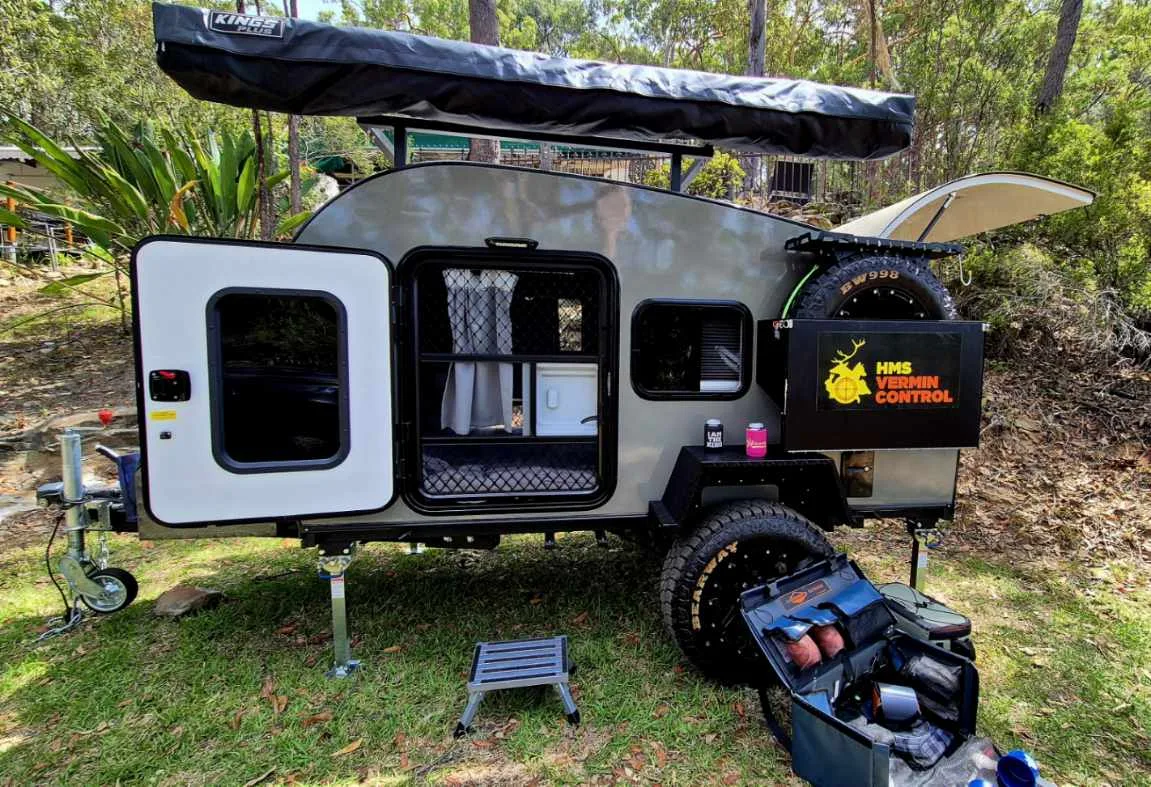
Weight is the single most consequential decision you’ll make when buying a camper trailer in Australia — and most buyers only discover this after they’ve signed on the dotted line.
Choose too heavy and you’ll exceed your SUV’s braked towing capacity, torch your fuel budget, and find yourself barred from half the campsites you planned to visit. Choose too light and you might sacrifice the bathroom, the water capacity, or the range you need for that 90-day Big Lap you’ve been planning since 2019.
In 2026, the Australian market spans everything from a 280 kg micro-trailer that tows behind a hatchback to a 4,500 kg expedition caravan that needs a twin-turbo diesel to move it. This guide cuts through the noise with real figures: what each weight class actually costs, how much fuel you’ll burn, which vehicles can tow what, and — critically — who should choose each category. For a deep-dive on the terminology behind the numbers, see our guide on teardrop camper weights in Australia.
The Weight Terms You Need to Understand
Before comparing lightweight versus heavy, you need to speak the language. Australian towing regulations use a specific vocabulary, and mixing up these terms is how buyers get into legal (and physical) trouble.
| Term | What It Means | Why It Matters |
|---|---|---|
| Tare weight | Empty trailer weight, as delivered | Starting point for payload calculations |
| ATM (Aggregate Trailer Mass) | Maximum loaded trailer weight (alone, on jockey wheel) | The legal limit on what you can carry |
| GTM (Gross Trailer Mass) | Maximum weight on the trailer’s own axles (excludes towball) | Determines brake requirement (>750 kg = brakes needed) |
| Payload | ATM minus tare | How much gear, water, food, and accessories you can actually load |
| Towball weight | Force the trailer exerts on your towball (typically 10–15% of ATM) | Comes off your tow vehicle’s GVM — reduces usable passenger/cargo space |
| GVM | Gross Vehicle Mass — maximum legal weight of your tow vehicle fully loaded | Easy to exceed when you add passengers, gear and towball download |
| GCM | Gross Combination Mass — max legal weight of vehicle + trailer combined | A cap that catches people who focus only on towing capacity |
A common trap: a buyer sees their car rated to 2,000 kg braked towing capacity and assumes they can safely tow a 1,900 kg ATM trailer. But if towball weight is 190 kg and their car is already at GVM with three adults and a roof box, they’re over the GCM limit and unlicensed to drive — regardless of what the towing sticker says.
Australia’s Four Camper Trailer Weight Classes
The Australian market breaks cleanly into four weight bands, each with its own economics, vehicle requirements, and lifestyle fit.
| Class | ATM Range | Typical Tow Vehicle | Category Examples | Typical AUD Price |
|---|---|---|---|---|
| Ultra-light | Under 750 kg | Any modern SUV, even 4-cylinder | Teardrops, micro-caravans, basic canvas campers | $8,000–$35,000 |
| Light-medium | 750–1,500 kg | Most mid-size SUVs, some crossovers | Premium teardrops, lightweight caravans, forward-fold hybrids | $25,000–$65,000 |
| Medium-heavy | 1,500–2,500 kg | Diesel 4WDs (Prado, HiLux, Everest) | Off-road caravans, large forward-folds, slide-out kitchens | $50,000–$110,000 |
| Heavy | 2,500 kg+ | Heavy-duty 4WDs (200 Series, RAM 1500) | Expedition caravans, slide-ons, full off-grid rigs | $80,000–$200,000+ |
Ultra-light trailers under 750 kg ATM are the fastest-growing segment in Australia. Hard-shell teardrops dominate here — the Breath Essential at 700 kg tare is the lightest hard-shell option with a full rear galley — but canvas pop-tops and basic folding campers also live in this bracket. The defining advantage is that almost every new SUV in Australia (RAV4, Forester, CX-5, Outlander) can legally tow one.
Light-medium is where most buyers end up who want genuine features without needing a Landcruiser. The Breath Max at 1,200 kg — the only teardrop on the Australian market under $50k with a full interior bathroom — sits here. Most medium SUVs with a 2,000 kg towing rating can handle this class comfortably.
Medium-heavy and heavy trailers are purpose-built for buyers who are spending months on the road and need long-range water, large solar capacity, and full residential comforts. They require dedicated tow vehicles and a very different financial conversation.
The 750 kg Brake Rule — and Why It Divides the Market
Australian law requires that any trailer with a GTM exceeding 750 kg must have brakes on at least one axle. Above 2,000 kg, brakes are required on all wheels plus a breakaway system that automatically applies the brakes if the trailer separates from the tow vehicle.
This single rule shapes the economics significantly:
- Under 750 kg GTM: No electric brake controller needed. No annual brake adjustment. No roadworthy requirement for brake functionality. Saves $400–$800 upfront and reduces annual maintenance cost by roughly $100–$200.
- 750 kg–2,000 kg GTM: Electric brakes on at least one axle required. You’ll need a brake controller fitted to your tow vehicle ($300–$800 installed) and the trailer needs annual brake inspection.
- Over 2,000 kg GTM: Full brake system on all axles + breakaway. Heavy Vehicle National Law provisions may apply. Annual inspection costs climb.
Beyond brakes, all trailers in Australia require registration, appropriate safety chains, correct lighting, and compliance with the Australian Design Rules (VSB1). Weight limits vary by state for single-axle versus tandem configurations.
Speed limits when towing are 100 km/h in most states regardless of trailer weight — though the Northern Territory permits 110 km/h in some zones. Heavy tow combinations may be subject to additional restrictions on certain roads.
What Your SUV Can Actually Tow in Australia (2026)
The number on your car’s towing sticker is a legal maximum, not a comfort zone. Most experienced towers recommend the 80% rule: load your trailer to no more than 80% of your vehicle’s braked towing capacity for comfortable stopping distances, hill-climbing ability, and reduced mechanical wear.
| Tow Vehicle | Braked Towing Cap | Towball Weight Limit | 80% Practical Limit | Weight Class Suitable |
|---|---|---|---|---|
| Toyota RAV4 Hybrid | 1,500 kg | 100 kg | 1,200 kg | Ultra-light, some light-medium |
| Subaru Forester 2.5i | 1,500 kg | 150 kg | 1,200 kg | Ultra-light, some light-medium |
| Mazda CX-5 2.5 Turbo | 2,000 kg | 200 kg | 1,600 kg | Ultra-light through light-medium |
| Mitsubishi Pajero Sport | 3,000 kg | 300 kg | 2,400 kg | Up to medium-heavy |
| Toyota Prado 150 (diesel) | 3,000 kg | 300 kg | 2,400 kg | Up to medium-heavy |
| Toyota HiLux SR5 (diesel) | 3,500 kg | 350 kg | 2,800 kg | All classes |
| Ford Everest Platinum | 3,100 kg | 310 kg | 2,480 kg | Up to medium-heavy |
| Toyota LandCruiser 200 | 3,500 kg | 350 kg | 2,800 kg | All classes |
Critical check beyond towing capacity: always calculate your GCM. If your fully loaded vehicle (passengers, fuel, luggage, accessories) plus your fully loaded trailer exceeds the GCM, you’re over-limit even if both the vehicle and trailer are within their individual ratings. Some popular family cars have GCMs that cap out well below what their towing rating implies.
For a full pre-trip towing checklist, read our camper trailer towing guide for Australia.
Fuel Cost: The Price You Pay for Every Extra Kilogram
This is where lightweight vs heavy becomes a straightforward maths problem — and it’s where most buyers systematically underestimate the cost of “just a bit more” trailer.
A modern 4WD or SUV running solo typically does 9–13 L/100km. Towing adds drag and weight, and the fuel penalty scales roughly (though not linearly) with ATM.
| Trailer Class | ATM | Fuel Penalty | Consumption Towing | Cost per 10,000 km* | 5-Year Cost (8,000 km/yr towing)** |
|---|---|---|---|---|---|
| Ultra-light | ~700 kg | +2–3 L/100km | ~12–15 L/100km | ~$252–$315 | ~$10,080–$12,600 |
| Light-medium | ~1,200 kg | +3–5 L/100km | ~14–17 L/100km | ~$294–$357 | ~$11,760–$14,280 |
| Medium-heavy | ~2,000 kg | +5–8 L/100km | ~16–20 L/100km | ~$336–$420 | ~$13,440–$16,800 |
| Heavy | ~3,000 kg | +8–12 L/100km | ~19–24 L/100km | ~$399–$504 | ~$15,960–$20,160 |
* Based on diesel at $2.10/L
** 8,000 km/yr towing is a reasonable average for a serious Australian camping household
Over five years, a buyer who chooses a 2,000 kg ATM caravan over a 700 kg teardrop trailer will spend $3,000–$7,000 more in fuel alone, without counting tyres, tow vehicle wear, or the upgrade to a higher-capacity tow vehicle that a heavier trailer often demands.
Off-Road Capability: Does Lighter Always Mean Less Capable?
There’s a persistent myth in the Australian camping community that heavier equals more capable off-road. It’s wrong — and it costs buyers money.
Off-road performance is determined by suspension travel, approach angle, departure angle, ground clearance, and axle articulation. None of these require weight. The reason heavy expedition caravans are heavy is because they carry 250 L of water, 500 Ah of lithium, a diesel heater, an air conditioner, a generator, and a dishwasher — not because weight makes them better off-road.
In practice, a well-engineered lightweight teardrop with independent suspension, 200 mm ground clearance, and a low centre of gravity can follow a HiLux down a corrugated outback track without drama, while a 3,000 kg twin-axle caravan simply cannot: the swing of a long wheelbase over off-camber terrain becomes a safety hazard, and the weight creates sink risk on soft terrain.
For more on what makes teardrop trailers genuinely capable off-road in Australia, see our off-road teardrop camper guide.
Where heavy trailers genuinely win: range and self-sufficiency. A 2,500 kg expedition rig might carry 300+ litres of fresh water, 600 Ah of lithium, a 3kW solar array, and enough food for a month. A 700 kg teardrop with 80 L of water and 100 Ah runs out of margin after 4–5 days without access to a tap. Match your rig to your trip length:
- Weekend/school holiday trips → ultra-light or light-medium
- 2–4 week remote trips → light-medium to medium-heavy
- 90+ day Big Lap with no planned resupply → medium-heavy to heavy
Comfort and Features by Weight Class
| Class | Sleeping | Bathroom | Kitchen | Power | AU Price Range |
|---|---|---|---|---|---|
| Ultra-light (<750 kg) | Queen mattress | None or external shower only | Rear galley, 2-burner | 100–120 Ah AGM/LiFePO4 | $8,000–$35,000 |
| Light-medium (750–1,500 kg) | Queen bed, some optional bunks | External shower + toilet, or full ensuite (premium models) | Rear galley, 2–3 burner, full fridge | 120–200 Ah lithium | $25,000–$65,000 |
| Medium-heavy (1,500–2,500 kg) | Queen bed + bunk options | Full internal bathroom | Slide-out kitchen, sink, large fridge | 200–400 Ah lithium, 200–400W solar | $50,000–$110,000 |
| Heavy (2,500 kg+) | Multiple sleeping zones | Full-size bathroom, some with bath | Full kitchen bench, dishwasher options | 400–800 Ah, 600+ W solar, inverter | $80,000–$200,000+ |
The bathroom decision is the one that most reshapes buyer priorities. For most couples, the upgrade from an external shower to a full interior ensuite adds 300–500 kg of trailer weight and $10,000–$20,000 to the purchase price. The Breath Max is notable because it delivers a full interior bathroom at 1,200 kg and $39,000 — sitting in the light-medium class rather than the medium-heavy category where most bathroom-equipped trailers sit.
For couples figuring out what they actually need, our guide on teardrop campers for couples in Australia walks through this decision in detail. For families of three or four, the family teardrop camper guide covers sleeping arrangements and annexe strategies.
5-Year Total Cost of Ownership: The Real Numbers
Purchase price is the tip of the iceberg. Here’s how a 700 kg teardrop compares to a 2,000 kg caravan over five years for a buyer doing around 8,000 km of towing annually.
| Cost Item | 700 kg Teardrop (e.g., Breath Plus $25,740) | 2,000 kg ATM Caravan (~$65,000) |
|---|---|---|
| Purchase price | $25,740 | $65,000 |
| 5-yr depreciation (retained value) | ~$17,250 (67% retained) | ~$30,000 (46% retained) |
| Net depreciation cost | ~$8,490 | ~$35,000 |
| Fuel (8,000 km/yr × 5 yr) | ~$11,760 | ~$16,800 |
| Insurance (avg 5 yr) | ~$2,000 | ~$3,800 |
| Maintenance (incl. rego, tyres) | ~$1,500 | ~$4,000 |
| 5-Year Total Cost | ~$23,750 | ~$59,600 |
The caravan costs more than twice as much over five years, even before accounting for the likely need to upgrade your tow vehicle (adding $15,000–$40,000 if you need to move from a RAV4 to a Prado). For a solo traveller, couple, or family who camps 4–8 weekends a year plus a longer annual trip, the lighter teardrop is the rational financial choice by a significant margin.
For detailed resale data, see teardrop camper resale value in Australia.
Who Should Choose Lightweight — and Who Should Go Heavier
Choose lightweight (under 1,000 kg ATM) if:
- Your tow vehicle is a 4-cylinder SUV rated under 2,000 kg braked
- You camp on weekends and holidays (fewer than 30 nights/yr)
- You value sub-5-minute setup time
- You’re a couple or solo traveller and don’t need multiple sleeping zones
- Fuel budget matters to you (you’re covering 6,000+ km/yr towing)
- You want to avoid the 750 kg brake requirement and its associated costs
- Storage at home is tight — teardrops fit in a standard carport
Choose medium-heavy to heavy (1,500 kg+ ATM) if:
- You own a diesel 4WD rated 3,000+ kg braked and plan to keep it
- You’re doing a 60-day Big Lap or longer continuous trip
- You need 200+ litres of fresh water capacity on board
- You require a full separate bathroom with toilet, shower and basin
- You’re travelling with a family of 4+ and need multiple sleeping areas
- Budget is secondary to comfort and self-sufficiency
The middle ground: the 800–1,200 kg class is where the most interesting trade-offs happen. Models like the Breath Ultra (900 kg, $30,290 with external shower) and Breath Max (1,200 kg, $39,000 with interior bathroom) sit in this zone. They tow behind a Mazda CX-5 or Toyota RAV4 Adventure, stay under 1,500 kg ATM, but deliver features most buyers don’t expect at this weight — lithium battery systems, insulated hard-shell cabins, and queen beds.
If you’re still weighing up new versus secondhand in any weight class, our new vs used camper trailer guide covers the trade-offs honestly.
Frequently Asked Questions
What is the lightest camper trailer available in Australia in 2026? Canvas swag trailers and basic tent trailers start around 200–350 kg. The lightest hard-shell teardrop with a proper bed and kitchen is around 500–700 kg. The Breath Essential starts at 700 kg tare with a rear galley kitchen and queen mattress.
Do I need electric brakes on my camper trailer in Australia? Yes, if your trailer’s GTM exceeds 750 kg. GTM is typically slightly lower than ATM (ATM includes towball weight; GTM doesn’t), so a trailer with a 900 kg ATM might have a GTM of 780–820 kg — above the brake threshold. Your trailer’s compliance plate shows both figures. Trailers under 750 kg GTM do not legally require brakes.
How much extra fuel does a heavy trailer use compared to a lightweight one? As a rough guide, every 500 kg of additional ATM adds approximately 1.5–2 L/100km to your fuel consumption. Over 80,000 km of towing across five years, the difference between a 700 kg teardrop and a 2,500 kg caravan can easily exceed $6,000 in fuel.
Can a lightweight teardrop trailer handle Australian off-road conditions? Yes — with caveats. A well-built teardrop with independent suspension, 200 mm ground clearance, and good departure angles (like the Breath Plus or Ultra) can handle most gravel roads, national park tracks, and moderately rough 4WD terrain. What it won’t do is carry 300 L of water for multi-week remote camps or survive repeated deep-water crossings. Match the rig to the mission.
What is the 80% towing rule? A widely adopted safety guideline suggesting you limit your loaded trailer ATM to 80% of your vehicle’s rated braked towing capacity. So a vehicle rated at 2,000 kg braked should ideally tow no more than 1,600 kg ATM in real-world conditions. This provides a margin for hills, emergency braking, crosswinds and unexpected load.
Is a lightweight trailer harder to reverse than a heavy one? No — in most cases, it’s easier. A shorter, lighter trailer responds more predictably to steering inputs, sits more stably on uneven terrain, and is less affected by crosswinds. Many experienced caravanners who downsize to a teardrop report that reversing and manoeuvring became significantly less stressful.
The Weight Choice Is a Lifestyle Choice
There’s no universally “best” weight class for an Australian camper trailer. The right answer depends on what you drive, where you go, how long you go for, and what you consider essential versus optional.
What the numbers consistently show is that the market has over-sold the heavy end: most buyers who initially assume they “need” 2,000+ kg of trailer discover, after the first season, that they used 20% of the capacity 80% of the time. The lightweight and light-medium segments have matured to the point where you can get a queen bed, lithium power, insulated hard shell, external shower, and a full rear galley — at 800–900 kg — for under $32,000.
If you’re at the start of your research, the comparison page shows how Breath Trailer’s four models (700–1,200 kg) sit across the spectrum, with full specs and pricing. If you’re ready to talk through which weight class matches your vehicle and travel plans, book a viewing at our Sydney facility.