Ningaloo Reef Camping Guide for Camper Trailers 2026
Plan your Ningaloo Reef camper trailer trip in 2026: Cape Range campgrounds, monthly batch booking tips, seasonal guide, whale sharks, and which model to bring.
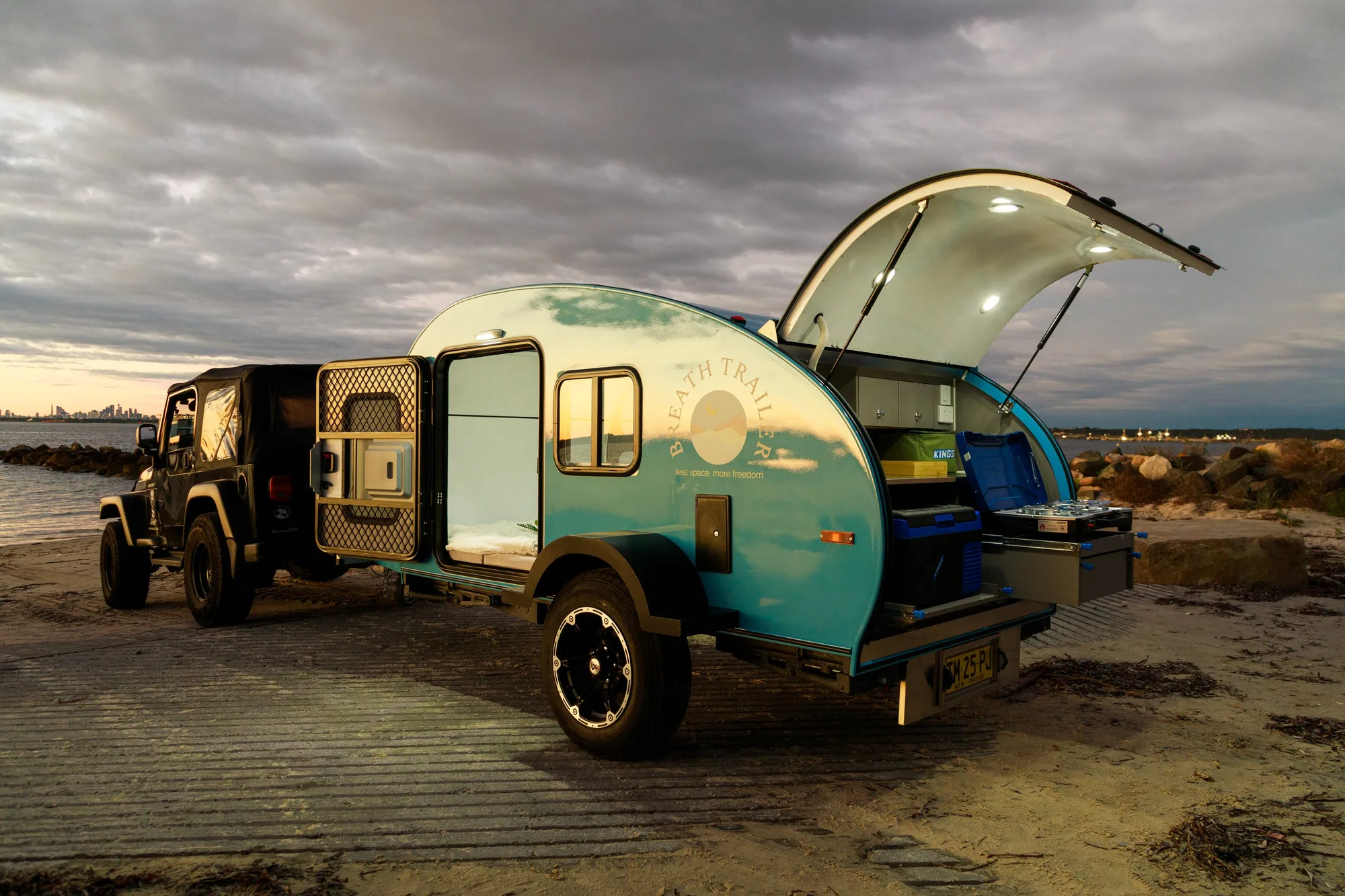
At 260 kilometres long, Ningaloo Reef is the world’s largest fringing reef — and unlike the Great Barrier Reef, you can swim right off the beach to reach it. Every April the world’s biggest fish, the whale shark, arrives to feed. Manta rays wheel year-round in Coral Bay’s glassy lagoon. The campgrounds at Cape Range National Park sit directly on the reef’s edge, separated from turquoise water by nothing but a short walk across coral limestone.
For camper trailer owners, Ningaloo represents something unusual: a UNESCO World Heritage destination where a compact rig beats a big caravan. The campgrounds inside Cape Range National Park have reverse-in gravel sites, limited room for slide-outs, and roads that favour a lower tare weight. With no power at any DBCA campground and most sites carrying no fresh water at all, self-containment and a solid 12V setup matter more here than almost anywhere else in Australia.
This guide covers every Cape Range campground, the booking system’s monthly batch releases, seasonal conditions, the Coral Bay and Warroora Station alternatives, and which Breath Trailer model handles the trip best.
Why Ningaloo Suits a Camper Trailer
Ningaloo sits on Western Australia’s Coral Coast, roughly 1,270 kilometres north of Perth. The reef runs along two main hubs: Exmouth (gateway to Cape Range National Park) and Coral Bay (~152 km south of Exmouth). Most national park campgrounds are inside Cape Range NP, which borders the reef’s western edge.
The hard-shell camper trailer scores at Ningaloo for three reasons:
- No canvas maintenance in coastal conditions. Salt air, UV, and heat destroy canvas in a season. A fibreglass shell needs nothing beyond a rinse.
- Self-containment unlocks remote sites. Many Ningaloo-area free camps and Warroora Station sites require you to carry your own waste — an interior bathroom or grey water tank keeps your options open.
- Low tare fits the campground sites. Tulki Beach, for example, has 11 reverse-in gravel sites each suited to a lightweight rig; a large van or a fifth-wheeler overwhelms the layout.
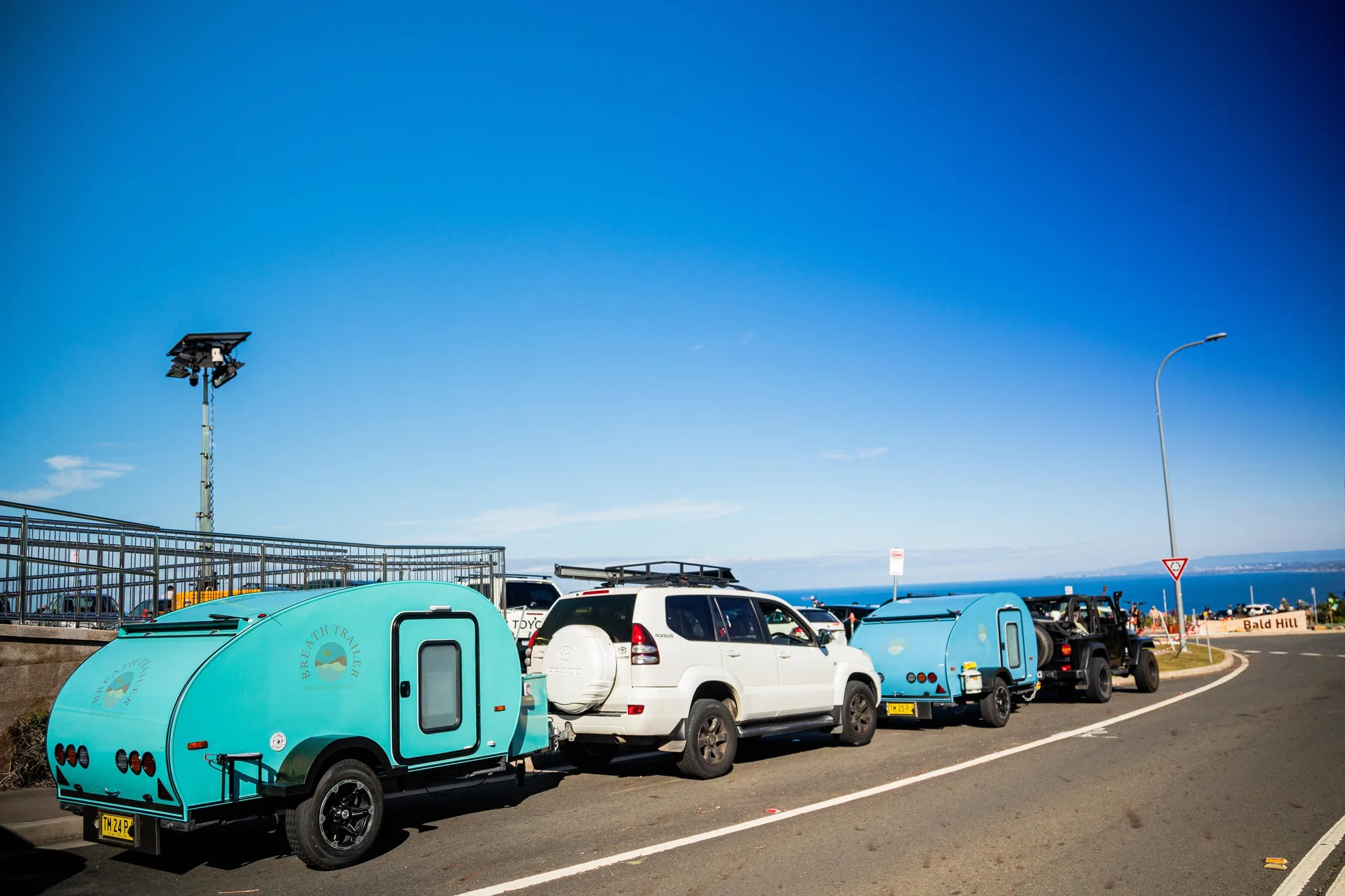
The Coral Coast rewards a lighter rig — compact teardrops navigate the reverse-in gravel sites far more easily than a full van.
When to Visit: Ningaloo Seasonal Guide
| Season | Months | Conditions | Highlights |
|---|---|---|---|
| Autumn (best) | Apr–May | 22–30°C days, calm seas | Whale shark season starts; coral spawning; low crowds |
| Winter (peak) | Jun–Aug | 18–28°C days, some wind | Peak whale shark swims; humpback whales; school holidays in July |
| Spring | Sep–Oct | 24–33°C days | Humpbacks departing; manta rays; shoulder season value |
| Summer (avoid) | Nov–Mar | 35–45°C+, cyclone risk | Extreme heat; some campgrounds close; reef bleaching risk |
The whale shark season runs roughly March to August, with June–August the most reliable window from Exmouth. First sightings for 2026 were reported in March, and operators expect a good year. Manta rays are present year-round at Coral Bay, making them the best fallback if you visit outside whale shark season. Humpback whales pass through from June to October.
Avoid December to February. Inland temperatures regularly exceed 40°C, with one 2026 reading of 45°C near the park. Water temperatures at the reef remain warm, but heat inside a parked trailer — even one shaded by an awning — can become dangerous overnight without air conditioning.
Getting There: Perth to Ningaloo
| Route option | Distance | Driving time | Notes |
|---|---|---|---|
| Perth → Exmouth direct | ~1,270 km | 12–14 hrs | North West Coastal Hwy, divide over 2 days |
| Perth → Coral Bay | ~1,125 km | 11–13 hrs | Turn-off at Minilya River Roadhouse |
| Perth → Exmouth via Coral Bay | ~1,280 km | 13–15 hrs | Add Coral Bay as overnight stop |
The drive is sealed all the way to Exmouth and to Coral Bay. Breaking it over two days is strongly advised when towing — tyre heat on long stretches, fatigue, and the Carnarvon → Exmouth section with limited services make a two-day itinerary standard practice. The Overlander Roadhouse (~480 km north of Perth), Carnarvon (~900 km), and Coral Bay (~1,125 km) are logical overnight stops.
Fuel: diesel and unleaded are available in Carnarvon and Exmouth. Between Carnarvon and Exmouth (~380 km), the only reliable fuel stop is the Minilya River Roadhouse. Fill up before leaving Carnarvon.
For a 7-day route that includes Ningaloo as part of a wider WA loop, see our best 7-day road trips guide and the Big Lap preparation guide.
Cape Range National Park Campgrounds
All campgrounds inside Cape Range NP are unpowered, reverse-in gravel sites. Park entry fees apply to motor vehicles only — trailers and caravans are not charged a vehicle entry fee.
| Campground | Sites | Road access | Notes |
|---|---|---|---|
| Osprey Bay | 46 | 2WD coral limestone | Largest site; generator permitted in northern section only; reef snorkelling directly from site |
| Tulki Beach | 11 | 2WD coral limestone | Small, intimate; pit toilets only; no generators |
| Kurrajong | 35 | 2WD coral limestone | Self-service on-arrival booking available; no campfires |
| Mesa | 23 | 2WD coral limestone | Suits large rigs; no generators |
| Bungarra | 5 | 2WD coral limestone | Very small and secluded; pit toilet only |
| North Mandu | 5 | 2WD coral limestone | Next to Mandu Sanctuary Zone; snorkelling access |
| Yardie Creek | Unpowered | 2WD coral limestone | River gorge setting; pit toilet and picnic tables |
| Boat Harbour | CLOSED | — | Still closed 2026 (cyclone damage — check DBCA before travel) |
Key rules across all campgrounds:
- No campfires or solid fuel barbecues at any time
- No dogs or domestic animals (this is a firm rule — check our dogs and camping guide for dog-friendly WA alternatives)
- Generator use varies by site; Tulki Beach and Mesa prohibit them entirely
- Maximum stay: 14 nights if any night falls within WA school holidays; 28 nights otherwise
- Fees: per-person camping fee + per-vehicle entry fee; trailers carry no extra entry charge
What’s still closed in 2026: Boat Harbour and One K campgrounds remain inaccessible following cyclone damage. Some sites at 14 Mile Campground on the Warroora Coast (Nyinggulara National Park) are also closed after Severe Tropical Cyclone Narelle. Check Park Stay WA for the latest alerts before you go.
How the Monthly Batch Booking System Works
Cape Range campgrounds are part of a DBCA trial that releases blocks of bookings on a rolling calendar — not the standard 180-day rolling window used for most WA parks.
System in brief:
- Bookings open for a month’s worth of stays at 10 am on the first Tuesday of each month
- Released six months in advance (e.g., first Tuesday in April opens October stay dates)
- Bookings are online only via Park Stay WA
- One campsite per booking; you must personally occupy the site
- Payment by credit card when booking; cancellation fees apply
In practice, popular campgrounds (Osprey Bay, Tulki Beach) sell out within minutes of release for peak periods. Set a calendar reminder for 9:55 am AWST on the first Tuesday of each month, have your login and payment ready, and have a backup site preference ready if your first choice sells out.
For the July school holiday period — the busiest stretch of year — the relevant release falls on the first Tuesday in January. That’s the one to protect.
Beyond Cape Range: Coral Bay and Warroora Station
Coral Bay (no national park booking required)
Coral Bay is a small town on the reef edge, with a lagoon you can snorkel directly from the beach. Camping options include a private powered park (Ningaloo Coral Bay Camp) with 2026 high-season rates from $74 per night (1 April–31 October 2026). The town has a service station, small supermarket, and café. It’s a relaxed alternative if Cape Range campgrounds are booked out.
Manta rays are reliably spotted in the lagoon year-round, with wingspans reported up to 8 metres. Several operators run guided manta snorkel tours departing from the beach.
Warroora Station (~1 hour south of Coral Bay)
Warroora is a working cattle station with coastal camping for trailer owners. Sites are unpowered with a basic ablutions block. The homestead is 2WD accessible, but you’ll need a 4WD to reach the beach camps.
Key details for 2026:
- Fees from $10 per person per night (children under 16 free)
- Cash only; no pre-booking for camping
- Non-potable bore water available; bring your own drinking water
- Generators permitted 8 am–6 pm
- Some 14 Mile Campground sites nearby remain closed after cyclone damage — confirm before heading there
For more on WA free and low-cost camping, the free camping guide covers state forest and crown land options near the Coral Coast.
What You Can Do at Ningaloo
| Activity | Best time | Booking required | Notes |
|---|---|---|---|
| Whale shark swims | Mar–Aug | Yes (mandatory) | ~$625/adult from Exmouth; 3-metre rule; fins only |
| Manta ray snorkel | Year-round | Optional | Coral Bay lagoon; DIY possible at Bill’s Bay |
| Snorkelling the reef | Apr–Oct | No | 2WD access to turquoise bay, Lakeside, Oyster Stacks car parks |
| Humpback whale swims | Jun–Oct | Yes | Exmouth operators; wet suit required |
| Mandu Mandu Gorge hike | Apr–Oct | No | 3 km return; early morning recommended |
| Yardie Creek gorge cruise | Year-round | Yes (operator) | 1-hour boat tour; black-footed rock wallabies |
| Cape Range NP drives | Apr–Oct | Park Pass | Scenic drives; reef lookouts |
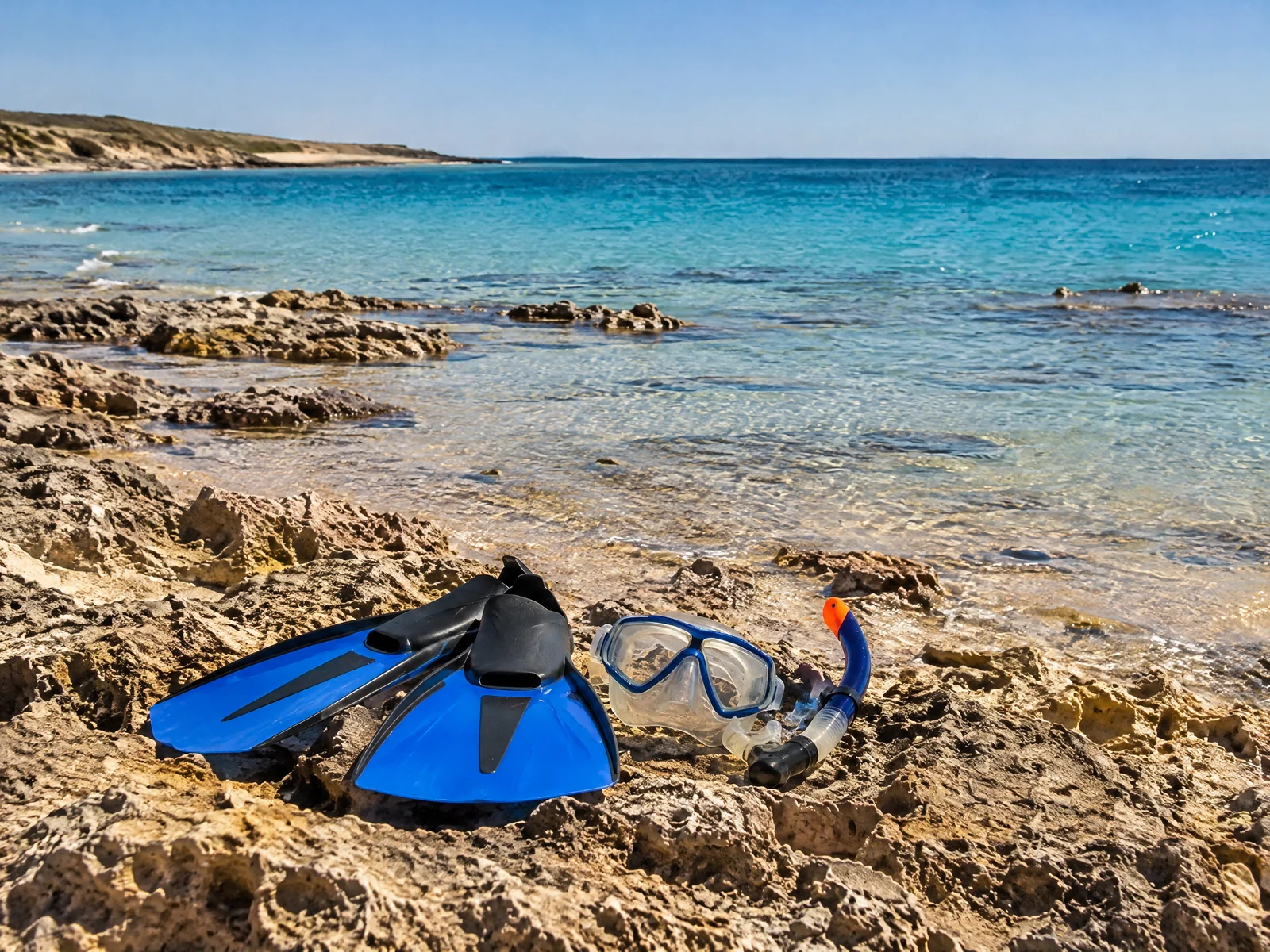
Illustration: The reef begins just metres offshore at several Cape Range campgrounds.
Water, Power, and Self-Containment Planning
Water: the single biggest risk
Most Cape Range campgrounds have no fresh water whatsoever. Osprey Bay and Tulki Beach have no water taps. You must arrive with enough water for your entire stay, including cooking and washing up.
Water budget for Ningaloo:
- Drinking: 4–5 L per person per day (more in heat)
- Cooking, washing up: ~5–6 L per day per couple
- Showering (if you have one): ~8–10 L per 2-minute shower
- Couple, 5 nights: plan for at least 80–100 L plus an emergency reserve
The Ultra and Max models carry an 80 L fresh water tank — enough for a couple over 4–5 days at moderate usage. The Essential and Plus carry a 40 L tank, which suits 2 days without resupply. Exmouth town (~50 km from the Cape Range entrance) has a dump and refill point.
For a full breakdown of sizing your water system, see our camper trailer water guide.
Power: solar sizing for WA sunshine
The Gascoyne averages 8–9 peak sun hours per day in autumn and winter — one of the best solar resources in Australia. A 200 Ah lithium battery with 200 W of solar is comfortably sufficient to run a 12V compressor fridge, LED lighting, and USB charging for a couple. The Max and Ultra ship with a lithium setup ready to go; the Essential and Plus can be upgraded.
On self-containment: the Breath Max is the only teardrop on the Australian market under $50,000 with a full interior bathroom — cassette toilet, basin, and handheld shower all enclosed. That’s the difference between needing a dump point after every 3–4 days and staying off-grid for longer. For details on matching your power system to Ningaloo’s requirements, see our off-grid teardrop guide and how long you can stay off-grid.
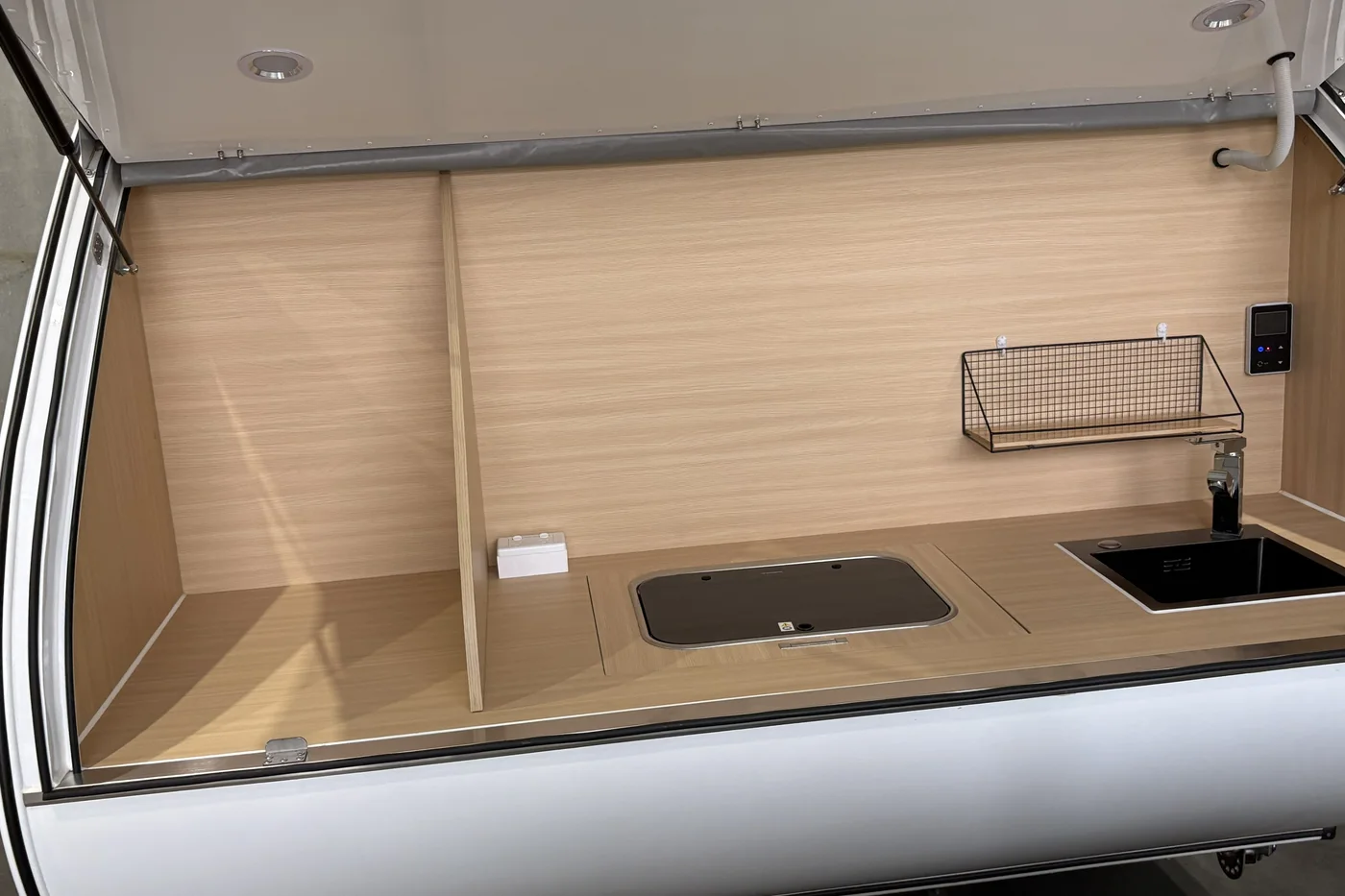
The Max rear galley is fully self-sufficient — cooktop, sink, fridge slide, and LED lights without a shore power hookup.
Towing Your Camper Trailer to Ningaloo
The full Perth–Exmouth run of 1,270 km takes most tow vehicles two comfortable days. A few towing-specific details:
Tyre pressure: The coral limestone tracks inside Cape Range NP are sealed with compact gravel and remain 2WD-friendly for all Breath Trailer models. You don’t need to deflate for the Cape Range internal roads. The beaches themselves are a different matter — stay on sealed access tracks unless you’re in a 4WD with a tyre gauge. For full tyre pressure guidance, see the camper trailer tyre guide.
Speed on North West Coastal Highway: The highway passes through 110 km/h sections; towing limits in WA are set by your trailer’s ATM:
- Under 4.5t GTM → no separate WA towing speed limit over the standard road limit
- Standard WA towing advice: 100 km/h maximum on open highway with a loaded trailer
Fuel stops southbound to northbound: Carnarvon → Minilya River Roadhouse (~200 km) → Exmouth (~380 km from Carnarvon). There is no fuel between Minilya and Exmouth. Fill the tow vehicle at Carnarvon.
Heat management: Driving through the Pilbara in summer exposes both tow vehicle and trailer to 40–45°C ambient temperatures. Tow vehicle coolant, tyre pressure, and trailer coupling lubrication should all be checked before departing. See the essential pre-trip checklist for a full run-down.
For recovery gear, PLB, and satellite comms — which become mandatory at this distance from a major centre — the off-road accessories guide has current 2026 prices.
Which Breath Trailer Model Suits Ningaloo?
| Model | Tare | Water tank | Bathroom | Best for |
|---|---|---|---|---|
| Essential ($23,320) | 700 kg | 40 L | None | Weekend or base-camp trips; resupply every 2 days at Exmouth |
| Plus ($29,766) | 800 kg | 40 L | None | Couples who resupply water in Exmouth; fridge included |
| Ultra ($34,749) | 900 kg | 80 L | External shower only | 5+ nights; good water capacity; shower useful after beach |
| Max ($42,900) | 1,200 kg | 80 L | Full interior bathroom | Self-contained long stays; no amenities block needed; the definitive Ningaloo rig |
For a 5-night stay with no amenities block — the standard Cape Range situation — the Max is the practical choice if budget allows. Its full bathroom means you’re not relying on the limited (or non-existent) facilities at Tulki Beach or Bungarra. The Ultra handles 4–5 nights well if you’re disciplined with water usage and comfortable using the external shower.
The Essential and Plus are best suited to base-camp-style visits where you plan to drive 50 km into Exmouth every 2–3 days for water, fuel, and a shower block. That adds time and cost to the trip but keeps the purchase price lower.
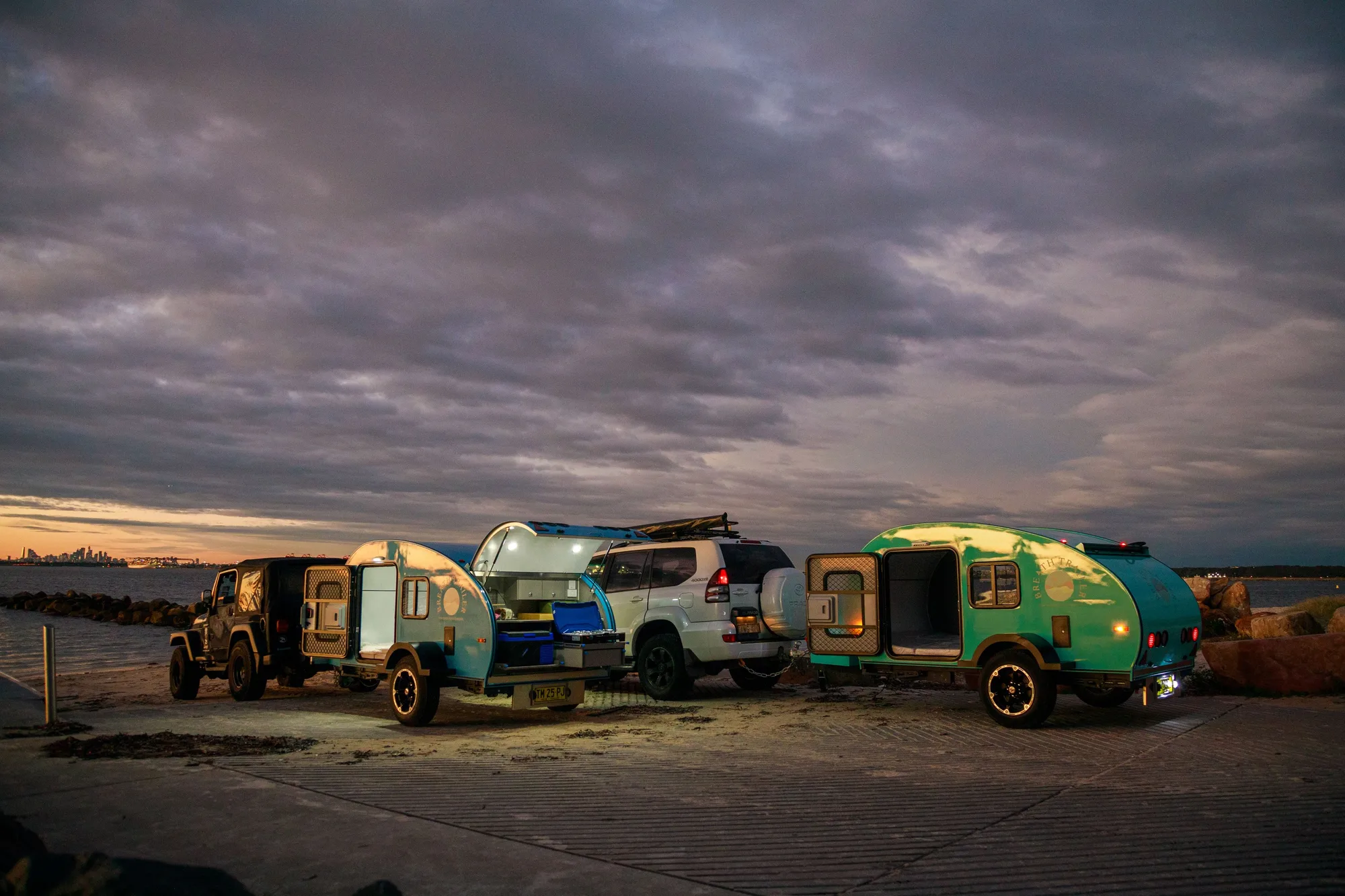
Teardrops with lit interiors at a coastal camp — the small footprint fits neatly into Cape Range’s gravel sites.
Ningaloo Packing Checklist
| Category | Items |
|---|---|
| Water | 100–120 L fresh water (couple, 5 nights); water purification tablets; collapsible jerry can for top-up |
| Sun and heat | 50+ SPF sunscreen; shade tarp; oven mitts for metal fittings at midday; insulated water bottles |
| Marine access | Snorkel, mask, fins; wetsuit or rashie (water is warm May–Oct, ~22–24°C); reef shoes |
| Navigation | Hema Explorer app or paper map; no mobile coverage inside the national park |
| Safety | PLB registered with AMSA; UHF CB radio; satellite communicator (Garmin inReach or ZOLEO); first aid kit |
| Tow vehicle | Full tank leaving Carnarvon; spare tyre; jump leads; coolant check |
| Camping | Freestanding shade structure (no tree tie-offs); gas cooktop (campfires banned); rubbish bags (pack-out everything) |
| Wildlife | Binoculars; snorkelling flag for whale shark tour; sunglasses polarised for reef spotting |
Frequently Asked Questions
Can I take my dog to Cape Range National Park? No. Dogs and other domestic animals are prohibited in all DBCA parks including Cape Range. There are no exceptions. If you’re travelling with a dog, Warroora Station allows pets (on lead), and some Exmouth caravan parks accept them. For a full state-by-state guide, see our camping with dogs in Australia article.
Do I need 4WD to camp at Ningaloo? No, for the main Cape Range campgrounds. All DBCA campgrounds inside Cape Range NP are accessible by 2WD on compact coral limestone roads from the park entrance. You’ll need 4WD for beach driving at Warroora Station and for some remote south-of-Exmouth camps.
How much does it cost to camp at Cape Range National Park? The fee structure is a per-person camping fee plus a per-vehicle park entry fee. Trailers and caravans are not charged a separate entry fee — only motor vehicles. WA Park Passes (5-day $30 / 14-day $50 / annual $130) cover park entry but not the camping component; you pay both. Confirm current per-person rates on Park Stay WA when booking.
When does the monthly batch booking open? At 10 am AWST on the first Tuesday of each month, for stay dates six months out. For July 2027 bookings, that’s the first Tuesday of January 2027. Set a reminder the day before and have your Park Stay WA login ready.
Is a self-contained setup really necessary? Not for all campgrounds, but it dramatically expands your options. Osprey Bay has a pit toilet; Tulki Beach, Bungarra, and North Mandu are basic. If you’re at the more isolated sites with no water and basic toilets, a grey water tank and interior cassette toilet remove the stress of managing waste in remote conditions. Self-containment is the legal and practical standard for free camping at WA crown land sites south of Exmouth, too.
What mobile coverage can I expect? Telstra provides the most coverage in the Exmouth township and along the highway. Inside the national park and at most campgrounds, you’ll have little to no mobile signal. A satellite communicator (Garmin inReach Mini 2, ZOLEO, or similar) is strongly recommended for emergency contact. Download offline maps and park information before leaving Exmouth.
Recommended Reading
- Best Camping Spots in Western Australia — statewide WA campground guide with fee tables and booking windows
- Free Camping Australia: The Camper Trailer Guide — state forest, crown land, and rest areas including the Coral Coast
- Camper Trailer Water System Guide — sizing your fresh and grey water setup for extended remote travel
- Off-Grid Teardrop Camper Australia — solar, lithium, and power for nights away from the grid
- Must-Have Accessories for Off-Road Adventures — PLB, recovery, comms, and tyre gear for remote WA travel
Ready to plan your Ningaloo trip? Compare all four Breath Trailer models or book a time to speak with our team.