Rooftop Tent vs Hard Floor Camper Trailer Australia: The Honest 2026 Guide
Rooftop tent or hard floor camper trailer? We compare purchase cost, fuel penalty, sleeping comfort, off-road capability and 5-year ownership costs for Australian buyers.
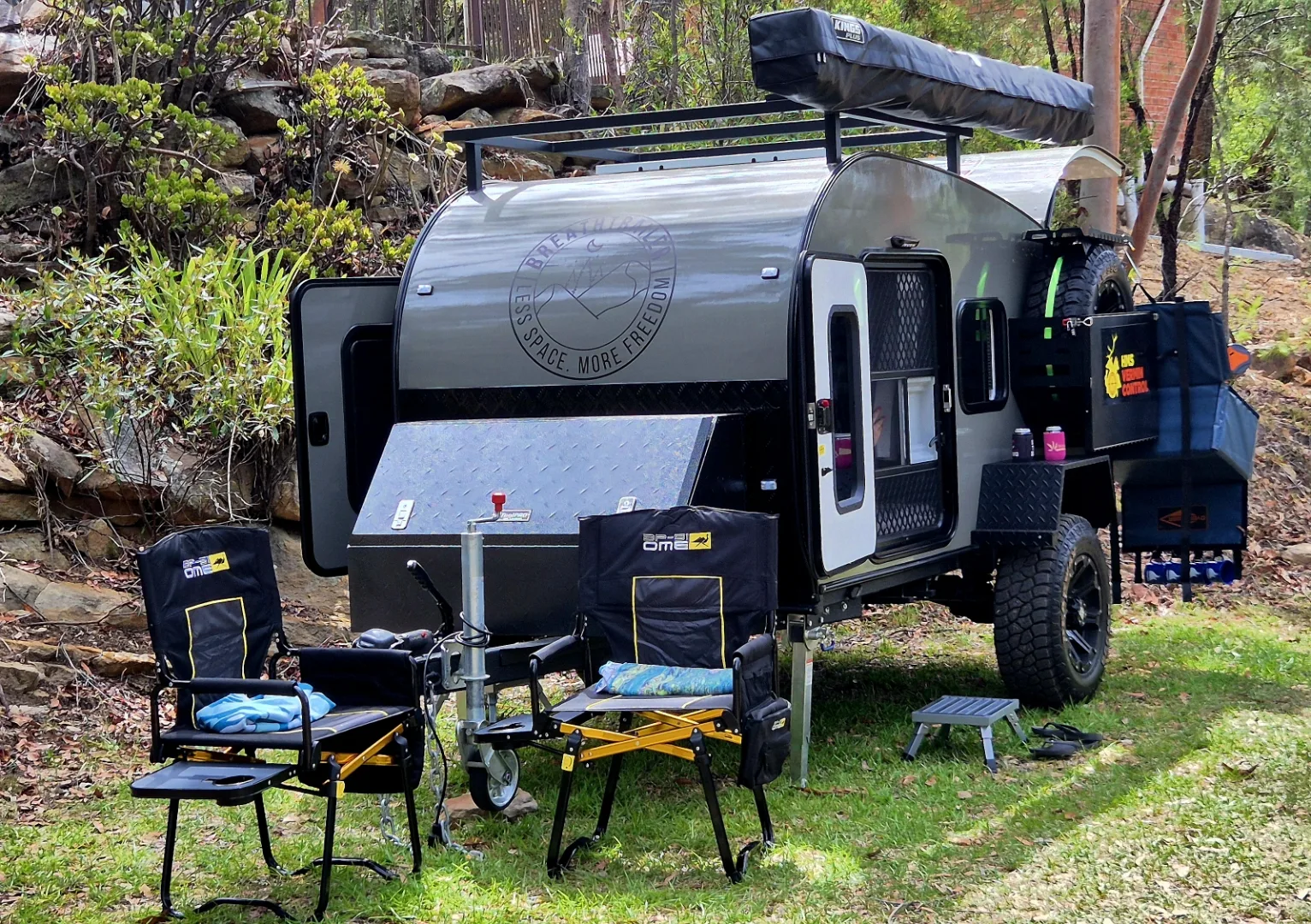
Walk into any 4WD accessories store in Australia in 2026 and you will find rooftop tents stacked floor to ceiling. Scroll through any overlanding forum and someone is asking whether a rooftop tent is better than a camper trailer. The question is more complicated than the sales floor makes it seem.
Both options let you sleep off the ground with far less faff than a swag and a rolled sleeping mat. But they suit genuinely different camping styles, budgets and vehicles. This guide cuts through the marketing hype with real prices, real fuel numbers and an honest look at who benefits from each setup — and when a hard floor camper trailer (the teardrop specifically) beats the rooftop tent hands down.
Understanding the Two Categories
Rooftop tents (RTTs) mount directly to your vehicle’s roof rack and unfold into a sleeping platform above your car. They come in two formats:
- Soft shell: a folded canvas tent on a rack, propped up with a ladder and poles. Setup takes 3–8 minutes; pack-down takes 8–12 minutes. Price range: $1,200–$3,000 AUD.
- Hard shell: a fibreglass or aluminium clamshell that pops open (or twists) automatically. Setup takes 30–60 seconds; pack-down around 2 minutes. Price range: $3,000–$8,500 AUD for quality Australian-market units (Ironman Orion 1400 ~$3,990, Thule Tepui Foothill $2,999, ARB and iKamper premium units $5,000–$8,500).
Hard floor camper trailers are towed behind your vehicle and include a rigid sleeping base — usually an aluminium or composite floor that flips or slides out — with a proper mattress at close-to-ground height. Hard-floor teardrops take this further with a fully enclosed fibreglass shell: no canvas at all, no poles, no guy ropes.
| Feature | Soft Shell RTT | Hard Shell RTT | Hard Floor Teardrop |
|---|---|---|---|
| Price (entry-level AU) | $1,200–$3,000 | $3,000–$8,500 | $19,990–$39,000 |
| Setup time | 3–8 min | 30–60 sec | 5 min |
| Sleeping height | ~1.2 m above roof | ~1.1–1.4 m above roof | ~600 mm above ground |
| Sleeping area | 2 people (standard) | 2 people (standard) | Queen bed |
| Integrated kitchen | No | No | Yes (Breath Plus and above) |
| Integrated bathroom | No | No | Optional (Ultra/Max) |
| Detach at campsite | No | No | Yes |
| 5-year resale | ~30–50% of RRP | ~40–55% of RRP | ~60–75% of RRP |
Purchase Cost: What You Actually Need to Buy
The sticker price of a rooftop tent understates the real outlay. A $3,500 hard shell RTT needs:
- Roof rack or bars: $300–$800 depending on vehicle
- 12V compressor fridge: $800–$1,500 (Dometic CFX3 45, Evakool, Engel) — this goes in your car or trailer, not the tent
- Portable camp kitchen: $200–$500
- Camp storage system: $300–$600
Total RTT-based setup with comparable camping capability: $5,100–$11,900 (and you still have no shelter for cooking/eating in rain).
A Breath Trailer Essential at $19,990 includes the enclosed sleeping shell, a 60 L water tank, external kitchen prep bench, LED lighting and 100 Ah AGM battery. You still need a 12V fridge (~$1,000) but the integration is there. The Breath Plus at $25,740 includes the fridge.
The gap narrows considerably once you kit out the RTT for the same level of comfort.
The Fuel Penalty: The Number Nobody Talks About Honestly
The rooftop tent is frequently praised for its lower fuel impact compared with towing a trailer. This claim is technically accurate per kilometre driven while camping, but it ignores a crucial reality: the rooftop tent lives on your roof every day of the year.
A quality hard shell RTT adds 1.5–2.5 L/100 km in aerodynamic drag — measured by real-world owner data and confirmed by overlanding forums. That penalty applies every time you drive to work, the school run, the supermarket — not just on camping trips.
A teardrop trailer only creates a fuel penalty when it is physically attached to your towball.
| Scenario | Rooftop Tent | Breath Trailer (teardrop) |
|---|---|---|
| Annual km driven | 15,000 km | 15,000 km |
| Km where fuel penalty applies | 15,000 km (always on roof) | ~2,000 km (towing to campsites) |
| Fuel penalty rate | +2 L/100 km | +3 L/100 km |
| Extra litres per year | 300 L | 60 L |
| Extra cost at $2.20/L | $660/yr | $132/yr |
Over five years, that is $3,300 extra in fuel for the RTT versus $660 for the teardrop — a gap of $2,640. The “fuel-efficient” option is only efficient for committed overlanders who camp more than 50 nights a year. Most Australians camp 10–20 nights per year.
For a deeper dive on towing costs and fuel economy, see our camper trailer towing guide for Australia.
Sleeping Comfort, Space and the Ladder Problem
Both options sleep two adults comfortably. But the experience is meaningfully different.
Rooftop tent sleeping:
- Mattress is typically 60–120 mm thick foam (higher-end models)
- You are 1.1–2.0 m above ground (tent floor + roof height), accessed by a ladder
- Wind noise is more pronounced at height
- Morning condensation builds up inside soft shell tents in cold or humid conditions
- Pack-up in the rain means getting your mattress wet or packing down wet canvas
Hard floor teardrop sleeping:
- Mattress is 100–150 mm foam or pocket spring at ground level (around 600 mm off the dirt)
- No ladder — you step in through the rear hatch
- Hard shell eliminates all condensation concerns; a hard fibreglass roof does not soak up moisture
- You can leave the bed made all week; you never need to pack it away unless moving sites
The ladder issue is worth taking seriously. Getting up at 2 am to use the toilet when you are half asleep, climbing 1.8 m down a cold aluminium ladder in the dark, is not a trivial inconvenience. For older campers, those with knee or hip issues, or for families with young children, this is a genuine deal-breaker. Our teardrop camper for retirees guide and guide for couples both identify this as one of the top reasons buyers switch from RTTs to hard-shell teardrops.
The Detachment Advantage
This is the single biggest practical difference between a rooftop tent and any form of trailer, and it rarely gets the emphasis it deserves.
With a rooftop tent, your sleeping quarters are bolted to your car. If you want to drive to the nearest town for supplies, to explore a side track, or to go on a day hike from base camp, you must either:
- Pack up your tent completely (8–12 min for soft shell), or
- Leave your vehicle at camp and walk
With a hard floor teardrop, you unhitch the trailer, leave camp fully set up, and drive away. Return whenever you like. The camp is there waiting: bed made, fridge running, gear stowed.
For the style of camping most Australians actually do — setting up a base camp for 3–5 nights and exploring the surrounding area — this detachment advantage is transformative.
Storage, Kitchen and Self-Contained Living
A rooftop tent is a sleeping platform. Nothing more. All your cooking, storage, eating and shelter needs must be solved separately:
- Camp kitchen: portable slide-out unit on your bar fridge drawer, or a standalone camp table
- Storage: roof bars, drawers in the tray, gear bag — nothing integrated
- Rain shelter: a separate awning (another $500–$1,500)
- Bathroom: a bush toilet or driving to amenities
A hard floor teardrop integrates many of these needs from the factory:
| Category | RTT Setup | Breath Essential | Breath Plus | Breath Ultra | Breath Max |
|---|---|---|---|---|---|
| Kitchen | Separate (DIY) | Prep bench + sink | Fridge incl. | Fridge + external shower | Full interior bathroom |
| Water storage | Jerrycan | 60 L tank | 80 L tank | 80 L tank | 120 L tank |
| 12V battery | Vehicle battery | 100 Ah AGM | 100 Ah AGM | 150 Ah LiFePO₄ | 200 Ah LiFePO₄ |
| Storage | Vehicle/tray only | 150 L integrated | 180 L integrated | 200 L integrated | 300 L integrated |
| Rain shelter | Separate awning | Awning optional | Awning optional | Awning optional | Awning optional |
| Bathroom | No | No | No | External shower | Full interior WC + shower |
For self-contained free camping — away from powered sites, national park facilities, or amenities — the Breath Max with its interior bathroom and 120 L water tank is the only teardrop on the Australian market under $50,000 that qualifies as genuinely self-contained under CMCA self-containment guidelines. RTTs do not qualify by definition.
Vehicle Compatibility and Roof Load Safety
This is where the rooftop tent story gets uncomfortable.
Most Australian 4WDs and popular SUVs have a dynamic roof load rating of 50–100 kg. This is the maximum weight the roof structure can safely carry while the vehicle is moving. A quality hard shell RTT weighs 45–90 kg. Add a roof rack (15–25 kg) and you are at 60–115 kg combined — frequently at or above the vehicle’s dynamic limit.
| Vehicle | Dynamic roof load limit | RTT + rack (typical) | Assessment |
|---|---|---|---|
| Toyota LandCruiser 300 | 150 kg | 75–115 kg | Safe |
| Toyota HiLux (dual cab) | 100 kg | 75–115 kg | Borderline/over |
| Toyota Prado 150 | 75 kg | 75–115 kg | At/over limit |
| Subaru Outback | 70 kg | 75–115 kg | Over limit |
| Ford Ranger | 75 kg | 75–115 kg | Borderline/over |
| Isuzu MU-X | 80 kg | 75–115 kg | Borderline |
| Mitsubishi Pajero Sport | 75 kg | 75–115 kg | At/over limit |
Exceeding your roof load limit raises centre of gravity, increases rollover risk, compromises braking and reduces handling precision — particularly significant on unsealed outback tracks. Australian road rules do not specify a maximum roof weight, but a vehicle loaded beyond manufacturer specifications is technically not roadworthy and may void your insurance in an at-fault incident.
Hard floor teardrops attach at the towball. The only vehicle requirement is a tow rating equal to or above the trailer’s ATM (Aggregate Trailer Mass). For Breath Trailer models, ATMs range from 700 kg (Essential) to 1,200 kg (Max) — well within the towing capacity of any mid-size SUV including a Subaru Outback (1,500 kg tow rating), RAV4 Hybrid (1,500 kg) or Kia Sorento (2,000 kg).
For a full breakdown of teardrop weight specs and towing maths, see Teardrop Camper Weight Australia.
Off-Road Capability
Both setups can go off-road. The differences come down to approach angle and leverage.
A rooftop tent adds nothing below the chassis line — your departure angle, approach angle and ground clearance remain unchanged. The weight sits high, however, which affects handling on side slopes and corrugated tracks. Hard shell RTTs are generally better than soft shells here: they are more aerodynamic when closed, and their lower profile reduces wind sail effect on exposed ridgelines.
Hard floor teardrops can be built with serious off-road capability: independent coil suspension, DO35 articulating couplings, 16-inch alloy wheels, and galvanised chassis. The Breath Trailer range runs independent coil suspension across all models, handling corrugated tracks, creek crossings and rocky terrain without drama. The constraint is approach angle when reversing into camp on very steep exits — but at 700–1,200 kg tare these trailers are light enough to disconnect and push manually if needed.
The bottom line: a RTT on a lifted 4WD gets you onto tougher terrain than a teardrop on a family SUV. But a teardrop on that same 4WD with a DO35 coupling will keep up with most off-road scenarios short of the most technical 4WD-only tracks. Our off-road teardrop camper guide maps out where each model is comfortable.
Resale Value and 5-Year Ownership Cost
The resale story strongly favours hard floor trailers.
RTTs are durable in principle, but the canvas (on soft shells) deteriorates with UV exposure, and roof racks accumulate corrosion. The broader market for used RTTs is soft: once a tent shows sun bleaching, zipper wear or condensation staining, buyers discount heavily. Expect 30–55% of original value at five years for a quality RTT setup.
Hard floor teardrops in good condition hold value exceptionally well in Australia. The used teardrop market is thin — demand consistently exceeds supply. Our analysis of teardrop resale value found quality hard-shell models retaining 60–75% of purchase price after five years, versus 45–55% for forward-fold canvas trailers and 30–50% for RTTs.
| Cost item (5 years) | RTT hard shell setup | Breath Essential ($19,990) |
|---|---|---|
| Purchase price | $5,500 (tent + rack) | $19,990 |
| Extra camping gear needed | $2,500 | $1,000 (fridge) |
| Total outlay | $8,000 | $20,990 |
| Annual fuel penalty (est.) | $660 × 5 = $3,300 | $132 × 5 = $660 |
| Maintenance 5 yr | $300 | $750 |
| Resale at yr 5 | −$4,000 (50% of $8k) | −$13,600 (65% of $19,990) |
| Net 5-year cost | $7,600 | $8,800 |
The RTT setup is cheaper over five years for average users — by roughly $1,200. That gap represents around $240 per year. Against the comfort, detachment, kitchen and bathroom integration that a teardrop offers, many buyers consider $240/year excellent value. For very occasional campers (under 8 nights/year), the RTT is the stronger financial choice. For regular campers (15+ nights/year), the maths close further, and the quality-of-life premium of a hard floor teardrop becomes an easy decision.
Who Should Choose a Rooftop Tent?
A rooftop tent makes sense when:
- You already own a capable roof-racked 4WD with adequate dynamic load rating
- You move camp every single night and cannot leave a trailer behind
- Your destinations require technical track access where a trailer is genuinely impractical (tight turns, extreme grades)
- You camp under 10 nights per year and cannot justify a higher purchase price
- You travel solo and sleeping space for two is more than enough
- Weight on the towball is not viable (no towbar, caravan restrictions in some national parks)
For solo travel specifically, the teardrop vs RTT decision hinges heavily on where you want to go: RTT for mountain bike trails and single-track national park roads, teardrop for coastal free camps and national park powered sites.
Who Should Choose a Hard Floor Camper Trailer?
A hard floor teardrop is the better choice when:
- You camp with a partner and an integrated kitchen/bathroom matters
- You set up a base camp for multiple nights and want to explore in the vehicle each day
- You have knee, hip or back issues that make ladder access uncomfortable
- You camp more than 15 nights per year (5-year cost calculation narrows considerably)
- Self-contained free camping is the goal (Breath Max only, among teardrops under $50k)
- You prioritise resale security if your circumstances change
- You have young children (no ladder, no condensation, bathroom access at night)
- Weather protection is important: a hard shell is impervious to rain, UV, and wind in a way canvas and RTT fabrics simply are not
For couples planning longer trips, our teardrop for couples guide covers the queen-bed experience, towing anxiety solutions and the Subaru / RAV4 tow scenario in detail.
For families, the Breath Max with 2.1 m interior standing height, full bathroom and queen bed is worth exploring against the best camper trailer for families alternatives.
A Note on Hybrid Setups
Some buyers bolt a rooftop tent to a trailer chassis — a dedicated RTT trailer that you tow. This solves the vehicle compatibility and roof-load problem but eliminates the key advantage of the RTT (not needing to tow). It is niche, suits specific use cases (multiple kids needing separate sleeping), and costs $3,000–$6,000 for the trailer plus the RTT itself.
Most buyers who reach this point find a forward-fold or hard-floor trailer is simpler, better value and more integrated. It’s worth knowing the option exists, but it rarely makes sense as a first purchase.
Frequently Asked Questions
Is a rooftop tent cheaper than a hard floor camper trailer? Yes — an entry RTT setup (tent + rack + cooking gear) runs $5,000–$10,000 versus $19,990–$39,000 for a teardrop. The gap narrows over five years once you factor in the RTT’s higher annual fuel penalty (always on the roof) and faster depreciation, but the rooftop tent is the lower upfront cost option.
Can my Subaru Outback or RAV4 safely carry a rooftop tent? Many popular Australian family SUVs have dynamic roof load limits of 70–80 kg. Most quality hard shell RTTs weigh 45–90 kg, and roof racks add 15–25 kg. You may be at or above your vehicle’s rated limit — check your owner’s manual before buying. A teardrop trailer avoids this issue entirely: it attaches to the towball and both the Outback and RAV4 have 1,500 kg tow ratings.
Does a rooftop tent really use less fuel than towing a trailer? Per kilometre of towing, yes: an RTT adds ~2 L/100 km aerodynamic drag versus ~3 L/100 km for a teardrop. But the RTT is always on your roof — on every drive, all year. If you drive 15,000 km annually and camp for 2,000 km of that, the RTT costs roughly $660/yr extra in fuel versus $132/yr for the teardrop. See the table above.
Can a rooftop tent qualify as self-contained in Australia? No. Self-containment under CMCA guidelines requires an onboard toilet, grey water management and minimum water storage. A rooftop tent is sleeping quarters only and cannot meet this standard. The Breath Max is designed to qualify as self-contained, making it suitable for areas where unpowered free camping requires self-containment.
Which is better for off-road camping in Australia? A lifted 4WD with an RTT reaches tighter tracks where a trailer cannot follow. A hard-floor teardrop on an independent coil suspension chassis handles most unsealed roads, corrugated outback tracks and bush camps comfortably. The question is whether your actual destination is a technical 4WD-only track (RTT wins) or a remote free camp accessible on a dirt road (teardrop wins). Most Australian free camps fall into the second category.
How long does it take to set up a hard floor teardrop versus a rooftop tent? A hard shell RTT takes 30–60 seconds to open (unlatch and lift). A Breath Trailer teardrop takes around 5 minutes to unhitch, level, connect power and open the rear hatch. A soft shell RTT takes 3–8 minutes. Setup times are genuinely close for hard shell RTTs — but the teardrop advantage is that you do not have to pack down between day trips, so across a multi-day stay you save significant cumulative time.
The Bottom Line
Neither the rooftop tent nor the hard floor teardrop is universally superior. They are tools for different styles of travel.
If you move every night, access technical terrain, camp occasionally and want the lowest entry price, a hard shell RTT is a sensible choice. If you set up a base camp, want kitchen and bathroom integration, camp regularly and plan to sell your unit in five years, a hard floor teardrop gives you a meaningfully better camping experience for a manageable total cost.
The honest answer for most couples and families planning regular Australian adventures? The teardrop wins — not because it is cheaper, but because the quality of the camping experience it enables is categorically different. The question shifts from how do I survive this trip? to do I want to stay another week?
Explore the Breath Trailer range at our comparison page or book a factory viewing in Sydney.