Why Air Conditioning Is Becoming Essential in Australian Camper Trailers (2026)
Running aircon off-grid needs more battery than most setups carry. The real power draw, and what you need to run it overnight.
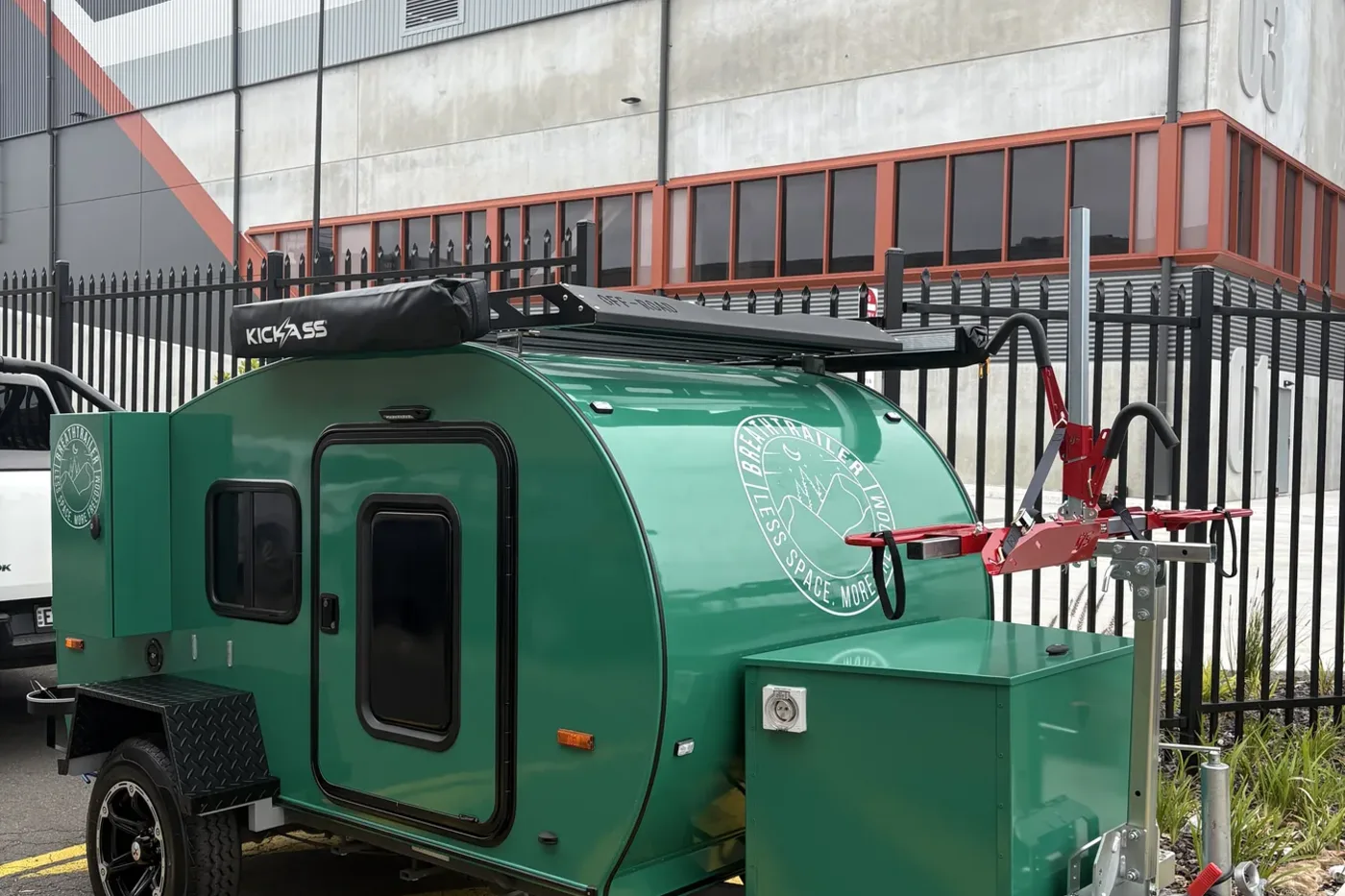
There is a camping experience every Australian recognises: you zip up the tent at 11 pm, temperature still hovering at 30°C, and spend the next four hours staring at the ceiling. By morning you are exhausted, sunburnt, and silently reconsidering your life choices.
That experience has driven a quiet but significant shift in how Australians equip their camper trailers. Air conditioning — once considered a luxury reserved for motorhomes and full caravans — is now one of the most-searched features for compact camper trailers and teardrops in 2026. The data backs it up: Australia recorded its fourth-warmest year on record in 2025, summer nights are warming faster than summer days, and roughly one in three Australians already reports waking in the middle of the night due to heat. When you are 400 km from the nearest town on a remote track, the gap between “tolerable” and “essential” closes fast.
This guide explains why that shift is happening, what your options actually are for a compact camper trailer, and how to size a system that runs without plugging into a powered campsite.
Australia’s Heat Reality in 2026
The number campers underestimate most is the overnight minimum, not the daytime maximum. Onslow, Western Australia reached 50.7°C in a recent summer, matching Australia’s highest temperature on record. Moomba, South Australia peaked at 49.6°C during a three-week heat wave. These are extreme one-day figures, but the trend that matters for camping is the slower, structural creep in overnight temperatures.
The Bureau of Meteorology confirmed that summer 2025–26 carried above 60–80% probability of above-average daytime temperatures across most of Australia — with Northern Australia carrying an even stronger chance of unusually warm minimums. And unlike daytime heat, which you can escape through shade, water, and a drive in an air-conditioned tow vehicle, overnight heat has nowhere to go. If the ambient temperature stays above 25°C through the night, your body’s core cooling cycle — which requires the environment to be cooler than you are — simply cannot complete. Sleep quality degrades, recovery is impaired, and consecutive nights stack the deficit.
A 2024 systematic review published in Sleep Medicine Reviews confirmed what every summer camper already knows intuitively: higher outdoor temperatures are directly associated with worse sleep quality and reduced total sleep time, regardless of latitude.
For grey nomads managing health conditions, families with young children, and solo travellers on remote routes, this is not a comfort question. It is a safety one.
Why Teardrop Campers Are Actually Better Suited to AC Than You Think
The intuitive assumption is that larger caravans suit air conditioning and compact teardrops do not. The reality is closer to the opposite for off-grid use.
A full-size caravan interior might measure 15–20 square metres. A hard-shell teardrop sleeping cabin is typically 4–6 square metres — roughly the size of a large walk-in wardrobe. A modest 5,000–6,000 BTU portable unit that would be useless in a full caravan can drop a teardrop cabin from 38°C to 22°C in under 20 minutes. That same unit running on battery power for 6–8 hours in a small teardrop will exhaust a lithium bank in a much larger caravan in under two hours.
The second advantage is insulation. Hard-shell teardrop construction — fully sealed composite panels with internal insulation — holds a cooled temperature far better than canvas walls or poorly-sealed caravan construction. An insulated hard shell holds the cool-down from an evening AC session for hours after the unit switches off, reducing total runtime and battery draw. In a canvas tent or soft-floor camper trailer, warm air infiltrates continuously the moment you stop cooling.
This combination — small volume, sealed insulation — means teardrops are among the most AC-efficient camping platforms available.
Types of Air Conditioning for Camper Trailers
There are four realistic options for a compact camper trailer or teardrop. They differ substantially in power source, installation requirement, off-grid capability, and price.
1. 240V Rooftop Air Conditioners (Shore Power or Generator)
The traditional caravan solution. Units from Dometic (FreshJet FJZ7 Pro, around $2,245), Truma, Coleman, and Furrion mount on the roof, ducted through the ceiling, and deliver serious cooling — typically 7,000–10,000 BTU. They run on 240V, which means a powered campsite or a generator.
Pros: Strongest cooling capacity. Quiet operation. Integrated into the cabin ceiling.
Cons: Requires 240V — generator or powered site. Generator adds $800–$3,000 in cost, noise, fuel, and weight. Not truly off-grid capable.
If you spend most nights at powered holiday parks, this is the most comfortable option. If you are targeting free-camping and remote tracks, it is the wrong architecture.
2. 12V DC Rooftop Air Conditioners
A rapidly growing category. Units like the Dometic CoolAir RTX 2000 (6,824 BTU, runs on 24V DC) and the Outbax Cold King 12V rooftop (7,500 BTU) mount similarly to traditional rooftop units but draw directly from your DC battery bank. No generator required.
Pros: Significant cooling power. Roof-mounted (no internal space consumed). Runs off lithium batteries with solar charging.
Cons: High battery demand — typically 60–100Ah per hour at 12V under load. Requires 300–400Ah of lithium as a practical floor. Installation requires roof penetration and DC wiring.
The maths on 12V rooftop units: at 100Ah per hour draw, a 200Ah lithium bank (a common Breath Plus or Ultra setup) gives you roughly two hours of cooling. Add a 300Ah bank and 200W of solar charging while the sun is up, and you can realistically run 3–4 hours of nighttime AC with a solar-topped bank. For the Breath Max (the heaviest model at 1,200 kg with the largest cabin), this is the most viable integrated solution.
3. Portable Battery-Powered Air Conditioners
The category that has changed most rapidly in the last two years. Units like the EcoFlow WAVE 3 (6,100 BTU cooling, 6,800 BTU heating, up to 8 hours wireless runtime, ~$1,500–$2,000 AUD) and the Zero Breeze Mark 3 (5,280 BTU, ~$3,100 AUD with battery) are self-contained units with their own integrated battery packs. Place them inside the cabin, vent the exhaust through a cracked hatch or window, and run them without any fixed installation.
Pros: No roof penetration. No professional installation. Portable between trailers or tents. No generator. Modern units last 6–8 hours on internal battery, extended further by plugging into an external power station.
Cons: Occupies internal floor space in a compact cabin. Needs an exhaust vent (handled via a hose kit). Lower BTU ceiling than rooftop units.
For a teardrop cabin of 4–6 square metres, 5,000–6,100 BTU is more than sufficient to achieve comfortable sleeping temperatures. The portability benefit is real: the same unit works in your home, in a mate’s camper, or at a festival. The Zero Breeze Mark 3 has become one of the most-reviewed compact camping AC units in Australia in 2025–26.
4. Evaporative / Swamp Coolers and High-Airflow Fans
Not true AC, but worth including for the right conditions. Evaporative coolers (like the Coolzy-Pro, a three-time ProductReview.com.au award winner) work by evaporating water — dropping the local temperature 3–6°C in low-humidity environments. They fail in humidity above ~50%, which rules them out for northern Queensland, Darwin, and coastal NSW in summer.
High-flow roof fans (MaxxAir Fan: ~$400–$600 AUD) are the most practical partial solution for all conditions: move enough air through a teardrop cabin to make 28°C feel tolerable, add a Maxxfan reverse function to exhaust hot air in the evening, and pair with Reflectix window insulation to reduce solar heat load through the day. In the right conditions (low humidity, altitude, southern Australia), a good fan can substitute for AC entirely.
AC Option Comparison Table
| Option | BTU | Power source | Off-grid? | AU price (approx) | Best for |
|---|---|---|---|---|---|
| 240V rooftop (e.g. Dometic FreshJet FJZ7 Pro) | 9,000–12,000 | 240V shore/generator | No | $2,200–$3,500 installed | Powered site users |
| 12V DC rooftop (e.g. Outbax Cold King 12V) | 7,500 | 12V/24V DC battery | Yes (high draw) | $1,500–$2,500 + install | Large lithium banks (300Ah+) |
| Portable battery AC (EcoFlow WAVE 3) | 6,100 | Internal battery + DC/AC | Yes | $1,500–$2,000 | Off-grid teardrops, flexibility |
| Portable battery AC (Zero Breeze Mark 3) | 5,280 | Internal battery + DC | Yes | ~$3,100 with battery | Compact teardrop, occasional use |
| Evaporative cooler (Coolzy-Pro) | N/A (evaporative) | 12V / USB | Yes (low humidity only) | $400–$700 | SA, WA, VIC inland in summer |
| High-flow roof fan (MaxxAir) | N/A | 12V DC | Yes | $400–$600 | All conditions, partial relief |
Battery Sizing for Off-Grid AC
This is where most buyers underestimate requirements. The AC unit itself is straightforward; the battery bank that feeds it is the constraint.
A portable unit drawing 400–600W for 6–8 hours overnight requires:
- At 12V: 400W ÷ 12V = 33A × 8 hours = 264Ah drawn from the battery. At 80% DOD (depth of discharge) on lithium, you need ~330Ah of lithium capacity to run the unit overnight without touching your floor reserve.
- At 240V (via inverter): Add ~15% inverter loss on top. A 2,000W inverter running a 600W AC unit draws roughly 700W from the battery, putting overnight draw closer to 350Ah.
For 12V DC rooftop units drawing 70–100A, even 200Ah lithium is exhausted in two hours. The practical configuration for off-grid overnight cooling with these units is:
- 200Ah LiFePO4: 2–2.5 hours of rooftop AC. Adequate as a sleeping cool-down window.
- 300Ah LiFePO4: 3–4 hours of rooftop AC, or full overnight with a portable 6,000 BTU unit.
- 400Ah+ LiFePO4: Full overnight rooftop AC with solar top-up buffer. Best for longer remote trips.
Solar charging during the day meaningfully extends off-grid capability. A 200W solar panel generates roughly 80–100Ah per day in good Australian sun (5–6 peak sun hours in most of the country). On a 300Ah bank, that’s a full third of your battery bank replaced during the travel day, before you even set up camp. Our complete guide to camper trailer power systems covers how to size a solar + lithium + DC-DC system for your daily consumption profile.
Power Budget: AC vs Your Other Loads
Air conditioning does not exist in isolation. You are also running a compressor fridge, lighting, phone charging, and potentially a CPAP or laptop. Here is a realistic daily power budget for an off-grid touring couple:
| Appliance | Running draw | Daily hours | Daily Wh |
|---|---|---|---|
| 12V compressor fridge (55L) | 40W average | 24 | 960 Wh |
| Portable AC (EcoFlow WAVE 3) | 550W average | 6 (overnight) | 3,300 Wh |
| LED lighting | 20W | 4 | 80 Wh |
| Phone/tablet charging | 30W | 3 | 90 Wh |
| Water pump | 60W | 0.25 | 15 Wh |
| Total daily draw | ~4,445 Wh |
At 12V, 4,445 Wh = roughly 370Ah. A 400Ah LiFePO4 bank with 300W of solar provides exactly this capability on a good sun day. On overcast days, you need to reduce AC runtime or supplement with the tow vehicle’s alternator via a DC-DC charger.
This is the budget reality that makes AC viable only when paired with a properly sized lithium system — not a factory-fit AGM battery. The AGM vs lithium comparison covers why AGM cannot realistically support overnight AC loads.
Hard-Shell Advantage: Insulation Matters More Than BTU
One of the least-discussed advantages of a hard-shell teardrop over a canvas camper trailer is the insulation retention effect. Canvas walls have R-values close to zero. Composite hard-shell panels — the kind used on all four Breath Trailer models — hold an R-value that is meaningfully higher, depending on the specific panel construction and air gap.
In practical camping terms: if you run a portable AC for 90 minutes before bed in a hard-shell teardrop and bring the cabin to 20°C, the insulated shell holds that temperature for several hours after the unit switches off. You might sleep comfortably through the night on just one pre-sleep cool-down session.
In a canvas camper trailer or soft-floor unit, warm air infiltrates the sleeping space immediately when the fan stops. You are effectively cooling the outdoors, not the cabin.
This structural difference means teardrop owners can often get away with smaller, lighter, more battery-efficient AC units than equivalent canvas campers — and still achieve a better sleeping outcome.
The Alternatives: When AC Is Not the Answer
Air conditioning is not the only approach to summer comfort, and for many itineraries it is not the best value:
Roof ventilation fans (MaxxAir, Hella, Fiamma) move 200–400 cubic metres per hour through a teardrop cabin, creating airflow that drops perceived temperature by 4–8°C. At 12V, most draw only 3–5A — a fraction of AC draw. In the south of Australia from October through March, a good roof fan handles most nights. Above the Tropic of Capricorn in summer, fans alone become inadequate as overnight temps stay above 28–30°C.
Campsite selection eliminates much of the cooling load. A coastal campsite with sea breeze, a forested site with canopy shade, or a high-altitude inland site (1,000+ m above sea level) can reduce overnight lows by 5–8°C versus a flat, exposed outback location. Planning your summer routing to avoid the worst daytime heat radiated from bitumen and bare ground is a free form of temperature management.
Thermal window covers (Reflectix, commercial caravan thermal blinds) reduce solar heat loading through windows and hatches during the day. In direct sun, unshaded caravan windows can contribute 200–400W of radiant heat load into the cabin. Blocking this input reduces the cooling work your AC (or fan) needs to do.
Early-morning departure strategy: travelling the hottest part of the day and arriving at camp in the late afternoon avoids the peak radiant loading period entirely, and the cabin’s thermal mass hasn’t had eight hours of direct sun to absorb. Combined with shade and ventilation, this often eliminates the need for AC entirely in shoulder months (September–October, March–April).
For a detailed breakdown of all the components that make up a fully capable off-grid setup — including ventilation, refrigeration, and power — our ultimate off-grid setup guide covers each system in turn.
Per-Model AC Compatibility: Breath Trailer
All four Breath Trailer models share the hard-shell composite construction that makes AC efficient in a compact cabin. Here is how the practical situation varies by model:
| Model | Tare | Cabin size | Best AC option | Notes |
|---|---|---|---|---|
| Essential $23,320 | 700 kg | Compact | Portable battery unit (EcoFlow WAVE 3) | Portable suits the weight-conscious build; no fixed installation required |
| Plus $29,766 | 800 kg | Mid-size | Portable or 12V rooftop (aftermarket) | Included fridge reduces power budget; 12V rooftop requires battery upgrade |
| Ultra $34,749 | 900 kg | Mid-large | 12V rooftop or portable battery | External shower + grey water — best self-contained touring platform with AC |
| Max $47,190 | 1,200 kg | Largest (2.1m standing height) | 12V rooftop or 240V (with generator) | Largest cabin volume — most benefit from higher-BTU rooftop unit; full bathroom already included |
The Breath Max is the most AC-relevant model: its 2.1 m interior standing height and full interior bathroom create a genuinely liveable cabin in extreme summer heat — particularly for grey nomads doing extended Big Lap tours where 40°C days and 28°C nights are routine. For that use case, pairing the Max with a 12V rooftop AC and a 300–400Ah lithium bank represents the highest-comfort off-grid touring package currently available in a sub-$50k teardrop.
For Essential and Plus owners, a portable battery-powered unit like the EcoFlow WAVE 3 adds summer-cooling capability without any permanent modification, can be removed for urban storage, and doubles as emergency home cooling during grid outages.
What to Ask Before You Buy an AC System
Before purchasing or commissioning an AC installation, five questions matter:
1. What is your BTU requirement? A teardrop sleeping cabin of 4–6 m² requires 5,000–6,500 BTU. Oversizing wastes power and money; undersizing gives you a unit that runs continuously and still fails to cool. A quick calculation: 500 BTU per square metre of sleeping space is a practical rule of thumb for a well-insulated hard-shell interior.
2. What power source do you actually have access to? If 80% of your nights are at powered campgrounds, a 240V rooftop unit is the simplest, cheapest, most powerful option. If 80% are free-camping, you need a portable battery unit or a properly sized 12V system. Know your camping style before committing.
3. What battery capacity can your trailer support? If you currently have a single 100Ah AGM or 100Ah lithium, AC is not practical yet. The first investment should be a lithium battery upgrade to 200Ah minimum, and ideally 300Ah or more. See our lithium battery guide for the full comparison.
4. What is your solar input? A 100–200W solar panel charging 200–300Ah of lithium during a touring day genuinely makes overnight AC feasible. Without solar, a single night of AC would require a full recharge from mains or generator the next day. Our solar sizing guide walks through the calculation for your specific daily load.
5. Does the installation require a licensed electrician? Any 240V work in a trailer requires a licensed electrician under Australian regulations, and the system must comply with AS/NZS 3001.2:2022. Twelve-volt DC wiring is less regulated but poor installation causes fire risk — especially at the high current draws involved in AC compressor loads. If you are adding a 12V rooftop unit, use a properly rated cable and fuse for the current involved. Our guide to why professional installation matters explains what to insist on.
FAQ
Can I run a portable AC unit off my existing caravan battery?
It depends on what you have. A single 100Ah AGM battery has roughly 50Ah of usable capacity before damage — enough for less than one hour of a 6,000 BTU portable unit. A single 100Ah lithium gives you 80Ah usable — still under two hours. For practical overnight cooling, you need 200Ah lithium as an absolute minimum, and 300Ah for comfort.
Will AC work in a teardrop camper without roof modifications?
Yes. Self-contained portable units like the EcoFlow WAVE 3 and Zero Breeze Mark 3 require only a small exhaust hose vented through a cracked hatch or window vent — no roof cutting, no installation. This makes them the easiest entry point for teardrop owners.
Is a 12V rooftop air conditioner worth it over a portable unit?
For owners with an existing 300Ah+ lithium bank and solar charging, a 12V rooftop unit offers more cooling power, does not consume internal cabin space, and delivers a more integrated outcome. For owners who haven’t yet upgraded their electrical system, the portable battery-powered units are the pragmatic starting point — they require no installation and can be progressively supplemented as the power system grows.
How much does it cost to have a rooftop caravan AC installed in Australia?
Supply and installation for a 240V rooftop unit typically runs $2,000–$3,500 AUD including the unit, caravan penetration, ducting, and licensed electrical connection. A 12V DC rooftop system costs $1,500–$2,500 for the unit plus $300–$600 for professional DC wiring, depending on the trailer’s existing 12V architecture.
Does air conditioning affect my GVM or towing capacity?
A rooftop AC unit adds 15–30 kg to the trailer’s tare weight. For a Breath Essential (700 kg tare) already close to its GVM, this needs checking. For heavier models like the Ultra or Max, the marginal weight is less significant. A portable battery unit adds 5–10 kg as payload weight inside the cabin — less structural impact but still counts toward ATM. Our camper trailer weight guide explains how to calculate remaining payload capacity.
Can I use a split system (mini-split) in a camper trailer?
Mini-split systems are theoretically possible in larger caravans with dedicated generator or shore power, but the refrigerant lines, compressor mounting, and electrical requirements make them impractical for a compact teardrop trailer. Portable battery units or 12V rooftop systems are the correct category for trailers under 1,500 kg tare.
Conclusion
Air conditioning has moved from a nice-to-have to a legitimate touring essential for Australian summers — particularly for remote free-camping where 35°C overnight minimums are no longer rare. The structural change is not just in Australia’s climate; it is in what the technology now makes possible. A 6,100 BTU portable unit that runs 8 hours on its own battery, or a 12V rooftop unit that runs off a well-sized lithium bank charged by solar, fundamentally changes the summer camping calculation.
For teardrop and hard-shell camper owners, the small cabin volume and insulated construction give you a structural efficiency advantage that full caravans do not have. You need less BTU, less battery, and less runtime to achieve the same sleeping temperature. The question is no longer whether AC belongs in a compact camper trailer — it is which system best matches your battery architecture, touring style, and budget.
If you are at the stage of configuring a new build, the best approach is to plan the power system from the start: right-sized lithium bank, solar charging, DC-DC charger from the tow vehicle, and a pre-wired provision for a 12V rooftop unit or portable AC inlet. That’s a conversation worth having before the trailer is built.
Recommended Reading
- The Complete Guide to Camper Trailer Power Systems
- AGM vs Lithium Batteries for Camper Trailers
- How Much Solar Do You Need for a Camper Trailer?
- The Ultimate Off-Grid Camper Trailer Setup
- Teardrop Camper Accessories Guide — Australia
Ready to configure a Breath Trailer with the right power architecture from the start? Compare all four models or book a viewing session.