Bike Rack for a Camper Trailer in Australia (2026 Guide)
Drawbar, rear-mount or roof: load limits, ball weight impact, and which setups survive corrugations.
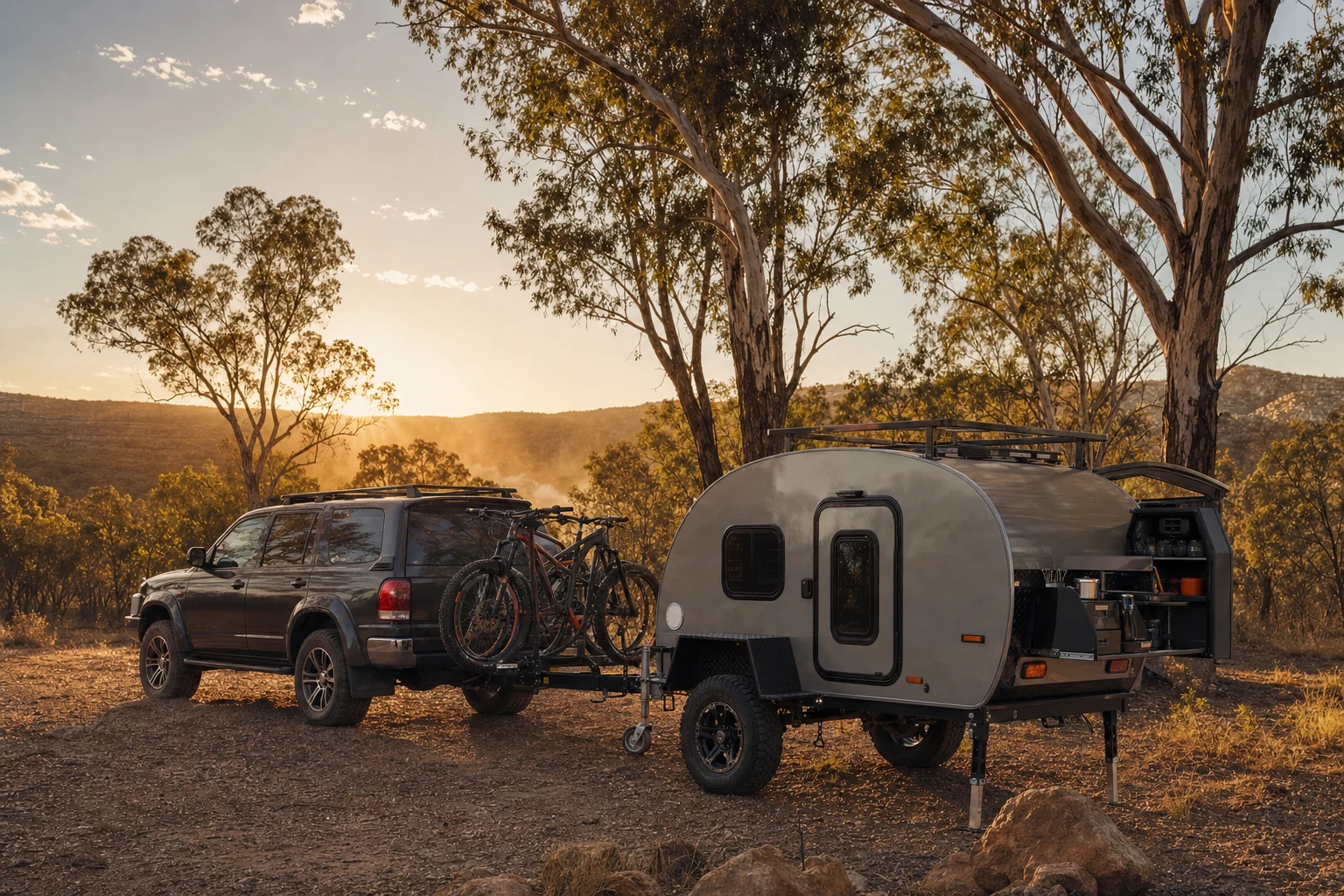
Two bikes and a rack weigh about 60 kg. That sounds trivial next to a 1,500 kg trailer — right up until you work out where those 60 kg actually land. Mount them on the drawbar and roughly 50 of those kilos transfer straight onto your tow ball, which on a mid-size SUV rated to 150 kg download is the difference between legal and not. Mount them on the back wall and you remove around 30 kg of ball weight, which is how a stable rig starts to sway at 95 km/h on the Hume.
Bike racks are the most under-thought accessory in Australian camping. Most buyers pick one on price, bolt it wherever it fits, and discover the problems on the first corrugated road — a cracked mount, a $544 fine for an obscured number plate, or an e-bike that arrives at camp with a derailleur full of bulldust.
This guide covers the four mounting options for a camper trailer, the weight maths nobody does, the state-by-state number plate rules that catch out most travellers, real 2026 Australian prices, and what actually works on a hard-shell teardrop where the drawbar is short and the roof is 1.9 m off the ground.
The four places bikes can go — and what each costs you
There are only four viable mounting positions on a tow vehicle + camper trailer combination. Every product on the Australian market is a variation of one of them.
| Mount position | Bikes | Effect on ball weight | Corrugation tolerance | Obscures trailer plate? | Typical AU cost |
|---|---|---|---|---|---|
| A-frame / drawbar (on the trailer) | 1–4 | Adds ~80–95% of load | Best — close to the hitch, rigid | No | $700–$1,650 |
| Rear wall / rear bumper (on the trailer) | 1–4 | Removes ~40–55% of load | Worst — maximum vibration leverage | Yes — plate required | $400–$1,300 |
| Trailer roof rack | 1–2 | Neutral to slightly negative | Good, but raises centre of gravity | No | $150–$450 (mounts only, rack fitted) |
| Tow-vehicle roof | 1–4 | None | Good | No | $300–$900 |
Note what is not on that list: a tow-ball mounted rack. Those are excellent racks — but the tow ball is occupied by the camper trailer. You cannot use both, and no legal adapter lets you tow a trailer through a bike rack.
The honest answer for most teardrop owners
If you already have roof bars on the tow vehicle and you’re carrying two ordinary bikes, put them on the car and skip the trailer rack entirely. It’s the cheapest option, it doesn’t touch your trailer’s weight distribution, and it doesn’t create a single legal question. The fuel penalty is real — Berkeley Lab’s road testing found a rooftop cargo box added 8.8% fuel consumption in the city and 20.8% on the highway for a small sedan, though only 2.5% and 6.2% for an SUV — but on a four-week trip that’s cheaper than a $1,300 rack.
The trailer rack becomes the right answer when the bikes are heavy (e-bikes), when you’re carrying three or four, or when your roof is already full of a rooftop tent, awning or maxtrax.
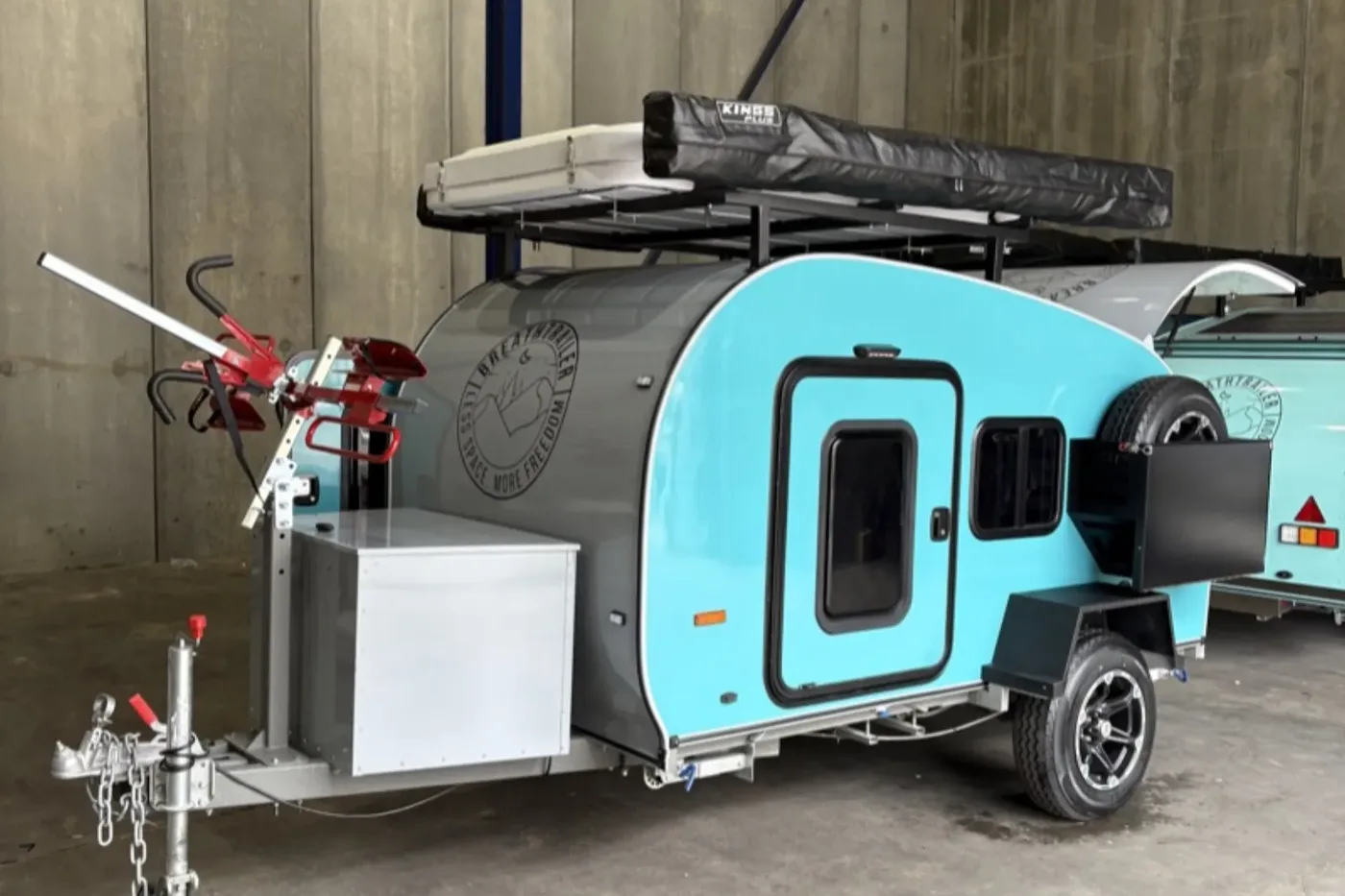
With a rooftop tent and awning taking the roof, the drawbar is where the bikes end up.
A-frame drawbar racks: the outback default
An A-frame rack bolts onto the trailer’s drawbar, between the coupling and the front wall. It’s the position Australian manufacturers and long-distance travellers converge on, and the reasoning is mechanical rather than aesthetic.
Why it survives corrugations. The drawbar is the stiffest single member on a trailer and it sits closest to the tow point, where vertical acceleration is lowest. A rack mounted here experiences a fraction of the vibration a rear-mounted rack sees. Aussie Traveller’s guidance is blunt on this point: rigid mounting near the drawbar handles corrugated roads more effectively, while the rear of a van is subject to extreme dynamic forces that can compromise the chassis and tow point.
Why it helps stability. Weight forward of the trailer axle increases ball weight, and adequate ball weight is what keeps a trailer tracking straight. Adding bikes at the front pushes you toward the stable end of the range rather than away from it — which is why the same setup that would make a rear rack dangerous makes a front rack benign.
The teardrop-specific catch. A teardrop drawbar is short. Before buying, physically measure the clear length between your coupling and the front wall, and check what already lives there: jockey wheel, stone guard, gas bottle holder, spare wheel, water tank filler, and a DO35-style articulating coupling that needs swing clearance. On many teardrops there is 500–700 mm of usable drawbar, and a two-bike rack plus mounts wants most of it.

On a teardrop, the bike rack shares a short drawbar with the front toolbox and jockey wheel.
Then check jack-knife clearance. Reverse your rig to full lock in an empty car park before you load bikes. If the tow vehicle’s rear corner would contact a loaded rack, you will find out at a boat ramp with an audience.
What a real A-frame rack weighs and carries
The Australian-made GripSport Van Rack is the reference product in this category, and its published numbers are a useful yardstick for the whole class:
| Spec | GripSport 2-bike Van Rack |
|---|---|
| Price (2026) | ~$1,265–$1,325 |
| Rating per bike | 30 kg |
| Total bike capacity | 60 kg |
| Rack weight | 19 kg (+13 kg with bolt-on mount kit) |
| Mounting | Bolt-on, no welding — tall / short / quick-release kits |
| Terrain rating | Light to medium off-road use only |
| Warranty | 5-year structural |
| Tilt | Tilts forward fully loaded (rear hatch access) |
That “light to medium off-road use only” line matters more than the price. No mainstream bike rack in Australia is warranted for sustained heavy corrugation. If your trip includes the Gibb River Road, the Oodnadatta Track or Cape York, plan to carry bikes inside the tow vehicle or leave them home — a point worth reading alongside our guide to why suspension matters on an off-road camper trailer, because the same forces that destroy cheap suspension destroy bike racks.
Rear-mounted racks: convenient, and the most punished
Rear racks are popular because they’re easy to load and don’t touch the drawbar. On a camper trailer used for sealed-road touring they’re perfectly serviceable. On corrugations they are the worst position available, for two compounding reasons.
Leverage. The rear of the trailer is the furthest point from the axle. Every bump is amplified by that lever arm, so the rack, its mounts and the bikes themselves see the highest accelerations on the vehicle. Loosened fixtures, cracked welds and fatigued mounting points are the standard failure mode.
Ball weight, backwards. Load behind the axle acts as a lever that lifts weight off the tow ball. The maths is simple: the ball weight lost is roughly the load multiplied by (distance behind the axle ÷ distance from the axle to the coupling). A 60 kg rack-and-bikes load 1.4 m behind an axle that sits 2.8 m ahead of the coupling strips about 30 kg off your ball weight.
If you were running a healthy 10% ball weight — 130 kg on a 1,300 kg loaded trailer — you’ve just dropped to 100 kg, or 7.7%. That’s the region where trailers begin to sway. Everything in our camper trailer towing guide about load distribution applies double once a rear rack is involved.
Never bolt a rear rack to a surface that isn’t engineered for it. Composite rear walls, aluminium cladding and bumper bars are not structural mounting points. If the manufacturer doesn’t publish a rated rear mount, treat the answer as no — and check your warranty first, because unapproved structural modifications are a common exclusion.
Roof racks: the trailer roof vs the car roof
If your camper trailer has a proper roof rack, it can take a bike — with caveats.
The lifting problem is real. A teardrop roof sits roughly 1.8–2.0 m off the ground. Lifting a 14 kg mountain bike up there is awkward; lifting a 25 kg e-bike is a genuine two-person job, and it’s the single most common reason owners abandon the roof option after one trip. If you’re travelling solo or you’re in the grey-nomad demographic we cover in our teardrop camper guide for retirees, be realistic about this before you spend money.
Respect the dynamic load rating. Roof racks have two ratings: static (parked) and dynamic (moving). The dynamic figure is the one that matters and it’s always the lower of the two. It also has to cover everything else already up there — awning, solar, jerry cans, maxtrax. On the Breath Ultra and Breath Max, the roof rack is standard and already carries the awning, so budget the remaining capacity honestly rather than optimistically.
Centre of gravity. Weight on the roof raises the trailer’s centre of gravity, which reduces rollover margin on off-camber tracks and increases sway sensitivity in crosswinds. Two bikes at 2 m is not catastrophic on a low teardrop, but it’s not free either.
The weight maths nobody does
Bikes are heavier than people remember, and e-bikes have changed the arithmetic completely.
| Item | Typical weight |
|---|---|
| Road bike | 8–10 kg |
| Hardtail mountain bike | 12–15 kg |
| Full-suspension mountain bike | 14–17 kg |
| Hybrid / commuter | 13–16 kg |
| E-bike (commuter/hybrid) | 22–28 kg |
| E-MTB (full suspension) | 21–28 kg, some to 38 kg |
| Rack itself (A-frame, 2-bike) | 19–32 kg |
| Rack itself (rear wall, 2-bike) | 12–25 kg |
A motor and battery add roughly 6–7 kg to an otherwise identical bike. That’s why two e-bikes plus a rack lands at 75–90 kg — a figure that consumes a meaningful slice of both your trailer payload and your tow ball allowance.
Three numbers you must check before buying
- Rack rating per bike. Most quality Australian racks are rated to 30 kg per bike. A 28 kg e-MTB is inside that; a heavy fat-tyre e-bike is not.
- Trailer payload (ATM − tare). Bikes on the trailer are trailer payload, competing with water, food, gear and gas. Our teardrop camper weight guide explains tare, ATM, GTM and payload in full.
- Tow vehicle’s maximum tow ball download. Frequently 150 kg on mid-size SUVs, sometimes less. A drawbar rack pushes you toward this ceiling. Weigh the loaded rig at a public weighbridge — every other method is guessing.
Where bikes go on each Breath Trailer model
| Model | Tare | ATM | Payload | Roof rack | Best bike option |
|---|---|---|---|---|---|
| Essential ($23,320) | 700 kg | 1,500 kg | 800 kg | Not fitted | Tow-vehicle roof, or bolt-on A-frame rack |
| Plus ($29,766) | 800 kg | 1,500 kg | 700 kg | Optional upgrade | A-frame rack; roof rack if added later |
| Ultra ($34,749) | 900 kg | 1,500 kg | 600 kg | Included (carries awning) | A-frame rack — roof already partly committed |
| Max ($42,900) | 1,200 kg | 1,700 kg | 500 kg | Included (90/180/270° awning) | A-frame rack; check drawbar clearance around spare |
We don’t sell bike racks, and we’re not going to pretend one model is dramatically better than another for carrying bikes. What differs is how much roof is already spoken for and how much drawbar you have to work with. If bikes are central to how you’ll travel, raise it when you compare the models so the drawbar layout is specified with that in mind rather than retro-fitted around it.
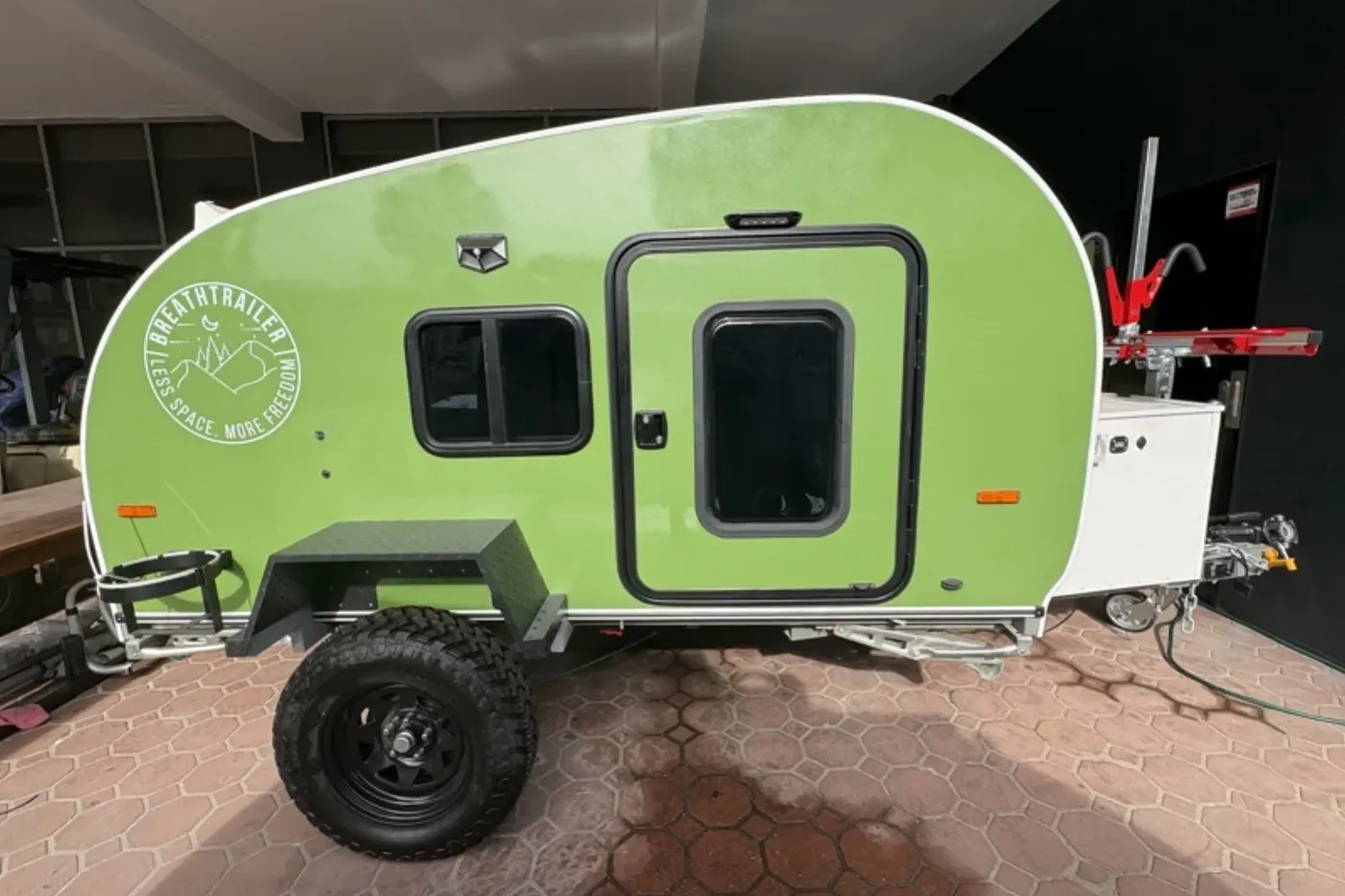
Mounted ahead of the body, a drawbar rack leaves the roof free and the rear of the trailer clear.
The number plate trap: an auxiliary plate is not optional
This is where most Australians get caught. If a bike or rack obscures the rear number plate — of the trailer, since that’s the plate at the back of your combination — you need an auxiliary plate. It’s a strict-liability offence in most jurisdictions, meaning “I didn’t realise” is not a defence, and an empty rack that covers the plate is enough to be fined.
Fines are not trivial:
| State | Penalty for an obscured plate |
|---|---|
| NSW | Up to $544 + 3 demerit points (max $2,200 if elected to court) |
| QLD | $341, no demerits (max $6,452 in court) |
| SA | Maximum $2,500 |
| WA | $1,000 |
| VIC | On-the-spot fine + 3 demerit points |
How to order one, by state
Names, costs and lead times differ in every jurisdiction. Fees below were current at the time of writing — confirm with your state authority before ordering, and note lead times, because several states take weeks.
| State | Called | Cost | Order via | Lead time |
|---|---|---|---|---|
| NSW | Auxiliary plate | $44.00 | Service NSW / myPlates 131 758 | ~21 days |
| VIC | Bicycle rack plate | $34.20 | VicRoads 13 11 71 | ~14 working days |
| QLD | Accessory plate | $81.10 ($30.20 if personalised) | ppq.com.au or TMR centre | 12–14 working days |
| SA | Bike rack plate | $22.00 | ezyplates.sa.gov.au | ~10 working days |
| WA | Auxiliary plate | $26.85 | DoTDirect (online only) | Up to 4 weeks |
| TAS | Bike rack plate | $18.17 | MR171 form, Service Tasmania | 4–6 weeks |
| ACT | Bike rack plate | $41.70 metal / $74.50 plastic | Access Canberra 13 22 81 | — |
| NT | — | $67.00 | mvr@nt.gov.au | ~6 weeks |
The plate must be legible from 20 metres, kept clean, and illuminated at night. DIY or photocopied plates are illegal everywhere in Australia. Several states (VIC, SA, NT) also allow you to simply relocate the existing plate onto the rack instead of buying a second one.
The drawbar rack’s quiet advantage: mounted at the front of the trailer, it obscures nothing. No auxiliary plate, no fee, no six-week wait in Tasmania.
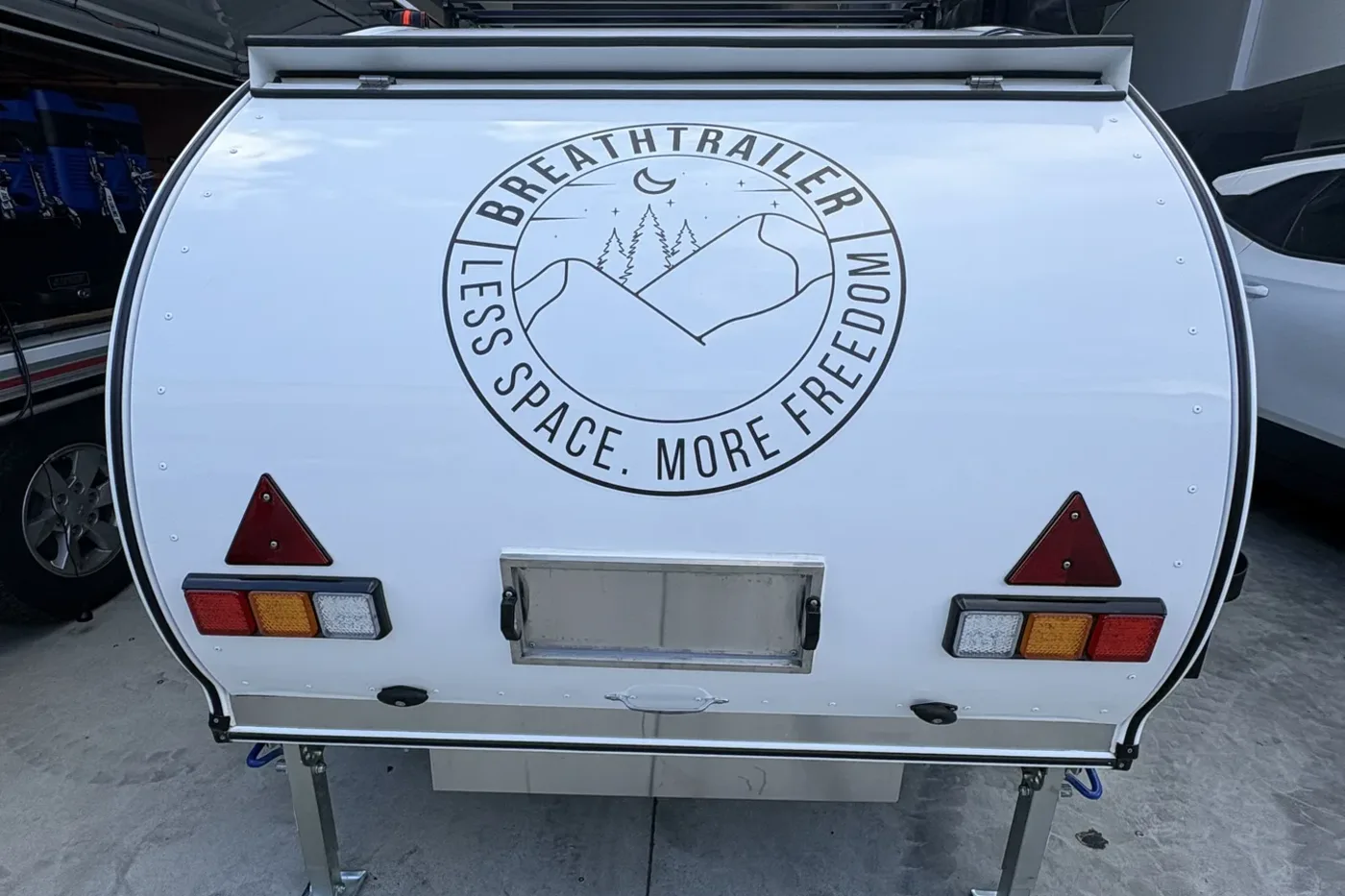
With the bikes up front, the trailer’s rear plate and tail lights stay fully visible.
Lights and indicators are the other half of the rule
Obscuring the trailer’s brake lights, indicators or tail lights is a separate offence and a genuine safety issue — the vehicle behind you cannot see you braking. Transport for NSW covers this in Vehicle Standards Information No. 10. A light board or supplementary lamp bar is the standard fix on rear racks, and it needs to be wired properly — see our note on why professional installation matters before you splice into a trailer loom.
Projection and dimension limits
Bikes stick out. Australia’s light vehicle loading rules put hard numbers on how far.
| Direction | Limit | If exceeded |
|---|---|---|
| Rear projection | 1.2 m beyond the rear of the vehicle | Red flag (min 300 mm per side) by day; red light visible at 200 m by night |
| Side projection | 150 mm beyond the outermost part of either side | Not permitted |
| Front projection | 1.2 m in front of the vehicle | Warning signal required |
| Total combination length | 12.5 m | Not permitted |
Handlebars are the usual offender on the side limit — a wide mountain bar mounted across a rack can exceed the trailer’s width. Check with a tape measure, not by eye. The NHVR’s guidance on the size and projection of loads is the reference document.
Protecting bikes from corrugations and bulldust
Australian conditions destroy bikes on racks faster than the racks themselves. The failures are predictable, so the prevention is too.
- Remove the e-bike battery and carry it inside the trailer or vehicle. It’s 3–4 kg off the rack’s top-heavy mass, it’s protected from vibration, and it’s out of the heat.
- Cover the battery contacts on the frame with a proper cover, or a plastic bag and tape. Dust and moisture in the contacts is a common and expensive failure.
- Bag or wrap the drivetrain. Bulldust in a chain and cassette grinds the drivetrain in a few hundred kilometres. A cheap bike cover pays for itself on one trip.
- Wrap the display and derailleur. Padding on the rear derailleur — the most exposed and most easily bent component on the bike — costs nothing.
- Strap the frame and both wheels. Rack straps alone let the wheels oscillate; add a strap that ties the bike to the rack’s mast so nothing can rotate.
- Re-torque the mounts. Check every rack bolt after the first 100 km of dirt, then daily on corrugated sections. Vibration loosens fasteners — this is the same discipline we apply to wheel bearings and running gear.
- Clean before you cover. Grit trapped under a cover sands the paint off a frame.
Five mistakes that cost real money
| Mistake | What it costs | Fix |
|---|---|---|
| Fitting a rear rack for outback touring | Cracked mounts, lost bikes, sway | Use the drawbar, or carry bikes in the tow vehicle |
| Ignoring the auxiliary plate | $341–$1,000 on the spot, plus demerits | Order the plate weeks before you leave |
| Assuming the rack fits the drawbar | Rack that fouls the jockey wheel or gas bottle | Measure clear drawbar length first |
| Forgetting ball weight | Over the tow vehicle’s 150 kg limit, or under-weighted and swaying | Weighbridge, loaded, before the trip |
| Buying a 25 kg-rated rack for e-bikes | Voided warranty, failed rack | Check the per-bike rating against actual bike weight |
Frequently asked questions
Can I put a bike rack on the back of a camper trailer in Australia?
Yes, but only onto a rated structural mounting point supplied or approved by the manufacturer, and you’ll need an auxiliary number plate plus lights that remain visible. It’s a reasonable choice for sealed-road touring and a poor one for corrugated roads, where the rear of a trailer sees the highest vibration of any point on the rig.
Do I need a number plate for a bike rack on a trailer?
If the bikes or the rack obscure the rear plate, yes — every Australian state and territory requires an auxiliary, accessory or bike-rack plate. Costs range from $18.17 in Tasmania to $81.10 in Queensland, and lead times run from 10 working days to six weeks. Fines for an obscured plate reach $1,000 in WA and $2,500 in SA.
How much weight can a caravan bike rack hold?
Quality Australian racks are typically rated at 30 kg per bike, so 60 kg for a two-bike rack. Always check the per-bike figure rather than the total — one heavy e-bike can exceed a per-bike rating even when the total looks fine.
Will a bike rack affect my tow ball weight?
Substantially. A drawbar-mounted rack transfers roughly 80–95% of its total load onto the tow ball, so a 60 kg rack-and-bikes load can add close to 55 kg. A rear-mounted rack does the opposite, removing around 25–35 kg. Both directions can take you outside a safe 10% ball weight — the only way to know is a weighbridge.
Can I carry e-bikes on a teardrop camper?
Yes, on a drawbar rack rated to 30 kg per bike, provided the combined weight fits your trailer payload and your vehicle’s tow ball limit. Remove the batteries for transit and carry them inside. Lifting a 25 kg e-bike onto a teardrop roof rack is not realistic for most people working alone.
Is it better to put bikes on the car or the trailer?
On the car, if you have the roof or space and only two ordinary bikes — it’s cheaper and it doesn’t disturb your trailer’s weight distribution. On the trailer, if you’re carrying e-bikes, three or more bikes, or your vehicle roof is already committed to an awning, solar or recovery gear.
The short version
Bikes belong on the drawbar. That position handles corrugations best, improves rather than degrades towing stability, and doesn’t obscure your trailer’s number plate — which alone saves you a fee, a wait, and a potential four-figure fine. Rear racks are for sealed roads and rated mounting points only. Roof racks work until you have to lift an e-bike.
Whatever you choose, do the weight maths before you buy, not after. Two bikes and a rack is 60–90 kg that has to fit inside a payload figure, a tow ball limit and a rack rating — three numbers that are cheap to check and expensive to ignore.
If you’re working out how bikes fit into your setup, compare the four Breath Trailer models or book a viewing and bring a tape measure. Measuring your drawbar before you buy a rack is five minutes that saves a return shipping bill.