Camp Cooking Australia: The Complete Camper Trailer Kitchen Guide (2026)
From gas compliance and campfire rules by state to easy camp meals and food safety — everything Australians need to master camp cooking with a camper trailer in 2026.
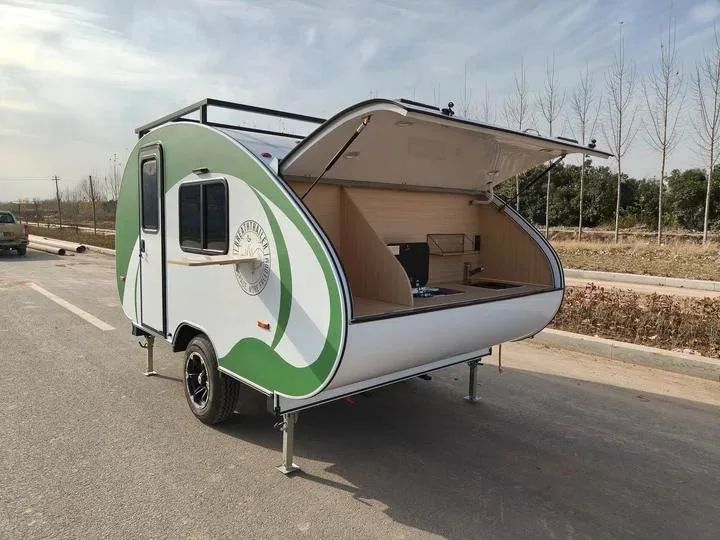
More than 5 million Australians go camping each year, and almost every one of them will tell you the same thing: the camp meal is as much part of the trip as the scenery. Done right, a slow-cooked lamb stew over a campfire or a fresh barramundi foil-wrapped on the coals beats anything you can order at a restaurant. Done wrong — with the wrong gear, expired gas, or a meal planned around a campfire that’s been banned for the season — it becomes the story everyone retells for the wrong reasons.
A purpose-built camper trailer galley changes the equation completely. With 80 litres of fresh water, a 12V compressor fridge and a slide-out gas stove, a modern teardrop can feed two people for five nights without a resupply stop. What it cannot do is waive the safety rules, plan your menu, or tell you whether campfires are permitted in the park you’ve booked. That’s what this guide is for.
Below you’ll find everything you need to cook well on the road in Australia in 2026: gas setup compliance, state-by-state campfire permit rules, must-have equipment and prices, easy meal ideas that actually work in a camp kitchen, food safety essentials, and a model-by-model look at how each Breath Trailer is set up for cooking.
Your Camper Trailer Gas Kitchen: Safety and Compliance
The first thing to understand about your camper trailer’s gas cooking system is that it is a regulated installation. In Australia, gas appliances fitted to recreational vehicles — including camper trailers — must comply with AS/NZS 5601.2, the national standard for gas installations in caravans and camping vehicles.
In practice this means:
- Gas cylinders must be stored in a sealed, ventilated external compartment — never inside the sleeping area or the kitchen drawer with food
- Maximum capacity is two cylinders of up to 9 kg each (approximately 25 L per cylinder) per trailer
- All gas appliances must be fitted and certified by a licensed gasfitter — when you take delivery of a new camper trailer, the gasfitter’s certificate should be part of your handover documentation. See our camper trailer handover checklist for the full paperwork to request.
- No gas appliance may be operated inside the sleeping or living area of the trailer while people are sleeping
Before the first use of the season, check every gas connection with the soapy water test: apply a thick soap-and-water mix to each fitting, open the cylinder valve and watch for bubbles. Any bubble is a leak; close the valve immediately and have it inspected before using the stove.

The slide-out rear galley on the Plus and Essential puts a full two-burner gas stove, fridge and storage within arm’s reach — no setting up a separate camp kitchen table.
Gas stove types and prices in Australia
| Stove type | Best for | Price (AU, 2026) | Pros | Cons |
|---|---|---|---|---|
| Built-in slide-out (in trailer) | Camper trailer owners | Included in trailer | No setup, stays put | Can’t move away from trailer |
| Portable 1-burner gas | Solo/ultralight | $25–60 | Packable, light | Limited to one pot |
| Portable 2-burner gas | Couples, families | $79–190 | Versatile, stable | Extra storage space required |
| Camp oven (cast iron, 4–6 QT) | Groups, stays of 3+ nights | $80–250 | Baking + slow cooking + campfire capable | Heavy (3–8 kg), learning curve |
| Weber Q (LPG, Baby Q / Q1200) | BBQ enthusiasts | $279–450 | Full BBQ grilling | Uses more gas, heavier |
Gas cylinder tip: A standard 9 kg cylinder lasts roughly 4–6 hours on a medium-heat two-burner. For a 5-night trip for two, one cylinder is usually enough. Carry a spare for extended trips.
Campfire Rules Across Australia in 2026
One of the most common mistakes Australians make when planning a camping trip is assuming the campfire is a given. In reality, campfires in Australian national parks and state forests are tightly regulated — and the rules change by season, by weather and by state.
The general principle is this: during the declared Fire Danger Season, you need to check before you light. Outside a Total Fire Ban, most parks and state forests allow fires in designated fire rings. During a Total Fire Ban, all solid-fuel fires — campfire, camp oven, wood BBQ — are prohibited. Gas stoves with fully enclosed burners are typically still permitted during bans, but check your state’s ruling each time.
The apps to download before you leave: Hazards Near Me (NSW), VicEmergency (VIC), Queensland Fire Danger Rating (QLD), Emergency WA (WA), CFS SA app (SA), Tasmania Fire Service website (TAS).
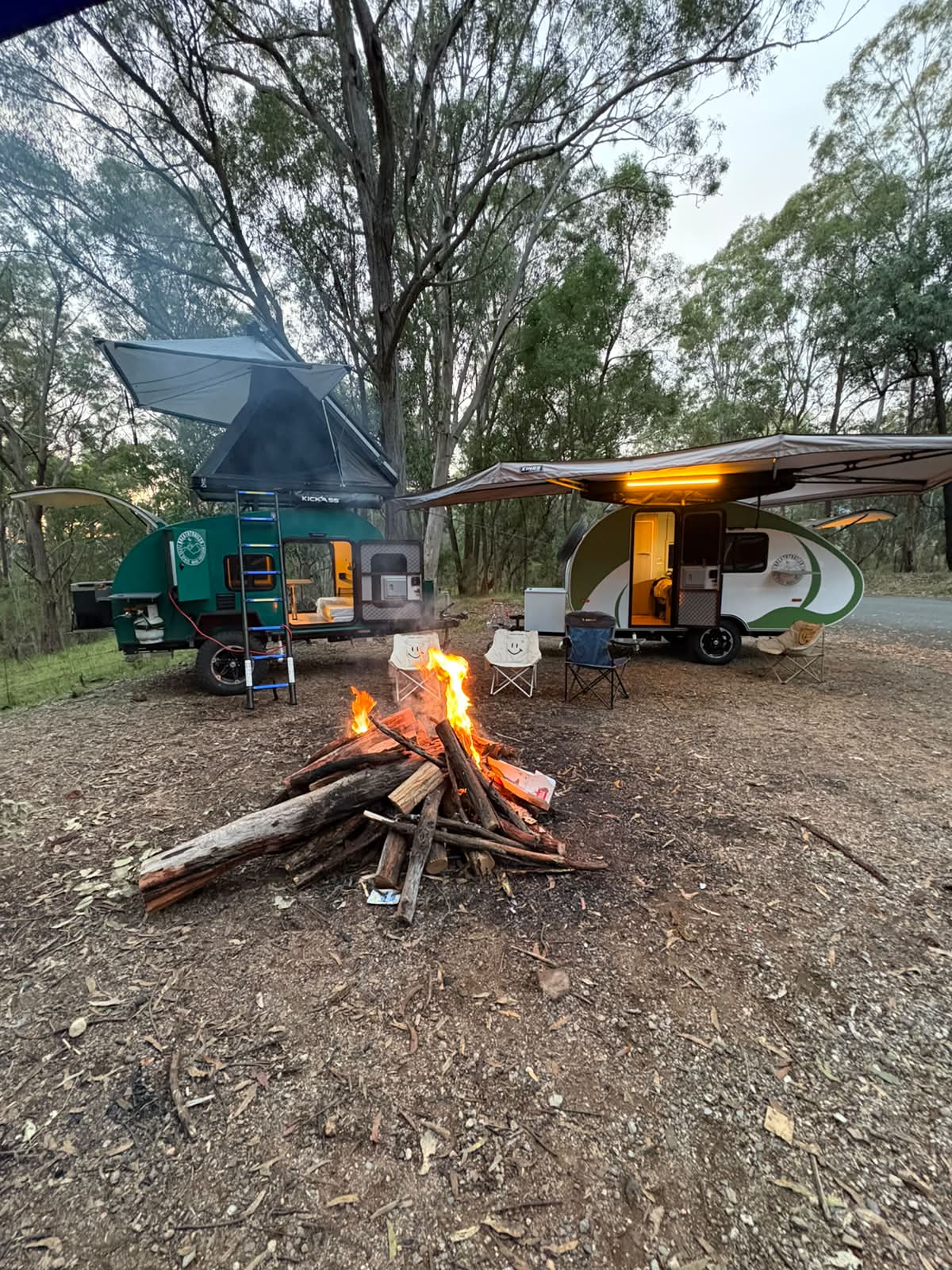
A campfire is the heart of many Australian camping trips — but always confirm the permit status for your park on arrival. Fire danger conditions can change overnight.
Campfire permit rules by state (2026)
| State/Territory | Fire Danger Season | Open fires in parks | Source to check |
|---|---|---|---|
| NSW | Oct–Apr (by district) | Designated fire rings only; Total Fire Ban = no solid fuel | NSW RFS Hazards Near Me |
| VIC | Mostly Oct–May (by municipality) | Fire Danger Period declared: no fire on declared days; other times, fire rings only | VicEmergency app |
| QLD | Oct–May (coastal/SE); year-round in some regions | Designated fire areas in QPWS parks; Fire Danger Rating High+ = no fires | Queensland Fire Dept website |
| WA | Oct–Apr (SW); year-round Kimberley/Pilbara | Prohibited burning season: no fires; other times fire rings in DBCA parks | Emergency WA app |
| SA | Oct–Apr | Fire Prohibition Period = no solid fuel; other times designated fire rings in DEW parks | CFS SA website |
| TAS | Oct–Mar | Fire Permit Season: permit required for any open fire in declared areas | TFS website / Parks Tas |
| NT | Declared as needed | Dry season (May–Oct) generally permitted in established fire rings | NTFRS website |
| ACT | Oct–Mar | Designated areas only; Total Fire Ban = no open fires | ESA ACT website |
Note: Park-specific rules may be stricter than state rules. Some campgrounds have permanently prohibited open fires regardless of fire danger. Always check the park’s booking notes and the notice board on arrival.
Essential Camp Cooking Equipment and Prices
A great camp kitchen does not require a lot of gear. The most common mistake is over-packing — a full set of home cookware added to a loaded camper trailer chews into payload and becomes a nuisance to store. The list below covers what genuinely earns its place.
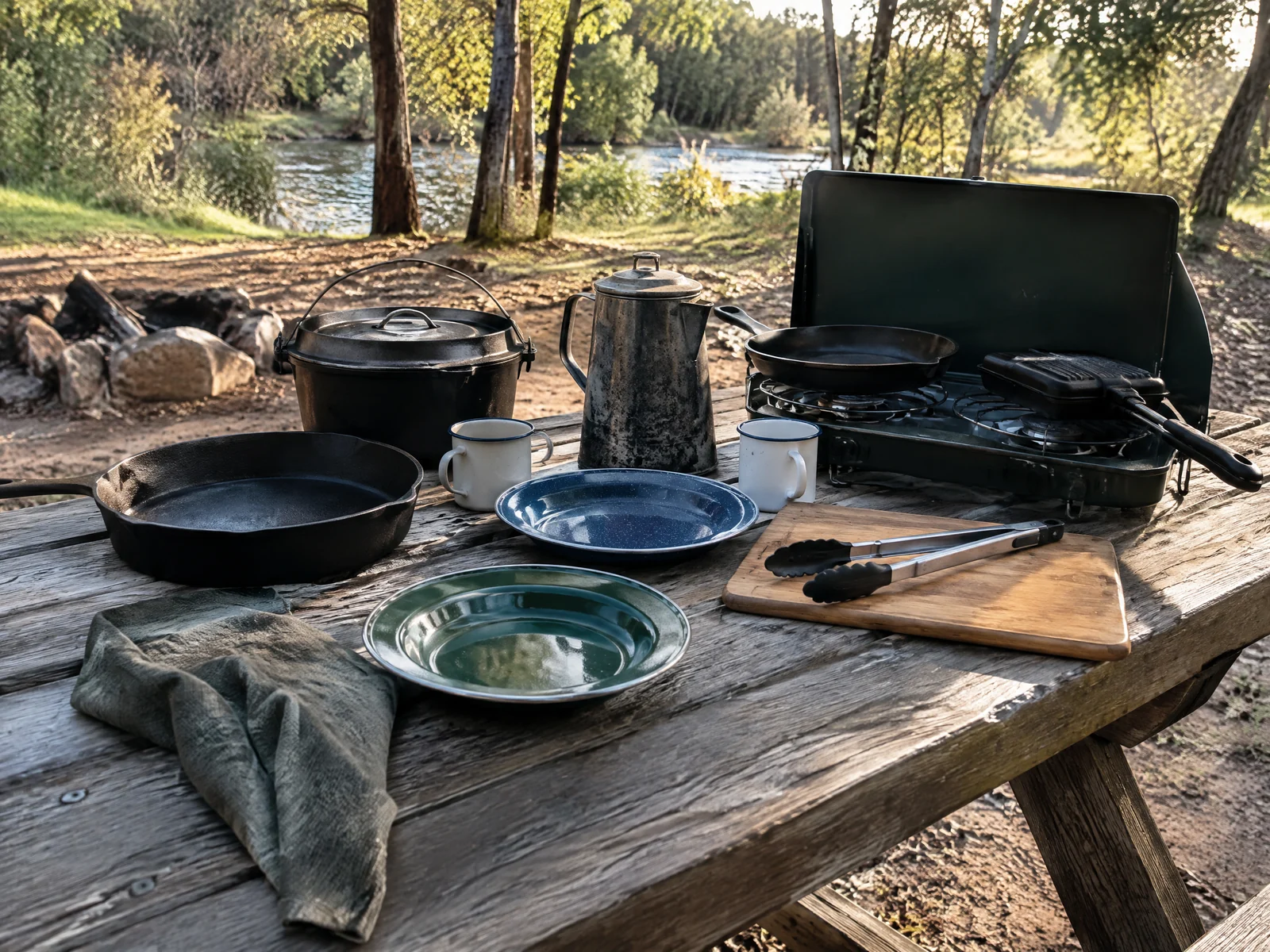
Illustration: Good camp cooking comes down to a short list of the right gear — not a full replica of your home kitchen.
Essential camp cooking kit (2026 prices)
| Item | Price (AU) | Notes |
|---|---|---|
| 2-burner portable gas stove | $79–190 | Gasmate Travelmate $79, Coleman Classic $150, only needed if trailer has no built-in stove |
| Cast iron frying pan (25–28 cm) | $35–80 | Lodge 26 cm ~$60; handles eggs, steak, stir-fry |
| Camp oven (4 QT cast iron) | $80–180 | Frontier ~$85, Ozpig 3.5L ~$179; worth it for stays of 3+ nights |
| Nesting billy/pot set (3 piece) | $25–50 | Boiling, pasta, soups |
| Jaffle iron (sandwich press) | $25–60 | Breakfast jaffles are the universal camp crowd-pleaser |
| Folding silicone chopping board | $15–30 | Saves galley bench space |
| Good camp knife with sheath | $40–120 | Victorinox Fibrox $45; a sharp knife beats a full block |
| Long-handled tongs | $15–30 | Campfire and stove use |
| Biodegradable camp soap | $8–15 | Required for grey water compliance in most parks |
| Collapsible wash basin | $15–30 | Washing up away from waterways |
| Gas lighter (piezo) | $8–15 | Backup to the built-in igniter |
| Total (approximate) | $325–770 | Excluding built-in stove; adjust for what you already own |
Weight check: Cast iron is the most space-efficient per meal you can produce — but a 4 QT camp oven weighs 3–4 kg. Add it to your payload calculation before you commit.
For a complete list of what to pack beyond the kitchen, see our camper trailer packing list.
10 Easy Camp Meals That Actually Work
The goal of camp cooking is not to replicate your kitchen at home. It is to produce something satisfying with limited bench space, one water source, a two-burner stove (or campfire), and a fridge that holds roughly the same as two supermarket shopping bags.
These meal ideas are tested against real camp kitchen constraints: minimal preparation, few pots, ingredients that travel well.
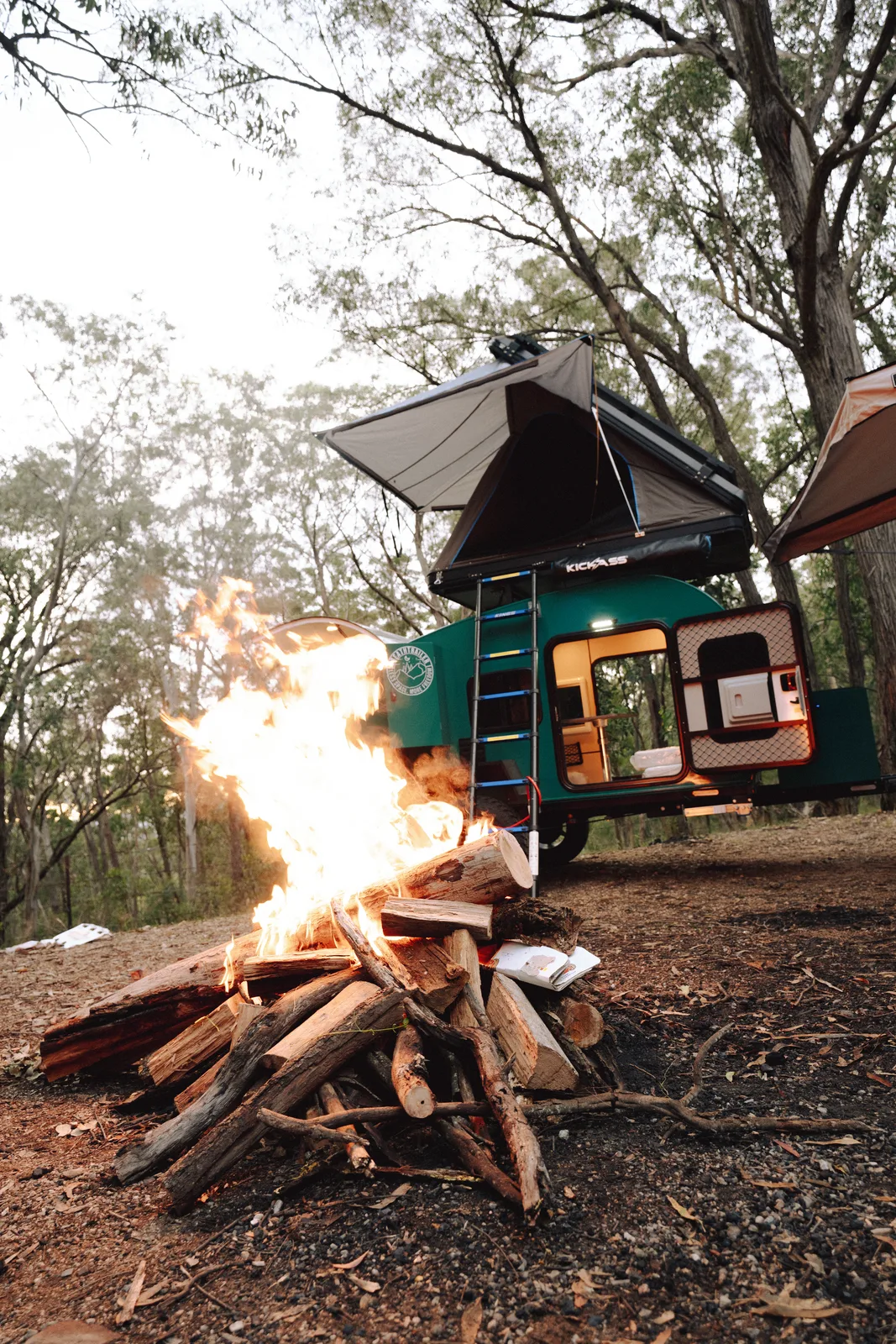
Slow-cooked meals in a camp oven are one of the great rewards of a longer stay — set it up before the arvo walk, eat at sunset.
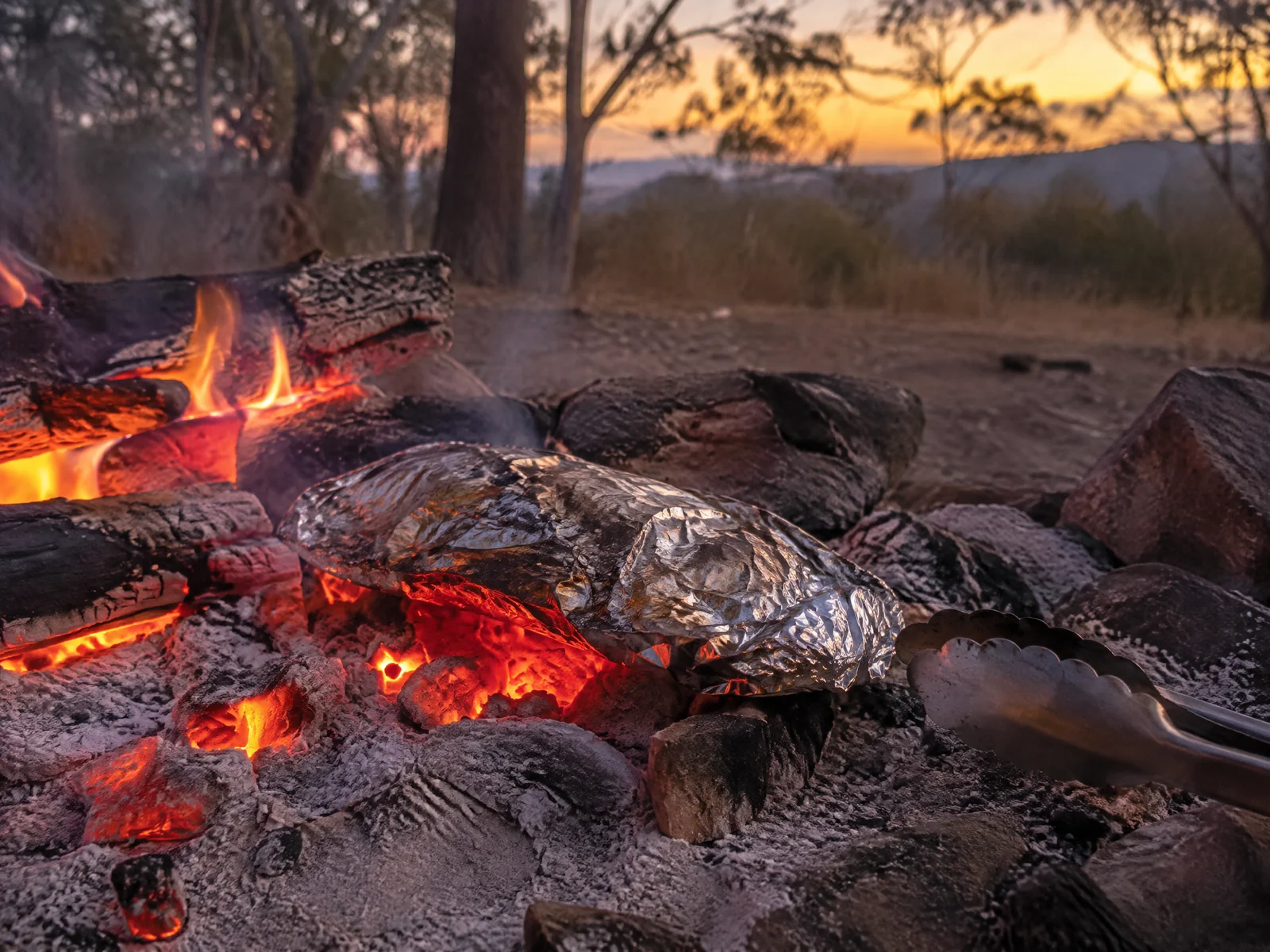
Illustration: Foil-wrapped barramundi with garlic butter and lemon needs five minutes of prep and 12 minutes on the coals.
Camp meals by type
| Meal type | Ideas | Method | Approx. prep + cook time |
|---|---|---|---|
| Breakfast | Bacon & eggs in cast iron; banana bread in camp oven; cheese & chorizo jaffle; damper with golden syrup | Gas stove / fire coals | 10–40 min |
| Lunch | Wraps with deli meat & avocado; toasted jaffle; cold pasta salad (prepped night before); tinned tuna & crackers | No-cook / gas stove | 5–15 min |
| Dinner | One-pot lamb & potato curry; beef stew in camp oven; foil-wrapped barramundi on coals; chorizo & chickpea pasta | Gas stove / fire coals | 20–60 min |
| Dessert | Nutella & banana jaffle; apple crumble in camp oven; marshmallows on the fire; damper with jam | Gas stove / fire coals | 15–40 min |
| Snacks | Trail mix; muesli bars; hard cheese with crackers; fruit (apples, oranges travel well); beef jerky | No cook | — |
Three meals to master first
1. Foil-wrapped barramundi — Lay a barra fillet on two sheets of foil, add a knob of butter, 3 slices of lemon, a crushed garlic clove, salt and pepper. Seal the parcel and cook directly on coals for 10–12 minutes. Zero cleanup, zero skill required.
2. One-pot lamb and chickpea curry — Brown a diced lamb shoulder in the camp oven with oil and onion, add a 400 g tin of tomatoes, a 400 g tin of chickpeas, 2 tablespoons of curry paste and 200 mL of water. Simmer 45 minutes. Serve with store-bought pappadums. Feeds four.
3. The camp jaffle — Every camper trailer owner eventually becomes evangelical about their jaffle iron. The winning combination: two slices of thick white bread, cheddar, sliced tomato and vegemite. 5 minutes on a medium flame, crispy on both sides. Perfect for a cold morning before the gas has properly heated.
Food Safety and Fridge Management on the Road
Australia’s outdoor temperatures make food safety in a camp setting genuinely important. The FSANZ (Food Standards Australia New Zealand) danger zone is 5°C to 60°C — in this range, bacteria in food can double roughly every 20 minutes. On a 35°C day in the Flinders Ranges, a chicken breast left on the bench for 90 minutes is a food safety risk.
Food safety temperature guide
| Zone | Temperature | Rule |
|---|---|---|
| Frozen safe | −18°C or below | Frozen meat, ice cream |
| Safe cold storage | 0–5°C | Dairy, raw meat, cooked leftovers, opened sauces |
| FSANZ danger zone | 5°C–60°C | Bacteria doubles every 20 min; minimise time here |
| Hot holding | 60°C and above | Keep cooked dishes above 60°C until served |
| Safe minimum internal temp (poultry) | 75°C | Cook chicken all the way through |
| Leftover rule | ≤2 hours in danger zone | Refrigerate or discard |
Fridge management tips for the road
Set your fridge to 2–3°C, not 5°C. Ambient temperatures in a camper trailer’s rear galley can add 2–4°C to the internal temperature during the middle of the day, especially in summer. A fridge nominally set at 5°C can be running at 7–9°C in the heat.
Pre-freeze where you can. Meat and fish can be frozen at home and used as their own cold packs for the first two nights of a trip. This significantly extends your effective cold storage window.
Pack in order of use. Place day-5 items at the bottom, day-1 items at the top. This minimises the time the lid is open and reduces temperature swings.
For a deeper dive on 12V fridge power draw and management, see our guide to keeping food cold while camping off-grid.
Water Budget for Camp Cooking
Camp cooking uses more water than most campers plan for. The general rule of thumb for a comfortably equipped camper is 10–15 litres per person per day, split roughly as:
| Use | Litres/person/day |
|---|---|
| Drinking | 2–3 L |
| Cooking (boiling, rinsing veg, pasta water) | 2–3 L |
| Washing up dishes | 3–5 L |
| Personal hygiene (face wash, hands) | 2–3 L |
| Total | 9–14 L |
On an 80-litre tank with two people, that gives you 4–5 days of cooking comfort before a resupply. The Ultra includes a second 80-litre grey water tank, and the Max pairs a larger 120-litre fresh tank with a 70-litre grey tank; the grey tank collects wash water and meets self-containment rules for free camping across most Australian states — including CMCA-registered parks and 72-hour roadside stops.
For the full breakdown of water system options and grey water compliance, see our camper trailer water system guide.
Meal Planning: A 5-Night Camp Menu
Planning meals before you leave is the single biggest upgrade you can make to your camp cooking. It eliminates the daily “what are we having tonight” decision, cuts down on food waste, and means your fridge packing makes sense.
Sample 5-night camp menu for two people
| Night | Dinner | Next morning breakfast | Notes |
|---|---|---|---|
| 1 | Foil barramundi on coals + steamed rice | Bacon & eggs in cast iron | Fish fresh from the esky — eat it first |
| 2 | Chorizo & chickpea pasta (one pot) | Cheese jaffle + fruit | Pasta takes 20 min, one pot to wash |
| 3 | One-pot lamb curry + pappadums | Camp oven banana bread | Curry on night 3 keeps flavour through next day |
| 4 | Camp oven beef stew (make the night before) | Leftover stew on toast | Double batch the stew for two nights |
| 5 | Reheated stew + crusty bread | Muesli + yoghurt (last of dairy) | Yoghurt survives 4–5 nights if kept at 2°C |
Pantry essentials to keep stocked: Tinned tomatoes, tinned chickpeas or lentils, tinned fish, olive oil, curry paste (Patak’s Rogan Josh), pasta, rice, pappadums, crackers, instant oats, teabags, filter coffee, salt, pepper, dried chilli flakes, cumin, garlic powder.
These 15 items weigh approximately 3 kg and support almost any improvised camp meal when fresh ingredients run out.
How Each Breath Trailer Is Set Up for Camp Cooking
Every Breath Trailer model includes a slide-out rear galley as standard. Here is how the cooking capabilities compare across the range.
Per-model kitchen comparison
| Model | Starting price | Gas stove | Fridge | Sink | Water | Key cooking notes |
|---|---|---|---|---|---|---|
| Essential | $23,320 | 2-burner slide-out | Optional add-on | No | 80L fresh | Rear galley, gas bottle holder; fridge is the key upgrade decision |
| Plus | $29,766 | 2-burner slide-out | 40L compressor fridge (included) | No | 80L fresh | Fridge included from factory; side table for extra bench space |
| Ultra | $34,749 | 2-burner slide-out | 60L compressor fridge | External (side) | 80L fresh + 80L grey | External shower doubles as the dish-washing station; grey water tank for free-camping compliance |
| Max | $42,900 | Double gas stove (built-in galley) | Full upright fridge | Interior sink | 120L fresh + 70L grey | Interior kitchen with running sink — the only teardrop on the Australian market under $50k with this configuration; grey water self-contained |
The fridge decision is the biggest kitchen upgrade between the Essential and the Plus. A 40-litre 12V compressor fridge running at 2°C draws approximately 25–35 Ah per day at 20°C ambient — well within the solar and battery capacity of the Plus and above. Without a fridge, you are limited to ice box cooling or non-perishable ingredients, which is workable for long weekends but uncomfortable on 5-night trips in summer.
The sink decision is what separates the Max from the rest of the range. An interior running sink means washing up happens at the kitchen bench, not crouched over a collapsible basin in the dirt. On the Ultra, the external shower provides the functional equivalent for galley cleaning — a short hose-down before wiping down surfaces.
For more detail on galley layouts and inclusions, see our camper trailer kitchen features guide.
Frequently Asked Questions
Can I use my gas camp stove during a Total Fire Ban? In most Australian states, yes — a portable gas stove or a gas BBQ with fully enclosed burners is permitted during a Total Fire Ban. However, the rules vary: some states or park authorities may prohibit all cooking appliances on Catastrophic fire danger days. Always check your state fire service and the park notice board on the day.
How long does a 9 kg gas cylinder last? On a medium-heat two-burner stove, approximately 4–6 hours of total cooking time. For a couple cooking three meals a day with a daily total of around 60–80 minutes of stove use, one cylinder comfortably covers 5–7 nights. Carry a spare for trips longer than a week.
Is it safe to cook in the rain under the trailer’s awning? Yes, with conditions. Maintain adequate ventilation — gas combustion products need to disperse freely. Never cook fully enclosed by awning walls on all sides without a gap at the top. Keep the gas stove clear of the awning fabric (a minimum 600 mm clearance is good practice), and never cook with a portable burner inside the trailer body itself.
What’s the easiest camp meal for first-timers? Foil-wrapped fish or foil-wrapped potatoes on the coals — essentially no cleanup and very forgiving. The second-easiest is the jaffle: virtually impossible to get wrong, and adaptable to whatever filling you have. For a gas stove with no campfire, a chorizo and tinned tomato pasta in one pot takes 20 minutes and feeds two.
How do I minimise washing up at camp? Use the same cup and plate all day and rinse between meals. Cook in one pot where possible. Line the camp oven with baking paper for baked dishes. Pre-mix spices and sauces at home in small sealed containers. Carry a small bottle of biodegradable camp soap and wash up in a basin — never wash directly in a creek or lake.
Does the Breath Essential come with a fridge? No — the Essential’s fridge is an optional add-on. The Plus includes a 40L compressor fridge as standard. If you’re planning multi-night trips with fresh produce, the Plus is the entry point for a complete camp kitchen without any extras to add.
Recommended Reading
- Camper Trailer Kitchen Features — What to Look For
- How to Keep Food Cold While Camping Off-Grid
- The Best Awning Setup for Camping
- Camper Trailer Water System Guide
- Camper Trailer Packing List Australia
Ready to choose the right camp kitchen for your trips? Compare all four Breath Trailer models or book a personalised tour.