Camper Trailer Packing List: The Complete Australian Guide (2026)
The definitive camper trailer packing list for Australia — per-category checklists, weight distribution rules, per-model inclusions, and what NOT to pack. 2026 edition.
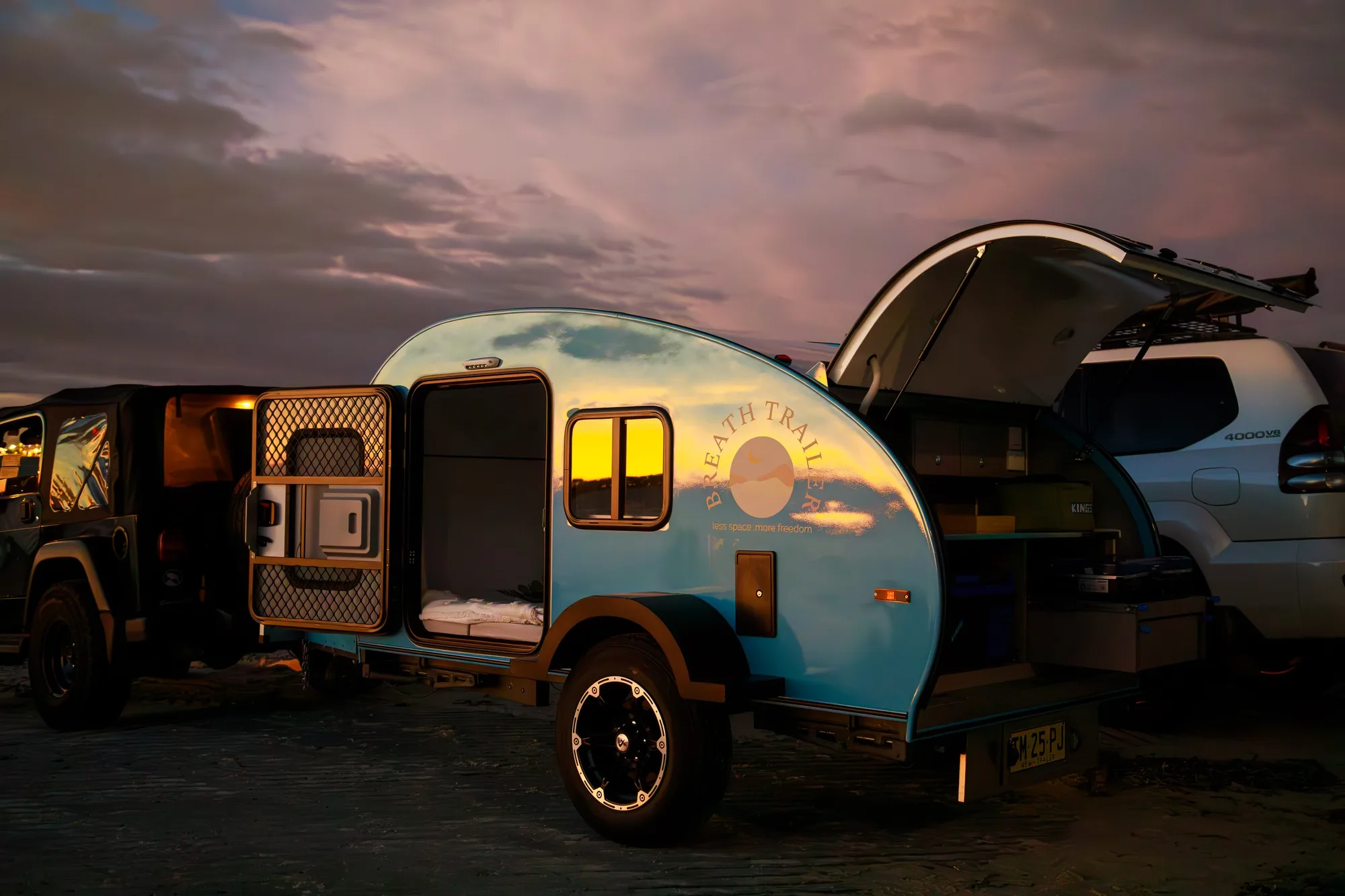
The Packing Problem Most Campers Get Wrong
Here’s a stat that shocks most first-timers: the average Australian hard-shell teardrop camper has a payload of 250–500 kg — and the average first-timer fills roughly 80% of it with gear they’ll never touch. That means a compromised tow, stressed tyres, and a boot so packed you can’t find the tin opener.
The opposite mistake costs you, too. Forget the electrical adaptor for a campsite with 240 V power, leave behind the cable for your 12 V fridge, or skip the tyre gauge — and a weekend trip turns into a hardware-store pilgrimage in the nearest regional town.
This guide solves both problems. It gives you a complete camper trailer packing list for Australia in 2026, organised by category with notes on what’s already standard on your trailer, how to load it for safe towing, and how to cut dead weight by 30% without sacrificing comfort.
Know your payload first. Before you pack a single bag, check the tare weight and payload figures for your specific trailer. Overloading is a roadworthiness issue — and an insurance void.
1. Know Your Payload Before You Pack
Every camper trailer has three key numbers stamped on its compliance plate:
| Term | What it means |
|---|---|
| Tare (unladen) weight | Trailer as delivered, empty of water and gear |
| ATM (Aggregate Trailer Mass) | Maximum allowable total trailer mass when moving |
| Payload | ATM minus tare — how much you can put IN it |
Payload by Breath Trailer model (2026)
| Model | Tare (kg) | ATM (kg) | Payload (kg) |
|---|---|---|---|
| Essential | 700 | 1,400 | ~700 |
| Plus | 800 | 1,500 | ~700 |
| Ultra | 900 | 1,500 | ~600 |
| Max | 1,200 | 1,700 | ~500 |
The Max has the smallest payload because it carries more standard equipment (full bathroom, 2.1 m headroom structure). Fill the water tank (120 L = 120 kg) and payload shrinks fast. Always weigh your loaded trailer at a public weighbridge before heading bush — they cost $10–20 and are available at most large service stations and council depots.
Rule of thumb: target 70–75% of payload maximum when packing for trips longer than 3 days, to leave buffer for food, water top-ups, and spontaneous firewood.
2. What’s Already On Your Trailer (Don’t Double-Pack)
One of the most common first-timer mistakes is buying duplicate gear for items that are standard on the trailer. Here’s what each Breath Trailer model includes as standard in 2026:
| Category | Essential | Plus | Ultra | Max |
|---|---|---|---|---|
| Queen bed (innerspring mattress) | ✅ | ✅ | ✅ | ✅ |
| Bedding (pillows, sheets) | ❌ | ❌ | ❌ | ❌ |
| Fresh water tank (80 L; 120 L on Max) | ✅ | ✅ | ✅ | ✅ |
| 12 V water pump | ✅ | ✅ | ✅ | ✅ |
| 12 V fridge/freezer | ❌ | ✅ | ✅ | ✅ |
| Slide-out galley kitchen | ✅ | ✅ | ✅ | ✅ |
| 2-burner gas stove | ✅ | ✅ | ✅ | ✅ |
| External shower | ❌ | ❌ | ✅ | ✅ |
| Interior ensuite bathroom | ❌ | ❌ | ❌ | ✅ |
| MPPT solar (120 W) | ✅ | ✅ | ✅ | ✅ |
| LiFePO4 lithium battery | ✅ | ✅ | ✅ | ✅ |
| ADR38 electric brakes | ✅ | ✅ | ✅ | ✅ |
| Anderson plug (12 V) | ✅ | ✅ | ✅ | ✅ |
| 240 V shore power inlet | ❌ | ❌ | ✅ | ✅ |
If you have a Plus, Ultra, or Max, you can leave the portable 12 V fridge off your list. Essential owners need to bring their own. Refer to the full model comparison for current specs.
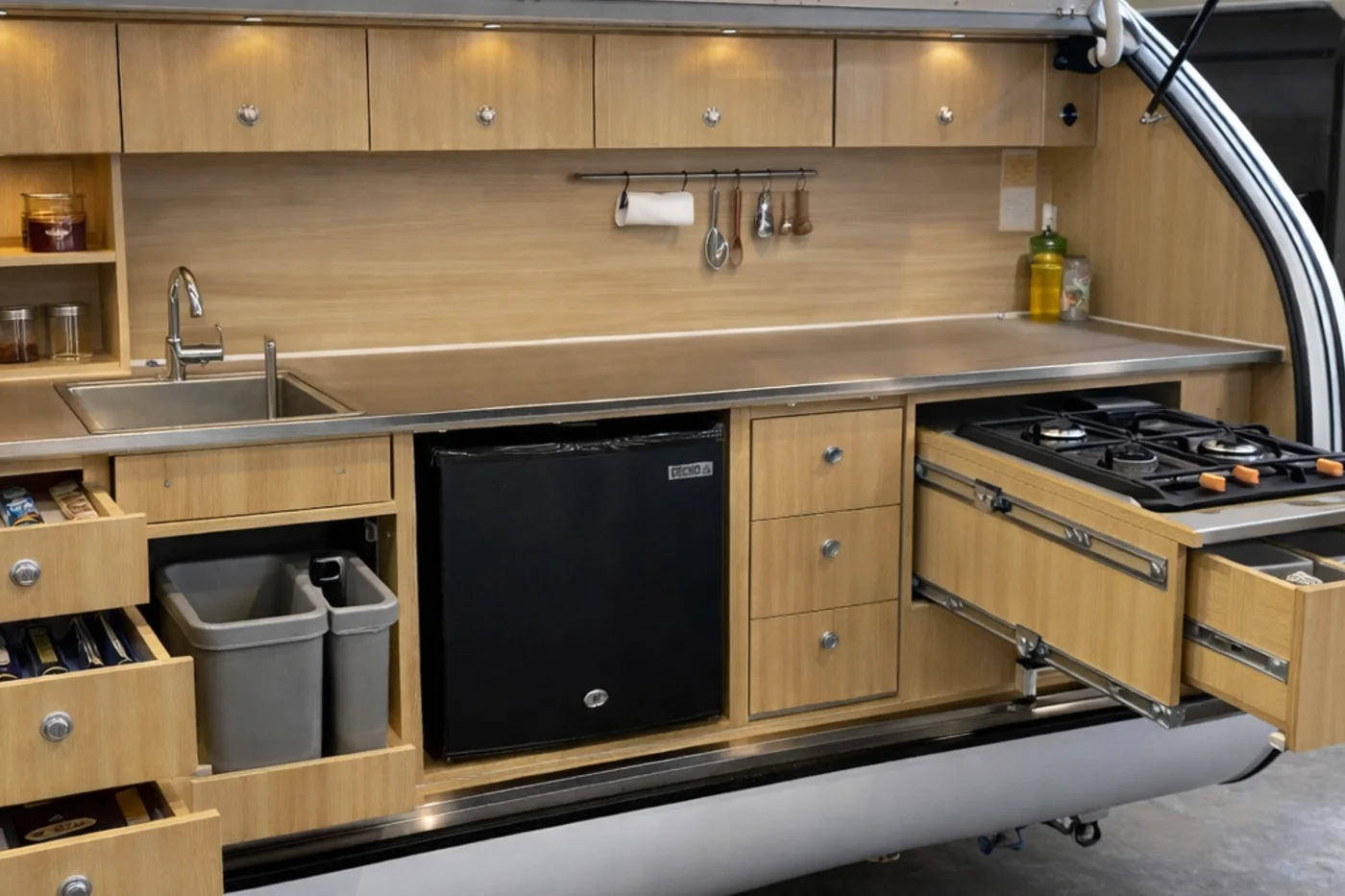
When the fridge and stove are already in the galley, they come off the packing list.
3. The Complete Camper Trailer Packing List
3.1 Sleeping and Bedding
Your trailer has a queen mattress — but you’ll need to bring:
- Fitted sheet + top sheet (or fitted sheet + sleeping bag liner for cooler nights)
- Duvet or sleeping bag rated for the expected overnight low (alpine = −5 °C; coastal summer = +15 °C)
- 2 × pillowcases (pillows are standard)
- Eye mask — particularly useful in coastal campsites where the sun rises early
- Ear plugs — campgrounds in spring/summer can be noisy
Weight tip: merino wool base layers double as sleepwear and reduce the need for a heavy sleeping bag in all but the coldest conditions. A 750 g merino ensemble beats a 1.8 kg bag for shoulder-season camping.
3.2 Kitchen and Cooking
The galley kitchen is built in with a 2-burner stove, bench, and 12 V pump. You still need cookware and consumables:
Cookware (per couple)
| Item | Notes |
|---|---|
| 2-piece nesting pot set (18 cm + 22 cm) | Avoids duplication with built-in bench space |
| Non-stick frypan (26 cm) | Collapsible silicone handle saves space |
| Lid (universal fit) | One lid fits both pots |
| Cutting board (lightweight poly) | Folds flat; avoid glass |
| Knife set (3-piece) | Chef’s + paring + bread knife |
| Can opener | Manual — batteries die |
| Tongs + spatula + wooden spoon | 3 utensils, not 15 |
| Colander/strainer | Foldable silicone |
Tableware (per person)
- Deep bowl (doubles as plate for one-pot meals)
- Coffee mug (insulated 400 mL)
- Reusable water bottle (1 L minimum)
- Cutlery set
Consumables to bring
- Cooking oil spray (aerosol saves weight vs a bottle)
- Salt, pepper, stock cubes, soy sauce in small containers
- Dish soap, scourer, tea towels × 2
- Snap-lock bags and reusable zip pouches
- Rubbish bags × 5 (leave no trace)
- Paper towel roll
Food planning: plan for 3 meals and 2 snacks per person per day. For a 7-day trip for two, that’s roughly 42 meals to account for. See the camper trailer kitchen features guide for galley space benchmarks per model.
3.3 Water and Hydration
Your trailer has an 80 L tank (120 L on the Max). Fill it before departure — that’s 80 kg (or 120 kg) of the payload budget gone, but it’s also your single most critical consumable.
Water consumption planning (2026)
| Activity | Litres per person per day |
|---|---|
| Drinking + cooking | 3–5 L |
| Washing dishes (2 persons) | 5–8 L shared |
| Personal hygiene (wipe-down) | 2 L |
| External shower (Ultra/Max) | 8–12 L per 5-min shower |
| Total: no shower | ~10 L/person/day |
| Total: with shower | ~15–18 L/person/day |
An 80 L tank gives a couple roughly 4 days without showering, or 2–2.5 days with daily external showers. For trips to free-camping areas, carry a 20 L jerry can as backup — rated for potable water (blue or clear, food-grade HDPE, BPA-free).
Additional items:
- Water filter (Katadyn BeFree 1 L or Sawyer Squeeze) — for creek top-ups in remote areas
- Collapsible 10 L bucket — washing, composting, rinsing
- Aquatabs × 20 — emergency water treatment
For a full analysis of how long your water supply lasts, see How Long Can You Stay Off-Grid?
3.4 Power and Electrical
Your trailer has a solar panel, MPPT controller, LiFePO4 battery, and Anderson plug. What you still need:
Bring from home
| Item | Notes |
|---|---|
| Brake controller cable (7-pin flat) | Or 7-pin to 7-round adaptor for older tow vehicles |
| Anderson plug to cigarette adaptor | For charging devices off the trailer’s 12 V supply |
| 240 V shore power lead (15 A, 10 m) | Ultra/Max only — check if park has powered sites |
| USB-A/C charging hub | 1 hub, not 6 individual chargers |
| Portable power bank (20,000 mAh) | For phones when away from the trailer |
| Headtorch × 2 | 200 lm minimum; waterproof |
| Lantern (12 V LED or battery) | Campsite ambient lighting |
| Extension lead (5 m, 10 A) | For powered sites (Ultra/Max with 240 V) |
What to skip: a portable solar panel if you have the standard 120 W roof solar. For a full power system explainer, see the complete guide to camper trailer power systems.
Fridge note: Essential owners need a portable 12 V fridge. Recommended: Dometic CFX3 35 (35 L, ~40 Ah/day at 25 °C ambient, $999–1,299). Plus/Ultra/Max owners have it built in. See the 12 V fridge guide for consumption data.
3.5 Shelter and Outdoor Living
Your teardrop has a hard shell — you don’t need a tent. But your outdoor living space is entirely what you bring:
| Item | Recommended spec | Est. cost |
|---|---|---|
| Awning (180° or 270°) | ARB 2.5 m × 2.5 m or Darche XTENDER 2.5 | $399–$749 |
| Awning poles × 2 | Adjustable 180–280 cm aluminium | Included with most |
| Awning pegs × 8 + guy ropes | 200 mm steel (sand, 300 mm) | $30–50 |
| Camp chairs × 2 | Helinox Ground Chair or similar lightweight | $120–$200 |
| Folding table (60 × 60 cm) | Aluminium, under 3 kg | $49–$99 |
| Doormat (EVA foam) | Keeps dirt outside; folds flat | $20 |
| Anti-flap kit for awning | Required above 30 km/h wind | $25–$45 |
For awning mounting options on teardrops and how to configure a 3-layer outdoor lighting setup, see the best awning setup guide.
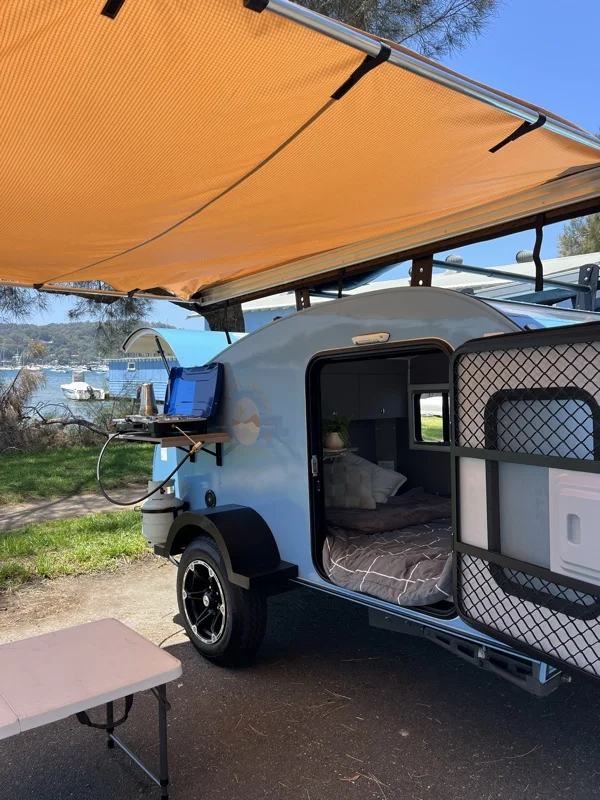
The awning, a folding table and the cooking gear are the outdoor living space you pack yourself.
3.6 Clothing (Per Person, 7-Day Trip)
The golden rule: pack half of what you think you need, then remove 2 more items.
| Category | Quantity |
|---|---|
| Merino wool base layers (top + bottom) | 2 sets |
| Mid layer (fleece or lightweight down jacket) | 1 |
| Rain jacket (3-layer, packable) | 1 |
| Shorts | 2 |
| Casual pants (zip-off or trail pant) | 1–2 |
| T-shirts (non-cotton for quick dry) | 3 |
| Socks (merino wool, ankle) | 5 pairs |
| Underwear | 5 pairs |
| Sun hat (broad brim, UPF 50+) | 1 |
| Beanie (shoulder-season nights can drop to 5–8 °C) | 1 |
| Thongs + trail runners/hiking boots | 1 pair each |
| Swimwear | 1–2 |
Weight target: total clothing should weigh under 5 kg per person for a week.
3.7 Toiletries and Personal Care
Keep this ruthless — it’s the category most people over-pack.
- Toothbrush + toothpaste (travel size)
- Shampoo + conditioner (2-in-1; small bottle)
- Body wash (bar soap weighs less than a bottle)
- Moisturiser + lip balm (SPF 30+)
- Sunscreen (SPF 50+, 150 mL or 200 mL spray)
- Insect repellent (DEET 40% or Picaridin; 100 mL)
- Toilet paper × 4 rolls (in a sealed zip-lock)
- Wet wipes × 1 pack (for no-shower nights)
- Hand sanitiser
- Feminine hygiene products as required
- Prescription medications (7-day supply + 2 spare days minimum)
- CPAP machine + distilled water — see grey nomad travel notes in the retirees guide
Bathroom note: Essential and Plus owners use campground amenities blocks or solar shower bags. Ultra and Max owners have a built-in external or interior shower — pack accordingly.
3.8 First Aid and Safety
Non-negotiable. Australian bush first aid requirements are different from urban kits — snake bite, heat, remote evacuation, no mobile coverage.
Minimum first aid kit for Australian bush camping
| Item | Notes |
|---|---|
| DRESSIT or St John remote kit | Covers splints, burn gel, eye wash, SAM splint |
| Compression bandages × 4 | For snake bite: immobilisation bandaging technique |
| Triangular bandages × 2 | Arm sling, improvised splint support |
| Saline eye wash 250 mL | Dust/foreign body |
| Betadine antiseptic | Wound cleaning |
| Blister kit (Compeed or equivalent) | Especially for hiking days |
| Tweezers (fine point) | Splinters, ticks |
| Medical scissors | Cutting dressings |
| Thermometer | |
| Paracetamol + ibuprofen | 50-tablet supply for 2 people |
| Antihistamine (cetirizine) | Stings, rashes |
| Rehydration sachets × 10 | Heat, gastro |
Communications
| Device | Notes |
|---|---|
| PLB (406 MHz) | Non-negotiable for remote areas. GME MT610G $389. Registered to AMSA free. EPIRB equivalent for land. |
| UHF CB radio (handheld) | Ch 40 road/convoy; Ch 10 4WD clubs |
| InReach Mini 2 or ZOLEO | Two-way satellite messaging when PLB-level not needed |
| Hema Explorer GPS or GaiaGPS app | Offline mapping |
For the full accessories priority list with prices, see Must-Have Accessories for Off-Road Adventures.
3.9 Vehicle and Towing Essentials
Gear that lives in the tow vehicle, not the trailer:
| Item | Notes |
|---|---|
| Tyre pressure gauge (digital) | Carry regardless of on-board display |
| 12 V tyre inflator (ARB CKMTP12 or similar) | 155 L/min; recovers 4WD tyres from 18 psi road pressure |
| Spare tyre (trailer) | 1 × trailer spare wheel, same tyre spec |
| Wheel brace (fits trailer wheel nuts) | Manufacturer-spec nut size — check manual |
| Jumper cables or jump pack | 12 V boost pack (500 A; lithium) |
| Tow ball spanner + spare hitch pin | Losing the hitch pin strands you |
| Spare globes kit | Indicator, running lights, brake lights for the trailer |
| Tyre plugging kit | Not a permanent fix, but buys you 100 km |
| Multi-tool or leatherman | |
| Duct tape + zip ties | The universal field fix |
| 5 L engine oil (tow vehicle spec) | Long trips consume more oil |
| 1 L coolant (pre-mixed) | |
| Recovery gear | MaxTrax × 2 + snatch strap (rated to your GVM) |
For a step-by-step hitching checklist and pre-departure sequence, see teardrop camper towing tips.
4. Packing Strategy: Load Distribution for Safe Towing
How you pack matters as much as what you pack. Improper load distribution causes sway — the most dangerous towing failure on Australian roads.
The 60/40 rule: aim for 60% of the payload forward of the axle, 40% behind it. This keeps the drawbar weight (the “nose weight” pressing down on the tow ball) between 5–10% of the total trailer mass — the legal and physical sweet spot.
| Load zone | What to put here |
|---|---|
| Forward of axle (front compartment) | Water jerry can, heavy tools, food boxes, battery-powered devices |
| Over axle | Fridge (if external), medium-weight gear |
| Rear of axle | Clothing, sleeping bags, lightweight soft items |
| Roof / high | Nothing heavy — raising the centre of gravity increases sway |
Drawbar weight: this is measurable. Park the trailer on level ground and use a bathroom scale under the jockey wheel. Aim for 5–10% of ATM (so for a Plus at 1,500 kg ATM, that’s 75–150 kg on the ball). Under 50 kg and you risk trailer sway; over 200 kg and you overload the tow vehicle’s rear axle.
See teardrop camper towing tips for the complete pre-departure load check, including how to safely redistribute gear mid-trip if your initial balance is off.

Heavy gear belongs low and forward of the axle; racks and rear carriers are for light items.
5. Destination-Based Packing Adjustments
The standard list above is your base. Adjust it depending on where you’re going:
Outback and Remote (e.g., Simpson Desert, Gibb River Road)
Add:
- Extra jerry can water (20 L × 2)
- 3-day food surplus above plan
- Second spare tyre (or tyre plug kit minimum)
- Satellite comms device (PLB + InReach minimum)
- Engine air filter spare
- Fuel bladder or additional jerry cans (diesel)
- Fire extinguisher (1 kg dry powder, BCF or Supercheap $49)
Remove: umbrellas, heavy books, anything fragile
Coastal and Beach Camping
Add:
- Freshwater rinse bottle (2 L, for post-beach salt rinse of gear and exterior)
- Sand pegs (300 mm spiral or screw type — standard 200 mm pegs pull out in sand)
- Snorkelling kit
- Portable shower (solar bag or 12 V pump) — essential without Ultra/Max exterior shower
- Zinc oxide sunscreen (reef-safe for WA’s Ningaloo; standard sunscreen restricted at marine parks)
Remove: heavy sleeping bags (coastal nights rarely drop below 15 °C in spring/summer)
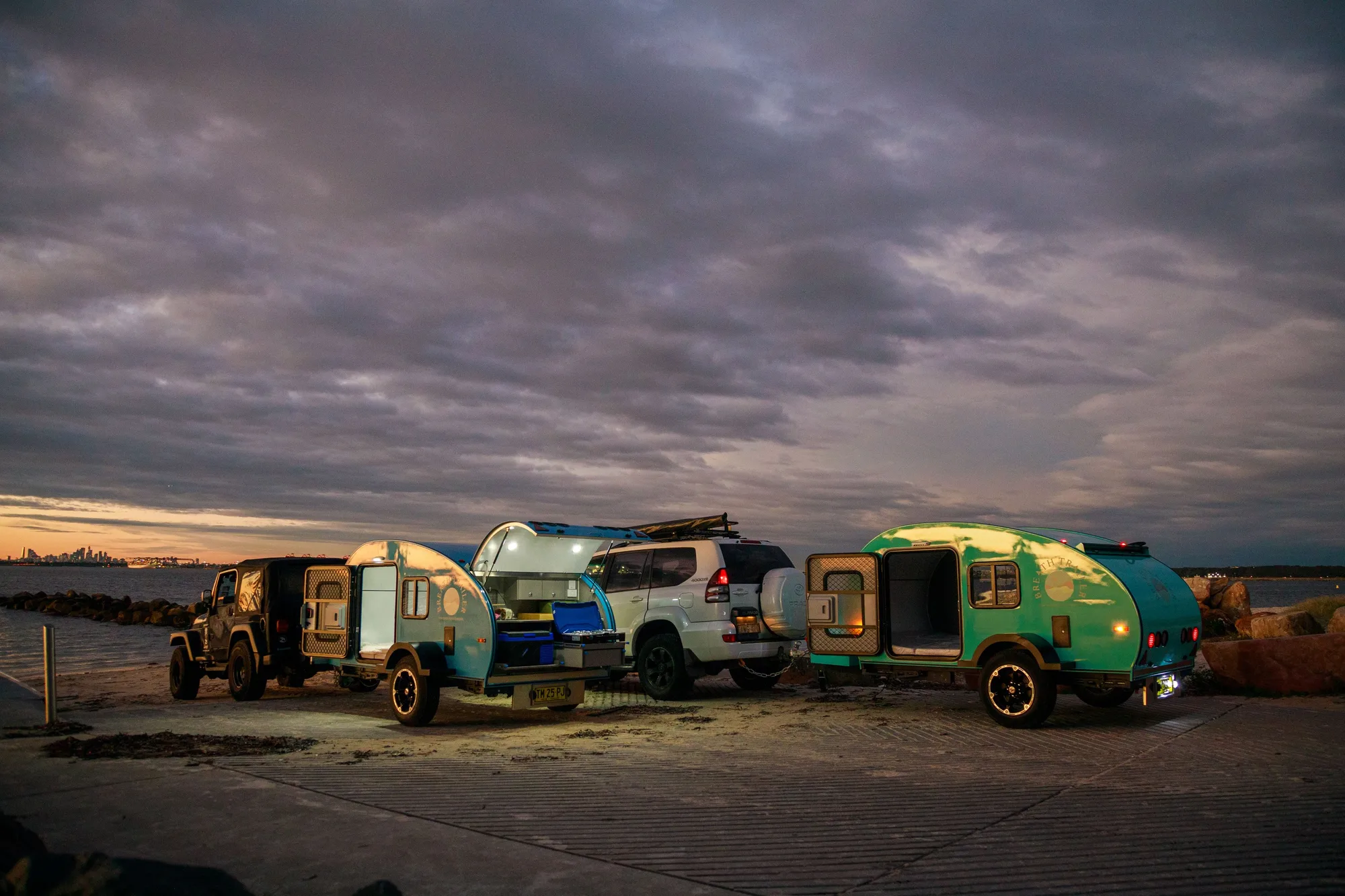
Coastal trips add sand pegs and a freshwater rinse to the base list.
Alpine and High Country (e.g., Kosciuszko, Victorian Alps)
Add:
- Sleeping bag rated to −5 °C
- Diesel heater (Vevor 5 kW diesel $70–80 + installation, or Webasto AIR TOP 2000 ST $1,200+)
- Snow chains (check current road conditions — mandatory Jun–Sep in Alpine NP)
- Window insulation kit (thermal cell foam cut-to-size, ~$15)
- Extra gas canister (cold reduces gas pressure; LPG harder to ignite below 5 °C)
For a full winter camping guide, see winter camping with a teardrop camper Australia.
6. The Seasonal Checklist
Quick tick-off by season (Southern Hemisphere):
| Item | Spring (Sep–Nov) | Summer (Dec–Feb) | Autumn (Mar–May) | Winter (Jun–Aug) |
|---|---|---|---|---|
| Sleeping bag (summer) | ✅ | ✅ | ✅ | ❌ |
| Sleeping bag (winter −5 °C) | ❌ | ❌ | ❌ | ✅ |
| Heavy rain jacket | ✅ | ❌ | ✅ | ✅ |
| Snake bite kit + awareness | ✅✅ | ✅✅ | ✅ | ❌ |
| Full sunscreen (SPF 50+) | ✅ | ✅✅ | ✅ | ✅ |
| Diesel heater | Optional | ❌ | Optional | ✅✅ |
| Fan / battery-powered cooling | ✅ | ✅✅ | ✅ | ❌ |
| Fire restriction check | ✅ | ✅✅ | ✅ | ❌ |
| Campsite pre-booking | ✅ | ✅✅ | ✅ | ❌ |
| Sand pegs (coastal) | ✅ | ✅✅ | ✅ | ✅ |
Spring note (September–October): snakes become active as ground temperatures rise above 18 °C. Carry compression bandages and know the immobilisation technique (pressure immobilisation, not a tourniquet). If planning free camping in spring, check fire permit requirements — Total Fire Ban seasons now begin as early as September in parts of NSW, VIC, and SA.
7. The 10 Things First-Timers Always Overpack
These items collectively weigh 15–25 kg and go largely unused on most trips:
- Full dinner set for 8 — you have 2 bowls, 2 cups and 2 plates. That’s it.
- Cast iron cookware — a 4 kg cast iron Dutch oven sounds rustic; it eats 0.8% of your entire Plus payload.
- Hard suitcases — replace with soft duffel bags. Hard cases waste 20–30% of internal volume.
- The full medicine cabinet — 10 types of medication for ailments you don’t have. Pack the 5 you actually use.
- Duplicate tools — if your trailer has a 12 V fridge (Plus/Ultra/Max), leave the esky.
- Excess books + magazines — 3 kg of reading for a 4-day trip. Download instead.
- Full wardrobe — a week in the bush in 3 pairs of pants and 5 shirts. Nobody cares.
- Generator — if you have MPPT solar and lithium, you don’t need it for a typical 7-day trip. See the generator vs solar analysis.
- All your spices — 10 individual jars = 800 g. A camping spice tin (5-compartment) weighs 200 g.
- Portable washing machine — campground laundromats are $4/load; a 3 kg portable washer costs you more in payload than it saves.
8. Pre-Departure Packing Sequence
Follow this sequence to avoid the 11 pm “I forgot the …” panic:
- Fill the water tank and check for leaks (trailer weight + 80 kg)
- Pack the kitchen — stove fuel check, spice kit, full consumables run-through
- Load heavy items first (over or forward of axle) — water jerry, fridge, tools
- Load mid-weight items — bedding, clothing boxes
- Pack light items last — sleeping bags, soft bags, pillows
- Weigh drawbar — jockey wheel + bathroom scale; adjust until within 5–10% of ATM
- Connect and test — 7-pin plug, brake controller calibration, all trailer lights functional
- Run pre-departure checklist — see essential checklist before leaving for an adventure for the 90-item master version
- Drive shakedown (2–5 km) — return and re-torque wheel nuts to spec (usually 110–120 Nm; check your manual)
9. Per-Trip Restock Guide
After each trip, check these consumables and restock before storing:
| Category | Check for |
|---|---|
| Gas cylinders | Weight check (or weigh before/after trip) |
| Drinking water | Flush tank if stored >2 weeks; sanitise with 125 mL bleach per 1,000 L |
| First aid kit | Replace any opened dressings, expired medications |
| Batteries (torch, remote, etc.) | Replace or recharge |
| Sunscreen + insect repellent | Check expiry; sunscreen expires within 3 years of manufacture |
| Tyre pressures (trailer) | Set to spec before re-storage (prevents flat spots on extended storage) |
For the full maintenance schedule and what a seasonal service covers, see teardrop camper maintenance and care Australia.
10. Frequently Asked Questions
How much should a fully packed camper trailer weigh? Add your tare weight, full water tank (80 kg for most teardrops), and all gear. The result must not exceed your trailer’s ATM. Aim to stay at 85–90% of ATM to leave buffer. For a Breath Essential (700 kg tare, 1,400 kg ATM), a fully packed ready-to-roll target is around 1,200–1,250 kg.
How do I pack a camper trailer for a month-long trip? Think in resupply cycles, not single-trip loads. Plan for 7–10 days of consumables (food, water, gas) and resupply at regional towns. Keep your load consistent — remove consumed food weight but don’t replace it with new items unless they replace something used. For a full long-trip framework, see how to prepare for long-term travel around Australia.
Do I need to bring bedding if the trailer has a mattress? Yes. Every Breath Trailer includes a quality innerspring queen mattress, but bedding (sheets, duvet or sleeping bag, pillowcases) is not included. Budget 3–5 kg per couple for a summer linen setup, or 5–8 kg with a 3-season quilt.
Can I pack a roof box on top of the trailer for more storage? Raising heavy items onto the roof of a teardrop significantly increases the centre of gravity, increasing sway risk. Avoid it. Add a drawbar-mounted storage box or a rear receiver hitch extension box on the tow vehicle instead — both keep weight low.
What’s the minimum safety kit for solo camping in remote Australia? Absolute minimum for solo remote camping: PLB registered with AMSA, UHF CB radio, first aid kit with snake bite supplies, 3-day food/water surplus, offline maps (Hema), and a trip plan lodged with a reliable contact who knows when to call emergency services. For the full solo camping guide, see teardrop camper for solo travellers Australia.
Ready to Pack?
The single biggest thing you can do before your first trip is weigh your loaded trailer. Most campers are genuinely surprised by how heavy their “essential” pile is once it’s on a scale.
Breath Trailer’s four models come with a meaningful list of standard inclusions — the fridge, solar, kitchen, and (on Ultra and Max) shower systems that most campers spend thousands separately installing are already there. That means more payload for the things that actually make a trip great: food, water, and comfort gear.
Explore the full model comparison or book a viewing at a Breath Trailer ambassador location near you.
Recommended Reading
- Teardrop Camper Accessories Australia — what to add to make every model better
- Camper Trailer Towing Tips Australia — how to tow safely once packed
- Must-Have Accessories for Off-Road Adventures — beyond the basics for bush travel
- How Long Can You Stay Off-Grid? — water, power and food duration planning
- Essential Checklist Before Leaving for an Adventure — the complete 90-item pre-departure sequence